
Screw Fastener Market Share, Growth & Demand by 2034
Coverage: By Product Type (Deck Screws, Hex Lag Screws, Self-Drilling Screws, Sheet Metal Screws, Wood Screws); Material (Steel, Copper, Aluminum, Others); Application (Automotive, Machinery, Construction, Others) , and Geography (North America, Europe, Asia Pacific, and South and Central America)
- Status : Data Released
- Report Code : TIPRE00027347
- Category : Manufacturing and Construction
- No. of Pages : 150
- Available Report Formats :


- Last update date : September 22, 2026


2025 Market Size
US$ 53.53 Bn
Base year value
2034 Forecast
US$ 74.87 Bn
Projected by 2034
CAGR 2026-2034
3.80 %
Growth rate
Addressable Market
US$ 583.23 Bn
(2026-2034)
The screw fastener market is valued at US$ 53.53 Billion in 2025 and is projected to reach US$ 74.87 Billion by 2034, registering a CAGR of 3.80% during 2026–2034. The market encompasses deck screws, hex lag screws, self-drilling screws, sheet metal screws, and wood screws across steel, copper, and aluminum materials, with automotive, machinery, and construction representing the principal application areas.
In North America, screw fastener market size expansion is supported by automotive production, commercial construction, industrial machinery replacement, and infrastructure modernization. The region is estimated to register a CAGR of 3.9–4.4% through 2034. Demand is increasingly influenced by corrosion-resistant coatings, automated installation, tighter quality specifications, and localized sourcing strategies that reduce exposure to international logistics disruptions.
Screw Fastener Market Assessment and Insights
- North America: North America is estimated to hold a 23–26% share in 2025 and expand at a CAGR of 3.9–4.4% between 2026–2034, supported by automotive manufacturing, infrastructure investment, machinery production, and industrial maintenance demand.
- US: The US represents approximately 76–80% of North American demand in 2025 and is projected to grow at a CAGR of 3.8–4.2% through 2034, led by construction and industrial applications.
- Europe: Europe accounts for an estimated 19–22% share in 2025 and is expected to grow at a CAGR of 3.5–4.0%, with Germany, Italy, France, the UK, and Spain supported by automotive, machinery, renewable-energy, and construction applications.
- Asia Pacific: Asia Pacific represents approximately 40–43% of the 2025 market and is projected to record a CAGR of 4.6–5.1%, with China, Japan, India, and South Korea benefiting from manufacturing, construction, electronics, automotive, and machinery production.
- Largest Segment: Product Type is estimated to command a 72–77% market share in 2025 across the defined product categories and is projected to expand at a CAGR of 3.8–4.3%.
- High Growth Segment: Aluminum is estimated to hold a 10–14% market share in 2025 and is projected to grow at a CAGR of 5.0–5.6%, supported by lightweighting and corrosion resistance.
- Key companies analyzed in detail: Acument Global Technologies, Arconic, Big Bolt Nut, Ciser Fasteners, Cooper and Turner Ltd., Dokka Fasteners Inc., LISI SA, Marmon Group, NingBoXinXing Fasteners Manufacture Co., Ltd., and Stanley Black & Decker, Inc.
Source: The Insight Partners' analysis based on proprietary research, government publications, company annual reports, investor presentations, industry databases, and expert interviews.
The screw fastener market has evolved from standardized commodity products toward application-specific fastening systems differentiated by geometry, coating, material grade, installation performance, and traceability. Automobile and machinery producers are now making increasing use of fasteners that meet torque, fatigue, corrosion, and dimensioning criteria. Meanwhile, advancements in automated cold heading, thread rolling, finishing, and inspection processes are allowing more consistency with less scrap and greater installation uniformity in large-scale production operations.
Going forward, growth will be more a product of local production, regional sourcing, and advanced fastening technology development. Asia-Pacific will continue to be the key production and consumption region, whereas North America and Europe will focus on engineering fasteners, supply chain robustness, and higher-end applications. Sustainability criteria will drive material savings, recycling of metal, energy-efficient manufacturing processes, and environmentally benign coating processes.
Screw Fastener Market Report Scope
| Report Attribute | Details |
|---|---|
| Market size in 2025 | US$ 53.53 Billion |
| Market Size by 2034 | US$ 74.87 Billion |
| Global CAGR (2026 - 2034) | 3.80% |
| Historical Data | 2021-2024 |
| Forecast period | 2026-2034 |
Screw Fastener Market Analysis
The screw fastener market growth is closely linked to vehicle production, machinery output, construction activity, and industrial capital expenditure. The value chain starts with the producers of steel, aluminum, and copper, which are succeeded by the wire and rod processing, cold heading, machining, threading, heat treating, coating, inspection, packaging, and distribution. OEMs and industrial distributors facilitate the relationship between the producers and the assembly plants, contractors, and maintenance sites. Procurement cycle time, certification, stock management, and product performance specific to an application are some of the demand variables that are increasingly influencing the market.
Prices of raw materials continue to be an important supply variable due to the fact that steel continues to dominate as the material base of screws. The producers, therefore, need to control the purchase, production schedules, and regional stock in order to minimize the effects of price fluctuations. Large producers have the economies of scale in forming, plating, heat treating, and automated inspection, whereas small producers can compete with specialization, engineering capabilities, rapid tooling, and smaller production runs.
The screw fastener market analysis indicates a fragmented competitive environment combining multinational engineered-component suppliers, diversified industrial manufacturers, and specialized fastener producers. Acument Global Technologies and Stanley Black & Decker, Inc. have strong market shares in engineered fasteners, but LISI SA has its focus on higher-value aerospace and automotive uses. Arconic has expertise in materials and engineered components, whereas Ciser Fasteners, Cooper and Turner Ltd. and Dokka Fasteners Inc. provide for specific industrial needs.
Increasing competition in the market involves productivity, qualification, application engineering, and delivery, more than price only. Big Bolt Nut, Marmon Group, NingBoXinXing Fasteners Manufacture Co., Ltd., and similar companies may compete efficiently where customers need customized dimensions or materials. Investments are also made in automation, digital quality control, production flexibility and geographic spread of capacity. Such strengths allow the competitors to sustain margins under increasing customer demands and production volumes.
● REPORT CUSTOMIZATION
Tailor This Report To Align With Your Specific Business Requirements
This report can be customized to align precisely with your business objectives, scope, and target markets. Customization options include tailored segmentation, geography, competitive analysis, and strategic insights to support informed decision-making.
Customize This Report →WHAT YOU CAN ADJUST
- ● Segmentations
- ● Geography
- ● Competitive Analysis
- ● Language Preferences
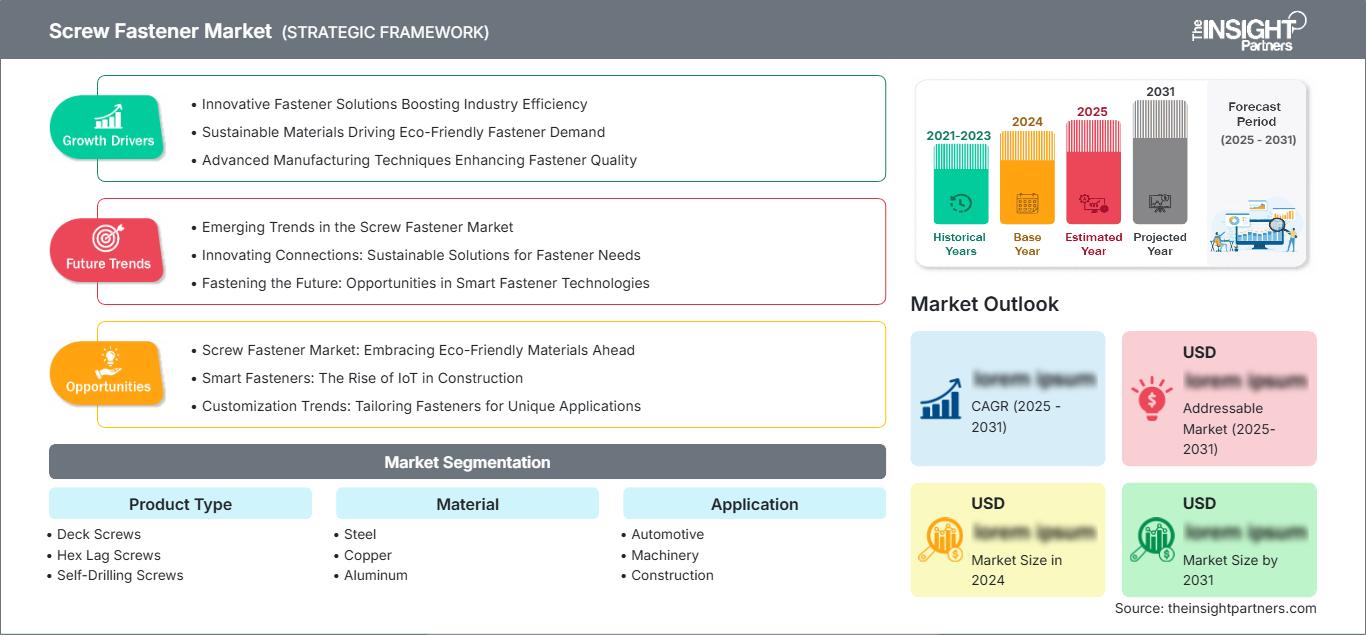
Screw Fastener Market: Strategic Insights
Regional Insights
North America screw fastener market
North America is estimated to represent 23–26% of the global screw fastener market demand in 2025 and is expected to grow at a CAGR of 3.9–4.4% through 2034. The United States remains the regional anchor because of its large automotive, machinery, aerospace, commercial construction, and industrial maintenance base. Mexico contributes through automotive manufacturing and cross-border supply chains, while Canada supports demand from construction, energy, transportation, and industrial equipment.
Regional procurement increasingly emphasizes domestic or nearshore availability, standardized quality documentation, and corrosion-resistant products. Infrastructure modernization, warehouse development, utility construction, and manufacturing investment support recurring demand for structural and general-purpose screws. Automotive plants also require controlled fastening specifications for body, powertrain, battery, and interior assemblies. Distributor networks remain important because maintenance customers frequently prioritize delivery speed and SKU availability over very large production volumes.
U.S. screw fastener Market
The US represents approximately 76–80% of the North American screw fastener market demand in 2025 and is projected to grow at a CAGR of 3.8–4.2% through 2034. Automotive assembly, machinery manufacturing, commercial buildings, residential construction, electrical equipment, and maintenance operations form the principal consumption base. Suppliers increasingly differentiate through corrosion protection, high-strength grades, dimensional consistency, and traceable production.
Application trends are also changing as manufacturers expand automation and lightweight equipment. Engineered fastening is gaining importance in vehicle electrification, industrial machinery, renewable-energy equipment, and aerospace assemblies, where joint integrity can influence safety and operating performance. Stanley Black & Decker, Inc., Acument Global Technologies, Arconic, and other established suppliers serve varied industrial requirements, while distributors support decentralized purchasing across construction and maintenance channels.
Europe screw fastener Market
Europe is estimated to account for 19–22% of the global screw fastener market in 2025 and is expected to register a CAGR of 3.5–4.0%. Germany leads regional demand, supported by automotive engineering, machinery, industrial equipment, and precision manufacturing. Italy and France contribute substantial consumption through automotive, construction, industrial equipment, and specialized manufacturing, while the UK and Spain add demand from infrastructure, energy, and industrial projects.
The UK maintains a diversified requirement spanning construction, transportation, machinery, and industrial maintenance, with procurement increasingly attentive to supply continuity and product certification. Germany has a deeper concentration of automotive and machinery OEMs, creating sustained demand for precision fastening and documented quality. France combines aerospace, automotive, construction, and industrial applications, while Italy and Spain benefit from machinery, renewable energy, transportation, and building activity. Regional buyers increasingly favor engineered products that support productivity, traceability, and resource efficiency.
APAC screw fastener Market
APAC represents approximately 40–43% of the 2025 screw fastener market share and is expected to expand at a CAGR of 4.6–5.1%. China remains the leading country, supported by extensive manufacturing and construction. Japan and South Korea emphasize precision automotive and machinery applications, while India and Australia add demand through infrastructure, industrialization, mining, and energy projects.
Regional policy initiatives supporting manufacturing localization, infrastructure expansion, and industrial investment strengthen consumption. China combines large-scale production with export activity, while India is increasing domestic manufacturing capacity. Japan and South Korea prioritize high-specification applications, and Australia remains relevant for construction, mining, and resource infrastructure. The region therefore, combines high-volume standard products with growing demand for engineered fastening systems.
Middle East & Africa screw fastener Market
The Middle East and Africa screw fastener market demand is expected to expand at a CAGR of 4.2–4.8% through 2034. Saudi Arabia leads regional opportunities, followed by the UAE and South Africa. Large infrastructure programs, industrial diversification, energy projects, logistics facilities, and commercial construction create recurring requirements for structural, machinery, and general-purpose fastening products.
Saudi Arabia benefits from industrial and infrastructure investment, while the UAE provides demand through construction, logistics, energy, and manufacturing. South Africa supports mining, machinery, infrastructure, and maintenance requirements. The rest of MEA remains comparatively fragmented, with procurement influenced by project-based investment and import availability. Regional suppliers and distributors can therefore gain from inventory positioning near major industrial corridors and construction hubs.
Segmentation Analysis
Product Type
Product Type is expected to expand at a CAGR of 3.8–4.3% during 2026–2034. Demand remains broad because different screw geometries address distinct installation environments, substrate characteristics, load conditions, and assembly processes. Self-drilling and sheet metal products benefit from faster installation, while wood and deck screws remain important in construction. Product differentiation increasingly depends on thread design, coating, drive configuration, and material strength, reflecting key trends.
- Deck Screws: Demand is concentrated in residential and commercial decking, outdoor structures, and treated-material applications. Corrosion-resistant finishes and improved thread designs support longer service life where moisture exposure is significant.
- Hex Lag Screws: These products remain important for heavy-duty wood-to-wood and wood-to-metal connections. Their mechanical strength and installation familiarity support structural construction, equipment mounting, and renovation applications.
- Self-Drilling Screws: Integrated drilling capability reduces installation steps in sheet-metal and construction applications. Their productivity advantage makes them strategically relevant where contractors seek shorter assembly cycles and lower labor requirements.
- Sheet Metal Screws: Demand is associated with HVAC, electrical enclosures, appliances, machinery, and light construction. Thread geometry and corrosion resistance remain key purchasing criteria in repetitive assembly environments.
- Wood Screws: Wood screws retain a broad construction and furniture application base. Product innovation focuses on drive efficiency, holding strength, installation speed, and resistance to splitting or corrosion.
Material
Material is projected to register a CAGR of 3.6–4.0% during 2026–2034. Steel remains the principal material because of its strength, availability, manufacturing maturity, and broad application compatibility. Aluminum is gaining strategic attention where weight reduction and corrosion resistance matter, while copper retains specialized applications requiring conductivity or specific corrosion characteristics.
- Steel: Steel supports the largest portion of demand because it offers high strength and extensive compatibility with automotive, construction, and machinery applications. Coatings increasingly determine corrosion performance.
- Copper: Copper screws serve specialized applications where electrical conductivity, corrosion resistance, or compatibility with copper-based systems justifies higher material cost. Their role is more application-specific than volume-oriented.
- Aluminum: Aluminum benefits from lightweighting initiatives and corrosion resistance. Its use is particularly relevant where reducing assembly mass can improve equipment efficiency, transportation performance, or installation handling.
Application
Application is expected to grow at a CAGR of 4.0–4.7% during 2026–2034. Automotive, machinery, and construction collectively represent broad and recurring demand because fastening is integral to structural assembly, component integration, maintenance, and field installation. The screw fastener market scope increasingly includes application-specific engineering, automated installation compatibility, and quality documentation rather than commodity supply alone.
- Automotive: Automotive demand emphasizes dimensional consistency, fatigue resistance, corrosion protection, and compatibility with automated assembly. Electrification is creating additional requirements for lightweight structures and battery-related components.
- Machinery: Machinery manufacturers use screws across equipment frames, housings, assemblies, guards, and serviceable components. Procurement emphasizes reliability, repeatability, and compatibility with automated or semi-automated assembly.
- Construction: Construction represents a broad-volume application spanning structural components, roofing, decking, interiors, and building systems. Contractors prioritize installation speed, durability, availability, and compliance with project specifications.
Opportunity Snapshot
| Application | Revenue Contribution (High/Medium/Low) | Trend Tag | Adoption Stage |
| Automotive | High | EV Assembly | Scaling |
| Machinery | High | Precision Assembly | Mature |
| Construction | High | Modular Building | Mature |
Screw Fastener Market Growth Drivers and Impact Analysis
Automotive lightweighting and electrification are changing fastening specifications
The automotive industry is striving towards lighter assembly weights as well as the implementation of batteries, light-weight bodies and different architectures for the components. This will necessitate the use of fasteners with reduced weight as well as controlled mechanical and anti-corrosion properties. Fastening solutions based on aluminum or steel could offer advantages through material substitution to achieve efficient vehicles without weakening the joints. In addition, electric vehicles will need fastening solutions for batteries, thermal management systems and power electronics, among other applications. Suppliers that will be able to come up with validated combinations of materials and installation specifications will get closer to OEM programs.
Construction productivity is increasing demand for faster installation systems
Pressure on construction firms to lower installation time and deal with labor shortages remains a constant problem. Fastening solutions using screws can offer efficiency gains since installation tends to be easier and less complex compared to other methods. Increase in use of modular constructions, prefabrication of building parts, commercial buildings and renovation activities has increased the opportunities for products that are tailored to particular substrates and installation equipment. Manufacturers stand to gain from improved drive system designs, thread design, coatings and packaging. The impact in the market is felt most strongly when a supplier is able to combine efficient product availability, application information, and proper packaging for contractors, together with accurate dimensions across a broad geographical area.
Industrial automation is raising requirements for consistency and traceability
Automated assembly demands fastening of products that have known geometry, surface finish, feeding properties, and mechanical properties. Any deviation will lead to disruption of the manufacturing process, rework, or failure, which makes consistency a vital factor for procurement for automotive and machine-making firms. This is why producers are spending money on automated inspections, process controls, heat treatment controls, and better coating facilities. Traceability is also becoming more important as OEMs demand traceable information about the grade of materials, manufacturing batch, and quality assurance. All these trends make a good case for manufacturers with production integration and process control skills. As a distributor, this means a transition to building inventories with technical differences instead of focusing solely on SKU width.
Screw Fastener Market Future Trends
Digital fastening systems will connect product design with installation control
The fastening industry is likely to move more toward integration of engineered screws with installation tools, torque measuring systems, vision inspection, and manufacturing data. Rather than thinking of the screw as a discrete component, the manufacturers will come up with fastening systems based on the performance measure of the joint. This approach is most likely to be adopted in the automotive and aerospace industries due to the expensive failure and because of the manufacturing data that would help quality control. Data gathered during the installation process could reveal problems in torque level, tool condition, or joint variations prior to the completion of the manufacturing process. Manufacturers that offer compatible screws, tool specifications, and digital verification would be included in the customer's design processes earlier.
Material optimization will support lower-weight and lower-impact assemblies
Future product development will increasingly concentrate on decreasing material use while maintaining joint integrity. High-strength steel can help make smaller geometries possible, whereas aluminum and advanced coatings can fulfill the weight and corrosion criteria for particular applications. The procurement teams will consider the percentage of recycled materials used, coating composition, energy consumption during manufacturing, and recyclability at the end of life as well. All these measures will not lead to the disappearance of traditional steel fasteners since cost, strength, and availability still matter in numerous applications. This means that the product portfolio will change towards becoming more diversified based on lifecycle performance criteria. Fastener suppliers able to provide such information can be more competitive against OEMs and construction companies aiming to achieve sustainability without sacrificing mechanical integrity.
Screw Fastener Market Opportunities
Localized production can strengthen supply resilience in major manufacturing corridors
Investment in regional manufacturing capacity presents an opportunity where customers increasingly prioritize shorter lead times and reduced exposure to international logistics disruptions. Fastener producers can establish or expand forming, heat treatment, coating, and inspection capabilities near automotive, machinery, and construction clusters. The strongest opportunity lies in products with recurring demand and technical specifications that justify local production rather than pure commodity imports. Strategic partnerships with distributors can further improve inventory visibility and reduce working-capital requirements. Companies can also use regional plants to customize thread profiles, coatings, packaging, and delivery schedules for major OEM programs. This approach creates a differentiated supply proposition based on responsiveness and qualification support, while reducing dependence on long-distance transportation and improving the ability to respond to sudden changes in customer production volumes.
Application-specific fastening portfolios can capture higher-value industrial demand
The screw fastener market forecasts indicate that value creation will increasingly depend on specialized solutions rather than unit-volume expansion alone. Suppliers can target applications requiring corrosion resistance, lightweighting, high fatigue performance, controlled installation, or compatibility with automated feeding systems. Automotive battery assemblies, machinery modules, renewable-energy equipment, and advanced construction systems offer areas where engineering support can influence supplier selection. Developing application-specific product families also enables manufacturers to standardize production around reusable platforms while customizing geometry or coating for individual customers. Companies should prioritize qualification capabilities, joint-design assistance, testing infrastructure, and digital documentation alongside production capacity. Such investments can increase customer retention because qualified fastening solutions are costly to replace after validation and integration into automated manufacturing processes.
Frequently Asked Questions

- Comprehensive Market Sizing and Forecast Analysis
- Detailed Segmentation Analysis
- In-Depth Market Dynamics Assessment
- Regional and Country-Level Insights
- Competitive Landscape and Company Benchmarking
- Strategic Business Intelligence
Recent Reports
Testimonials

The Insight Partners provided valuable market intelligence that supported our global go-to-market strategy. Their team was professional, responsive, and attentive to our feedback, providing thoughtful analysis and helpful methodological clarifications throughout the project.
Junmo Kim Chief Financial Officer (CFO), Enertech Co., Ltd.
The Insight Partners' SCADA System Market report is comprehensive, with valuable insights on current trends and future forecasts. The team was highly professional, responsive, and supportive throughout. We are very satisfied and highly recommend their services.
RAN KEDEM Partner, Reali Technologies LTDs
I requested a report on a very specific software market and the team produced the report in a few days. The information was very relevant and well presented. I then requested some changes and additions to the report. The team was again very responsive and I got the final report in less than a week.
JEAN-HERVE JENN Chairman, Future Analytica
We worked with The Insight Partners for an important market study and forecast. They gave us clear insights into opportunities and risks, which helped shape our plans. Their research was easy to use and based on solid data. It helped us make smart, confident decisions. We highly recommend them.
PIYUSH NAGPAL Sr. Vice President, High Beam Global
The Insight Partners delivered insightful, well-structured market research with strong domain expertise. Their team was professional and responsive throughout. The user-friendly website made accessing industry reports seamless. We highly recommend them for reliable, high-quality research services
YUKIHIKO ADACHI CEO, Deep Blue, LLC.
This is the first time I have purchased a market report from The Insight Partners.While I was unsure at first, I visited their web site and felt more comfortable to take the risk and purchase a market report.I am completely satisfied with the quality of the report and customer service. I had several questions and comments with the initial report, but after a couple of dialogs over email with their analyst I believe I have a report that I can use as input to our strategic planning process.Thank you so much for taking the extra time and making this a positive experience.I will definitely recommend your service to others and you will be my first call when we need further market data.
JOHN SUZUKI President and Chief Executive Officer, Board Director, BK Technologies
I wish to appreciate your support and the professionalism you displayed in the course of attending to my request for information regarding to infectious disease IVD market in Nigeria. I appreciate your patience, your guidance, and the fact that you were willing to offer a discount, which eventually made it possible for us to close a deal. I look forward to engaging The Insight Partners in the future, all thanks to the impression you have created in me as a result of this first encounter.
DR CHIJIOKE ONYIA MANAGING DIRECTOR, PineCrest Healthcare Ltd.Reason to Buy
- Informed Decision-Making
- Understanding Market Dynamics
- Competitive Analysis
- Identifying Emerging Markets
- Customer Insights
- Market Forecasts
- Risk Mitigation
- Boosting Operational Efficiency
- Strategic Planning
- Investment Justification
- Tracking Industry Innovations
- Aligning with Regulatory Trends





 Get Free Sample for