
Sensor Bearing Market Demand, Size & Forecast by 2034
Coverage: by Functionality (Speed, Temperature, Vibration, Displacement, Others); Application (ABS, Material Handling Equipment, Electric Motors, Others); Industry Vertical (Automotive, Transportation, Metal and Mining, Aerospace and Defense, Oil and Gas, Others) , and Geography (North America, Europe, Asia Pacific, and South and Central America)
- Status : Data Released
- Report Code : TIPRE00007038
- Category : Manufacturing and Construction
- No. of Pages : 150
- Available Report Formats :


- Last update date : July 10, 2026


2025 Market Size
US$ 802.68 Mn
Base year value
2034 Forecast
US$ 1,137. Mn
Projected by 2034
CAGR 2026-2034
3.94 %
Growth rate
Addressable Market
US$ 8,807.61 Mn
(2026-2034)
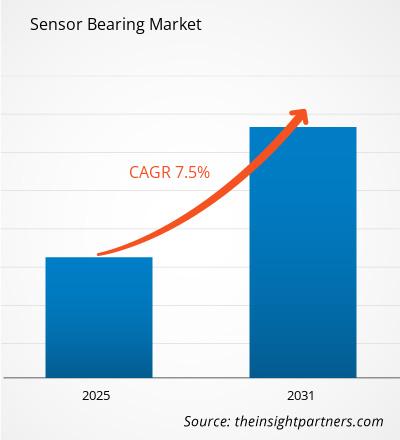
The global Sensor Bearing market was valued at US$ 802.68 million in 2025 and is expected to reach US$ 1137 million by 2034; it is estimated to record a CAGR of 3.94% during 2026-2034.
Sensor Bearing Market Assessment and Insights
- North America: The region accounted for 28–31% of the Sensor Bearing Market share in 2025 and is projected to grow at a CAGR of 4.1–4.5% during 2026–2034, led by ABS adoption, aerospace maintenance, and industrial automation upgrades.
- US: The US represented 78–82% of North America in 2025 and is expected to grow at a CAGR of 4.2–4.6%, supported by electric motors, defense platforms, and material handling systems.
- Europe: Europe held 27–30% share in 2025 and is forecast to grow at a CAGR of 4.0–4.4% during 2026–2034, with Germany, France, Italy, Spain, and the UK leading precision machinery and mobility demand.
- Asia Pacific: Asia Pacific captured 31–34% share in 2025 and is set to grow at a CAGR of 4.7–5.2%, driven by China, Japan, South Korea, India, and Australia across EVs, robotics, and industrial equipment.
- Largest Segment: ABS held 39–43% market share in 2025 and is projected to grow at a CAGR of 4.0–4.4%, reflecting mandatory safety systems and wheel-speed feedback needs.
- High Growth Segment: Electric Motors held 27–31% market share in 2025 and is expected to grow at a CAGR of 4.9–5.4%, supported by electrification and compact motion control.
- Key companies analyzed in detail: ABB Ltd, Fersa Bearings S.A., JTEKT Corporation, NSK Ltd., NTN Corporation, Schaeffler AG, AB SKF, The Timken Company, Thomson Industries, Inc., Waukesha Bearings Corporation.
Source: The Insight Partners' analysis based on proprietary research, government publications, company annual reports, investor presentations, industry databases, and expert interviews.
The Sensor Bearing Market forecast has shifted from mechanical bearing replacements to embedded sensor technologies where sensing is integrated with load bearing and feedback of speed, temperature, vibration, and displacement. The production trends are changing as the bearing suppliers embed magnetic encoders, hall sensors, signal housing materials, and electronics within compact systems. Automotive applications like ABS continue to drive the market, but the industrial customers now consider the total life cost of sensors, their reliability, and ability to be used for condition monitoring applications.
New demand will emerge from manufacturing zones in Asia Pacific, aerospace applications in North America, and automation investments in Europe. Focus on vehicle safety, energy efficiency, and equipment reliability regulations will expand the scope of the Sensor Bearing Market beyond conventional bearing replacements. The development of smart factories, electrified powertrain, and asset monitoring will boost the usage of OEMs.
Sensor Bearing Market Report Scope
| Report Attribute | Details |
|---|---|
| Market size in 2025 | US$ 802.68 Million |
| Market Size by 2034 | US$ 1,137. Million |
| Global CAGR (2026 - 2034) | 3.94% |
| Historical Data | 2021-2024 |
| Forecast period | 2026-2034 |
Sensor Bearing Market Analysis
Sensor Bearing Market growth is driven by requirements for accurate motion information from miniaturized systems. Precise wheel-speed information is essential for ABS modules, while rotor position information is needed for electric motors. Real-time vibration information adds benefit to material handling machinery. Value chain involves bearing steel suppliers, sensor chip suppliers, seal providers, encoders, systems integrators, and OEM validation experts.
Factors driving supply chain involve manufacturers which will be able to merge mechanical strength and electronics safety. Temperature changes, contact with lubricants, electrical noise, and shock loads need to be considered together through proper design of materials, seals, and signal processing. Analysis of Sensor Bearing Market reveals that in procurement considerations lifecycle value of products, not only its cost, becomes more and more important.
The competitive environment still consists mainly of diversified bearing and motion technology providers. The Sensor Bearing Market report highlights key companies including AB SKF, Schaeffler AG, NSK Ltd., NTN Corporation, JTEKT Corporation, and The Timken Company which rely on their accuracy of manufacturing, applications engineering, and global OEM connections, whereas ABB Ltd and Thomson Industries, Inc. develop partnerships in automation and motion control ecosystems.
Investment opportunities lie in sensor integration, digital services, and regional resilience in manufacturing. The companies, such as Fersa Bearings S.A. and Waukesha Bearings Corporation, focus on special duty cycles, while market leaders invest in condition monitoring solutions and validated product platforms. The strategic positioning in the Sensor Bearing Market includes quality assurance system, software compliant output, and engineering support for OEMs.
● REPORT CUSTOMIZATION
Tailor This Report To Align With Your Specific Business Requirements
This report can be customized to align precisely with your business objectives, scope, and target markets. Customization options include tailored segmentation, geography, competitive analysis, and strategic insights to support informed decision-making.
Customize This Report →WHAT YOU CAN ADJUST
- ● Segmentations
- ● Geography
- ● Competitive Analysis
- ● Language Preferences
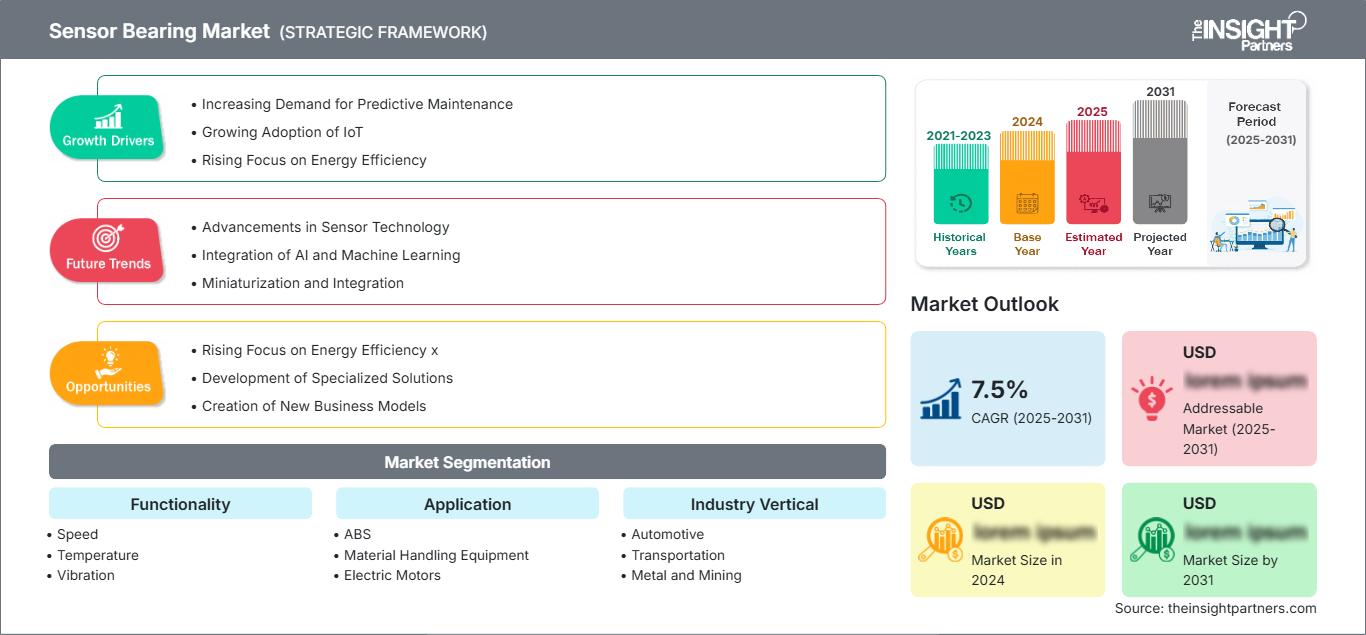
Sensor Bearing Market: Strategic Insights
Regional Insights
North America Sensor Bearing
North America accounted for 28–31% share in 2025 and is expected to grow at a CAGR of 4.1–4.5% during 2026–2034. Demand is reinforced by automotive safety electronics, aircraft maintenance cycles, automated warehousing, and oilfield rotating equipment. The Sensor Bearing Market share in this region benefits from high replacement value and rigorous quality expectations.
Industrial users are replacing reactive maintenance with data-led reliability programs, increasing acceptance of vibration and temperature sensing at the bearing level. The US and Canada also host strong electric motor, defense, and material handling equipment production bases. These conditions support steady Sensor Bearing Market growth without relying on aggressive volume assumptions.
U.S. Sensor Bearing Market
The US represented 78–82% of North America in 2025 and is projected to grow at a CAGR of 4.2–4.6% during 2026–2034. Automotive ABS, defense aviation, conveyor systems, and premium electric motors are the principal application areas. Domestic engineering centers and distributor networks help shorten qualification cycles for sensor-integrated assemblies.
AB SKF, Schaeffler AG, NSK Ltd., The Timken Company, ABB Ltd, and Thomson Industries, Inc. maintain strong commercial positions through technical support, aftermarket channels, and OEM programs. Application trends emphasize sealed sensor packages, electromagnetic compatibility, and predictive maintenance integration, especially where downtime costs exceed the premium for intelligent bearing units.
Europe Sensor Bearing Market
Europe held 27–30% share in 2025 and is forecast to grow at a CAGR of 4.0–4.4% during 2026–2034. Germany is the top performer owing to automotive technology, machine tools, robots, and quality industrial motors. Their suppliers value feedback, low friction, and performance-based safety.
The UK relies on the demand from the aerospace sector, defense, and advanced manufacturing industry, in which traceability and reliability norms are strict. France receives an impetus from its aerospace supply chain, railway, and industrial automation sectors, while Italy's strength comes from machinery, metalworking, and packaging machines, which need rotating parts.
Spain is becoming significant because of its automotive sector and renewable energy supply chain. In Europe, the regulation-driven efficiency program and safety norms drive the Sensor Bearing Market trends in ABS, electric motors, and material handling machinery. The players compete based on localized engineering capability, sustainability and, condition monitoring platform compatibility.
APAC Sensor Bearing Market
APAC accounted for 31–34% share in 2025 and is expected to grow at a CAGR of 4.7–5.2% during 2026–2034. China leads regional demand through EVs, industrial motors, and automated logistics, while Japan and South Korea support high-precision robotics and electronics manufacturing.
India is expanding through two-wheeler safety systems, industrial machinery, and domestic manufacturing incentives. Australia contributes through mining equipment, conveyors, and maintenance-intensive heavy industries.
Policy support for electrification, factory automation, and resilient supply chains strengthens the regional outlook. The Sensor Bearing Market size in APAC benefits from both high-volume vehicle platforms and growing adoption of predictive maintenance in industrial plants.
Middle East & Africa Sensor Bearing Market
Middle East & Africa is projected to grow at a CAGR of 3.6–4.1% during 2026–2034. Saudi Arabia is the leading country, supported by oil and gas rotating equipment, industrial diversification, and infrastructure projects.
The UAE adds demand from logistics, aviation support, and smart infrastructure. South Africa contributes through mining, metals, and heavy industry applications.
Rest of MEA adoption remains selective because sensor-bearing premiums require clear downtime savings. Energy and infrastructure operators are nevertheless adopting vibration and temperature feedback where asset accessibility, safety risk, and maintenance costs justify intelligent bearing assemblies.
Segmentation Analysis
Functionality
The functionality segment is expected to grow at a CAGR of 4.3–4.8% during 2026–2034 as OEMs integrate sensing closer to rotating assets. Selection depends on the operating risk profile: speed for control, temperature for lubrication and overload detection, vibration for predictive maintenance, and displacement for precision alignment. Adoption is strongest where signal accuracy directly improves safety, uptime, or process repeatability.
- Speed remains the most established functionality because ABS, motor control, and conveyor systems require dependable rotational feedback in sealed, compact assemblies exposed to dust, heat, and vibration.
- Temperature sensing supports lubrication management and thermal overload detection, especially in electric motors, oil and gas pumps, and aerospace equipment where early warning prevents secondary component damage.
- Vibration sensing is strategically important for predictive maintenance, enabling operators to detect imbalance, misalignment, bearing wear, and lubrication failure before failures disrupt production schedules.
- Displacement sensing serves precision equipment where shaft position, alignment, or axial movement affects machine accuracy, making it relevant to advanced manufacturing, aerospace actuation, and specialized industrial systems.
Application
The application segment is forecast to grow at a CAGR of 4.4–4.9% during 2026–2034. ABS represents the mature demand base, while material handling equipment benefits from automation and warehouse uptime requirements. Electric motors provide the strongest expansion path as manufacturers integrate bearing-level data for compact feedback, energy efficiency, and condition-based maintenance across industrial and mobility platforms.
- ABS is the largest application because wheel-speed feedback is essential for braking stability, traction control, and electronic safety systems across passenger cars, commercial vehicles, and two-wheelers.
- Material handling equipment uses sensor bearings in conveyors, automated storage systems, forklifts, and sortation lines where vibration and speed data reduce stoppages and support predictive maintenance programs.
- Electric motors are gaining strategic importance as electrification expands in mobility and industry, requiring compact position feedback, thermal monitoring, and durable bearings compatible with high-speed operation.
Industry Vertical
The industry vertical segment is projected to grow at a CAGR of 4.2–4.7% during 2026–2034. Automotive remains the demand anchor because safety electronics and electrification require reliable motion feedback. Transportation, mining, aerospace and defense, and oil and gas use sensor bearings where unplanned downtime, safety exposure, and maintenance accessibility create clear economic justification.
- Automotive demand is driven by ABS, electrified drivetrains, and compact motor systems that require speed and position data without adding external sensor packages.
- Transportation applications include rail, logistics, and fleet equipment where durability, maintenance planning, and safety compliance encourage adoption of integrated sensing at rotating interfaces.
- Metal and mining users value vibration and temperature monitoring for crushers, conveyors, mills, and heavy-duty motors operating in dusty, high-load, and remote environments.
- Aerospace and defense applications prioritize qualified components, traceable manufacturing, and high-reliability feedback for actuation, auxiliary systems, and maintenance-intensive rotating equipment.
- Oil and gas adoption is concentrated in pumps, compressors, turbines, and drilling equipment where early fault detection reduces shutdown risk and supports safer field operations.
Opportunity Snapshot
| Application | Revenue Contribution | Trend Tag | Adoption Stage |
| ABS | High | Safety Feedback | Mature |
| Material Handling Equipment | Medium | Warehouse Uptime | Scaling |
| Electric Motors | High | Rotor Sensing | Scaling |
Sensor Bearing Market Growth Drivers and Impact Analysis
Expansion of Vehicle Safety Electronics
The use of wheel speed and movement sensors has become widespread in relation to features like ABS, stability control, traction control, and braking systems. This ensures continued demand for sensor bearings since the sensing unit is enclosed within a smaller mechanism compared to when it is installed externally. The greatest effect is observed in passenger vehicles, trucks, and motorcycles as safety systems have been standardized in most models of each vehicle type.
Predictive Maintenance in Industrial Assets
Manufactures, mining facilities, warehousing, and energy production companies are adopting a policy of shifting maintenance budgets from scheduled replacement toward condition-based maintenance. Condition monitoring can be achieved using sensor bearings that are capable of measuring vibration, speed, displacement, or temperature of rotating contacts. The impact of the market is evident in reduced unscheduled downtime, spare part planning, and reducing secondary failures due to overheating or imbalance. This technology is most effective in cases where bearings are used in inaccessible machinery, high throughput conveyors, pumps, compressors, and motors.
Electrification of Motors and Mobility Platforms
Electrification increases the requirement for miniaturized sensors in motors operating at high speeds, auxiliary drive systems, and powertrain assembly. Sensor bearing aids machinery engineers to minimize the number of sensors outside, provide feedback from rotors, and track the temperature behavior in restricted space. Driver of Sensor Bearing Market is due to the requirement for resilient feedback components that can withstand high speed rotation, oil exposure, and electromagnetic interference arising from electric mobility and electrified industries.
Sensor Bearing Market Future Trends
Edge-Enabled Bearing Intelligence
The sensor bearing market trends will shift from mere signal transmission to localized interpretation of vibration, temperature, and speed trends. Using embedded electronics and edge analytics, noise can be filtered, fault patterns detected, and only useful signals transmitted to maintenance software. Such developments will be especially applicable to distributed machinery such as conveyors, wind-based rotational machines, pumps, and automated storage facilities. It is therefore expected that the Sensor Bearing Market will evolve in favor of firms offering a combination of mechanical design, sensor calibration, electronics protection, and data utility.
Compact Integrated Sensing for High-Speed Motors
Motors employed in electric automobiles, robotics, compressors, and other modern drive systems will need to have sensors that take up little space but retain their signals' integrity. This may be achieved by using sensor bearings that incorporate rotor sensing capabilities, bearing support, and heat detection into one qualified component. The future will focus on insulation, electromagnetic resistance, high-temperature electronics, and compact motor enclosures. With a reduction in assembly steps by Original Equipment Manufacturers (OEMs), integrated sensing will increasingly become a mandatory design element.
Sensor Bearing Market Opportunities
OEM Partnerships in Automated Warehousing
The automation of warehousing presents a viable solution since conveyors, sorters, automated storage systems, and mobile equipment function on a continuous basis and are susceptible to any downtime. The bearing manufacturers can team up with the original equipment manufacturers (OEM) to come up with sensor-bearing solutions that will be based on the shaft size, cycle time, and control system needs. Commercially, what is of value is to provide a package solution and not a generic part.
Aftermarket Reliability Packages for Heavy Industry
In heavy industries, there is a market space created by the high cost of replacements, labor, and downtime. Sensor kits for mining conveyor belts, metal processing lines, oil field pumps, and compressors may be placed within a maintenance-oriented framework. Manufacturers of the sensors need to concentrate on durable seals, ease of installation, and guidance to the maintenance staff. This is more likely in plants with old machinery, difficult access to rotating equipment, and reliability programs in place.
Recent Developments
- July 2026: The Swedish bearings manufacturer SKF and Leaderdrive (LD), a worldwide manufacturer of robotic components of high accuracy, have signed an agreement to create a joint venture in China that will produce components for robot joints with high precision. This move is part of SKF's strategy within the field of robotics, especially in regard to the use of humanoids operating via Embodied AI technology in an industrial setting.
- August 2025: With high speed and the highest precision being the standards of SKF’s rolling bearing solutions for machine tools, at the EMO 2025 from 22 to 26 September, the spotlight will be on the rolling bearing innovations of the UltraFast range and the Extreme bearing range, as well as the cylindrical roller bearings of the NN range. But those who attend the exhibition at the SKF stand (Hall 006, Stand J24) will not only learn about the rolling bearing innovations of SKF but will also receive unique information about the new SKF Super-precision centre in Airasca, Italy.
- July 2022: Sensor Integrated Bearing “Talking Bearing™” is a new development by NTN Corporation (hereafter, NTN), which consists of sensors, power generators, and wireless units embedded in the bearing. Information about temperature, vibration, and rotation rate is wirelessly transmitted. With the integration of sensors in the bearing, the latest invention is superior to other sensors that are mounted on the exterior of machinery.
Frequently Asked Questions

- Comprehensive Market Sizing and Forecast Analysis
- Detailed Segmentation Analysis
- In-Depth Market Dynamics Assessment
- Regional and Country-Level Insights
- Competitive Landscape and Company Benchmarking
- Strategic Business Intelligence
Recent Reports
Testimonials

The Insight Partners provided valuable market intelligence that supported our global go-to-market strategy. Their team was professional, responsive, and attentive to our feedback, providing thoughtful analysis and helpful methodological clarifications throughout the project.
Junmo Kim Chief Financial Officer (CFO), Enertech Co., Ltd.
The Insight Partners' SCADA System Market report is comprehensive, with valuable insights on current trends and future forecasts. The team was highly professional, responsive, and supportive throughout. We are very satisfied and highly recommend their services.
RAN KEDEM Partner, Reali Technologies LTDs
I requested a report on a very specific software market and the team produced the report in a few days. The information was very relevant and well presented. I then requested some changes and additions to the report. The team was again very responsive and I got the final report in less than a week.
JEAN-HERVE JENN Chairman, Future Analytica
We worked with The Insight Partners for an important market study and forecast. They gave us clear insights into opportunities and risks, which helped shape our plans. Their research was easy to use and based on solid data. It helped us make smart, confident decisions. We highly recommend them.
PIYUSH NAGPAL Sr. Vice President, High Beam Global
The Insight Partners delivered insightful, well-structured market research with strong domain expertise. Their team was professional and responsive throughout. The user-friendly website made accessing industry reports seamless. We highly recommend them for reliable, high-quality research services
YUKIHIKO ADACHI CEO, Deep Blue, LLC.
This is the first time I have purchased a market report from The Insight Partners.While I was unsure at first, I visited their web site and felt more comfortable to take the risk and purchase a market report.I am completely satisfied with the quality of the report and customer service. I had several questions and comments with the initial report, but after a couple of dialogs over email with their analyst I believe I have a report that I can use as input to our strategic planning process.Thank you so much for taking the extra time and making this a positive experience.I will definitely recommend your service to others and you will be my first call when we need further market data.
JOHN SUZUKI President and Chief Executive Officer, Board Director, BK Technologies
I wish to appreciate your support and the professionalism you displayed in the course of attending to my request for information regarding to infectious disease IVD market in Nigeria. I appreciate your patience, your guidance, and the fact that you were willing to offer a discount, which eventually made it possible for us to close a deal. I look forward to engaging The Insight Partners in the future, all thanks to the impression you have created in me as a result of this first encounter.
DR CHIJIOKE ONYIA MANAGING DIRECTOR, PineCrest Healthcare Ltd.Reason to Buy
- Informed Decision-Making
- Understanding Market Dynamics
- Competitive Analysis
- Identifying Emerging Markets
- Customer Insights
- Market Forecasts
- Risk Mitigation
- Boosting Operational Efficiency
- Strategic Planning
- Investment Justification
- Tracking Industry Innovations
- Aligning with Regulatory Trends





 Get Free Sample for