
Serverless Security Market Size, Growth & Trends by 2034
Serverless Security Market Size and Forecasts (2021 - 2034), Global and Regional Share, Trends, and Growth Opportunity Analysis Report Coverage : By Service Model (FAAS, BAAS), Security Type (Data Security, Network Security, Application Security, Others), Deployment (Cloud, On-Premise), End Use (BFSI, Healthcare, Retail and E-commerce, IT and Telecommunications, Government and Public Sector, Manufacturing, Others)
- Status : Data Released
- Report Code : TIPRE00039623
- Category : Technology, Media and Telecommunications
- No. of Pages : 150
- Available Report Formats :


- Last update date : August 06, 2026


2025 Market Size
US$ 3.82 Bn
Base year value
2034 Forecast
US$ 43.94 Bn
Projected by 2034
CAGR 2026-2034
31.18 %
Growth rate
Addressable Market
US$ 168.80 Bn
(2026-2034)
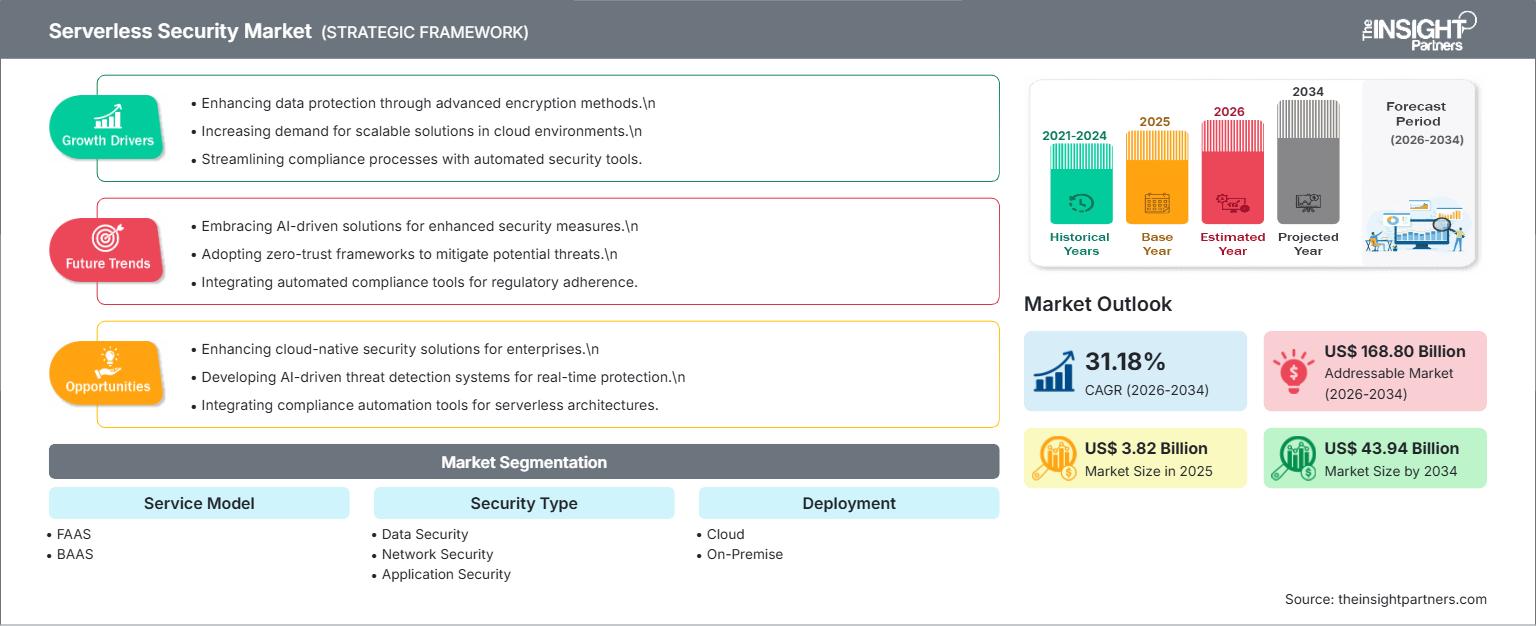
The Serverless security market was valued at US$ 3.82 Billion in 2025 and is projected to reach US$ 43.94 Billion by 2034, expanding at a CAGR of 31.18% during 2026–2034. Growth is supported by accelerating enterprise migration toward cloud-native architectures, rising adoption of function-based computing models, and increasing security requirements for distributed workloads. Organizations are prioritizing runtime protection, identity control, and continuous monitoring as serverless environments become integral to digital transformation strategies.
Across North America, the serverless security market size benefits from mature cloud ecosystems, widespread enterprise SaaS adoption, and strong cybersecurity spending. The regional market is estimated to expand at a CAGR of 29–32% through 2034. Increasing implementation of zero-trust frameworks, higher regulatory scrutiny on cloud environments, and growing adoption of serverless applications across the BFSI and healthcare sectors continue to create sustained demand for specialized security solutions.
Serverless Security Market Assessment and Insights
- North America: Strong cloud infrastructure investments, advanced cybersecurity spending, and widespread enterprise adoption of cloud-native applications support regional leadership. Share in 2025 is estimated at 37–41%, with a CAGR between 29–32% during 2026–2034.
- US: High concentration of hyperscale cloud providers, leading cybersecurity vendors, and large-scale enterprise cloud deployments sustain market growth. Share of North America in 2025 is estimated at 75–80%, with a CAGR between 29–32% during 2026–2034.
- Europe: Germany, the UK, and France lead regional adoption, supported by stringent regulatory compliance requirements, sovereign cloud initiatives, and growing investments in cloud security. Share in 2025 is estimated at 25–29%, growing at a CAGR between 28–31% during 2026–2034.
- Asia Pacific: China, Japan, India, and South Korea are accelerating investments in cloud-native application protection, digital transformation, and enterprise cybersecurity. Share in 2025 is estimated at 22–26%, with a CAGR between 33–36% during 2026–2034.
- Largest Segment: Cloud Deployment remains the dominant segment with a 68–72% market share in 2025 and a CAGR between 31–34% during 2026–2034, driven by increasing reliance on public, private, and hybrid cloud platforms.
- High Growth Segment: Application Security accounts for approximately 30–34% market share in 2025 and is expected to expand at a CAGR between 34–37% during 2026–2034 as organizations strengthen runtime protection, API security, and cloud-native workload defense.
- Key companies analyzed in detail: Aqua Security Software Ltd.; Check Point Software Technologies Ltd.; Datadog, Inc.; Imperva, Inc.; Palo Alto Networks, Inc.; Protego Labs Inc.; StackHawk, Inc.; Thundra, Inc.; Trend Micro Incorporated; Zscaler, Inc.
Source: The Insight Partners' analysis based on proprietary research, government publications, company annual reports, investor presentations, industry databases, and expert interviews.
The marketplace has matured from cloud workload monitoring into a set of dedicated platforms built to meet the requirements of event-driven architectures, APIs, and cloud computing functions. The expansion in FaaS adoption has resulted in the need for runtime visibility, threat detection, identity management, and policy compliance. Companies now look to have a security solution that can be used to secure both development environments and production environments at the same time.
The serverless security market is rapidly evolving as organizations increasingly adopt serverless computing architectures to enhance scalability and reduce operational costs. This paradigm shift, while beneficial, introduces unique security challenges that necessitate specialized solutions. As businesses migrate to serverless environments, concerns around data protection, identity management, and compliance become paramount. The market is witnessing a surge in demand for tools and services that can provide real-time monitoring, threat detection, and automated incident response tailored for serverless applications.
Serverless Security Market Report Scope
| Report Attribute | Details |
|---|---|
| Market size in 2025 | US$ 3.82 Billion |
| Market Size by 2034 | US$ 43.94 Billion |
| Global CAGR (2026 - 2034) | 31.18% |
| Historical Data | 2021-2024 |
| Forecast period | 2026-2034 |
Serverless Security Market Analysis
The serverless security market growth is primarily driven by enterprise adoption of microservices, containers, and event-driven application architectures. Organizations have started distributing workloads on AWS Lambda, Azure Functions, and Google Cloud Functions, and hence, there is a need for specialized security controls. The security professionals have started focusing on workload visibility, API protection, vulnerability detection, and identity management, which help mitigate the security risks in distributed computing environments.
The market ecosystem comprises cloud platform vendors, application developers, security solution providers, managed service providers, and compliance experts. With the rise in serverless computing, there is an increasing requirement for automated controls to protect dynamic workloads. There is high demand from the BFSI, healthcare, and government sectors.
From a competitive perspective, serverless security market analysis indicates increasing convergence between cloud-native application protection platforms and broader cybersecurity ecosystems. Vendors are expanding portfolios through product integration, platform enhancement, and AI-driven threat detection capabilities. Market participants focus on runtime visibility, workload telemetry, posture management, and developer-centric security tools.
Companies such as Palo Alto Networks, Aqua Security, Trend Micro, Check Point Software Technologies, and Zscaler continue strengthening cloud-native security capabilities in the Serverless Security Market. Meanwhile, Datadog, StackHawk, Protego, Thundra, and Imperva are emphasizing observability, application protection, and developer integration strategies. Investments remain concentrated on automation, threat intelligence, and policy-driven governance models.
● REPORT CUSTOMIZATION
Tailor This Report To Align With Your Specific Business Requirements
This report can be customized to align precisely with your business objectives, scope, and target markets. Customization options include tailored segmentation, geography, competitive analysis, and strategic insights to support informed decision-making.
Customize This Report →WHAT YOU CAN ADJUST
- ● Segmentations
- ● Geography
- ● Competitive Analysis
- ● Language Preferences
Serverless Security Market: Strategic Insights
Regional Insights
North America Serverless Security Market
North America accounted for 37–41% of the global market in 2025 and remains the leading regional contributor. Enterprise cloud migration programs, growing use of serverless application architectures, and increasing cybersecurity expenditures support strong demand. The region is projected to expand at a CAGR of 29–32% during 2026–2034. Financial services, healthcare, and telecommunications organizations represent key adopters due to stringent security and compliance requirements.
The region also holds the highest serverless security market share, supported by the presence of major cloud service providers and cybersecurity innovators. Increased implementation of zero-trust security frameworks and AI-enabled monitoring platforms is improving visibility across cloud-native environments. Enterprises are increasingly integrating security directly within development pipelines to reduce vulnerabilities across serverless workloads.
U.S. Serverless Security Market
The United States represents 75–80% of North American revenue and is forecast to grow at a CAGR of 29–32% through 2034. Strong investment in cloud infrastructure and widespread enterprise adoption of modern application architectures continue to support the deployment of advanced cloud-native security technologies.
Leading vendors, including Palo Alto Networks, Datadog, Zscaler, Imperva, and Check Point Software Technologies, maintain substantial operational footprints in the country. Demand is particularly strong among financial institutions, technology providers, and healthcare organizations seeking automated threat detection, runtime monitoring, and compliance management capabilities. Continued adoption of AI-enabled cloud environments is expected to support sustained market expansion.
Europe Serverless Security Market
Europe held 25–29% of global revenue in 2025 and is projected to register a CAGR of 28–31% through 2034. The region benefits from increasing cloud adoption, growing cybersecurity awareness, and regulatory requirements focused on data protection and digital resilience, supporting growth in the Serverless Security Market.
The UK remains a major contributor owing to mature financial services infrastructure and significant cybersecurity investments. Germany leads industrial adoption through cloud transformation initiatives spanning manufacturing and enterprise software sectors. France, Italy, and Spain are witnessing increased deployment of cloud-native applications across public and private organizations. Germany is expected to remain the leading country due to strong enterprise technology spending and expanding cloud security requirements.
APAC Serverless Security Market
Asia Pacific accounted for 22–26% of global revenue in 2025 and is expected to record the fastest regional CAGR of 33–36% through 2034. Rapid cloud adoption, digital banking expansion, and large-scale digital transformation programs support demand.
China remains the largest regional contributor, while India demonstrates strong momentum through accelerating cloud-native development. Japan, South Korea, and Australia continue investing in advanced cybersecurity platforms. Government-led digitization initiatives and increasing cloud infrastructure investments enhance long-term growth potential.
Middle East & Africa Serverless Security Market
The Middle East and Africa are emerging as a promising growth region, supported by cloud modernization initiatives and national cybersecurity programs. The market is expected to expand at a CAGR of 27–30% during the forecast period.
Saudi Arabia and the UAE lead adoption through smart city projects and digital government investments. South Africa remains a significant contributor within Africa. Expansion of cloud infrastructure, energy-sector digitization, and rising cybersecurity requirements continue to support demand for advanced serverless workload protection.
Segmentation Analysis
Service Model
Service Model is projected to grow at a CAGR of 30–33% during 2026–2034. The segment forms the foundation of the serverless security market scope, as organizations increasingly deploy workload protection controls aligned with function-based and backend service architectures.
- FAAS: Widely adopted for event-driven applications where visibility, runtime monitoring, and policy enforcement are essential to mitigate exposure across distributed workloads.
- BAAS: Supports rapid application development through managed backend services while requiring strong identity, access, and data governance controls.
Security Type
Security Type is expected to expand at a CAGR of 32–35% through 2034. Organizations are prioritizing integrated protection frameworks capable of securing application logic, network traffic, and sensitive information across cloud-native environments.
- Data Security: Critical for protecting confidential information, compliance workloads, and regulated datasets processed through serverless infrastructures.
- Network Security: Focuses on traffic inspection, segmentation, and threat detection across interconnected cloud services and APIs.
- Application Security: Increasingly important for runtime protection, code analysis, vulnerability management, and API security integration.
Deployment
Deployment is forecast to grow at a CAGR of 31–34% during the assessment period. Enterprises continue evaluating operational flexibility, compliance requirements, and scalability considerations while selecting deployment environments.
- Cloud: Dominant position supported by scalability, operational efficiency, and strong adoption of cloud-native development practices.
- On-Premise: Preferred among organizations requiring enhanced control, regulatory compliance, and customized security governance.
End Use
End Use is projected to register a CAGR of 30–33% through 2034. Demand is expanding as industry-specific organizations integrate serverless technologies into digital transformation and modernization strategies.
- BFSI: Strong adoption driven by fraud prevention, data protection requirements, and secure digital banking initiatives.
- Healthcare: Rising use of digital health platforms increases demand for workload visibility and compliance-focused security.
- Retail and E-commerce: Supports secure online transactions, customer data protection, and scalable digital commerce operations.
- IT and Telecommunications: Early adopter segment leveraging cloud-native infrastructure and advanced development frameworks.
- Government and Public Sector: Increasing deployment of secure digital services and citizen-facing platforms.
- Manufacturing: Growing use of connected systems and industrial applications supports adoption of cloud-native security technologies.
Opportunity Snapshot
| End Use | Revenue Contribution | Trend Tag | Adoption Stage |
| BFSI | High | Digital Banking | Mature |
| Healthcare | Medium | Health Platforms | Scaling |
| Retail and E-commerce | High | Omnichannel Retail | Scaling |
| IT and Telecommunications | High | Cloud Native | Mature |
| Government and Public Sector | Medium | Digital Services | Scaling |
| Manufacturing | Medium | Industrial Cloud | Emerging |
Serverless Security Market Growth Drivers and Impact Analysis
Expansion of cloud-native application development
There is an increase in organizations implementing microservices and event-driven architectures due to the advantages in terms of scalability and efficiency in development. However, this calls for security mechanisms that will help protect very distributed environments that may run only for a few milliseconds. The traditional cybersecurity solutions that work within the perimeter are usually unaware of serverless architectures, and there is a need for more specialized security systems.
Cloud-native application development has revolutionized the world of software because it makes it possible for businesses to develop, deploy, and scale applications efficiently. Cloud-native application development utilizes microservices architecture, containerization, and orchestration technologies, thus making it easier to update and manage applications. As businesses adopt digital transformation, the need for cloud-native software becomes more pronounced because of the benefits associated with it, such as increased efficiency, faster time to market, better resource utilization, and scalability. Moreover, with DevOps approaches becoming prevalent, along with CI/CD processes, cloud-native application development becomes even more efficient.
Growing regulatory focus on cloud security governance
There has been an increasing shift in global regulatory regimes towards protecting data, resilience, and cyber risk management. Corporations functioning within the finance industry, healthcare, and public sector need to ensure visibility and compliance regarding their cloud workloads continuously. Serverless security technologies enable corporations to achieve these objectives through automatic logging, identity management, and workload monitoring. Thus, the regulations have become an important driver in the cloud-native security space.
With the increased attention being paid to cloud security governance by regulatory bodies, cloud security is changing the way companies manage data protection and compliance in the new era. With the rising adoption of cloud computing, it is becoming increasingly necessary for regulatory authorities to pay attention to the issue of the safety of data in cloud storage, resulting in the development of strict regulatory policies and frameworks. In order to comply with regulations such as GDPR, HIPAA, and others, companies have no other choice but to adopt effective governance models involving risk management and incident response measures.
Increasing sophistication of cloud-based cyber threats
Threat actors tend to focus on APIs, identities, and vulnerable cloud configurations. The serverless approach offers a unique set of risks due to the inherently dynamic and distributed nature of such solutions. The contemporary security tools can detect attacks, analyze behaviors, and remediate problems automatically, thus minimizing the exposure time of any attacks. Increased awareness of these threats is making companies think about adopting proactive approaches and workload protection platforms.
The growing sophistication of the cloud cyber threats presents a number of challenges for organizations using cloud computing. As the methods used by threat actors evolve through time (multi-vector attacks, ransomware, insider threats), the security measures available at this moment turn out to be insufficient for tackling these kinds of risks. The dynamic nature of the cloud environments adds to these challenges, allowing cyber criminals to gain access to the system and data.
Serverless Security Market Future Trends
AI-driven runtime protection platforms
The serverless security market trends increasingly point toward AI-enabled platforms capable of continuously analyzing workload behavior and identifying anomalies in real time. Advanced analytics will support automated response mechanisms, reducing operational burden on security teams. Vendors are investing in contextual threat prioritization and predictive risk assessment capabilities that improve accuracy while limiting alert fatigue. These developments are expected to enhance adoption among large enterprises and regulated industries.
Convergence of security and developer workflows
Security capabilities are increasingly being integrated directly into software development pipelines. Future solutions will provide continuous visibility from code creation through production deployment. Automated scanning, policy enforcement, and workflow integration are expected to improve collaboration between developers and security teams while accelerating application deployment cycles. This convergence is likely to become a defining characteristic of next-generation platforms.
Serverless Security Market Opportunities
Expansion across regulated industry environments
Financial institutions, healthcare providers, and public-sector organizations continue migrating critical workloads to cloud-native environments. serverless security market Forecasts indicate significant investment opportunities for vendors providing compliance-focused monitoring, automated reporting, and workload governance capabilities. Organizations increasingly require vertical-specific security controls capable of satisfying regulatory requirements while supporting operational flexibility. Vendors with specialized offerings may benefit from long-term contracts and recurring revenue models.
Security platforms for multi-cloud management
Enterprises increasingly operate across multiple cloud providers, creating demand for unified visibility and governance solutions. Security vendors can capitalize by offering centralized policy management, threat detection, and compliance monitoring capabilities that function consistently across environments. Organizations seeking operational efficiency are expected to prioritize integrated platforms capable of reducing complexity while supporting growing application portfolios and distributed infrastructures.
Frequently Asked Questions

- Comprehensive Market Sizing and Forecast Analysis
- Detailed Segmentation Analysis
- In-Depth Market Dynamics Assessment
- Regional and Country-Level Insights
- Competitive Landscape and Company Benchmarking
- Strategic Business Intelligence
Recent Reports
Testimonials

The Insight Partners' SCADA System Market report is comprehensive, with valuable insights on current trends and future forecasts. The team was highly professional, responsive, and supportive throughout. We are very satisfied and highly recommend their services.
RAN KEDEM Partner, Reali Technologies LTDs
I requested a report on a very specific software market and the team produced the report in a few days. The information was very relevant and well presented. I then requested some changes and additions to the report. The team was again very responsive and I got the final report in less than a week.
JEAN-HERVE JENN Chairman, Future Analytica
We worked with The Insight Partners for an important market study and forecast. They gave us clear insights into opportunities and risks, which helped shape our plans. Their research was easy to use and based on solid data. It helped us make smart, confident decisions. We highly recommend them.
PIYUSH NAGPAL Sr. Vice President, High Beam Global
The Insight Partners delivered insightful, well-structured market research with strong domain expertise. Their team was professional and responsive throughout. The user-friendly website made accessing industry reports seamless. We highly recommend them for reliable, high-quality research services
YUKIHIKO ADACHI CEO, Deep Blue, LLC.
This is the first time I have purchased a market report from The Insight Partners.While I was unsure at first, I visited their web site and felt more comfortable to take the risk and purchase a market report.I am completely satisfied with the quality of the report and customer service. I had several questions and comments with the initial report, but after a couple of dialogs over email with their analyst I believe I have a report that I can use as input to our strategic planning process.Thank you so much for taking the extra time and making this a positive experience.I will definitely recommend your service to others and you will be my first call when we need further market data.
JOHN SUZUKI President and Chief Executive Officer, Board Director, BK Technologies
I wish to appreciate your support and the professionalism you displayed in the course of attending to my request for information regarding to infectious disease IVD market in Nigeria. I appreciate your patience, your guidance, and the fact that you were willing to offer a discount, which eventually made it possible for us to close a deal. I look forward to engaging The Insight Partners in the future, all thanks to the impression you have created in me as a result of this first encounter.
DR CHIJIOKE ONYIA MANAGING DIRECTOR, PineCrest Healthcare Ltd.Reason to Buy
- Informed Decision-Making
- Understanding Market Dynamics
- Competitive Analysis
- Identifying Emerging Markets
- Customer Insights
- Market Forecasts
- Risk Mitigation
- Boosting Operational Efficiency
- Strategic Planning
- Investment Justification
- Tracking Industry Innovations
- Aligning with Regulatory Trends





 Get Free Sample for