Service Resource Planning Tool Market Share, Growth & Demand by 2034

Coverage: By Service (Consulting Service, Implementation Service, Integration Service); Industry Vertical (Manufacturing Sector, Healthcare Sector, Public Sector, BFSI, Transportation Sector, Others) , and Geography (North America, Europe, Asia Pacific, and South and Central America)

Historic Data: 2021-2024 | Base Year: 2025 | Forecast Period: 2026-2034
  • Status : Data Released
  • Report Code : TIPRE00028896
  • Category : Technology, Media and Telecommunications
  • No. of Pages : 150
  • Available Report Formats : pdf-format excel-format
  • Last update date : August 04, 2026
Service Resource Planning Tool Market Share, Growth & Demand by 2034
Report Date: August 04, 2026   |   Report Code: TIPRE00028896 Email: sales@theinsightpartners.com

2025 Market Size

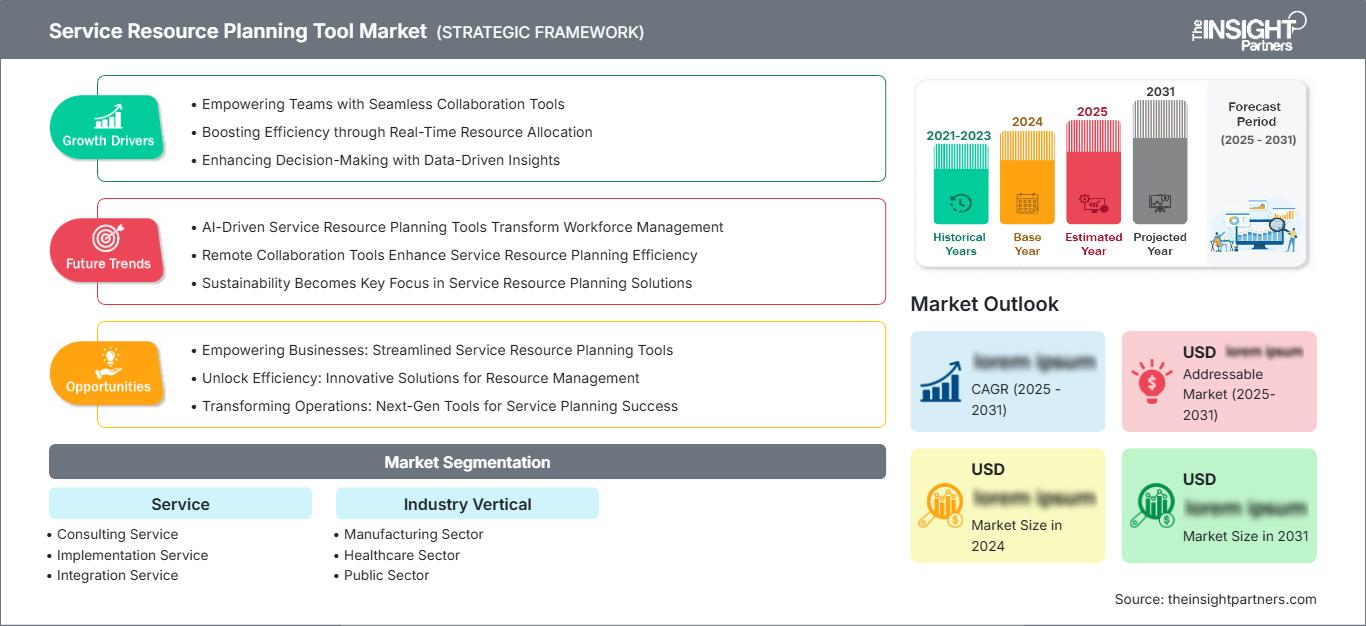
US$ 7.14 Bn

Base year value

2034 Forecast

US$ 13.24 Bn

Projected by 2034

CAGR 2026-2034

7.09 %

Growth rate

Addressable Market

US$ 91.93 Bn

(2026-2034)

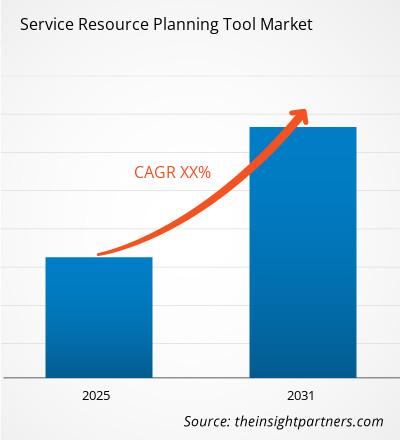
The Service resource planning tool market was valued at US$ 7.14 Billion in 2025 and is projected to reach US$ 13.24 Billion by 2034, expanding at a CAGR of 7.09% during 2026–2034. Increasing adoption of enterprise resource management platforms, demand for operational visibility, and growing focus on service efficiency are supporting market expansion. Organizations across manufacturing, healthcare, banking, and public sectors are implementing these tools to optimize workforce allocation, project execution, and service delivery processes.

The service resource planning tool market size is gaining momentum in North America, where adoption is expected to expand at a CAGR range of 7–9% during 2026–2034. Growth is supported by enterprise digital transformation initiatives, increasing cloud-based business applications, and demand for integrated resource management solutions. Organizations are prioritizing operational automation, workforce optimization, and improved utilization of service resources to enhance productivity across complex business environments.

Service Resource Planning Tool Market Assessment and Insights

  • North America: Accounted for a 35–39% share in 2025 and is growing at a CAGR range of 7–9% between 2026–2034, supported by advanced enterprise software adoption, cloud migration, and demand for integrated service management solutions.
  • US: Represented 75–80% share of North America in 2025 and is expanding at a CAGR range of 7–8% between 2026–2034, driven by large enterprise investments in automation, resource optimization, and digital operations.
  • Europe: Held a 27–31% share in 2025 and is growing at a CAGR range of 6–8% between 2026–2034, with Germany, the UK, and France leading adoption through industrial modernization and enterprise resource planning upgrades.
  • Asia Pacific: Captured a 20–24% share in 2025 and is expanding at a CAGR range of 8–10% between 2026–2034, led by China, India, Japan, and South Korea due to manufacturing growth and digital transformation initiatives.
  • Largest Segment: Consulting Service accounted for a 35–40% market share in 2025 and is growing at a CAGR range of 6–8% between 2026–2034, supported by enterprise customization and implementation requirements.
  • High Growth Segment: Integration Service represented a 25–30% market share in 2025 and is expanding at a CAGR range of 8–10% between 2026–2034, driven by demand for connected enterprise platforms and workflow automation.
  • Key companies analyzed in detail: SAP SE, Oracle Corp., Microsoft Corp., Infor US Inc., Epicor Software Corporation, Lawson Inc., Consona Corporation, Activant Group Inc., IBM Corporation, and QAD Inc.

Source: The Insight Partners' analysis based on proprietary research, government publications, company annual reports, investor presentations, industry databases, and expert interviews.

The service resource planning tool market has evolved from basic scheduling and workforce allocation systems into integrated platforms supporting analytics, automation, and enterprise-wide resource visibility. Technology advancements in cloud computing, artificial intelligence, and enterprise application integration are reshaping solution capabilities. Organizations are increasingly adopting connected systems that improve planning accuracy, resource utilization, and decision-making across service-intensive operations.

Enterprise software providers are focusing on flexible architectures that support industry-specific requirements, real-time monitoring, and integration with existing business applications, contributing to growth in the Service Resource Planning Tool Market share. Manufacturing and healthcare organizations are adopting these platforms to coordinate complex operations, while financial institutions and public sector entities are improving resource governance. The ecosystem includes software vendors, implementation partners, consultants, and enterprise technology providers.

Service Resource Planning Tool Market Report Scope

Report Attribute Details
Market size in 2025 US$ 7.14 Billion
Market Size by 2034 US$ 13.24 Billion
Global CAGR (2026 - 2034)7.09%
Historical Data 2021-2024
Forecast period 2026-2034
Inquire More about this report.
Inquire More

Service Resource Planning Tool Market Analysis

The service resource planning tool market growth is influenced by increasing enterprise demand for workforce optimization, project visibility, and efficient allocation of service resources across complex operational environments. Organizations are now aligning their planning systems with ERP, CRM, and analytical systems to increase the effectiveness of usage. The market consists of software providers, implementers, consultants, and managed service providers for digital transformation projects.

Providers are developing these systems by adding automation, artificial intelligence, and real-time reporting to cater to the changing needs of the workforce. The supply market is becoming dynamic due to an emphasis on building flexible products catering to various sectors like manufacturing, healthcare, banking, and the public sector. Increasing use by SMEs is also motivating providers to offer subscription-based models.

The service resource planning tool market analysis highlights increasing competition among established enterprise software providers and specialized resource management vendors. Companies such as SAP SE, Oracle Corp., Microsoft Corp., IBM Corporation, and Infor US Inc. are strengthening their portfolios through cloud integration, workflow automation, and advanced analytics capabilities. These companies are positioning their solutions to support enterprise-wide resource planning requirements.

Strategic investments are focused on improving interoperability, artificial intelligence-driven forecasting, and industry-specific functionalities. Epicor Software Corp., QAD Inc., and other technology providers are developing solutions that address operational complexity across manufacturing and service-driven industries. Partnerships, acquisitions, and platform enhancements remain important strategies as vendors compete to deliver flexible and integrated resource planning environments, according to the Service Resource Planning Tool Market report.

● REPORT CUSTOMIZATION

Tailor This Report To Align With Your Specific Business Requirements

This report can be customized to align precisely with your business objectives, scope, and target markets. Customization options include tailored segmentation, geography, competitive analysis, and strategic insights to support informed decision-making.

Customize This Report →

WHAT YOU CAN ADJUST

  • Segmentations
  • Geography
  • Competitive Analysis
  • Language Preferences

Service Resource Planning Tool Market: Strategic Insights
service-resource-planning-tool-market
Download Free sample to check more details about report.
This FREE sample will include data analysis, ranging from market trends to estimates and forecasts.
Download Free Sample

Regional Insights

North America Service Resource Planning Tool Market

North America accounted for approximately 34–38% share in 2025 and is expected to expand at a CAGR of 7–9% between 2026–2034. The region benefits from strong enterprise software adoption, advanced cloud infrastructure, and increasing demand for automated workforce and service management solutions, supporting the Service Resource Planning Tool Market forecast.

The United States represents the largest contributor within the region, supported by technology investments across manufacturing, healthcare, financial services, and government organizations. Enterprises are adopting resource planning platforms to improve operational efficiency, manage distributed teams, and integrate service workflows with existing enterprise applications.

U.S. Service Resource Planning Tool Market

The U.S. represented around 70–75% of North America’s share in 2025 and is projected to grow at a CAGR of 7–8% during 2026–2034. The market is supported by widespread enterprise digital transformation programs and demand for cloud-based operational management platforms, reflecting key Service Resource Planning Tool Market trends.

Companies including Microsoft Corp., Oracle Corp., SAP SE, and IBM Corporation maintain a strong presence through integrated enterprise solutions. Application trends emphasize automated scheduling, resource forecasting, and analytics-driven decision-making. Industries such as healthcare, banking, and manufacturing are increasingly adopting these platforms to improve productivity and service delivery.

Europe Service Resource Planning Tool Market

Europe held approximately 27–31% share in the Service Resource Planning Tool Market in 2025 and is projected to grow at a CAGR of 6–8% between 2026–2034. There is substantial adoption within the region because of modernization within organizations, regulation, and the need for visibility of resource usage. There are continuous investments being made in the region by businesses within the manufacturing, healthcare, utilities, and professional services industries to adopt service resource planning solutions.

The UK is a major market because of the adoption of service resource planning solutions within professional services, healthcare, and public organizations in search of operational efficiency. Germany is growing due to digital transformation within manufacturing and Industry 4.0, while France, Italy, and Spain are growing through adoption within the banking, transport, and service industries.

APAC Service Resource Planning Tool Market

Asia Pacific accounted for approximately 22–26% share in the Service Resource Planning Tool Market in 2025 and is expected to register a CAGR of 9–11% from 2026–2034. China, Japan, South Korea, and India are key contributors owing to enterprise automation projects, increased digitization, and increased use of cloud computing for resource planning and workforce management solutions.
India is fast becoming a key market owing to technology adoption by service providers and enterprises. Expansion in manufacturing, digitization programs from the government, and cloud computing usage are fueling demand in the region. Businesses are deploying resource planning platforms to enhance business control and scalability.

Middle East & Africa Service Resource Planning Tool Market

Middle East & Africa represented approximately 8–10% share in the Service Resource Planning Tool Market in 2025 and is projected to grow at a CAGR of 6–8% between 2026–2034. In Saudi Arabia and the UAE, the leadership in terms of adoption is driven by intelligent infrastructure, enterprise transformation, and investments in digital transformation technologies for resource planning and optimization.

The South African market is an important one due to the increasing demand for financial services and technology markets. In the region as a whole, there is a significant investment in digital technologies for efficient resource planning and workforce management.

service-resource-planning-tool-market-cagr-image
Get a regional analysis of this market.
Download Free Sample Brochure

Segmentation Analysis

Service

The Service segment is expected to expand at a CAGR of 7–9% between 2026–2034. Organizations require specialized support for the implementation, integration, customization, and optimization of resource planning platforms. Service providers assist enterprises in aligning solutions with operational processes, improving adoption, and maximizing technology investments.

  • Consulting Service: Consulting services help organizations evaluate resource planning requirements, define implementation strategies, and optimize workflows. Demand is increasing among enterprises seeking expert guidance for digital transformation projects.
  • Implementation Service: Implementation services support the deployment, configuration, and customization of platforms across enterprise environments. These services are important for reducing complexity and ensuring successful adoption.
  • Integration Service: Integration services enable connectivity between resource planning tools and existing enterprise applications. They support seamless data exchange, workflow automation, and improved operational visibility.

Vertical Sector

The Vertical Sector segment is projected to grow at a CAGR of 7–9% during 2026–2034. Different industries are adopting specialized resource planning solutions to manage workforce allocation, service delivery, and operational complexity. Industry-focused platforms provide improved functionality for sector-specific requirements.

  • Manufacturing Sector: Manufacturers use resource planning platforms to coordinate production activities, optimize workforce utilization, and improve operational planning across complex supply chains.
  • Healthcare Sector: Healthcare organizations adopt these solutions to manage staff allocation, improve service coordination, and support efficient resource utilization.
  • Public Sector: Government organizations implement planning tools to improve workforce management, project execution, and administrative efficiency.
  • Banking, Financial and Insurance Services: Financial institutions use resource planning platforms to optimize service operations, compliance activities, and workforce scheduling.
  • Transportation Sector: Transportation companies adopt these tools to improve operational coordination, employee allocation, and service management across distributed networks.

Opportunity Snapshot

Industry Vertical

Revenue Contribution

Trend Tag

Adoption Stage

Manufacturing Sector

High

Smart Operations

Scaling

Healthcare Sector

High

Workforce Optimization

Scaling

Public Sector

Medium

Digital Governance

Emerging

Banking, Financial, and Insurance Services

High

Process Automation

Mature

Transportation Sector

Medium

Fleet Coordination

Scaling

Request for Customization for extensive market insights.
Customize This Report

Service Resource Planning Tool Market Growth Drivers and Impact Analysis

Increasing Demand for Workforce Optimization

In today’s world, organizations have been increasingly emphasizing their efforts to enhance the productivity of the workforce, better utilize the resources, and increase visibility in their operations. In this way, there is a growing demand for advanced planning platforms that are capable of managing the workforce in the organization effectively. In manufacturing, healthcare, and even financial service organizations, there is a need for platforms that are capable of allocating the workers, monitoring the workloads, and delivering services efficiently. Due to the rise of distributed workplaces, the importance of resource management systems has grown significantly.

Growth of Enterprise Digital Transformation Initiatives

The implementation of digital transformation projects has been making enterprises opt for automatic solutions to handle their planning procedures. Many organizations are integrating service planning systems with ERP, CRM, and Business Intelligence solutions in order to facilitate better coordination among different units within an enterprise. With cloud adoption projects and software transformation projects going on in many organizations, organizations can easily implement flexible solutions without having to make significant investments in infrastructure. Sectors such as manufacturing and healthcare are increasingly embracing digital technology in order to enhance productivity and performance levels.

Expansion of Cloud-Based Enterprise Applications

The development of cloud-based enterprise applications is considerably affecting the way businesses adopt these tools. Cloud-based deployment allows businesses to utilize the capabilities of resource planning with less infrastructure and more scalability. SMEs have started to favor subscription models of software because they are flexible and allow for rapid deployment. Large enterprises are also moving towards cloud-based platforms in order to facilitate integration of their business application and operations systems. The benefits of improved security, accessibility, and constant updating of software are adding value to the use of cloud-based platforms. Adoption of cloud-based platforms by enterprises is likely to lead to increasing demand for flexible resource planning solutions.

Service Resource Planning Tool Market Future Trends

Artificial Intelligence-Based Resource Forecasting

Future resource planning is anticipated to be influenced by artificial intelligence in terms of being able to forecast, automate scheduling, and make decisions intelligently. Complex algorithms will use data from past performance, demand patterns, and staff availability to suggest optimal ways of allocating resources. Companies have started looking for platforms that are equipped with artificial intelligence capabilities to plan more effectively and avoid any delays. The integration of machine learning with enterprise software will help firms predict resource needs before any problems arise. Such an approach is believed to attract companies whose operations require precise coordination, such as healthcare, manufacturing, and financial services.

Integration with Advanced Business Analytics

It is forecasted that future platforms will feature advanced analytics features, which will help better understand the performance and efficiency of the resources. It is required for organizations to get systems that not only plan resources but also have visualization capabilities, reports, and forecasting abilities. Integration with enterprise intelligence platforms will give managers the possibility to analyze productivity trends, recognize resource gaps and conduct better strategic planning. It will help make decisions based on data in industries with complicated service processes. As enterprises are becoming more oriented towards improving performance, there is forecasted increasing popularity of the resource planning platforms that use analytics.

Service Resource Planning Tool Market Opportunities

Expansion Across Emerging Enterprise Markets

There are numerous business opportunities that can be gained by emerging economies as more firms increase digitization efforts. Many countries in the Asia Pacific, Middle East, and Latin American regions have been adopting enterprise software to boost their productivity and competitive nature. The vendors have an opportunity to increase their sales by creating scalable platforms that are adaptable to different firms depending on the level of their technological advancement. Business service resource planning forecasts also suggest many business opportunities for companies searching for workforce management tools as they expand their operations.

Development of Industry-Specific Solutions

Industry-focused solutions represent an important opportunity as enterprises require specialized capabilities aligned with operational requirements. Healthcare providers need workforce coordination tools, manufacturers require production-linked planning systems, and financial institutions demand secure operational management platforms. Vendors investing in vertical-specific functionalities can improve adoption by addressing unique business challenges. Integration with compliance systems, analytics platforms, and enterprise applications can further enhance solution value. Customized offerings allow providers to differentiate themselves in an increasingly competitive environment. As organizations continue seeking solutions tailored to their operational models, industry-focused development strategies will create opportunities for technology providers and implementation partners.


Frequently Asked Questions

Organizations should assess integration capabilities, scalability, security features, customization options, and compatibility with existing enterprise applications. Vendor support and implementation expertise are also important considerations.

Businesses can maximize value by aligning platform deployment with operational objectives, training users effectively, and integrating planning tools with existing workflow systems.

Manufacturing, healthcare, banking, and public sector organizations are expected to demonstrate strong adoption due to increasing requirements for operational efficiency and workforce coordination.

Cloud deployment provides scalability, accessibility, and reduced infrastructure requirements, making it suitable for organizations seeking flexible technology investments.

The Service Resource Planning Tool Report provides insights into market dynamics, technology developments, competitive positioning, and adoption patterns that help businesses evaluate future opportunities.
Ankita Mittal
Manager,
Market Research & Consulting

Ankita is a dynamic market research and consulting professional with over 8 years of experience across the technology, media, ICT, and electronics & semiconductor sectors. She has successfully led and delivered 100+ consulting and research assignments for global clients such as Microsoft, Oracle, NEC Corporation, SAP, KPMG, and Expeditors International. Her core competencies include market assessment, data analysis, forecasting, strategy formulation, competitive intelligence, and report writing.

Ankita is adept at handling complete project cycles—from pre-sales proposal design and client discussions to post-sales delivery of actionable insights. She is skilled in managing cross-functional teams, structuring complex research modules, and aligning solutions with client-specific business goals. Her excellent communication, leadership, and presentation abilities have enabled her to consistently deliver value-driven outcomes in fast-paced and evolving market environments.

  • Comprehensive Market Sizing and Forecast Analysis
  • Detailed Segmentation Analysis
  • In-Depth Market Dynamics Assessment
  • Regional and Country-Level Insights
  • Competitive Landscape and Company Benchmarking
  • Strategic Business Intelligence

Testimonials

Reason to Buy

  • Informed Decision-Making
  • Understanding Market Dynamics
  • Competitive Analysis
  • Identifying Emerging Markets
  • Customer Insights
  • Market Forecasts
  • Risk Mitigation
  • Boosting Operational Efficiency
  • Strategic Planning
  • Investment Justification
  • Tracking Industry Innovations
  • Aligning with Regulatory Trends
Sales Assistance
US: +1-646-491-9876
UK: +44-20-8125-4005
DUNS Logo
ISO Certified Logo
GDPR
CCPA