
Shipboard Incineration Market Size, Share & Forecast by 2034
Coverage: By Type (Horizontal, Vertical); Application (Passenger Ships, Tankers, Fishing Boats, Cargo Ships, Boats, Others) , and Geography (North America, Europe, Asia Pacific, and South and Central America)
- Status : Data Released
- Report Code : TIPRE00010150
- Category : Manufacturing and Construction
- No. of Pages : 150
- Available Report Formats :


- Last update date : July 15, 2026


2025 Market Size
US$ 584.04 Mn
Base year value
2034 Forecast
US$ 947.42 Mn
Projected by 2034
CAGR 2026-2034
5.52 %
Growth rate
Addressable Market
US$ 6,942.73 Mn
(2026-2034)
The Shipboard Incineration Market size is expected to reach US$ 947.42 Million by 2034, up from US$ 584.04 Million in 2025, with an anticipated CAGR of 5.52% in 2026–2034. Market demand will be driven by the need for onboard waste reduction, adherence to MARPOL Annex VI, renewal of cruise and cargo fleets, and increased scrutiny of the management of sludge, garbage, and regulated waste on board.
North America continues to be a structurally significant market for demand, with revenue driven by cruise homeporting, offshore energy transportation, naval fleet upgrades, and stricter waste management at ports. Region-wide demand growth is expected to occur at a 5.1–5.6% CAGR in 2026–2034 as compliance with onboard waste treatment, reduced landed waste volume, and ship waste handling become priorities.
Shipboard Incineration Market Assessment and Insights
- North America held 28–31% share in 2025 and is projected to grow at a 5.1–5.6% CAGR between 2026–2034, supported by cruise retrofits, naval waste controls, and offshore fleet compliance.
- US accounted for 76–80% of North America in 2025 and is expected to expand at a 5.2–5.7% CAGR between 2026–2034, led by cruise ports and defense vessels.
- Europe represented 27–30% share in 2025 and is forecast to grow at a 5.0–5.5% CAGR between 2026–2034, with Norway, Germany, Italy, and the UK leading demand.
- Asia Pacific captured 25–28% share in 2025 and is projected to grow at a 5.8–6.4% CAGR between 2026–2034, driven by China, Japan, South Korea, India, and Australia.
- Largest Segment Vertical systems held 56–60% market share in 2025 and are expected to grow at a 5.3–5.8% CAGR between 2026–2034 due to compact vessel integration.
- High Growth Segment Passenger ships held 24–28% market share in 2025 and are forecast to grow at a 6.0–6.6% CAGR between 2026–2034 as cruise operators expand onboard waste treatment.
- Key companies analyzed in detail: ACS, Inc., Alfa Laval AB, ATLAS INCINERATORS ApS, Evac Group, Fuente International Co., Ltd., Hansun (Shanghai) Marine Technology Co., Ltd., Kangrim Heavy Industries Co., Ltd., Mavi Deniz Environmental Protection Co., Scanship Environmental AS, Wärtsilä Corporation
Source: The Insight Partners' analysis based on proprietary research, government publications, company annual reports, investor presentations, industry databases, and expert interviews.
The fleet companies are moving away from basic combustion systems toward more sophisticated thermal systems that offer increased automation, emission monitoring, sludge-friendly operation, and energy recycling capabilities. Further, the production trend is dynamic due to shipyards' demand for modular systems that fit within limited machine room space and installation time. Hence, the market will shift from being replacement-based due to compliance to integrated waste management in the cruise, tanker, and cargo fleet, depending on the availability of storage, labor, and port facilities.
As far as the coming period is concerned, investments in the ship incineration market will be directed at the construction of a newbuild yard in the Asia Pacific, the refits of cruise ships in North America, and the operations of European ships that face stringent environmental requirements. The tailwinds in the regulatory front, such as MARPOL Annex VI Regulation 16, that requires the use of approved equipment and forbids some types of waste, dictate purchasing decisions.
Shipboard Incineration Market Report Scope
| Report Attribute | Details |
|---|---|
| Market size in 2025 | US$ 584.04 Million |
| Market Size by 2034 | US$ 947.42 Million |
| Global CAGR (2026 - 2034) | 5.52% |
| Historical Data | 2021-2024 |
| Forecast period | 2026-2034 |
Shipboard Incineration Market Analysis
The increase in demand is due to the reality that the vessels would need to minimize the waste produced but without totally depending on the ports for the same. The market growth is attributed to longer voyages, increased waste per passenger, waste record-keeping, and the oily sludge generated through normal procedures. According to the IMO, incineration can take place in certain equipment, but certain kinds of waste are not allowed.
Burners, refractories, yards, classification societies, suppliers of marine waste and service personnel make up the value chain. In the supply chain, companies that can provide compact machines, approval certificates, spare parts, and training services would have the edge. The procurement processes tend to be scheduled around dry-docking periods and retrofits, among others.
The competitive positioning strategy is influenced by the installed base, experience in marine certification, and the capability to integrate incinerators into overall water and waste systems. Shipboard Incineration Market report finds that such companies as Alfa Laval AB, Evac Group, Wärtsilä Corporation, and Scanship Environmental AS use advantages associated with their system-level marine presence, whereas such firms as ATLAS INCINERATORS ApS, Kangrim Heavy Industries Co., Ltd., and Hansun (Shanghai) Marine Technology Co., Ltd. specialize in equipment-based offerings.
Current investments go into retrofits, remote management, and alternative-fuel vessels when there is a need to treat waste gases or sludge streams. ACS, Inc., Fuente International Co., Ltd., and Mavi Deniz Environmental Protection Co. enhance supply base fragmentation by serving regional demand. Buyers pay increasing attention to the total cost of ownership, risk of downtime, and audit compliance.
● REPORT CUSTOMIZATION
Tailor This Report To Align With Your Specific Business Requirements
This report can be customized to align precisely with your business objectives, scope, and target markets. Customization options include tailored segmentation, geography, competitive analysis, and strategic insights to support informed decision-making.
Customize This Report →WHAT YOU CAN ADJUST
- ● Segmentations
- ● Geography
- ● Competitive Analysis
- ● Language Preferences
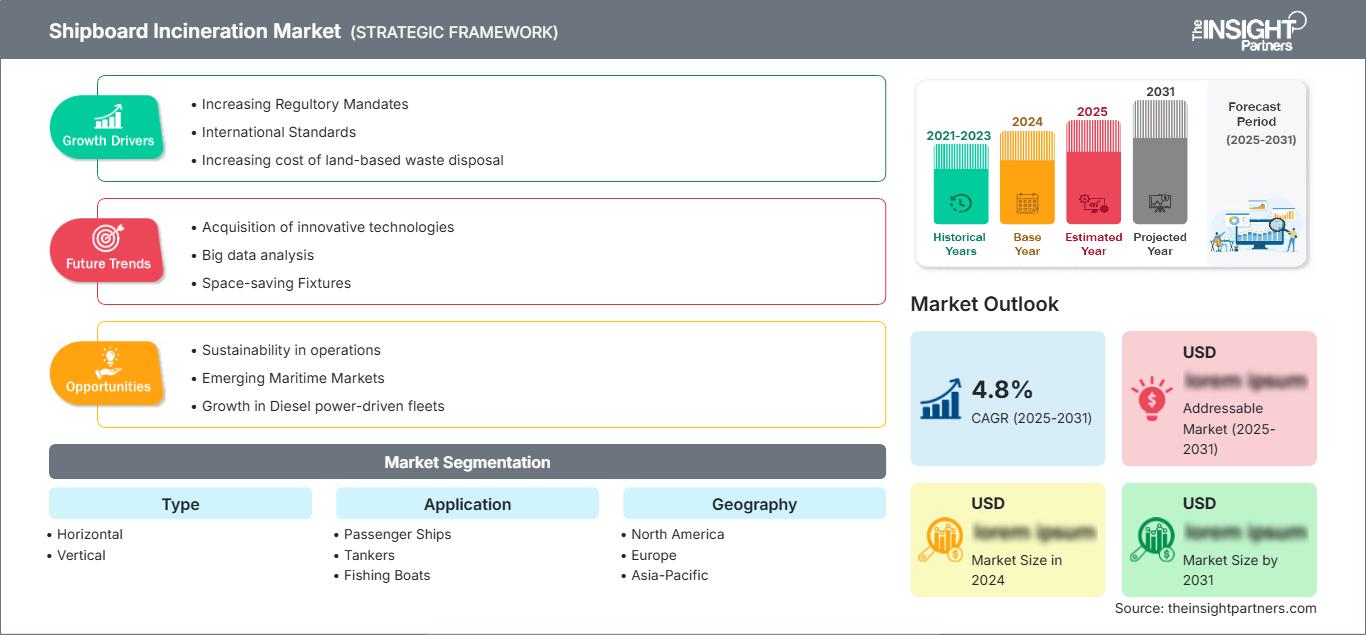
Shipboard Incineration Market: Strategic Insights
Regional Insights
North America Shipboard Incineration Market
North America accounted for 28–31% of the Shipboard Incineration Market share in 2025 and is projected to grow at a 5.1–5.6% CAGR. Cruise ships operating from Florida, Alaska itineraries, Great Lakes vessels, offshore support ships, and naval fleets create diverse demand for compliant onboard waste reduction. The region also benefits from higher drydock activity and port scrutiny of landed waste.
Structural determinants include existing classification backing, quality ship owners, and the readiness to invest in retrofits to reduce waste discharge risks. MARPOL Annex VI Regulation 16 and port reception requirements provide the basis for equipment renewal, and cruise lines are assessing the possibility of acquiring better equipment to handle food waste, cardboard, plastic waste, and sludge produced during weekly cruises.
U.S. Shipboard Incineration Market
In 2025, the U.S. accounted for 76-80% of North America, and it is expected that the country will record a 5.2-5.7% CAGR between 2026-2034. There are many cruise homeports, defense logistics, offshore vessels, and coastal freight that drive the need for incinerators to operate efficiently. Passenger ships generate large amounts of waste, whereas tankers and cargo ships primarily handle sludge and oily waste.
The market players have a significant presence via marine suppliers globally and service providers and retrofitting companies in the U.S. ports and yards. Some of the application trends include the need for redundancy for cruise ships, strong sludge burning ability for tankers, and compact vertical designs for cargo ships.
Europe Shipboard Incineration Market
Europe's share was 27-30% in 2025, and the region is estimated to grow at a 5.0-5.5% CAGR. UK promotes retrofit installations via cruise, ferry, and offshore vessel operations while Norway is significant owing to the environmentally friendly practices in the maritime industry and its vessel upgrades along the coast.
Germany is prominent due to its shipbuilding, equipment engineering, and classification-related procurement practices. France, Italy, and Spain play an important role by providing Mediterranean cruise services, naval operations, ship repairs, and policies that favor onboard waste control. Environmental inspections in Europe are a common practice,, and therefore, operators seek consistency in this regard.
APAC Shipboard Incineration Market
The APAC region contributed a 25-28% share in 2025 and is forecast to grow at a CAGR of 5.8-6.4%. China dominates in shipbuilding capacity, cargo vessel operations, and local manufacturing of marine equipment. Other major contributors include Japan and South Korea that drive high-end newbuildings, whereas India and Australia contribute to demand via naval, offshore, fishing, and coastal shipping projects.
The industrial factors contributing to growth include large order books, shipyards geared toward exports, and increasing concerns over waste compliance of internationally trading vessels. Alignment with IMO standards encourages customers to select type-approved products for newbuilds. The participation of local suppliers is helpful in improving cost effectiveness, thus expanding the Market.
Middle East & Africa Shipboard Incineration Market
Middle East & Africa will witness a CAGR of 4.7-5.2%, led by demand from Saudi Arabia and the UAE for energy logistics, offshore logistics support, port development, and tanker logistics. South Africa will provide demand through coastal cargo logistics, ship repair facilities, and fisheries that need assured waste management.
MEA demands will be project-driven, linked to port upgrade initiatives, ship acquisitions, and offshore infrastructure. The adoption rate will be slower than in APAC, as fleet upgrade initiatives will not be uniform; however, trade routes and energy export ships will help sustain the upgrades. Vertical equipment design and easy maintenance designs will be preferred in this market.
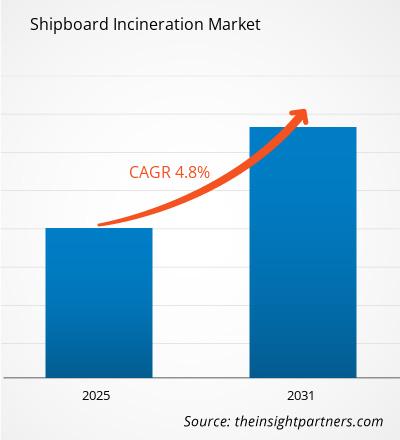
Segmentation Analysis
Type
Type is expected to have a CAGR of 5.2%-5.8% between 2026 and 2034. Scope of selection of the market in terms of type takes into account machinery room availability, types of waste, emissions, and whether it can be installed as retrofit. The vertical model is more common in smaller applications whereas the horizontal model is relevant in larger technical spaces.
- Horizontal systems suit vessels with broader technical spaces and higher service access needs, offering stable loading arrangements for sludge, solids, and mixed combustible waste streams.
- Vertical systems hold the leading position because compact footprints, simpler integration, and efficient exhaust routing match cruise, cargo, tanker, and offshore vessel design constraints.
Application
The application is projected to experience a CAGR of 5.4–6.1% in the forecast period of 2026-2034 due to the alignment of waste management strategies with the journey time, number of passengers on board, fuel system, and constraints at port reception facilities. Passenger vessels produce the most complicated waste streams, while tankers need sludge-oriented reliability.
- Passenger Ships generate high volumes of food waste, packaging, sludge, and hotel-related refuse, making onboard treatment capacity strategically important for cruise operators seeking predictable itineraries.
- Tankers depend on robust equipment for oily sludge and operational residues, with purchasing decisions influenced by safety standards, cargo route profiles, and inspection exposure.
- Fishing Boats adopt smaller units where long trips, limited storage, and port distance require practical waste reduction without compromising deck layout or crew workload.
- Cargo Ships represent steady demand because internationally trading fleets need compliant waste handling, durable components, and cost-efficient systems that fit varied vessel classes.
- Boats require compact, serviceable systems for specialized commercial, patrol, offshore, and utility missions where waste storage capacity and regulatory expectations are rising.
Opportunity Snapshot
| Segment Name | Revenue Contribution | Trend Tag | Adoption Stage |
| Passenger Ships | High | Cruise Retrofit | Scaling |
| Tankers | High | Sludge Control | Mature |
| Fishing Boats | Low | Trip Waste | Emerging |
| Cargo Ships | Medium | Fleet Compliance | Scaling |
| Boats | Low | Compact Units | Emerging |
Shipboard Incineration Market Growth Drivers and Impact Analysis
Stricter MARPOL Compliance for Onboard Waste Treatment
MARPOL Annex VI Regulation 16 permits incineration only in equipment designed for that purpose and requires type approval for modern shipboard units. This regulation also prohibits incineration of several cargo residues, PCBs, heavy-metal garbage, halogenated refined petroleum products, outside-source sludge, and exhaust gas cleaning system residues. These restrictions increase the importance of equipment selection, operating manuals, and crew training. The impact on the Market is direct: operators replace outdated units, specify compliant systems in newbuilds, and demand documentation that can withstand port state control and classification review.
Cruise Fleet Waste Volumes and Retrofit Requirements
Vessels transporting passengers generate high concentrations of waste, such as food scraps, packaging, cardboard, sludge, and other hotel service waste, on fixed, regular weekly itineraries. If there is not enough capacity on the vessel, the operator will have to disembark large amounts of waste at the port of departure, raising logistics costs, increasing complexity, and increasing emissions from land transport. Adding more capacity to burn garbage can increase operational reliability without altering sailing itineraries. This factor is particularly significant for the market, as cruise ships tend to use standardized equipment across ships.
Fleet Renewal Across Cargo, Tanker, and Offshore Vessels
Newbuild ordering and drydock modernization create structured procurement windows for incinerator upgrades. Cargo ships and tankers require dependable waste reduction for long voyages, while offshore support vessels and energy logistics fleets need equipment that handles sludge, oily residues, and mixed operational waste safely. Shipyards increasingly prefer pre-engineered, type-approved systems that reduce integration risk and documentation delays. This expands the addressable base for the market by linking demand to broader vessel renewal, environmental compliance, and onboard waste strategy rather than isolated replacement purchases.
Shipboard Incineration Market Future Trends
Integration with Alternative Fuel Safety Systems
Alternative marine fuels will reshape the Shipboard Incineration Market trends as ammonia, methanol, and other fuel pathways introduce new waste-gas and residue management needs. Alfa Laval AB’s 2025 order for a marine boiler system designed to safely incinerate ammonia emissions illustrates how thermal treatment can evolve beyond conventional garbage and sludge disposal. Future vessels may require hybrid systems that combine safety, emissions control, automation, and heat recovery. Suppliers that validate performance with engine makers and shipyards can access higher-value specifications as fuel-transition projects move from pilots to fleets.
Digitally Verified Waste and Emissions Operations
Digital monitoring is expected to become a differentiator as vessel operators seek traceable waste logs, combustion-temperature records, maintenance alerts, and emissions evidence for audits. Sensors that confirm chamber conditions, fuel consumption, soot performance, and operating cycles can reduce manual reporting burdens and improve crew decisions. Over time, incinerators may connect with broader ship energy and waste platforms. The impact will be strongest on cruise, naval, and high-compliance commercial fleets where operational proof matters as much as installed capacity.
Shipboard Incineration Market Opportunities
Cruise Retrofit Packages with Waste-System Integration
Cruise retrofits offer a high-value route for suppliers that can deliver incinerators, shredders, waste silos, exhaust routing, controls, and commissioning within operating schedules. Large passenger vessels cannot easily absorb service disruption, so engineering confidence becomes a procurement advantage. Providers can create standardized retrofit modules for vessel classes, supported by pre-survey, space modeling, and documentation. This opportunity is attractive because operators face rising waste volumes, sustainability reporting expectations, and port handling costs, making onboard capacity an operational risk-management investment rather than a discretionary upgrade.
Asia Pacific Newbuild Specification Partnerships
Asia Pacific shipyards provide an opportunity to embed type-approved incinerators at the design stage, reducing retrofit complexity and strengthening lifecycle service capture. Suppliers that partner with Chinese, Japanese, and South Korean builders can influence layouts, exhaust paths, automation interfaces, and training packages before vessels enter service. Localized manufacturing or assembly can improve cost competitiveness, while global certification support reassures owners trading internationally. For the Shipboard Incineration Market, these partnerships can convert regional shipbuilding scale into recurring equipment and aftermarket revenue.
Recent Developments
- July 2026: Evac incinerator retrofit reduces waste and emissions on Icon of the Seas. A second incinerator installed on Icon of the Seas significantly increased its waste-handling capacity, while also reducing the emissions associated with landside waste handling. Evac delivered the first-of-its-kind retrofit as the vessel remained in continuous operation.
- February 2026: In an increasingly regulated maritime industry, compliance is fundamental to safe, efficient, and sustainable vessel operations. TeamTec is a recognized market leader in IMO-compliant marine incinerators and shipboard environmental systems, with regulatory integrity embedded into every stage of design, manufacture, and lifecycle support. For shipowners and shipyards worldwide, TeamTec acts as a trusted regulatory partner – delivering technically sound solutions that meet international requirements today and remain compliant throughout the vessel’s operational life.
- June 2025: Alfa Laval announces a milestone in maritime decarbonization with an order for the world’s first marine boiler system designed for the safe incineration of ammonia emissions. Confirmed for a fleet of four ammonia dual-fuel vessels, this innovation is part of a joint development project with industry frontrunners and is set for delivery in 2027-2028.
Frequently Asked Questions

- Comprehensive Market Sizing and Forecast Analysis
- Detailed Segmentation Analysis
- In-Depth Market Dynamics Assessment
- Regional and Country-Level Insights
- Competitive Landscape and Company Benchmarking
- Strategic Business Intelligence
Recent Reports
Testimonials

The Insight Partners' SCADA System Market report is comprehensive, with valuable insights on current trends and future forecasts. The team was highly professional, responsive, and supportive throughout. We are very satisfied and highly recommend their services.
RAN KEDEM Partner, Reali Technologies LTDs
I requested a report on a very specific software market and the team produced the report in a few days. The information was very relevant and well presented. I then requested some changes and additions to the report. The team was again very responsive and I got the final report in less than a week.
JEAN-HERVE JENN Chairman, Future Analytica
We worked with The Insight Partners for an important market study and forecast. They gave us clear insights into opportunities and risks, which helped shape our plans. Their research was easy to use and based on solid data. It helped us make smart, confident decisions. We highly recommend them.
PIYUSH NAGPAL Sr. Vice President, High Beam Global
The Insight Partners delivered insightful, well-structured market research with strong domain expertise. Their team was professional and responsive throughout. The user-friendly website made accessing industry reports seamless. We highly recommend them for reliable, high-quality research services
YUKIHIKO ADACHI CEO, Deep Blue, LLC.
This is the first time I have purchased a market report from The Insight Partners.While I was unsure at first, I visited their web site and felt more comfortable to take the risk and purchase a market report.I am completely satisfied with the quality of the report and customer service. I had several questions and comments with the initial report, but after a couple of dialogs over email with their analyst I believe I have a report that I can use as input to our strategic planning process.Thank you so much for taking the extra time and making this a positive experience.I will definitely recommend your service to others and you will be my first call when we need further market data.
JOHN SUZUKI President and Chief Executive Officer, Board Director, BK Technologies
I wish to appreciate your support and the professionalism you displayed in the course of attending to my request for information regarding to infectious disease IVD market in Nigeria. I appreciate your patience, your guidance, and the fact that you were willing to offer a discount, which eventually made it possible for us to close a deal. I look forward to engaging The Insight Partners in the future, all thanks to the impression you have created in me as a result of this first encounter.
DR CHIJIOKE ONYIA MANAGING DIRECTOR, PineCrest Healthcare Ltd.Reason to Buy
- Informed Decision-Making
- Understanding Market Dynamics
- Competitive Analysis
- Identifying Emerging Markets
- Customer Insights
- Market Forecasts
- Risk Mitigation
- Boosting Operational Efficiency
- Strategic Planning
- Investment Justification
- Tracking Industry Innovations
- Aligning with Regulatory Trends





 Get Free Sample for