
Signature Pad Market Size, Growth & Demand by 2034
Coverage: by Type (Monochrome, Color); Component (Hardware, Software); End User (BFSI, Retail, Healthcare, Government, Others) , and Geography (North America, Europe, Asia Pacific, and South and Central America)
- Status : Data Released
- Report Code : TIPRE00004106
- Category : Electronics and Semiconductor
- No. of Pages : 150
- Available Report Formats :


- Last update date : July 21, 2026


2025 Market Size
US$ 469.93 Mn
Base year value
2034 Forecast
US$ 836.72 Mn
Projected by 2034
CAGR 2026-2034
7.48 %
Growth rate
Addressable Market
US$ 6,171.92 Mn
(2026-2034)
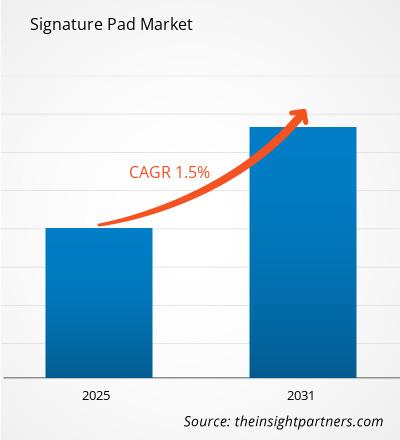
The global Signature Pad Market size was estimated at US$ 469.93 Million in 2025 and will have a value of US$ 836.72 Million by 2034, at a CAGR of 7.48% between 2026 and 2034. The need to capture handwritten signatures digitally while preserving transaction evidence and audit trails has been driving the demand.
The use of signature pads in North America is anticipated to increase at a CAGR of 6.9%–7.3% as banks, healthcare organizations, retailers, and government bodies upgrade their on-site authorization. Signature Pads in North America are boosted by well-established payment systems, stringent document retention procedures, and the need to replace older hardware with more sophisticated systems that provide encrypted signatures, color screen, and better integration with digital document management systems.
Signature Pad Market Assessment and Insights
- North America accounted for 34–36% Signature Pad Market share in 2025 and is forecast to grow at a CAGR between 6.9–7.3% during 2026–2034, led by branch digitization and healthcare consent workflows.
- US represented 78–82% of North America in 2025 and is projected to expand at 6.8–7.2% CAGR, supported by banking, retail, and government authentication needs.
- Europe held 24–26% share in 2025 and should grow at 6.6–7.0% CAGR, with Germany, the UK, France, Italy, and Spain leading adoption.
- Asia Pacific captured 26–28% share in 2025 and is expected to grow at 8.2–8.6% CAGR as China, Japan, South Korea, India, and Australia scale digital service delivery.
- Largest Segment Hardware held 68–72% market share in 2025 and is set to grow at 6.7–7.1% CAGR, reflecting continued enterprise preference for secure physical capture.
- High Growth Segment Healthcare held 17–19% market share in 2025 and is forecast to grow at 8.4–8.8% CAGR, driven by patient consent and EHR-linked authorization.
- Key companies analyzed in detail: Ambir Technology Inc., ELCOM spol. s r.o., ePadLink, Hanvon Technology Co., Ltd., HUION, Olivetti SpA, Scriptel Corporation, Signotec GmbH, Topaz Systems, Inc., Wacom Co., Ltd.
Source: The Insight Partners' analysis based on proprietary research, government publications, company annual reports, investor presentations, industry databases, and expert interviews.
The device progression has evolved from simple black-and-white screens to encryptions, pressure-sensitive capture terminals with better display resolution, and software development kits. Device production is still based on hardware components, but now it requires the use of better firmware security, more stable drivers, and interoperability with document management systems. The vendors need to achieve the right balance between the reliable USB connections and the mobile connections, while the enterprise customers take into account the life-cycle expenses, compliance proof, and effort of integration.
During the forecast period, the procurement will expand beyond the banks to include hospitals, transport offices, insurance offices, and omnichannel retailing service counters. The new markets will be inclined to start using the mid-level devices initially, followed by the color and biometric devices, with the further advancement of digital identification regulations.
Signature Pad Market Report Scope
| Report Attribute | Details |
|---|---|
| Market size in 2025 | US$ 469.93 Million |
| Market Size by 2034 | US$ 836.72 Million |
| Global CAGR (2026 - 2034) | 7.48% |
| Historical Data | 2021-2024 |
| Forecast period | 2026-2034 |
Signature Pad Market Analysis
Demand is driven by businesses that must obtain consent and authorization, and identify themselves at the time of service. Signature Pad Market Demand is highest in areas where traditional paper-based processes involve signature-based activities such as opening accounts, prescribing medicines, filing claims, accepting deliveries, and filling out government documents. The hardware-based signature pad brings an element of evidence through stroke order, pressure, and timing, elements that are not easily achievable in software-based systems.
The industry consists of component providers, device manufacturers, encryption & driver providers, system integrators, payment terminals, and document workflow management systems. The supply side factors affecting this market include display availability, stylus sensor accuracy, security chip availability, and certification. There is an increasing preference among buyers for devices that can be used in multiple applications rather than one-time-use counters.
The level of competitive intensity is medium due to switching costs that arise from reliability, channel coverage, and software compatibility issues. According to the Signature Pad Market analysis, companies like Topaz Systems, Inc., ePadLink, Signotec GmbH, Wacom Co., Ltd., and Scriptel Corporation compete on enterprise integrations, whereas Ambir Technology Inc., ELCOM spol. s r.o., Hanvon Technology Co., Ltd., HUION, and Olivetti SpA meet specific regional and application needs.
The current trend involves investing in color displays, tamper-proof recording features, cloud-friendly device management, and application programming interfaces that enable quick deployments. Positioning strategy requires focusing on regulatory industries rather than generic peripheral volume. Those companies that can synchronize their hardware replacement cycles with electronic health record systems, banking workflows, and public-sector identity solutions are more likely to preserve profit margins.
● REPORT CUSTOMIZATION
Tailor This Report To Align With Your Specific Business Requirements
This report can be customized to align precisely with your business objectives, scope, and target markets. Customization options include tailored segmentation, geography, competitive analysis, and strategic insights to support informed decision-making.
Customize This Report →WHAT YOU CAN ADJUST
- ● Segmentations
- ● Geography
- ● Competitive Analysis
- ● Language Preferences
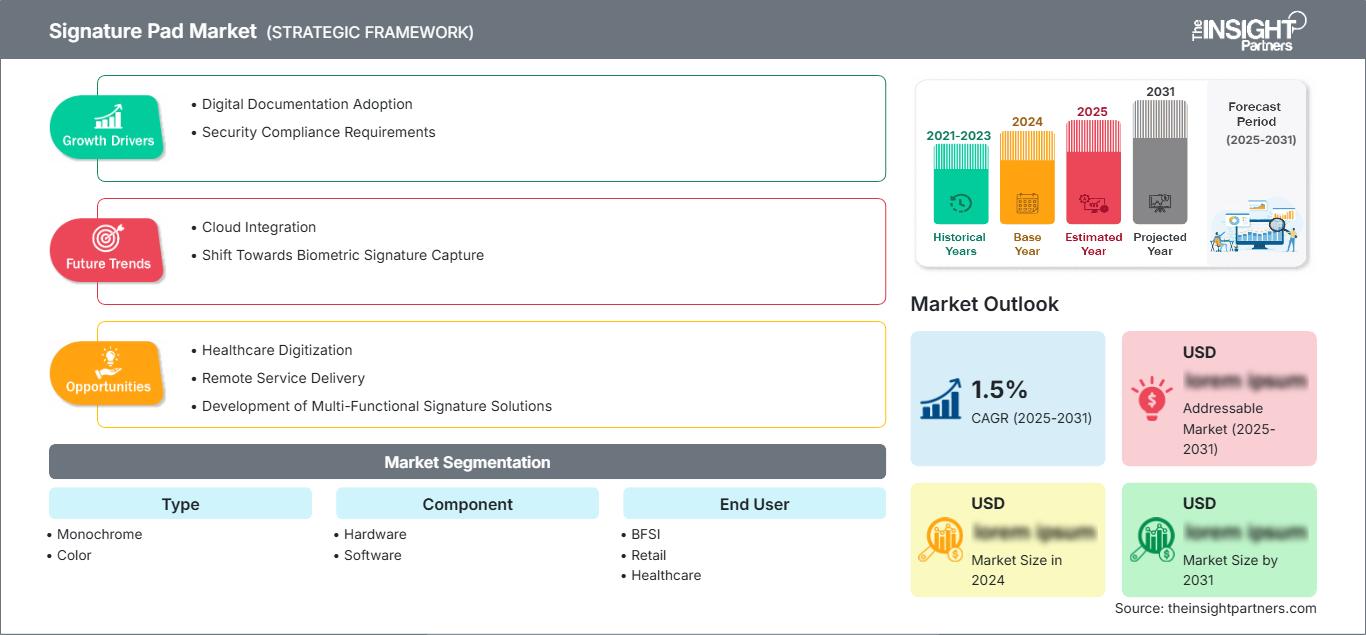
Signature Pad Market: Strategic Insights
Regional Insights
North America Signature Pad Market
In 2025, North America accounted for 34-36% of Signature Pad Market revenue, making it the largest share by region. The projected regional CAGR is 6.9-7.3% in 2026-2034, due to the upgrading of banks' branches, hospitals' adoption of digitalization, and governments' automation initiatives. Though demand is mainly driven by replacements, improvements in color display and encryption technology increase the average selling price.
For enterprises in the region, it is of high importance to have an audit trail of workflow processes, since signatures are usually used for regulated transactions rather than simple confirmations. There is a need for payment networks, insurance companies, pharmacies, and government offices to have peripheral devices compatible with existing terminals and document repositories.
U.S. Signature Pad Market
The United States constituted 78-82% share of North America in 2025 and is expected to witness a CAGR of 6.8-7.2% till 2034. The applications are mainly found in financial departments, healthcare registration counters, retail service counters, and government offices due to the need for handwritten biometric proof to resolve disputes.
Topaz Systems, Inc., ePadLink, Scriptel Corporation, and Ambir Technology Inc. help increase supply and integration capabilities within the country, whereas Wacom Co., Ltd. and Signotec GmbH help with enterprise and specialty implementations. Applications include small and portable USB models in the economical counters, colored tablets for the customers, and software packages with lower IT support needs.
Europe Signature Pad Market
Europe accounted for 24-26% market share in 2025 and is forecast to grow at a 6.6-7.0% CAGR. Germany has seen increased deployment due to the need to verify personal identity in banking, insurance, healthcare, and public administration. The UK will continue to matter for demand for smaller, regulatory-compliant signature terminals, driven by branch transformation and healthcare digitalization initiatives.
France, Italy, and Spain have made contributions through their public service portals, pharmacies, retail banking, and telecommunications customer onboarding. The Europeans emphasize security of data, the longevity of devices, and compatibility with local documents. Competitors include Signotec GmbH, ELCOM spol. s r.o., Olivetti SpA, Wacom Co., Ltd., and ePadLink.
APAC Signature Pad Market
APAC accounted for 26-28% in 2025 and is expected to record the highest regional CAGR of 8.2-8.6%. China is a regional volume leader, whereas Japan and South Korea focus on quality displays and styli technology. India and Australia are digitizing public service delivery, financial inclusion, and medical records, thereby generating years-long requirements for secure signature capture.
Industrial expansion, investments in e-government, and payment innovations are expanding the installed base. Hanvon Technology Co., Ltd., HUION, and Wacom Co., Ltd. enjoy advantages in regional manufacture and display capabilities. Although consumers tend to consider cost-efficiency, banks and hospitals increasingly demand encryption and centralized device management capabilities.
Middle East & Africa Signature Pad Market
Middle East and Africa is projected to grow at 7.5–7.9% CAGR as Saudi Arabia, the UAE, South Africa, and Rest of MEA digitize citizen services, banking branches, healthcare counters, and logistics documentation. Saudi Arabia leads regional opportunity due to public-sector modernization and investment in digital identity infrastructure.
Energy-linked infrastructure programs, airport expansion, and financial inclusion initiatives create demand for tamper-resistant authorization tools. Adoption is uneven because procurement depends on budget cycles and systems integrators, yet government-backed service digitization is pushing banks, hospitals, and utilities toward standardized signing stations.
Segmentation Analysis
Type
Type is expected to grow at 7.1–7.5% CAGR during 2026–2034 as buyers choose between cost-efficient monochrome pads and richer color displays. The Signature Pad Market scope within type is shaped by counter density, transaction complexity, customer-facing use, and the need to show forms, terms, or prompts directly on the device.
- Monochrome remains widely used in high-volume counters where durability, low cost, and simple signature capture matter more than on-screen guidance or branding.
- Color is gaining relevance in healthcare, retail finance, and public services because it can display consent text, transaction prompts, and clearer customer instructions.
Component
Component is forecast to grow at 7.0–7.4% CAGR through 2034, with hardware remaining the main revenue base and software improving device value. Enterprises increasingly evaluate bundled drivers, encryption modules, capture libraries, and fleet management tools alongside device durability, making integrated component strategies more important than standalone peripheral pricing.
- Hardware held 68–72% market share in 2025, supported by physical signing stations, replacement cycles, and regulated workflows requiring dedicated capture devices.
- Software supports authentication, workflow integration, encryption, and device management, becoming a strategic differentiator as enterprises connect pads with broader document platforms.
End User
End User is projected to grow at 7.4–7.8% CAGR as regulated service industries digitize consent, onboarding, and transaction authorization. BFSI remains the largest demand pool, while healthcare is the fastest-growing vertical due to patient consent, prescription authorization, and electronic health record integration across hospitals, clinics, and pharmacies.
- BFSI uses pads for branch onboarding, loan documents, insurance forms, and dispute-resistant approvals, making signature evidence part of secure customer identity workflows.
- Retail demand is linked to point-of-sale authorization, service contracts, returns, financing, and loyalty enrollment where fast counter interactions still need customer confirmation.
- Healthcare is the high-growth segment, with 17–19% market share in 2025, as providers digitize patient consent, admissions, pharmacy receipts, and care documentation.
- Government adoption is tied to citizen service counters, permits, licensing, social benefits, and courts, where auditable handwritten acceptance supports public-record integrity.
Opportunity Snapshot
| End User | Revenue Contribution | Trend Tag | Adoption Stage |
| BFSI | High | Branch ID | Mature |
| Retail | Medium | POS Consent | Scaling |
| Healthcare | Medium | Patient Consent | Scaling |
| Government | Medium | Citizen Forms | Scaling |
| Others | Low | Field Signing | Emerging |
Signature Pad Market Growth Drivers and Impact Analysis
Regulated Digital Consent at Physical Service Points
Organizations continue to engage in numerous valuable engagements via face-to-face engagements despite their move towards digitization in the back office. Banking through branches, admissions to hospitals, dispensing of medicines by pharmacists, claims processing in insurance firms, and issuance of licenses by governments all involve signature processes that have to be linked to particular individuals, documents, times, and transactions. The use of pads enhances the evidentiary value of such engagements, as they record handwriting while reducing reliance on paper scanning and storage. The effect is increased deployment of devices in counter operations that require legal enforcement and user familiarity.
Integration with Enterprise Workflow Platforms
The importance of signing devices increasingly depends on their integration capabilities with document management systems, electronic health records, core banking systems, and POS solutions. Businesses seek to have their signatures captured within business processes, not via files or upload procedures. Signing devices that come with solid SDKs, cross-platform drivers, encryption capabilities, and remote maintenance reduce implementation risk for businesses operating across multiple locations. This changes the purchase process to life-cycle assessment of signing devices. Device manufacturers that will provide integrator assistance, certification, and easy deployment will enjoy renewal benefits, even though their software platform may not be very strong.
Replacement of Paper-Heavy Counter Operations
Paper-heavy service counters create recurring costs through printing, archiving, courier handling, scanning, and dispute retrieval. Signature pads reduce these costs by moving acceptance directly into electronic records at the point of interaction. The benefit is especially visible where transaction volumes are high and staff must process standardized forms quickly. Retail finance, bank branches, hospitals, and public offices can shorten service time while improving record completeness. As organizations measure operational savings alongside compliance value, device refresh budgets become easier to justify, particularly when newer models support clearer prompts and more secure capture than legacy terminals.
Signature Pad Market Future Trends
Biometric-Rich Signature Capture Becomes Standard
Signature Pad Market trends point toward richer biometric datasets becoming a standard requirement in regulated deployments. Future devices will capture not only signature images but also pressure, pen angle, stroke order, speed, and time stamps in more structured formats. This evolution will help banks, insurers, and healthcare providers improve fraud review and dispute resolution without making the signing process unfamiliar to users. Vendors will need to protect biometric data through encryption, access controls, and clear retention rules. The market impact will be a shift from low-cost capture pads toward validated devices that support evidence-grade records.
Device Management Moves to Cloud-Controlled Fleets
Large enterprises will increasingly manage signing devices as connected fleets rather than isolated peripherals. Centralized configuration, firmware updates, diagnostics, and usage monitoring can reduce downtime across branches, clinics, stores, and government offices. This trend will favor vendors offering administrative dashboards, security policy enforcement, and integration with IT asset systems. It may also create recurring software revenue around support, compliance reporting, and device health analytics. Buyers will benefit from lower maintenance effort and clearer visibility into underused or failing units, making total cost of ownership a more decisive purchasing metric.
Signature Pad Market Opportunities
Healthcare Consent Modernization Programs
Hospitals, clinics, pharmacies, and diagnostic networks present a strong opportunity because consent events occur repeatedly across the patient journey. Vendors can target admissions, procedure approvals, prescription collection, insurance forms, and discharge documentation with devices that integrate into electronic health records. The most attractive approach is to package signature capture with workflow templates, audit trails, and privacy controls that fit healthcare compliance teams. Channel partnerships with health IT integrators can shorten sales cycles. Manufacturers that offer washable surfaces, durable stylus designs, and compact footprints can also address clinical counter constraints more effectively.
Public-Sector Counter Digitization in Emerging Markets
Government service counters in emerging markets are moving from paper registers to electronic identity, licensing, tax, welfare, and permit systems. This creates a practical opportunity for rugged, affordable pads that can operate in high-traffic offices and connect with national document platforms. Suppliers should focus on localization, language support, durable hardware, and integrator relationships rather than premium specifications alone. Financing models and bundled maintenance can help agencies standardize devices across districts. Successful deployments can create reference accounts that later expand into utilities, transport offices, courts, and municipal service centers.
Recent Developments
- January 2025: Remote Signature Pad is launched on 1 Jan 2025. The dedicated Remote Signature Pad platform offers a mobile and desktop application that turns your smartphone into a virtual signature pad.
- December 2024: In fall 2024, StepOver introduced a new model to its proven signature pad series: the duraSign Pad 4.3. This modern low-cost model is the direct successor to the long-standing successful naturaSign Pad Mobile and offers numerous improvements, making it stand out from its predecessor both functionally and visually.
- January 2024: StepOver has developed a unique new signature pad that works completely independently and is tailored to the needs of customers and partners. For the first time, communication with the signature pad can take place directly via the network. Hence, the signature pad no longer needs to be connected to a computer – only an Ethernet connection is required. This has the advantage that an unlimited number of users can access the same network device to request signatures.
Frequently Asked Questions

- Comprehensive Market Sizing and Forecast Analysis
- Detailed Segmentation Analysis
- In-Depth Market Dynamics Assessment
- Regional and Country-Level Insights
- Competitive Landscape and Company Benchmarking
- Strategic Business Intelligence
Recent Reports
Testimonials

The Insight Partners' SCADA System Market report is comprehensive, with valuable insights on current trends and future forecasts. The team was highly professional, responsive, and supportive throughout. We are very satisfied and highly recommend their services.
RAN KEDEM Partner, Reali Technologies LTDs
I requested a report on a very specific software market and the team produced the report in a few days. The information was very relevant and well presented. I then requested some changes and additions to the report. The team was again very responsive and I got the final report in less than a week.
JEAN-HERVE JENN Chairman, Future Analytica
We worked with The Insight Partners for an important market study and forecast. They gave us clear insights into opportunities and risks, which helped shape our plans. Their research was easy to use and based on solid data. It helped us make smart, confident decisions. We highly recommend them.
PIYUSH NAGPAL Sr. Vice President, High Beam Global
The Insight Partners delivered insightful, well-structured market research with strong domain expertise. Their team was professional and responsive throughout. The user-friendly website made accessing industry reports seamless. We highly recommend them for reliable, high-quality research services
YUKIHIKO ADACHI CEO, Deep Blue, LLC.
This is the first time I have purchased a market report from The Insight Partners.While I was unsure at first, I visited their web site and felt more comfortable to take the risk and purchase a market report.I am completely satisfied with the quality of the report and customer service. I had several questions and comments with the initial report, but after a couple of dialogs over email with their analyst I believe I have a report that I can use as input to our strategic planning process.Thank you so much for taking the extra time and making this a positive experience.I will definitely recommend your service to others and you will be my first call when we need further market data.
JOHN SUZUKI President and Chief Executive Officer, Board Director, BK Technologies
I wish to appreciate your support and the professionalism you displayed in the course of attending to my request for information regarding to infectious disease IVD market in Nigeria. I appreciate your patience, your guidance, and the fact that you were willing to offer a discount, which eventually made it possible for us to close a deal. I look forward to engaging The Insight Partners in the future, all thanks to the impression you have created in me as a result of this first encounter.
DR CHIJIOKE ONYIA MANAGING DIRECTOR, PineCrest Healthcare Ltd.Reason to Buy
- Informed Decision-Making
- Understanding Market Dynamics
- Competitive Analysis
- Identifying Emerging Markets
- Customer Insights
- Market Forecasts
- Risk Mitigation
- Boosting Operational Efficiency
- Strategic Planning
- Investment Justification
- Tracking Industry Innovations
- Aligning with Regulatory Trends





 Get Free Sample for