
Dynamic Signature Market Size, Growth & Demand by 2034
Coverage: By Component (Hardware, Software); Application (Transactional Authentication, Wireless Device Security, Other Applications); Vertical (BFSI, Real Estate, Automotive, Healthcare, IT and Telecommunication, Retail, Others) , and Geography (North America, Europe, Asia Pacific, and South and Central America)
- Status : Data Released
- Report Code : TIPRE00021746
- Category : Electronics and Semiconductor
- No. of Pages : 150
- Available Report Formats :


- Last update date : August 11, 2026


2025 Market Size
US$ 1.38 Bn
Base year value
2034 Forecast
US$ 3.55 Bn
Projected by 2034
CAGR 2026-2034
11.07 %
Growth rate
Addressable Market
US$ 21.77 Bn
(2026-2034)
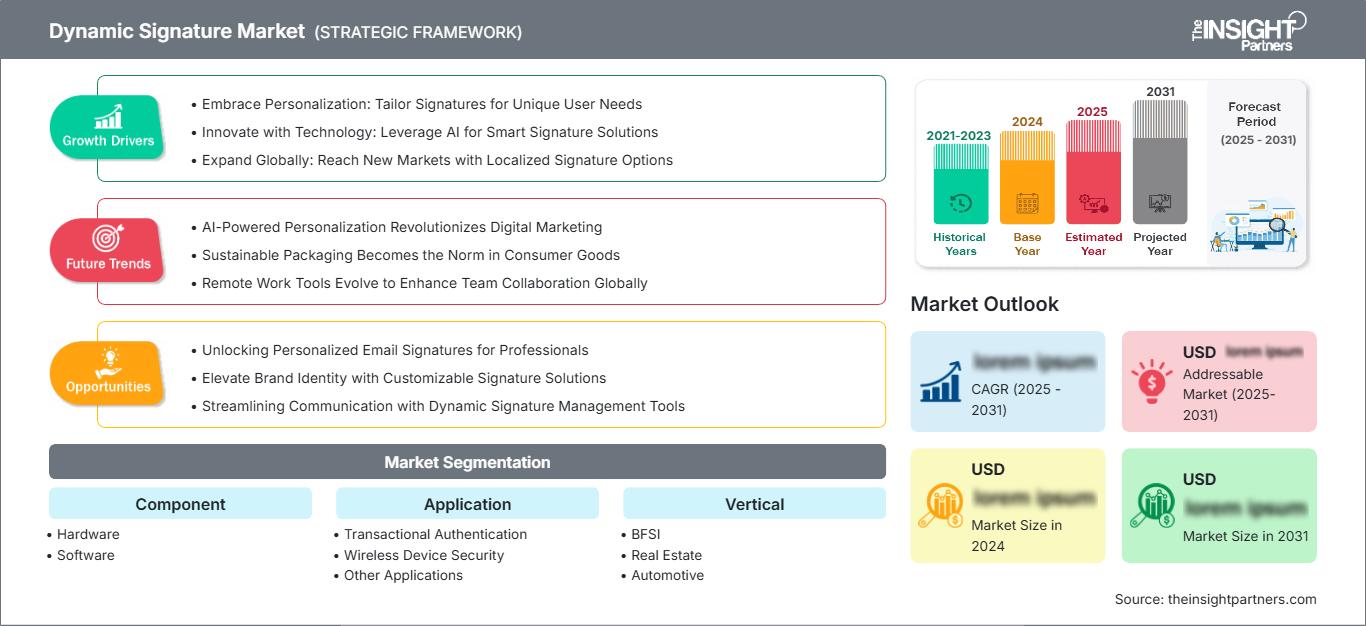
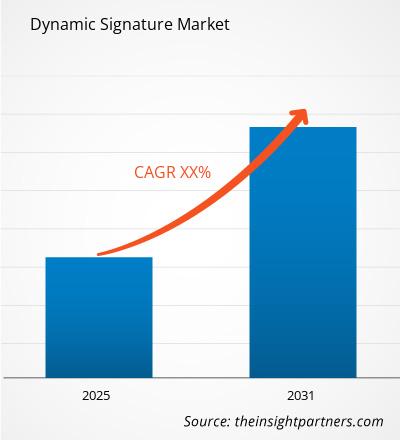
The Dynamic Signature market was valued at US$ 1.38 billion in 2025 and is expected to reach US$ 3.55 billion by 2034; it is estimated to record a CAGR of 11.07% during 2026-2034.
Dynamic Signature Market Assessment and Insights
- North America: holds a market share of 34-38% in 2025, growing at a CAGR of 11-13% during 2026-2034. Growth driven by advanced digital infrastructure, stringent regulatory frameworks, and high adoption of biometric authentication solutions across BFSI and healthcare sectors.
- US: accounts for 78-82% of the North American market in 2025, growing at a CAGR of 11-13% during 2026-2034. The market is supported by the presence of key technology providers and strong demand from financial institutions for fraud prevention solutions.
- Europe: accounts for 24-28% market share in 2025, growing at a CAGR of 11.5-13.5% during 2026-2034. Leading countries include Germany, the UK, and France, driven by stringent data protection regulations and digital transformation initiatives in banking and government sectors.
- Asia Pacific: accounts for 22-26% market share in 2025, growing at the highest CAGR of 14.5-16.5% during 2026-2034. Leading countries include China, Japan, India, and Australia, driven by rapid digitalization, rising e-commerce adoption, and government initiatives promoting digital identity frameworks.
- Largest Segment (Component – Software): holds a market share of 62-66% in 2025, with a CAGR of 13-14.5% during 2026-2034. Software dominance is driven by flexibility, scalability, and seamless integration with existing digital systems across various industries.
- High Growth Segment (Application – Wireless Device Security): accounts for 18-22% market share in 2025, with a CAGR of 16-18% during 2026-2034. Growth is fueled by the proliferation of mobile devices and increasing adoption of mobile banking and digital signatures.
- Key companies analyzed in detail: ARGO Data Resource Corporation, Communication Intelligence Corporation, Cyber SIGN Inc, Dynamic Biometric Systems Inc, Parascript LLC, ProgressSoft Corporation, SOFTPRO GmbH, SQN Banking Systems, WonderNet Ltd, ACECAD Enterprise Co. Ltd.
Source: The Insight Partners' analysis based on proprietary research, government publications, company annual reports, investor presentations, industry databases, and expert interviews.
The market is witnessing rapid changes owing to technological advancements and change in production dynamics. The use of static signatures is gradually making way for dynamic signatures which are being used as behavioral biometric data. With the help of advanced technologies such as AI and ML algorithms, there has been a remarkable improvement in fraud detection capabilities, thus leading to real-time verification of identities in banking, legal, and government industries. There will be an increasing demand for companies to deploy dynamic signatures in their digital identity management process in the near future.
There will be significant growth in the market in the coming years, especially from emerging economies. Increasing cloud infrastructure investment and mobile-first solutions will boost the adoption of the solution among SMEs. Favorable regulations, including those in Europe and APAC with eIDAS regulations and digital identity policies respectively, will support market growth.
Dynamic Signature Market Report Scope
| Report Attribute | Details |
|---|---|
| Market size in 2025 | US$ 1.38 Billion |
| Market Size by 2034 | US$ 3.55 Billion |
| Global CAGR (2026 - 2034) | 11.07% |
| Historical Data | 2021-2024 |
| Forecast period | 2026-2034 |
Dynamic Signature Market Analysis
The Dynamic Signature Market growth is being driven by the rising instances of identity fraud and data theft in the industry. Companies have been putting in substantial investments in secure authentication systems in order to ensure that their information is safe and they are compliant with all regulations. The value chain of the market includes hardware suppliers, software providers, systems integrators, and end users who are operating in BFSI, healthcare, government, and retail segments. In terms of supply, the industry has seen a trend of moving toward software as a service models.
Competitive environment in the Dynamic Signature Market Report consists of established technology companies and biometric solution providers. The firms like ARGO Data Resource Corporation, Communication Intelligence Corporation, and Cyber SIGN Inc are concentrating their efforts on development of intelligent solutions that offer more accurate and convenient services to users. Financial analysis demonstrates increased R&D spending in behavioral biometrics and mobile authentication solutions. Positioning strategies include provision of integrated solutions by combining dynamic signature with other authentication options, including multi-factor authentication. Collaboration between technology providers and financial organizations becomes quite frequent practice allowing for integration of dynamic signature solutions in financial systems.
● REPORT CUSTOMIZATION
Tailor This Report To Align With Your Specific Business Requirements
This report can be customized to align precisely with your business objectives, scope, and target markets. Customization options include tailored segmentation, geography, competitive analysis, and strategic insights to support informed decision-making.
Customize This Report →WHAT YOU CAN ADJUST
- ● Segmentations
- ● Geography
- ● Competitive Analysis
- ● Language Preferences
Dynamic Signature Market: Strategic Insights
Regional Insights
North America Dynamic Signature Market
North America dominates the Dynamic Signature Market share with 34-38% share in 2025 due to the presence of a technologically advanced ecosystem and early adoption of solutions related to biometric authentication. This region has strict regulation such as the ESIGN Act and data privacy acts by states ensuring security during digital transactions. There is the presence of major banks and technology providers that contribute to the creation of demand for dynamic signatures. Identity theft has increased in the region and as such, companies have resorted to investing in advanced technology for verification. The increase in digital transformation projects in health care and government sectors also propels the growth of the market due to need for document authentication. The region is expected to dominate the market and will grow at a CAGR of 11-13%.
U.S. Dynamic Signature Market
The market share of the U.S. in the North American Dynamic Signature Market stands between 78-82%, with a global market share estimated at 28-32% for 2025, owing to the availability of major players such as ARGO Data Resource Corporation and Parascript LLC along with the extensive use of digital banking and e-commerce platforms. Major demand is seen in the BFSI segment due to the use of the dynamic signature technology in transactions to verify transactions and prevent frauds. The healthcare segment is another area where the technology has been used because of the requirement of identity verification and electronic health records. It is expected to grow at a CAGR of 11-13% in the period of 2026-2034 due to constant innovation and awareness regarding biometric authentication.
Europe Dynamic Signature Market
The Europe market has a CAGR of 11.5-13.5% during 2026-2034 to become 24-28% of the global market in 2025 due to strict regulatory measures in terms of protecting personal data in Europe such as GDPR and eIDAS, which include the requirement for using reliable solutions for secure digital identity verification for any transaction. The UK market has a large share (18-22%) due to its well-developed financial services industry and the development of the digital identity market encouraged by the government. The German market has a large share of 16-20% due to the well-developed manufacturing and automotive industry. In addition, France, Italy, and Spain together have a share of 25-30%.
APAC Dynamic Signature Market
The Asia-Pacific region is the highest growing region with a market share of 22-26% in 2025 and CAGR of 14.5-16.5% from 2026-2034. China dominates the market in the region owing to digitalization and government backing of digital identity systems. India and Southeastern Asian countries are gaining importance in the region with increased use of smartphones and digital payments. Growth in the Japanese market is facilitated due to high technology and cybersecurity focus. The Australian market shows high adoption in banking and government sectors. Growth in the region is driven by industrialization, policies for digital transformation, and recognition of benefits of biometric authentication.
Middle East & Africa Dynamic Signature Market
Middle East & Africa is an emerging market that exhibits great potential for growth, with a CAGR of 12-14% between 2026-2034. Saudi Arabia is leading the market owing to the implementation of Vision 2030 program focused on digital transformation in government and finance sectors. The UAE comes next owing to good adoption of biometrics in banking and real estate sectors. South Africa is the biggest market in Africa, fueled by the adoption of digital banking. Market growth in this region is due to developments in infrastructure and energy sectors as well as government programs targeted at improving identity verification through biometrics.
Segmentation Analysis
Component
The Market is segmented into Hardware and Software. The Software segment dominates with a share of 62-66% in 2025, growing at a CAGR of 13-14.5% during 2026-2034. Software solutions offer flexibility, scalability, and seamless integration with existing digital systems, making them the preferred choice across industries. The increasing adoption of cloud-based delivery models is further driving software segment growth.
- Hardware: This segment includes signature capture devices such as digital pens, tablets, and touch-sensitive screens used for capturing biometric signature data. Demand is driven by the need for accurate data capture in high-security environments such as banking branches and government offices.
- Software: This segment includes dynamic signature verification solutions, authentication platforms, and integration tools. The dominance is driven by the flexibility to deploy on-premise or cloud-based models, continuous updates, and integration capabilities with existing enterprise systems.
Application
The market is segmented into Transactional Authentication, Wireless Device Security, and Other Applications. The Wireless Device Security segment is the high growth segment, reflecting the increasing adoption of mobile devices for financial transactions and digital signatures.
- Transactional Authentication: This segment involves using dynamic signatures to authorize financial transactions, legal documents, and contracts. It remains the largest application area, driven by stringent regulatory requirements in banking and financial services.
- Wireless Device Security: This segment focuses on securing mobile transactions and accessing enterprise systems through dynamic signature verification. Growth is fueled by the proliferation of mobile banking, BYOD policies, and the need for secure remote access to corporate resources.
- Other Applications: This segment includes identity verification for government services, healthcare patient identification, and educational certificate authentication.
Vertical
The market is segmented into BFSI, Real Estate, Automotive, Healthcare, IT and Telecommunication, and Retail. BFSI is the largest vertical, driven by the critical need for fraud prevention and regulatory compliance in financial transactions.
- BFSI: The largest vertical, driven by the need for secure transaction authentication, account opening, and contract signing in banking and insurance. Adoption is accelerated by increasing financial fraud and stringent KYC norms.
- Real Estate: Dynamic signatures are used for property purchase agreements, lease contracts, and mortgage documentation. Growth is driven by the digitalization of property transactions and remote dealing.
- Automotive: Used for vehicle purchase agreements, financing documentation, and warranty registrations. Adoption is supported by the shift towards online vehicle sales platforms.
- Healthcare: Dynamic signatures are employed for patient consent forms, medical records authentication, and insurance claims processing. Growth is driven by digital health initiatives and data privacy requirements.
- IT and Telecommunication: Used for service contracts, network access authentication, and customer onboarding. The sector's digital-first nature drives early adoption of advanced verification technologies.
- Retail: Dynamic signatures are used for online order confirmations, loyalty program enrollments, and payment authorizations. Growth is fueled by the rapid expansion of e-commerce and need for seamless checkout experiences.
Opportunity Snapshot
| Segment Name | Revenue Contribution | Trend Tag | Adoption Stage |
| Transactional Authentication | High | Secure Transactions | Mature |
| Wireless Device Security | High | Mobile Security | Scaling |
| Other Applications | Medium | Identity Verification | Emerging |
Dynamic Signature Market Growth Drivers and Impact Analysis
Increasing Incidence of Identity Fraud and Data Breaches
The rising number of identity fraud cases and data breaches across industries is a primary driver for the market. Organizations face significant financial losses due to fraudulent transactions and identity theft, prompting investment in robust authentication solutions. Dynamic signature technology provides enhanced security by capturing behavioral biometrics that are difficult to replicate, making it an effective tool against forgery. The growing sophistication of cyber threats has made traditional verification methods inadequate, accelerating the adoption of dynamic signature solutions across BFSI, healthcare, and government sectors where data sensitivity is paramount.
Stringent Regulatory Frameworks for Identity Verification
Regulatory bodies worldwide are implementing stricter identity verification standards to combat fraud and ensure secure digital transactions. Regulations such as the eIDAS in Europe, ESIGN Act in the US, and various data protection laws mandate secure authentication methods for financial and legal processes. These regulations drive organizations to adopt dynamic signature solutions to ensure compliance and avoid penalties. The regulatory push is particularly strong in the BFSI and healthcare sectors, where identity verification is critical for patient safety and financial integrity.
Digital Transformation and Remote Work Trends
The accelerated digital transformation across industries and the shift towards remote work models have created an urgent need for secure remote identity verification solutions. Dynamic signature technology enables organizations to authenticate documents and transactions without physical presence, supporting business continuity and operational efficiency. The growing adoption of digital banking, e-commerce, and online government services has increased the demand for reliable authentication methods. This trend is expected to continue as organizations prioritize digital-first strategies and remote work becomes a permanent feature of the business landscape.
Dynamic Signature Market Future Trends
Integration of Artificial Intelligence and Machine Learning
The integration of AI and ML algorithms into dynamic signature verification systems is enhancing accuracy and reducing false rejection rates. These technologies enable systems to learn from signature patterns, adapt to natural variations in signing behavior, and detect even sophisticated forgery attempts. AI-powered solutions can analyze behavioral biometrics in real-time, providing instant verification while improving user experience. This trend is expected to accelerate adoption across sectors that require high-volume transaction authentication, such as banking, e-commerce, and government services. The ongoing development of neural network-based verification systems will further enhance market capabilities.
Cloud-Based Deployment Models
The shift towards cloud-based deployment models is transforming the dynamic signature market by offering scalability, remote accessibility, and cost efficiency. Cloud solutions eliminate the need for significant upfront infrastructure investment, making dynamic signature technology accessible to smaller organizations. This trend is particularly relevant for SMEs that require robust authentication solutions but have limited IT resources. Cloud-based systems also facilitate easier updates and integration with other digital services, supporting the broader trend of digital transformation. The adoption of Software-as-a-Service models is expected to accelerate market growth globally.
Dynamic Signature Market Opportunities
Emerging Applications in IoT and Connected Devices
The proliferation of Internet of Things (IoT) devices and connected systems presents significant opportunities for dynamic signature technology. Smart home systems, connected vehicles, and industrial IoT applications require secure user authentication to prevent unauthorized access. Dynamic signatures can provide a convenient and secure method for device authentication, particularly in scenarios where traditional passwords are impractical. The opportunity lies in developing lightweight dynamic signature solutions optimized for resource-constrained IoT devices, enabling their integration into a wide range of connected applications across automotive, healthcare, and smart city sectors.
Expansion in Developing Economies
Developing economies in Asia Pacific, Latin America, and Africa present substantial growth opportunities due to rapid digitalization and increasing adoption of digital payment systems. The growing middle class and expanding internet connectivity are driving demand for secure digital services, creating a need for robust identity verification solutions. Governments in these regions are investing in digital identity infrastructure, presenting opportunities for dynamic signature technology providers. The opportunity lies in developing affordable, mobile-first solutions that can operate effectively in regions with limited technological infrastructure.
Recent Developments
- July 2026: Dynamic Aerospace Systems and Flightbox, Inc. announced a strategic collaboration to develop autonomous medical drone logistics solutions for healthcare, government, emergency response, and commercial markets. The partnership will integrate Flightbox’s secure autonomous logistics and digital chain-of-custody platform with Dynamic Aerospace Systems’ US-1 long-endurance electric logistics drone and G1 hybrid VTOL aircraft to enable secure, trackable transportation of medical supplies, pharmaceuticals, laboratory samples, and other time-sensitive payloads. The collaboration aims to improve healthcare access in rural and underserved areas, enhance logistics efficiency, and create scalable autonomous delivery networks with real-time monitoring, authenticated access, and regulatory compliance capabilities.
- June 2025: DocuSign announced the launch of six new personalized electronic signature styles to celebrate the 25th anniversary of the U.S. ESIGN Act, which established the legal validity of electronic signatures. Designed in collaboration with typeface designers Libbie Bischoff and Lynne Yun, the new signature options allow users to add more personal expression to digital agreements while maintaining DocuSign’s focus on secure, fast, and reliable e-signature experiences. The new styles include options such as “The Curator,” “The Letter Writer,” “The Overachiever,” “The Party Starter,” “The Renaissance Soul,” and “The Vintage Enthusiast,” reflecting different personalities and signature preferences.
- March 2026: Esquire Financial Holdings, Inc. announced a definitive agreement to acquire Signature Bancorporation Inc., the parent company of Signature Bank, in an all-stock transaction valued at approximately $348.4 million. The acquisition expands Esquire’s presence into the Chicago commercial banking market, strengthens its national banking verticals, enhances its litigation-focused banking platform, and combines Esquire’s specialized financial services expertise with Signature’s established commercial banking franchise. Upon completion, the combined company is expected to have approximately $4.8 billion in assets, creating a larger platform for growth and diversification
Frequently Asked Questions

- Comprehensive Market Sizing and Forecast Analysis
- Detailed Segmentation Analysis
- In-Depth Market Dynamics Assessment
- Regional and Country-Level Insights
- Competitive Landscape and Company Benchmarking
- Strategic Business Intelligence
Recent Reports
Testimonials

The Insight Partners' SCADA System Market report is comprehensive, with valuable insights on current trends and future forecasts. The team was highly professional, responsive, and supportive throughout. We are very satisfied and highly recommend their services.
RAN KEDEM Partner, Reali Technologies LTDs
I requested a report on a very specific software market and the team produced the report in a few days. The information was very relevant and well presented. I then requested some changes and additions to the report. The team was again very responsive and I got the final report in less than a week.
JEAN-HERVE JENN Chairman, Future Analytica
We worked with The Insight Partners for an important market study and forecast. They gave us clear insights into opportunities and risks, which helped shape our plans. Their research was easy to use and based on solid data. It helped us make smart, confident decisions. We highly recommend them.
PIYUSH NAGPAL Sr. Vice President, High Beam Global
The Insight Partners delivered insightful, well-structured market research with strong domain expertise. Their team was professional and responsive throughout. The user-friendly website made accessing industry reports seamless. We highly recommend them for reliable, high-quality research services
YUKIHIKO ADACHI CEO, Deep Blue, LLC.
This is the first time I have purchased a market report from The Insight Partners.While I was unsure at first, I visited their web site and felt more comfortable to take the risk and purchase a market report.I am completely satisfied with the quality of the report and customer service. I had several questions and comments with the initial report, but after a couple of dialogs over email with their analyst I believe I have a report that I can use as input to our strategic planning process.Thank you so much for taking the extra time and making this a positive experience.I will definitely recommend your service to others and you will be my first call when we need further market data.
JOHN SUZUKI President and Chief Executive Officer, Board Director, BK Technologies
I wish to appreciate your support and the professionalism you displayed in the course of attending to my request for information regarding to infectious disease IVD market in Nigeria. I appreciate your patience, your guidance, and the fact that you were willing to offer a discount, which eventually made it possible for us to close a deal. I look forward to engaging The Insight Partners in the future, all thanks to the impression you have created in me as a result of this first encounter.
DR CHIJIOKE ONYIA MANAGING DIRECTOR, PineCrest Healthcare Ltd.Reason to Buy
- Informed Decision-Making
- Understanding Market Dynamics
- Competitive Analysis
- Identifying Emerging Markets
- Customer Insights
- Market Forecasts
- Risk Mitigation
- Boosting Operational Efficiency
- Strategic Planning
- Investment Justification
- Tracking Industry Innovations
- Aligning with Regulatory Trends





 Get Free Sample for