
Smart Bottle Market Size, Share & Growth by 2034
Coverage: By Material (Glass, Flexible Films, Stainless Steel, Plastic); Technology (Lights, Sensors); Application (Water, Alcohol, Pharmaceutical) , and Geography (North America, Europe, Asia Pacific, and South and Central America)
- Status : Data Released
- Report Code : TIPTE100001188
- Category : Electronics and Semiconductor
- No. of Pages : 150
- Available Report Formats :


- Last update date : July 31, 2026


2025 Market Size
US$ 2.74 Bn
Base year value
2034 Forecast
US$ 10.13 Bn
Projected by 2034
CAGR 2026-2034
15.64 %
Growth rate
Addressable Market
US$ 54.66 Bn
(2026-2034)
The Smart Bottle Market size is expected to grow from US$ 2.74 Billion in 2025 to US$ 10.13 Billion in 2034, growing at a CAGR of 15.64% during 2026–2034. This growth can be attributed to increased commercialization and adoption of connected hydration solutions, sensor-packaging, and wellness accessories in different consumer use cases, healthcare and beverage segments.
The North America region continues to be an important revenue market owing to the presence of key driving factors such as adoption of smart bottles due to the adoption of fitness culture and premium drinkware among consumers and availability of robust digital health ecosystems in the region. Growth in the region is anticipated at a CAGR of 13.8–14.6% during 2026–2034 as connected wellness devices gain more traction on the retail front via e-commerce portals, specialty retail, and corporate wellness programs.
Smart Bottle Market Assessment and Insights
- North America held 34–36% share in 2025 and is growing at a CAGR range of 13.8–14.6% during 2026–2034, supported by smart device penetration, sports hydration demand, and premium reusable bottle purchasing.
- US represented 78–82% of North America in 2025 and is growing at 13.6–14.4% CAGR during 2026–2034, led by app-enabled hydration products and retail availability.
- Europe accounted for 24–27% share in 2025 and is expanding at 12.8–13.6% CAGR during 2026–2034, with the UK, Germany, and France leading adoption through sustainability-led drinkware replacement.
- Asia Pacific captured 22–25% share in 2025 and is growing at 16.8–17.6% CAGR during 2026–2034, driven by China, Japan, South Korea, India, and Australia.
- Largest Segment Plastic held 38–42% market share in 2025 and is growing at 13.4–14.2% CAGR during 2026–2034 due to affordability and lightweight consumer formats.
- High Growth Segment Sensors held 56–60% of the smart bottle market share in 2025 and is growing at 16.2–17.0% CAGR during 2026–2034 as sip tracking and mobile synchronization improve utility.
- Key companies analyzed in detail: Koninklijke Philips N.V., REBO, Ecomo Inc., Hidrate Inc., Prozis.com, S.A., EQUA, Water.io LTD, Groking Lab Limited, Thermos L.L.C., Smart Bottle Inc.
Source: The Insight Partners' analysis based on proprietary research, government publications, company annual reports, investor presentations, industry databases, and expert interviews.
Technology migrations are driving the development of the Smart Bottle Market by moving away from basic light reminder devices to hydration tracking, temperature regulation, sterilization, and package technology. Changes in production models are also happening through a combination of stainless-steel bottle bodies, affordable plastic, chargeable caps and sensors. Meanwhile, contract manufacturers have become concerned with battery safety, water-proofing of electronics, and compatibility with applications, whereas beverage and wellness companies are investigating bottle devices as ways to engage consumers on an ongoing basis.
Future developments in the market are expected in urban Asia, premium Europe, and connected healthcare distribution channels where the monitoring of hydration can be used for preventive medicine, medicine consumption monitoring, and corporate wellness programs. Concerns around single-use plastics by regulatory bodies are improving the economics of reusable bottles, whereas investments in UV-C cleaning, near-field communications, and low-power sensors are creating new product opportunities.
Smart Bottle Market Report Scope
| Report Attribute | Details |
|---|---|
| Market size in 2025 | US$ 2.74 Billion |
| Market Size by 2034 | US$ 10.13 Billion |
| Global CAGR (2026 - 2034) | 15.64% |
| Historical Data | 2021-2024 |
| Forecast period | 2026-2034 |
Smart Bottle Market Analysis
The Smart Bottle Market Growth is occurring due to consumer desire for hydration tracking without having to wear yet another wearable tech gadget. Consumers in regions where fitness apps, corporate wellness programs, and reusable bottles are already present are the most eager users. Applications involving water are the predominant type in terms of volumes; however, applications for alcohol and drugs are growing in importance as brands need temperature proofing, anti-counterfeiting capabilities, and interactive packaging.
Supply is limited by more than just the process of bottle production. Supply is limited by precision of sensors, waterproofing, energy provision, and data integration. Those brands that will succeed at standardizing components will be able to grow faster, because lid electronics will play an important role in profitability, warranties, and customer satisfaction.
Smart Bottle Market Report reveals a competitive market landscape featuring competition based on consumer electronics companies specializing in hydration solutions versus drinkware innovations. Among these, Koninklijke Philips N.V. focuses on UV-C disinfection and filtration-based hydration, Hidrate Inc. focuses on sip tracking and reminder apps, Thermos L.L.C. maintains its reputation in terms of insulated drinkware, while Water.io LTD focuses on smart packaging of beverages and pharmaceuticals.
The importance of designing rechargeable lids, strong stainless steel water bottles, direct selling, and building loyalty through data analysis is increasing. REBO, EQUA, Ecomo Inc., Groking Lab Limited, Prozis.com, S.A., and Smart Bottle Inc. compete by virtue of their design and sustainability, as well as consumer engagement. Strategic positioning will require balancing expensive prices, good battery performance, hygiene benefits, and hydration outcomes.
● REPORT CUSTOMIZATION
Tailor This Report To Align With Your Specific Business Requirements
This report can be customized to align precisely with your business objectives, scope, and target markets. Customization options include tailored segmentation, geography, competitive analysis, and strategic insights to support informed decision-making.
Customize This Report →WHAT YOU CAN ADJUST
- ● Segmentations
- ● Geography
- ● Competitive Analysis
- ● Language Preferences
Smart Bottle Market: Strategic Insights
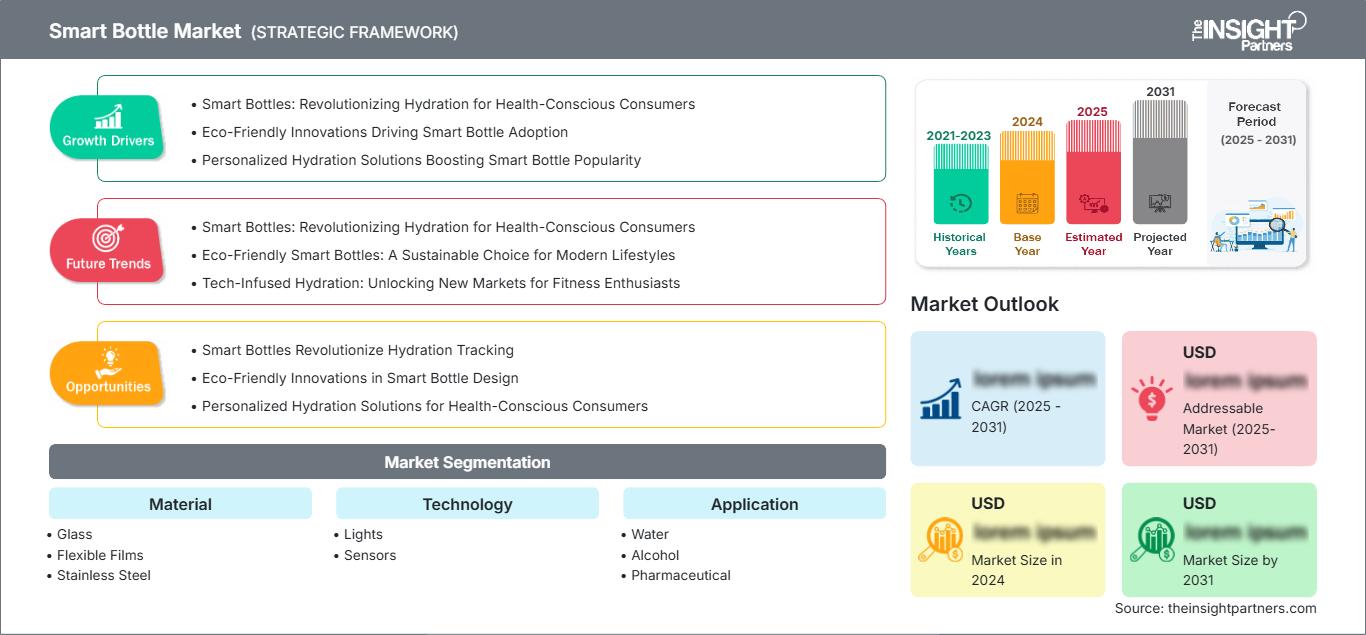
Regional Insights
North America Smart Bottle Market
North America had market share in the range of 34-36% in 2025, and is expected to grow at a CAGR of 13.8-14.6% during 2026-2034. Adoption is driven by factors such as connected fitness trends, buying of premium reusable bottles, and easy availability online. Hydration reminders, UV-C sanitizing and monitoring through applications are particularly relevant for commuters, gym-goers, and health-conscious households.
Factors aiding regional adoption include awareness about the issue of dehydration in healthcare, workplace wellness initiatives, and retail systems that enable connected accessories. The growth in adoption of Smart Bottles is being fueled by premium models made out of stainless steel and budget models made out of plastic. The presence of mature smartphone ecosystem in the region facilitates the adoption process, as consumers prefer using reusable bottles.
U.S. Smart Bottle Market
In 2025, the U.S. constituted 78%-82% of North America and is expected to have a CAGR of 13.6%-14.4% during 2026-2034. Smart hydration companies enjoy the advantage of nationwide availability through e-commerce platforms, app stores, and electronic stores' partnerships. Consumer needs are focused on the application of water, wherein sip tracking and reminders offer instantaneous benefits.
The company presence is widespread with Hidrate Inc., Thermos L.L.C., Smart Bottle Inc., and GoZero products linked to Philips providing visibility in the market. There are applications in the pharmaceutical industry where dose timing and hydration alerts can assist the patients' regimen. The use of alcohol in smart hydration is rare but pertinent for premium packaging and authentication.
Europe Smart Bottle Market
In 2025, Europe held 24-27% market share, and is projected to exhibit a CAGR of 12.8-13.6% during 2026-2034. UK dominates regional implementation with lifestyle retailing and wellness buying by companies. Germany is the second largest owing to its sustainability-driven need for reusable drinking vessels that can be of stainless steel and have sensor capabilities.
Other countries such as France, Italy, and Spain drive the market through outdoor activities, commuting, and aesthetic bottles. Regulatory push towards reusing and reduced use of plastics by consumers drive purchase intentions. Penetration of Smart Bottle Market continues to be in the premium end, but smart lids, hygiene claims, and aesthetic bottles are attracting other consumers.
APAC Smart Bottle Market
Asia Pacific had 22-25% market share in 2025 and is growing at a CAGR of 16.8-17.6% from 2026-2034. Leading Asia Pacific nations like China excel in production and digital buying habits whereas Japan and South Korea prefer premium insulated bottles and electronics-based bottles. India and Australia contribute towards growth by means of fitness enthusiasts, metropolitan professionals, and environmental consumers.
Industry drivers include regional electronics manufacturing, app development skills, and adaptable manufacturing for own brand products. Policies against plastic disposables encourage usage of reusable bottles in metropolitan cities. Smart Bottle Market would witness quick diversification in APAC due to localizing of material, lid with sensors, and retail partners.
Middle East & Africa Smart Bottle Market
Growth projections for MEA during 2026 to 2034 range between 11.2% and 12.0% CAGR, and the drivers include the UAE and Saudi Arabia. Smart insulated bottles appeal in hot climate, tourism facilities, luxury retail and health-conscious urban residents. The contribution from South Africa includes outdoor, sports and specialty retail channels.
Both energy and infrastructure become important due to the reliance of smart bottles on recharging devices and consumer preference to pay for quality products. The adoption is at an early stage in other parts of MEA, yet airport retail, hospitality, and premium wellness venues can help speed up the uptake of connected bottles.Europe accounted for 24–27% share in 2025 and is expected to record a 12.8–13.6% CAGR during 2026–2034. The UK leads regional adoption through premium lifestyle retail and corporate wellness procurement. Germany follows with sustainability-focused reusable drinkware demand, while strong engineering preferences support durable stainless steel and sensor-enabled formats.
Segmentation Analysis
Material
Material is forecast to grow at a 14.0–14.8% CAGR during 2026–2034 as brands balance durability, recyclability, price, and sensor integration. The Smart Bottle Market scope across material choices is shaped by premium stainless steel demand, lightweight plastic affordability, glass hygiene perception, and flexible films for connected packaging applications in beverages and pharmaceuticals.
- Glass appeals to premium wellness and pharmaceutical users seeking taste neutrality, visibility, and hygiene cues, though breakage risk keeps adoption selective in travel and sports settings.
- Flexible Films serve connected packaging use cases where labels, pouches, or interactive surfaces can support authentication, temperature indication, and consumer engagement without rigid bottle redesign.
- Stainless Steel remains strategically important for premium reusable bottles, insulation performance, and long service life, particularly where consumers value durability, cold retention, and reduced disposable packaging.
- Plastic leads mass-market accessibility through lightweight design and lower cost, making it suitable for entry-level smart hydration products, kids’ bottles, sports formats, and promotional programs.
Technology
Technology is expected to advance at a 15.8–16.6% CAGR during 2026–2034 as smart lids become the main differentiator. Sensors capture drinking events, temperature, or fill levels, while lights translate data into immediate behavior cues. The Smart Bottle Market increasingly depends on low-power electronics that survive washing, travel, and repeated charging cycles.
- Lights remain a simple, visible reminder technology, helping users respond without opening an app and supporting lower-cost models aimed at everyday hydration behavior change.
- Sensors are the strategic core of premium products, enabling sip recognition, temperature monitoring, app synchronization, and potential healthcare or pharmaceutical adherence functions.
Application
Application is projected to grow at a 15.0–15.8% CAGR during 2026–2034 as smart bottles move from personal water tracking into broader liquid intelligence. Water dominates adoption because use frequency is daily, while alcohol and pharmaceutical applications create value through authentication, temperature assurance, refill reminders, and brand interaction.
- Water remains the core application because hydration reminders, intake tracking, purification, and insulation provide immediate consumer benefits across fitness, commuting, school, workplace, and travel routines.
- Alcohol uses connected features selectively for premium gifting, product authentication, temperature cues, and consumer engagement, with higher relevance in spirits, wine, and experiential packaging.
- Pharmaceutical applications are strategically important where reminders, dose-linked hydration cues, tamper evidence, and cold-chain or temperature monitoring can support adherence and product integrity.
Opportunity Snapshot
| Application | Revenue Contribution | Trend Tag | Adoption Stage |
| Water | High | Hydration Apps | Scaling |
| Alcohol | Low | Smart Labels | Emerging |
| Pharmaceutical | Medium | Adherence Cues | Emerging |
Smart Bottle Market Growth Drivers and Impact Analysis
Connected Wellness Becomes Everyday Consumer Behavior
Measurement of health parameters using smartphones has made the measurement of sleeping, number of steps taken, calories burned, and hydration common practices, providing greater value for smart bottles. This trend has real-world implications, such as reminding people when they need to take action, and for brands, gathering information on the use of their products in an anonymous way that helps them design better products. This trend makes repeat purchasing possible through the comparison of accuracy, battery life, ease of use, and materials used. It has shifted the nature of competition away from just the looks of containers to their results.
Reusable Packaging Economics Strengthen Replacement Demand
The growing policy push against disposable plastics and consumers’ inclination towards durability is helping make the economics of reuse more favorable. Functionality features give an incentive to upgrade especially when UV-C sanitation, thermal insulation, or intake monitoring makes it less troublesome. The retailer can market the smart bottle as a sustainable lifestyle item rather than a specialty gadget, thus selling it not only through sports stores but home and office channels as well. This driver has most leverage in places where premium steel and budget plastic bottles both are available.
Sensor Miniaturization Improves Product Reliability
Lower-power sensors, compact batteries, and improved sealing methods are reducing the historical barriers that limited smart bottle reliability. Better electronics enable sip detection, temperature readings, and reminder lights without making the lid bulky or fragile. This improves consumer trust and lowers warranty exposure for brands. As component costs decline, smart functions can move from premium models into mid-priced ranges. The market impact is a broader addressable base, faster private-label development, and more realistic expansion into pharmaceutical and beverage packaging formats requiring dependable data capture.
Smart Bottle Market Future Trends
Predictive Hydration Algorithms
Smart Bottle Market trends will increasingly move from static reminders to predictive hydration guidance. Future products can combine weather, activity, body profile, sleep data, and drinking history to recommend personalized intake timing. The commercial value will come from software retention rather than bottle hardware alone. Brands that responsibly manage data privacy and app interoperability will be better placed to enter wellness programs, travel retail, and healthcare-adjacent channels. This trend may also encourage subscription services for analytics, replacement filters, cleaning modules, or companion nutrition products.
Multi-Function Smart Packaging Platforms
Smart bottles are expected to evolve into flexible packaging platforms that combine hydration, authentication, temperature monitoring, and brand communication. Beverage and pharmaceutical companies can use connected caps, labels, or films to verify product status and deepen consumer engagement after purchase. The opportunity is especially relevant for premium liquids, cold-chain products, and limited-edition launches. Over time, modular electronics could let brands deploy the same intelligence layer across glass, plastic, flexible films, and stainless steel formats without redesigning every container.
Smart Bottle Market Opportunities
Healthcare-Adjacent Hydration and Medication Support
Healthcare-adjacent use cases create an actionable opportunity because hydration reminders and medication routines often intersect. Smart bottles can support elderly users, athletes in recovery, patients managing heat exposure, and people taking medicines that require adequate water intake. Commercial execution should focus on simple interfaces, caregiver visibility, long battery life, and data controls that meet healthcare expectations. Partnerships with pharmacies, remote patient monitoring providers, and insurers could create higher-value channels than standard retail, while pharmaceutical packaging applications may support adherence and product integrity.
Localized Mid-Price Products for Asia Pacific
Asia Pacific offers a practical expansion opportunity for mid-price smart bottles that combine essential reminders, durable materials, and localized mobile experiences. Brands can reduce cost through regional electronics supply chains while tailoring designs for commuting, school, fitness, and hot-weather hydration. Distribution should emphasize online marketplaces, specialty sports stores, and workplace wellness programs. Success will depend on balancing affordability with reliable sensors and clear hygiene benefits. Companies that localize language, app integration, and after-sales support can build defensible positions before premium saturation increases.
Recent Developments
- May 2026: Philips Water Solutions published a hydration industry perspective highlighting smart, sustainable, and plastic-free hydration systems, including Philips GoZero smart hydration bottles with filtration and UV-C self-cleaning technology for cleaner daily use and lower reliance on disposable packaging.
- October 2025: HidrateSpark, the pioneer behind the world's smartest water bottle, announced its most advanced model yet, the HidrateSpark PRO 2, is now available in Apple Stores worldwide. The PRO 2 delivers HidrateSpark's most sophisticated technology, featuring integrated Apple Find My support, sleek finishes, and enhanced features to help people stay healthy, hydrated, and connected.
- October 2025: WaterH, the innovative brand redefining hydration through smart technology, announced a strategic leap into the children’s wellness market with the launch of the WaterH Boost Kids bottle, featuring the animated companion HydroBuddy Kiki.
Frequently Asked Questions

- Comprehensive Market Sizing and Forecast Analysis
- Detailed Segmentation Analysis
- In-Depth Market Dynamics Assessment
- Regional and Country-Level Insights
- Competitive Landscape and Company Benchmarking
- Strategic Business Intelligence
Recent Reports
Testimonials

The Insight Partners' SCADA System Market report is comprehensive, with valuable insights on current trends and future forecasts. The team was highly professional, responsive, and supportive throughout. We are very satisfied and highly recommend their services.
RAN KEDEM Partner, Reali Technologies LTDs
I requested a report on a very specific software market and the team produced the report in a few days. The information was very relevant and well presented. I then requested some changes and additions to the report. The team was again very responsive and I got the final report in less than a week.
JEAN-HERVE JENN Chairman, Future Analytica
We worked with The Insight Partners for an important market study and forecast. They gave us clear insights into opportunities and risks, which helped shape our plans. Their research was easy to use and based on solid data. It helped us make smart, confident decisions. We highly recommend them.
PIYUSH NAGPAL Sr. Vice President, High Beam Global
The Insight Partners delivered insightful, well-structured market research with strong domain expertise. Their team was professional and responsive throughout. The user-friendly website made accessing industry reports seamless. We highly recommend them for reliable, high-quality research services
YUKIHIKO ADACHI CEO, Deep Blue, LLC.
This is the first time I have purchased a market report from The Insight Partners.While I was unsure at first, I visited their web site and felt more comfortable to take the risk and purchase a market report.I am completely satisfied with the quality of the report and customer service. I had several questions and comments with the initial report, but after a couple of dialogs over email with their analyst I believe I have a report that I can use as input to our strategic planning process.Thank you so much for taking the extra time and making this a positive experience.I will definitely recommend your service to others and you will be my first call when we need further market data.
JOHN SUZUKI President and Chief Executive Officer, Board Director, BK Technologies
I wish to appreciate your support and the professionalism you displayed in the course of attending to my request for information regarding to infectious disease IVD market in Nigeria. I appreciate your patience, your guidance, and the fact that you were willing to offer a discount, which eventually made it possible for us to close a deal. I look forward to engaging The Insight Partners in the future, all thanks to the impression you have created in me as a result of this first encounter.
DR CHIJIOKE ONYIA MANAGING DIRECTOR, PineCrest Healthcare Ltd.Reason to Buy
- Informed Decision-Making
- Understanding Market Dynamics
- Competitive Analysis
- Identifying Emerging Markets
- Customer Insights
- Market Forecasts
- Risk Mitigation
- Boosting Operational Efficiency
- Strategic Planning
- Investment Justification
- Tracking Industry Innovations
- Aligning with Regulatory Trends





 Get Free Sample for