
Smart Digital Education Market Growth, Size & Forecast by 2034
Smart Digital Education Market Size and Forecasts (2021–2034), Global and Regional Share, Trends, and Growth Opportunity Analysis Report Coverage : By Offering (Hardware, Software, Services), Learning Model (Virtual Instructor-led Training, Simulation-Based Learning, Social Learning, Blended Learning, Adaptive Learning, Collaborative Learning), End User (Academics, Corporate)
- Status : Data Released
- Report Code : TIPRE00039630
- Category : Electronics and Semiconductor
- No. of Pages : 150
- Available Report Formats :


- Last update date : August 06, 2026


2025 Market Size
US$ 82.3 Bn
Base year value
2034 Forecast
US$ 292.05 Bn
Projected by 2034
CAGR 2026-2034
15.11 %
Growth rate
Addressable Market
US$ 1,597.70 Bn
(2026-2034)
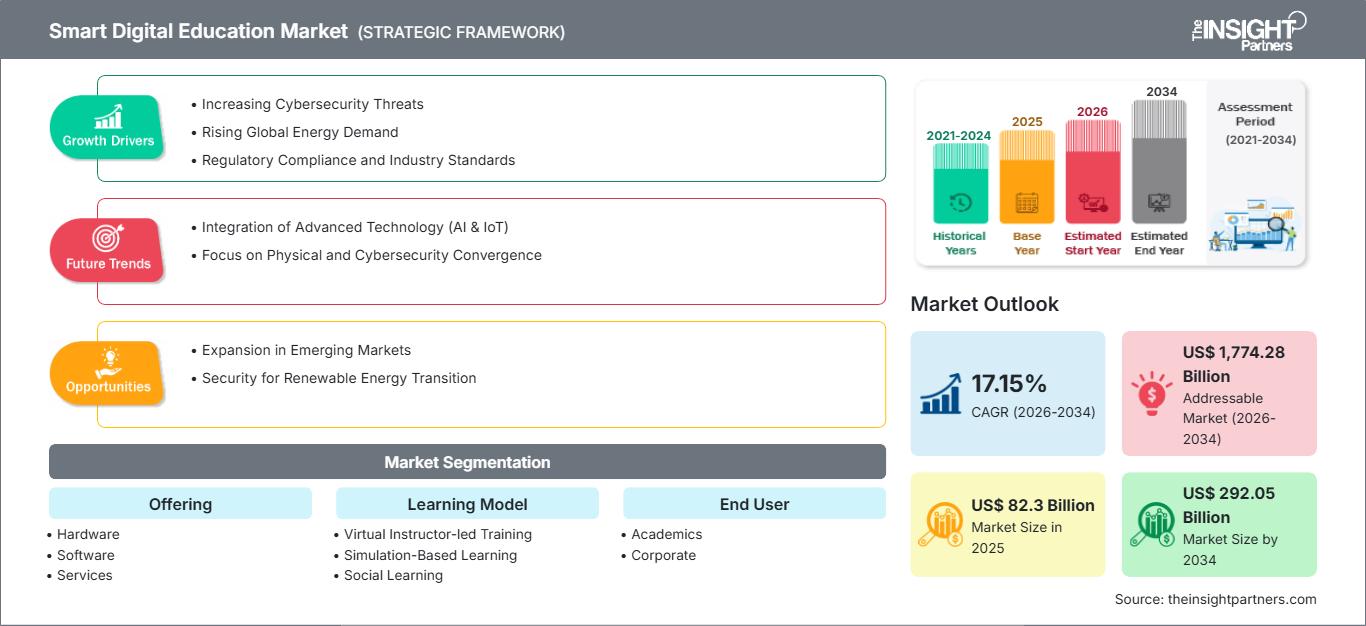
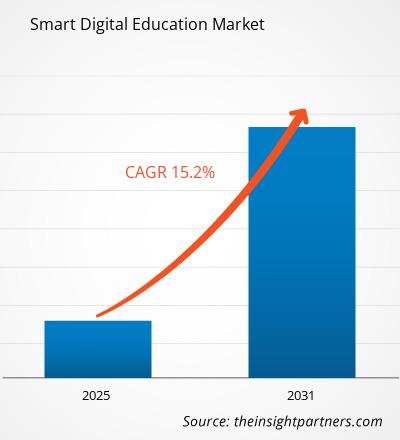
The Smart Digital Education market was valued at US$ 82.3 billion in 2025 and is expected to reach US$ 292.05 billion by 2034; it is estimated to record a CAGR of 15.11% during 2026-2034.
Smart Digital Education Market Assessment and Insights
- North America accounted for 34–37% share in 2025 and is projected to grow at a CAGR of 15–17% during 2026–2034, supported by mature cloud learning adoption, enterprise training demand, and strong digital infrastructure.
- US represented 78–82% of North America in 2025 and is expected to grow at a CAGR of 14–16%, led by LMS upgrades and AI classroom pilots.
- Europe held 23–26% share in 2025 and is forecast to grow at a CAGR of 13–15%, with the UK, Germany, and France leading institutional procurement and lifelong learning initiatives.
- Asia Pacific captured 25–28% share in 2025 and is set to grow at a CAGR of 20–23%, with China, India, Japan, South Korea, and Australia expanding digital education access.
- Largest Segment Software held 45–48% market share in 2025 and is projected to grow at a CAGR of 18–20%, reflecting platform-led adoption across academic and corporate users.
- High Growth Segment Adaptive Learning held 9–12% market share in 2025 and is expected to grow at a CAGR of 22–25%, driven by AI-based personalization and analytics.
- Key companies analyzed in detail: NIIT Limited, Ellucian Company L.P., Unit4 Business Software Ltd., Adobe Inc., SMART Technologies ULC, Educomp Solutions Limited, Cornerstone OnDemand, Inc., Anthology Inc., Cisco Systems, Inc., D2L Corporation.
Source: The Insight Partners' analysis based on proprietary research, government publications, company annual reports, investor presentations, industry databases, and expert interviews.
Platform migration, classroom device integration, and analytics-led instruction have moved the Smart Digital Education Market from emergency remote learning toward structured digital transformation. Institutions now prioritize interoperable software, secure content delivery, and hardware that supports interactive learning. Production dynamics are also shifting as vendors bundle devices, cloud services, assessment tools, and managed support into recurring contracts rather than one-time technology deployments.
Over the forecast period, emerging geographies are expected to accelerate adoption as governments expand connectivity, digital identity, and skills-development programs. Regulatory focus on data privacy and accessibility is increasing procurement discipline, while private capital continues to support AI tutoring, simulation, and multilingual content models. The Smart Digital Education Market is therefore becoming more outcome-oriented, with measurable learning gains influencing buying decisions.
Smart Digital Education Market Report Scope
| Report Attribute | Details |
|---|---|
| Market size in 2025 | US$ 82.3 Billion |
| Market Size by 2034 | US$ 292.05 Billion |
| Global CAGR (2026 - 2034) | 15.11% |
| Historical Data | 2021-2024 |
| Forecast period | 2026-2034 |
Smart Digital Education Market Analysis
Smart Digital Education Market growth will be facilitated due to the convergence of hybrid learning, lifelong learning, and the digital transformation of workforces. Educational establishments are seeking to adopt cloud-based solutions to facilitate the management of content, assessment, attendance, and learners' data analysis, while businesses will seek to adopt virtual instructor-led training and simulation systems for their compliance training and skill development programs. Hardware is still important, but software plays a greater part in achieving quality and scalability.
The supply side will be driven by cloud service providers, LMS providers, hardware providers, content providers, and systems integrators. Evidence-based procurement cycles will become more prevalent as organizations will evaluate learner outcomes, cybersecurity, compliance with accessibility requirements, and integration with student information systems.
The Smart Digital Education Market analysis indicates a competitive landscape split between enterprise software specialists, education platform providers, and classroom technology firms. Adobe Inc. enhances the workflows related to content creation, Cisco Systems Inc. backs up the infrastructure for collaboration, and D2L Corporation deals with learning experience platform products. Anthology Inc. and Ellucian Company L.P. stay relevant for higher education administration and LMS ecosystem.
The investment trends reflect the increasing engagement with AI tutoring, adaptive assessment, skills intelligence, and immersive simulation. NIIT Limited receives more investments due to corporate learning demands, and SMART Technologies ULC helps modernize the interactive classroom space. The Unit4 Business Software Ltd. offers solutions for education administration, and Cornerstone OnDemand Inc. combines learning with talent development.
● REPORT CUSTOMIZATION
Tailor This Report To Align With Your Specific Business Requirements
This report can be customized to align precisely with your business objectives, scope, and target markets. Customization options include tailored segmentation, geography, competitive analysis, and strategic insights to support informed decision-making.
Customize This Report →WHAT YOU CAN ADJUST
- ● Segmentations
- ● Geography
- ● Competitive Analysis
- ● Language Preferences
Smart Digital Education Market: Strategic Insights
Regional Insights
North America Smart Digital Education Market
North America held 34–37% share in 2025 and is projected to grow at a CAGR of 15–17% during 2026–2034. The region’s Smart Digital Education Market share reflects high institutional spending, strong broadband availability, widespread LMS penetration, and mature use of cloud collaboration tools across K-12, higher education, and corporate training.
Structural drivers include digital equity funding, enterprise reskilling budgets, and accelerating AI governance in education. Universities are replacing legacy learning systems with integrated platforms that support analytics and accessibility. Corporate buyers are also shifting from classroom-only training to blended models that reduce travel costs and improve completion tracking across distributed workforces.
U.S. Smart Digital Education Market
The U.S. represented 78–82% of North America in 2025 and is forecast to grow at a CAGR of 14–16% through 2034. This is because it is supported by big schools in the districts, education technology to improve education at the tertiary level, and learning systems used in corporations working in the healthcare sector, technology, finance, manufacturing, and government institutions.
The presence of such companies is another vital aspect in terms of Adobe Inc., Cisco Systems Inc., Anthology Inc., and Cornerstone OnDemand Inc. that serve the areas of content creation, collaboration, LMS, and workforce learning. The features of the application include the application of artificial intelligence in creating courses, skill mapping, virtual laboratories, and learner analytics.
Europe Smart Digital Education Market
Europe accounted for 23–26% share in 2025 and is expected to grow at a CAGR of 13–15% during 2026–2034. In the United Kingdom, leadership in adoption is through digitization in universities and corporate learning. In Germany, there is an emphasis on vocational training, industry simulation, and safe learning environments that conform to the data protection standards.
In France, there are plans to develop digital campuses, in Italy, there is an improvement in the blended learning infrastructure, and in Spain, there is an increase in online skill programs to enhance youth employment and career development. Public funding, multilingual content requirements, and accessibility regulations are influencing procurement in the region.
APAC Smart Digital Education Market
APAC held 25–28% share in 2025 and is forecast to grow at a CAGR of 20–23%, making it the fastest-growing region. China is still the biggest country market, while India is growing fast with digital public infrastructure, affordable mobile access, and enterprise demand for upskilling.
Japan, South Korea, and Australia are deploying simulations, collaboration solutions, and adaptive learning in higher education and workplace learning. The main motivations behind policy measures are digital literacy programs, skills missions, and broadband infrastructure rollout. Industrial demand for these solutions is also growing as manufacturing and technology firms use digital platforms for technical training.
Middle East & Africa Smart Digital Education Market
The Middle East & Africa is expected to grow at a CAGR of 16–18% during 2026–2034, with Saudi Arabia leading regional adoption. Education modernization, smart city programs, and workforce localization initiatives are increasing demand for cloud learning, virtual classrooms, and digital content platforms.
The UAE is investing in AI-enabled education and private higher education platforms, while South Africa is expanding blended learning despite infrastructure gaps. Rest of MEA demand is linked to connectivity, youth skills, and teacher enablement. Energy-sector training also supports simulation-based learning for safety and technical operations.
Segmentation Analysis
Offering
Offering is projected to grow at a CAGR of 17–19% during 2026–2034 as buyers combine hardware, software, and services into integrated learning ecosystems. The Smart Digital Education Market scope across offerings is widening because institutions need content delivery, learner analytics, connected classrooms, implementation support, and ongoing platform optimization rather than isolated technology purchases.
- Hardware continues to be critical in interactive displays, smart boards, tablets, and classroom connections, particularly in institutions that upgrade their physical learning spaces to accommodate hybrid and collaborative learning.
- Software is driving adoption because LMS, LCMS, adaptive learning, assessments, content creation, and collaboration tools have become essential to the governance of academic offerings and corporate training.
- Services assist in consultation, integration, training, content migration, cybersecurity setup, and operations management, enabling buyers to mitigate risks and maximize the platform.
Learning Model
Learning Model is expected to expand at a CAGR of 18–20% during 2026–2034 as education providers shift from single-mode delivery to flexible architectures. Demand is strongest where institutions combine synchronous teaching, adaptive content, simulation, collaboration, and peer learning to improve engagement, completion, and measurable learner outcomes across varied user groups.
- Virtual Instructor-led Training supports real-time interaction, expert access, and structured learning, making it valuable for corporate compliance, professional certification, and higher education programs.
- Simulation-Based Learning is gaining relevance in healthcare, engineering, safety, aviation, and industrial training, where learners need practice environments without operational risk.
- Social Learning strengthens peer engagement through discussion forums, communities, and knowledge sharing, particularly in corporate learning and higher education collaboration.
- Blended Learning remains widely adopted because it combines classroom instruction with digital modules, supporting flexibility while preserving instructor guidance and institutional oversight.
- Adaptive Learning uses data-driven pathways to personalize content, pacing, and feedback, making it important for remediation, skills mastery, and scalable learner support.
- Collaborative Learning enables group projects, shared workspaces, and real-time co-creation, aligning with workplace skill requirements and project-based academic learning.
End User
End User is projected to grow at a CAGR of 16–18% during 2026–2034 as academics and corporate buyers pursue different but complementary outcomes. Academic institutions focus on access, engagement, assessment integrity, and retention, while corporate users prioritize speed-to-skill, compliance tracking, and workforce productivity improvements.
- Academics represent the broadest user base, spanning schools, colleges, and universities that require scalable platforms for instruction, assessment, student support, and digital administration.
- Corporate demand is expanding as enterprises use digital learning to standardize onboarding, reskill employees, reduce travel-led training costs, and link learning to performance systems.
Opportunity Snapshot
| End User | Revenue Contribution | Trend Tag | Adoption Stage |
| Academics | High | Hybrid Campus | Scaling |
| Corporate | Medium | Skills Cloud | Scaling |
Smart Digital Education Market Growth Drivers and Impact Analysis
AI Personalization Moving from Pilot Programs to Core Platforms
The evolution of AI is revolutionizing how organizations detect learning needs, suggest content, and provide teaching assistance at scale. Adaptive sequencing, feedback automation, and prediction are some ways in which teachers can get involved at an earlier stage, and enterprises can customize skill development for roles based on individual requirements. The effects of AI will be substantial due to the increased switching costs associated with its inclusion in LMS and content ecosystems. Customers are demanding explainable algorithms, privacy settings, and audit trails, which plays to the advantage of existing players that have secure and education-focused infrastructure.
Corporate Reskilling Creating Recurring Enterprise Demand
Enterprises are using digital learning to address skills shortages, compliance obligations, and faster technology cycles. Instead of relying on periodic classroom sessions, employers now deploy modular training libraries, virtual instructor-led sessions, simulations, and analytics dashboards that measure completion and proficiency. This creates recurring demand for platforms that integrate with human capital systems and support role-based learning paths. The Smart Digital Education Market benefits because corporate buyers typically require scalability, security, multilingual access, and measurable return on learning investment. As reskilling becomes continuous, vendors gain predictable subscription and service revenue.
Hybrid Learning Infrastructure Becoming a Permanent Education Layer
The hybrid approach is not just an interim continuity strategy anymore but an ongoing delivery channel for all education and training establishments. They provide their classrooms with displays, cameras, collaboration applications, cloud storage systems, and assessment tools that allow both on-site and remote presence in the lessons. Such technology facilitates the involvement of adult students, those living in rural areas, and overseas education projects. As a result, there will be a wider range of procurement options when it comes to hardware, software, and services. Companies that can connect classroom technology with digital solutions stand a higher chance of winning modernization contracts.
Smart Digital Education Market Future Trends
Outcome-Based Learning Analytics
The next phase of Smart Digital Education Market trends will emphasize outcomes rather than platform usage alone. Institutions will increasingly measure mastery, retention, employability, accessibility, and learner progression through integrated analytics layers. This shift will push vendors to connect content engagement with assessment performance and skills evidence. Buyers will favor dashboards that translate learner behavior into interventions, accreditation support, and workforce planning signals. As funding bodies and employers demand clearer proof of learning value, analytics will become a differentiator in both academic and corporate procurement.
Immersive and Simulation-Led Digital Instruction
In terms of immersive learning, there will be a shift from VR pilot programs to simulation solutions in the realms of health care, engineering, manufacturing, cyber security, and safety training. As the costs of devices decrease and cloud rendering becomes more advanced, such simulations will become increasingly easy to implement. This trend will complement traditional educational courses rather than replace them. It will be the companies that will successfully integrate scenario building, performance analysis, and LMS integration who will capture market share.
Smart Digital Education Market Opportunities
Localized AI Content for Multilingual Learners
Localized AI content represents a major investment opportunity because many high-growth regions require affordable learning materials in local languages. Platforms that can translate, adapt, and assess content while preserving curriculum quality will improve access for rural students, vocational learners, and frontline employees. Smart Digital Education Market Forecasts indicate strong upside where governments and enterprises need scalable skilling at lower delivery cost. Investors can prioritize content engines, speech tools, and assessment models that support regional languages, accessibility standards, and educator review workflows.
Managed Digital Learning Services for Institutions
Many educational institutions, colleges, and mid-size businesses do not have the technical wherewithal to set up, secure, and tune advanced learning systems. Managed services represent a solution that allows for the consolidation of set-up, training, analytics set-up, migration, cyber security, and ongoing support into multi-year contracts. Such an approach enables customers to mitigate technology risk while making it easier for vendors to retain their customers. Service-based solutions represent an extremely appealing value proposition in new markets, where spending on digital education is increasing but limited internal technology capabilities exist.
Recent Developments
- July 2026: The Ministry of Education handles the enhancement of digital education and infrastructure through its flagship centrally sponsored scheme, Samagra Shiksha, rather than a stand-alone allocation of INR 100 crore. The centrally managed funding and programmatic execution for establishing ICT (Information and Communication Technology) labs and smart classrooms follow operational guidelines as outlined in “Samagra Shiksha – Framework for Implementation”. The Ministry of Education implements ICT and digital initiatives such as PM eVidya and DIKSHA under Samagra Shiksha to enhance digital learning in government schools across the country, including the rural, remote and tribal areas, like the Aravalli and Sabarkantha districts of Gujarat. The initiatives aim to enhance the quality of education by integrating technology into teaching and learning processes. Under the scheme, funds are provided for setting up ICT Labs and Smart Classrooms according to the requirement of the State submitted in the Annual Work Plan & Budget (AWP&B).
- June 2025: As part of its ongoing commitment to equitable, connected learning, SMART Technologies is helping bring interactive technology to underserved communities around the world through a collaboration with the N50 Project and its EdTech for All initiative. Recent projects supported by SMART include a new digital lab for students in Indianapolis and expanded connectivity for a rural school in Kenya, where students and teachers now have access to internet, hardware, and hands-on IT training — including the latest in SMART Board interactive displays.
- August 2025: Starting August 2025, Adobe will launch its new lineup of higher education offerings in a phased rollout—empowering institutions to embrace innovative solutions at a pace that aligns with their unique goals. Each new Adobe offering is designed to empower higher education institutions with tailored tools and transformative capabilities.
Frequently Asked Questions

- Comprehensive Market Sizing and Forecast Analysis
- Detailed Segmentation Analysis
- In-Depth Market Dynamics Assessment
- Regional and Country-Level Insights
- Competitive Landscape and Company Benchmarking
- Strategic Business Intelligence
Recent Reports
Testimonials

The Insight Partners' SCADA System Market report is comprehensive, with valuable insights on current trends and future forecasts. The team was highly professional, responsive, and supportive throughout. We are very satisfied and highly recommend their services.
RAN KEDEM Partner, Reali Technologies LTDs
I requested a report on a very specific software market and the team produced the report in a few days. The information was very relevant and well presented. I then requested some changes and additions to the report. The team was again very responsive and I got the final report in less than a week.
JEAN-HERVE JENN Chairman, Future Analytica
We worked with The Insight Partners for an important market study and forecast. They gave us clear insights into opportunities and risks, which helped shape our plans. Their research was easy to use and based on solid data. It helped us make smart, confident decisions. We highly recommend them.
PIYUSH NAGPAL Sr. Vice President, High Beam Global
The Insight Partners delivered insightful, well-structured market research with strong domain expertise. Their team was professional and responsive throughout. The user-friendly website made accessing industry reports seamless. We highly recommend them for reliable, high-quality research services
YUKIHIKO ADACHI CEO, Deep Blue, LLC.
This is the first time I have purchased a market report from The Insight Partners.While I was unsure at first, I visited their web site and felt more comfortable to take the risk and purchase a market report.I am completely satisfied with the quality of the report and customer service. I had several questions and comments with the initial report, but after a couple of dialogs over email with their analyst I believe I have a report that I can use as input to our strategic planning process.Thank you so much for taking the extra time and making this a positive experience.I will definitely recommend your service to others and you will be my first call when we need further market data.
JOHN SUZUKI President and Chief Executive Officer, Board Director, BK Technologies
I wish to appreciate your support and the professionalism you displayed in the course of attending to my request for information regarding to infectious disease IVD market in Nigeria. I appreciate your patience, your guidance, and the fact that you were willing to offer a discount, which eventually made it possible for us to close a deal. I look forward to engaging The Insight Partners in the future, all thanks to the impression you have created in me as a result of this first encounter.
DR CHIJIOKE ONYIA MANAGING DIRECTOR, PineCrest Healthcare Ltd.Reason to Buy
- Informed Decision-Making
- Understanding Market Dynamics
- Competitive Analysis
- Identifying Emerging Markets
- Customer Insights
- Market Forecasts
- Risk Mitigation
- Boosting Operational Efficiency
- Strategic Planning
- Investment Justification
- Tracking Industry Innovations
- Aligning with Regulatory Trends





 Get Free Sample for