
Digital Voice Recorder Market Size, Trends & Demand by 2034
Coverage: By Reorder Interface (Bluetooth, USB, SD Card, Wireless); Application (Voice Recording, Interview Recording, Video Recording, Others); End User (Education, Commercial, Entertainment, Other) , and Geography (North America, Europe, Asia Pacific, and South and Central America)
- Status : Data Released
- Report Code : TIPRE00019778
- Category : Electronics and Semiconductor
- No. of Pages : 150
- Available Report Formats :


- Last update date : August 10, 2026


2025 Market Size
US$ 1.9 Bn
Base year value
2034 Forecast
US$ 3.32 Bn
Projected by 2034
CAGR 2026-2034
6.39 %
Growth rate
Addressable Market
US$ 23.61 Bn
(2026-2034)
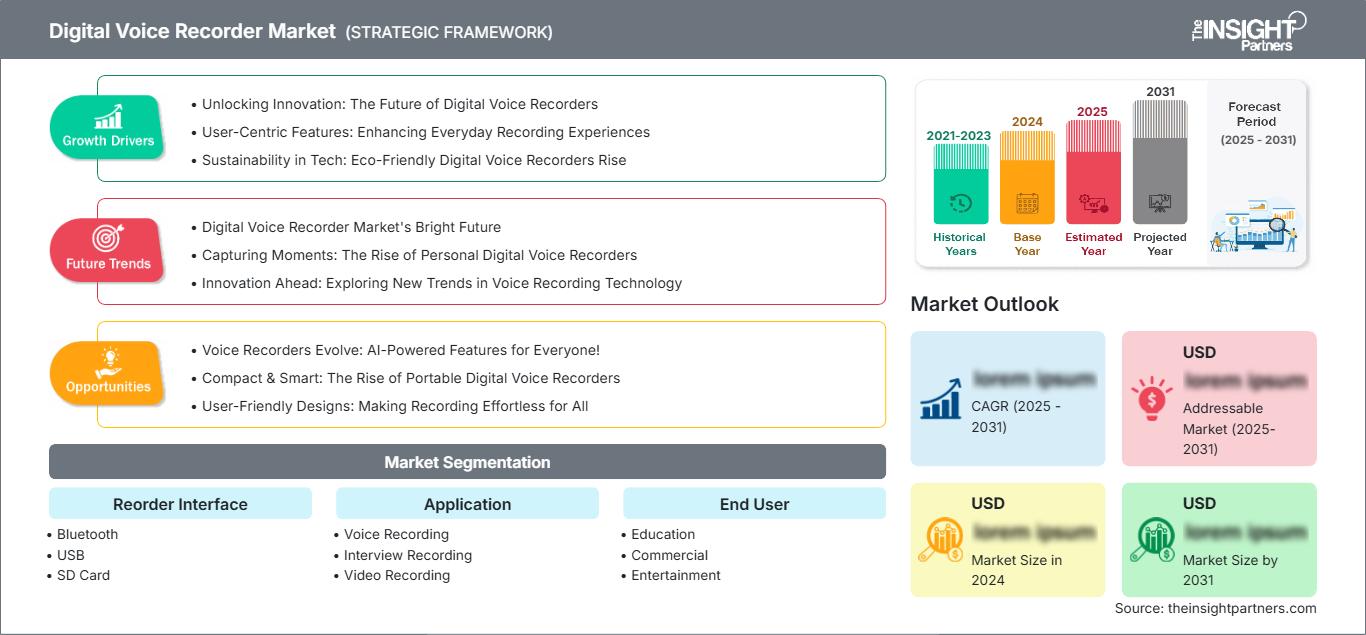
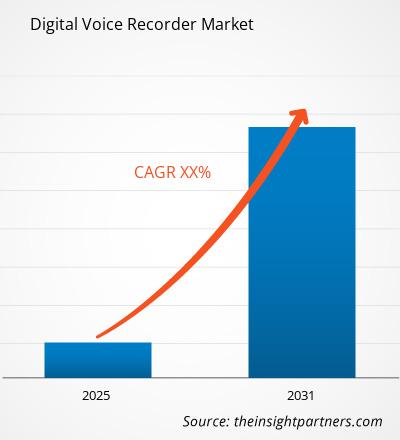
The Digital Voice Recorder Market is valued at US$ 1.9 Billion in 2025 and is projected to reach US$ 3.32 Billion by 2034, registering a CAGR of 6.39% during 2026–2034. Demand is supported by portable documentation, lecture capture, interview recording, field journalism, content production, legal dictation, and professional audio workflows requiring clearer sound, longer storage, and faster file transfer.
Across North America, Digital Voice Recorder Market size is expected to advance at a 5.9–6.6% CAGR as universities, law firms, media teams, corporate training groups, and public agencies continue to digitize spoken records. Structural demand is reinforced by hybrid work, podcast production, accessible learning, professional transcription, and product upgrades that combine USB, Bluetooth, wireless transfer, and removable SD card storage.
Digital Voice Recorder Market Assessment and Insights
- North America: The region holds 33–36% share in 2025 and is forecast to grow at a CAGR of 5.9–6.6% during 2026–2034, supported by education recording, legal documentation, podcasting, and enterprise meeting capture.
- US: The country represents 76–80% of North America in 2025 and is projected to grow at a CAGR of 6.0–6.7% during 2026–2034.
- Europe: Europe accounts for 24–27% share in 2025 and is expected to grow at a CAGR of 5.6–6.3% during 2026–2034, led by Germany, the UK, France, Italy, and Spain.
- Asia Pacific: Asia Pacific represents 28–31% share in 2025 and is forecast to grow at a CAGR of 6.9–7.7% during 2026–2034, with China, Japan, South Korea, India, and Australia driving adoption.
- Largest Segment: Voice Recording holds 42–46% market share in 2025 and is expected to grow at a CAGR of 5.8–6.5% during 2026–2034.
- High Growth Segment: Wireless interface holds 14–18% market share in 2025 and is expected to grow at a CAGR of 7.4–8.2% during 2026–2034.
- Key companies analyzed in detail: Sony Corporation; OM Digital Solutions Corporation; Zoom Corporation; TEAC Corporation; Roland Corporation; Audio-Technica Corporation; Philips Dictation; iFLYTEK Co., Ltd.; Shenzhen Cenlux Digital Technology Co., Ltd.; Jingwah Digital Technology Co., Ltd.; Aigo Digital Technology Co., Ltd.; EVISTR; Word Systems, Inc.; Vaso Corporation.
Source: The Insight Partners' analysis based on proprietary research, government publications, company annual reports, investor presentations, industry databases, and expert interviews.
The recorder market has progressed from basic memo devices to more sophisticated, connected audio devices that enable directional microphones, noise cancellation, timestamping, encryption, rechargeable batteries, and applications-based transfer. The dynamics of production are still firmly rooted in Asian electronics manufacturing, but the dynamics of premium products are defined by codecs supported, microphone design, low-noise preamp, and durability.
Future demand will be driven by digitization of education, growth of the creator economy, dictation in healthcare, and compliance considerations. New regions are purchasing inexpensive recorders for training, public administration, and fieldwork, whereas established regions are migrating towards secure data storage and wireless transfer. Compliance issues concerning consent, privacy, and evidence processing suggest a preference for recorders with efficient data management systems and metadata capabilities.
Digital Voice Recorder Market Report Scope
| Report Attribute | Details |
|---|---|
| Market size in 2025 | US$ 1.9 Billion |
| Market Size by 2034 | US$ 3.32 Billion |
| Global CAGR (2026 - 2034) | 6.39% |
| Historical Data | 2021-2024 |
| Forecast period | 2026-2034 |
Digital Voice Recorder Market Analysis
Demand for such devices is highest in those places where recording oral communication without relying on mobile phones is necessary. Specific recording devices are needed in universities, media, research organizations, police departments, courts, podcasters, filmmakers, and corporate training centers. There should be some factors that can enable them to work for long periods of time, and place the microphone in the right place.
Value chain players include microphone suppliers, codecs providers, flash memory suppliers, battery suppliers, plastics and casing suppliers, firmware developers, distribution, e-commerce retailers and audio professionals. The supply chain is biased towards firms that can offer low-end consumer devices alongside high-end professional recorders that can record in WAV, MP3, DSS formats, multitracks, hot shoe mountable and file transfer capabilities.
The market is an amalgamation of consumer electronic giants, professional audio companies, and dictation solution providers. The Digital Voice Recorder Market Report includes Sony Corporation, OM Digital Solutions Corporation, Zoom Corporation, TEAC Corporation, Roland Corporation, Audio-Technica Corporation, Philips Dictation, and iFLYTEK Co., Ltd. These companies compete with each other through their sound quality, workflow software, small size, channel distribution, and reliability.
Emerging investment strategies include the development of artificial intelligence-based transcription solutions, wireless transfer capabilities, external storage capability, voice-activated features, encryption, and packages targeting content creators. Strategic positioning relies more and more on niche targeting: small-sized lecture recorders for the educational segment, secure dictation recorders for legal and medical professionals, and high-quality audio recorders for the video production industry.
● REPORT CUSTOMIZATION
Tailor This Report To Align With Your Specific Business Requirements
This report can be customized to align precisely with your business objectives, scope, and target markets. Customization options include tailored segmentation, geography, competitive analysis, and strategic insights to support informed decision-making.
Customize This Report →WHAT YOU CAN ADJUST
- ● Segmentations
- ● Geography
- ● Competitive Analysis
- ● Language Preferences
Digital Voice Recorder Market: Strategic Insights
Regional Insights
North America Digital Voice Recorder Market
The market share of North America is between 33% and 36% in 2025 and is forecasted to have a CAGR of 5.9% and 6.6% between 2026 and 2034. The Digital Voice Recorder Market share is driven by high education recordings, legal interrogations, public statement recordings, pod-cast recordings, and corporate information management. Consumers prefer specialized devices when confidentiality, battery life, mic, and offline recording are key considerations.
The regional preference is on USB and wireless products, which make it possible to make a fast transfer to transcriptions, learning, and media editing software. Professional audio sellers generate demand for such companies as Zoom Corporation, TEAC Corporation, Roland Corporation, and Audio-Technica Corporation, while office and dictation consumers review OM Digital Solutions Corporation, Philips Dictation, Sony Corporation, Word Systems, Inc., and iFLYTEK Co., Ltd.
U.S. Digital Voice Recorder Market
The United States has an 80–76% share of North America in 2025 and has been predicted to have a CAGR of 6.0–6.7% between 2026 and 2034. The trends in usage are in classroom accommodation, deposition transcription, podcasting field recording, healthcare dictation, law enforcement interview, corporate training, and video production with dedicated microphones that enhance clarity.
Presence in business is common in online, pro-audio, educational, and enterprise retail. Zoom Corporation and TEAC Corporation serve the creator and video producer markets; Sony Corporation and OM Digital Solutions Corporation offer notetaking and dictation products; and Word Systems, Inc. offers government and legal process solutions including evidence management and archiving.
Europe Digital Voice Recorder Market
Europe holds 24–27% share in 2025 and will register growth at a CAGR of 5.6–6.3% between 2026 and 2034. Germany leads via professional applications, industry training, research, and public administration use. The UK provides support to university, law firm, journalism, podcasting, and government documentation needs.
Educational requirement, entertainment content creation, tourism education, and field practice are some of the ways France, Italy, and Spain participate in the media industry. Procurement is based on data privacy, accessibility, and offline capturing needs of the multilingual environment. Philips Dictation, Sony Corporation, OM Digital Solutions Corporation, Zoom Corporation, TEAC Corporation, and Audio-Technica Corporation are available through specialty distributors.
APAC Digital Voice Recorder Market
APAC accounts for 28–31% share in 2025 and is expected to grow at a CAGR of 6.9–7.7% during 2026–2034. China is the leading country, supported by electronics manufacturing, online education, government training, creator activity, and rapid adoption of AI transcription devices.
Professional audio, language learning, broadcast production, and electronic device retailing are among the ways that Japan and South Korea contribute. India and Australia make their contributions in education, legal, healthcare, and journalism. This is where companies such as Jingwah Digital Technology Co., Ltd., Shenzhen Cenlux Digital Technology Co., Ltd., and Aigo Digital Technology Co., Ltd. have much to gain from.
Middle East & Africa Digital Voice Recorder Market
The Middle East & Africa market is anticipated to register CAGR of 5.1% to 5.9% from 2026 to 2034. Saudi Arabia dominates owing to the need for portable voice recording technology for education modernization, public administration, media production, aviation training, and energy sector documentation.
The UAE drives the growth by providing smart campuses, corporate training, tourism, and multilingual business processes, while South Africa and Rest of MEA rely on the recorders in journalism, legal interviews, mining training, and healthcare documentation. Durability, ease of data transfer, support for Arabic and English user interfaces, and battery availability are key buying criteria.
Segmentation Analysis
Reorder Interface
The Reorder Interface segment is projected to grow at a CAGR of 6.3–7.0% during 2026–2034. Digital Voice Recorder Market scope includes wired transfer, removable media, Bluetooth pairing, and wireless workflows that determine how quickly users move files into transcription, editing, storage, or learning platforms. Interface choice increasingly defines productivity after capture.
- Bluetooth supports cable-free transfer to smartphones, tablets, and companion applications, making it strategically important for mobile reporters, students, trainers, and creators who need quick review.
- USB remains widely used because it offers dependable file transfer, charging convenience, and compatibility with office computers, transcription systems, and institutional workflows.
- SD Card appeals to professional users requiring removable storage, extended sessions, backup flexibility, and easy handoff to editors, legal teams, or archiving staff.
- Wireless is gaining importance as advanced recorders connect directly to cloud services, mobile apps, and collaborative workflows, reducing manual file handling after recording.
Application
The Application segment is estimated to grow at a CAGR of 6.1–6.8% during 2026–2034. Voice recording remains the largest application because everyday documentation, lectures, and meetings require dependable capture. Interview and video recording add premium demand where microphone quality, time alignment, storage, and post-production compatibility influence purchase decisions.
- Voice Recording dominates routine use in classrooms, offices, courts, clinics, and field notes, where users value portability, instant start, battery life, and clear speech capture.
- Interview Recording is critical for journalism, legal discovery, research, hiring, and investigations because accurate speaker capture improves transcription quality, accountability, and later content review.
- Video Recording supports creators, documentary teams, event producers, and training departments that need separate high-quality audio synchronized with camera footage.
End User
The End User segment is projected to grow at a CAGR of 6.2–6.9% during 2026–2034. Education provides consistent volume, commercial users drive workflow-based replacement, and entertainment users lift average selling prices through professional audio requirements. Adoption depends on recording quality, privacy expectations, storage capacity, and integration with downstream software.
- Education users include students, lecturers, accessibility offices, training centers, and language programs that need lecture capture, revision material, and reliable offline documentation.
- Commercial users adopt recorders for meetings, dictation, interviews, audits, customer research, legal documentation, healthcare notes, and employee training where clarity and retention matter.
- Entertainment users include podcasters, videographers, musicians, event producers, and broadcasters who prioritize microphone quality, stereo capture, external inputs, and editing compatibility.
Opportunity Snapshot
| Application | Revenue Contribution | Trend Tag | Adoption Stage |
| Voice Recording | High | Lecture Capture | Mature |
| Interview Recording | Medium | Legal Audio | Scaling |
| Video Recording | Medium | Creator Sync | Scaling |
Digital Voice Recorder Market Growth Drivers and Impact Analysis
Digitization of Spoken Documentation Workflows
Spoken conversations are being turned into searchable documents in order to train, document, comply, learn, and understand customers. Dedicated recorders are still useful as they can record longer recordings without interruptions from apps, preserve the battery on a phone, and offer consistent audio settings. The driver can be observed through legal interrogations, college accommodation, medical note taking, and company meetings where lack of information leads to re-work or risk. Devices that have timestamps, file folders, password security, and common audio file types enable organizations to process recordings for transcription and storage.
Rise of Creator Audio and Video Production
The growing number of podcast, short video, documentary, webinar, and hybrid event productions requires recorders with better-quality audio than what can be achieved with inbuilt camera and phone microphones. For this reason, the Digital Voice Recorder Market is positively influenced by the need for stereo recording capability, microphone inputs, high-quality WAV files, wind noise cancellation, and simple synchronization with video timelines. This reduces the demand for budget-friendly memo recorders in favor of more sophisticated models with improved preamps and accessories. The market gets positively influenced mostly by entertainment and education media groups, as well as small studios.
Expansion of Education and Accessibility Recording
Institutions such as schools, colleges, and universities employ the technology of audio recording for the purposes of revision, language acquisition, note taking assistance, and self-study in an asynchronous manner. Standalone recorders are widely favored in a number of institutions due to their user-friendliness, less disruptive nature compared to the smartphone and reliability over extended periods of time. The impact on the marketplace is characterized by regular procurement, calls for cheaper USB-powered recorders, as well as increased interest in voice activation and noise elimination technologies.
Digital Voice Recorder Market Future Trends
AI-Assisted Transcription and Summarization
Digital Voice Recorder Market trends are moving toward devices that capture cleaner source audio for AI transcription, speaker labeling, and meeting summarization. Future systems will combine directional microphones, noise suppression, local encryption, and app-based processing so users can create text records faster while retaining original audio. The trend will not remove demand for standalone recorders because better input quality improves automated output. Vendors that provide privacy controls, offline modes, export flexibility, and integration with document platforms can capture value beyond hardware margins.
Converged Wireless Recording Ecosystems
Next-generation recorders will operate as part of connected audio ecosystems spanning microphones, cameras, smartphones, cloud storage, and editing software. Wireless transfer will reduce friction after interviews, lectures, and shoots, while metadata tagging will make files easier to retrieve. Product differentiation will shift from recording alone to end-to-end workflow speed. This favors brands that support stable pairing, mobile control, battery-efficient connectivity, and secure sharing. Enterprise users will also seek administrative tools for device fleets and standardized file policies.
Digital Voice Recorder Market Opportunities
Education Bundles for Hybrid Learning Programs
Digital Voice Recorder Market Forecasts point to education as a practical opportunity because institutions need reliable lecture capture, accessibility support, language practice, and fieldwork documentation. Vendors can package entry-level recorders with USB transfer, long battery life, storage cards, headset support, and basic transcription guidance for schools and universities. Distribution through education technology resellers can reduce procurement friction. The strongest opportunity lies in standardized classroom kits that combine affordability with privacy-conscious offline recording, helping institutions support students without depending fully on personal smartphones.
Secure Dictation Workflows for Legal and Healthcare Users
Legal, healthcare, insurance, and public-sector users require recordings that can be captured, stored, transferred, and retrieved with minimal ambiguity. Manufacturers and resellers can build value around encrypted devices, docking stations, transcription software, user training, and support contracts. This opportunity is less price-sensitive than consumer note-taking because workflow reliability and confidentiality matter. Vendors that document security features, provide local service, and integrate with dictation platforms can win replacement programs where older devices lack wireless control, modern codecs, or policy-compliant file handling.
Recent Developments
- March 2026: PLAUD launched the NotePin S wearable AI voice recorder in the Japanese market, expanding its AI-powered note-taking portfolio with a compact hands-free device designed for business meetings, interviews, and discussions. The NotePin S features physical recording and highlight buttons, AI-generated transcription and contextual summaries, infographic generation, support for multiple AI models, 64 GB of storage, and up to 20 hours of continuous recording. The launch also reinforces PLAUD’s enterprise strategy by offering secure data processing through the AWS Tokyo Region and enhancing productivity through AI-driven information organization and decision-making
- March 2026: Zeno launched the Weaver AI Voice Recorder in India, an AI-powered smart recording device designed for professionals, students, journalists, and business users to simplify meeting notes, interviews, and lectures. The compact recorder enables one-tap voice recording, real-time transcription, AI-generated summaries, and translation, converting conversations into more than 50 professional formats including meeting minutes, interview notes, blog drafts, video scripts, and mind maps. Powered by AI capabilities, the device features a multi-microphone array with noise cancellation, 32 GB internal storage, up to 40 hours of recording capacity, and integration with a companion mobile app for accessing recordings, transcripts, and summaries.
- July 2026: OpenHome partnered with ElevenLabs to accelerate the development and adoption of voice AI-powered hardware devices by supporting developers building next-generation ambient AI systems. Through the collaboration, OpenHome’s developer ecosystem will gain access to ElevenLabs’ advanced speech synthesis (TTS) and speech recognition (STT) technologies for creating natural conversational experiences in smart devices, AI assistants, and connected hardware products. The partnership includes a developer program in Japan that provides resources and support for building voice-enabled applications, helping expand the use of realistic AI voice interactions across consumer and enterprise hardware platforms.
Frequently Asked Questions

- Comprehensive Market Sizing and Forecast Analysis
- Detailed Segmentation Analysis
- In-Depth Market Dynamics Assessment
- Regional and Country-Level Insights
- Competitive Landscape and Company Benchmarking
- Strategic Business Intelligence
Recent Reports
Testimonials

The Insight Partners' SCADA System Market report is comprehensive, with valuable insights on current trends and future forecasts. The team was highly professional, responsive, and supportive throughout. We are very satisfied and highly recommend their services.
RAN KEDEM Partner, Reali Technologies LTDs
I requested a report on a very specific software market and the team produced the report in a few days. The information was very relevant and well presented. I then requested some changes and additions to the report. The team was again very responsive and I got the final report in less than a week.
JEAN-HERVE JENN Chairman, Future Analytica
We worked with The Insight Partners for an important market study and forecast. They gave us clear insights into opportunities and risks, which helped shape our plans. Their research was easy to use and based on solid data. It helped us make smart, confident decisions. We highly recommend them.
PIYUSH NAGPAL Sr. Vice President, High Beam Global
The Insight Partners delivered insightful, well-structured market research with strong domain expertise. Their team was professional and responsive throughout. The user-friendly website made accessing industry reports seamless. We highly recommend them for reliable, high-quality research services
YUKIHIKO ADACHI CEO, Deep Blue, LLC.
This is the first time I have purchased a market report from The Insight Partners.While I was unsure at first, I visited their web site and felt more comfortable to take the risk and purchase a market report.I am completely satisfied with the quality of the report and customer service. I had several questions and comments with the initial report, but after a couple of dialogs over email with their analyst I believe I have a report that I can use as input to our strategic planning process.Thank you so much for taking the extra time and making this a positive experience.I will definitely recommend your service to others and you will be my first call when we need further market data.
JOHN SUZUKI President and Chief Executive Officer, Board Director, BK Technologies
I wish to appreciate your support and the professionalism you displayed in the course of attending to my request for information regarding to infectious disease IVD market in Nigeria. I appreciate your patience, your guidance, and the fact that you were willing to offer a discount, which eventually made it possible for us to close a deal. I look forward to engaging The Insight Partners in the future, all thanks to the impression you have created in me as a result of this first encounter.
DR CHIJIOKE ONYIA MANAGING DIRECTOR, PineCrest Healthcare Ltd.Reason to Buy
- Informed Decision-Making
- Understanding Market Dynamics
- Competitive Analysis
- Identifying Emerging Markets
- Customer Insights
- Market Forecasts
- Risk Mitigation
- Boosting Operational Efficiency
- Strategic Planning
- Investment Justification
- Tracking Industry Innovations
- Aligning with Regulatory Trends





 Get Free Sample for