
Smart Government Market Trends, Size & Growth by 2034
Smart Government Market Size and Forecasts (2021 - 2034), Global and Regional Share, Trends, and Growth Opportunity Analysis Report Coverage : By Component (Solution, Service); Deployment (On-premises, Cloud); Geography (North America, Europe, Asia-Pacific, Middle East & Africa, South and Central America)
- Status : Data Released
- Report Code : TIPRE00039631
- Category : Technology, Media and Telecommunications
- No. of Pages : 150
- Available Report Formats :


- Last update date : August 04, 2026


2025 Market Size
US$ 50.11 Bn
Base year value
2034 Forecast
US$ 232.93 Bn
Projected by 2034
CAGR 2026-2034
18.62 %
Growth rate
Addressable Market
US$ 1,165.08 Bn
(2026-2034)
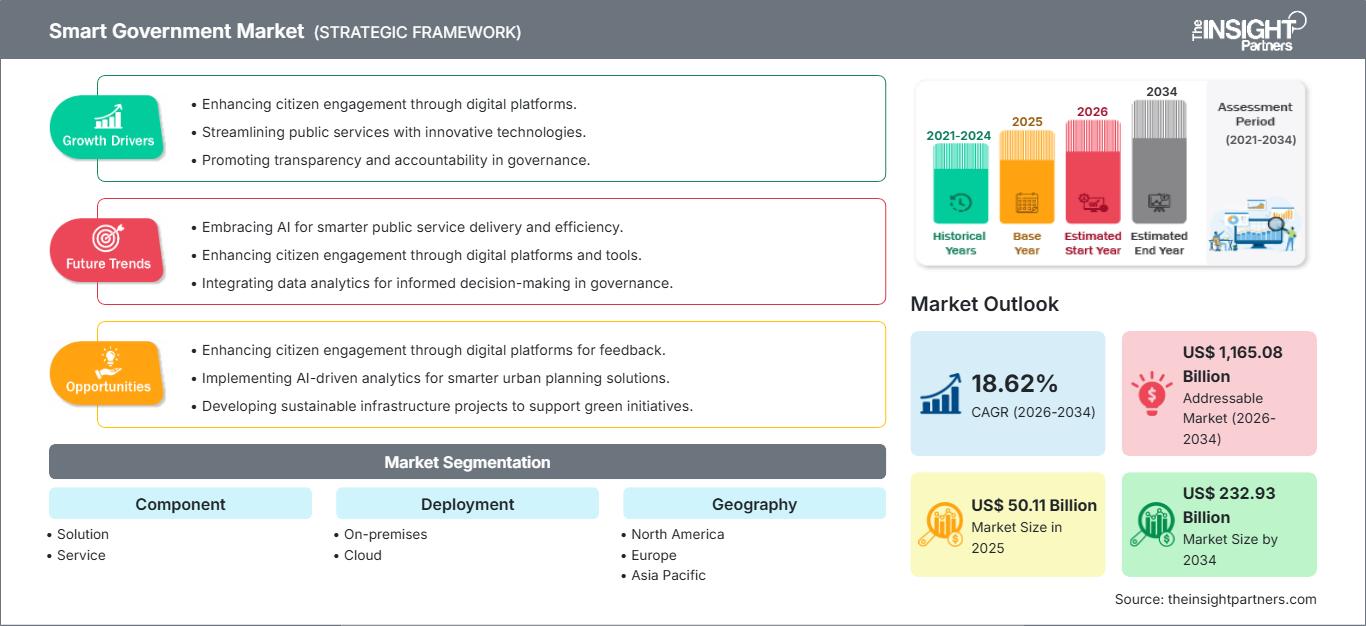
The smart government market was valued at US$ 50.11 Billion in 2025 and is projected to reach US$ 232.93 Billion by 2034, registering a CAGR of 18.62% during 2026–2034. Growing investments in digital governance, connected public infrastructure, artificial intelligence-enabled citizen services, cloud modernization, and secure digital identity platforms continue to reshape public administration worldwide. Governments are increasingly prioritizing integrated digital ecosystems to improve operational efficiency, transparency, and service delivery across national, regional, and municipal agencies.
Across North America, public agencies continue accelerating investments in digital transformation, cloud-first architectures, and cybersecurity modernization to improve citizen engagement and operational resilience. The region is expected to record a CAGR ranging between 17.5% and 18.5% during 2026–2034, supported by federal funding initiatives, expanding adoption of artificial intelligence, and modernization of legacy IT infrastructure. The smart government market size continues expanding as governments strengthen digital public services while improving data interoperability among agencies.
Smart Government Market Assessment and Insights
- North America: Accounted for 36–39% share in 2025 and is projected to expand at a CAGR of 17.5–18.5% during 2026–2034. Strong public-sector technology investments, mature digital infrastructure, and increasing cybersecurity spending continue to support regional leadership.
- U.S.: Represented 77–81% of the North American market in 2025 and is anticipated to grow at a CAGR of 17.8–18.8% during 2026–2034, supported by federal cloud modernization programs, AI-enabled governance initiatives, and extensive digital public service investments.
- Europe: Held 27–30% share in 2025 and is forecast to register a CAGR of 18.0–19.0% during 2026–2034. Germany, the United Kingdom, France, Italy, and Spain continue to lead investments in digital public administration and secure government cloud infrastructure.
- Asia Pacific: Captured 23–26% share in 2025 while advancing at a CAGR of 20.0–21.0% during 2026–2034. China, Japan, South Korea, India, and Australia are strengthening national digital transformation strategies and expanding smart city ecosystems.
- Largest Segment: Solution accounted for 66–69% market share in 2025 and is projected to grow at a CAGR of 18.3–19.0% during 2026–2034, driven by integrated digital governance platforms, analytics, cybersecurity, and citizen engagement applications.
- High Growth Segment: Cloud deployment represented 41–44% share in 2025 and is expected to register a CAGR of 20.5–21.5% during 2026–2034, supported by scalable infrastructure, faster implementation, and improved interoperability across government agencies.
- Key companies analyzed in detail: Accela; Amazon Web Services, Inc.; CivicPlus; Google LLC; International Business Machines Corporation; Microsoft Corporation; Oracle Corporation; Palantir Technologies Inc.; Salesforce, Inc.; Snowflake Inc.
Source: The Insight Partners' analysis based on proprietary research, government publications, company annual reports, investor presentations, industry databases, and expert interviews.
The evolution of digital transformation in public administration has moved from standalone e-government solutions to holistic digital ecosystems that can facilitate the provision of services in real-time, secure data exchange, and intelligent decision-making. Thanks to cloud computing, artificial intelligence, geographic analysis, and IoT technologies, it has become possible for governments to revamp legacy systems and increase efficiency. The increasing focus on resilience in cybersecurity, digital identity systems, and platform interoperability will make the digital governance efforts of nations even more advanced in the future.
Looking ahead, investment activity in the Smart Government Market is expected to accelerate across emerging economies as governments prioritize digital inclusion, resilient infrastructure, and citizen-centric public services. National digital transformation roadmaps, increasing availability of sovereign cloud infrastructure, and regulatory frameworks supporting trusted data exchange are expected to create new deployment opportunities. Public-private partnerships, expanding broadband coverage, and continuous innovation in AI-enabled government platforms will further improve administrative efficiency while encouraging sustainable digital governance across regional and municipal authorities.
Smart Government Market Report Scope
| Report Attribute | Details |
|---|---|
| Market size in 2025 | US$ 50.11 Billion |
| Market Size by 2034 | US$ 232.93 Billion |
| Global CAGR (2026 - 2034) | 18.62% |
| Historical Data | 2021-2024 |
| Forecast period | 2026-2034 |
Smart Government Market Analysis
Digital governance initiatives continue creating sustained demand for intelligent platforms that simplify citizen interactions, automate administrative processes, and improve institutional transparency. The smart government market growth is supported by increasing investments in cloud-native applications, digital identity ecosystems, predictive analytics, and cybersecurity frameworks. Governments are integrating connected infrastructure with centralized data management platforms to enable evidence-based policymaking while improving emergency response capabilities and public resource allocation.
Technology providers, cloud service providers, security firms, and integrators collaborate to enhance the value chain of the industry through offering scalable digital governance solutions. The rising need for interoperability makes way for an architecture that is open to linking tax, health, transport, educational, and municipal systems using digital platforms. Modernization efforts also create a constant need for consulting, implementation, integration, and managed services.
Competitive intensity continues increasing as established enterprise software companies expand government-focused product portfolios through artificial intelligence, advanced analytics, and secure cloud capabilities. The smart government market analysis indicates that vendors increasingly differentiate themselves through interoperability, cybersecurity certifications, sovereign cloud offerings, and integrated citizen engagement platforms. Strategic collaborations with public agencies also improve long-term contract opportunities while supporting modernization initiatives.
These include firms such as Microsoft Corporation, Amazon Web Services, Inc., International Business Machines Corporation, Oracle Corporation, Google LLC, Salesforce, Inc., Palantir Technologies Inc., Snowflake Inc., Accela, and CivicPlus. These firms are increasingly focusing on developing innovative government technologies through migration to the cloud, AI-based decision-making support systems, and secure management of data to meet changing regulations and build strong ties with government organizations.
● REPORT CUSTOMIZATION
Tailor This Report To Align With Your Specific Business Requirements
This report can be customized to align precisely with your business objectives, scope, and target markets. Customization options include tailored segmentation, geography, competitive analysis, and strategic insights to support informed decision-making.
Customize This Report →WHAT YOU CAN ADJUST
- ● Segmentations
- ● Geography
- ● Competitive Analysis
- ● Language Preferences
Smart Government Market: Strategic Insights
Regional Insights
North America Smart Government Market
North America accounted for 36–39% of the global smart government market share in 2025 and is projected to expand at a CAGR of 17.5–18.5% during 2026–2034. Strong federal and state investments in cloud modernization, cybersecurity, digital identity, and artificial intelligence continue supporting regional market expansion. Government departments continue to leverage integrated digital platforms that enhance citizen interaction, automate administrative processes, and increase interoperability among different departments. With increasing investments as part of national digital transformation programs, there is a drive toward leveraging cloud-based platforms and analytics.
There is also an advantage in the form of an established technology environment, a broad broadband infrastructure, and effective public and private partnerships in the region. The need for resilient public infrastructure and emergency management systems, along with digital public services, helps in investing in the long term. Increasing regulatory requirements on data security, cybersecurity, and secure information exchange keep driving the demand for enterprise government technology solutions.
U.S. Smart Government Market
The United States represented 77–81% of the North American Smart Government Market in 2025 and is anticipated to register a CAGR of 17.8–18.8% during 2026–2034. Federal organizations will be advancing further on cloud computing migration, AI utilization, and zero-trust cybersecurity deployment for the purpose of modernizing essential governmental activities. Moreover, the United States still enjoys a powerful representation of enterprise technology firms that allow for the fast development of scalable digital governance systems through such areas as transportation, healthcare, taxation, education, and security.
Investments in digital public infrastructure, data integration, and citizen services' modernization still represent core priorities for both federal and state strategies for digital transformation. Smart cities programs, broadband expansion, and the growing use of predictive analytics help with the efficient allocation of resources. Collaboration between governmental departments and software companies is still driving technological innovations and the improvement of service provision in the public sector.
Europe Smart Government Market
Europe captured 27–30% of the global Smart Government Market in 2025 and is expected to grow at a CAGR of 18.0–19.0% during 2026–2034. This regional market growth is aided by coordinated digital governance, interoperable systems, and investments in secure cloud-based systems. Germany dominates the regional market due to its high levels of digitization in the public sector, smart city plans, and industrial digital infrastructure, due to high uptake of enterprise software and digital administration in the country.
The UK is further developing its digital public services through cloud-based procurement, AI-powered citizen services, and investments in cybersecurity. Other countries that are developing their digital transformation programs, modernizing their municipal services, and increasing interoperability among government departments include France, Italy, and Spain. There is continued EU support for digital identity, secure data sharing, and innovation within the public sector in support of the sustainable growth of the market.
APAC Smart Government Market
Asia Pacific accounted for 23–26% of the global Smart Government Market in 2025 and is forecast to record a CAGR of 20.0–21.0% during 2026–2034. China remains the leading contributor through extensive investments in smart cities, digital governance platforms, and artificial intelligence. Japan and South Korea continue expanding intelligent public infrastructure supported by advanced ICT capabilities.
India and Australia are accelerating government cloud adoption, digital identity initiatives, and integrated citizen service platforms. Expanding broadband infrastructure, supportive public policies, and increasing investments in digital administration continue strengthening long-term regional growth prospects across both developed and emerging economies.
Middle East & Africa Smart Government Market
The Middle East & Africa region is projected to register a CAGR of 19.0–20.0% during 2026–2034. Saudi Arabia and the United Arab Emirates continue investing in national digital transformation strategies, smart city ecosystems, and AI-enabled government services. These initiatives support the modernization of public administration while improving operational efficiency and citizen engagement.
South Africa and the Rest of MEA are steadily expanding digital public infrastructure through cloud adoption, cybersecurity investments, and e-government programs. Increasing infrastructure development, diversification strategies, and long-term public-sector modernization initiatives continue creating favorable opportunities for technology providers across the region.
Segmentation Analysis
Component
The Component segment plays a central role in determining technology adoption across government organizations. The smart government market scope continues expanding as agencies prioritize integrated software platforms and specialized professional services to modernize administrative operations, improve cybersecurity, and enhance citizen experiences. The segment is projected to grow at a CAGR of 18.5–19.2% during 2026–2034, supported by continued investments in digital transformation initiatives.
- Solution – Solutions account for the larger share of component adoption owing to widespread implementation of digital identity, analytics, cybersecurity, workflow automation, document management, and citizen engagement platforms that enable integrated public-sector operations.
- Service – Professional, consulting, implementation, integration, training, and managed services remain strategically important as governments modernize legacy systems while ensuring secure deployment, regulatory compliance, and continuous operational support.
Deployment
The Deployment segment of the Smart Government Market continues evolving as governments balance operational flexibility, cybersecurity requirements, and regulatory compliance. The segment is expected to register a CAGR of 19.1–19.8% during 2026–2034, supported by increasing investments in scalable digital infrastructure, hybrid IT environments, and secure cloud migration strategies that improve interoperability, enhance service delivery, and promote long-term cost efficiency across government agencies.
- On-premises – On-premises deployment remains important for agencies managing highly sensitive national security, defense, judicial, and classified information, where strict data sovereignty and regulatory compliance requirements influence infrastructure decisions.
- Cloud – Cloud deployment is witnessing rapid adoption because it enables scalable computing resources, lower infrastructure costs, accelerated implementation, enhanced disaster recovery, and seamless integration across multiple government departments and citizen service platforms.
Opportunity Snapshot
| Deployment | Revenue Contribution | Trend Tag | Adoption Stage |
| Cloud | High | Sovereign Cloud | Scaling |
| On-premises | Medium | Secure Infrastructure | Mature |
Smart Government Market Growth Drivers and Impact Analysis
Expansion of National Digital Transformation and Public Service Modernization
Governments around the world are speeding up their long-term plans on digital transformations to increase administrative efficiency, transparency, and citizen participation. The focus of national digital strategies is shifting towards cloud computing, government portals, digital identification systems, and data platforms with capabilities of integration between different government agencies. The growing demands for quick provision of public services and secure online transactions will keep driving investments into enterprise software, AI, and automation solutions. International organizations such as OECD and the United Nations keep promoting maturity in digital government using governance models and interoperability standards, while national funding initiatives facilitate the modernization of existing infrastructure. These factors enhance procurement prospects for IT solution providers and system integrators, as well as increase public sector productivity and reduce costs. Commitments on digital transformations by governments in developed and developing countries will drive IT spending over the forecast period.
Growing Cybersecurity Requirements and Sovereign Cloud Adoption
With an increasing number of cyber threats aimed at government systems, cybersecurity has evolved from being an operationally important issue into a strategic investment priority. Government departments are deploying zero-trust architecture, advanced cyber threat intelligence, identity and access management systems, and encrypted data exchange environments to safeguard sensitive information. Sovereign cloud technology adoption additionally helps with meeting the requirements of the national security and data residency regulations while offering scalable digital service delivery capability. Resilience is being bolstered by means of continuous monitoring, security operations center setup, and multi-cloud environments. These efforts prompt adoption of integrated cybersecurity solutions, secure cloud offerings, and compliance management platforms. With the growing coverage of cyber regulations, IT vendors will likely find themselves better positioned with their trusted, certified, and interoperable technologies.
Increasing Adoption of Artificial Intelligence and Data-Driven Governance
Artificial intelligence is becoming a foundational technology for modern public administration by enabling predictive analytics, intelligent automation, and faster policy implementation. Governments increasingly utilize AI to optimize transportation systems, healthcare administration, emergency response coordination, tax compliance, and resource allocation. The integration of machine learning with geospatial intelligence, digital twins, and Internet of Things infrastructure supports real-time decision-making while improving operational efficiency. The expanding availability of high-quality government data and improved interoperability between agencies continue to enhance AI implementation across diverse administrative functions. Ethical AI governance frameworks, transparent decision-making processes, and investments in digital skills are also encouraging wider adoption. As governments pursue evidence-based policymaking and citizen-centric service delivery, AI-enabled digital platforms are expected to generate measurable improvements in administrative performance and long-term public value.
Smart Government Market Future Trends
Artificial Intelligence Becoming the Core of Digital Public Services
Artificial intelligence is expected to transform government operations beyond automation by enabling predictive governance, personalized citizen interactions, and intelligent policy evaluation. The smart government market trends increasingly reflect investment in generative AI, conversational virtual assistants, multilingual citizen support platforms, and predictive public resource planning. Governments are also integrating AI with cloud-native applications and advanced analytics to improve service accessibility and accelerate administrative decisions. Responsible AI frameworks, explainable algorithms, and transparent governance practices will become increasingly important as public agencies seek to balance innovation with accountability, privacy protection, and regulatory compliance throughout the forecast period.
Interoperable Digital Ecosystems Supporting Connected Government
Future public-sector modernization will increasingly emphasize interoperable digital ecosystems capable of securely connecting ministries, municipalities, public utilities, healthcare organizations, and transportation authorities. Governments are expected to invest in standardized data-sharing frameworks, API-driven platforms, and integrated digital identity solutions that reduce administrative complexity while improving citizen experiences. Cloud-native architectures, open standards, and secure information exchange will support seamless collaboration across agencies. As governments continue adopting connected infrastructure and intelligent public services, integrated digital ecosystems will become essential for improving operational resilience, accelerating innovation, and supporting sustainable long-term digital governance strategies.
Smart Government Market Opportunities
Expanding Investment Opportunities Across Emerging Digital Economies
Emerging economies represent substantial long-term investment opportunities as governments prioritize nationwide digital infrastructure, broadband expansion, and modernization of public administration. The smart government market Forecasts indicate that increasing public-sector technology budgets, international development funding, and growing adoption of cloud-based government platforms will encourage market expansion across Asia Pacific, the Middle East, Africa, and Latin America. Technology providers capable of delivering scalable, cost-efficient, and interoperable digital governance solutions are well-positioned to support evolving public-sector requirements. Strategic partnerships with local system integrators, telecommunications providers, and government agencies will further strengthen market penetration while supporting sustainable digital transformation initiatives and long-term infrastructure modernization.
Integrated Citizen Experience Platforms Creating New Value Streams
Governments are increasingly seeking unified digital platforms capable of delivering multiple public services through a single secure interface. This creates opportunities for software vendors offering integrated citizen relationship management, digital identity, workflow automation, payment processing, and analytics capabilities. Investments in mobile-first public services, multilingual digital platforms, and accessibility-focused applications are expected to expand procurement opportunities across national and municipal governments. Vendors emphasizing cybersecurity, interoperability, artificial intelligence integration, and regulatory compliance can strengthen long-term contracts while supporting continuous improvement of citizen satisfaction, operational efficiency, and transparent public administration.
Frequently Asked Questions

- Comprehensive Market Sizing and Forecast Analysis
- Detailed Segmentation Analysis
- In-Depth Market Dynamics Assessment
- Regional and Country-Level Insights
- Competitive Landscape and Company Benchmarking
- Strategic Business Intelligence
Recent Reports
Testimonials

The Insight Partners' SCADA System Market report is comprehensive, with valuable insights on current trends and future forecasts. The team was highly professional, responsive, and supportive throughout. We are very satisfied and highly recommend their services.
RAN KEDEM Partner, Reali Technologies LTDs
I requested a report on a very specific software market and the team produced the report in a few days. The information was very relevant and well presented. I then requested some changes and additions to the report. The team was again very responsive and I got the final report in less than a week.
JEAN-HERVE JENN Chairman, Future Analytica
We worked with The Insight Partners for an important market study and forecast. They gave us clear insights into opportunities and risks, which helped shape our plans. Their research was easy to use and based on solid data. It helped us make smart, confident decisions. We highly recommend them.
PIYUSH NAGPAL Sr. Vice President, High Beam Global
The Insight Partners delivered insightful, well-structured market research with strong domain expertise. Their team was professional and responsive throughout. The user-friendly website made accessing industry reports seamless. We highly recommend them for reliable, high-quality research services
YUKIHIKO ADACHI CEO, Deep Blue, LLC.
This is the first time I have purchased a market report from The Insight Partners.While I was unsure at first, I visited their web site and felt more comfortable to take the risk and purchase a market report.I am completely satisfied with the quality of the report and customer service. I had several questions and comments with the initial report, but after a couple of dialogs over email with their analyst I believe I have a report that I can use as input to our strategic planning process.Thank you so much for taking the extra time and making this a positive experience.I will definitely recommend your service to others and you will be my first call when we need further market data.
JOHN SUZUKI President and Chief Executive Officer, Board Director, BK Technologies
I wish to appreciate your support and the professionalism you displayed in the course of attending to my request for information regarding to infectious disease IVD market in Nigeria. I appreciate your patience, your guidance, and the fact that you were willing to offer a discount, which eventually made it possible for us to close a deal. I look forward to engaging The Insight Partners in the future, all thanks to the impression you have created in me as a result of this first encounter.
DR CHIJIOKE ONYIA MANAGING DIRECTOR, PineCrest Healthcare Ltd.Reason to Buy
- Informed Decision-Making
- Understanding Market Dynamics
- Competitive Analysis
- Identifying Emerging Markets
- Customer Insights
- Market Forecasts
- Risk Mitigation
- Boosting Operational Efficiency
- Strategic Planning
- Investment Justification
- Tracking Industry Innovations
- Aligning with Regulatory Trends





 Get Free Sample for