
Smokehouse Market Size, Demand & Growth by 2034
Coverage: By Product Type (Electric Grill Smokehouse, Charcoal and Wood Grill Smokehouse, Gas Grill Smokehouse); Application (Residential, Commercial) , and Geography (North America, Europe, Asia Pacific, and South and Central America)
- Status : Data Released
- Report Code : TIPRE00026906
- Category : Manufacturing and Construction
- No. of Pages : 150
- Available Report Formats :


- Last update date : October 30, 2026


2025 Market Size
US$ 151.35 Mn
Base year value
2034 Forecast
US$ 202.54 Mn
Projected by 2034
CAGR 2026-2034
3.29 %
Growth rate
Addressable Market
US$ 1,607.06 Mn
(2026-2034)
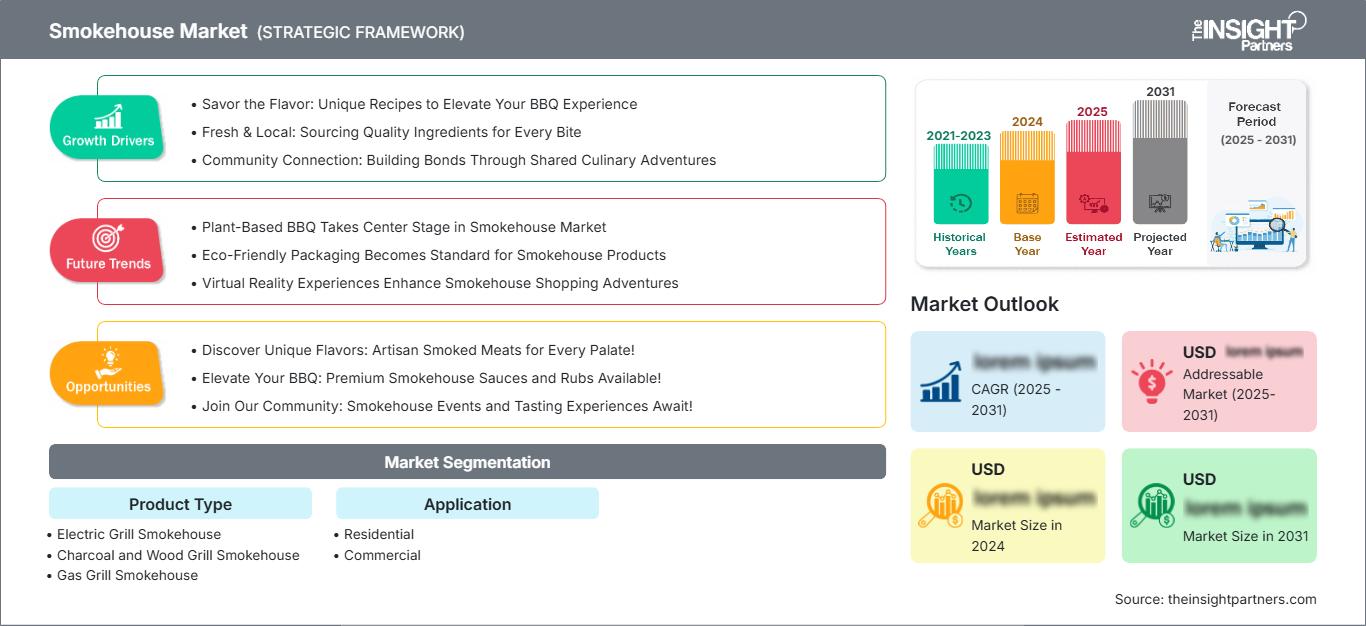
The Smokehouse Market was valued at US$ 151.35 Million in 2025 and is projected to reach US$ 202.54 Million by 2034, registering a CAGR of 3.29% from 2026 to 2034. The market covers equipment designed for controlled smoking and slow cooking across residential and commercial settings, with product differentiation based on electric grill smokehouses, charcoal and wood grill smokehouses, and gas grill smokehouses. Demand is shaped by outdoor cooking adoption, foodservice requirements, equipment convenience, cooking consistency, and the continuing preference for smoke-infused food preparation.
The Smokehouse Market size outlook in North America is supported by established barbecue culture, broad household ownership of outdoor cooking equipment, and replacement demand for digitally controlled and more efficient smokers. The region is also characterized by a mature commercial foodservice ecosystem, established specialty retailers, and strong product development activity around temperature control, connectivity, fuel efficiency, and multi-function cooking equipment.
Smokehouse Market Assessment and Insights
Regional Outlook
- North America: ~35% of the global market in 2025 | ~3% CAGR through 2034. Market position: North America represents the largest regional market, supported by established outdoor cooking practices, high household participation in grilling and smoking, extensive specialty retail distribution, and a mature commercial barbecue equipment base.
- US: ~80% of North American market revenue in 2025 | ~3% CAGR through 2034. Market position: The US accounts for the largest share within North America because residential barbecue culture is deeply established, while restaurants, caterers, and specialty food operators sustain demand for higher-capacity commercial smokehouses.
- Europe: ~30% of the global market in 2025 | ~3% CAGR through 2034. Market position: Europe is a mature but diversified market, with demand supported by premium outdoor cooking, expanding barbecue culture, and foodservice applications. Germany represents the leading country in Europe, followed by established demand in the UK, France, Italy, and Spain.
- Asia Pacific: ~25% of the global market in 2025 | ~5% CAGR through 2034. Market position: Asia Pacific is the fastest-growing region as premium outdoor cooking gains traction, organized foodservice expands, and manufacturers introduce compact and digitally controlled equipment. China represents the leading country in Asia Pacific, supported by manufacturing depth and expanding consumer demand.
Segment Outlook
- Application - Residential: ~70% Share in 2025 | ~3% CAGR through 2034. Market position: Residential use leads because smokehouses are increasingly positioned as accessible outdoor cooking appliances. Demand is reinforced by backyard entertainment, product simplification, digital temperature controls, and growing consumer interest in slow-cooked food.
- Application - Commercial: ~30% Share in 2025 | ~5% CAGR through 2034. Market position: Commercial applications represent the higher-growth main segment as restaurants, catering businesses, and specialty food operators seek repeatable smoking performance, larger cooking capacity, lower labor requirements, and equipment capable of integrating smoking with cooking and holding.
Competitive Coverage
Town Food Service Equipment Co., Inc., Masterbuilt, Char-Broil, Southern Pride, Alto-Shaam, ScottPec, Inc., Bradley Smoker, Camp Chef, Old Smokey, LANDMANN
Methodology
The Insight Partners follows Data Collection & Secondary Research, Primary Research, Data Analysis, and Data Triangulation & Final Review to validate market estimates and insights.
Source: The Insight Partners' analysis based on proprietary research, government publications, company annual reports, investor presentations, industry databases, and expert interviews.
In the Smokehouse Market, innovations have shifted towards equipment where smoke generating technology is accompanied by more efficient temperature control systems. Such innovations as electric controls, digital thermostats, probe integration, wireless communication, insulation of the cooking area, and charcoal gravity feed systems minimize the extent of operator intervention involved in long cooking processes. At the commercial level, manufacturers are integrating the process of smoking with cooking and holding functions, thus allowing foodservice operators to control the process of manufacturing in a consistent manner. The portfolio of products includes residential products, vertical smokers, mobile commercial solutions, and smoker ovens of high capacity.
Between now and 2034, demand will continue to be irregular in different geographies and applications. In emerging markets within Asia Pacific, it can be positively affected by growing disposable incomes, increased familiarity with barbecue in Western countries, and development of organized foodservice. In mature markets, the drivers will not be new purchases, but rather replacement cycles, premiumization, connectivity, and upgrading of existing equipment. Regulations addressing the safety of outdoor appliances, energy use, emissions, and electrical reliability will also affect the product development trends.
Smokehouse Market Report Scope
| Report Attribute | Details |
|---|---|
| Market size in 2025 | US$ 151.35 Million |
| Market Size by 2034 | US$ 202.54 Million |
| Global CAGR (2026 - 2034) | 3.29% |
| Historical Data | 2021-2024 |
| Forecast period | 2026-2034 |
Smokehouse Market Analysis
The demand is driven by two related eco-systems – outdoor cooking at home and cooking in commercial establishments. In terms of residential users, there has been increasing interest in those products that are easy to manage in terms of controlling the temperature, whereas commercial customers look for efficient production, repeatability of cooking, and consistency in work. The value chain includes the following participants: manufacturers of cooking equipment, heating system providers and manufacturers of control systems, metal fabricators, providers of fuels and woodchips, distributors, specialized retailers, and foodservice equipment dealers.
The Smokehouse Market Growth is fueled by replacement demand and incremental adoption of equipment with electronic control. Differentiation opportunities include capacity for cooking, insulation, accuracy of control, ability to be connected, use of different fuels, mobility, and easy cleaning. Buyers of commercial food preparation equipment are now starting to evaluate the equipment not only by the price, but also by its efficiency in work. In this way, suppliers with equipment having abilities of smoking, cooking, and holding can satisfy the needs other than smoking.
Competitors range from existing outdoor cookers and specialist manufacturers of commercial equipment. Masterbuilt offers electric, propane, and charcoal-based products such as digital controllers and connected smokers whereas Char-Broil is in competition with outdoor cooking equipment that is electric and other types of smokers. Southern Pride has its strengths in commercial gas, electric and mobile smokers and Alto-Shaam with commercial smoker ovens for smoking, cooking and holding. Camp Chef and LANDMANN cater to outdoor cooking consumers while Town Food Service Equipment Co., Inc., ScottPec, Inc., Bradley Smoker and Old Smokey are specialized equipment providers.
The Smokehouse Market Report also shows that current investments trends are focused on control, convenience and lifecycle economics. The residential manufacturers can boost their addressable demand by making operation simple and installing smart controls without sacrificing the sensorial aspects of smoking. Commercial manufacturers can leverage themselves with programmable recipes, remote monitoring, optimized capacity, lower labor requirements and flexible equipment. Strategic positioning is becoming increasingly determined by the capability of providing a blend of authentic smoking and predictable results.
● REPORT CUSTOMIZATION
Tailor This Report To Align With Your Specific Business Requirements
This report can be customized to align precisely with your business objectives, scope, and target markets. Customization options include tailored segmentation, geography, competitive analysis, and strategic insights to support informed decision-making.
Customize This Report →WHAT YOU CAN ADJUST
- ● Segmentations
- ● Geography
- ● Competitive Analysis
- ● Language Preferences
Smokehouse Market: Strategic Insights
Regional Insights
North America Smokehouse Market
North America accounted for ~35% of the global Smokehouse Market in 2025 and is projected to expand at ~3% CAGR through 2034. The region has a mature outdoor cooking ecosystem supported by established barbecue traditions, widespread retail availability, specialty distributors, and a substantial installed base. Replacement demand is therefore an important component of market development, particularly as consumers move toward products offering better temperature control and easier operation.
The United States is considered to be the largest national market within North America, contributing around 80% to the regional revenues in 2025. The residential demand includes backyard cooking and entertaining, while the commercial demand is attributed to restaurants, caterers, barbecue experts, and foodservice providers. Innovations in product design are becoming more concentrated on digital control, monitoring, multifunction cooking, and fuel management. Canada adds extra demand due to residential outdoor cooking and foodservice applications, however, it is smaller than the US market.
U.S. Smokehouse Market
The United States had a share of around 80% in North American Smokehouse Market revenues in 2025 and was estimated to register ~3% CAGR during the period till 2034. The US enjoys an established barbecue culture, together with significant involvement in cooking outdoors. Product ranges from small portable electric and propane smokers to larger charcoal and commercial smokers, forming several price and performance levels.
US competitors are Masterbuilt, Char-Broil, Southern Pride, Alto-Shaam, Camp Chef, Old Smokey, and others. The residential segment still remains relevant due to the fact that convenient products simplify the process technically. For commercial applications, throughput, reliability, efficiency, and multifunctionality gain relevance, especially in restaurants and catering businesses. Smart controls and programmability become distinguishing factors if the client is interested in remote management and repeatable cooking procedures.
Europe Smokehouse Market
In 2025, Europe was estimated to account for ~30% of the global Smokehouse Market Share and is anticipated to grow ~3% CAGR up to 2034. In Europe, Germany has the largest share because of strong outdoor cooking participation, manufacturing capacity, specialty distribution, and the need for high-end equipment. The UK has a well-developed barbecue and smoking culture, but the demand covers not only backyard enthusiasts but also American barbecue restaurants. France and Italy are active in premium outdoor cooking and professional foodservice while Spain profits from good conditions for outdoor eating and hospitality business.
The difference in the European market compared to North America is that smoking is considered along with outdoor cooking and culinary experience in general, which means it cannot be regarded as a dominating cooking technique on its own. The differentiation therefore focuses on product features such as design, compactness, fuel versatility, controllability, and convenience. The commercial segment is also interested in efficiency and effective space utilization, driving the demand for electric and multifunctional products.
APAC Smokehouse Market
The Asia Pacific segment accounts for ~25% of the global market share in 2025 and is set to witness ~5% CAGR until 2034 to become the fastest growing region. The largest market within the APAC segment is China, driven by production facilities, growing consumer spending power, and outdoor cooking equipment availability. Japan and South Korea make their contribution through premium cooking appliances and food cultures, while India and Australia create additional demand through hospitality and barbecue-based foodservice.
Production facilities help create supply availability in the region, whereas rising organized foodservice helps drive demand for commercial kitchen equipment. Companies are increasingly becoming able to cater to the regional market with miniaturized products, digitally controlled cooking appliances, and smaller space cooking appliances. The barbecue culture is well established in Australia, whereas the demand in China, India, and other countries in the Asia region is still developing due to low penetration levels.
Middle East & Africa Smokehouse Market
Middle East & Africa is developing from a comparatively smaller installed base, with demand supported by hospitality, tourism, outdoor dining, premium residential developments, and foodservice investment. Saudi Arabia represents an important market in the Middle East because of hospitality and tourism expansion, while the UAE benefits from a concentration of hotels, restaurants, catering businesses, and premium residential consumers. South Africa provides a distinct outdoor cooking culture and contributes to regional demand.
The region is expected to register ~4% CAGR through 2034. Commercial requirements are particularly relevant where hospitality operators need consistent cooking capacity and specialized barbecue menus. Residential adoption remains concentrated among higher-income consumers and outdoor entertainment applications. Equipment suppliers that can provide reliable operation in demanding climates, straightforward maintenance, and suitable fuel configurations can address operational requirements across the region.
Segmentation Analysis
Product Type
The Product Type segment in the Smokehouse Market is expected to register ~3% CAGR from 2026 to 2034. Product selection reflects the trade-off between flavor characteristics, operating convenience, temperature control, fuel availability, and equipment cost. Electric products appeal to users prioritizing simplicity and precise control, while charcoal and wood systems retain strong appeal among users seeking traditional smoke characteristics. Gas systems provide rapid heating and operational control, particularly for commercial users.
- Electric Grill Smokehouse: Electric models appeal to residential users seeking convenient temperature management and comparatively simple operation. Digital controls, programmable settings, integrated probes, and connected features can reduce manual intervention, supporting adoption where convenience is prioritized over traditional fuel handling.
- Charcoal and Wood Grill Smokehouse: Charcoal and wood systems remain important for users seeking traditional smoke profiles and direct control over fuel and wood selection. Their strategic importance is strongest among barbecue enthusiasts and commercial operators where authentic smoke characteristics form part of the product offering.
- Gas Grill Smokehouse: Gas models provide controllable heat and relatively straightforward operation, making them relevant to both residential and commercial users. Commercial demand benefits from faster temperature recovery, scalable equipment configurations, and compatibility with established foodservice operating practices.
Application
The Application segment in the Smokehouse Market is projected to register ~4% CAGR through 2034. Demand is divided between residential users purchasing smokehouses for outdoor cooking and commercial users seeking equipment for restaurants, catering, hospitality, and specialized food production. Commercial applications have a higher growth trajectory because operators increasingly evaluate equipment based on labor savings, consistency, throughput, and multifunctional use.
- Residential: Residential demand is supported by backyard cooking, recreational use, entertaining, and interest in slow-cooked food. Compact footprints, digital controls, simplified cleaning, and connectivity are important product attributes because they allow occasional users to achieve more consistent results without extensive smoking expertise.
- Commercial: Commercial users prioritize capacity, reliability, repeatability, labor productivity, and integration with broader kitchen workflows. Restaurants and caterers can use larger smokehouses to produce meat and other smoked foods at scale, while programmable controls and cook-and-hold functionality can improve production planning.
Opportunity Snapshot
| Application | Revenue Contribution | Trend Tag | Adoption Stage |
| Residential | High | Backyard Cooking | Mature |
| Commercial | Medium | Labor Efficiency | Scaling |
Smokehouse Market Growth Drivers and Impact Analysis
Rising Demand for Convenient Outdoor Cooking Equipment
Consumer expectations around outdoor cooking are shifting toward equipment that delivers traditional flavors with less active supervision. Digital temperature controls, integrated probes, automated fuel management, and connected interfaces reduce the amount of manual adjustment required during extended cooking cycles. This expands the potential customer base beyond experienced barbecue enthusiasts to households that may previously have considered smoking too complex or time intensive. Manufacturers can respond by offering multiple control tiers, from simple thermostatic systems to fully connected platforms. The market impact is strongest in residential channels, where ease of use directly affects purchase decisions and replacement preferences. As convenience becomes a standard expectation, equipment suppliers increasingly compete on the overall cooking experience rather than only on chamber capacity or fuel type.
Expansion of Commercial Foodservice Smoking Applications
Restaurants, catering businesses, hotels, and specialty food operators are incorporating smoked proteins and other smoked foods into menus, creating demand for equipment capable of producing consistent results at higher volumes. Commercial buyers increasingly assess smokehouses through operational metrics such as cooking capacity, labor requirements, temperature consistency, recovery time, cleaning, and utilization across multiple menu items. This favors equipment that combines smoking with cooking and holding functions. Commercial smokehouses can also support centralized food preparation, allowing operators to prepare batches in advance and synchronize production with service periods. The resulting demand is less dependent on hobbyist participation and more closely linked to foodservice expansion, menu diversification, and the need to standardize output across multiple locations.
Product Integration and Multi-Function Equipment Development
Equipment manufacturers are increasingly combining smoking, grilling, cooking, and holding capabilities within the same platform. This approach allows customers to obtain more utility from limited kitchen or outdoor space and can improve equipment utilization across different cooking periods. Integrated systems are particularly relevant to commercial operators that need to maximize productivity from fixed kitchen footprints. Residential buyers can also benefit from hybrid products that support multiple cooking methods without requiring several appliances. The impact on competition is a gradual shift from single-function product differentiation toward broader equipment ecosystems. Suppliers with capabilities in controls, thermal management, software, accessories, and after-sales service can build more comprehensive product propositions and address multiple customer needs through a single equipment platform.
Smokehouse Market Future Trends
Smart Monitoring and Connected Smoking Systems
Smokehouse Market trends are expected to increasingly center on connected monitoring and intelligent temperature management. Wi-Fi and Bluetooth-enabled equipment can allow users to monitor cooking conditions remotely, receive alerts, adjust settings, and track cooking progress through mobile interfaces. The commercial opportunity extends beyond consumer convenience because connected equipment can support recipe standardization, operating visibility, maintenance monitoring, and centralized management across multiple locations. Over time, connectivity can become integrated with temperature probes, programmable cooking stages, automated alerts, and cloud-based equipment management. The technology is unlikely to eliminate traditional smoking methods, but it can reduce operational complexity and make long-duration cooking more predictable. Suppliers that successfully integrate digital functionality without compromising reliability and ease of use can strengthen differentiation in both residential and commercial channels.
Greater Emphasis on Energy Efficiency and Operating Economics
Future equipment development is likely to place greater emphasis on insulation, heat retention, fuel efficiency, thermal recovery, and optimized cooking cycles. Higher energy and labor costs make operating economics increasingly relevant to commercial customers, while residential buyers are also more attentive to fuel consumption and convenience. Electric systems can benefit from precise temperature management, while gas and charcoal systems can improve efficiency through better airflow control and insulation. Commercial smoker ovens may increasingly integrate cook-and-hold capabilities to reduce equipment duplication and make better use of overnight preparation periods. This trend could encourage manufacturers to invest in thermal engineering, improved controls, and equipment monitoring rather than relying solely on larger cooking chambers or higher heating capacity as primary differentiators.
Smokehouse Market Opportunities
Expansion of Commercial and Multi-Location Foodservice Solutions
Smokehouse Market Forecasts indicate an opportunity for suppliers to develop commercial platforms targeted at restaurants, hospitality groups, caterers, and multi-location foodservice operators. These customers can benefit from standardized recipes, programmable cooking cycles, remote monitoring, consistent smoke profiles, and cook-and-hold functionality. Equipment suppliers can also create value through service contracts, maintenance programs, accessories, replacement components, and digital support. Multi-location operators are particularly relevant because consistent equipment settings can help reduce variation between kitchens. The opportunity extends beyond traditional barbecue restaurants into hotels, casual dining, catering, and specialty food businesses that use smoked ingredients as part of broader menus. Manufacturers that combine equipment reliability with operational software and service capabilities can address a wider portion of the commercial purchasing decision.
Premium Residential Equipment and Smart Product Upgrades
A second opportunity lies in premium residential equipment that combines traditional smoking characteristics with simplified controls and connected functionality. Consumers who already participate in outdoor cooking represent a natural upgrade pool for larger cooking chambers, better insulation, integrated temperature probes, automated fuel management, and mobile monitoring. Product manufacturers can segment offerings according to cooking capacity, fuel type, control sophistication, and accessory compatibility. Premium positioning does not necessarily require highly complex equipment; intuitive controls and reliable performance can be equally important for adoption. Manufacturers can also expand recurring revenue through accessories, replacement components, covers, fuel products, and digital content. The opportunity is therefore linked to both new household adoption and replacement of older manually controlled equipment.
Recent Developments
- September 2026: Char-Broil, LLC — Char-Broil announced a voluntary recall of certain Bistro Pro electric grills manufactured between October and December 2025 in cooperation with the US Consumer Product Safety Commission and Health Canada. The development illustrates the continuing importance of electrical safety, product compliance, and post-sale support as electric outdoor cooking equipment expands.
- September 2025: Alto-Shaam — Alto-Shaam announced that it would showcase its commercial cooking and holding technologies at HOST Milano 2025 as part of its 70th anniversary activities. Its smoker-oven portfolio combines smoking, cooking, and holding functions, while advanced models incorporate touchscreen controls and ChefLinc remote management.
- January 2025: Weber LLC — Weber introduced its 2025 product collection, including the Weber SMOQUE pellet smoker, alongside new grills, griddles, and outdoor cooking accessories. The launch reflects continued product development around simplified outdoor cooking, versatility, and dedicated smoking equipment for consumers.
Frequently Asked Questions

- Comprehensive Market Sizing and Forecast Analysis
- Detailed Segmentation Analysis
- In-Depth Market Dynamics Assessment
- Regional and Country-Level Insights
- Competitive Landscape and Company Benchmarking
- Strategic Business Intelligence
Recent Reports
Testimonials

The Insight Partners provided valuable market intelligence that supported our global go-to-market strategy. Their team was professional, responsive, and attentive to our feedback, providing thoughtful analysis and helpful methodological clarifications throughout the project.
Junmo Kim Chief Financial Officer (CFO), Enertech Co., Ltd.
The Insight Partners' SCADA System Market report is comprehensive, with valuable insights on current trends and future forecasts. The team was highly professional, responsive, and supportive throughout. We are very satisfied and highly recommend their services.
RAN KEDEM Partner, Reali Technologies LTDs
I requested a report on a very specific software market and the team produced the report in a few days. The information was very relevant and well presented. I then requested some changes and additions to the report. The team was again very responsive and I got the final report in less than a week.
JEAN-HERVE JENN Chairman, Future Analytica
We worked with The Insight Partners for an important market study and forecast. They gave us clear insights into opportunities and risks, which helped shape our plans. Their research was easy to use and based on solid data. It helped us make smart, confident decisions. We highly recommend them.
PIYUSH NAGPAL Sr. Vice President, High Beam Global
The Insight Partners delivered insightful, well-structured market research with strong domain expertise. Their team was professional and responsive throughout. The user-friendly website made accessing industry reports seamless. We highly recommend them for reliable, high-quality research services
YUKIHIKO ADACHI CEO, Deep Blue, LLC.
This is the first time I have purchased a market report from The Insight Partners.While I was unsure at first, I visited their web site and felt more comfortable to take the risk and purchase a market report.I am completely satisfied with the quality of the report and customer service. I had several questions and comments with the initial report, but after a couple of dialogs over email with their analyst I believe I have a report that I can use as input to our strategic planning process.Thank you so much for taking the extra time and making this a positive experience.I will definitely recommend your service to others and you will be my first call when we need further market data.
JOHN SUZUKI President and Chief Executive Officer, Board Director, BK Technologies
I wish to appreciate your support and the professionalism you displayed in the course of attending to my request for information regarding to infectious disease IVD market in Nigeria. I appreciate your patience, your guidance, and the fact that you were willing to offer a discount, which eventually made it possible for us to close a deal. I look forward to engaging The Insight Partners in the future, all thanks to the impression you have created in me as a result of this first encounter.
DR CHIJIOKE ONYIA MANAGING DIRECTOR, PineCrest Healthcare Ltd.Reason to Buy
- Informed Decision-Making
- Understanding Market Dynamics
- Competitive Analysis
- Identifying Emerging Markets
- Customer Insights
- Market Forecasts
- Risk Mitigation
- Boosting Operational Efficiency
- Strategic Planning
- Investment Justification
- Tracking Industry Innovations
- Aligning with Regulatory Trends





 Get Free Sample for