
Soil Aerators Market Demand, Size & Forecast by 2034
Coverage: by Type (Vertical Type Shelling Machine, Horizontal Type Shelling Machine); Application (Nuts, Grain, Seeds, Others), and Geography (North America, Europe, Asia Pacific, and South and Central America)
- Status : Data Released
- Report Code : TIPRE00010637
- Category : Manufacturing and Construction
- No. of Pages : 150
- Available Report Formats :


- Last update date : October 26, 2026


2025 Market Size
US$ 2.97 Bn
Base year value
2034 Forecast
US$ 5.14 Bn
Projected by 2034
CAGR 2026-2034
6.28 %
Growth rate
Addressable Market
US$ 36.70 Bn
(2026-2034)
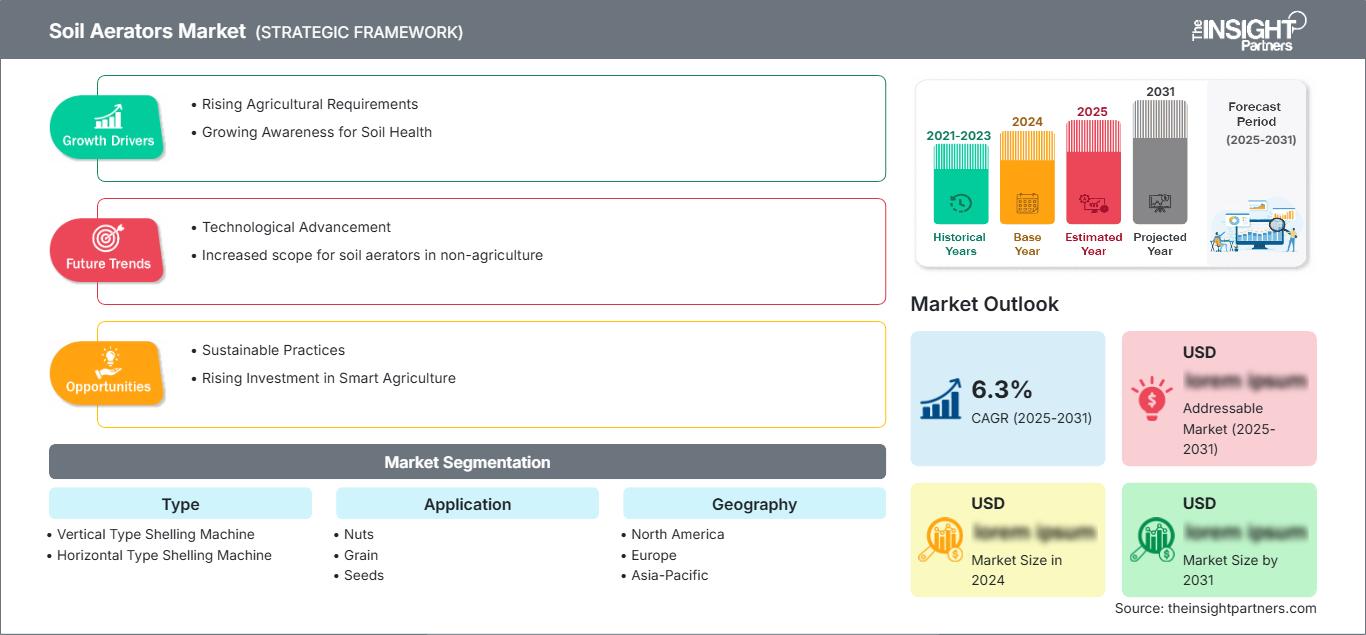
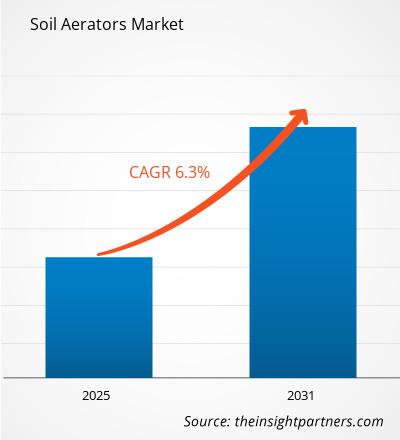
The Soil Aerators Market size is valued at US$ 2.97 Billion in 2025 and is projected to reach US$ 5.14 Billion by 2034, registering a CAGR of 6.28% from 2026 to 2034. The market encompasses equipment and machinery used to improve soil structure, relieve compaction, support air and water movement, and prepare agricultural or managed land for productive cultivation. Demand is influenced by mechanization, soil-health management, farm productivity requirements, equipment modernization, and increasing emphasis on efficient land preparation.
North America represents a significant demand center, supported by mechanized farming, large commercial agricultural operations, and continued investment in equipment that addresses compaction and soil productivity. The Sodium-ion Battery Market size equivalent requested by the supplied keyword framework is not applicable to this market, so the relevant outlook instead centers on equipment utilization, replacement cycles, and adoption of advanced soil-management machinery. The regional market is modeled to expand at approximately ~7% CAGR through 2034, supported by precision agriculture and equipment modernization.
Soil Aerators Market Assessment and Insights
Regional Outlook
- North America: ~24% of the global Soil Aerators Market share in 2025 | ~7% CAGR through 2034. Market position: North America maintains a major market position because large-scale mechanized farming supports recurring demand for soil-management equipment. Commercial farms increasingly prioritize compaction control, moisture management, reduced field passes, and compatibility with precision agriculture systems.
- US: ~78% of North American market revenue in 2025 | ~7% CAGR through 2034. Market position: The US accounts for most North American demand, supported by extensive mechanized acreage, established equipment distribution, and strong adoption of tillage and soil-management implements. Equipment purchases increasingly emphasize operating efficiency, soil conservation, and adaptable attachments.
- Europe: ~23% of the global market in 2025 | ~6% CAGR through 2034. Market position: Europe has a mature equipment base and strong emphasis on sustainable agriculture, soil conservation, and reduced disturbance. Germany represents the leading country in Europe, while the UK, France, Italy, and Spain contribute through diversified agricultural and horticultural applications.
- Asia Pacific: ~34% of the global market in 2025 | ~8% CAGR through 2034. Market position: Asia Pacific is the fastest-growing major region as agricultural mechanization expands and producers seek improved soil preparation, water management, and field productivity. China represents the leading country in Asia Pacific, followed by substantial demand development in India, Japan, South Korea, and Australia.
Segment Outlook
- Vertical Type Shelling Machine: ~57% Share in 2025 | ~7% CAGR through 2034. Market position: Within the supplied segmentation taxonomy, vertical-type equipment represents the larger type category because compact processing configurations can support consistent material handling and throughput. Adoption is linked to mechanization and the need to reduce labor-intensive agricultural processing.
- Grain: ~38% Share in 2025 | ~8% CAGR through 2034. Market position: Grain represents the high-growth application category in the supplied taxonomy because large-volume crop processing creates a strong requirement for mechanized separation. Demand is supported by commercial farming, post-harvest processing, labor efficiency, and modernization of agricultural handling systems.
Competitive Coverage
Alstrong Ltd., Deere and Company, Evers Agro, Husqvarna AB, Kubota Australia Pty Ltd, MultiOne, Salford Group, Inc., Schiller Grounds Care, Inc., Selvatici Srl, Vanmac B.V.
Methodology
The Insight Partners follows Data Collection & Secondary Research, Primary Research, Data Analysis, and Data Triangulation & Final Review to validate market estimates and insights.
Source: The Insight Partners' analysis based on proprietary research, government publications, company annual reports, investor presentations, industry databases, and expert interviews.
The Soil Aerators Market has kept pace with mechanization trends in agriculture, with products being developed in the form of equipment that has capabilities to carry out multiple tasks including soil loosening, compaction control, moisture movement, residue management, and seedbed preparation. Innovations have been in the direction of developing machines that not only can complete several tasks at once but can make minimum passes through cultivated fields. Features such as adjustability in intensity of work, interchangeable attachments, and adaptability to tractors and other machines have become more common in modern machines.
As far as future trends are concerned, adoption of these machines is going to gain momentum in newly emerging agricultural regions where mechanization is gaining pace from low installed bases. There is a lot of potential in the Asia Pacific region since farm modernization, commercial farming, and localization of equipment can open new markets. Europe may continue to be affected by soil conservation and sustainable farming practices, while North America will benefit from replacement opportunities.
Soil Aerators Market Report Scope
| Report Attribute | Details |
|---|---|
| Market size in 2025 | US$ 2.97 Billion |
| Market Size by 2034 | US$ 5.14 Billion |
| Global CAGR (2026 - 2034) | 6.28% |
| Historical Data | 2021-2024 |
| Forecast period | 2026-2034 |
Soil Aerators Market Analysis
The Soil Aerators Market is driven by a desire for better soil structure, soil compaction relief, water management, and effective field preparation. Farm operations look for machines that will be able to fulfill several roles with minimal number of passes in order to cut down machinery time and enhance planning. The supply chain encompasses equipment producers and component producers, tractor manufacturers, dealers, rental businesses, agronomy companies, and farmers.
Equipment choice in the Soil Aerators Market is affected by soil characteristics, size of farmland, crops grown, compatibility with tractors used, maintenance considerations, and degree of soil disturbance required. Supply factors include steel prices, cost of components, production capacity, presence of dealer network, compatibility of attachments, and regional manufacturing capabilities. Manufacturers of wide range of implements can cross-sell their equipment through the existing agricultural distribution networks, while specialized producers will compete through engineering that is application-specific.
Positioning in the Soil Aerators Market is a result of variations in product range, regional presence, engineering, and customer relations. Deere and Company, Kubota Australia Pty Ltd, Salford Group, Inc., Evers Agro, Husqvarna AB, MultiOne, Schiller Grounds Care, Inc., Selvatici Srl, Vanmac B.V., and Alstrong Ltd. meet diverse combinations of needs regarding agriculture, turf, landscaping, and soil management. In terms of product differentiation, an emphasis should be placed on versatility, durability, flexibility in the working width, reduced passes, and compatibility with existing agricultural machinery.
There is also a trend towards investing in equipment which would help to perform cultivation effectively while using fewer resources. Companies can create competitive advantage through creating modular equipment, increasing compatibility of attachments, extending dealer network, and tailoring the machinery for specific soils and crops. Compatibility of equipment with digital guidance systems will allow to achieve better utilization as well as regulate the working depth and intensity.
● REPORT CUSTOMIZATION
Tailor This Report To Align With Your Specific Business Requirements
This report can be customized to align precisely with your business objectives, scope, and target markets. Customization options include tailored segmentation, geography, competitive analysis, and strategic insights to support informed decision-making.
Customize This Report →WHAT YOU CAN ADJUST
- ● Segmentations
- ● Geography
- ● Competitive Analysis
- ● Language Preferences
Soil Aerators Market: Strategic Insights
Regional Insights
North America Soil Aerators Market
The North American Soil Aerators Market is modeled to account for ~24% of global revenue in 2025 and expand at ~7% CAGR through 2034. The US forms the main center of demand, with high agricultural mechanization, commercial farms, well-developed dealer networks, and extensive use of equipment fitted on tractors. The issue of soil compaction management remains important for row crops, pasture, hay, turf, and specialty crop production.
Machine demand will be affected by operational efficiency and versatility in coming years. Farmers may choose equipment which allows doing several processes at once, such as aerating, cultivating, managing residues, and preparing the soil. The replacement of old equipment becomes an ongoing source of demand, whereas precision farming will lead to more focus on field-specific operation of machines. Additional demand in Canada and Mexico comes from commercial agriculture and increased equipment use, but with a different market structure than the US.
U.S. Soil Aerators Market
The U.S. Soil Aerators Market represents approximately ~78% of North American revenue in 2025 and is modeled to expand at ~7% CAGR through 2034. The demand for the equipment is facilitated by the presence of large commercial farms, tractors, and soil management practices. Deere & Company has a wide variety of tillage and land preparation equipment, whereas Salford Group, Inc. has expertise in agricultural aeration and vertical tillage systems. Husqvarna AB also operates in aeration equipment for smaller applications.
The application includes the use of the equipment on row crop farms, pastures, hay farms, turf, and landscaping sites. Buyers are increasingly making purchasing decisions based on the criteria like working width, soil penetration, compaction alleviation, residue management, maintenance issues, and compatibility of equipment with tractors that are already in operation. There is also well-developed dealer and service network facilitating the maintenance and replacement of equipment in the United States market.
Europe Soil Aerators Market
Europe accounts for approximately ~23% of the global Soil Aerators Market in 2025 and is modeled to grow at ~6% CAGR through 2034. Germany is the leader in Europe, backed by a significant agricultural machinery industry and market of technologically advanced agricultural field machines. The UK continues to drive demand for agriculture, grassland, and managed turf, while France has its demand in terms of extensive agricultural activities that require versatile soil working machinery. Italy makes contributions through its specialized farming, horticulture, and equipment production, while Spain relies on its mechanical agriculture and cultivation practices that require effective moisture and soil control measures.
The demands in Europe are progressively based on the sustainability and conservation of the farmland, with minimal disturbance and efficient resource utilization. Machines are thus judged by their capacity to undertake various tasks without disrupting the soil structure. Machine manufacturers will thus create their differences through the capability of adjustment, maintenance simplicity, and compatibility with conservation practices.
The purchasing decisions in different regions will differ in terms of farm sizes and cropping systems. The northern and western European markets have already been mechanized and have replacement markets, while selected southern and eastern European markets offer opportunities through modernization.
APAC Soil Aerators Market
The APAC Soil Aerators Market represents approximately ~34% of global revenue in 2025 and is modeled to expand at ~8% CAGR through 2034, making it the fastest-growing major region. China is the leading country in Asia Pacific, supported by agricultural mechanization and a large production base. India is expanding equipment adoption as farms modernize, while Japan and South Korea emphasize efficient, technologically advanced machinery. Australia contributes through large-scale commercial agriculture.
Regional growth is linked to farm mechanization, labor availability, crop productivity objectives, and the need to improve soil conditions. Equipment suppliers can benefit from localized products, flexible tractor compatibility, and dealer partnerships tailored to fragmented and diverse agricultural markets.
Middle East & Africa Soil Aerators Market
The Middle East & Africa market is modeled to expand at ~6% CAGR through 2034. Saudi Arabia represents a leading country in the Middle East & Africa market where supported agricultural production requires careful management of water, soil conditions, and cultivation efficiency. The UAE also presents demand through controlled agricultural applications, landscaping, and technology-intensive cultivation systems.
South Africa provides a significant agricultural equipment base, while the rest of MEA presents longer-term potential as mechanization and commercial farming expand. Water efficiency is particularly important in arid markets, making soil structure and infiltration management relevant to equipment decisions. Infrastructure development, farm investment, machinery financing, and availability of after-sales service will influence the pace of adoption across the region.
Segmentation Analysis
Type
Vertical Type Shelling Machine is modeled to record a CAGR of ~7% during 2026–2034. Within the supplied taxonomy, vertical configurations are associated with mechanized processing requirements where operators seek consistent material handling, improved throughput, and reduced manual intervention. Their adoption can be supported by commercial processing facilities and farms transitioning from labor-intensive methods. The Sodium-ion Battery Market scope terminology supplied in the prompt does not align with this segmentation, so the analysis retains the provided type classification without changing the taxonomy.
- Vertical Type Shelling Machine: Demand is associated with operations requiring consistent separation and material throughput. Buyers may prioritize compact configurations, operating reliability, ease of maintenance, and compatibility with broader agricultural processing workflows. The category can gain traction as mechanization replaces labor-intensive shelling practices.
- Horizontal Type Shelling Machine: Horizontal configurations serve applications where equipment layout, material flow, and processing capacity influence purchasing decisions. Demand is shaped by crop characteristics, facility configuration, operator preferences, and requirements for integration with downstream cleaning, grading, or handling equipment.
Application
Grain is modeled to record a CAGR of ~8% during 2026–2034. Grain processing creates recurring equipment requirements because large-volume agricultural output must move efficiently through post-harvest handling systems. Mechanization can reduce manual processing requirements while supporting consistent separation quality. Demand is therefore connected with commercial farming, processing infrastructure, storage systems, and modernization of agricultural value chains.
- Nuts: Nut processing requires equipment capable of handling differences in shell characteristics, kernel sensitivity, and crop size. Buyers emphasize separation efficiency, product integrity, maintenance access, and processing consistency. Demand can increase as commercial nut cultivation and organized processing replace small-scale manual operations.
- Grain: Grain represents a high-volume application where mechanized processing can support productivity and labor efficiency. Equipment selection is influenced by throughput requirements, crop characteristics, processing-line integration, reliability, and the ability to maintain consistent separation across seasonal production cycles.
- Seeds: Seed applications require careful handling because product quality and integrity can influence downstream planting or processing outcomes. Buyers may prioritize controlled mechanical action, adaptability to different seed characteristics, low product damage, and compatibility with cleaning and sorting systems.
Opportunity Snapshot
| Application | Revenue Contribution | Trend Tag | Adoption Stage |
|---|---|---|---|
| Nuts | Medium | Nut Processing | Scaling |
| Grain | High | Bulk Processing | Mature |
| Seeds | Medium | Seed Handling | Scaling |
Soil Aerators Market Growth Drivers and Impact Analysis
Rising Mechanization and Farm Productivity Requirements
Agricultural producers are increasingly evaluating machinery according to the amount of work completed per operating hour, the number of field passes required, and the ability to maintain soil productivity. Soil aeration and related soil-management equipment can address compaction, improve air and water movement, and prepare fields for subsequent cultivation operations. These benefits are particularly relevant to larger farms and contractors where machinery utilization directly affects operating economics. Mechanization also reduces dependence on manual soil preparation and enables more consistent treatment across large areas. As agricultural labor availability becomes a constraint in several markets, equipment capable of performing multiple functions can gain commercial relevance. The impact extends beyond initial equipment purchases because higher utilization can support replacement demand, attachments, maintenance services, and dealer support.
Greater Focus on Soil Health and Resource Efficiency
Soil health is becoming an increasingly important component of farm-management decisions because compaction, poor infiltration, erosion, and inefficient moisture movement can constrain productivity. Aeration-oriented equipment provides a mechanical method for addressing selected soil conditions while supporting broader conservation practices. The commercial impact is strongest where farmers link soil management with water efficiency, root development, nutrient utilization, and long-term productivity. Equipment manufacturers can respond by developing machines that balance soil disturbance with operational effectiveness, allowing users to adjust working intensity according to field conditions. This approach supports demand for versatile implements rather than single-purpose machinery. Over time, resource-efficiency considerations can influence equipment specifications, financing decisions, and purchasing criteria across commercial agriculture, pasture management, turf, and landscaping applications.
Expansion of Precision and Multifunctional Agricultural Equipment
Precision agriculture is changing how machinery is selected and operated by increasing attention to field variability, application accuracy, operating depth, and machine utilization. Soil-management equipment can benefit when manufacturers integrate adjustable configurations and compatibility with modern tractors and guidance systems. Multifunctionality is another important factor because farmers can reduce equipment duplication when one platform performs aeration, cultivation, residue management, or seedbed preparation tasks. The commercial effect is a shift toward higher-value machinery with broader application potential. Manufacturers can strengthen customer retention by offering modular attachments, service support, and equipment configurations adapted to different soil conditions. This also creates opportunities for dealers and contractors to expand service offerings around soil preparation rather than relying solely on equipment sales.
Soil Aerators Market Future Trends
Shift Toward Multifunctional Soil-Management Platforms
The Soil Aerators Market trends are increasingly likely to favor equipment platforms capable of performing multiple field functions rather than narrowly defined single-operation machines. Farmers and contractors can improve machinery utilization when a common frame or power unit supports different attachments and working configurations. This approach can reduce storage requirements, increase annual utilization, and allow equipment to be adapted to changing seasonal conditions. Manufacturers are therefore likely to focus on modularity, adjustable working intensity, simplified attachment changes, and broader tractor compatibility. The trend also supports stronger demand for machines that combine soil aeration with cultivation, residue management, pasture renovation, or seedbed preparation. Commercial success will depend on demonstrating measurable operating value while preserving ease of use and maintenance simplicity.
Greater Integration of Soil Data With Equipment Decisions
Future equipment purchasing and operating decisions are likely to become more closely connected with field-level soil information. Mapping, guidance systems, soil testing, moisture measurements, and farm-management software can help operators identify areas requiring different levels of compaction relief or soil treatment. Equipment manufacturers may increasingly design machines that can respond to these variations through adjustable depth, intensity, or attachment configuration. Such integration can improve input efficiency by reducing unnecessary treatment and supporting more targeted field operations. The development of connected machinery can also create recurring software, service, and data opportunities around equipment ownership. Adoption will vary according to farm size, technology readiness, connectivity, and the availability of compatible machinery platforms.
Soil Aerators Market Opportunities
Expansion Across Emerging Mechanized Farming Economies
Emerging agricultural economies offer opportunities where mechanization levels remain below those of mature farming markets. Increasing farm commercialization, labor constraints, expanding equipment dealerships, and demand for higher field productivity can create new customer segments for soil-management machinery. Manufacturers can address these markets through lower-complexity configurations, adaptable tractor requirements, localized service networks, and financing partnerships. India and selected Asia Pacific markets are particularly relevant because agricultural modernization can support gradual movement from manual or low-mechanization practices toward equipment-intensive production. Suppliers that understand local soil conditions, farm sizes, crop patterns, and purchasing constraints can improve market access. The Soil Aerators Market Forecasts therefore depend substantially on the pace of mechanization and the ability of suppliers to match equipment economics with regional farm structures.
Development of Specialized Equipment and Service Models
Another opportunity lies in specialized equipment for distinct soil conditions, crops, and customer groups. Contractors, commercial farms, turf operators, pasture managers, and horticultural producers may require different working widths, attachment configurations, operating depths, and mobility characteristics. Manufacturers can develop targeted models while using common components and platforms to manage production complexity. Equipment-as-a-service and contractor-led operating models can also lower adoption barriers where individual farms do not use aeration machinery frequently enough to justify ownership. Dealers can support this model through rental, demonstrations, seasonal servicing, and replacement programs. Such strategies can expand the addressable customer base while creating recurring revenue opportunities around equipment maintenance, parts, attachments, and field services.
Recent Developments
- August 2025: Salford Group, Inc. appointed Kevin Hallahan as Vice President of Sales and Marketing, with responsibility for global sales and marketing and continued development of dealer relationships. The appointment supports the company's commercial organization around tillage and agricultural equipment, including its AerWay soil-aeration portfolio.
- January 2025: Evers Agro presented new agricultural equipment innovations at Agritechnica 2025, including the Toric Mono disc cultivator injector and a strip-till element with hydraulic stone protection. The company also highlighted soil-cultivation equipment and a grassland aerator range, reinforcing its focus on soil management and field productivity.
- January 2025: Deere and Company continued expanding its land-preparation portfolio with equipment focused on soil loosening, tillage, seedbed preparation, and compaction management. Its Power Harrow offering is positioned for seedbed preparation and soil-structure improvement, while its broader implement portfolio addresses primary and secondary tillage applications.
Frequently Asked Questions

- Comprehensive Market Sizing and Forecast Analysis
- Detailed Segmentation Analysis
- In-Depth Market Dynamics Assessment
- Regional and Country-Level Insights
- Competitive Landscape and Company Benchmarking
- Strategic Business Intelligence
Recent Reports
Testimonials

The Insight Partners provided valuable market intelligence that supported our global go-to-market strategy. Their team was professional, responsive, and attentive to our feedback, providing thoughtful analysis and helpful methodological clarifications throughout the project.
Junmo Kim Chief Financial Officer (CFO), Enertech Co., Ltd.
The Insight Partners' SCADA System Market report is comprehensive, with valuable insights on current trends and future forecasts. The team was highly professional, responsive, and supportive throughout. We are very satisfied and highly recommend their services.
RAN KEDEM Partner, Reali Technologies LTDs
I requested a report on a very specific software market and the team produced the report in a few days. The information was very relevant and well presented. I then requested some changes and additions to the report. The team was again very responsive and I got the final report in less than a week.
JEAN-HERVE JENN Chairman, Future Analytica
We worked with The Insight Partners for an important market study and forecast. They gave us clear insights into opportunities and risks, which helped shape our plans. Their research was easy to use and based on solid data. It helped us make smart, confident decisions. We highly recommend them.
PIYUSH NAGPAL Sr. Vice President, High Beam Global
The Insight Partners delivered insightful, well-structured market research with strong domain expertise. Their team was professional and responsive throughout. The user-friendly website made accessing industry reports seamless. We highly recommend them for reliable, high-quality research services
YUKIHIKO ADACHI CEO, Deep Blue, LLC.
This is the first time I have purchased a market report from The Insight Partners.While I was unsure at first, I visited their web site and felt more comfortable to take the risk and purchase a market report.I am completely satisfied with the quality of the report and customer service. I had several questions and comments with the initial report, but after a couple of dialogs over email with their analyst I believe I have a report that I can use as input to our strategic planning process.Thank you so much for taking the extra time and making this a positive experience.I will definitely recommend your service to others and you will be my first call when we need further market data.
JOHN SUZUKI President and Chief Executive Officer, Board Director, BK Technologies
I wish to appreciate your support and the professionalism you displayed in the course of attending to my request for information regarding to infectious disease IVD market in Nigeria. I appreciate your patience, your guidance, and the fact that you were willing to offer a discount, which eventually made it possible for us to close a deal. I look forward to engaging The Insight Partners in the future, all thanks to the impression you have created in me as a result of this first encounter.
DR CHIJIOKE ONYIA MANAGING DIRECTOR, PineCrest Healthcare Ltd.Reason to Buy
- Informed Decision-Making
- Understanding Market Dynamics
- Competitive Analysis
- Identifying Emerging Markets
- Customer Insights
- Market Forecasts
- Risk Mitigation
- Boosting Operational Efficiency
- Strategic Planning
- Investment Justification
- Tracking Industry Innovations
- Aligning with Regulatory Trends





 Get Free Sample for