
Solar Water Pump Market Size, Trends & Demand by 2034
Coverage: By Type (Submersible, Surface); Drive Type (AC Motor, DC Motor); End User (Residential, Commercial, Industrial) , and Geography (North America, Europe, Asia Pacific, and South and Central America)
- Status : Data Released
- Report Code : TIPRE00025684
- Category : Manufacturing and Construction
- No. of Pages : 150
- Available Report Formats :


- Last update date : October 16, 2026


2025 Market Size
US$ 701.41 Mn
Base year value
2034 Forecast
US$ 4,327.54 Mn
Projected by 2034
CAGR 2026-2034
22.41 %
Growth rate
Addressable Market
US$ 19,811.50 Mn
(2026-2034)
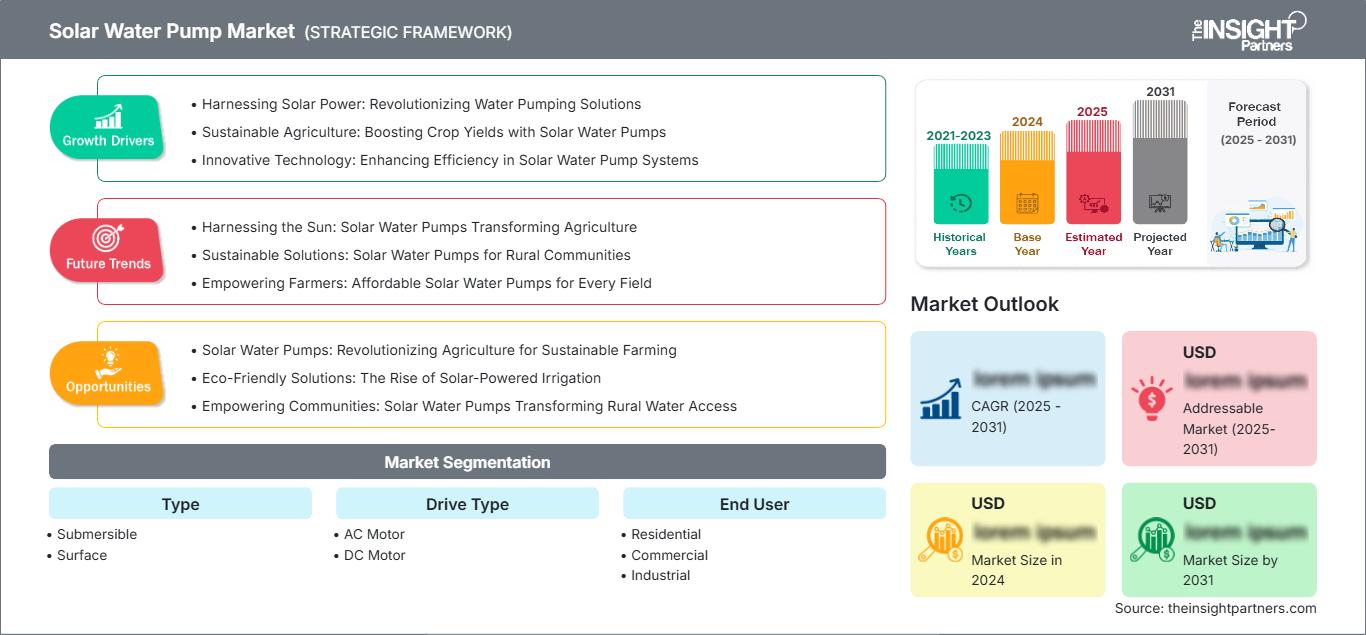
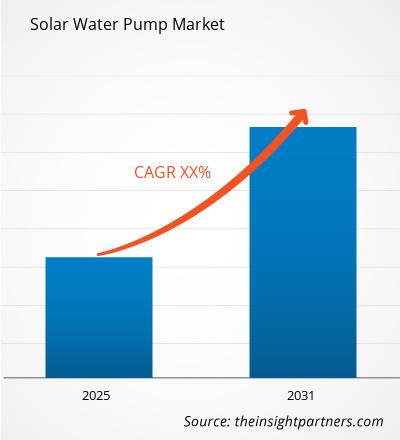
The Solar Water Pump Market is becoming an increasingly relevant solution for decentralized irrigation, rural water supply, livestock watering, and selected commercial applications where grid reliability or fuel availability constrains conventional pumping. The market was valued at US$ 701.41 Million in 2025 and is projected to reach US$ 4,327.54 Million by 2034, expanding at a CAGR of 22.41% from 2026 to 2034. Growth reflects the wider deployment of photovoltaic-powered pumping systems and the increasing demand for lower-operating-cost water infrastructure.
North America represents an established application base for solar pumping, supported by agricultural modernization, remote water infrastructure, and increasing interest in distributed renewable-energy systems. The regional market is projected to expand at a ~16% CAGR through 2034, with demand increasingly linked to the replacement of fuel-dependent pumping equipment, water-management requirements, and integration of efficient pump controls with photovoltaic generation. The Solar Water Pump Market size is therefore increasingly influenced by system economics rather than pump hardware alone.
Solar Water Pump Market Assessment and Insights
Regional Outlook
- North America: ~18% of the global market in 2025 | ~16% CAGR through 2034. Market position: North America maintains a substantial installed-equipment base and established agricultural pumping infrastructure. Replacement demand, remote-site applications, water conservation initiatives, and distributed energy adoption support continued expansion despite comparatively mature solar and pumping markets.
- US: ~86% of North American market revenue in 2025 | ~16% CAGR through 2034. Market position: The US represents the principal demand center within North America, supported by large-scale agriculture, livestock operations, remote water applications, and increasing deployment of renewable-powered equipment where fuel and grid-extension costs affect operating economics.
- Europe: ~22% of the global market in 2025 | ~18% CAGR through 2034. Market position: Europe combines mature water-management infrastructure with decarbonization objectives and distributed-energy adoption. Germany represents the leading country in Europe, while France, Italy, Spain, and the UK contribute through agricultural modernization, rural water applications, and renewable-energy integration.
- Asia Pacific: ~45% of the global market in 2025 | ~27% CAGR through 2034. Market position: Asia Pacific is the largest and fastest-growing region, supported by agricultural irrigation requirements, rural electrification gaps, government-supported solar pumping, and expanding local manufacturing. India is the leading country in Asia Pacific, followed by China and other high-irradiance agricultural markets.
Segment Outlook
- End User: ~55% Share in 2025 | ~23% CAGR through 2034. Market position: End-user demand is led by agricultural and water-intensive operating requirements, with residential, commercial, and industrial customers increasingly evaluating solar pumping according to lifecycle energy costs, reliability, water-access requirements, and availability of decentralized power.
- Drive Type: ~35% Share in 2025 | ~25% CAGR through 2034. Market position: Drive systems are central to pump efficiency and system flexibility. DC motors benefit from direct compatibility with photovoltaic generation, while AC motors remain relevant where hybrid operation, established maintenance practices, or larger installed systems require conventional motor configurations.
Competitive Coverage
ACVA Solar, Aqua Sun Solar Solutions, CAP Solar Pumps Ltd., Commodore Australia, Grundfos, Jakson, Lubi Electronics, Tata Power Solar, Waaree Energies Ltd., Xiamen Amplesolar Technology Co., Ltd.
Methodology
The Insight Partners follows Data Collection & Secondary Research, Primary Research, Data Analysis, and Data Triangulation & Final Review to validate market estimates and insights.
Source: The Insight Partners' analysis based on proprietary research, government publications, company annual reports, investor presentations, industry databases, and expert interviews.
The market has progressed to become more complex, including photovoltaic pumping systems which integrate high-efficiency motors, electronics, maximum power point tracking, hydraulics, and monitoring technology. Submersible solutions have also become more prominent due to the need to lift groundwater from deeper sources, whereas surface pumps continue to be used in reservoirs, canals, tanks, and shallow water. The production process has also been altered by the increased scale of photovoltaic manufacturing, higher efficiency motors, and local manufacturing capabilities, all of which decrease the cost of the system.
Looking toward 2034, Solar Water Pump Market share is expected to broaden beyond established agricultural markets into underserved rural communities, livestock operations, decentralized municipal water systems, and selected commercial facilities. The countries with high solar intensity and poor grid quality are likely to offer a lot of chances to the players in the market. The policies that decrease capital investment costs, promote agricultural electrification and support irrigation using renewable power generation are going to play an important role in adoption and market share in developing countries. However, the issues with governance of water use will gain importance because the reduction of pumping costs can lead to increased abstraction of groundwater where irrigation is inefficient. Thus, companies providing effective pumps are likely to improve their positions in the market.
Solar Water Pump Market Report Scope
| Report Attribute | Details |
|---|---|
| Market size in 2025 | US$ 701.41 Million |
| Market Size by 2034 | US$ 4,327.54 Million |
| Global CAGR (2026 - 2034) | 22.41% |
| Historical Data | 2021-2024 |
| Forecast period | 2026-2034 |
Solar Water Pump Market Analysis
The Solar Water Pump Market growth is primarily connected to the intersection of energy economics and water-access requirements. Photovoltaic pumping systems have become a viable choice for farmers and water providers if the high cost of diesel, electricity tariffs, power supply instability, and the cost of extending the electricity network result in repeated operational costs. The supply chain includes photovoltaic modules, controllers, motor, hydraulic unit, pump, structure assemblies, system assemblies, installation, financing, and after-sales services. This presents business opportunities for suppliers that offer complete systems and not component-based products.
Furthermore, the supply dynamics are getting more localized as well. Product designs for capacity, motor, controller, and hydraulic characteristics are being adapted according to local water conditions and irrigation needs. In submersible systems, borewell considerations, sand resistance, dry run protection, and maintenance access need special consideration, while surface systems are easier to maintain. Installation and financing channels are still important as the initial cost is incurred during installation, while the operational cost advantage is enjoyed later on.
The Solar Water Pump Market forecast indicates that competition will increasingly center on system efficiency, operational reliability, product breadth, local service capabilities, and project execution. Grundfos emphasizes integrated AC/DC solar pumping configurations, while Tata Power Solar and Waaree Energies Ltd. participate across broader solar and pumping ecosystems. Lubi Electronics continues to strengthen its positioning in agricultural solar-pumping applications, while Jakson combines renewable-energy capabilities with project execution expertise. ACVA Solar, Aqua Sun Solar Solutions, CAP Solar Pumps Ltd., Commodore Australia, and Xiamen Amplesolar Technology Co., Ltd. contribute specialist and regional offerings. Through 2034, competitive differentiation is expected to shift toward integrated pumping solutions, improved energy efficiency, digital controls, dependable after-sales support, and configurations suited to diverse agricultural and off-grid water requirements.
Investments are therefore going into scalable production, control systems, logistics, and project-based installation. Those companies that have the opportunity to work in photovoltaic supply chains will be able to lower the cost of the system, while pump manufacturers can build upon their installed base in agriculture, municipalities, and commerce. Competitive advantage will increasingly be gained based on performance over the lifetime of the equipment, financial arrangements, and service.
● REPORT CUSTOMIZATION
Tailor This Report To Align With Your Specific Business Requirements
This report can be customized to align precisely with your business objectives, scope, and target markets. Customization options include tailored segmentation, geography, competitive analysis, and strategic insights to support informed decision-making.
Customize This Report →WHAT YOU CAN ADJUST
- ● Segmentations
- ● Geography
- ● Competitive Analysis
- ● Language Preferences
Solar Water Pump Market: Strategic Insights
Regional Insights
North America Solar Water Pump Market
North America accounted for ~18% of the global Solar Water Pump Market in 2025 and is projected to register a ~16% CAGR through 2034. The US forms the principal demand center, supported by extensive agricultural pumping infrastructure, livestock operations, remote water requirements, and growing interest in decentralized energy systems. Solar pumping is particularly relevant where operators seek to reduce exposure to diesel prices or avoid costly grid expansion.
Canada contributes through agricultural, rural, and remote-site applications, while demand in the US is more closely connected to irrigation, livestock watering, groundwater extraction, and distributed water infrastructure. The region's market structure is relatively mature compared with high-growth developing markets, making replacement and modernization important demand mechanisms. System efficiency, pump durability, remote monitoring, and compatibility with hybrid power architectures are increasingly relevant procurement considerations.
U.S. Solar Water Pump Market
The US represented ~86% of North American Solar Water Pump Market revenue in 2025 and is expected to expand at a ~16% CAGR through 2034. Agricultural operators are evaluating solar pumping as an alternative to conventional electrically or fuel-powered systems where operating costs and reliability affect farm economics. Rural water infrastructure and livestock applications provide additional demand beyond crop irrigation.
The competitive environment includes international pump manufacturers, solar solution providers, and specialized system integrators. Adoption is also supported by the ability to pair pumping equipment with existing photovoltaic installations, storage, or hybrid controls. Large farms can prioritize higher-capacity systems, whereas remote livestock and small agricultural applications can favor modular installations. Consequently, product differentiation increasingly centers on hydraulic performance, controller flexibility, service availability, and system-level economics.
Europe Solar Water Pump Market
Europe represented ~22% of the global Solar Water Pump Market in 2025 and is projected to grow at a ~18% CAGR through 2034. Germany is the leading country in Europe, supported by its established renewable-energy ecosystem and technology-oriented agricultural sector. Italy and Spain have significant relevance because irrigation demand intersects with high solar-resource availability, water-management requirements, and agricultural modernization. France provides a sizeable agricultural application base, while the UK offers opportunities in rural water management, livestock operations, and distributed renewable-energy systems.
The European market is characterized by comparatively mature electrical and water infrastructure, so adoption is less dependent on basic electrification and more dependent on lifecycle economics, energy transition objectives, water efficiency, and system modernization. Southern European markets can benefit from strong solar irradiation and irrigation requirements, while northern markets can develop more specialized applications where decentralized renewable power offsets operating costs or supports remote water assets. Product suppliers must therefore address different climatic, hydraulic, regulatory, and agricultural conditions rather than rely on a single deployment model.
APAC Solar Water Pump Market
APAC accounted for ~45% of global Solar Water Pump Market revenue in 2025 and is forecast to expand at a ~27% CAGR through 2034, making it the fastest-growing region. India is the leading country in Asia Pacific, supported by extensive agricultural irrigation requirements, solar-energy programs, and a large installed base of conventional pumps. China also represents a major manufacturing and deployment center.
Japan and South Korea provide more technology-intensive applications, while Australia contributes through agriculture, livestock, and remote water infrastructure. Across the region, the combination of high solar irradiation, rural energy requirements, agricultural productivity objectives, and expanding domestic manufacturing supports adoption. Policy-supported deployment is particularly important in emerging markets because reducing upfront capital costs can materially improve farmer access.
Middle East & Africa Solar Water Pump Market
The Middle East and Africa Solar Water Pump Market demand is expected to expand at a ~24% CAGR through 2034. Saudi Arabia represents the leading country in the Middle East and Africa region, where evidence supports a strong combination of solar-resource availability, water infrastructure investment, and agricultural modernization. The UAE provides a smaller but technology-intensive market linked to water management and decentralized energy applications.
South Africa contributes through agricultural, livestock, rural, and off-grid applications, while the rest of the region includes countries where unreliable electricity and diesel dependence increase the relevance of solar pumping. Water scarcity, remote settlements, irrigation expansion, and the need to control recurring fuel expenditure create a strong structural rationale. However, deployment depends on financing, local maintenance capacity, groundwater governance, and the availability of appropriately sized equipment.
Segmentation Analysis
Type
Type is a core product dimension covering submersible and surface configurations. The segment is expected to expand at a ~22% CAGR from 2026 to 2034 as users increasingly select pump architecture according to water depth, hydraulic head, installation conditions, and maintenance requirements. Demand is particularly strong where conventional pumping systems face fuel, grid, or reliability constraints.
- Submersible: Submersible systems are important for borewell and groundwater applications where water must be lifted from deeper sources. Their enclosed configuration reduces priming requirements and supports reliable operation in agricultural, rural water, livestock, and decentralized supply applications.
- Surface: Surface pumps remain relevant for shallow wells, reservoirs, tanks, canals, and open-water sources. Their comparatively accessible installation and maintenance characteristics support applications where lifting requirements are moderate and service access is readily available.
Drive Type
The Solar Water Pump Market trends indicate increasing emphasis on drive efficiency and controller compatibility as photovoltaic pumping systems become more integrated. The Drive Type segment is projected to register a CAGR of approximately 25% from 2026 to 2034, reflecting growing demand for solutions that optimize motor performance under variable solar conditions. Drive selection is increasingly influencing energy conversion efficiency, operating flexibility, maintenance requirements, and overall system reliability. The shift toward intelligent controllers, variable-speed operation, and integrated motor-drive architectures is expected to further improve pumping efficiency and support reliable operation across agricultural, irrigation, and off-grid water applications.
- AC Motor: AC motors remain widely applicable because of established maintenance practices, broad availability, and compatibility with hybrid systems. They are relevant to larger installations where conventional motor infrastructure and the ability to operate from both solar and grid sources are valued.
- DC Motor: DC motors provide direct compatibility with photovoltaic power and can reduce conversion stages in appropriately designed systems. They are strategically important for off-grid and smaller decentralized installations where efficient operation under variable solar conditions is a priority.
End User
End User represents the broadest demand category and is expected to expand at a ~23% CAGR from 2026 to 2034. Adoption is being shaped by the need to lower recurring energy expenditure, improve water availability, and deploy pumping infrastructure where grid connectivity is unreliable or uneconomic.
- Residential: Residential applications include household water supply, borewell pumping, garden irrigation, and decentralized rural water access. Demand is strongest where reliable electricity is limited and homeowners or communities require relatively small, low-maintenance pumping systems.
- Commercial: Commercial users include farms, small enterprises, hospitality facilities, agricultural processing sites, and water-service operators. Procurement increasingly considers lifecycle cost, operational continuity, and the ability to combine pumping with broader distributed solar installations.
- Industrial: Industrial applications require higher reliability and carefully engineered hydraulic performance. Solar pumping can support process water, raw-water intake, wastewater-related applications, and remote facilities when energy costs or grid constraints justify decentralized generation.
Opportunity Snapshot
| End Users | Revenue Contribution | Trend Tag | Adoption Stage |
|---|---|---|---|
| Residential | Medium | Rural Water Access | Scaling |
| Commercial | High | Farm Electrification | Scaling |
| Industrial | Medium | Distributed Water | Emerging |
Solar Water Pump Market Growth Drivers and Impact Analysis
Rising Need for Reliable Irrigation and Decentralized Water Access
The provision of agricultural water will continue to be connected to consistent pumping, especially in areas where the availability of electricity is weak and intermittent, or diesel continues to be one of the inputs of operation. Solar pumping alters the cost structure because it causes a shift of costs from recurrent payments to initial investment in the system, while reducing the need for recurring energy costs. The process is very critical when the pump is operated consistently in areas where there is plenty of sunlight. Additionally, solar pumps could play a vital role in providing water to rural communities through the provision of water where expansion of the electricity network is costly in comparison to the number of people being supplied with water.
Expansion of Solar Energy and Improvements in Pump System Efficiency
As new advances are made with photovoltaic modules, power electronics, motors and hydraulic pumps, the technology is becoming increasingly viable on both a technical and economic basis. Modern systems may also be able to include controllers that are able to compensate for changes in the amount of solar radiation, thereby ensuring that the pumping is performed in line with the available production. The development of more efficient motors may also mean that more water is pumped with a given photovoltaic capacity. This reduces the significance of basic matching of panels and pumps and increases the significance of engineering. Manufacturers of equipment offering efficient pumps, controllers, monitoring and installation will be able to cater to a greater variety of conditions. For end users, this translates into reduced losses and effective use of solar energy and predictable operation.
Government Support for Renewable-Powered Agricultural Infrastructure
Public sector programs may affect the uptake of solar pumps since one of the key barriers is the cost of capital investment. Various types of subsidies, special financing, purchasing programs, targets for the use of renewable energy, and agriculture electrification programs can lower the cost burden and facilitate the process of replacing traditional pumping systems. The way in which public policy is implemented also shapes the market structure through setting what kinds of equipment are used, technical standards, qualifications of installers, and monitoring requirements. Where there are many agricultural communities, government-supported programs could lead to significant volumes for manufacturing companies and their system integration partners, and thus promote assembling on site and building up service networks. Nevertheless, effective programs now have to pay attention not only to energy efficiency but to water use efficiency. If using solar pumping systems leads to lower costs, then their unregulated deployment may increase groundwater extraction.
Solar Water Pump Market Future Trends
Integration of Smart Controls, Remote Monitoring, and Water Management
Future systems will likely shift towards digitally operated pumping systems, which will include the use of photovoltaics, smart controllers, sensors, and remote monitoring. Systems are no longer limited to being driven by the availability of pumps but will be able to take into account water levels, irrigation schedules, solar generation capacity, the state of storage and equipment as well. Predictive maintenance and efficient use of pump assets are thus made possible through the development of this trend. Remote monitoring will become particularly useful in cases where there is geographic dispersion of agricultural systems and community water systems, where service calls are expensive to make. In the future, system providers can differentiate through diagnostic, fault detection and reporting capabilities using software as well as farm management.
Hybrid Solar Pumping and Storage-Based Architectures
The future steps of deployment will probably involve hybrid structures that involve solar power generation along with grid energy, batteries, water storage, or any other source of energy. The architecture will solve the issue of the lack of synchronization between the hours of generation and consumption without overdimensioning the photovoltaic installation for each specific application. Water storage will become a relatively inexpensive source of energy management, whereas batteries will assist in cases where continuity of operation needs to be ensured. The compatibility of AC/DC equipment will provide even greater opportunities in terms of the usage of energy from any available sources, based on the situation in the particular place. Hybrids will become increasingly important for commercial and industrial consumers who cannot afford interruption of operation and for agriculture needing water in non-optimal hours.
Solar Water Pump Market Opportunities
Expansion of Integrated Solar Pumping Solutions in Emerging Agricultural Markets
These new agricultural markets have a chance for those who will bundle together the sale of pumps, photovoltaic power generation, control systems, installation, financing, and services in standard bundles. Many potential customers can be found suffering from multiple constraints like electricity, money, technology, and water infrastructure at once. The bundling solution will work much better than the sale of the pump alone. Cooperation with agricultural distributors, irrigation specialists, banks, and rural organizations will help to expand the sales territory and solve all possible issues concerning the installation and support of the equipment. The customization of products depending on the depth of the water table, crop specifics, farm size, and climate zone is also feasible. Other commercial solutions like leasing, pay-per-use, energy as a service, or financing might also become more common.
Specialized Solutions for Remote Commercial, Livestock, and Community Water Systems
Remote water infrastructure provides a distinct opportunity because the economic comparison is often between solar pumping and the continuing cost of fuel delivery, generator operation, manual water collection, or grid extension. Livestock farms, rural communities, small water utilities, tourism facilities, and isolated industrial sites can benefit from autonomous pumping where reliability is critical. Suppliers can differentiate through robust equipment, simplified maintenance, remote diagnostics, dry-run protection, and appropriately sized water-storage integration. In these applications, system reliability can be more important than achieving the lowest initial equipment price. Partnerships with local engineering firms and water-management organizations can help suppliers navigate site surveys, borewell characteristics, installation standards, and service requirements. This creates an opportunity for vendors to move from equipment sales toward recurring service and system-management models.
Recent Developments
- August 2025: Lubi Electronics published an update on its solar-pump portfolio, highlighting agricultural irrigation, livestock watering, horticulture, greenhouse applications, and end-to-end project execution. The company also emphasized in-house manufacturing and the ability to deploy solar pumping systems across India, reflecting continued expansion of integrated solar-water solutions for agricultural users.
- July 2025: Waaree Energies reported continued expansion of its renewable-energy manufacturing platform and stated that its solar portfolio includes solar water pumps. Its 2025 product material describes AC and DC motor configurations and pump systems covering multiple power ratings, demonstrating the company's participation in both photovoltaic generation and solar-pumping equipment.
- April 2024: ABB launched the new ACQ80 variable speed drive (VSD) puts sustainable solar power to work for various water pumping needs including irrigation and water utility supplies.
Frequently Asked Questions

- Comprehensive Market Sizing and Forecast Analysis
- Detailed Segmentation Analysis
- In-Depth Market Dynamics Assessment
- Regional and Country-Level Insights
- Competitive Landscape and Company Benchmarking
- Strategic Business Intelligence
Recent Reports
Testimonials

The Insight Partners provided valuable market intelligence that supported our global go-to-market strategy. Their team was professional, responsive, and attentive to our feedback, providing thoughtful analysis and helpful methodological clarifications throughout the project.
Junmo Kim Chief Financial Officer (CFO), Enertech Co., Ltd.
The Insight Partners' SCADA System Market report is comprehensive, with valuable insights on current trends and future forecasts. The team was highly professional, responsive, and supportive throughout. We are very satisfied and highly recommend their services.
RAN KEDEM Partner, Reali Technologies LTDs
I requested a report on a very specific software market and the team produced the report in a few days. The information was very relevant and well presented. I then requested some changes and additions to the report. The team was again very responsive and I got the final report in less than a week.
JEAN-HERVE JENN Chairman, Future Analytica
We worked with The Insight Partners for an important market study and forecast. They gave us clear insights into opportunities and risks, which helped shape our plans. Their research was easy to use and based on solid data. It helped us make smart, confident decisions. We highly recommend them.
PIYUSH NAGPAL Sr. Vice President, High Beam Global
The Insight Partners delivered insightful, well-structured market research with strong domain expertise. Their team was professional and responsive throughout. The user-friendly website made accessing industry reports seamless. We highly recommend them for reliable, high-quality research services
YUKIHIKO ADACHI CEO, Deep Blue, LLC.
This is the first time I have purchased a market report from The Insight Partners.While I was unsure at first, I visited their web site and felt more comfortable to take the risk and purchase a market report.I am completely satisfied with the quality of the report and customer service. I had several questions and comments with the initial report, but after a couple of dialogs over email with their analyst I believe I have a report that I can use as input to our strategic planning process.Thank you so much for taking the extra time and making this a positive experience.I will definitely recommend your service to others and you will be my first call when we need further market data.
JOHN SUZUKI President and Chief Executive Officer, Board Director, BK Technologies
I wish to appreciate your support and the professionalism you displayed in the course of attending to my request for information regarding to infectious disease IVD market in Nigeria. I appreciate your patience, your guidance, and the fact that you were willing to offer a discount, which eventually made it possible for us to close a deal. I look forward to engaging The Insight Partners in the future, all thanks to the impression you have created in me as a result of this first encounter.
DR CHIJIOKE ONYIA MANAGING DIRECTOR, PineCrest Healthcare Ltd.Reason to Buy
- Informed Decision-Making
- Understanding Market Dynamics
- Competitive Analysis
- Identifying Emerging Markets
- Customer Insights
- Market Forecasts
- Risk Mitigation
- Boosting Operational Efficiency
- Strategic Planning
- Investment Justification
- Tracking Industry Innovations
- Aligning with Regulatory Trends





 Get Free Sample for