
South & Central America Training Manikins Market Report 2031 by Segments, Geography, Dynamics, Recent Developments, and Strategic Insights
Coverage: By Type (CPR Training Manikins, Nursing Care Training Manikins, Emergency Care Training Manikins, General Care Training Manikins, Basic Life Support Training Manikins, and Others), Application (Critical Care, Obstetrics and Gynecology, Cardiology, Pulmonology, and Others), Age Group (Adult Manikins, Pediatric Manikins, and Neonatal Manikins), and End User (Medical School and Community Classrooms, Hospitals, Clinics, and Others)
- Status : Published
- Report Code : TIPRE00029051
- Category : Life Sciences
- No. of Pages : 178
- Available Report Formats :


- Last update date : March 10, 2026


2024 Market Size
US$ 204.2 Mn
Base year value
2031 Forecast
US$ 562.9 Mn
Projected by 2031
CAGR 2025-2031
15.7 %
Growth rate
Addressable Market
US$ 2,671.76 Mn
(2025-2031)
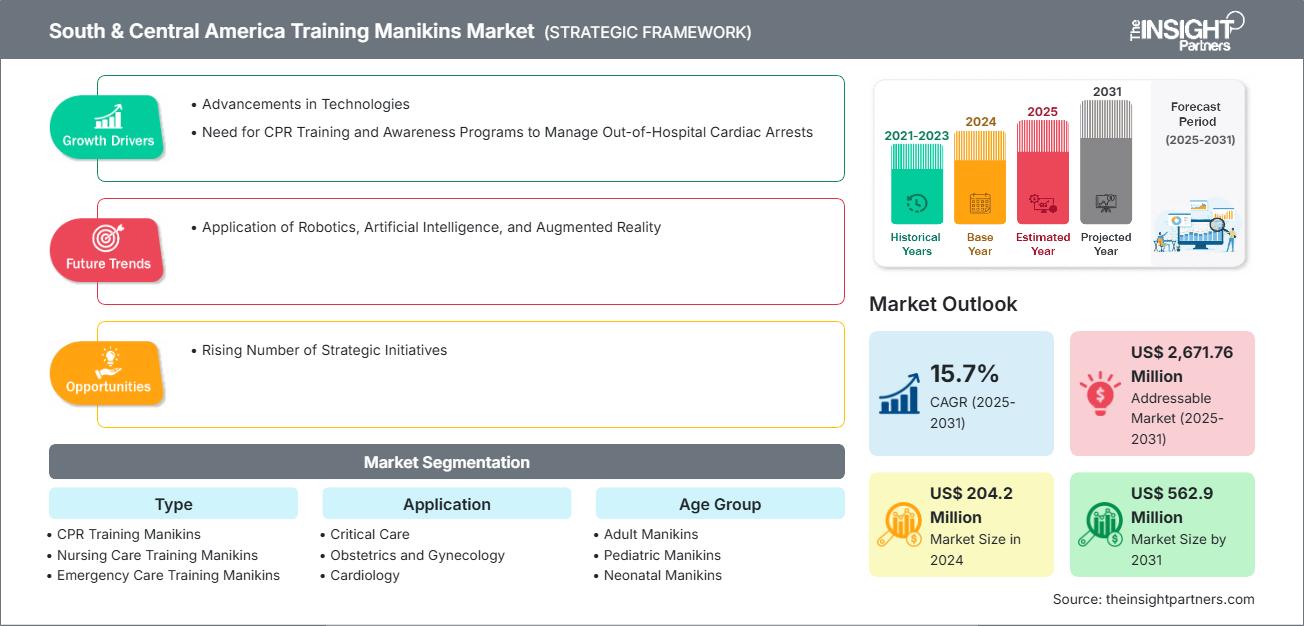
The South and Central America Training Manikins Market size is expected to reach US$ 562.9 Million by 2031 from US$ 204.2 Million in 2024. The market is estimated to record a CAGR of 15.7% from 2025 to 2031.
Executive Summary and South and Central America Training Manikins Market Analysis:
The training manikins market in South & Central America is segmented into Brazil, Argentina, and the Rest of South & Central America. The healthcare sector in the region is developing significantly owing to increasing investments and surging healthcare expenditure. Moreover, technological advancements, new product launches, and increasing training programs are expected to favor the growth of the market in South & Central America. With an increasing focus on healthcare infrastructure development, governments, educational institutions, and private organizations are investing in advanced medical training tools, including training manikins. These manikins simulate real-life medical scenarios, providing hands-on experience that is crucial for improving healthcare delivery.
Another significant driver is the growing number of healthcare professionals and the need for continuous skill development. In South & Central America, there is a notable increase in the number of healthcare workers, but the region faces challenges such as skill gaps and resource limitations in medical training. Training manikins, which offer lifelike simulations of patients, help bridge these gaps by allowing medical students, nurses, and paramedics to practice procedures like CPR, intubation, and trauma care in a safe, controlled environment. This enhances competency and prepares healthcare workers for real-world medical emergencies.
● REPORT CUSTOMIZATION
Tailor This Report To Align With Your Specific Business Requirements
This report can be customized to align precisely with your business objectives, scope, and target markets. Customization options include tailored segmentation, geography, competitive analysis, and strategic insights to support informed decision-making.
Customize This Report →WHAT YOU CAN ADJUST
- ● Segmentations
- ● Geography
- ● Competitive Analysis
- ● Language Preferences
South & Central America Training Manikins Market: Strategic Insights
-
Get Top Key Market Trends of this report.This FREE sample will include data analysis, ranging from market trends to estimates and forecasts.
South and Central America Training Manikins Market Segmentation Analysis:
- By Type, the South and Central America Training Manikins Market is segmented into CPR Training Manikins, Nursing Care Training Manikins, Emergency Care Training Manikins, General Care Training Manikins, Basic Life Support Training Manikins, and Others. CPR Training Manikins held the largest share of the market in 2024.
- By Application, the South and Central America Training Manikins Market is segmented into Critical Care, Obstetrics and Gynecology, Cardiology, Pulmonology, and Others. Cardiology held the largest share of the market in 2024.
- By Age Group, the South and Central America Training Manikins Market is segmented into Adult Manikins, Pediatric Manikins, and Neonatal Manikins. Adult Manikins held the largest share of the market in 2024.
- By End User, the South and Central America Training Manikins Market is segmented into Medical School and Community Classrooms, Hospitals, Clinics, and Others. Medical School and Community Classrooms held the largest share of the market in 2024.
South & Central America Training Manikins Market Report Scope
| Report Attribute | Details |
|---|---|
| Market size in 2024 | US$ 204.2 Million |
| Market Size by 2031 | US$ 562.9 Million |
| CAGR (2025 - 2031) | 15.7% |
| Historical Data | 2021-2023 |
| Forecast period | 2025-2031 |
| Segments Covered |
By Type
|
| Regions and Countries Covered |
South and Central America
|
| Market leaders and key company profiles |
|
South & Central America Training Manikins Market Players Density: Understanding Its Impact on Business Dynamics
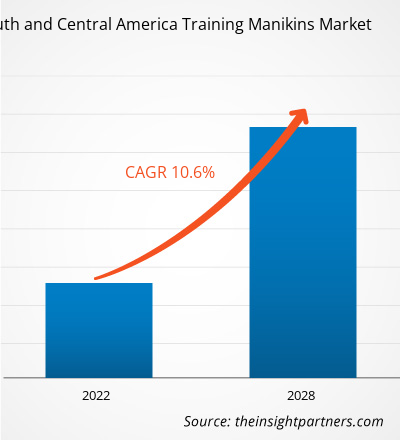
The South & Central America Training Manikins Market is growing rapidly, driven by increasing end-user demand due to factors such as evolving consumer preferences, technological advancements, and greater awareness of the product's benefits. As demand rises, businesses are expanding their offerings, innovating to meet consumer needs, and capitalizing on emerging trends, which further fuels market growth.
South and Central America Training Manikins Market Outlook
The surge in strategic initiatives offers a powerful growth avenue for the Training Manikins Market. By embracing cutting-edge technology and forging innovative partnerships, companies can create more immersive and effective training tools. These proactive moves enable better customization to diverse medical scenarios, enhancing learner engagement. Expanding global outreach through targeted campaigns further unlocks untapped markets. Ultimately, these strategic efforts pave the way for stronger market presence and long-term success. Small and big companies operating in the training manikins market are increasingly adopting strategies such as geographic expansion, new product development, and technological advancements to boost their revenues. A few recent development in the training manikins market is mentioned below:
- In July 2022, A Head Simulations launched CARL, a universal, advanced, and multifunctional head manikin designed for a wide variety of tasks-including research, training, and product demonstrations-within hearing healthcare.
Therefore, the active participation of market players in product launches, expansions, partnerships, and mergers & acquisitions creates lucrative growth opportunities in the training manikin's market.
South and Central America Training Manikins Market Country Insights
By country, the South and Central America Training Manikins Market is segmented into Brazil, Argentina, and the Rest of South and Central America. Brazil held the largest share in 2024.
Brazil is a rapidly developing country in South & Central America, with a notable presence of healthcare facilities and technology providers. As per the article "First Evaluation of the Brazilian Advanced Life Support Training", published in Sociedade Brasileira de Cardiologia, ~200,000 cardiac arrest cases are registered annually in Brazil. According to a Brazilian study, patients who had an OHCA and were resuscitated by emergency ambulance staff reported a hospital discharge rate of 3.9%. Owing to the surging prevalence and poor prognosis of cardiac arrest, organizations in Brazil are focusing on introducing courses for training people and professionals on the management of cardiac arrest incidents. The American Heart Association's (AHA) Advanced Cardiovascular Life Support (ACLS) course launched the TECA A (i.e., Treinamento em Emergências Cardiovasculares Avançado - Advanced Cardiovascular Emergency Training) simulation methods for the improved management of cardiac arrest, acute coronary syndrome, acute heart failure, cerebrovascular accident, and some arrhythmias. Such training initiatives for cardiology disease management among healthcare professionals fuel the growth of the training manikins market in Brazil.
South and Central America Training Manikins Market Company Profiles
Some of the key players operating in the market include CAE Inc., Laerdal Medical AS, Ambu A/S, Gaumard Scientific Co. Inc., Simulaids Ltd, Nasco Healthcare, TruCorp, 3B Scientific, V4EMS Inc. (SmartMan), Ruth Lee Ltd, Innosonian Inc., Practiman, WorldPoint ECC, and Erler-Zimmer GmbH & Co. KG
These players are adopting various strategies such as expansion, product innovation, and mergers and acquisitions to provide innovative products to their consumers and increase their market share.
South and Central America Training Manikins Market Research Methodology
The following methodology has been followed for the collection and analysis of data presented in this report:
Secondary Research
The research process begins with comprehensive secondary research, utilizing internal and external sources to gather qualitative and quantitative data for each market. Commonly referenced secondary research sources include, but are not limited to:
- Company websites, annual reports, financial statements, broker analyses, and investor presentations
- Industry trade journals and other relevant publications
- Government documents, statistical databases, and market reports
- News articles, press releases, and webcasts specific to companies operating in the market
Note:
All financial data included in the Company Profiles section has been standardized to US$. For companies reporting in other currencies, figures have been converted to US$ using the relevant exchange rates for the corresponding year.Primary Research
The Insight Partners conducts a significant number of primary interviews each year with industry stakeholders and experts to validate its data analysis and gain valuable insights. These research interviews are designed to:
- Validate and refine findings from secondary research
- Enhance the expertise and market understanding of the analysis team
- Gain insights into market size, trends, growth patterns, competitive dynamics, and future prospects
Primary research is conducted via email interactions and telephone interviews, encompassing various markets, categories, segments, and sub-segments across different regions. Participants typically include:
- Industry stakeholders: Vice Presidents, Business Development Managers, Market Intelligence Managers, and National Sales Managers
- External experts: Valuation specialists, research analysts, and key opinion leaders with industry-specific expertise

- Comprehensive Market Sizing and Forecast Analysis
- Detailed Segmentation Analysis
- In-Depth Market Dynamics Assessment
- Regional and Country-Level Insights
- Competitive Landscape and Company Benchmarking
- Strategic Business Intelligence
Recent Reports
Testimonials

The Insight Partners' SCADA System Market report is comprehensive, with valuable insights on current trends and future forecasts. The team was highly professional, responsive, and supportive throughout. We are very satisfied and highly recommend their services.
RAN KEDEM Partner, Reali Technologies LTDs
I requested a report on a very specific software market and the team produced the report in a few days. The information was very relevant and well presented. I then requested some changes and additions to the report. The team was again very responsive and I got the final report in less than a week.
JEAN-HERVE JENN Chairman, Future Analytica
We worked with The Insight Partners for an important market study and forecast. They gave us clear insights into opportunities and risks, which helped shape our plans. Their research was easy to use and based on solid data. It helped us make smart, confident decisions. We highly recommend them.
PIYUSH NAGPAL Sr. Vice President, High Beam Global
The Insight Partners delivered insightful, well-structured market research with strong domain expertise. Their team was professional and responsive throughout. The user-friendly website made accessing industry reports seamless. We highly recommend them for reliable, high-quality research services
YUKIHIKO ADACHI CEO, Deep Blue, LLC.
This is the first time I have purchased a market report from The Insight Partners.While I was unsure at first, I visited their web site and felt more comfortable to take the risk and purchase a market report.I am completely satisfied with the quality of the report and customer service. I had several questions and comments with the initial report, but after a couple of dialogs over email with their analyst I believe I have a report that I can use as input to our strategic planning process.Thank you so much for taking the extra time and making this a positive experience.I will definitely recommend your service to others and you will be my first call when we need further market data.
JOHN SUZUKI President and Chief Executive Officer, Board Director, BK Technologies
I wish to appreciate your support and the professionalism you displayed in the course of attending to my request for information regarding to infectious disease IVD market in Nigeria. I appreciate your patience, your guidance, and the fact that you were willing to offer a discount, which eventually made it possible for us to close a deal. I look forward to engaging The Insight Partners in the future, all thanks to the impression you have created in me as a result of this first encounter.
DR CHIJIOKE ONYIA MANAGING DIRECTOR, PineCrest Healthcare Ltd.Reason to Buy
- Informed Decision-Making
- Understanding Market Dynamics
- Competitive Analysis
- Identifying Emerging Markets
- Customer Insights
- Market Forecasts
- Risk Mitigation
- Boosting Operational Efficiency
- Strategic Planning
- Investment Justification
- Tracking Industry Innovations
- Aligning with Regulatory Trends





 Get Free Sample for