
Special Purpose Machines Market Share, Growth & Forecast by 2034
Coverage: By Type (Conventional Machines, Computer Numerical Control (CNC) Machines); End-user (Automotive, Aerospace and Defense, Manufacturing, Electrical and Electronics, Shipbuilding, Textile, Others) , and Geography (North America, Europe, Asia Pacific, and South and Central America)
- Status : Data Released
- Report Code : TIPRE00019045
- Category : Manufacturing and Construction
- No. of Pages : 150
- Available Report Formats :


- Last update date : October 30, 2026


2025 Market Size
US$ 14.58 Bn
Base year value
2034 Forecast
US$ 27.55 Bn
Projected by 2034
CAGR 2026-2034
7.33 %
Growth rate
Addressable Market
US$ 190.03 Bn
(2026-2034)
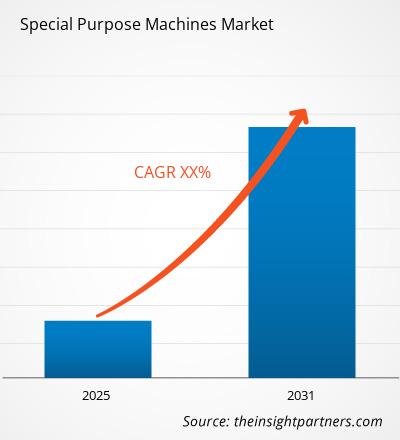
The Special Purpose Machines Market was valued at US$ 14.58 Billion in 2025 and is projected to reach US$ 27.55 Billion by 2034, expanding at a CAGR of 7.33% during 2026–2034. Market participants include traditional machines and computer numerical control machines used in the automotive industry, the aerospace and defense sector, manufacturing, the electrical and electronics sector, shipbuilding, and textiles.
It is anticipated that North America will see an approximate CAGR of 7% up to 2034 due to technological upgrading in machining cells, localization of manufacturing, and addressing shortage of labor through automation. The growth of the Special Purpose Machines Market Size in North America will be fueled by the requirement for digitized machinery in the automotive sector, aerospace backlogs, defense, and high-mix manufacturing.
Special Purpose Machines Market Assessment and Insights
Regional Outlook
- North America: ~28% of the global market in 2025 | ~7% CAGR through 2034. Market position: The region ranks third, supported by aerospace, defense, automotive localization, and replacement of aging equipment with automated, data-enabled production cells.
- US: ~82% of North American market revenue in 2025 | ~7% CAGR through 2034. Market position: The US leads North America through deep aerospace and automotive supply chains, strong systems integration capability, and demand for precision machining in high-value applications.
- Europe: ~31% of the global market in 2025 | ~6% CAGR through 2034. Market position: Europe holds a mature position anchored by Germany, Italy, France, the UK, and Spain, where machine-building expertise and industrial modernization sustain demand.
- Asia Pacific: ~36% of the global market in 2025 | ~9% CAGR through 2034. Market position: Asia Pacific is the largest and fastest-growing region, led by China, Japan, South Korea, and India as capacity expansion and factory automation accelerate.
Segment Outlook
- Computer Numerical Control Machines: ~64% Share in 2025 | ~8% CAGR through 2034. Market position: CNC machines lead because programmable precision, repeatability, multi-axis processing, and integration with robotic handling support high-throughput production and rapid product changeovers.
- Electrical and Electronics: ~15% Share in 2025 | ~9% CAGR through 2034. Market position: Growth is driven by miniaturized components, tighter tolerances, electric powertrain electronics, semiconductor equipment demand, and automated assembly requirements.
Competitive Coverage
Contrinex AG, EMAG GmbH & Co. KG, Genertec Dalian Machine Tool Group Co., Ltd., GROB Systems, Inc., HMT Machine Tools Limited, ICM, Komatsu NTC Ltd., Loiretech, RNA Automation Limited, Springfield NE Ltd
Methodology
The Insight Partners follows Data Collection & Secondary Research, Primary Research, Data Analysis, and Data Triangulation & Final Review to validate market estimates and insights.
Source: The Insight Partners' analysis based on proprietary research, government publications, company annual reports, investor presentations, industry databases, and expert interviews.
Production systems have evolved from mechanical to CNC machines that are configurable, automated loading and inspection, and connected controls. These innovations allow the customized cell to remain customized and application specific despite being able to accommodate different products and smaller batch sizes. The trend towards automotive electrification drives new machining and assembly needs, and aerospace and defense programs create demand for processing difficult materials. Suppliers tend to integrate process engineering, tooling, controls, and service.
During the next decade up to 2034, capital investments will be made in India, Southeast Asia, Mexico, and some Middle Eastern manufacturing locations due to localization policy considerations and the impact on the supply chain. The focus will be on modularity, efficiency, diagnostics capabilities, and faster ramp-up times. Increased regulation regarding employee safety, traceability, and product quality is expected to increase the amount of automation spending despite sensitivity to interest rates, utilization, and customer sentiment.
Special Purpose Machines Market Report Scope
| Report Attribute | Details |
|---|---|
| Market size in 2025 | US$ 14.58 Billion |
| Market Size by 2034 | US$ 27.55 Billion |
| Global CAGR (2026 - 2034) | 7.33% |
| Historical Data | 2021-2024 |
| Forecast period | 2026-2034 |
Special Purpose Machines Market Analysis
Special Purpose Machines Market is driven by the need for increasing throughput while maintaining dimensional precision. Customers in the form of OEMs and tier suppliers seek machines for specific drilling, milling, grinding, assembly, inspection or handling operations. This ecosystem comprises machine manufacturers, controls providers, sensors, tooling specialists, robot integrators, software companies and after sales service firms.
Factors influencing supply include the ability of the vendor to design around the workpiece and prove out the cycle time prior to installing the machine. Long lead components, engineering capacity, and customer acceptance testing could be limiting factors for the supplier. Machine modularity reduces engineering efforts whereas the presence of local service groups increases availability.
Competitive Landscape as stated in Special Purpose Machines Market Report is quite fragmented with both scale and application expertise equally relevant. EMAG GmbH & Co. KG and GROB Systems Inc. are competing based on their integrated machining and automation systems, and Komatsu NTC Ltd. and Genertec Dalian Machine Tool Group Co. Ltd. bring their well-established machine tools expertise to the competition.
Experts like RNA Automation Ltd, ICM, Loiretech, Contrinex AG, HMT Machine Tools Ltd, and Springfield NE Ltd provide feeding solutions, forming systems, sensing equipment, assemblies and custom-made products. Capital investment is moving towards software-driven services, simulation-based engineering and regional manufacturing capacity. Strategic edge now comes from faster commissioning, proven process capability and flexibility in retrofitting the existing systems.
● REPORT CUSTOMIZATION
Tailor This Report To Align With Your Specific Business Requirements
This report can be customized to align precisely with your business objectives, scope, and target markets. Customization options include tailored segmentation, geography, competitive analysis, and strategic insights to support informed decision-making.
Customize This Report →WHAT YOU CAN ADJUST
- ● Segmentations
- ● Geography
- ● Competitive Analysis
- ● Language Preferences
Special Purpose Machines Market: Strategic Insights
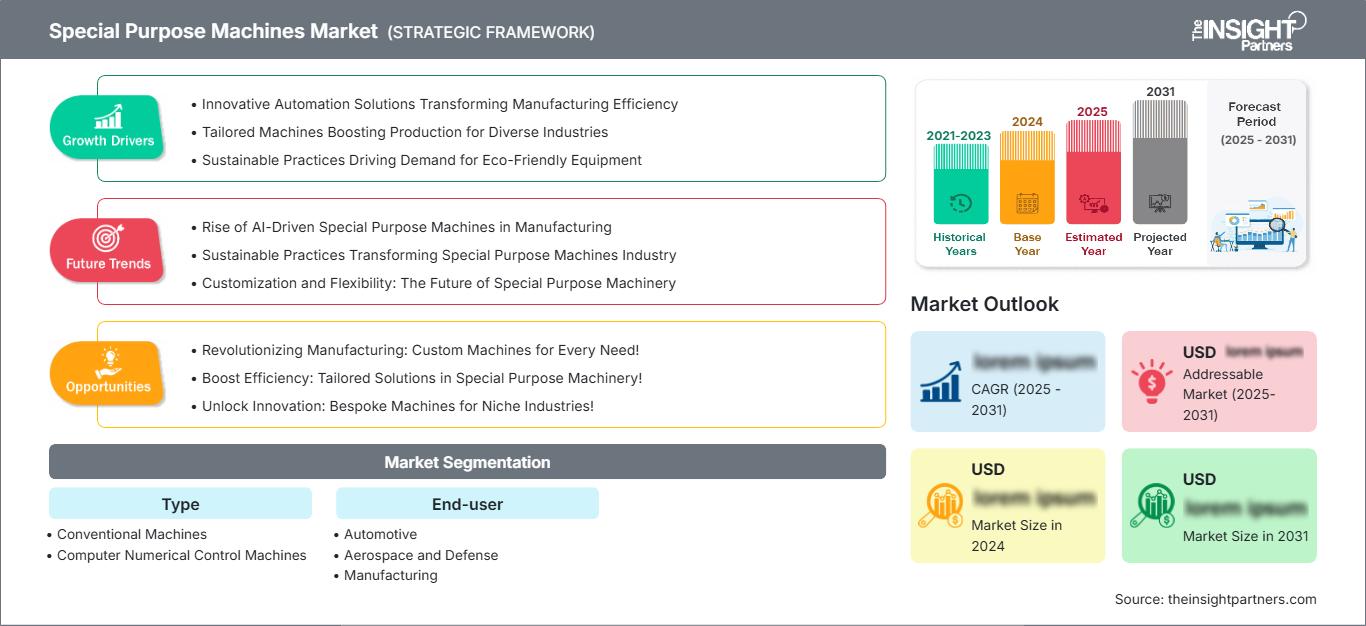
Regional Insights
North America Special Purpose Machines Market
Expansion in North America is expected to grow at a CAGR of about 7% through 2034. The demand will arise from aerospace structure, defense applications, automotive powertrain changeover, medical manufacturing, and industrial equipment. Manufacturers are specifying five-axis machining, automated part loading, in-process inspection, and digital maintenance capability in order to address labor shortage issues.
There is an existing installed base in North America which creates both retrofit and greenfield opportunity. Nearshoring advantages can be realized in U.S. and Mexico plants, whereas Canada demand is associated with aerospace, automotive, and processing equipment. The Special Purpose Machines Market share in North America shows the high cost per unit of equipment and turnkey cell requirement.
U.S. Special Purpose Machines Market
North America represents ~82% of revenue in 2025 for the US, which is expected to expand at a ~7% CAGR until 2034. Backlogs in the aerospace sector, modernization of defense capabilities, spending in semiconductors, and changes in vehicle platforms drive demand for customized machining and assembly equipment. Requirements include considerations such as cyber security, traceability, local availability of service, and ability to interface with current software used in the factory.
GROB Systems, Inc. operates in the US while EMAG GmbH & Co. KG, Komatsu NTC Ltd., RNA Automation Limited, among others, offer products to end users via local operations and integrators. Applications are most common when volume warrants customization but complexity necessitates programability and flexibility in fixturing and changeover.
Europe Special Purpose Machines Market
In 2025, Europe accounted for ~31% of the worldwide revenue and is forecasted to achieve a ~6% CAGR through 2034. Germany is the dominant nation in Europe due to its machine building capabilities, premium automotive manufacturing, and robust supply chain of industrial suppliers. Italian suppliers offer specialized machinery and flexibility in automation whereas French and UK companies get support from their aerospace, defense, energy, and transport equipment applications.
Spanish companies provide demand in automotive assembly, railways, and renewable energy equipment. Throughout the region, companies are trying to reconcile their reduced near-term capital expenditure with long-term requirements for energy savings, digitization, and labor saving. Mature installed bases create value in controls, automation modules, and service contracts.
There are some strengths in the hands of European suppliers in terms of process integration and precise systems. The challenge of energy prices and global competition makes customers look into the total cost per part rather than just the price of equipment. Equipment that can integrate operations, save on scrap, and record quality is more defendable against single function equipment without connectivity.
APAC Special Purpose Machines Market
Asia Pacific held ~36% of global revenue in 2025 and is forecast to grow at a ~9% CAGR through 2034, making it the largest and fastest-growing region. China is the leading country in Asia Pacific due to its manufacturing scale, machine-tool ecosystem, and investment in electric vehicles, electronics, and industrial automation.
Japan and South Korea provide sophisticated machine tool providers and precision machine users, whereas India benefits from investments related to production. Australia provides selective market demands in the areas of military equipment, mining equipment, and high-tech manufacturing. Policy backing, capacity expansion, and increasing quality needs promote special purpose CNC machine tools.
Middle East & Africa Special Purpose Machines Market
There is an expected ~7% CAGR growth for this area until 2034 with industrial diversification beyond oil & gas. Saudi Arabia leads in Middle East & Africa in terms of countries with localization activities for defense, automotive, metal working, and energy equipment manufacturing. The United Arab Emirates includes aerospace maintenance, precision engineering, and logistics-related production requirements.
South Africa continues to be a significant hub for automotive and mining equipment manufacturing, while Rest of MEA varies in development based on infrastructure and industrial parks. Implementation will benefit from strong equipment, remote assistance, and turnkey cell lines as maintenance capabilities may be restricted in some areas.
Segmentation Analysis
Type
The Type segment is projected to grow at a ~7% CAGR during 2026–2034. The Special Purpose Machines Market scope spans mechanically dedicated platforms and programmable CNC systems engineered for specific machining, assembly, inspection, or handling tasks. Purchasers choose between the two according to volume stability, tolerance requirements, changeover frequency, workforce capability, and lifecycle cost.
- Conventional Machines: These systems remain relevant for repetitive, stable processes where simplicity, ruggedness, and lower initial cost outweigh flexibility. Demand is strongest in mature component lines, basic fabrication, and applications with limited product variation.
- Computer Numerical Control Machines: CNC platforms hold ~64% share in 2025 and expand at a ~8% CAGR through 2034. They support programmable precision, multi-axis processing, adaptive controls, automated loading, and digital quality records across complex production environments.
End-user
The End-user segment in the Special Purpose Machines Market is forecast to advance at a ~7% CAGR during 2026–2034. Demand varies by production volume, tolerance, material, regulation, and product lifecycle. Automotive remains the largest user base, while electrical and electronics is the high-growth main segment at ~15% share and ~9% CAGR, supported by precision assembly and component miniaturization.
- Automotive: High-volume manufacturing sustains demand for dedicated machining, welding, assembly, leak testing, and inspection. Electric powertrains alter component mixes, but they also create new requirements for motors, batteries, housings, and thermal-management systems.
- Aerospace and Defense: Tight tolerances, difficult materials, traceability, and low-defect requirements favor high-value customized systems. Programs often require five-axis machining, special tooling, in-process measurement, and long-term service support.
- Manufacturing: General industrial users adopt special-purpose machines to consolidate operations, remove bottlenecks, and reduce unit cost. Flexible cells are especially relevant where product families share processes but differ in dimensions or fixtures.
- Electrical and Electronics: Miniaturized parts and sensitive assemblies require repeatable feeding, placement, fastening, testing, and inspection. Growth is reinforced by power electronics, connectors, sensors, and electrified industrial equipment.
- Shipbuilding: Demand centers on heavy fabrication, panel processing, pipe preparation, welding, and component machining. Equipment must accommodate large workpieces, harsh environments, and project-based production schedules.
- Textile: Specialized machinery supports high-speed cutting, handling, joining, finishing, and quality control. Adoption is shaped by labor costs, export competitiveness, material variety, and the need for consistent throughput.
Opportunity Snapshot
| End Users | Revenue Contribution | Trend Tag | Adoption Stage |
| Automotive | High | EV Retooling | Mature |
| Aerospace and Defense | High | Precision Cells | Scaling |
| Manufacturing | High | Flexible Automation | Mature |
| Electrical and Electronics | Medium | Micro Assembly | Scaling |
| Shipbuilding | Low | Panel Automation | Emerging |
| Textile | Low | Smart Handling | Scaling |
Special Purpose Machines Market Growth Drivers and Impact Analysis
Factory Automation and Skilled-Labor Constraints
Manufacturers are redesigning production around fewer manual interventions, consistent cycle times, and repeatable quality. Special-purpose equipment concentrates several operations in a controlled sequence, reducing work-in-process movement and dependence on scarce specialist operators. Robotic loading, automated tool changes, and in-process inspection extend unattended production while preserving traceability. The commercial impact is strongest in plants with stable product families and high downtime costs, where a validated cell can lower cost per part over its operating life. Suppliers that provide simulation, acceptance testing, training, and responsive service can reduce commissioning risk and strengthen recurring revenue through maintenance, spares, and upgrades.
Precision Requirements in Mobility and Aerospace
Electric vehicles, aircraft engines, structural components, and defense systems require tighter tolerances, difficult-material capability, and documented process control. Dedicated fixtures and optimized tool paths help maintain accuracy across repetitive operations, while multi-axis CNC designs combine turning, milling, drilling, or grinding in fewer setups. This reduces handling errors and supports higher first-pass yield. Market impact extends beyond new equipment because legacy lines need retooling for changing component geometries, lightweight materials, and electrified powertrains. Vendors with application expertise in workholding, thermal stability, metrology, and process validation are positioned to capture projects that general-purpose equipment cannot address efficiently.
Regionalization of Critical Manufacturing Capacity
Supply-chain disruptions and industrial policy are encouraging manufacturers to place more capacity near end markets. New plants require localized machining, assembly, testing, and material-handling infrastructure, creating demand for purpose-built systems that match regional labor, energy, and service conditions. The effect is visible in automotive corridors, aerospace clusters, semiconductor ecosystems, and defense supply chains. Localization also changes vendor selection: customers favor suppliers able to engineer globally while commissioning and servicing locally. This creates room for regional specialists and partnerships, but it also raises expectations for standardized modules, spare-parts availability, cybersecurity, and multilingual technical support across a machine’s lifecycle.
Special Purpose Machines Market Future Trends
Software-Defined, Self-Monitoring Production Cells
Special Purpose Machines Market trends will increasingly center on connected controls, digital twins, condition monitoring, and adaptive process parameters. Machines will generate richer operating data for tool-life prediction, quality correlation, and remote diagnostics. Rather than replacing mechanical engineering, software will make dedicated systems more configurable and easier to validate across product variants. Adoption will progress fastest where data governance and plant connectivity are mature. Suppliers will need interoperable interfaces, secure remote access, and analytics that translate signals into actionable maintenance decisions. The result should be higher utilization and faster root-cause analysis, although buyers will scrutinize integration effort and measurable return.
Modular Automation for High-Mix Manufacturing
Future designs will combine standardized machine modules with application-specific tooling, fixtures, and software. This architecture can shorten engineering lead times while preserving the performance advantages of a dedicated cell. Quick-change tooling, vision-guided handling, and recipe-based controls will broaden the addressable customer base beyond very high-volume production. Equipment builders may also offer staged automation, allowing customers to start with manual loading and add robots or pallet systems as volumes rise. Commercial success will depend on mechanical interfaces, control compatibility, and validation methods that let modules be changed without destabilizing the complete process.
Special Purpose Machines Market Opportunities
Retrofitting Installed Equipment with Digital Controls
A large installed base of mechanically sound machinery creates an opportunity for controls upgrades, sensor packages, robotic tending, safety modernization, and energy monitoring. Special Purpose Machines Market Forecasts support investment models that compare retrofit cost with replacement, lost production, and expected life extension. Suppliers can build recurring revenue by auditing installed assets, prioritizing bottlenecks, and packaging upgrades with service agreements. The strongest cases will target machines whose basic structure remains accurate but whose controls, drives, or data interfaces limit productivity. Retrofit offerings also appeal to customers seeking faster implementation and lower embodied carbon than complete replacement.
Localized Turnkey Cells for Emerging Industrial Hubs
India, Southeast Asia, Mexico, and selected Middle Eastern markets offer opportunities for scalable cells aligned with new automotive, electronics, defense, and industrial-equipment capacity. Winning suppliers will combine proven core platforms with local tooling, fixtures, commissioning, and operator training. Financing options and phased capacity expansion can lower adoption barriers for mid-sized manufacturers. Partnerships with regional integrators may improve response times and compliance with local procurement requirements. Investment should focus on applications with repeatable demand, measurable cycle-time savings, and sufficient spare-parts support rather than highly customized projects that cannot be serviced economically after installation.
Recent Developments
- September 2026: Zimmermann showcased the new FZU22 5-axis portal milling machine at IMTS 2026 for lighter-weight machining of large structures. The machine supports aluminum, plastics, wood, and composite materials, including carbon fiber, with a 24-tool changer and 15 kW spindle. Its thermally symmetrical design is intended to improve precision, energy efficiency, speed, and machining stability.
- September 2026: SANY India unveiled 31 machines, including 13 new launches, at Bauma CONEXPO India 2026 covering earthmoving, mining, roads, ports, material handling, and transportation. The showcase placed significant emphasis on electrification, including electric excavators, wheel loaders, mining trucks, reach stackers, aerial platforms, and heavy-duty vehicles. The portfolio reflects SANY India's focus on localized engineering, sustainability, and expanding electric equipment offerings.
- September 2026: SANY India launched three excavators, the SY215C-9LC Quarry, SY210C-9 Quarry, and 90-tonne-class SY900H, at Bauma CONEXPO India 2026. The two quarry models target stone, limestone, aggregate, and hard-rock operations, while the SY900H is designed for heavy mining, stripping, and loading applications. The quarry excavators also incorporate SANY EVI remote monitoring for machine tracking, health alerts, and fleet management
Frequently Asked Questions

- Comprehensive Market Sizing and Forecast Analysis
- Detailed Segmentation Analysis
- In-Depth Market Dynamics Assessment
- Regional and Country-Level Insights
- Competitive Landscape and Company Benchmarking
- Strategic Business Intelligence
Recent Reports
Testimonials

The Insight Partners provided valuable market intelligence that supported our global go-to-market strategy. Their team was professional, responsive, and attentive to our feedback, providing thoughtful analysis and helpful methodological clarifications throughout the project.
Junmo Kim Chief Financial Officer (CFO), Enertech Co., Ltd.
The Insight Partners' SCADA System Market report is comprehensive, with valuable insights on current trends and future forecasts. The team was highly professional, responsive, and supportive throughout. We are very satisfied and highly recommend their services.
RAN KEDEM Partner, Reali Technologies LTDs
I requested a report on a very specific software market and the team produced the report in a few days. The information was very relevant and well presented. I then requested some changes and additions to the report. The team was again very responsive and I got the final report in less than a week.
JEAN-HERVE JENN Chairman, Future Analytica
We worked with The Insight Partners for an important market study and forecast. They gave us clear insights into opportunities and risks, which helped shape our plans. Their research was easy to use and based on solid data. It helped us make smart, confident decisions. We highly recommend them.
PIYUSH NAGPAL Sr. Vice President, High Beam Global
The Insight Partners delivered insightful, well-structured market research with strong domain expertise. Their team was professional and responsive throughout. The user-friendly website made accessing industry reports seamless. We highly recommend them for reliable, high-quality research services
YUKIHIKO ADACHI CEO, Deep Blue, LLC.
This is the first time I have purchased a market report from The Insight Partners.While I was unsure at first, I visited their web site and felt more comfortable to take the risk and purchase a market report.I am completely satisfied with the quality of the report and customer service. I had several questions and comments with the initial report, but after a couple of dialogs over email with their analyst I believe I have a report that I can use as input to our strategic planning process.Thank you so much for taking the extra time and making this a positive experience.I will definitely recommend your service to others and you will be my first call when we need further market data.
JOHN SUZUKI President and Chief Executive Officer, Board Director, BK Technologies
I wish to appreciate your support and the professionalism you displayed in the course of attending to my request for information regarding to infectious disease IVD market in Nigeria. I appreciate your patience, your guidance, and the fact that you were willing to offer a discount, which eventually made it possible for us to close a deal. I look forward to engaging The Insight Partners in the future, all thanks to the impression you have created in me as a result of this first encounter.
DR CHIJIOKE ONYIA MANAGING DIRECTOR, PineCrest Healthcare Ltd.Reason to Buy
- Informed Decision-Making
- Understanding Market Dynamics
- Competitive Analysis
- Identifying Emerging Markets
- Customer Insights
- Market Forecasts
- Risk Mitigation
- Boosting Operational Efficiency
- Strategic Planning
- Investment Justification
- Tracking Industry Innovations
- Aligning with Regulatory Trends





 Get Free Sample for