
Spray Drying Equipment Market Trends, Demand & Growth by 2034
Coverage: By Type (Rotary Atomizer, Nozzle Atomizer, Fluidized, Closed Loop, Centrifugal, and Others), Flow Type (Co-Current, Counter-Current, and Mixed Flow), Cycle Type (Open Cycle and Closed Cycle), Drying Stage (Single Stage and Multi Stage), End-user (Pharmaceutical, Chemical, Food and Dairy, and Others), and Geography (North America, Europe, Asia Pacific, and South and Central America)
- Status : Data Released
- Report Code : TIPRE00008298
- Category : Manufacturing and Construction
- No. of Pages : 150
- Available Report Formats :


- Last update date : October 30, 2026


2025 Market Size
US$ 6.63 Bn
Base year value
2034 Forecast
US$ 12.82 Bn
Projected by 2034
CAGR 2026-2034
7.60 %
Growth rate
Addressable Market
US$ 87.61 Bn
(2026-2034)
The Spray Drying Equipment Market is valued at US$ 6.63 Billion in 2025 and is projected to reach US$ 12.82 Billion by 2034, expanding at a CAGR of 7.60% during 2026–2034. Spray drying equipment converts liquid feeds into powders by atomizing the feed and rapidly removing moisture through controlled hot-gas contact. The equipment supports particle engineering, moisture control, product stability, and continuous processing across food, dairy, pharmaceuticals, chemicals, nutrition, and specialty materials.
North America represents a technologically mature market supported by pharmaceutical manufacturing, specialty food processing, and investments in automated powder-processing systems. The region is projected to expand at a modeled CAGR of ~7% through 2034. Demand for energy-efficient drying, process monitoring, closed-cycle configurations, and equipment upgrades is strengthening the Spray Drying Equipment Market size across established production facilities.
Spray Drying Equipment Market Assessment and Insights
Regional Outlook
- North America: ~25% of the global market in 2025 | ~7% CAGR through 2034. Market position: North America maintains a substantial mature-market position, supported by pharmaceutical and biotechnology manufacturing, advanced food processing, established powder-production infrastructure, equipment replacement, and increasing adoption of automated process-control technologies.
- US: ~82% of North American market revenue in 2025 | ~7% CAGR through 2034. Market position: The US represents the principal North American demand center, supported by pharmaceutical formulation, nutrition products, dairy ingredients, specialty chemicals, and advanced manufacturing facilities requiring precise particle and moisture control.
- Europe: ~28% of the global market in 2025 | ~7% CAGR through 2034. Market position: Europe has a mature installed base and strong engineering capabilities, with Germany, the UK, France, Italy, and Spain supporting demand. Germany is the leading country in Europe, reflecting its industrial processing base and equipment-manufacturing capabilities.
- Asia Pacific: ~38% of the global market in 2025 | ~9% CAGR through 2034. Market position: Asia Pacific is the fastest-growing region, driven by expanding food, dairy, pharmaceutical, nutritional, and chemical production. China is the leading country in Asia Pacific, supported by manufacturing scale, domestic equipment demand, and expanding processing capacity.
Segment Outlook
- Rotary Atomizer: ~34% Share in 2025 | ~7% CAGR through 2034. Market position: Rotary atomizers lead because they provide flexible droplet-size control and support high-throughput industrial drying. Their application across dairy, food ingredients, chemicals, and pharmaceuticals reinforces their established position in large-scale powder production.
- Closed Cycle: ~28% Share in 2025 | ~9% CAGR through 2034. Market position: Closed-cycle systems have a high-growth outlook because they enable controlled atmospheres and solvent recovery while reducing dependence on ambient process conditions. Their relevance to pharmaceuticals, specialty chemicals, and heat-sensitive products supports adoption.
Competitive Coverage
Dedert Corporation, European SprayDry Technologies, GEA Group, Shandong Shungeng Drying Equipment Co., Ltd., Shanghai Jiadi Machinery Co. Ltd, SPX FLOW, Swenson Technology, Inc., Tetra Pak, Transparent Technologies Pvt. Ltd, Yamato Scientific America Inc.
Methodology
The Insight Partners follows Data Collection & Secondary Research, Primary Research, Data Analysis, and Data Triangulation & Final Review to validate market estimates and insights.
Source: The Insight Partners' analysis based on proprietary research, government publications, company annual reports, investor presentations, industry databases, and expert interviews.
The evolution of the market has shifted from traditional single stage systems to integrated drying systems comprising atomization, fluidized bed finishing, filtration, automation, and powder handling. Both rotary and nozzle atomization continue to play key roles in industrial applications, but multi-stage systems are increasingly being used to optimize particle morphology, solubility, bulk density, and heat sensitivity. Suppliers are also now offering process control systems that continuously monitor operational conditions and allow producers to achieve greater consistency and reduced product losses. Such trends are especially important for dairy powders, nutritional ingredients, pharmaceutical formulations, and specialty chemicals.
In the coming years, investment will shift towards systems that offer production flexibility along with low energy consumption and better process visibility. New production sites in the Asia Pacific region will increase demand for equipment due to localization of food, pharmaceutical, and chemical production. Hygiene, containment, explosion protection, and emissions regulations will also drive equipment updates. Producers will increasingly strive for increased production capacity without increased operating costs, which will boost interest in modular systems, heat recovery, digitalization, and scalable pilot-to-production platforms.
Spray Drying Equipment Market Report Scope
| Report Attribute | Details |
|---|---|
| Market size in 2025 | US$ 6.63 Billion |
| Market Size by 2034 | US$ 12.82 Billion |
| Global CAGR (2026 - 2034) | 7.60% |
| Historical Data | 2021-2024 |
| Forecast period | 2026-2034 |
Spray Drying Equipment Market Analysis
The Spray Drying Equipment Market growth is driven by the growing demand for shelf-stable powder, pharmaceutical intermediate, nutrition ingredient, dairy products, and specialty chemicals. The industry includes feed preparation, concentration, atomization, drying chambers, fluid bed, cyclone or filter, powder recovery, cooling, packaging, controls, and after-sales services. Increasingly, equipment specification is based not just on drying capacity but also on particle properties and economics of processes, and application engineering becomes an important competitive factor.
The supply is determined by engineering knowledge, atomization technology, chamber design, heat management systems, control systems, and the availability of special components. The large companies provide complete processing lines, while the specialists differentiate themselves via customization of dryers, lab units, retrofit packages, and special configurations. The energy consumption is an important purchasing factor due to the thermal nature of the process. Therefore, the equipment upgrade, which involves energy recovery, improved air flow, automation of operating conditions, and reduction of powder losses, creates additional demand aside from the new plants construction.
The Spray Drying Equipment Market report highlights competition among multinational companies offering process technology solutions and specialized manufacturers of drying equipment. The GEA Group and Tetra Pak offer product ranges covering applications in the food, dairy, nutritional, and pharmaceutical industries, while SPX FLOW offers the Anhydro drying systems and automation. On the other hand, Dedert Corporation and European SprayDry Technologies offer engineered drying solutions, while Swenson Technology and Shandong Shungeng Drying Equipment Co., Ltd and Shanghai Jiadi Machinery Co. Ltd focus on the market using specialty equipment.
Funding is now geared towards automation, energy savings, flexibility, and service. For instance, GEA Group focuses on advanced process control solutions, energy-saving technologies, and the upgrading of existing spray dryers, while SPX FLOW has grown to offer SmartDry automation solutions. Meanwhile, Tetra Pak helps in developing powder products and scale-up to industrial level by means of its dedicated processing systems. Yamato Scientific America Inc. offers small-scale and R&D solutions thus connecting lab testing with commercial scale production development.
● REPORT CUSTOMIZATION
Tailor This Report To Align With Your Specific Business Requirements
This report can be customized to align precisely with your business objectives, scope, and target markets. Customization options include tailored segmentation, geography, competitive analysis, and strategic insights to support informed decision-making.
Customize This Report →WHAT YOU CAN ADJUST
- ● Segmentations
- ● Geography
- ● Competitive Analysis
- ● Language Preferences
Spray Drying Equipment Market: Strategic Insights
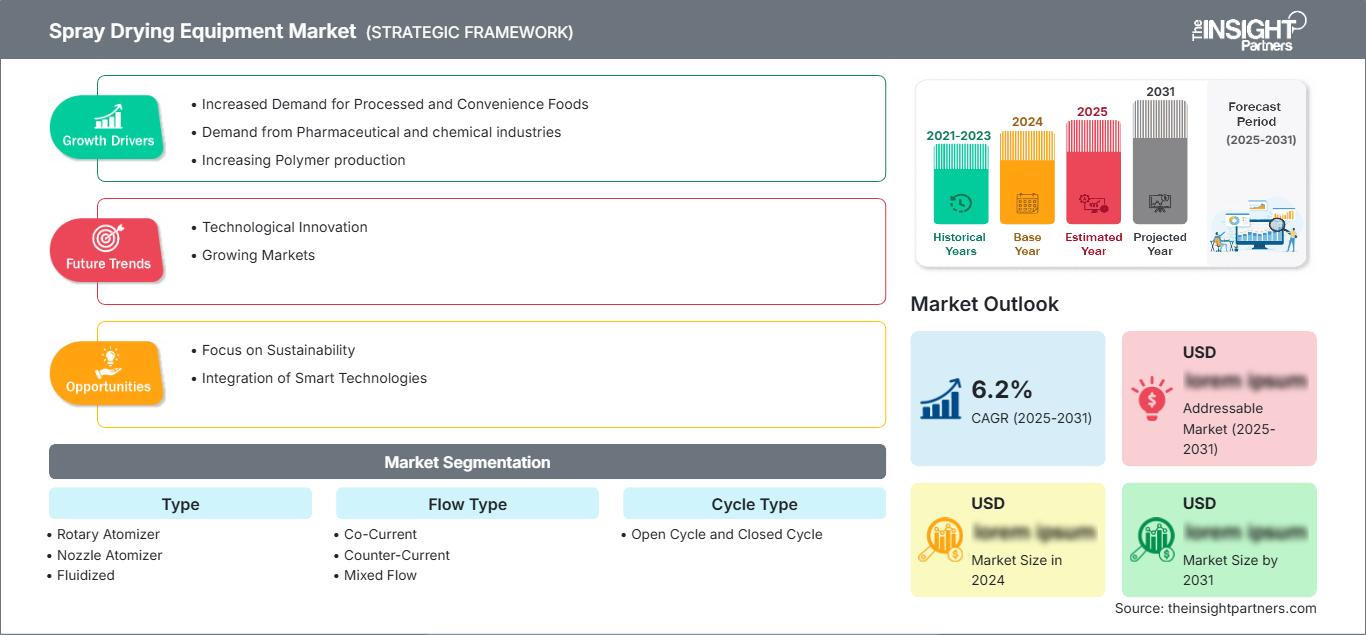
Regional Insights
North America Spray Drying Equipment Market
North America is home to an advanced equipment portfolio that is backed up by pharmaceuticals, biotech, food, dairy, and specialty chemical industries. The regional market is expected to witness a CAGR of ~7% till 2034. Rising demand for the equipment is related to replacement of old drying equipment, better consistency in the quality of powder, and automation in existing production facilities. Pharmaceuticals need control environments, whereas food manufacturers focus on throughput, hygiene, and consistent particle properties.
North America, in 2025, will be dominated by the United States, with a share of ~82% in regional revenue. Suppliers provide equipment for such applications as nutritional powders, dairy ingredients, pharmaceuticals, and specialty chemicals. Domestic manufacturing, contract manufacturing, and process optimization create potential for such technologies as modular dryers, closed loop systems, and online monitoring. Canada supports the North American market via its food processing, nutritional ingredients, and special industrial applications, while Mexico is another demand driver due to its manufacturing and food processing capabilities.
U.S. Spray Drying Equipment Market
The US accounts for ~82% of North American market revenues in 2025 and is poised to grow at a CAGR of ~7% over 2034. This is owing to the extensive activities associated with the production of pharmaceuticals, biotech products, food products, nutraceuticals, and chemicals. Manufacturers need drying equipment that offers consistency in terms of particle size, moisture control, scaleability, and hygiene. Replacement of old equipment and plant upgrades alongside new capacities are being considered by manufacturers.
GEA Group, SPX FLOW, Tetra Pak, Dedert Corporation, Swenson Technology, Inc. and Yamato Scientific America Inc. operate in diverse applications and capacities in the market. Pharmaceuticals and biotech manufacturers look for controlled environment for drying and scaleability of processes from pilot to commercial scales, whereas food and dairy processors look for continuous operation, recovery of powders and energy conservation.
Europe Spray Drying Equipment Market
Europe accounted for around 28% of the global Spray Drying Equipment Market share in 2025 and is estimated to grow at a CAGR of around 7% up to 2034. This region possesses a large installed processing base along with superior engineering capabilities and demands for hygiene, energy, process safety, and environmental performance. Germany is the market leader in Europe driven by the industrial machinery base, food processing, chemical manufacturing, and pharmaceutical manufacturing. The United Kingdom drives the growth with pharmaceutical, specialty ingredients, and food applications whereas France has substantial dairy, nutrition, and food processing needs.
The equipment engineering capabilities of Germany drive regional technological advancement and exports. France and Italy have large food and dairy processing sectors while Italy further has specialization in specialty manufacturing and pharmaceutical applications. Spain drives the sector from food ingredients, dairy processing, and growing nutritional applications. In Europe, the trend in replacement projects is to improve thermal efficiencies and reduce powder losses in place of merely expanding installed capacity. The suppliers are thus developing technologies for integrated fluid-bed systems, automation, heat recovery, and retrofit projects.
APAC Spray Drying Equipment Market
The Asia Pacific region makes up approximately 38% of the worldwide revenue in 2025 and is estimated to have a CAGR of ~9%, making it the region that is growing the fastest. The dominant country within the Asia Pacific region is China due to extensive manufacturing of food, dairy products, chemicals, and pharmaceuticals. Japan and South Korea have contributions through their advanced applications in pharmaceutical, specialty chemicals, and food processing, where equipment accuracy is an important purchase criterion.
Indonesia is generating new demand through dairy processing, pharmaceuticals, nutrition, and food ingredients, while Australia is supporting through dairy processing, nutritional, and specialty food applications. Localization of industries, expansion of domestic processing capabilities, and modernization of production facilities are all contributing to the investment in equipment. Buyers in this region are also becoming increasingly interested in energy savings and automation systems, opening doors for multi-stage and closed-cycle systems.
Middle East & Africa Spray Drying Equipment Market
Middle East & Africa is developing from a smaller installed base, with demand supported by food security initiatives, dairy processing, pharmaceuticals, chemicals, and industrial infrastructure. The regional market is projected to expand at a CAGR of ~7% through 2034. Saudi Arabia is an important country in the Middle East & Africa market, particularly as investments in domestic food production and industrial diversification increase the requirement for processing equipment.
Food manufacturing and logistics along with investments in industry have become the means to drive demand from the UAE, whereas South Africa has been a significant processing hub for food products, dairy, pharmaceuticals, and chemicals. Demand in other parts of MEA will depend on infrastructural development and enhancement of local production capabilities. Energy availability and efficiency become significant criteria for buying decisions due to high thermal energy consumption in spray drying process. Equipment manufacturers providing compact designs, energy optimization, and automation become relevant to the task.
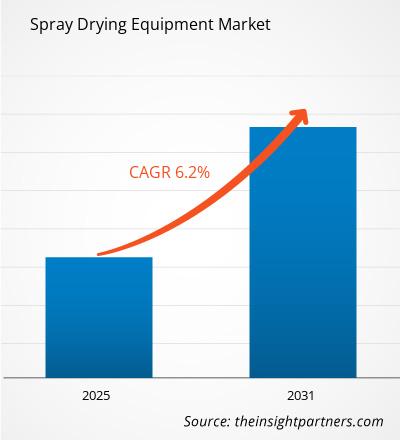
Segmentation Analysis
Type
Type covers rotary atomizer, nozzle atomizer, fluidized, closed loop, centrifugal, and other configurations used to control droplet formation and drying behavior. The segment is projected to grow at a CAGR of ~7% through 2034. Rotary atomization has a strong installed base because of its flexibility for industrial powder production, while nozzle-based systems remain important where pressure control and specific particle characteristics are required. The Spray Drying Equipment Market scope within this segment therefore extends from conventional systems to specialized configurations for pharmaceutical, food, chemical, and nutritional applications.
- Rotary Atomizer: Widely used for high-throughput powder production because atomization speed and wheel configuration can influence droplet size and particle characteristics. Its flexibility supports dairy, food ingredients, chemicals, and pharmaceutical applications.
- Nozzle Atomizer: Provides controlled liquid atomization through pressure or two-fluid arrangements. It is strategically important where manufacturers need defined particle properties, flexible feed handling, or specialized drying conditions.
- Fluidized: Combines drying and particle treatment through fluidized-air movement. Demand is associated with agglomeration, final moisture adjustment, cooling, and applications requiring improved powder flow and reconstitution.
- Closed Loop: Uses recirculated drying gas and controlled process conditions. It is increasingly relevant for products requiring containment, solvent recovery, oxygen-sensitive processing, or controlled atmospheric conditions.
- Centrifugal: Uses centrifugal force to generate droplets and can support consistent atomization across industrial applications. Its importance stems from controllable particle formation and suitability for specialized powder-processing requirements.
Flow Type
Flow Type includes co-current, counter-current, and mixed-flow arrangements. The segment is expected to expand at a CAGR of ~7% through 2034. Flow configuration influences residence time, thermal exposure, particle movement, moisture removal, and final powder characteristics. Co-current systems are widely used for heat-sensitive products because feed droplets initially encounter the hottest drying gas while moisture evaporation provides cooling. Counter-current and mixed-flow arrangements provide alternative control over drying intensity and particle behavior.
- Co-Current: Feed droplets and drying gas move in the same general direction, supporting rapid evaporation and helping protect temperature-sensitive products. It remains important in dairy, nutritional, pharmaceutical, and food powder processing.
- Counter-Current: Feed and drying gas move in opposite directions, allowing stronger thermal interaction toward the end of drying. It is useful for applications requiring specific final moisture and particle characteristics.
- Mixed Flow: Combines directional flow characteristics to balance drying efficiency and particle quality. Its flexibility makes it relevant where conventional co-current or counter-current arrangements do not fully meet process requirements.
Cycle Type
Cycle Type comprises open cycle and closed cycle systems and is projected to grow at a CAGR of ~9% through 2034. Closed-cycle technology is gaining strategic importance because it can recirculate drying gas and support controlled atmospheres. Such systems are particularly relevant for pharmaceutical, chemical, and specialty applications involving solvents, oxygen-sensitive materials, or stringent containment requirements. Open-cycle systems remain broadly used for conventional aqueous feeds where ambient air can serve as the drying medium.
- Open Cycle: Uses fresh drying gas that passes through the process before exhaust. It remains the standard approach for many food, dairy, nutritional, and chemical applications where aqueous feedstocks dominate.
- Closed Cycle: Recirculates process gas within a controlled system, supporting solvent recovery, containment, and oxygen-sensitive processing. Its strategic importance is increasing in higher-value and more technically demanding applications.
Drying Stage
Drying Stage consists of single-stage and multi-stage systems and is expected to expand at a CAGR of ~8% through 2034. Multi-stage equipment integrates primary spray drying with fluid-bed drying or cooling, enabling closer control of moisture, agglomeration, and powder characteristics. Single-stage systems remain attractive for simpler processes because of their lower process complexity and suitability for conventional powder production.
- Single Stage: Provides a straightforward drying configuration for applications where evaporation and powder collection can be completed within the principal drying chamber. It remains important for conventional food, chemical, and ingredient applications.
- Multi Stage: Combines spray drying with additional drying or cooling stages to improve moisture control, agglomeration, solubility, and powder handling. It is strategically relevant for nutritional, dairy, pharmaceutical, and specialty products.
End-User
The end-user segment plays a vital role in defining equipment demand across the Spray Drying Equipment Market. Spray drying technology is widely adopted for converting liquid feedstocks into stable powders while preserving product quality, shelf life, and functional characteristics. Growing demand for powdered products, process efficiency improvements, and advancements in drying technologies continue to support market expansion. Among end-user segments, the Pharmaceutical industry is expected to register a CAGR of ~7% during 2026–2034, driven by increasing production of drug formulations, biologics, and inhalable therapeutic products requiring precise particle engineering.
- Pharmaceutical: Spray drying equipment is extensively used for drug formulation development, amorphous solid dispersions, inhalable medicines, and active pharmaceutical ingredient processing. The technology enables enhanced bioavailability, controlled particle size distribution, and improved product stability, making it increasingly important in modern pharmaceutical manufacturing.
- Chemical: Chemical manufacturers utilize spray drying equipment to produce powders, catalysts, pigments, detergents, specialty chemicals, and industrial additives. The process supports consistent product quality, efficient moisture removal, and large-scale production requirements across diverse chemical applications.
- Food and Dairy: The food and dairy sector represents a major user of spray drying equipment for producing milk powders, infant formula, coffee, flavorings, nutritional supplements, and food ingredients. Rising demand for convenience foods, extended shelf life, and easy-to-transport powdered products continues to drive adoption in this segment.
Opportunity Snapshot
| Type | Revenue Contribution | Trend Tag | Adoption Stage |
| Rotary Atomizer | High | High Throughput | Mature |
| Nozzle Atomizer | High | Precision Droplets | Mature |
| Fluidized | Medium | Powder Finishing | Scaling |
| Closed Loop | Medium | Solvent Recovery | Scaling |
| Centrifugal | Medium | Particle Control | Scaling |
| Others | Low | Niche Processing | Emerging |
Spray Drying Equipment Market Growth Drivers and Impact Analysis
Expansion of Powder-Based Food and Nutritional Processing
Growth in shelf-stable dairy ingredients, infant nutrition, plant-based products, functional ingredients, flavors, and other powdered foods is increasing the requirement for reliable liquid-to-powder conversion. Spray drying provides manufacturers with control over moisture, particle morphology, density, and reconstitution characteristics, making it suitable for products where storage stability and handling are important. Expansion of processing capacity also creates demand for larger dryers, fluid-bed integration, automated powder handling, and equipment capable of processing different formulations. Producers increasingly evaluate equipment on total operating economics rather than nominal drying capacity alone. This favors systems that reduce product losses, maintain stable operation, and allow rapid recipe changes. The resulting investment cycle supports both greenfield installations and upgrades of existing drying plants.
Increasing Pharmaceutical and Biopharmaceutical Powder Processing
Pharmaceutical applications in the Spray Drying Equipment Market are creating demand for controlled spray-drying environments capable of producing powders with consistent particle size, morphology, moisture, and active-material distribution. Spray drying is increasingly relevant to inhalable formulations, biologics, specialty pharmaceutical intermediates, and formulations where particle engineering affects delivery performance. Manufacturers require equipment designed around containment, cleaning, reproducibility, and regulatory compliance, raising the technical specification of new installations. Pilot-scale systems are also important because pharmaceutical developers need to establish process parameters before committing to commercial production. As drug developers expand specialized formulation capabilities, suppliers can capture value through integrated systems that connect laboratory development, pilot production, process monitoring, and commercial-scale manufacturing. This dynamic broadens demand beyond traditional food and dairy applications.
Modernization of Energy-Intensive Drying Infrastructure
Energy consumption is a significant operating consideration in spray drying, making modernization an important source of equipment demand. Existing plants can improve economics through optimized airflow, improved atomization, heat recovery, process automation, and integration of additional drying stages. Modern control systems can adjust operating parameters in response to process conditions, supporting consistent output while limiting unnecessary energy use. Suppliers are therefore positioning retrofit services alongside new equipment, enabling customers to increase capacity or efficiency without fully replacing an installed plant. This creates a recurring revenue opportunity through upgrades, controls, service contracts, component replacement, and process optimization. The commercial effect is particularly relevant in mature regions where installed equipment provides a substantial addressable base for modernization.
Spray Drying Equipment Market Future Trends
Digital Process Optimization and Closed-Loop Control
Digitalization in the Spray Drying Equipment Market Trends is expected to move spray drying from parameter monitoring toward continuous optimization. Advanced sensors, process models, machine-learning algorithms, and automated controls can increasingly connect inlet conditions, atomization behavior, outlet conditions, powder characteristics, and energy consumption. This trend could allow operators to respond more quickly to feed variability and reduce the need for manual adjustments. The direction is already visible in commercial systems that provide automated optimization and real-time process monitoring. Over the longer term, digital capabilities are likely to become embedded within equipment specifications rather than treated solely as optional software. Suppliers that combine controls with engineering knowledge can differentiate through repeatability, reduced downtime, energy management, and faster product changeovers.
Higher Adoption of Resource-Efficient Multi-Stage Systems
Future equipment development is likely to emphasize the efficient use of heat, air, water, and production space. Multi-stage systems can distribute moisture removal across spray and fluid-bed operations, enabling manufacturers to achieve required powder characteristics with improved process control. Heat recovery and heat-pump technologies can further reduce thermal requirements where plant conditions allow their integration. Compact configurations are also relevant as producers seek additional output without extensive building expansion. These developments are particularly important for dairy, nutritional, pharmaceutical, and specialty food producers facing pressure to improve resource efficiency. As capital projects increasingly incorporate sustainability criteria alongside capacity requirements, energy and resource performance will become a more prominent element of equipment selection.
Spray Drying Equipment Market Opportunities
Expansion of Modular and Pilot-to-Production Systems
Manufacturers developing new formulations increasingly need equipment that can support experimentation before commercial scale-up. Modular pilot dryers create an opportunity to shorten technology-transfer cycles by allowing process parameters, atomization conditions, particle properties, and drying behavior to be evaluated at smaller scale. Suppliers can extend this opportunity through standardized platforms that share process architecture with larger production systems. Such solutions are attractive to pharmaceutical developers, specialty food companies, nutrition innovators, and chemical producers introducing new powders. Equipment providers can also create recurring revenue through test services, application engineering, consumables, upgrades, and commissioning support. The Spray Drying Equipment Market Forecasts therefore point to opportunities extending beyond large industrial dryers toward scalable development infrastructure.
Energy-Efficiency Retrofits and Lifecycle Services
The installed base provides an opportunity for suppliers to generate value through modernization rather than relying exclusively on new plant construction. Retrofit packages can include improved atomizers, airflow components, advanced controls, heat recovery, filtration, safety systems, and fluid-bed modifications. Such projects allow producers to address energy costs, capacity constraints, maintenance requirements, and changing product specifications while preserving existing plant infrastructure. Service providers can strengthen this model through condition assessments, remote monitoring, preventive maintenance, process audits, and performance optimization. The opportunity is particularly relevant in mature markets where customers have significant installed capacity but need better efficiency and flexibility. Lifecycle services can also deepen customer relationships and create repeat demand for specialized components and digital upgrades.
Recent Developments
- April 2026: ANDRITZ introduced a new generation of modular small-scale spray dryers under its ANDRITZ Dedert portfolio, designed to support research and development, process optimization, scale-up, process validation, and small-scale production. The portfolio comprises six models with water evaporation capacities ranging from 5 to 250 kg/hour. The systems are available in single-stage and multi-stage configurations, with an optional fluid bed for improving powder characteristics and energy efficiency.
- November 2025: Tetra Pak opened a Product Development Centre for Powder Process and Technology in France to help food and beverage powder producers validate formulations and processes at industrial scale. The facility strengthens development and scale-up capabilities for powder applications and supports customers seeking to move products from development toward production.
- July 2025: Alvinesa Natural Ingredients inaugurated a new spray-drying facility at its headquarters to expand its processing capabilities and support innovation and sustainability. The facility is equipped with a Techniprocess dual-effect spray dryer that can be converted to single-effect operation and has an evaporation capacity of up to 200 kg of water per hour. The system incorporates a fluidized bed and fines-recirculation technology, enabling improved yields and flexibility in producing powders with different particle sizes.
Frequently Asked Questions

- Comprehensive Market Sizing and Forecast Analysis
- Detailed Segmentation Analysis
- In-Depth Market Dynamics Assessment
- Regional and Country-Level Insights
- Competitive Landscape and Company Benchmarking
- Strategic Business Intelligence
Recent Reports
Testimonials

The Insight Partners provided valuable market intelligence that supported our global go-to-market strategy. Their team was professional, responsive, and attentive to our feedback, providing thoughtful analysis and helpful methodological clarifications throughout the project.
Junmo Kim Chief Financial Officer (CFO), Enertech Co., Ltd.
The Insight Partners' SCADA System Market report is comprehensive, with valuable insights on current trends and future forecasts. The team was highly professional, responsive, and supportive throughout. We are very satisfied and highly recommend their services.
RAN KEDEM Partner, Reali Technologies LTDs
I requested a report on a very specific software market and the team produced the report in a few days. The information was very relevant and well presented. I then requested some changes and additions to the report. The team was again very responsive and I got the final report in less than a week.
JEAN-HERVE JENN Chairman, Future Analytica
We worked with The Insight Partners for an important market study and forecast. They gave us clear insights into opportunities and risks, which helped shape our plans. Their research was easy to use and based on solid data. It helped us make smart, confident decisions. We highly recommend them.
PIYUSH NAGPAL Sr. Vice President, High Beam Global
The Insight Partners delivered insightful, well-structured market research with strong domain expertise. Their team was professional and responsive throughout. The user-friendly website made accessing industry reports seamless. We highly recommend them for reliable, high-quality research services
YUKIHIKO ADACHI CEO, Deep Blue, LLC.
This is the first time I have purchased a market report from The Insight Partners.While I was unsure at first, I visited their web site and felt more comfortable to take the risk and purchase a market report.I am completely satisfied with the quality of the report and customer service. I had several questions and comments with the initial report, but after a couple of dialogs over email with their analyst I believe I have a report that I can use as input to our strategic planning process.Thank you so much for taking the extra time and making this a positive experience.I will definitely recommend your service to others and you will be my first call when we need further market data.
JOHN SUZUKI President and Chief Executive Officer, Board Director, BK Technologies
I wish to appreciate your support and the professionalism you displayed in the course of attending to my request for information regarding to infectious disease IVD market in Nigeria. I appreciate your patience, your guidance, and the fact that you were willing to offer a discount, which eventually made it possible for us to close a deal. I look forward to engaging The Insight Partners in the future, all thanks to the impression you have created in me as a result of this first encounter.
DR CHIJIOKE ONYIA MANAGING DIRECTOR, PineCrest Healthcare Ltd.Reason to Buy
- Informed Decision-Making
- Understanding Market Dynamics
- Competitive Analysis
- Identifying Emerging Markets
- Customer Insights
- Market Forecasts
- Risk Mitigation
- Boosting Operational Efficiency
- Strategic Planning
- Investment Justification
- Tracking Industry Innovations
- Aligning with Regulatory Trends





 Get Free Sample for