Steam Turbine Market Share & Future Opportunities 2031
Historic Data: 2021-2023 | Base Year: 2024 | Forecast Period: 2025-2031Steam Turbine Market Size and Forecast (2021 - 2031), Global and Regional Share, Trend, and Growth Opportunity Analysis Report Coverage: By Type (Impulse Turbine and Reaction Turbine), Source (Fossil Fuel, Thermal Renewable, and Others), End User (Power Generation, Oil and Gas, and Others), Capacity (Less than 10 MW, 10 MW to 100 MW, 100 MW to 300 MW, and above 300 MW), and Geography (North America, Europe, Asia Pacific, Middle East and Africa, and South America)
- Report Date : Dec 2025
- Report Code : TIPRE00029390
- Category : Energy and Power
- Status : Published
- Available Report Formats :


- No. of Pages : 250
The steam turbine market size is projected to reach US$ 17.79 billion in 2024 and is expected to reach US$ 21.64 billion by 2031. The steam turbine market is estimated to register a CAGR of 2.75% from 2025–2031.
Steam Turbine Market Analysis
The worldwide steam turbine industry expansion is influenced by increasing power requirements owing to industrialization and urbanization, as well as commitments made for carbon neutrality and decarbonization targets. These changes are due to government policies aimed at cutting carbon emissions and strict environmental regulations, which push an accelerated pace of investment for thermal power modernization of coal, gas, biomass, and nuclear plants. Different high-efficiency steam turbines, such as supercritical and ultra-supercritical, are produced to improve thermal performance.
Steam Turbine Market Overview
Steam turbines are essential technologies used in thermal, nuclear, and combined heat and power (CHP) plants globally. They convert the thermal energy into mechanical power, which is then used for the generation of reliable electricity. The turbines can operate at high efficiency, can be turned on and off as needed (operational flexibility), and can be used in power plants fueled by coal, gas, biomass, or even nuclear heat (carbon-free).
Customize This Report To Suit Your Requirement
You will get customization on any report - free of charge - including parts of this report, or country-level analysis, Excel Data pack, as well as avail great offers and discounts for start-ups & universities
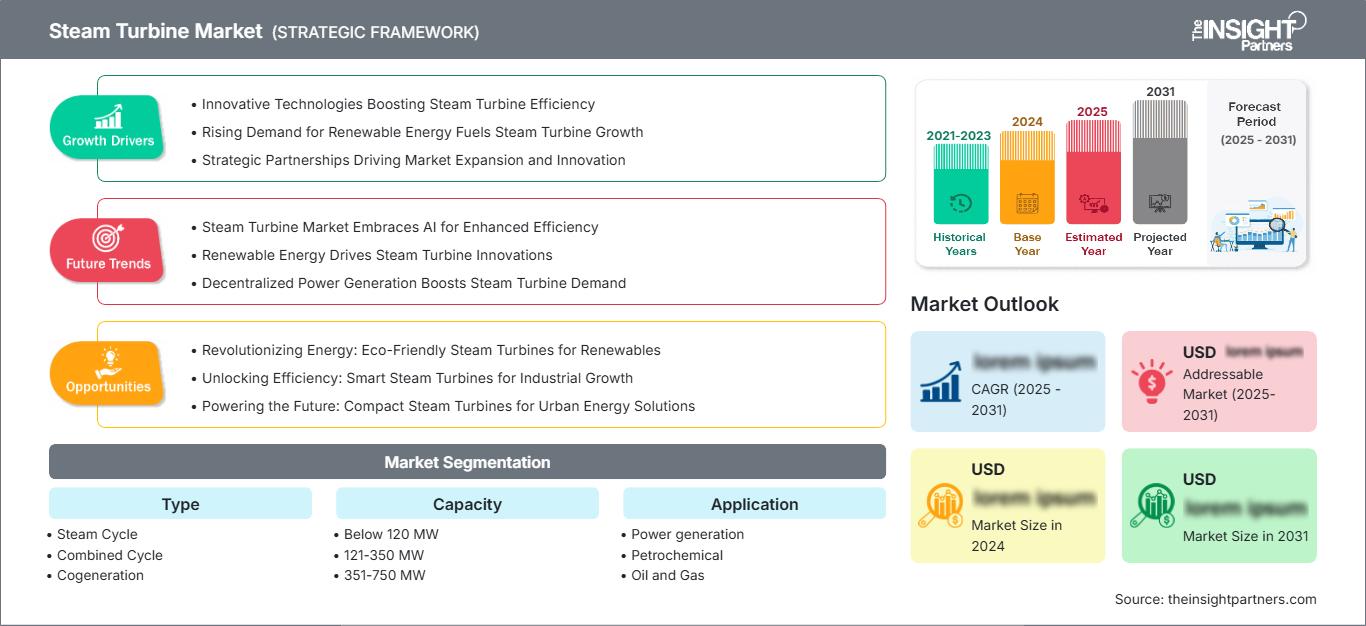
Steam Turbine Market: Strategic Insights
-
Get Top Key Market Trends of this report.This FREE sample will include data analysis, ranging from market trends to estimates and forecasts.
Steam Turbine Market Drivers and Opportunities
Market Drivers:
- Rising Demand for Reliable Power Supply: The global demand for electricity is increasing significantly from the industrial, commercial, and residential sectors, thus driving the demand for steam turbines.
- Supportive Policies and Decarbonization Initiatives: Policies implemented by governments to reduce emissions, improve efficiency, and modernize aging thermal and nuclear fleets of power plants attract investments in advanced steam turbine technologies and retrofit projects.
- Technological Advancements in High-Efficiency Turbines: The improvement of supercritical and ultra-supercritical designs, the enhancement of the quality of the materials used, and the introduction of digital controls are the ongoing innovations leading to higher efficiency and flexibility, thus integrating steam turbines deeply in modern power systems.
Market Opportunities:
- Expansion of Combined Heat and Power (CHP) Applications: The use of CHP in industrial plants and district heating networks is increasing, creating a demand for steam turbines that can provide both electricity and heat at the same time while increasing the overall energy utilization.
- Growth in Emerging Economies and New Power Infrastructure: Urbanization and industrialization happening rapidly in Asia, Africa, and Latin America are the major factors leading to new investments in coal, gas, biomass, and nuclear power stations.
- Integration with Renewable and Hybrid Energy Systems: The requirement for a flexible capacity that stabilizes the grid, with variable renewable generation, allows the use of steam turbines in hybrid plants, including biomass co-firing, solar thermal, and waste-to-energy projects.
Steam Turbine Market Report Segmentation Analysis
The steam turbine market is divided into different segments to give a clearer view of how it works, its growth potential, and the latest trends. Below is the standard segmentation approach used in industry reports:
By Type:
- Impulse Turbine: The main market of Impulse turbines is heavily shares as it can take high-pressure steam, has a very fast response time, and is very suitable for industrial processes, e.g., petrochemicals and small power generation modules.
- Reaction Turbine: Reaction turbines are ideal solutions for big power plants, enabling efficient multi-stage steam expansion and smooth operation over a wide range of loads.
By Voltage Range:
- Fossil Fuel
- Thermal Renewables
- Others
By End User:
- Power Generation
- Oil and Gas
- Others
By Capacity:
- Less than 10 MW
- 10 MW to 100 MW
- 100 MW to 300 MW
- Above 300 MW
By Geography:
- North America
- Europe
- Asia Pacific
- South America
- Middle East & Africa
Steam Turbine Market Regional Insights
The regional trends and factors influencing the Steam Turbine Market throughout the forecast period have been thoroughly explained by the analysts at The Insight Partners. This section also discusses Steam Turbine Market segments and geography across North America, Europe, Asia Pacific, Middle East and Africa, and South and Central America.
Steam Turbine Market Report Scope
| Report Attribute | Details |
|---|---|
| Market size in 2024 | US$ 17.79 Billion |
| Market Size by 2031 | US$ 21.64 Billion |
| Global CAGR (2025 - 2031) | 2.75% |
| Historical Data | 2021-2023 |
| Forecast period | 2025-2031 |
| Segments Covered |
By Type
|
| Regions and Countries Covered |
North America
|
| Market leaders and key company profiles |
|
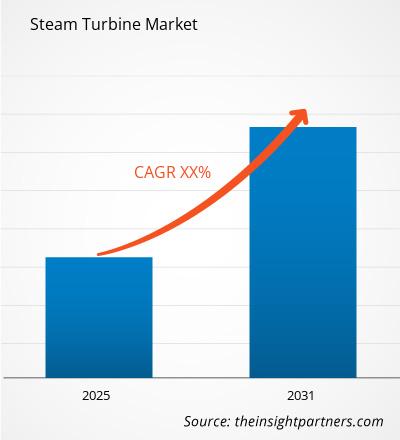
Steam Turbine Market Players Density: Understanding Its Impact on Business Dynamics
The Steam Turbine Market is growing rapidly, driven by increasing end-user demand due to factors such as evolving consumer preferences, technological advancements, and greater awareness of the product's benefits. As demand rises, businesses are expanding their offerings, innovating to meet consumer needs, and capitalizing on emerging trends, which further fuels market growth.
- Get the Steam Turbine Market top key players overview
Steam Turbine Market Share Analysis by Geography
Asia Pacific dominates global steam turbine demand, underpinned by rapid industrialization, urbanization, and strong electricity consumption in China, India, and Southeast Asia. The region’s large pipeline of coal, gas, nuclear, and cogeneration projects, combined with the modernization of aging thermal plants, sustains high installation rates for utility-scale units.
Below is a summary of market share and trends by region:
1. North America
- Market Share: A market that has reached maturity and has a steady demand for replacements, this is made possible by the large number of coal, gas, and nuclear plants that have been installed, the high reliability requirements of the grid, and the investments in life extension and modernization projects.
- Key Drivers:
- Refurbishment and uprating of aging steam turbine fleets in the US and Canada.
- Shift to gas-fired combined-cycle plants and nuclear life-extension to provide low‑carbon baseload power.
- Trends: The focus is on digital turbine monitoring, efficiency upgrades, and the flexible operation that can be used to complement the increased capacity of wind and solar generation.
2. Europe
- Market Share: A major share of the world demand, caused by the implementation of decarbonization policies, nuclear, and biomass projects, as well as CHP-based district heating networks in Central and Eastern Europe.
- Key Drivers:
- Wide adoption of cogeneration and waste‑to‑energy plants.
- Trends: The main focus is on using high-efficiency turbines, biomass and waste co‑firing, and repowering of existing sites with more flexible steam cycles.
3. MEA
- Market Share: The region is an emerging market, and a gradual increase in demand is visible.
- Key Drivers:
- Investment in large gas‑fired and desalination-linked power plants.
- Electrification and grid expansion.
- Trends: Local combined-cycle gas plants are supported by high-efficiency steam turbines, and there is also interest in solar thermal with storage, as well as a gradual move toward cleaner fuels.
4. Asia Pacific
- Market Share: The first biggest regional market is spread across China, India, Japan, and Southeast Asia, which have been adding substantial capacities of coal, gas, and industrial cogeneration.
- Key Drivers:
- Rapid industrialization, urbanization, and growth in electricity consumption volume.
- Upcoming pipeline of thermal, nuclear, and CHP projects.
- Trends: Strong uptake of supercritical and ultra‑supercritical technologies, expansion of industrial CHP, and increasing integration with renewables in hybrid plants.
5. South America
- Market Share: It has been holding a moderate share, with demand being mostly concentrated in Brazil, Argentina, and Chile. Thermal power is the source of energy used to complement hydro resources.
- Key Drivers:
- The need for backup capacity is to solve hydropower variability and droughts.
- Cogeneration in industries such as sugar, pulp, paper, and mining through the use of biomass and waste is one of the major drivers.
- Trends: The growth of biomass-fired CHP, the modernization of existing coal and gas plants, and selective investments in flexible steam turbines to support renewable integration.
Steam Turbine Market Players Density: Understanding Its Impact on Business Dynamics
High Market Density and Competition
Competition is strong due to the presence of established players such as GE Vernova Inc., Siemens Energy AG, Chart Industries Inc., and Baker Hughes Co. Regional and niche providers, such as Trillium Flow Technologies, Triveni Turbine Ltd, and Turtle Turbines (P) Ltd., also add to the competitive landscape across different regions.
This high level of competition urges companies to stand out by offering:
- High Efficiency and Flexible Steam Turbines
- Value-added lifecycle services
- Strong technical support
- Competitive project delivery models
Opportunities and Strategic Moves
- Turbine OEMs increasingly partner with utilities, independent power producers, EPC firms, and fuel suppliers to co-develop high-efficiency thermal, nuclear, and CHP projects, particularly in fast-growing Asian and Middle Eastern markets.
- Vendors are expanding retrofit and modernization portfolios—offering efficiency upgrades, emissions-improvement packages, and digital optimization solutions—to capture value from the large installed base of aging steam plants worldwide.
- Companies are developing integrated solutions that combine steam turbines with renewables, energy storage, and heat networks, positioning themselves as providers of flexible, low‑carbon power and cogeneration systems aligned with global decarbonization policies.
Other companies analyzed during the course of research:
- Power Machines
- Ebara Elliott Energy
- Mitsubishi Heavy Industries, Ltd (Mitsubishi Power)
- G - Team a.s.
- Kessels
- FINCANTIERI S.p.A.
- Fuji Electric Co., Ltd.
- Kawasaki Heavy Industries, Ltd.
- Toshiba Corporation
- SHIN Nippon
- Hangzhou Turbine Power Group Co., Ltd.
- Shanghai Electric
- MAPNA Turbine Engineering and Manufacturing
- Qingdao Jieneng
- Nanjing Steam Turbine Motor (Group) Co., Ltd.
Steam Turbine Market News and Recent Developments
- Baker Hughes will supply a Steam Turbine Generator to Technip Energies for the US Facility. In October 2025, Baker Hughes, an energy technology company, announced an award from Technip Energies to supply a steam turbine generator along with critical centrifugal compression equipment for the Blue Point Number One Ammonia Project in Modeste, Louisiana, US.
- Arabelle Solutions Signed Service Collaboration Agreement with Dongfang Electric Corporation In November 2025, Arabelle Solutions, part of the EDF Group and a market leader in nuclear turbine island technology and services, and Dongfang Electric Corporation, one of the largest energy equipment manufacturing enterprise groups in China, signed a service collaboration agreement related to the servicing and maintenance of the Taishan nuclear power plant, Units 1 and 2.
Steam Turbine Market Report Coverage and Deliverables
The "Steam Turbine Market Size and Forecast (2021–2031)" report provides a detailed analysis of the market covering below areas:
- Steam turbine market size and forecast at global, regional, and country levels for all the key market segments covered under the scope
- Steam turbine market trends, as well as market dynamics such as drivers, restraints, and key opportunities
- Detailed PEST and SWOT analysis
- Steam turbine market analysis covering key market trends, global and regional framework, major players, regulations, and recent market developments
- Industry landscape and competition analysis covering market concentration, heat map analysis, prominent players, and recent developments for the Steam turbine market growth
- Detailed company profiles
Frequently Asked Questions
What is the current size of the global steam turbine market?
What are the key factors driving growth in the steam turbine market?
Which type of segment is gaining traction in the steam turbine market?
Which regions are leading in the adoption of the steam turbine?
What factors create opportunities in the global steam turbine market?
Which capacity segment is growing at the fastest rate in the global steam turbine market?
Which leading companies are in the steam turbine market?

- Historical Analysis (2 Years), Base Year, Forecast (7 Years) with CAGR
- PEST and SWOT Analysis
- Market Size Value / Volume - Global, Regional, Country
- Industry and Competitive Landscape
- Excel Dataset
Recent Reports
Related Reports
Testimonials

The Insight Partners' SCADA System Market report is comprehensive, with valuable insights on current trends and future forecasts. The team was highly professional, responsive, and supportive throughout. We are very satisfied and highly recommend their services.
RAN KEDEM Partner, Reali Technologies LTDs
I requested a report on a very specific software market and the team produced the report in a few days. The information was very relevant and well presented. I then requested some changes and additions to the report. The team was again very responsive and I got the final report in less than a week.
JEAN-HERVE JENN Chairman, Future Analytica
We worked with The Insight Partners for an important market study and forecast. They gave us clear insights into opportunities and risks, which helped shape our plans. Their research was easy to use and based on solid data. It helped us make smart, confident decisions. We highly recommend them.
PIYUSH NAGPAL Sr. Vice President, High Beam Global
The Insight Partners delivered insightful, well-structured market research with strong domain expertise. Their team was professional and responsive throughout. The user-friendly website made accessing industry reports seamless. We highly recommend them for reliable, high-quality research services
YUKIHIKO ADACHI CEO, Deep Blue, LLC.
This is the first time I have purchased a market report from The Insight Partners.While I was unsure at first, I visited their web site and felt more comfortable to take the risk and purchase a market report.I am completely satisfied with the quality of the report and customer service. I had several questions and comments with the initial report, but after a couple of dialogs over email with their analyst I believe I have a report that I can use as input to our strategic planning process.Thank you so much for taking the extra time and making this a positive experience.I will definitely recommend your service to others and you will be my first call when we need further market data.
JOHN SUZUKI President and Chief Executive Officer, Board Director, BK Technologies
I wish to appreciate your support and the professionalism you displayed in the course of attending to my request for information regarding to infectious disease IVD market in Nigeria. I appreciate your patience, your guidance, and the fact that you were willing to offer a discount, which eventually made it possible for us to close a deal. I look forward to engaging The Insight Partners in the future, all thanks to the impression you have created in me as a result of this first encounter.
DR CHIJIOKE ONYIA MANAGING DIRECTOR, PineCrest Healthcare Ltd.Reason to Buy
- Informed Decision-Making
- Understanding Market Dynamics
- Competitive Analysis
- Identifying Emerging Markets
- Customer Insights
- Market Forecasts
- Risk Mitigation
- Boosting Operational Efficiency
- Strategic Planning
- Investment Justification
- Tracking Industry Innovations
- Aligning with Regulatory Trends



















 Get Free Sample For