
Stem Cell Therapy Market Growth, Trends & Demand by 2034
Coverage: By Type (Adult Stem Cell Therapy, Embryonic Stem Cell Therapy, Induced Pluripotent Stem Cell Therapy, and Other Stem Cell Therapy), Treatment (Allogeneic and Autologous), Application (Musculoskeletal, Dermatology, Cardiology, Drug Discovery and Development, and Other Applications); End User (Hospitals & Specialty Clinics and Academic & Research Institutes), and Geography
- Status : Data Released
- Report Code : TIPHE100000991
- Category : Life Sciences
- No. of Pages : 150
- Available Report Formats :


- Last update date : April 01, 2026


2025 Market Size
US$ 3.9 Bn
Base year value
2034 Forecast
US$ 9.9 Bn
Projected by 2034
CAGR 2026-2034
10.91 %
Growth rate
Addressable Market
US$ 61.03 Bn
(2026-2034)
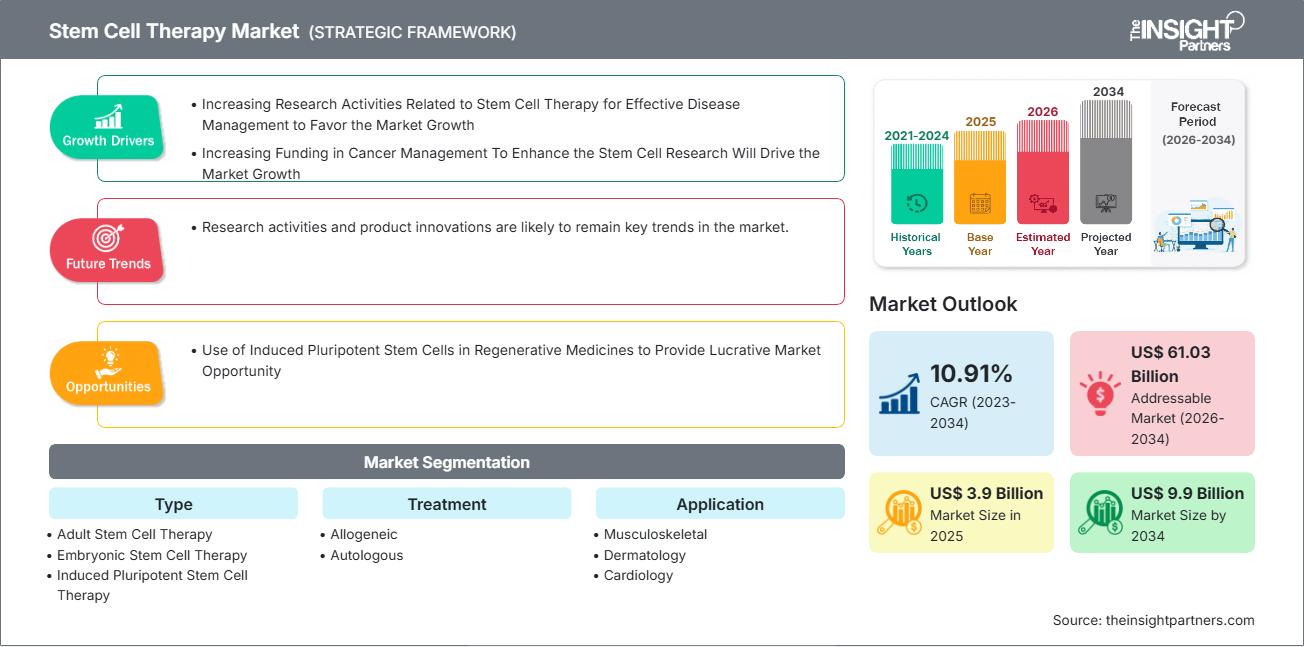
The global Stem Cell Therapy Market size is projected to reach US$ 9.9 billion by 2034 from US$ 3.9 billion in 2025. The market is anticipated to register a CAGR of 10.91% from 2026 to 2034
Key market dynamics include a heightening global focus on regenerative medicine, rising prevalence of chronic and degenerative diseases, and significant advancements in personalized treatment protocols. Additionally, the market is expected to benefit from the growing adoption of induced pluripotent stem cells (iPSCs), expansion in GMP-certified manufacturing facilities across emerging economies, and the increasing inclusion of stem cell treatments in high-value clinical segments like oncology and musculoskeletal repair.
Stem Cell Therapy Market Analysis
The stem cell therapy market analysis shows high-value regenerative solutions as clinicians prioritize long-term disease modification over short-term symptom management. The market indicates traditional autologous treatments and high-growth allogeneic off-the-shelf platforms that offer greater scalability. Strategic opportunities are emerging in oncology and neurology, where stem cells' ability to differentiate and repair damaged tissues offers a clear competitive advantage over conventional pharmaceuticals. The analysis also notes that market expansion depends on cold-chain integrity for live cellular products and bioreactor efficiency for large-scale cell expansion. Competitive differentiation now stands out depending on robust clinical trial data, regulatory compliance, and integrated cell-tracing technologies that ensure product safety and transparency. This approach helps manufacturers justify premium pricing in a market characterized by high technical barriers to entry.
Stem Cell Therapy Market Overview
Stem cell therapies have advanced from niche experimental programs to mainstream therapeutic pillars. The market encompasses a broad spectrum of advanced therapy medicinal products (ATMPs), including mesenchymal stem cell (MSC) applications for systemic inflammation and hematopoietic transplants for blood disorders. Both global biopharmaceutical giants and specialized biotech startups compete in this market, utilizing diverse cell sources such as bone marrow, adipose tissue, and umbilical cord blood. Growing demand for definitive cures rather than palliative care among aging populations in North America and Europe has increased the popularity of stem cell therapy as a transformational medical solution. While North America leads in commercial revenue due to its established reimbursement structures, Asia-Pacific region is advancing rapidly in manufacturing standardization and fast-track regulatory pathways. Competition among brands is fueling greater clinical variety and the inclusion of cutting-edge technologies like CRISPR gene editing and 3D bioprinting to create functional tissue grafts.
The US market leads in revenue due to its established clinical research culture and sophisticated bioprocessing infrastructure. The market is driven by rising chronic ailments and a robust product pipeline. Supportive regulatory pathways and heavy private investment in precision medicine continue to fuel innovation across oncology, musculoskeletal repair, and dermatology.
Market Research Highlights
- Global market for Stem Cell Therapy was valued at US$ 3.90 Billion in 2025
- Annual market size is expected to reach US$ 9.90 Billion by 2034
- Total addressable market (TAM) during 2026-2034 is projected to reach approximately US$ 61.03 Billion
- Market is anticipated to register a CAGR of 10.91% during the forecast period
- The United States represents a key market, supported by Increasing Research Activities Related to Stem Cell Therapy for Effective Disease Management to Favor the Market Growth, Increasing Funding in Cancer Management To Enhance the Stem Cell Research Will Drive the Market Growth, as well as evolving industry dynamics
- Market analysis covers North America, Europe, Asia-Pacific, South and Central America, Middle East and Africa, with growth evaluated across the forecast period
- Market opportunities such as Use of Induced Pluripotent Stem Cells in Regenerative Medicines to Provide Lucrative Market Opportunity are expected to influence market dynamics and addressable market
- Report profiles industry participants, including MEDIPOST, RichSource, BioTime, Inc, Mesoblast Limited, Holostem Terapie Avanzate Srl, US Stem Cell, Inc., TiGenix NV, AlloSource, NuVasive Inc, JCR Pharmaceuticals Co., Ltd., Other Market Players, while analyzing competitive strategies and innovation developments
-
Source: The Insight Partners' analysis based on proprietary research, government publications, company annual reports, investor presentations, industry databases, and expert interviews.
● REPORT CUSTOMIZATION
Tailor This Report To Align With Your Specific Business Requirements
This report can be customized to align precisely with your business objectives, scope, and target markets. Customization options include tailored segmentation, geography, competitive analysis, and strategic insights to support informed decision-making.
Customize This Report →WHAT YOU CAN ADJUST
- ● Segmentations
- ● Geography
- ● Competitive Analysis
- ● Language Preferences
Stem Cell Therapy Market: Strategic Insights
-
Get Top Key Market Trends of this report.This FREE sample will include data analysis, ranging from market trends to estimates and forecasts.
Stem Cell Therapy Market Drivers and Opportunities
Market Drivers:
- Advancements in Regenerative Medicine: Enhanced understanding of cell signaling and tissue engineering is driving the success of therapies aimed at repairing organs, particularly for cardiac and neurological abnormalities.
- Rising Prevalence of Chronic Diseases: The global surge in cancer, autoimmune disorders, and musculoskeletal injuries has sustained high demand for cell-based inputs as traditional treatments reach their limits.
- Supportive Regulatory Pathways: Expedited approval processes for advanced therapies in regions like the US (FDA) and Japan (PMDA) have removed traditional barriers, accelerating commercialization.
Market Opportunities:
- Emergence of Allogeneic Platforms: Donor-derived therapies offer significant opportunities to reduce patient waiting times and lower per-patient costs compared to personalized autologous models.
- Expansion into Drug Discovery: Beyond direct clinical use, stem cells offer a high-margin opportunity for pharmaceutical companies to test new drugs on human-derived cellular models, reducing reliance on animal testing.
- Growth in Emerging Biotech Hubs: Strategic partnerships between Western therapy developers and Asian CMOs may facilitate access to high-volume market segments in China and India.
Stem Cell Therapy Market Report Segmentation Analysis
The stem cell therapy market share is analyzed across various segments to provide a clearer understanding of its structure, growth potential, and emerging trends. Below is the standard segmentation approach used in most industry reports:
By Type:
- Adult Stem Cell Therapy: The dominant volume driver, particularly within traditional orthopedic and cardiovascular sectors, due to established safety profiles.
- Embryonic Stem Cell Therapy: A specialized segment aligned with fundamental research; increasingly restricted to high-end academic settings.
- Induced Pluripotent Stem Cell Therapy: The fastest-growing niche, aligning with global precision medicine trends and offering ethical advantages.
- Other Stem Cell Therapy: Includes emerging sources like perinatal and dental pulp stem cells.
By Treatment:
- Allogeneic: Projected to grow at the highest CAGR due to its potential for mass production and lower patient-specific costs.
- Autologous: The primary approach for personalized medicine, preferred for reducing immunogenicity risks in orthopedic and aesthetic applications.
By Application:
- Musculoskeletal: Represents the largest application share, driven by the global prevalence of chronic joint conditions like osteoarthritis.
- Dermatology: A growing segment focusing on wound healing and regenerative skincare solutions.
- Cardiology: High-growth area targeting heart tissue repair following cardiac events.
- Drug Discovery and Development: Anticipated to expand rapidly as a primary tool for evaluating drug efficacy and toxicity.
- Other Applications: Includes neurology (Parkinson’s/Alzheimer’s), oncology, and ophthalmic conditions.
By End User:
- Hospitals & Specialty Clinics: The primary channel for therapeutic delivery and patient administration.
- Academic & Research Institutes: Significant contributors through R&D contracts and early-stage clinical trial collaborations.
By Geography:
- North America
- Europe
- Asia Pacific
- South & Central America
- Middle East & Africa
Stem Cell Therapy Market Report Scope
| Report Attribute | Details |
|---|---|
| Market size in 2025 | US$ 3.9 Billion |
| Market Size by 2034 | US$ 9.9 Billion |
| Global CAGR (2023 - 2034) | 10.91% |
| Historical Data | 2021-2024 |
| Forecast period | 2026-2034 |
| Segments Covered |
By Type
|
| Regions and Countries Covered |
North America
|
| Market leaders and key company profiles |
|
Stem Cell Therapy Market Players Density: Understanding Its Impact on Business Dynamics
The Stem Cell Therapy Market is growing rapidly, driven by increasing end-user demand due to factors such as evolving consumer preferences, technological advancements, and greater awareness of the product's benefits. As demand rises, businesses are expanding their offerings, innovating to meet consumer needs, and capitalizing on emerging trends, which further fuels market growth.

Stem Cell Therapy Market Share Analysis by Geography
Asia-Pacific is expected to grow fastest in the coming years. Emerging markets in South & Central America, the Middle East, and Africa also have many untapped opportunities for regenerative medicine providers and specialized clinic chains to expand.
The stem cell therapy market is undergoing a significant transformation, moving from a traditional hospital staple to a global high-value functional medicine segment. Growth is driven by the rising prevalence of chronic conditions, a surge in personalized health demand, and the expansion of luxury medical tourism. Below is a summary of market share and trends by region:
North America
- Market Share: Holds the largest share globally, anchored by a robust pipeline of clinical trials and high healthcare spending.
- Key Drivers:
- Rising consumer preference for personalized medicine and mainstreaming of cell therapies in high-end medical networks.
- Significant government and private venture capital funding for late-stage clinical trials.
- Presence of a high number of FDA-approved protocols and Regenerative Medicine Advanced Therapy (RMAT) designations.
- Trends: Rapid adoption of automated, closed-system manufacturing to reduce labor costs and the successful integration of stem cell therapies into mainstream insurance frameworks.
Europe
- Market Share: Holds a significant share, supported by deep-seated academic ecosystems and harmonized regulatory frameworks in Germany, the UK, and France.
- Key Drivers:
- Strong institutional support for Advanced Therapy Medicinal Products (ATMPs).
- Established processing infrastructure and strict quality standards for traditional and bio-engineered cell products.
- Robust public funding for rare disease research and tissue engineering.
- Trends: A strategic shift toward prioritizing standardized, off-the-shelf allogeneic treatments and an increasing focus on cell-tracing technologies to meet stringent EMA safety regulations.
Asia-Pacific
- Market Share: The fastest-growing region, with Japan and China acting as the primary drivers for regulatory innovation and commercial adoption.
- Key Drivers:
- Massive consumer base seeking premium medical solutions and government-supported biotechnology initiatives.
- Rapid urbanization and rising disposable incomes are leading to a preference for advanced, westernized medical snacks and treatments.
- Fast-track regulatory pathways, such as Japan's conditional approval system for regenerative medicine.
- Trends: Heavy reliance on B2B contracts for high-end stem cell reagents and the rise of affordable, home-grown regenerative treatments catering to a burgeoning middle class.
South and Central America
- Market Share: Emerging market with a growing artisanal industry in countries like Brazil and Chile.
- Key Drivers:
- Increasing awareness of the regenerative superiority of stem cells for joint health and aesthetic rejuvenation.
- Modernization of private clinics into commercial-grade facilities to supply urban centers.
- Rising interest in cell-based therapies for chronic pain management among high-income segments.
- Trends: Growth of boutique regenerative brands and the introduction of specialized stem cell serums to differentiate from traditional pharmaceutical offerings.
Middle East and Africa
- Market Share: Developing market with deep cultural roots in medical excellence, transitioning toward formalized commercial production.
- Key Drivers:
- Strategic investments in Smart Healthcare to improve local medical security and reduce reliance on overseas treatment.
- High demand for specialized therapies for genetic and metabolic disorders common in the region.
- Implementation of modern bioprocessing and refrigeration technologies to formalize the local cellular market.
- Trends: Growth of medical tourism hubs in cities like Dubai and Riyadh, focusing on high-nutrient stem cell protocols for the orthopedic and pediatric segments.
High Market Density and Competition
Competition is intensifying due to the presence of established leaders such as Novartis AG, Gilead Sciences, Inc., and Mesoblast Ltd. Regional innovators and niche players like TiGenix and Medipost Co., Ltd., alongside North American experts such as Vericel Corporation and Fate Therapeutics, also contribute to a diverse and rapidly expanding market landscape.
This competitive environment pushes vendors to differentiate through:
- Premiumization and Functional Branding: Positioning stem cell therapy as a superior medical alternative by emphasizing its higher tissue-repair potential and long-term disease modification for health-conscious patients.
- Diversified Portfolios: Stem cell products now include more than just transplants. Companies offer specialized culture media, regenerative skincare serums, and high-end diagnostic kits for cell potency.
- Integrated Supply Chains: Producers manage the entire chain, from donor selection and GMP processing to final clinical delivery. This ensures quality, transparency, and meets ethical clean-label medical standards.
- New Processing Technologies: Tools like automated bioreactors and CRISPR gene editing help create high-quality, standardized cell products used in clinical and research applications worldwide.
Opportunities and Strategic Moves
- Partner with High-End Clinical Networks: Collaborate with specialty hospitals and e-commerce health platforms to tap into the surging demand for personalized and minimally invasive treatments in North American and Asian markets.
- Incorporate Sustainable and Ethical Sourcing: Adopt ethical cell procurement practices and regenerative bioprocessing certifications to appeal to socially conscious patients and investors seeking responsible medical innovations.
Major Companies operating in the Stem Cell Therapy Market are:
- MEDIPOST
- RichSource
- BioTime, Inc
- Mesoblast Limited
- Holostem Terapie Avanzate S.R.L.
- US Stem Cell, Inc.
- TiGenix NV
- AlloSource
- NuVasive Inc
- JCR Pharmaceuticals Co., Ltd.
- Other Market Players
Disclaimer: The companies listed above are not ranked in any particular order.
Stem Cell Therapy Market News and Recent Developments
- In February 2026, MEDIPOST Inc., a biotechnology company developing allogeneic, umbilical cord blood-derived stem cell therapies for inflammation-driven degenerative diseases, announced that it had filed an Investigational New Drug (IND) amendment to the U.S. Food and Drug Administration (FDA) to support the initiation of a Phase III clinical trial evaluating its investigational cell therapy for knee osteoarthritis.
- In December 2025, Cipla Limited announced the launch of Ciplostem, an innovative allogeneic mesenchymal stromal cell (MSC) therapy for Knee Osteoarthritis (Knee OA), approved by the Drug Controller General of India (DCGI). Developed by Stempeutics Research, the therapy offers a disease-modifying treatment option targeting Grade II and III Knee OA and marks a significant advancement in Cipla’s entry into Orthobiologic medicine.
Stem Cell Therapy Market Report Coverage and Deliverables
The Stem Cell Therapy Market Size and Forecast (2021–2034) report provides a detailed analysis of the market covering below areas:
- Stem Cell Therapy Market size and forecast at global, regional, and country levels for all the key market segments covered under the scope
- Stem Cell Therapy Market trends, as well as market dynamics such as drivers, restraints, and key opportunities
- Detailed PEST and SWOT analysis
- Stem Cell Therapy Market analysis covering key market trends, global and regional framework, major players, regulations, and recent market developments
- Industry landscape and competition analysis covering market concentration, heat map analysis, prominent players, and recent developments in the Stem Cell Therapy Market.
- Detailed company profiles
Frequently Asked Questions

- Comprehensive Market Sizing and Forecast Analysis
- Detailed Segmentation Analysis
- In-Depth Market Dynamics Assessment
- Regional and Country-Level Insights
- Competitive Landscape and Company Benchmarking
- Strategic Business Intelligence
Recent Reports
Testimonials

The Insight Partners' SCADA System Market report is comprehensive, with valuable insights on current trends and future forecasts. The team was highly professional, responsive, and supportive throughout. We are very satisfied and highly recommend their services.
RAN KEDEM Partner, Reali Technologies LTDs
I requested a report on a very specific software market and the team produced the report in a few days. The information was very relevant and well presented. I then requested some changes and additions to the report. The team was again very responsive and I got the final report in less than a week.
JEAN-HERVE JENN Chairman, Future Analytica
We worked with The Insight Partners for an important market study and forecast. They gave us clear insights into opportunities and risks, which helped shape our plans. Their research was easy to use and based on solid data. It helped us make smart, confident decisions. We highly recommend them.
PIYUSH NAGPAL Sr. Vice President, High Beam Global
The Insight Partners delivered insightful, well-structured market research with strong domain expertise. Their team was professional and responsive throughout. The user-friendly website made accessing industry reports seamless. We highly recommend them for reliable, high-quality research services
YUKIHIKO ADACHI CEO, Deep Blue, LLC.
This is the first time I have purchased a market report from The Insight Partners.While I was unsure at first, I visited their web site and felt more comfortable to take the risk and purchase a market report.I am completely satisfied with the quality of the report and customer service. I had several questions and comments with the initial report, but after a couple of dialogs over email with their analyst I believe I have a report that I can use as input to our strategic planning process.Thank you so much for taking the extra time and making this a positive experience.I will definitely recommend your service to others and you will be my first call when we need further market data.
JOHN SUZUKI President and Chief Executive Officer, Board Director, BK Technologies
I wish to appreciate your support and the professionalism you displayed in the course of attending to my request for information regarding to infectious disease IVD market in Nigeria. I appreciate your patience, your guidance, and the fact that you were willing to offer a discount, which eventually made it possible for us to close a deal. I look forward to engaging The Insight Partners in the future, all thanks to the impression you have created in me as a result of this first encounter.
DR CHIJIOKE ONYIA MANAGING DIRECTOR, PineCrest Healthcare Ltd.Reason to Buy
- Informed Decision-Making
- Understanding Market Dynamics
- Competitive Analysis
- Identifying Emerging Markets
- Customer Insights
- Market Forecasts
- Risk Mitigation
- Boosting Operational Efficiency
- Strategic Planning
- Investment Justification
- Tracking Industry Innovations
- Aligning with Regulatory Trends





 Get Free Sample for