
Straddle Carrier Market Share, Size & Demand by 2034
Coverage: By Operation Type (Manual, Semi-Automatic, Automatic); Loading Capacity (Below 40 Ton, 40 - 50 Ton, Above 50 Ton); Drive Type (Hydraulic Drive, Electric Drive, Hybrid Drive); Application (Port Terminals, Intermodal Yards, Others) , and Geography (North America, Europe, Asia Pacific, and South and Central America)
- Status : Data Released
- Report Code : TIPRE00014102
- Category : Manufacturing and Construction
- No. of Pages : 150
- Available Report Formats :


- Last update date : October 30, 2026


2025 Market Size
US$ 1.61 Bn
Base year value
2034 Forecast
US$ 3.31 Bn
Projected by 2034
CAGR 2026-2034
8.31 %
Growth rate
Addressable Market
US$ 22.06 Bn
(2026-2034)
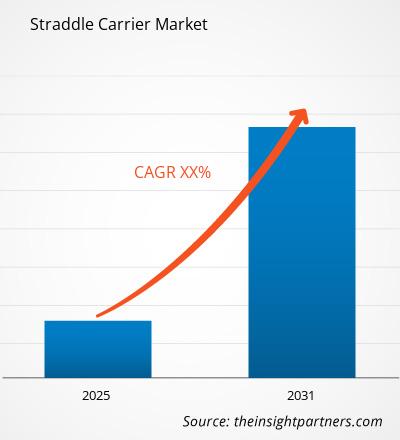
The Straddle Carrier Market is positioned for sustained expansion as ports modernize horizontal transport and container stacking operations. The market was valued at US$ 1.61 Billion in 2025 and is projected to reach US$ 3.31 Billion by 2034, registering a CAGR of 8.31% during 2026–2034. Procurement is increasingly shaped by requirements for higher yard productivity, lower operating emissions, safer vehicle movement, and tighter integration between carrier fleets, terminal operating systems, and quay-side workflows.
North America is expected to record a ~7% CAGR through 2034, supported by replacement of aging diesel fleets and capacity programs at major container gateways. The Straddle Carrier Market size in the region also benefits from hybrid retrofits, shore-power expansion, and terminal investment in automated dispatch, collision avoidance, and predictive maintenance. U.S. East Coast and Gulf facilities are prioritizing equipment capable of serving vessel transfer, stacking, truck interchange, and rail-linked movements without requiring extensive fixed-yard infrastructure.
Straddle Carrier Market Assessment and Insights
Regional Outlook
- North America: ~27% of the global Straddle Carrier Market share in 2025 | ~7% CAGR through 2034. Market position: The region ranks behind Europe and Asia Pacific but sustains a large replacement market, backed by hybrid procurement, terminal expansion, and high utilization at U.S. container gateways.
- US: ~81% of North American market revenue in 2025 | ~8% CAGR through 2034. Market position: The U.S. leads North America as ports invest in lower-emission fleets, automation-ready controls, and versatile carriers for quay, stacking, truck, and rail applications.
- Europe: ~31% of the global market in 2025 | ~7% CAGR through 2034. Market position: Europe is the largest regional market, reflecting a mature installed base, stringent decarbonization programs, and concentrated demand in the UK, Germany, the Netherlands, Belgium, France, Italy, and Spain.
- Asia Pacific: ~30% of the global market in 2025 | ~10% CAGR through 2034. Market position: Asia Pacific is the fastest-growing region as China, South Korea, India, Australia, and Southeast Asian gateways expand capacity and accelerate terminal automation.
Segment Outlook
- Application: ~72% Share in 2025 | ~8% CAGR through 2034. Market position: Application is the largest main segment because port terminals account for concentrated fleet deployments, intensive duty cycles, and recurring replacement demand across vessel, stack, and landside interfaces.
- Drive Type: ~24% Share in 2025 | ~11% CAGR through 2034. Market position: Drive Type is the high-growth main segment as electric and hybrid architectures gain from fuel savings, emissions targets, improved batteries, and charging infrastructure.
Competitive Coverage
CVS Ferrari S.r.l., BIA Group, Comtec TCS S.r.l., Cranes and Machinery, Easy Street JD&S, Gerlinger Carrier, GL POWER, LASE Industrielle Lasertechnik GmbH, S.B. Ballard Construction Company, SICK AG
Methodology
The Insight Partners follows Data Collection & Secondary Research, Primary Research, Data Analysis, and Data Triangulation & Final Review to validate market estimates and insights.
Source: The Insight Partners' analysis based on proprietary research, government publications, company annual reports, investor presentations, industry databases, and expert interviews.
Engineered for mechanical durability in diesel-powered cargo haulers, engineers are focusing on digital connectivity using technologies such as regenerative braking, energy management, remote diagnostics, and operator assistance systems. Manufacturers are designing components so that terminals may choose to use manual, semiautomatic, or fully automatic systems without needing an entirely new design of the truck. Production still retains a specialization characteristic since different terminals have unique specifications relating to frame geometry, lift heights, axle loading capacity, and duty cycles. This creates an opportunity for suppliers who are capable of offering application engineering, commissioning services, spare parts, and lifecycle maintenance.
From now to 2034, capacity expansion in Asia Pacific, the Middle East, and specific African ports will help widen the addressable customer base, but replacement will continue to play a key role in Europe and North America. In terms of capital investment, there will be preference for projects combining equipment with charging infrastructure and workforce transition plans, as opposed to purchasing vehicles alone. Requirements related to port emissions, local air quality, and available electricity will make it beneficial to introduce electric vehicles in the fleet wherever possible, while hybrids will remain important in locations where the electric grid is an issue.
Straddle Carrier Market Report Scope
| Report Attribute | Details |
|---|---|
| Market size in 2025 | US$ 1.61 Billion |
| Market Size by 2034 | US$ 3.31 Billion |
| Global CAGR (2026 - 2034) | 8.31% |
| Historical Data | 2021-2024 |
| Forecast period | 2026-2034 |
Straddle Carrier Market Analysis
Demand is based on container terminals’ desire for flexible horizontal lifting equipment capable of picking, transporting, stacking, and moving containers using little fixed infrastructure. Straddle Carrier Market expansion is driven by increasingly complex ship calls, the challenge of reducing truck turnaround time, and the necessity of fast stack realignment. Port terminals continue to be the main customers, and intermodal yards employ straddles selectively where high container throughput justifies dedicated fleets.
The system involves the production of steel chassis, suppliers of powertrains and batteries, hydraulics manufacturers, tire producers, spreader systems, sensors, control systems, software integrators, dealers, and maintenance companies. Long-lead parts and custom engineering prevent quick scaling, while service availability impacts competitive tendering. Customers analyze supply availability, energy consumption per move, spare part handling, battery charging capabilities, and integration risk together with purchase price.
Straddle Carrier market analysis suggests a concentrated competition of technologies despite the fact that the competitive environment provided is comprised of both vehicle manufacturers, distributors, construction and machinery companies, and automation suppliers. CVS Ferrari S.r.l. and integrators compete on equipment performance and speed of service. In addition, LASE Industrielle Lasertechnik GmbH and SICK AG support the sensing capabilities required for positioning and collisions prevention. BIA Group, Comtec TCS S.r.l., Cranes and Machinery, Easy Street JD&S, Gerlinger Carrier, GL POWER, and S.B. Ballard Construction Company provide geographical proximity or other capabilities.
Investments are being directed towards platforms capable of fleet management which allows for gradual automation and drive train replacement. The suppliers which can incorporate straddle carrier capabilities into controls and telematics as well as charging capabilities will be able to secure their margins and ensure customer loyalty. Strategic positioning increasingly requires demonstration of interoperability capabilities, local engineering competencies, and finance structure which ties payments for equipment to energy and maintenance savings.
● REPORT CUSTOMIZATION
Tailor This Report To Align With Your Specific Business Requirements
This report can be customized to align precisely with your business objectives, scope, and target markets. Customization options include tailored segmentation, geography, competitive analysis, and strategic insights to support informed decision-making.
Customize This Report →WHAT YOU CAN ADJUST
- ● Segmentations
- ● Geography
- ● Competitive Analysis
- ● Language Preferences
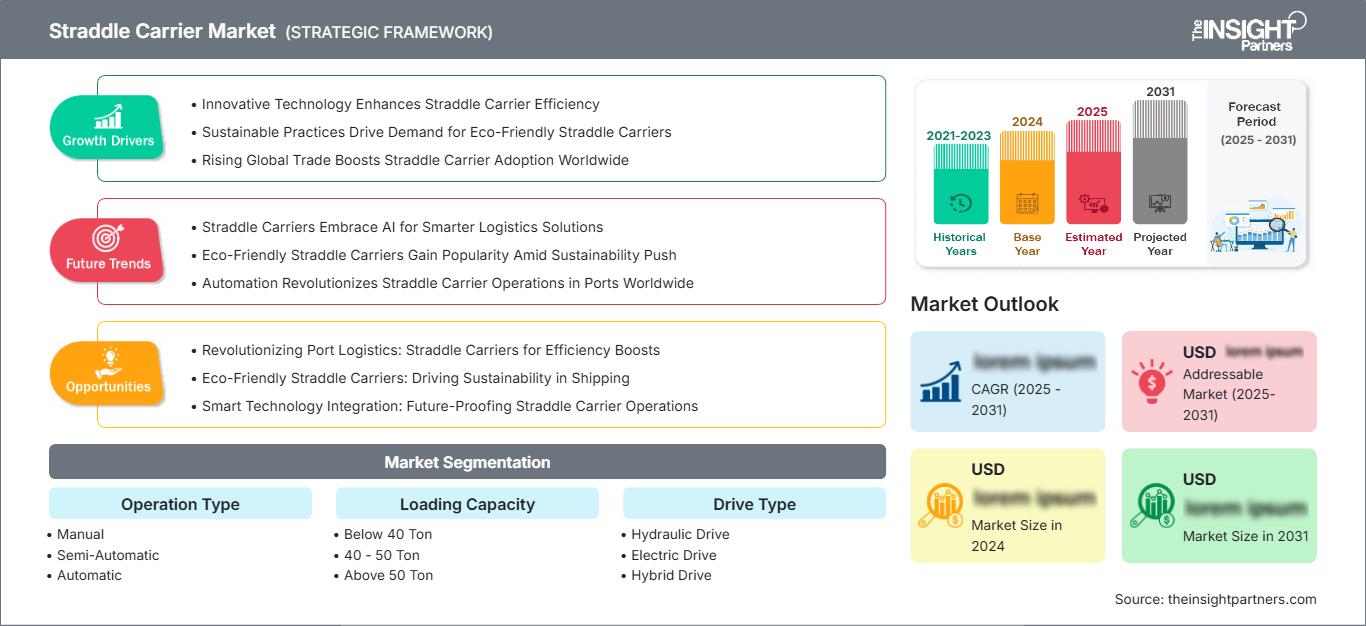
Straddle Carrier Market: Strategic Insights
Regional Insights
North America Straddle Carrier Market
North America is projected to expand at a ~7% CAGR through 2034, with demand concentrated in high-throughput container gateways and large intermodal complexes. The Straddle Carrier Market shares of ~27% in 2025 result from the large installed base, extended replacement cycles, and selective application of straddle carriers versus rubber tire gantries and tractor-trailer alternatives. The hybrid drive offers a good solution for applications requiring a reduction in emissions without depending completely on high-capacity battery charging.
Fleet purchase decisions will become more connected with terminal modernizations than with fleets' renewal individually. Carriers that can operate in all ship-to-shore transfer, stack operation, truck lanes, and rail operations are appreciated by operators, whereas telematics and condition monitoring provide solutions to issues related to manpower and availability. The Canadian and Mexican investments diversify the regional demand, while U.S. terminals dominate the market demand.
U.S. Straddle Carrier Market
The U.S. represents ~81% of North American market revenue in 2025 and is expected to post a ~8% CAGR through 2034. Terminals in East Coast with existing workflows in straddles represent an important part of the customer base, whereas on the West Coast and Gulf Coast, suppliers get evaluated for the yard management systems. Growth opportunities, bigger ships, and connections with the rail system encourage procurement of straddles with high utilization rates and flexible configuration capabilities.
Presense of the supplier is ensured by regional warehouses, field services, and long-term maintenance agreements. Trends include a mix of fleets for short-term decarbonization purposes and automation capable control systems for future use. Sensors by SICK AG and positioning systems by LASE Industrielle Lasertechnik GmbH cover gaps related to blind zones, lane alignment, and cooperation between equipment.
Europe Straddle Carrier Market
Europe held ~31% of global revenue in 2025 and is forecast to register a ~7% CAGR through 2034. It is marked by an extensive existing fleet, specialist equipment suppliers with experience, higher labor costs, and port decarbonization initiatives. Germany ranks the highest in Europe because of its extensive container gateways, engineering capability, and implementation of automated and low-emission cargo handling equipment. The UK is another country providing additional demand for terminal automation equipment via capacity additions and electrification at large logistics hubs.
The replacement/expansion patterns differ for France, Italy, and Spain. The French terminals focus on reliable equipment and integration into the overall digitalization of the port. The Italian terminals show demand at both gateway and transshipment terminals, where maneuverability and availability play a role. The Spanish terminals feature transshipment intensity and rail-connected logistics; therefore, they require hybrid and automation-ready equipment in cases of dense traffic.
The European buyers consider lifecycle emissions, charging policy, noise levels, maintenance and interoperable software during the tender evaluation process. The mature terminals will buy electric equipment in case they can charge their vehicles predictively, whereas other terminals will buy hybrids. Such approach guarantees consistent volumes of purchases even at modest growth rates.
APAC Straddle Carrier Market
Asia Pacific accounted for ~30% of the global market in 2025 and is the fastest-growing region, with a ~10% CAGR through 2034. China is the leader in the Asia Pacific region because it offers a terminal facility that has a combination of size, domestic equipment capability, and continuous automation investments. South Korea and Japan provide enabling environments for the adoption of controls, while India contributes greenfield and brownfield ports.
Australia offers a proven benchmarking environment for automated straddles, and there is increasing demand from regional operators for fleet management, radar and machine vision integration. Enabling policy support for trade facilitation, electrification of ports, and domestic manufacturing of equipment is helping the pipeline.
Middle East & Africa Straddle Carrier Market
The Middle East & Africa market is expected to grow at a ~9% CAGR through 2034 as logistics hubs expand container capacity and diversify beyond hydrocarbons. The UAE is the leading country in the Middle East & Africa, supported by large transshipment operations, integrated free-zone logistics, and continuing automation investment. Saudi Arabia is building port and industrial capacity linked to national diversification programs.
South Africa contributes replacement demand at established gateways, while the Rest of MEA offers selective opportunities around corridor development and new terminals. Projects favor rugged equipment, dependable cooling, remote diagnostics, and service models suited to harsh climates and variable technical infrastructure.
Segmentation Analysis
Operation Type
Operation Type is projected to expand at a ~9% CAGR during 2026–2034. The Straddle Carrier Market scope across manual, semi-automatic, and automatic configurations reflects different labor economics, brownfield constraints, safety requirements, and digital maturity. Manual fleets remain practical for variable layouts, semi-automatic systems reduce operator workload through guided functions, and automatic carriers suit high-volume terminals with controlled traffic zones and integrated terminal operating systems.
- Manual: Manual carriers retain a broad installed base because they offer operational flexibility and lower initial integration requirements. Demand is strongest where traffic patterns change frequently, labor remains available, or terminals prioritize straightforward maintenance.
- Semi-Automatic: Semi-automatic systems combine human oversight with assisted steering, positioning, and safety functions. They provide a practical migration path for brownfield terminals seeking measurable productivity and risk improvements without full infrastructure redesign.
- Automatic: Automatic carriers are strategically important for standardized, high-throughput yards. Adoption depends on reliable navigation, controlled access, cybersecurity, fleet orchestration, and process redesign, but can improve consistency and extend operating-hour flexibility.
Loading Capacity
Loading Capacity is forecast to record a ~8% CAGR through 2034. Capacity selection follows container weight profiles, stacking height, axle limits, pavement condition, and terminal versatility requirements. Mid-capacity equipment balances common laden-container handling with maneuverability and fleet standardization, while heavier carriers meet specialized industrial or project cargo needs. Buyers increasingly assess energy consumption and structural durability together because higher rated capacity can raise battery, tire, and maintenance demands.
- Below 40 Ton: Below 40 ton models address lighter containers, empty handling, and yards prioritizing agility. Their strategic value lies in lower energy demand and suitability for operations where maximum payload capability is not routinely required.
- 40 - 50 Ton: The 40 - 50 ton class aligns with mainstream laden-container handling and offers a favorable balance of payload, stack performance, and fleet utilization. It remains central to standardized port procurement.
- Above 50 Ton: Above 50 ton carriers serve heavy containers and specialized cargo flows. Demand is narrower but strategically important in industrial terminals and applications requiring additional structural margin, lifting capability, or nonstandard load handling.
Drive Type
Drive Type is expected to post a ~11% CAGR from 2026 to 2034, the highest among the main segments. Electric and hybrid platforms gain as terminals compare energy cost per move, local emissions, noise, maintenance, and charging uptime. Hydraulic systems retain relevance for proven durability and service familiarity, while modular electrification allows operators to phase infrastructure spending and align fleet conversion with power availability.
- Hydraulic Drive: Hydraulic drive systems remain valued for robust lifting performance, established maintenance knowledge, and parts availability. They are most defensible where utilization patterns, fuel logistics, or grid limitations weaken the case for rapid electrification.
- Electric Drive: Electric drive adoption is scaling at ports with predictable duty cycles and charging access. Lower local emissions, quieter operation, and fewer powertrain wear components strengthen lifecycle economics when electricity supply and fleet scheduling are coordinated.
- Hybrid Drive: Hybrid drive provides an intermediate path by combining combustion-based range with battery-assisted efficiency and regenerative energy capture. It is strategically relevant to brownfield terminals seeking emissions reductions without full charging dependence.
Application
Application is projected to advance at a ~8% CAGR through 2034 and represents the largest main segment, with ~72% share in 2025. Port terminals dominate because concentrated container exchanges support dedicated fleets and intensive utilization. Intermodal yards offer selective growth where rail-truck transfers, space constraints, and container repositioning volumes justify independent lifting vehicles. Application economics depend on moves per hour, stack density, travel distance, and synchronization with cranes and gate operations.
- Port Terminals: Port terminals generate the strongest demand through vessel transfer, stacking, and landside interchange. Strategic purchasing focuses on uptime, safety, fleet dispatch, decarbonization, and compatibility with quay cranes and terminal operating systems.
- Intermodal Yards: Intermodal yards adopt carriers where container transfer density and layout flexibility outweigh alternatives such as reach stackers or gantry cranes. Rail connectivity and peak-volume management shape the investment case.
Opportunity Snapshot
| Application | Revenue Contribution | Trend Tag | Adoption Stage |
| Port Terminals | High | Fleet Electrification | Scaling |
| Intermodal Yards | Medium | Rail Integration | Emerging |
Straddle Carrier Market Growth Drivers and Impact Analysis
Container Throughput and Yard Productivity Pressure
A total of 920 million TEUs have been handled by ports in 2024, whereas the growth rate of container throughput has been faster compared to previous two years. It creates higher demand for the timely movement of cargo between quayside cranes, stacking yards, gateways, and rail transfer stations. The straddle carriers give operational freedom since each machine can lift and move cargo without relying on other machines used for stacking. It creates the most effect when there is high demand during the changeover of vessels, creating high peaks and yard configuration that results in constant re-handling. Buyers emphasize acceleration, turning capacity, lifting speed, precision of dispatch, and availability of machines.
Decarbonization of Cargo-Handling Fleets
Terminals are tying equipment replacements to corporate emission goals, air quality laws in their jurisdiction, and cost savings for energy. Hybrids save fuel usage without having to go to a fully electric grid immediately, whereas battery electric equipment eliminates tailpipe emissions and is quieter than other technologies. Impact on the marketplace goes beyond just the trucks: initiatives are now including charging stations, substations, energy management software, route optimization, battery management, and training on the batteries. Timing of procurement will vary according to grid capacity and the ability to recharge during natural downtimes. Suppliers that can quantify fuel usage per move and offer battery warranties shorten approval times, whereas locations with unpredictable electricity supply may go hybrid instead.
Safety, Automation, and Labor Availability
Higher sightlines, blind spots, mixed vehicles, and high container loads contribute to the difficulty of straddle moves. Sensors like radar, lidar, cameras, object detection, lane guidance, and automated braking can lower the risk of collisions while ensuring more stable operation. On the other hand, it is challenging to hire experienced operators for the operation of straddle trucks in many mature ports. For this reason, there is an increasing tendency towards remote control and automatic driving. The practical consequence of this trend is the transition from a vehicle-based tendering approach to a solution that includes sensors, communication technology, traffic management, cybersecurity, and operator controls.
Straddle Carrier Market Future Trends
Megawatt Charging and Energy-Aware Fleet Scheduling
Straddle Carrier Market trends are moving beyond basic battery substitution toward coordinated energy operations. With increased battery capacity, megawatt level charging connections, automated connection, and schedule charging, it will be possible to match the energy charge with meal breaks, queue times, and low workload times. Fleet management software will begin to allocate jobs based on state of charge, priority of container, availability of charger, and congestion. This can lead to reduced spare vehicles and unproductive driving time, as long as substation and demand management system is built for handling simultaneous charging. By 2034, competitive advantage will be in validated operating time, thermal efficiency, battery condition analysis, and charging compatibility rather than just battery capacity.
Phased Autonomy Through Sensor Fusion and Digital Twins
Automation will progress through controlled phases rather than uniform fleet replacement. Terminals are expected to combine radar, lidar, cameras, satellite positioning, inertial sensing, and fixed-reference systems to maintain location accuracy in rain, fog, dust, and container canyons. Digital twins can test route rules, stack interactions, and exception handling before live deployment. Remote operators may supervise multiple vehicles and intervene only when the system encounters an ambiguous obstacle or process deviation. This architecture lowers the operational risk of autonomy, but it raises requirements for cybersecurity, network resilience, software validation, and disciplined change management across terminal processes.
Straddle Carrier Market Opportunities
Brownfield Fleet Conversion and Lifecycle Services
Most established terminals cannot rebuild the yard around a new handling concept without disrupting operations. This creates an opportunity for modular conversions, hybridization, automation-ready control upgrades, sensor retrofits, and service contracts that extend asset life. Straddle Carrier Market Forecasts support investment in diagnostic platforms, regional parts hubs, technician training, and performance-based maintenance. Vendors can target phased programs that begin with condition monitoring and collision avoidance, then add energy optimization and assisted driving. Commercial success will depend on demonstrating retrofit compatibility, predictable downtime, certified safety performance, and measurable savings against continued operation of aging fleets.
Integrated Electrification Packages for Emerging Gateways
Greenfield and expanding terminals in Asia Pacific, the Middle East, and Africa can design charging, traffic separation, and software architecture alongside equipment procurement. This reduces the integration compromises common in mature yards. Suppliers and infrastructure partners can offer bundled carriers, chargers, power studies, microgrid options, fleet orchestration, training, and multiyear service. Financing models linked to energy savings or equipment availability could improve project bankability. The most attractive targets are terminals with predictable routes, growing container volumes, supportive port policy, and sufficient grid planning, because those conditions improve utilization and lower the risk of stranded charging assets.
Recent Developments
- September 2026: Kalmar agreed to supply 12 hybrid straddle carriers to International Container Terminal Services, Inc. (ICTSI) for the new South Luzon Container Terminal at Bauan International Port in Batangas, Philippines. The order, booked in Q3 2026, also includes MyKalmar INSIGHT fleet monitoring and a straddle carrier simulator, with deliveries scheduled for Q3 2027. The terminal is planned with an 800-meter quay, 38 hectares of yard space, and annual capacity of 1.6 million TEUs.
- October 2025: Kalmar Corporation concluded an agreement with Rotterdam Shortsea Terminals (RST) to supply five Kalmar hybrid straddle carriers as part of RST’s fleet renewal program. The repeat order, booked in Kalmar’s Q3 2025 order intake, includes the MyKalmar INSIGHT performance management tool and is scheduled for delivery in Q3 2026. The new machines are intended to expand capacity and improve environmental performance, building on RST’s earlier order of six identical hybrid straddle carriers in 2023.
Frequently Asked Questions

- Comprehensive Market Sizing and Forecast Analysis
- Detailed Segmentation Analysis
- In-Depth Market Dynamics Assessment
- Regional and Country-Level Insights
- Competitive Landscape and Company Benchmarking
- Strategic Business Intelligence
Recent Reports
Testimonials

The Insight Partners provided valuable market intelligence that supported our global go-to-market strategy. Their team was professional, responsive, and attentive to our feedback, providing thoughtful analysis and helpful methodological clarifications throughout the project.
Junmo Kim Chief Financial Officer (CFO), Enertech Co., Ltd.
The Insight Partners' SCADA System Market report is comprehensive, with valuable insights on current trends and future forecasts. The team was highly professional, responsive, and supportive throughout. We are very satisfied and highly recommend their services.
RAN KEDEM Partner, Reali Technologies LTDs
I requested a report on a very specific software market and the team produced the report in a few days. The information was very relevant and well presented. I then requested some changes and additions to the report. The team was again very responsive and I got the final report in less than a week.
JEAN-HERVE JENN Chairman, Future Analytica
We worked with The Insight Partners for an important market study and forecast. They gave us clear insights into opportunities and risks, which helped shape our plans. Their research was easy to use and based on solid data. It helped us make smart, confident decisions. We highly recommend them.
PIYUSH NAGPAL Sr. Vice President, High Beam Global
The Insight Partners delivered insightful, well-structured market research with strong domain expertise. Their team was professional and responsive throughout. The user-friendly website made accessing industry reports seamless. We highly recommend them for reliable, high-quality research services
YUKIHIKO ADACHI CEO, Deep Blue, LLC.
This is the first time I have purchased a market report from The Insight Partners.While I was unsure at first, I visited their web site and felt more comfortable to take the risk and purchase a market report.I am completely satisfied with the quality of the report and customer service. I had several questions and comments with the initial report, but after a couple of dialogs over email with their analyst I believe I have a report that I can use as input to our strategic planning process.Thank you so much for taking the extra time and making this a positive experience.I will definitely recommend your service to others and you will be my first call when we need further market data.
JOHN SUZUKI President and Chief Executive Officer, Board Director, BK Technologies
I wish to appreciate your support and the professionalism you displayed in the course of attending to my request for information regarding to infectious disease IVD market in Nigeria. I appreciate your patience, your guidance, and the fact that you were willing to offer a discount, which eventually made it possible for us to close a deal. I look forward to engaging The Insight Partners in the future, all thanks to the impression you have created in me as a result of this first encounter.
DR CHIJIOKE ONYIA MANAGING DIRECTOR, PineCrest Healthcare Ltd.Reason to Buy
- Informed Decision-Making
- Understanding Market Dynamics
- Competitive Analysis
- Identifying Emerging Markets
- Customer Insights
- Market Forecasts
- Risk Mitigation
- Boosting Operational Efficiency
- Strategic Planning
- Investment Justification
- Tracking Industry Innovations
- Aligning with Regulatory Trends





 Get Free Sample for