
Subsea Tensioner Market Size, Demand & Growth by 2034
Coverage: By Type (Compact, Non-Compact); Application (Subsea Construction, Subsea Maintenance) , and Geography (North America, Europe, Asia Pacific, and South and Central America)
- Status : Data Released
- Report Code : TIPRE00015738
- Category : Manufacturing and Construction
- No. of Pages : 150
- Available Report Formats :


- Last update date : October 30, 2026


2025 Market Size
US$ 1.69 Bn
Base year value
2034 Forecast
US$ 2.49 Bn
Projected by 2034
CAGR 2026-2034
4.40 %
Growth rate
Addressable Market
US$ 18.98 Bn
(2026-2034)
The Subsea Tensioner Market was valued at US$ 1.69 Billion in 2025 and is expected to reach US$ 2.49 Billion by 2034, registering a CAGR of 4.40% during 2026–2034. The market covers compact and non-compact tensioning systems used in subsea construction and subsea maintenance, where controlled bolt preload supports reliable flange connections, manifolds, wellheads, pipelines, risers, and other underwater infrastructure.
Across North America, the Subsea Tensioner Market size is expected to expand at an estimated ~4% CAGR through 2034. Deepwater project sanctions in the Gulf of Mexico and recurring integrity work on installed subsea assets sustain demand. Buyers increasingly prioritize corrosion-resistant tooling, rapid reaction-nut designs, reliable load transfer, and service support that can reduce diver exposure and vessel time during installation or intervention campaigns.
Subsea Tensioner Market Assessment and Insights
Regional Outlook
- North America: ~29% of the global Subsea Tensioner Market share in 2025 | ~4% CAGR through 2034. Market position: The region ranks second, supported by high-specification Gulf of Mexico projects, established intervention fleets, rigorous joint-integrity practices, and recurring maintenance of deepwater production systems.
- US: ~74% of North American market revenue in 2025 | ~4% CAGR through 2034. Market position: The US anchors regional demand through Gulf of Mexico tiebacks, high-pressure developments, operator qualification requirements, local service capacity, and frequent use of subsea tooling in construction and life-extension programs.
- Europe: ~34% of the global market in 2025 | ~4% CAGR through 2034. Market position: Europe leads through its mature North Sea installed base, specialist engineering ecosystem, decommissioning workload, and continued field tiebacks, with Norway and the UK providing the strongest demand concentration.
- Asia Pacific: ~23% of the global market in 2025 | ~6% CAGR through 2034. Market position: Asia Pacific is the fastest-growing region as Australia, China, Malaysia, India, and South Korea expand offshore projects, localize marine engineering, and build maintenance capabilities.
Segment Outlook
- Compact: ~61% Share in 2025 | ~5% CAGR through 2034. Market position: Compact systems lead because restricted flange access, diver handling constraints, and the need for rapid multi-tool deployment favor smaller envelopes without sacrificing load capacity.
- Subsea Construction: ~48% Share in 2025 | ~5% CAGR through 2034. Market position: Construction records the stronger growth outlook as new tiebacks, pipelines, manifolds, offshore wind foundations, and brownfield expansions increase first-installation bolting work.
Competitive Coverage
Atlas Copco AB, FPT Fluid Power Technology S.r.l., HTL Group Ltd., Hydratight Limited, HYTORC, Nord-Lock Group, SPX FLOW, Inc., Stork, TorcUP, Inc., Tri-Star Industries Ltd.
Methodology
The Insight Partners follows Data Collection & Secondary Research, Primary Research, Data Analysis, and Data Triangulation & Final Review to validate market estimates and insights.
Source: The Insight Partners' analysis based on proprietary research, government publications, company annual reports, investor presentations, industry databases, and expert interviews.
Underwater bolting has progressed from manual, time-consuming processes involving single tools into synchronized hydraulic systems designed for reliable preloading, speed, and safety while underwater. Small size, high-grade, corrosion-resistant metals, stroke indicators, easy-to-remove reaction nuts, and multiple-tensioner hoses define product selection criteria. Manufacture is still very specialized as sealing, pressure, sizing, and flanges need to be manufactured and tested precisely. The rental and calibration services have grown in importance to be on par with sales of tools due to tight schedules, availability of divers, and expensive vessel time.
From 2025 to 2034, there is an opportunity for expansion beyond the North Sea and Gulf of Mexico. Australian tie-backs of gas fields, deep-water projects in Southeast Asia, Middle Eastern offshore operations, and offshore wind farms will drive expansion of the project portfolio. Investments are to be made in solutions compatible with API and ANSI flanges, remote pump technology, calibration, and load calculations of bolts. Regulations on leakage, personnel safety, and asset safety will raise demand, but procurement will be project-driven.
Subsea Tensioner Market Report Scope
| Report Attribute | Details |
|---|---|
| Market size in 2025 | US$ 1.69 Billion |
| Market Size by 2034 | US$ 2.49 Billion |
| Global CAGR (2026 - 2034) | 4.40% |
| Historical Data | 2021-2024 |
| Forecast period | 2026-2034 |
Subsea Tensioner Market Analysis
Tensioner subsea market growth depends on the number and complexity of underwater bolted joints rather than simply offshore investments. The installation of new trees, manifolds, pipeline end terminations, small flanges, and intervention connectors creates an initial market, with aging equipment creating repeat inspection, retensioning, and replacement processes. There are construction contractors, operators, rentals firms, and joint integrity services that make up the market ecosystem, with requirements that start with engineering and work their way into tooling and execution.
Economies of supply favor suppliers who can produce a standard set of load cells in combination with application-specific pullers, bridges, nuts, pumps, hydraulic lines, and documentation. Durable tools depend on stainless steel and coated steel, precise seals, and tested hydraulic components. Tight campaigns favor inventory and calibration turn around time. In this sense, regional servicing centers can affect procurement decisions, despite the manufacture of products coming from elsewhere.
Subsea Tensioner Market analysis points to an area of competition comprising diversified industrial-tool providers and bolting specialists. Atlas Copco AB, Hydratight Limited, HYTORC, and Nord-Lock Group are competing by means of their diversified portfolios, technical expertise, and international networks. HTL Group Ltd., TorcUP, Inc., FPT Fluid Power Technology S.r.l., Tri-Star Industries Ltd., Stork, and SPX FLOW, Inc. offer additional value by means of application knowledge, tool rentals, or specific equipment.
Key considerations for investment include miniaturized geometry, quick engagement of reaction nuts, corrosion-resistance, remote pressure regulation, and digital record-keeping. Increasingly, strategic positioning relies upon reduced cost of entire campaign instead of reduced cost of the tooling itself. Flange compatibility, tool repairability, fleet availability, and validated procedures are key elements allowing premium positioning. Cooperation with subsea contracting companies and regional servicing companies increases opportunities for specification prior to purchase.
● REPORT CUSTOMIZATION
Tailor This Report To Align With Your Specific Business Requirements
This report can be customized to align precisely with your business objectives, scope, and target markets. Customization options include tailored segmentation, geography, competitive analysis, and strategic insights to support informed decision-making.
Customize This Report →WHAT YOU CAN ADJUST
- ● Segmentations
- ● Geography
- ● Competitive Analysis
- ● Language Preferences
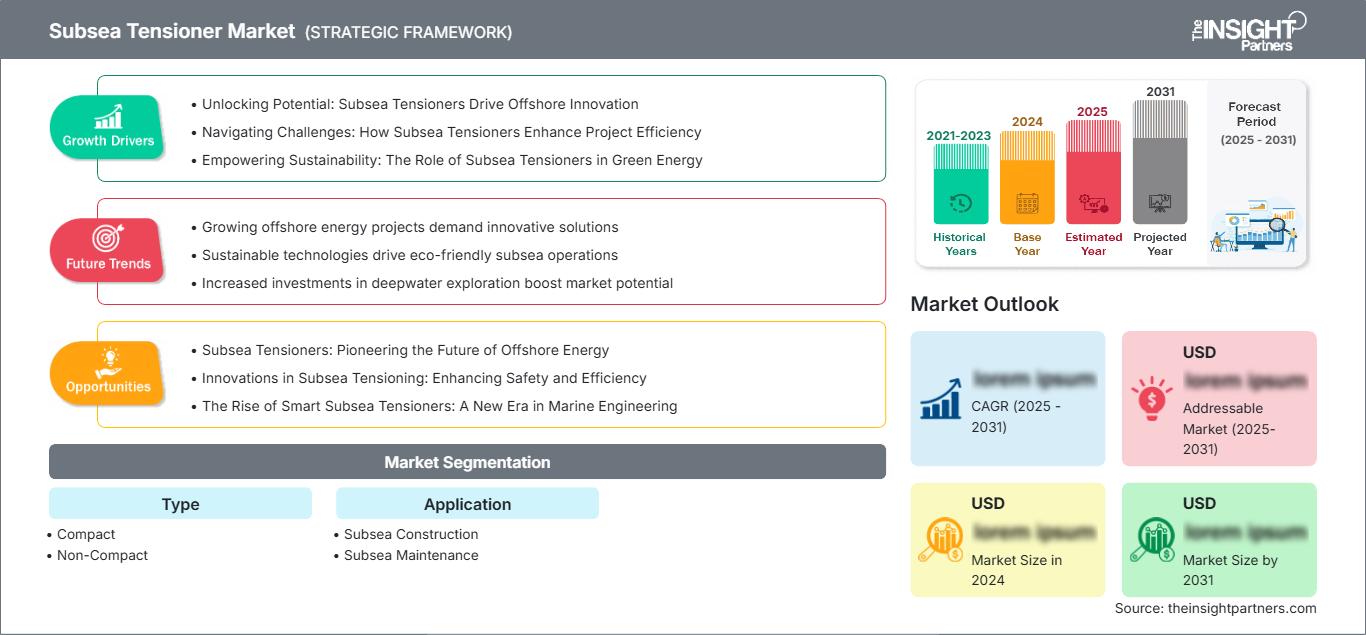
Subsea Tensioner Market: Strategic Insights
Regional Insights
North America Subsea Tensioner Market
North America is projected to advance at ~4% CAGR through 2034, supported by high-pressure developments, deepwater tiebacks, and life-extension work in the Gulf of Mexico. The engineering standards in the region favor bolt load control documentation, pressure equipment certification, and rapid field support. These buying factors increase demand for tensioning systems rather than individual load cells.
North America's market share in the Subsea Tensioner Market is a result of an established installed base and a focused ecosystem of operators, subsea contractors, rental fleets, and technicians. Canada provides selective offshore maintenance demand, whereas Mexico generates project-specific demand. Growth is conservative in the region due to mature infrastructure that limits volume expansion, but safety-dependent demands create revenue streams.
U.S. Subsea Tensioner Market
The US accounts for ~74% of North American revenue in 2025 and is projected to grow at ~4% CAGR through 2034. This position is based on Gulf of Mexico activity where deepwater, high pressure, and reduced intervention windows mandate that the controlled axial preloading is mandatory. Subsea installation fulfills the need for small tools in tree, manifold, flowline, and tie-in installations.
Companies like Atlas Copco AB, HYTORC, TorcUP, Inc., Hydratight Limited, and many more cater to this market through direct support, distributor, rental, and calibration operations. Tooling is now being evaluated with respect to total time of the vessel, ergonomic use by divers, flange coverage, and process traceability. Maintenance is still robust as maturing fields need integrity management work whereas new high-pressure field needs pumps, hoses, and load cells.
Europe Subsea Tensioner Market
Europe represents ~34% of global revenue in 2025 and is expected to expand at ~4% CAGR through 2034. It is the largest regional market, based on the North Sea’s extensive installed asset base, active tieback pipeline, mature subsea supply chain, and long-duration decommissioning need. Norway is the leading country in Europe because its offshore project pipeline combines new subsea production systems with demanding integrity and maintenance requirements. The UK follows with significant brownfield, inspection, repair, and decommissioning activity.
Germany, France, Italy, and Spain make their contribution not by asset ownership but rather through equipment production, engineering, marine and offshore activities. France and Italy offer their specialist industrial and energy services capabilities, while Germany’s advanced engineering provides a base for tooling and offshore wind activities. Spain’s marine infrastructures and renewable energy projects result in selective demand.
Nord-Lock Group, HTL Group Ltd., Hydratight Limited, Atlas Copco AB, and Stork benefit from proximity to engineering and service facilities of Europe. There is an equal balance between installation and life cycle business in demand. Tie-backs in new constructions will be accompanied by compact tools in limited interfaces, whereas old platforms and pipelines will generate recurrent interventions. Offshore wind opens up a long-term business perspective, however, the core commercial base is in sub-sea oil and gas operations.
APAC Subsea Tensioner Market
Asia Pacific holds ~23% of global revenue in 2025 and is forecast to record the fastest regional expansion at ~6% CAGR through 2034. Australia dominates the region, benefiting from offshore gas infrastructure, subsea systems over distance, and challenging maintenance. China brings fabrication and offshore capability, along with Malaysia and the other Southeast Asia markets that provide deepwater projects.
Japan and South Korea offer shipbuilding, offshore engineering, and equipment. India is developing its offshore capability and energy infrastructure. Energy security, local content, and marine industrial capability policy encourages regional supplies. Buyers like versatile tensioners, local parts supply, and training, as campaigns tend to cover remote basins where specialized skills are not readily available.
Middle East & Africa Subsea Tensioner Market
The Middle East & Africa market is projected to grow at ~5% CAGR through 2034. Saudi Arabia is the leading country in the Middle East & Africa where offshore field expansion, brownfield reliability programs, and local service development support demand. The UAE adds offshore production investment and a strong oilfield-services hub, improving access to rental, calibration, and technical support.
South Africa contributes marine engineering and port-linked capability, while the Rest of MEA includes emerging deepwater opportunities in West and Southern Africa. Growth depends on project sanctions, local content requirements, and the availability of intervention vessels. Suppliers that combine rugged equipment with training and regional inventory are better positioned to manage long logistics chains and variable campaign schedules.
Segmentation Analysis
Type
The Type segment is projected to expand at ~4% CAGR from 2026 to 2034. The Subsea Tensioner Market scope by type reflects a trade-off among installation envelope, handling, load capacity, flange geometry, and tool commonality. Compact units increasingly suit constrained subsea interfaces and diver-led work, whereas non-compact systems remain relevant where access and lifting arrangements permit larger bodies. Procurement typically evaluates the complete system, including adapters, reaction nuts, hoses, pumps, certificates, and maintenance requirements.
- Compact: Compact tensioners hold the stronger market position because reduced diameter and weight improve access around dense flange layouts. Their strategic value rises where short vessel windows and diver fatigue make rapid placement, connection, and removal commercially important.
- Non-Compact: Non-compact designs serve applications where workspace is less constrained and established tooling procedures favor conventional geometries. Demand is sustained by installed fleets, broad bolt coverage, familiar maintenance practices, and cost-sensitive projects that do not require minimal envelopes.
Application
The Application segment is expected to grow at ~5% CAGR during 2026–2034. Construction demand responds to project sanctions and equipment installation schedules, while maintenance produces a steadier requirement linked to inspections, leak prevention, refurbishment, and field-life extension. Across both uses, the purchasing decision centers on reliable preload, offshore handling time, compatibility with specified flanges, and service availability. The mix therefore balances cyclical capital projects with recurring operating expenditure.
- Subsea Construction: Construction is the higher-growth application as tiebacks, manifolds, pipelines, well systems, and offshore renewable foundations add new bolted interfaces. Project-specific tooling packages and pre-campaign verification make early engagement with engineering contractors strategically important.
- Subsea Maintenance: Maintenance provides resilient recurring demand across mature basins. Operators use tensioners during intervention, flange remediation, equipment replacement, and life-extension work, favoring rental availability, calibration traceability, robust corrosion protection, and rapid turnaround between campaigns.
Opportunity Snapshot
| Application | Revenue Contribution | Trend Tag | Adoption Stage |
| Subsea Construction | High | Deepwater Tiebacks | Scaling |
| Subsea Maintenance | High | Asset Integrity | Mature |
Subsea Tensioner Market Growth Drivers and Impact Analysis
Deepwater Tiebacks Increase Critical Joint Count
Deepwater and ultra-deepwater projects lead to the creation of complex tree networks, manifolds, pipeline end terminations, jumpers, and export networks that rely on controlled bolted connections. The 2025 offshore project featured many subsea trees and SURF operations, which suggests a robust demand for installation tools. Tensioning is preferred when accurate axial preload could lessen friction-induced variability and allow the creation of the sealing integrity. Commercial implications go beyond the sale of the tool itself, since every job may include additional equipment (such as pumps, hoses, adapters), calibration, mobilization, and technical services. Portable equipment becomes especially important in crowded interfaces, while a family of tools allows contractors to work with different flange sizes using less load cells.
Lifecycle Integrity Expands Recurring Maintenance Demand
Old offshore assets have to be secure and efficient under changing circumstances beyond what was designed for originally, and thus flange integrity, interventions, and consistent bolting processes are getting more attention. In this context, maintenance will become less tied to one specific new-build process since there will be periodic inspection, disassembly, repairs, and re-commissioning of subsea equipment. Each such intervention will incur high costs of vessels and personnel, and thus reliable devices that will save on set-up and rework time will provide significant operational value. Quick-release nuts, stroke visibility indicators, anti-slip materials, and durable design will directly improve diver efficiency and readiness of equipment. Moreover, rental fleets increase availability of such equipment to companies which cannot afford it due to infrequent operations.
Safety and Traceability Raise Tooling Requirements
Subsea joints are used in a situation whereby there might be interruption of flow due to leakage or lack of proper connection. For this reason, it is becoming increasingly important to have a record of pressure settings, load calculations, test certifications, and procedures. The hydraulic tensioning system enables the direct application of loads while it allows for the simultaneous loading of several studs at once; thus, it facilitates more even gasket compression compared to manual systems that lack proper control. From a market perspective, it represents the transition from buying products to buying a qualified system supported by data and service. The ability to provide evidence on pressure testing, sealing efficiency, compatibility with flanges, and calibration helps manufacturers win access to higher-value jobs.
Subsea Tensioner Market Future Trends
Connected Tensioning and Digital Joint Records
Subsea Tensioner Market trends will increasingly center on data capture, guided pressure application, and digitally traceable joint records. Tooling packages are likely to integrate sensors, pump controls, and software that connect specified bolt load with actual campaign execution. The change will not eliminate hydraulic hardware; instead, it will make the tool part of a broader quality-control system. Contractors can use structured records to verify completion, identify abnormal load behavior, and simplify handover documentation. Adoption should begin on high-value or high-pressure assets where the cost of rework is greatest. Suppliers will need interoperable data formats, rugged electronics, clear calibration governance, and cybersecurity practices that fit offshore operating environments.
Remote Operation Reduces Human Exposure
Remote pumping, longer control distances, and tooling suitable for remotely operated vehicle assistance are expected to reshape subsea bolting workflows through 2034. Many tasks will remain diver-supported, but the economic and safety case for reducing manual intervention strengthens as water depth and campaign complexity increase. Design priorities will include positive locking, simplified hose routing, clear visual indicators, low snag risk, and reliable operation after prolonged seawater exposure. Manufacturers that develop modular interfaces for both diver and remote handling can address a wider application base. The transition will occur progressively because vessel systems, procedures, and flange access differ by field, making retrofit compatibility as important as new technology.
Subsea Tensioner Market Opportunities
Regional Rental, Calibration, and Training Hubs
Service infrastructure offers a practical route to growth in Asia Pacific, the Middle East, and emerging African basins. Subsea Tensioner Market Forecasts indicate that equipment demand will disperse across offshore clusters where contractors need short lead times but may not maintain complete owned fleets. Vendors can invest in regional inventories, certified calibration benches, seal and hose replacement capability, and technician training. A hub model converts intermittent project sales into recurring rental and service revenue while improving bid responsiveness. Commercial priorities should follow visible project pipelines, port access, local-content requirements, and the density of subsea contractors. Partnerships with established oilfield-service providers can reduce market-entry cost and improve qualification with operators.
Compact Tool Families for Standard and Specialty Flanges
Manufacturers can capture value by building compact product families that cover common API and ANSI flanges while accommodating newer compact or project-specific interfaces. The opportunity is not simply miniaturization; it requires maintaining load capacity, stroke visibility, safe handling, corrosion resistance, and serviceability within a reduced envelope. Modular pullers, bridges, and reaction nuts can increase coverage without forcing customers to purchase a complete load cell for every bolt size. Engineering-led sales should target subsea contractors during front-end design, when access constraints and bolting procedures are still configurable. Suppliers that validate tool fit digitally before mobilization can reduce offshore surprises and strengthen specification loyalty.
Recent Developments
- August 2026: Saipem S.p.A. and Subsea7 S.A cleared a key U.S. antitrust milestone for their proposed merger after all applicable waiting periods under the U.S. Hart-Scott-Rodino Act expired. The companies were therefore permitted to close the transaction in the U.S., although regulatory approvals in other jurisdictions remained outstanding. The European Commission had opened a second-phase investigation over potential competition concerns in offshore engineering and construction markets, particularly subsea umbilicals, risers, and flowlines (SURF) services.
- July 2026: The European Commission initiated an in-depth Phase II investigation into the proposed Saipem-Subsea7 merger after concluding that the transaction raised serious doubts about its compatibility with the EU internal market. The investigation focuses on whether the combination could significantly reduce competition in certain offshore engineering and construction service markets, including SURF services for oil and gas and carbon capture and storage projects.
- May 2026: Maritime Developments Ltd. (MDL) acquired a fleet of third-party tensioners ranging from 3 to 36 tonnes of line-pull, with equipment located across the UK, Middle East, and Asia-Pacific. The acquisition expands MDL’s equipment availability for cable and pipelay operations across offshore oil and gas, renewable energy, and subsea markets. MDL plans to integrate and upgrade the acquired assets to its operational standards, strengthening its global offshore equipment rental and engineering offering.
Frequently Asked Questions

- Comprehensive Market Sizing and Forecast Analysis
- Detailed Segmentation Analysis
- In-Depth Market Dynamics Assessment
- Regional and Country-Level Insights
- Competitive Landscape and Company Benchmarking
- Strategic Business Intelligence
Recent Reports
Testimonials

The Insight Partners provided valuable market intelligence that supported our global go-to-market strategy. Their team was professional, responsive, and attentive to our feedback, providing thoughtful analysis and helpful methodological clarifications throughout the project.
Junmo Kim Chief Financial Officer (CFO), Enertech Co., Ltd.
The Insight Partners' SCADA System Market report is comprehensive, with valuable insights on current trends and future forecasts. The team was highly professional, responsive, and supportive throughout. We are very satisfied and highly recommend their services.
RAN KEDEM Partner, Reali Technologies LTDs
I requested a report on a very specific software market and the team produced the report in a few days. The information was very relevant and well presented. I then requested some changes and additions to the report. The team was again very responsive and I got the final report in less than a week.
JEAN-HERVE JENN Chairman, Future Analytica
We worked with The Insight Partners for an important market study and forecast. They gave us clear insights into opportunities and risks, which helped shape our plans. Their research was easy to use and based on solid data. It helped us make smart, confident decisions. We highly recommend them.
PIYUSH NAGPAL Sr. Vice President, High Beam Global
The Insight Partners delivered insightful, well-structured market research with strong domain expertise. Their team was professional and responsive throughout. The user-friendly website made accessing industry reports seamless. We highly recommend them for reliable, high-quality research services
YUKIHIKO ADACHI CEO, Deep Blue, LLC.
This is the first time I have purchased a market report from The Insight Partners.While I was unsure at first, I visited their web site and felt more comfortable to take the risk and purchase a market report.I am completely satisfied with the quality of the report and customer service. I had several questions and comments with the initial report, but after a couple of dialogs over email with their analyst I believe I have a report that I can use as input to our strategic planning process.Thank you so much for taking the extra time and making this a positive experience.I will definitely recommend your service to others and you will be my first call when we need further market data.
JOHN SUZUKI President and Chief Executive Officer, Board Director, BK Technologies
I wish to appreciate your support and the professionalism you displayed in the course of attending to my request for information regarding to infectious disease IVD market in Nigeria. I appreciate your patience, your guidance, and the fact that you were willing to offer a discount, which eventually made it possible for us to close a deal. I look forward to engaging The Insight Partners in the future, all thanks to the impression you have created in me as a result of this first encounter.
DR CHIJIOKE ONYIA MANAGING DIRECTOR, PineCrest Healthcare Ltd.Reason to Buy
- Informed Decision-Making
- Understanding Market Dynamics
- Competitive Analysis
- Identifying Emerging Markets
- Customer Insights
- Market Forecasts
- Risk Mitigation
- Boosting Operational Efficiency
- Strategic Planning
- Investment Justification
- Tracking Industry Innovations
- Aligning with Regulatory Trends





 Get Free Sample for