
Suction Excavator Market Size, Share & Forecast by 2034
Coverage: By Type (Liquid Suctioning Only, Liquid and Dry Suctioning, High Velocity); Application (Industrial, Excavation, Municipal, Others) , and Geography (North America, Europe, Asia Pacific, and South and Central America)
- Status : Data Released
- Report Code : TIPRE00020778
- Category : Manufacturing and Construction
- No. of Pages : 150
- Available Report Formats :


- Last update date : October 16, 2026


2025 Market Size
US$ 1.09 Bn
Base year value
2034 Forecast
US$ 1.9 Bn
Projected by 2034
CAGR 2026-2034
6.41 %
Growth rate
Addressable Market
US$ 13.56 Bn
(2026-2034)
The Suction Excavator Market is valued at US$ 1.09 Billion in 2025 and is projected to reach US$ 1.9 Billion by 2034, expanding at a 6.41% CAGR from 2026 to 2034. Demand is being supported by the growing use of non-destructive excavation for underground utility exposure, infrastructure maintenance, industrial cleaning, and municipal applications. Equipment capable of controlled soil and material removal is increasingly relevant where conventional mechanical excavation presents risks to buried assets, surrounding structures, or worksite safety.
The Suction Excavator Market size is shaped by infrastructure renewal, utility construction, industrial maintenance, and increasing contractor adoption of vacuum-based excavation methods in North America. North America is expected to record a modeled ~5% CAGR through 2034, supported by extensive underground utility networks, hydro excavation adoption, municipal sewer maintenance, and demand for equipment that can improve precision around sensitive infrastructure. Rental and specialized contracting models also support equipment utilization without requiring every end user to purchase a dedicated machine.
Suction Excavator Market Assessment and Insights
Regional Outlook
- North America: ~38% of the global Suction Excavator Market share in 2025 | ~5% CAGR through 2034. Market position: North America holds the largest regional position, supported by mature vacuum excavation practices, extensive utility infrastructure, municipal maintenance requirements, and strong contractor adoption of hydro excavation for controlled digging around buried assets.
- US: ~70% of North American market revenue in 2025 | ~5% CAGR through 2034. Market position: The US represents the largest country market within North America, with demand concentrated across utility construction, municipal sewer maintenance, industrial services, and contractors requiring non-destructive excavation capabilities.
- Europe: ~29% of the global market in 2025 | ~5% CAGR through 2034. Market position: Europe represents a mature regional market, with Germany as the leading country in Europe and meaningful demand from the UK, France, Italy, and Spain for infrastructure maintenance and industrial vacuum equipment.
- Asia Pacific: ~24% of the global market in 2025 | ~8% CAGR through 2034. Market position: Asia Pacific is the fastest-growing region, supported by infrastructure expansion, urban utility development, industrialization, and increasing use of controlled excavation equipment in China, Japan, South Korea, India, and Australia.
Segment Outlook
- Application: ~52% Share in 2025 | ~7% CAGR through 2034. Market position: Application is the largest main segment because industrial, excavation, and municipal users increasingly require controlled removal of soil, sludge, liquids, and debris where conventional digging creates safety, access, or infrastructure risks.
- Type: ~31% Share in 2025 | ~8% CAGR through 2034. Market position: Type represents the high-growth main segment as buyers increasingly evaluate equipment based on suction capability, material-handling flexibility, operating conditions, and the ability to perform wet and dry excavation tasks.
Competitive Coverage
Cappellotto S.p.A., Federal Signal Corporation, GapVax, Gradall Industries, Inc., Hi-Vac Corporation, Keith Huber Corporation, KOKS Group bv, Sewer Equipment, Super Products LLC, Vac-Con, Inc.
Methodology
The Insight Partners follows Data Collection & Secondary Research, Primary Research, Data Analysis, and Data Triangulation & Final Review to validate market estimates and insights.
Source: The Insight Partners' analysis based on proprietary research, government publications, company annual reports, investor presentations, industry databases, and expert interviews.
The Suction Excavator Market has grown from devices designed primarily for vacuum material extraction to include a more versatile approach to excavation and utilities exposure, sewer maintenance, industrial cleaning and controlled material handling. Product innovation has been oriented towards enhancing vacuum performance, debris capacity, boom range, maneuverability, filtration capabilities, water management and control functions. The equipment manufacturers are now offering a variety of combinations which include liquid extraction, dry material removal, hydro excavation and high velocity air systems. Such improvements have increased applicability of the technology not only to municipal cleaning but also to utility construction, industrial services, infrastructure renewal and specialized excavation contracting.
Future growth is anticipated to be more geographically diversified because of the increasing need for cities to grow their underground utility networks and infrastructure owners' desire to perform maintenance activities without interfering with adjacent facilities. Asia-Pacific will probably enjoy faster technology adoption because of the needs generated by infrastructure investments and urban development in terms of precise excavation around buried services. Europe will focus on efficient operation and emissions performance along with maximizing use of fleets. Demand in North America will stay dependent on utility renovation and contracting industry activity.
Suction Excavator Market Report Scope
| Report Attribute | Details |
|---|---|
| Market size in 2025 | US$ 1.09 Billion |
| Market Size by 2034 | US$ 1.9 Billion |
| Global CAGR (2026 - 2034) | 6.41% |
| Historical Data | 2021-2024 |
| Forecast period | 2026-2034 |
Suction Excavator Market Analysis
Market Growth for Suction Excavator is strongly influenced by the rising complexity of underground construction. Utility contractors, municipal authorities, industrial companies, and infrastructure managers require solutions that will be able to uncover pipes, cables, drains, and other underground structures with minimal collateral damage. Vacuum equipment helps to develop a method of material removal for pressurized water or compressed air. The market involves truck manufacturers, chassis producers, vacuum pump and blower makers, water-pump makers, suppliers of parts and components, distributors, rental companies, contractors, and maintenance services providers. In such a way, supply dynamics involve specialized body manufacture and access to appropriate commercial truck platforms.
Productivity during one shift, payload capacity usage, maneuverability, maintainability, safety, and configurability are key factors that differentiate between competitors in the industry. Specialized vacuum and hydro-excavation configurations are offered by GapVax, Sewer Equipment, Super Products LLC, KOKS Group bv, Vac-Con, Inc., while Federal Signal Corporation and Gradall Industries, Inc. are involved in offering a variety of equipment designed for infrastructure maintenance. Cappellotto S.p.A., Hi-Vac Corporation, Keith Huber Corporation, and other specialists provide specific equipment designed for particular applications thus adding more competition in the market. Investment is made in versatility of equipment, easier maintenance, distribution networks, and rentals.
● REPORT CUSTOMIZATION
Tailor This Report To Align With Your Specific Business Requirements
This report can be customized to align precisely with your business objectives, scope, and target markets. Customization options include tailored segmentation, geography, competitive analysis, and strategic insights to support informed decision-making.
Customize This Report →WHAT YOU CAN ADJUST
- ● Segmentations
- ● Geography
- ● Competitive Analysis
- ● Language Preferences
Suction Excavator Market: Strategic Insights
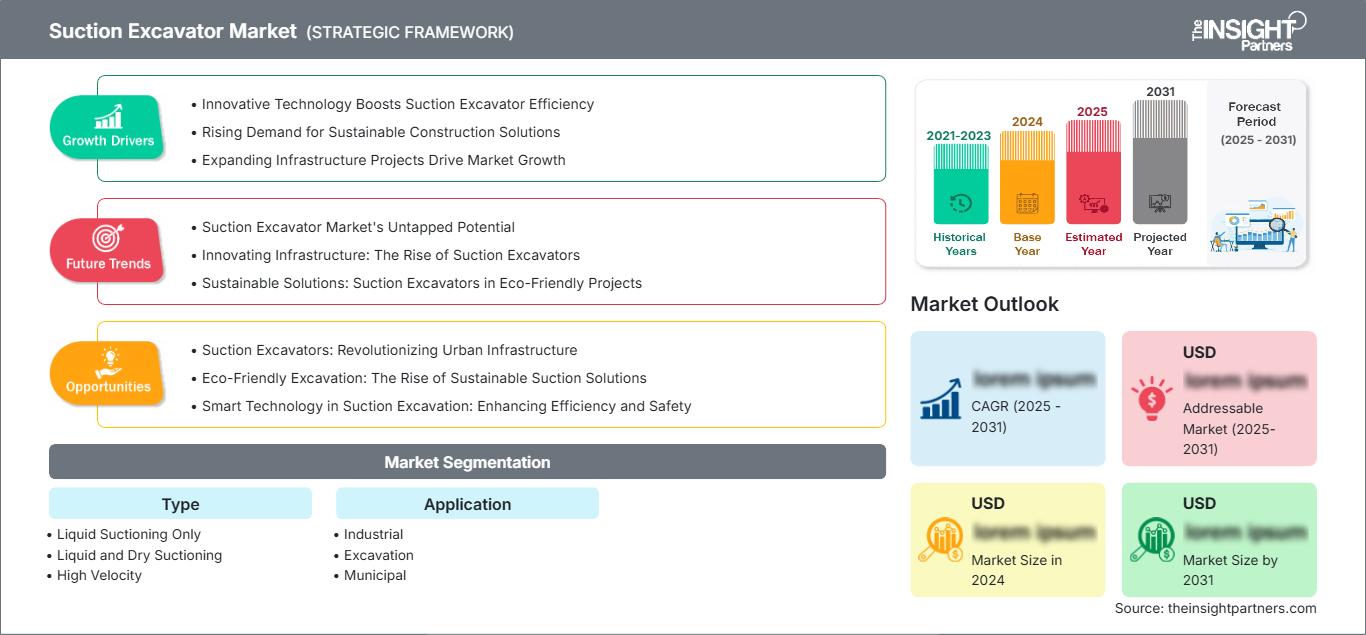
Regional Insights
North America Suction Excavator Market
North America accounted for approximately ~38% of the global Suction Excavator Market in 2025 and is projected to expand at a modeled ~5% CAGR through 2034. The area is fortunate to have a well-established eco-system of vacuum excavation contractors, equipment buyers, utility service providers and industrial maintenance companies. The established infrastructure of subterranean electricity, telecommunication, gas, water and sewer utilities results in a consistent demand for excavation and exposure processes.
The United States is the largest customer market as vacuum excavation equipment finds its use within utility potholing, daylighting, sewer maintenance, stormwater management, industrial cleaning and infrastructure building projects. Canada, as a country, contributes with its demand for equipment in utilities, oil and gas, municipal and industrial segments, especially when equipment has to work under adverse climatic and terrain conditions. Modern regional purchase decisions take into account payload, roadworthiness, support, winterization, maneuverability and cost of operation. Such needs prompt equipment makers to build both small and large equipment units.
U.S. Suction Excavator Market
The US represented approximately ~70% of North American Suction Excavator Market revenue in 2025 and is expected to expand at a modeled ~5% CAGR through 2034. Demand will be driven by utilities installation underground, aging water and sewer lines, installation of telecommunication lines, road and bridge construction, and industrial maintenance. Hydro excavation will become very applicable in cases where there is a need for controlled digging near existing utility lines, and not extensive mechanical excavation.
There are other competitors in the market, including GapVax, Sewer Equipment, Super Products LLC, Vac-Con, Inc., Hi-Vac Corporation, Keith Huber Corporation, and Gradall Industries, Inc., among many others. Application trends have seen multipurpose machines becoming the preferred equipment due to their ability to carry out excavations, vacuuming, debris handling, and sewer line work through one machine. The renting of the equipment and specialized contractors is an important application trend.
Europe Suction Excavator Market
Europe represented approximately ~29% of the global Suction Excavator Market in 2025 and is expected to expand at a modeled ~5% CAGR through 2034. Germany is the leading country in Europe, supported by industrial activity, specialized excavation contractors, infrastructure maintenance, and a strong equipment manufacturing base. The UK contributes through utilities, municipal works, drainage, and construction, while France and Italy benefit from infrastructure renewal and industrial applications. Spain is also adopting vacuum excavation equipment where urban construction and underground service management require controlled digging.
The Suction Excavator Market forecast shows that Germany's position reflects the combination of industrial demand, engineering capabilities, and infrastructure maintenance requirements. The UK market is influenced by utility and civil engineering projects where avoiding damage to buried services is commercially important. France and Italy provide demand across municipal and industrial applications, while Spain is supported by urban infrastructure projects and specialized contracting. European buyers also place increasing emphasis on equipment efficiency, operator safety, maintenance accessibility, and vehicle compliance. These factors favor manufacturers capable of adapting chassis, suction systems, filtration, debris bodies, and control systems to country-specific operating requirements.
APAC Suction Excavator Market
The Asia Pacific represented approximately ~24% of the global Suction Excavator Market in 2025 and is expected to register a modeled ~8% CAGR through 2034, making it the fastest-growing region. China is the leading country in Asia Pacific, supported by large infrastructure programs, industrial construction, urban utility development, and expanding requirements for efficient excavation around dense underground networks.
Japan and South Korea provide demand through mature industrial and urban infrastructure, while India is increasingly relevant as water, transport, telecommunications, energy, and urban infrastructure projects expand. Australia contributes through mining, utilities, civil construction, and infrastructure maintenance. Regional adoption is supported by urbanization and the need to manage underground services more safely during construction. Government-backed infrastructure investment, industrial expansion, and modernization of municipal networks provide a broad customer base for vacuum excavation equipment.
Middle East & Africa Suction Excavator Market
Middle East and Africa demand is expected to expand at a modeled ~7% CAGR through 2034. Saudi Arabia represents the leading country in the Middle East & Africa region where infrastructure construction, industrial projects, utility development, and large-scale urban developments create opportunities for vacuum excavation. The UAE also contributes through construction, municipal infrastructure, and industrial maintenance.
South Africa represents an important market in the region due to mining, utilities, construction, and municipal infrastructure requirements. Rest of MEA demand remains more project-driven and is influenced by infrastructure investment, energy developments, water networks, and urban expansion. In the Middle East, high-value construction and energy projects favor equipment capable of precise excavation and material handling around existing infrastructure. Increasing emphasis on project safety and efficient site execution can further improve adoption.
Segmentation Analysis
Type
Type is a key dimension of the Suction Excavator Market because equipment configuration determines the materials that can be removed, operating environments, and productivity profile. The segment is projected to expand at a modeled ~8% CAGR from 2026 to 2034. Demand is shifting toward versatile machines capable of supporting several excavation and cleaning requirements without extensive equipment changes.
- Liquid Suctioning Only: This configuration serves applications centered on removing liquids, sludge, wastewater, and other fluid materials. It remains relevant to municipal, industrial, and environmental service operators that prioritize dependable liquid handling and transport.
- Liquid and Dry Suctioning: This configuration supports both wet and dry material removal, providing flexibility across excavation, industrial cleaning, sewer maintenance, and utility applications. Its versatility makes it strategically important for contractors seeking higher equipment utilization.
- High Velocity: High-velocity systems are suited to applications requiring rapid movement of air and lightweight material through the vacuum system. Demand is associated with specialized excavation, debris handling, and situations where operating speed and suction performance are priorities.
Application
Application is the largest main segment, representing approximately ~52% of 2025 revenue, and is projected to expand at a modeled ~7% CAGR through 2034. The market scope across applications includes equipment used for industrial services, excavation, and municipal operations. Increasing infrastructure complexity and the need to protect buried assets support sustained demand across all three application categories.
- Industrial: Industrial users deploy suction equipment for material handling, spill response, plant maintenance, sludge removal, and specialized cleaning. Equipment flexibility is important because industrial sites often require vacuum systems to handle different materials and operating conditions.
- Excavation: Excavation applications include utility exposure, potholing, daylighting, trench support activities, and controlled soil removal. The segment benefits from requirements to expose underground assets while minimizing mechanical disturbance and improving worksite precision.
- Municipal: Municipal users apply equipment to sewer, stormwater, drainage, catch-basin, and public infrastructure maintenance. Fleet buyers typically prioritize reliability, payload, maneuverability, service availability, and the ability to perform multiple maintenance functions.
Opportunity Snapshot
| Application | Revenue Contribution | Trend Tag | Adoption Stage |
| Industrial | High | Process Cleaning | Scaling |
| Excavation | High | Utility Exposure | Scaling |
| Municipal | High | Sewer Maintenance | Mature |
Suction Excavator Market Growth Drivers and Impact Analysis
Expansion of Underground Utility Infrastructure
Expansion of electricity, telecommunications, gas, water, and wastewater networks is increasing the amount of construction activity taking place around existing underground assets. Conventional excavation can expose contractors to higher risks when utility locations are uncertain or infrastructure is densely concentrated. Vacuum excavation provides a controlled method for removing soil and exposing buried lines, making it particularly relevant to potholing, daylighting, maintenance, and repair activities. As urban areas become more congested, contractors increasingly need equipment that can work precisely within constrained spaces. This demand mechanism supports purchases by specialized excavation companies and utility contractors while also encouraging municipalities to specify safer excavation practices. Manufacturers benefit because utility-related applications can require specialized boom configurations, compact dimensions, high suction performance, and different debris capacities.
Increasing Infrastructure Maintenance and Rehabilitation
Aging water, sewer, drainage, transportation, and industrial infrastructure is creating recurring maintenance requirements that extend beyond new construction. Maintenance projects often involve removing accumulated sediment, sludge, debris, or excavated material from locations where access is restricted. Suction equipment can combine excavation and material removal capabilities, reducing the need for multiple machines and improving site logistics. Municipalities and contractors therefore evaluate equipment according to productivity, maneuverability, payload, serviceability, and compatibility with existing fleet practices. Rehabilitation programs can generate recurring demand because infrastructure assets require periodic inspection, cleaning, repair, and replacement. This recurring workload provides a more stable equipment utilization base than project types dependent solely on new construction. Manufacturers that offer multipurpose systems can capture demand across municipal and contractor fleets.
Growing Preference for Non-Destructive Excavation
The need to reduce accidental damage to buried infrastructure is strengthening the business case for non-destructive excavation. Utility strikes can generate repair costs, service interruptions, project delays, and safety consequences, making controlled excavation economically relevant in addition to its operational benefits. Vacuum excavation allows contractors to remove soil using suction after water or air loosens the material, enabling more precise exposure of underground assets. This operating model is particularly useful in utility corridors, congested urban areas, industrial facilities, and locations with uncertain subsurface conditions. The impact extends across equipment design because users increasingly seek combinations of strong suction, reliable water systems, precise booms, manageable vehicle dimensions, and easy maintenance. As contractors become more specialized, equipment selection is increasingly tied to project productivity and risk management.
Suction Excavator Market Future Trends
Higher Equipment Versatility and Multi-Application Platforms
The Suction Excavator Market trends show that future equipment development is likely to emphasize platforms capable of serving several work categories from the same vehicle. Contractors and municipal fleets increasingly value equipment that can move between excavation, sewer cleaning, industrial vacuuming, sludge removal, and infrastructure maintenance without extensive reconfiguration. This trend can improve annual utilization and strengthen the economics of higher-capacity machines. Manufacturers are therefore likely to expand modular configurations involving vacuum systems, water pumps, debris bodies, booms, filtration, discharge systems, and control interfaces. Compact platforms are also likely to receive attention because urban construction sites frequently impose restrictions on vehicle dimensions and access. The resulting product strategy should increasingly balance capacity with maneuverability, serviceability, road compliance, and operator ergonomics rather than maximizing a single performance specification.
Integration of Smarter Controls and Fleet Management
Digitalization is expected to influence future suction excavation equipment through improved monitoring, diagnostics, maintenance planning, and operator assistance. Fleet owners can benefit from tracking machine utilization, operating conditions, service intervals, and system performance across geographically dispersed equipment. Manufacturers may increasingly integrate sensors and electronic controls that help operators monitor vacuum performance, water systems, temperature, filter conditions, and component status. Data-enabled maintenance can reduce unplanned downtime by identifying conditions requiring attention before a failure interrupts a project. Remote support can also become more important as equipment is deployed across wider service territories. However, adoption will depend on balancing digital functionality with the simplicity required by contractors working in harsh environments. Equipment that combines useful diagnostics with straightforward field servicing can address both productivity and maintainability requirements.
Suction Excavator Market Opportunities
Rental and Specialized Contractor Fleet Expansion
Rental providers and specialized excavation contractors represent an opportunity because many construction and infrastructure projects require suction equipment only for defined work packages rather than continuous ownership. Rental access can lower the initial capital barrier for smaller contractors while enabling larger firms to scale capacity during periods of elevated project activity. Manufacturers can support this channel through durable designs, standardized configurations, remote diagnostics, service partnerships, financing programs, and readily available replacement components. Specialized contractors can also create recurring demand because they use equipment across multiple utility, municipal, industrial, and excavation projects. Companies that align products with common rental specifications can potentially increase fleet standardization and residual value. Dealer networks and aftermarket support will remain important because rental equipment experiences intensive utilization and requires predictable maintenance turnaround.
Emerging Infrastructure Markets in Asia Pacific
Asia Pacific provides an investment opportunity as urbanization, industrial expansion, utility development, and infrastructure modernization increase the need for controlled excavation. China, India, Japan, South Korea, and Australia have different infrastructure profiles, creating opportunities for localized equipment configurations rather than a single regional product strategy. India offers potential through expanding urban water, wastewater, transportation, telecommunications, and energy infrastructure, while Australia provides opportunities across utilities, mining-related infrastructure, and civil construction. Manufacturers can strengthen regional penetration through local distributors, service partnerships, localized spare-parts availability, and equipment adapted to local chassis and operating conditions. Training programs can further support adoption by demonstrating productivity and safety benefits to contractors that continue to rely on conventional excavation methods.
Recent Developments
- September 2026: Gainwell CAT unveiled the CAT 355 Excavator at bauma CONEXPO India 2026, expanding its heavy-duty equipment portfolio for demanding construction and infrastructure applications. The excavator is designed to deliver high productivity, digging performance, and operational efficiency across challenging job sites. The launch highlights Gainwell CAT’s focus on providing advanced Caterpillar equipment tailored to India’s evolving construction and infrastructure requirements.
- March 2026: Super Products LLC launched the Camel Max combination sewer cleaner with a 16-yard debris body, 2,000-gallon water capacity, and options including hydro excavation, wastewater recycling, and the Super Boom. The configuration expands the equipment's capability across sewer cleaning and excavation applications.
- August 2023: 365Vacex introduced its Suction Excavator Solutions, positioning vacuum-based excavation as a safer, more environmentally responsible, and efficient alternative to conventional digging methods. The technology uses high-powered vacuum systems to remove soil and debris while minimizing the risk of damaging underground utilities, cables, and pipelines. The solutions are designed to provide precise excavation in confined and sensitive areas while reducing excavation time and improving worker safety.
Frequently Asked Questions

- Comprehensive Market Sizing and Forecast Analysis
- Detailed Segmentation Analysis
- In-Depth Market Dynamics Assessment
- Regional and Country-Level Insights
- Competitive Landscape and Company Benchmarking
- Strategic Business Intelligence
Recent Reports
Testimonials

The Insight Partners provided valuable market intelligence that supported our global go-to-market strategy. Their team was professional, responsive, and attentive to our feedback, providing thoughtful analysis and helpful methodological clarifications throughout the project.
Junmo Kim Chief Financial Officer (CFO), Enertech Co., Ltd.
The Insight Partners' SCADA System Market report is comprehensive, with valuable insights on current trends and future forecasts. The team was highly professional, responsive, and supportive throughout. We are very satisfied and highly recommend their services.
RAN KEDEM Partner, Reali Technologies LTDs
I requested a report on a very specific software market and the team produced the report in a few days. The information was very relevant and well presented. I then requested some changes and additions to the report. The team was again very responsive and I got the final report in less than a week.
JEAN-HERVE JENN Chairman, Future Analytica
We worked with The Insight Partners for an important market study and forecast. They gave us clear insights into opportunities and risks, which helped shape our plans. Their research was easy to use and based on solid data. It helped us make smart, confident decisions. We highly recommend them.
PIYUSH NAGPAL Sr. Vice President, High Beam Global
The Insight Partners delivered insightful, well-structured market research with strong domain expertise. Their team was professional and responsive throughout. The user-friendly website made accessing industry reports seamless. We highly recommend them for reliable, high-quality research services
YUKIHIKO ADACHI CEO, Deep Blue, LLC.
This is the first time I have purchased a market report from The Insight Partners.While I was unsure at first, I visited their web site and felt more comfortable to take the risk and purchase a market report.I am completely satisfied with the quality of the report and customer service. I had several questions and comments with the initial report, but after a couple of dialogs over email with their analyst I believe I have a report that I can use as input to our strategic planning process.Thank you so much for taking the extra time and making this a positive experience.I will definitely recommend your service to others and you will be my first call when we need further market data.
JOHN SUZUKI President and Chief Executive Officer, Board Director, BK Technologies
I wish to appreciate your support and the professionalism you displayed in the course of attending to my request for information regarding to infectious disease IVD market in Nigeria. I appreciate your patience, your guidance, and the fact that you were willing to offer a discount, which eventually made it possible for us to close a deal. I look forward to engaging The Insight Partners in the future, all thanks to the impression you have created in me as a result of this first encounter.
DR CHIJIOKE ONYIA MANAGING DIRECTOR, PineCrest Healthcare Ltd.Reason to Buy
- Informed Decision-Making
- Understanding Market Dynamics
- Competitive Analysis
- Identifying Emerging Markets
- Customer Insights
- Market Forecasts
- Risk Mitigation
- Boosting Operational Efficiency
- Strategic Planning
- Investment Justification
- Tracking Industry Innovations
- Aligning with Regulatory Trends





 Get Free Sample for