
Tensile Testing Equipment Market Size, Demand & Growth by 2034
Coverage: By Powering Mechanism (Hydraulic, Electromechanical); Force Testing Range (Up to 100 kN, 101 to 150 kN, 151 to 200 kN, Beyond 250 kN); End-users (Materials and Packaging , Automotive, Manufacturing , Aerospace and Defense, Others) , and Geography (North America, Europe, Asia Pacific, and South and Central America)
- Status : Data Released
- Report Code : TIPMC00002760
- Category : Manufacturing and Construction
- No. of Pages : 150
- Available Report Formats :


- Last update date : July 10, 2026


2025 Market Size
US$ 506.39 Mn
Base year value
2034 Forecast
US$ 670.18 Mn
Projected by 2034
CAGR 2026-2034
3.16 %
Growth rate
Addressable Market
US$ 5,341.76 Mn
(2026-2034)
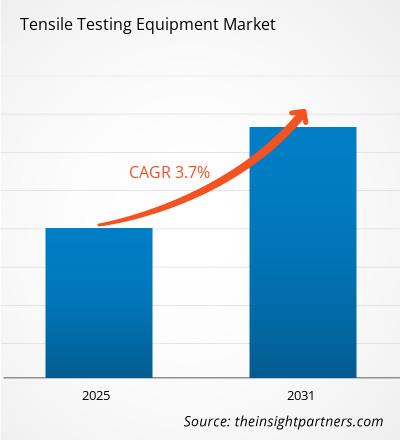
The Tensile Testing Equipment Market size is projected to grow from US$ 506.39 Million in 2025 to US$ 670.18 Million by 2034; it is expected to register a CAGR of 3.16% from 2026 to 2034. Demand is supported by quality validation across materials, packaging, automotive, manufacturing, aerospace and defense applications, where tensile strength, elongation, yield point, and failure behavior influence compliance, safety, and product lifecycle decisions.
The North American region is projected to register a 2.8–3.3% CAGR through 2026–2034 due to qualification for aerospace applications, materials testing for electric vehicles, packaging testing, and manufacturing investments due to reshoring trends. This region enjoys a legacy of using ASTM and ISO testing standards, having a high number of labs that are certified, and a consistent demand for electromechanical universal testing machines with data acquisition systems.
Tensile Testing Equipment Market Assessment and Insights
- North America: The tensile testing equipment market share in 2025 is estimated at 31–34%, with CAGR between 2026–2034 at 2.8–3.3%, reflecting aerospace certification, medical device quality systems, and durable packaging validation.
- US: Share in 2025 is estimated at 72–76% of North America, with CAGR between 2026–2034 at 2.9–3.4%, led by automotive lightweighting and defense materials testing.
- Europe: Share in 2025 is estimated at 25–28%, with CAGR between 2026–2034 at 2.6–3.1%, led by Germany, the UK, France, Italy, and Spain.
- Asia Pacific: Share in 2025 is estimated at 27–30%, with CAGR between 2026–2034 at 3.8–4.4%, led by China, Japan, South Korea, India, and Australia.
- Largest Segment: Electromechanical systems hold 60–64% market share in 2025 and grow at 3.3–3.8% CAGR during 2026–2034, supported by software-led precision testing.
- High Growth Segment: Aerospace and defense holds 14–17% market share in 2025 and grows at 4.1–4.7% CAGR during 2026–2034, driven by composites and alloy qualification.
- Key companies analyzed in detail: ADMET, Inc.; AMETEK, Inc.; Com-Ten Industries; Kokusai Co., Ltd.; Labthink Instruments Co., Ltd.; Mecmesin Limited; Qualitest International Inc.; Shimadzu Corporation; TESTEX Textile Testing Instruments Ltd.; TestResources, Inc.
Source: The Insight Partners' analysis based on proprietary research, government publications, company annual reports, investor presentations, industry databases, and expert interviews.
The development of Tensile Testing Equipment market has been from manual frame-based testers to those that involve digital control using electromechanical and servo-hydraulic mechanisms with force measurement, displacement control, extensometry and automatic reporting. The production landscape will change due to the desire by the laboratories for equipment that can perform standardized tests on polymers, metals, films, textiles, adhesives, and composite materials. Consequently, there has been an increased need for modular grips, interchangeable load cells, software integration, and traceability in order to minimize operator variations.
During the forecast period, the emergence of new manufacturing centers in Asia Pacific and infrastructure-driven demand in the Middle East region will widen the market scope for Tensile Testing Equipment. Investment in this market will be towards portable universal testing machines, automation of specimen handling, and laboratory information management systems that are cloud compatible. Product safety, packaging, aircraft material, and industrial quality standards will drive replacement activities.
Tensile Testing Equipment Market Report Scope
| Report Attribute | Details |
|---|---|
| Market size in 2025 | US$ 506.39 Million |
| Market Size by 2034 | US$ 670.18 Million |
| Global CAGR (2026 - 2034) | 3.16% |
| Historical Data | 2021-2024 |
| Forecast period | 2026-2034 |
Tensile Testing Equipment Market Analysis
Tensile Testing Equipment Demand derives from the repeatable validation of tensile strength, elongation, modulus, peel strength, puncture performance, and bond strength. Materials used for automotive lightweighting, multilayer packaging, aerospace composites, and manufacturing materials need to validate their mechanical properties prior to design approval or production.
The value chain consists of frame manufacturers, load cell manufacturers, extensometer manufacturers, calibration labs, software providers, distributors, and third-party testing services providers. Supply chains will remain moderately specialized due to the need to integrate precision machining, electronic circuitry, firmware, and standards requirements. Based on analysis of the Tensile Testing Equipment Market, services, application engineering, and calibration have become significant factors in purchasing decisions.
The competitive landscape is fragmented but technically differentiated. The tensile testing equipment market report highlights key players, including Shimadzu Corporation and AMETEK, Inc., that compete through broad instrumentation portfolios, while ADMET, Inc., TestResources, Inc., Mecmesin Limited, and Com-Ten Industries emphasize configurable systems and application support. Labthink Instruments Co., Ltd. and TESTEX Textile Testing Instruments Ltd. maintain relevance in packaging, films, and textile testing niches.
The trends in investments include automation, software compliance, low-force accuracy, and high-capacity machinery for metals, structural elements, and composites. Positioning is based on the coverage of the force range, quick responses from the controller, availability of standards libraries, and lifecycle support. In line with the standardization of the test data within laboratories, the tensile testing equipment market share will move towards suppliers of complete solutions.
● REPORT CUSTOMIZATION
Tailor This Report To Align With Your Specific Business Requirements
This report can be customized to align precisely with your business objectives, scope, and target markets. Customization options include tailored segmentation, geography, competitive analysis, and strategic insights to support informed decision-making.
Customize This Report →WHAT YOU CAN ADJUST
- ● Segmentations
- ● Geography
- ● Competitive Analysis
- ● Language Preferences
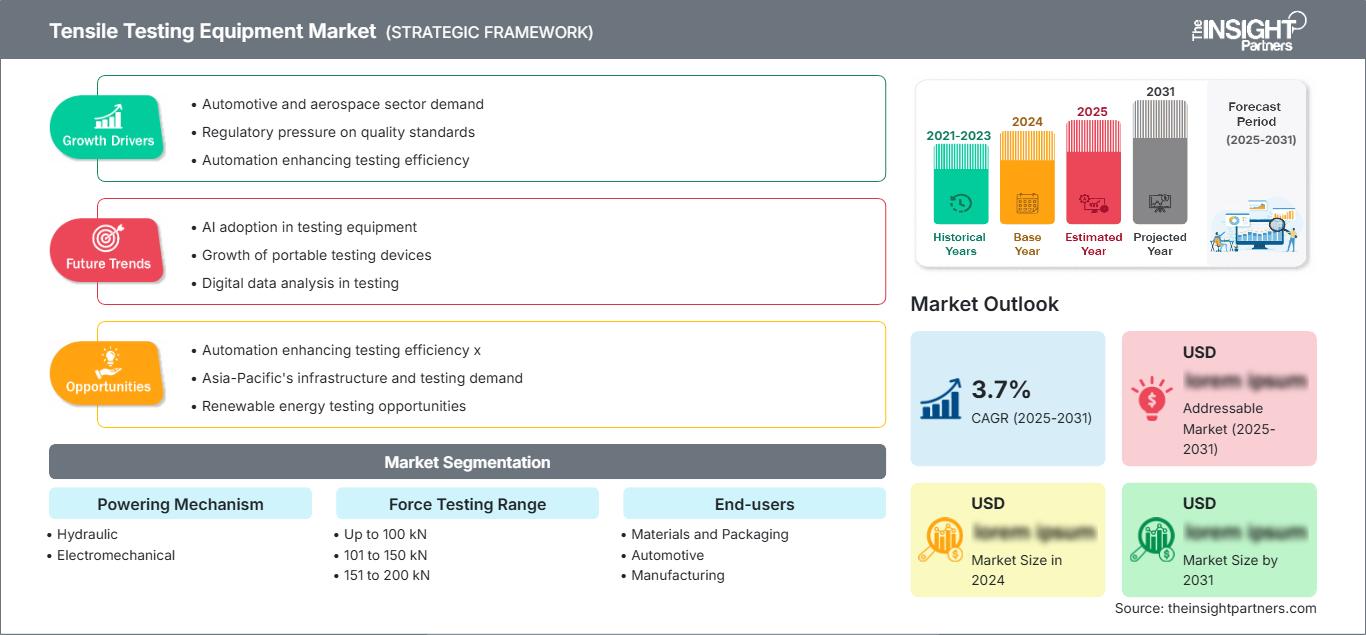
Tensile Testing Equipment Market: Strategic Insights
Regional Insights
North America Tensile Testing Equipment
North America accounts for 31–34% share in 2025 and is projected to grow at 2.8–3.3% CAGR through 2034. Demand is shaped by aerospace material qualification, medical device validation, automotive lightweighting, and packaging performance testing. Established ASTM methods, accredited laboratory networks, and strong calibration practices support replacement demand across quality-control environments.
The region’s procurement pattern is moving toward electromechanical systems with advanced controllers, digital extensometers, and automated reports. Laboratories prioritize repeatability, traceability, and reduced operator intervention. The Tensile Testing Equipment Market growth in North America remains steady rather than cyclical because compliance testing, warranty risk reduction, and new material introduction continue across production and R&D settings.
U.S. Tensile Testing Equipment Market
The U.S. represents 72–76% of North America’s 2025 revenue and is expected to grow at 2.9–3.4% CAGR from 2026 to 2034. Domestic demand is supported by aerospace, defense, electric vehicles, medical devices, and advanced polymers. Company presence is strengthened by ADMET, Inc., TestResources, Inc., AMETEK, Inc., and Com-Ten Industries.
Application trends show higher use of universal testing machines for battery components, films, adhesives, additive-manufactured specimens, and lightweight alloys. Procurement decisions increasingly include data integrity, software validation, and fixture flexibility. The U.S. market also benefits from reshoring initiatives where manufacturers need in-house mechanical testing to qualify suppliers, reduce scrap, and shorten validation cycles.
Europe Tensile Testing Equipment Market
Europe holds 25–28% share in 2025 and is expected to grow at 2.6–3.1% CAGR during 2026–2034. Germany is still the top country as automotive engineering, industrial machines, polymer processing, and precise manufacturing all call for repeatable strength testing on metals, plastics, elastomers, and composite materials.
The UK market is supported by the aerospace and defense industries, med tech, and university materials testing labs. Tracing test procedures, compact machines, and software-driven documentation are important considerations in the UK lab market. Replacements are also driven by recyclability studies and polymer film tests.
France, Italy, and Spain are involved in aerospace parts supplies, packaging converters, textile testing, and industrial component manufacturing. The demand is still selective and stable; customers value calibration services, standards compliance, and service support. Growth in Europe is slowed down by capital control, but quality requirements secure some investment level.
APAC Tensile Testing Equipment Market
APAC accounts for 27–30% share in 2025 and the tensile testing equipment market forecast is expected to register a CAGR of 3.8–4.4%. China is the leading country, supported by electronics, automotive, packaging, metals, and industrial manufacturing scale.
Japan and South Korea drive demand for high-precision systems in automotive, battery materials, semiconductors, and advanced polymers. India is expanding through local manufacturing, packaging, and defense procurement.
Australia adds demand from mining, infrastructure materials, and research laboratories. Policy support for domestic manufacturing and export quality compliance strengthens the Tensile Testing Equipment Market trends across APAC.
Middle East & Africa Tensile Testing Equipment Market
The Middle East & Africa market is projected to grow at 3.0–3.6% CAGR, supported by infrastructure, energy, metals, plastics, and construction material testing. Saudi Arabia is the leading country due to industrial diversification and large project pipelines.
The UAE supports demand through logistics, aviation, packaging, and certification services, while South Africa remains important for mining, manufacturing, and academic testing laboratories.
Rest of MEA demand is project-led and often tied to imported equipment, distributor service, and calibration access. Energy transition components and infrastructure durability assessments are expected to create selective opportunities.
Segmentation Analysis
Powering Mechanism
The Powering Mechanism segment is expected to grow at 3.1–3.6% CAGR during 2026–2034. Electromechanical systems dominate routine laboratory and production testing because they offer precise speed control, cleaner operation, compact footprints, and easier software integration. Hydraulic systems remain relevant where high-force testing, metals, structural materials, and heavy components require robust loading capacity.
- Hydraulic systems are preferred for high-load metals, construction products, and structural specimens where force capacity, durability, and frame rigidity are more important than compact design or low-force sensitivity.
- Electromechanical systems lead adoption in packaging, polymers, textiles, medical devices, and research laboratories because they combine precision, cleaner operation, digital control, and easier data reporting.
Force Testing Range
The Force Testing Range segment is projected to grow at 3.0–3.5% CAGR from 2026 to 2034. Demand is distributed across low-force testing for films, textiles, medical components, and adhesives, and higher-force systems for metals, composites, and structural applications. Buyers increasingly select scalable frames that accommodate interchangeable load cells and fixtures to widen laboratory utilization.
- Up to 100 kN systems serve the broadest base of packaging, plastics, textiles, adhesives, and component testing, making them strategically important for laboratories seeking versatile daily-use equipment.
- 101 to 150 kN systems support medium-load metals, polymers, rubber products, and engineered components where users need higher capacity without moving to heavy industrial frames.
- 151 to 200 kN systems are used in automotive parts, construction materials, and composite specimens requiring stronger frames, controlled loading, and reliable strain measurement.
- Beyond 250 kN systems address heavy metals, aerospace components, structural materials, and defense applications where high-force performance, safety enclosures, and advanced hydraulics are critical.
End-users
The End-users segment is expected to grow at 3.2–3.7% CAGR during 2026–2034. Materials and packaging laboratories account for steady utilization because tensile, peel, puncture, and seal-strength tests are central to qualification. Automotive, manufacturing, and aerospace users are increasing adoption as lightweight materials, supplier audits, and safety-critical component validation require repeatable mechanical performance evidence.
- Materials and Packaging users rely on tensile testing for films, laminates, paperboard, seals, and adhesives, making equipment uptime, low-force accuracy, and standardized reporting essential purchasing factors.
- Automotive users test metals, plastics, composites, elastomers, fasteners, battery materials, and adhesives to validate lightweighting strategies, durability expectations, and supplier quality across global production programs.
- Manufacturing users deploy tensile testing for incoming inspection, process control, product development, and failure analysis, prioritizing versatile fixtures and software that fits routine quality workflows.
- Aerospace and Defense users require highly traceable testing for alloys, composites, fasteners, and structural materials, with emphasis on calibration records, operator control, and compliance documentation.
Opportunity Snapshot
| End-users | Revenue Contribution | Trend Tag | Adoption Stage |
| Materials and Packaging | High | Film Integrity | Mature |
| Automotive | High | Lightweighting | Scaling |
| Manufacturing | Medium | Supplier QA | Mature |
| Aerospace and Defense | Medium | Composite Testing | Scaling |
| Others | Low | Lab Research | Emerging |
Tensile Testing Equipment Market Growth Drivers and Impact Analysis
Rising Quality Assurance Requirements Across Manufacturing
Increasing the levels of testing is becoming important for manufacturers due to recall, warranty risk, and variations in supplier quality, all of which may influence profit margins significantly. Tensile testing ensures that the materials used are up to strength, elongation, and deformation standards before production commences. This will have the greatest impact on packaging, automobiles, aerospace, and industrial parts industries, since a failure on the part of a material can result in problems during assembly or performance in the field. This driver fuels the Tensile Testing Equipment Market by ensuring continuous purchase of universal testing machines, grips, extensometers, and software modules.
Growth of Lightweight Materials and Advanced Composites
Polymer materials, alloys, adhesives, composite materials, and laminates used for transportation, aerospace applications, consumer goods, and industrial machinery in the process of lightweighting will generate an increased need for tensile, peel, shear, and elongation tests to validate design assumptions prior to launch. Laboratories will therefore be required to have machines with extended ranges of forces, enhanced strain gauging capabilities, and customized fixtures for testing brittle, ductile, thin, and highly elongated specimens. The actual implication of this is an increased demand for flexible testing machines as opposed to single-use machines.
Automation and Digital Traceability in Laboratories
Testing laboratories are required to increase throughput while maintaining repeatability and auditability. Automated test methods, electronic records, barcode scanning for sample identification, and report generation minimize transcription errors and enable quality auditing. These changes impact the Tensile Testing Equipment Market directly, since purchase considerations now include controller quality, data export ability, cyber security, and integration with lab management systems. Automation will also lead to increased unattended tests overnight on standardized samples. Frame and software suppliers with responsive service have a clear advantage.
Tensile Testing Equipment Market Future Trends
Connected Testing Platforms for Distributed Quality Teams
The future trends for tensile testing procedures will see more connections between machine, software, calibration, and quality system information between multiple sites. Manufacturing facilities around the world will require consistent information from different factories, suppliers, and R&D labs particularly in cases where material qualification is done worldwide. Connectivity solutions will help to establish a standardized test procedure, track the status of equipment used, and decrease variations among different operators or sites. The mentioned trend will affect the Tensile Testing Equipment Market because software systems will become as crucial as the frame technology.
Application-Specific Fixtures for New Material Formats
With decreasing thickness, increasing weight reduction, layering, recycling, or additive manufacturing of materials, the use of fixtures is likely to shift from being merely an accessory to a fixture that suits specific applications. Films, battery separators, fiber reinforced composites, bio-based plastics, and adhesive joints require gripping and extensometry equipment that can avoid slip, pre-mature failure, or erroneous data. The Tensile Testing Equipment market is likely to gain from this phenomenon since new material forms often need validation before commercialization.
Tensile Testing Equipment Market Opportunities
Localized Service Networks in Emerging Manufacturing Hubs
There is a growing need for tensile testing equipment in the new manufacturing locations, but the purchase process involves issues related to installation, calibration, training, and maintenance of equipment. The vendors should build an effective network of distributors, service partners, and local demo labs in India, Southeast Asia, the Middle East, and some regions of Latin America. This will minimize the risks for the potential clients and ensure better customer life cycle management. In case of the Tensile Testing Equipment Market, service localization will turn the first-time customers into loyal clients as their facilities grow.
Upgrade Programs for Legacy Mechanical and Hydraulic Frames
It is not uncommon to see many labs making use of legacy frame systems that do not have modern controllers, software, safety functions, and data validation capabilities. There can be cases where a laboratory upgrade can provide a more cost-effective solution through the installation of new load cells, digital controllers, extensometers, grips, and software solutions. Thus, there is room for growth for both original equipment manufacturers and dedicated retrofit providers in the Tensile Testing Equipment Market.
Recent Developments
- April 2026: Shimadzu Corporation — released the AUTOGRAPH AGS-X2 Series, positioning the system as a precision universal testing machine for broad strength evaluation applications. The launch emphasizes higher-level control, intuitive operation, safety considerations, and practical testing performance for laboratories requiring repeatable tensile and compression testing workflows.
- May 2026: Labthink Instruments Co., Ltd. — showcased packaging testing solutions at INTERPACK 2026, reinforcing its focus on barrier, integrity, and mechanical performance testing for packaging manufacturers. The activity supports demand for integrated laboratory systems used in film, flexible packaging, and quality-control environments where tensile and seal-strength performance remain central.
- July 2025: Shimadzu Corporation — released the AUTOGRAPH AGS-V Series precision universal testing machine, improving the guaranteed force-measurement accuracy range compared with existing machines. The update is designed to reduce sensor and accessory changes, helping laboratories improve throughput and simplify test setup across varied tensile testing applications.
Frequently Asked Questions

- Comprehensive Market Sizing and Forecast Analysis
- Detailed Segmentation Analysis
- In-Depth Market Dynamics Assessment
- Regional and Country-Level Insights
- Competitive Landscape and Company Benchmarking
- Strategic Business Intelligence
Recent Reports
Testimonials

The Insight Partners' SCADA System Market report is comprehensive, with valuable insights on current trends and future forecasts. The team was highly professional, responsive, and supportive throughout. We are very satisfied and highly recommend their services.
RAN KEDEM Partner, Reali Technologies LTDs
I requested a report on a very specific software market and the team produced the report in a few days. The information was very relevant and well presented. I then requested some changes and additions to the report. The team was again very responsive and I got the final report in less than a week.
JEAN-HERVE JENN Chairman, Future Analytica
We worked with The Insight Partners for an important market study and forecast. They gave us clear insights into opportunities and risks, which helped shape our plans. Their research was easy to use and based on solid data. It helped us make smart, confident decisions. We highly recommend them.
PIYUSH NAGPAL Sr. Vice President, High Beam Global
The Insight Partners delivered insightful, well-structured market research with strong domain expertise. Their team was professional and responsive throughout. The user-friendly website made accessing industry reports seamless. We highly recommend them for reliable, high-quality research services
YUKIHIKO ADACHI CEO, Deep Blue, LLC.
This is the first time I have purchased a market report from The Insight Partners.While I was unsure at first, I visited their web site and felt more comfortable to take the risk and purchase a market report.I am completely satisfied with the quality of the report and customer service. I had several questions and comments with the initial report, but after a couple of dialogs over email with their analyst I believe I have a report that I can use as input to our strategic planning process.Thank you so much for taking the extra time and making this a positive experience.I will definitely recommend your service to others and you will be my first call when we need further market data.
JOHN SUZUKI President and Chief Executive Officer, Board Director, BK Technologies
I wish to appreciate your support and the professionalism you displayed in the course of attending to my request for information regarding to infectious disease IVD market in Nigeria. I appreciate your patience, your guidance, and the fact that you were willing to offer a discount, which eventually made it possible for us to close a deal. I look forward to engaging The Insight Partners in the future, all thanks to the impression you have created in me as a result of this first encounter.
DR CHIJIOKE ONYIA MANAGING DIRECTOR, PineCrest Healthcare Ltd.Reason to Buy
- Informed Decision-Making
- Understanding Market Dynamics
- Competitive Analysis
- Identifying Emerging Markets
- Customer Insights
- Market Forecasts
- Risk Mitigation
- Boosting Operational Efficiency
- Strategic Planning
- Investment Justification
- Tracking Industry Innovations
- Aligning with Regulatory Trends





 Get Free Sample for