
Timber Harvesting Equipment Market Trends, Size & Growth by 2034
Coverage: By Product Type (Harvesters, Chainsaws, Forwarders, Feller Benches, Skidders); Price (Low, Medium, High); Distribution Channel (Direct, Indirect) , and Geography (North America, Europe, Asia Pacific, and South and Central America)
- Status : Data Released
- Report Code : TIPRE00023695
- Category : Manufacturing and Construction
- No. of Pages : 150
- Available Report Formats :


- Last update date : July 21, 2026


2025 Market Size
US$ 25.05 Bn
Base year value
2034 Forecast
US$ 42.34 Bn
Projected by 2034
CAGR 2026-2034
6.00 %
Growth rate
Addressable Market
US$ 305.13 Bn
(2026-2034)
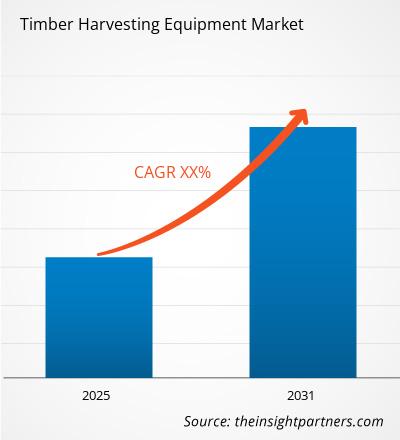
The Timber Harvesting Equipment Market is projected to grow from US$ 25.05 Billion in 2025 to US$ 42.34 Billion by 2034, registering a CAGR of 6.00% during 2026–2034. Demand for equipment will be driven by mechanization of forestry activities, higher output of roundwoods, increased safety in logging activities, and replacement of older fleets by new commercial forest machinery. Suppliers of such equipment are emphasizing increased productivity, fuel savings, telematics, and operator support systems due to lack of labor and increased pressure on sustainability standards.
North America still forms an important demand hub, which is facilitated by developed logging infrastructure, high levels of mechanization, and consistent supplies of timber from the U.S. South and Canada. This market is expected to record a CAGR of 5.4–5.8% during 2026–2034 due to salvaging operations following wildfires, housing construction demand for lumber, and rapid replacement of diesel machinery by low-emission and telematics-enabled equipment platforms.
Timber Harvesting Equipment Market Assessment and Insights
- North America accounted for 33–35% share in 2025 and is expected to grow at a 5.4–5.8% CAGR between 2026–2034, supported by mechanized logging, fleet renewal, and high-value softwood supply chains.
- US represented 64–66% of North America in 2025 and is projected to grow at a 5.5–5.9% CAGR between 2026–2034, led by southern timber belts.
- Europe held 25–27% share in 2025 and is forecast to expand at a 5.1–5.5% CAGR between 2026–2034, with Sweden, Finland, Germany, and France leading mechanized cut-to-length operations.
- Asia Pacific represented 22–24% share in 2025 and is expected to grow at a 6.8–7.2% CAGR between 2026–2034, led by China, Japan, India, and Australia.
- Largest Segment harvesters captured 30–33% market share in 2025 and are expected to grow at a 5.8–6.2% CAGR between 2026–2034, reflecting their central role in cut-to-length systems.
- High Growth Segment forwarders held 18–21% market share in 2025 and are projected to grow at a 6.6–7.0% CAGR between 2026–2034 due to low-impact extraction demand.
- Key companies analyzed in detail: Barko Hydraulics, LLC, Caterpillar Inc., Deere and Company, Komatsu Ltd., Ponsse Oyj, Rottne Industri AB, AB Volvo, Tigercat International Inc., Sandvik AB, and Hitachi Construction Machinery Co., Ltd.
Source: The Insight Partners' analysis based on proprietary research, government publications, company annual reports, investor presentations, industry databases, and expert interviews.
The mechanization of forest operations has advanced from mere cutting assistance to digitally enabled harvesting, forwarding and extraction operations. The Timber Harvesting Equipment Market is aided by improved hydraulic functions, sensing devices, fuel management system and safe operator cabs that ensure extended operation time frames. Changing production dynamics will involve contractors looking for smaller fleets with multifunctional capability to operate on steep, wet, thinning and plantations.
In the future, demand is likely to be fueled by the emergence of new forestry areas characterized by high manual logging activity and growing certification of timber chains. Investments by government in forest health, wildfire management and reforestation efforts are leading to investments in the upgrading of existing fleets while emission regulations in Europe and North America are pushing companies towards clean engines and hybrids.
Timber Harvesting Equipment Market Report Scope
| Report Attribute | Details |
|---|---|
| Market size in 2025 | US$ 25.05 Billion |
| Market Size by 2034 | US$ 42.34 Billion |
| Global CAGR (2026 - 2034) | 6.00% |
| Historical Data | 2021-2024 |
| Forecast period | 2026-2034 |
Timber Harvesting Equipment Market Analysis
Demands are based on continuous lumber production, housing construction, pulpwood processing, and biomass collection. The Timber Harvesting Equipment Market is also driven by labor scarcity since mechanized harvesting machines protect workers from dangerous felling and enhance productivity. The global dominance of industrial roundwood in countries like the U.S., China, Brazil, Russia, and Canada, according to FAO figures, explains the need for such equipment in the forest products industry.
This market comprises manufacturing firms of machinery, engines, and hydraulics suppliers, attachments providers, distributors, equipment rentals, contractors, forest companies, and maintenance organizations. Companies able to offer parts availability, operator education, telematics services, and financing will have competitive advantages due to the supply factors. Small-scale contractors operating in longer equipment replacement cycles generate demand for mid-price range products, while large companies buy comprehensive fleets capable of productivity measurement and preventive maintenance.
The degree of competition is moderately consolidated, with Caterpillar Inc., Deere and Company, Komatsu Ltd., Ponsse Oyj, Tigercat International Inc., and AB Volvo competing via dealer network, machine toughness, and efficiency in services. Timber Harvesting Equipment Market report shows that companies like Barko Hydraulics, LLC and Rottne Industri AB still play a role where there is a demand for specialist machines.
Key investment considerations are moving towards automation, assistance for operators, compliance with emission standards, and connectivity within the services platform. Sandvik AB and Hitachi Construction Machinery Co., Ltd. add value to their neighboring capabilities in the mining and construction sectors which affect toughness and controls in the forestry sector. Competitive advantage is gradually being based on minimizing the total cost of ownership as opposed to equipment capacity, especially when fuel and maintenance costs are rising.
● REPORT CUSTOMIZATION
Tailor This Report To Align With Your Specific Business Requirements
This report can be customized to align precisely with your business objectives, scope, and target markets. Customization options include tailored segmentation, geography, competitive analysis, and strategic insights to support informed decision-making.
Customize This Report →WHAT YOU CAN ADJUST
- ● Segmentations
- ● Geography
- ● Competitive Analysis
- ● Language Preferences
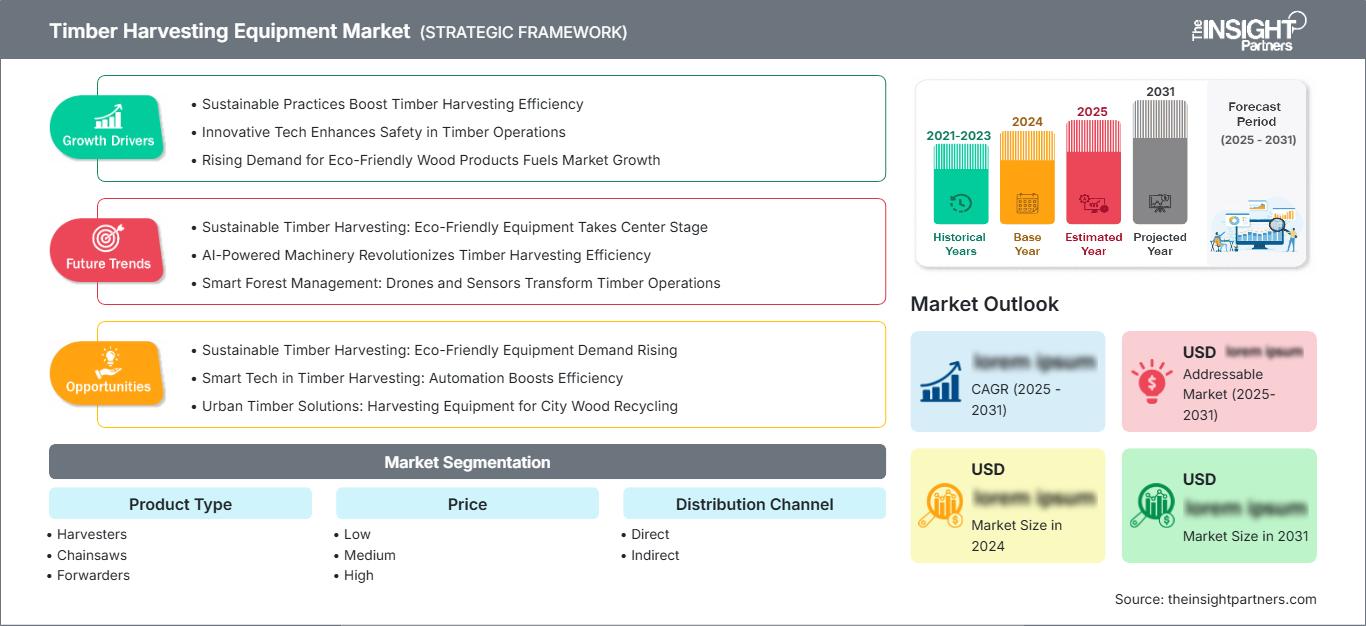
Timber Harvesting Equipment Market: Strategic Insights
Regional Insights
North America Timber Harvesting Equipment Market
guarantees the continuity of equipment purchases, while safety considerations move operations from manual felling to mechanized methods.
Europe Timber Harvesting Equipment Market
Europe held 25–27% share in 2025 and is projected to grow at a 5.1–5.5% CAGR during 2026–2034. Swedish and Finnish countries hold the position of leaders due to the extensive implementation of the cut-to-length technique and the advanced engineering capabilities of local manufacturers. The country of Germany increases demand with the presence of managed forests and sawmill connections, while environmental regulations stimulate the development of eco-friendly powertrains and efficiency analysis.
In the United Kingdom, there is high demand for small-sized harvesters and extraction machines, which results from plantation cutting, land management, and timber security. In Germany, the processing of storm damaged timber and bark beetle management play an important role. France, Italy, and Spain represent selective markets, where mountainous terrain, divided ownership, and state-owned forests make the machines needed expensive and flexible.
APAC Timber Harvesting Equipment Market
Asia Pacific represented 22–24% share in 2025 and is expected to expand at a 6.8–7.2% CAGR during 2026–2034, making it the fastest-growing major region. China leads demand through wood processing, plantation management, and domestic construction material requirements, while Japan and South Korea emphasize compact, precise equipment for managed forest blocks.
India and Australia add different growth profiles. India is moving gradually from manual harvesting toward mechanized and semi-mechanized systems, while Australia requires durable equipment for plantation forestry, fire recovery, and export-linked timber production. Policy support for forest productivity and industrial wood supply strengthens regional adoption.
Middle East & Africa Timber Harvesting Equipment Market
Middle East and Africa is projected to grow at a 4.7–5.1% CAGR during 2026–2034, with South Africa leading regional adoption. Demand is concentrated in plantation forestry, pulpwood supply, and land clearing linked to infrastructure corridors. Saudi Arabia and the UAE remain smaller markets, but equipment demand is supported by landscaping, construction-linked clearing, and managed greening programs.
Rest of MEA demand is uneven because capital availability, service infrastructure, and formal forestry operations vary widely. Where commercial plantations exist, buyers prioritize robust chainsaws, skidders, and mid-range extraction machines. Energy and infrastructure projects also create demand for clearing equipment, though sustainability controls are becoming more important in procurement.
Segmentation Analysis
Product Type
Product Type is expected to grow at a 5.8–6.4% CAGR during 2026–2034 as buyers balance productivity, terrain flexibility, fuel consumption, and operator safety. The Timber Harvesting Equipment Market scope across this segment is broad because mechanized felling, extraction, and roadside handling must work together to reduce delays and improve wood recovery.
- Harvesters remain the leading product group because they combine felling, delimbing, measuring, and bucking in one platform, improving recovery and lowering manual labor requirements in managed forests.
- Chainsaws retain strategic importance in thinning, smallholder forestry, rescue cutting, and maintenance work, especially where terrain or capital constraints limit use of large mechanized machines.
- Forwarders are gaining adoption where low-impact extraction, soil protection, and cut-to-length systems are priorities, making them essential for certified forestry and wet-ground operations.
- Feller Benches support rapid tree accumulation and bunching in high-volume logging areas, improving downstream skidding efficiency and reducing machine congestion at active harvest sites.
- Skidders remain critical in tree-length logging systems, particularly across North America and emerging regions, where durability, pulling power, and serviceability influence purchase decisions.
Price
Price is projected to grow at a 5.5–6.1% CAGR during 2026–2034 as purchasing decisions reflect contractor scale, financing access, and total cost of ownership. Low-price equipment supports basic operations, medium-price machines dominate replacement demand, and high-price models attract large operators seeking uptime, automation, telematics, and emission-compliant performance.
- Low price equipment serves small contractors and fragmented forestry areas where capital budgets are limited, but reliability, parts access, and basic safety features remain decisive.
- Medium price machines represent the broadest demand pool because they balance acquisition cost with productivity, making them suitable for recurring commercial logging and rental fleets.
- High price equipment appeals to large operators that prioritize automation, steep-slope capability, advanced hydraulics, telematics, and lower lifecycle cost over initial purchase savings.
Distribution Channel
Distribution Channel is forecast to expand at a 5.6–6.2% CAGR during 2026–2034, shaped by service quality, financing, and aftermarket responsiveness. Direct sales suit large fleet buyers requiring customized configurations, while indirect channels remain essential for regional contractors needing local demonstrations, spare parts, maintenance support, operator training, and resale assistance.
- Direct distribution supports strategic accounts, public agencies, and large forestry groups that require fleet planning, customized specifications, warranty coordination, and manufacturer-led technical support.
- Indirect distribution remains vital for smaller contractors because dealers provide local availability, financing guidance, used equipment options, service technicians, and rapid parts fulfillment.
Opportunity Snapshot
| Product Type | Revenue Contribution | Trend Tag | Adoption Stage |
| Harvesters | High | Cut-to-Length | Mature |
| Chainsaws | Medium | Portable Felling | Mature |
| Forwarders | High | Low Impact | Scaling |
| Feller Benches | Medium | High Volume | Scaling |
| Skidders | High | Tree-Length | Mature |
Timber Harvesting Equipment Market Growth Drivers and Impact Analysis
Mechanization to Reduce Logging Risk and Labor Dependence
Felling is still one of the most dangerous industrial sectors, and mechanized logging equipment becomes more and more popular to minimize risks of human involvement in the process of cutting, stripping, and transportation. Harvesters, feller benches, and skidders enable the operator to perform operations from a comfortable cabin and at the same time maintain productivity on a higher level. The reason why this driver has an effect on the market is the ability of fleet owners to compensate for labor shortages using equipment that increases productivity.
Sustainable Forestry and Certification Requirements
Forest owners and timber buyers are increasingly linking procurement to traceability, soil protection, and certified harvesting practices. This pushes contractors toward equipment that can operate with lower ground pressure, precise measurement, and reduced residual stand damage. Forwarders and cut-to-length harvesters are gaining traction because they support planned extraction routes and cleaner log handling. The Timber Harvesting Equipment Market benefits as sustainability moves from a policy statement to a purchasing criterion. Manufacturers that document fuel consumption, productivity, and site impact can strengthen bids with forestry groups, public agencies, and export-focused timber suppliers.
Fleet Renewal Driven by Emissions and Uptime Economics
Outdated harvesting equipment typically results in high fuel consumption, high downtime rates, and poor diagnostics capacity, which makes replacement increasingly profitable even long before reaching asset obsolescence. The development of stricter emission standards in industrialized countries is driving the need for environmentally friendly engines, while the contractors require efficiency of hydraulics, ability to monitor equipment remotely, and quick response on service issues. This becomes apparent in equipment purchasing where life cycle costs are evaluated against purchase costs. Good availability of spare parts in dealers is beneficial due to the impact of downtime on income during harvest periods.
Fleet Renewal Driven by Emissions and Uptime Economics
Older forestry machines often carry higher fuel use, longer downtime, and weaker diagnostic capability, making replacement increasingly economic even before full asset retirement. Emission standards in developed markets are accelerating the shift toward cleaner engines, while contractors also want hydraulic efficiency, remote monitoring, and faster service response. The impact is visible in procurement decisions that weigh lifecycle cost against upfront price. Dealers with strong parts availability gain an advantage because downtime during harvest windows directly affects revenue. Fleet renewal therefore supports both premium machine demand and aftermarket service intensity across the Timber Harvesting Equipment Market.
Timber Harvesting Equipment Market Future Trends
Connected Forestry Fleets Become Operating Platforms
Timber Harvesting Equipment Market trends point toward machines functioning as connected operating platforms rather than standalone assets. Telematics, digital work orders, route planning, fuel analytics, and predictive maintenance will increasingly shape contractor productivity. The next phase is expected to combine machine data with forest inventory maps, allowing operators to optimize cutting sequence, extraction routes, and service schedules. This trend will favor manufacturers with software ecosystems, dealer analytics teams, and open data interfaces. Buyers are likely to evaluate equipment based on measurable uptime and decision support, not only horsepower or lifting capacity.
Hybrid and Low-Emission Powertrains Move Toward Field Trials
Hybrid and low-emission platforms are expected to move from demonstration to selective commercial deployment where charging access, duty cycles, and regulations align. Forwarders, yard loaders, and compact machines may adopt electrified systems sooner than heavy skidders operating in remote terrain. Manufacturers will focus on modular batteries, efficient hydraulics, renewable diesel compatibility, and quieter operation near sensitive areas. Adoption will be gradual because forestry work demands high torque, long shifts, and rugged reliability. Even so, emission compliance and customer sustainability targets will keep powertrain innovation central to product roadmaps.
Timber Harvesting Equipment Market Opportunities
Emerging Market Mechanization Programs
Emerging markets create an opportunity for manufacturers and dealers to package machines with training, financing, maintenance, and safety programs. Many regions still rely on manual or semi-mechanized harvesting, leaving productivity gaps that can be addressed through mid-price harvesters, chainsaws, skidders, and forwarders. Timber Harvesting Equipment Market Forecasts indicate that structured mechanization could unlock demand where plantation forestry, pulpwood supply, and export timber quality standards are rising. Companies that build local service networks and operator academies can reduce adoption risk. The opportunity is strongest where governments support forest productivity, traceability, and rural industrial development.
Aftermarket, Retrofit, and Digital Service Expansion
Aftermarket services offer a durable revenue opportunity because forestry machines operate in abrasive, remote, and high-load conditions. Dealers can expand value through hydraulic rebuilds, attachment upgrades, telematics retrofits, wear-part programs, and preventive maintenance contracts. This opportunity is attractive across both developed and emerging regions because many contractors extend machine life to manage capital costs. Manufacturers that combine genuine parts, remote diagnostics, and field service response can deepen customer retention. Retrofit packages also help older fleets meet productivity and compliance expectations without forcing immediate full-equipment replacement.
Recent Developments
- March 2025: John Deere introduces new operator assistance features and enhancements on its 900 M-Series Tracked Feller Bunchers, 900 MH-Series Tracked Harvesters and 900 ML-Series Shovel Loggers. With a focus on customer productivity, the updates include an enhanced Dedicated Travel System, which has been updated for greater efficiency and is now a new feature on the 900 M-Series machines. Additionally, the new Return-to-Level functionality and further undercarriage improvements help to enhance durability. These operator assistance feature updates help improve the overall customer experience in variable operational applications.
- February 2025: Komatsu is pleased to introduce its newest log loader, the TimberPro TN230D. The new machine was built from the ground up based on customer and distributor feedback and was carefully engineered to help improve productivity and provide additional operator benefits. The 197-HP TN230D offers a 36-foot reach and 58,224 foot-pounds of swing torque. It also features Power Max, which temporarily increases engine horsepower and hydraulic flow to support tough forestry tasks.
- May 2026: Ponsse, a manufacturer of forest machines, has developed a new technology solution for forest regeneration. The PONSSE Buffalo Planter is a tillage and planting unit mounted on the frame of a forest machine, enabling mechanised and automated planting. This is the first tree-planting innovation in the company’s history.
Frequently Asked Questions

- Comprehensive Market Sizing and Forecast Analysis
- Detailed Segmentation Analysis
- In-Depth Market Dynamics Assessment
- Regional and Country-Level Insights
- Competitive Landscape and Company Benchmarking
- Strategic Business Intelligence
Recent Reports
Testimonials

The Insight Partners' SCADA System Market report is comprehensive, with valuable insights on current trends and future forecasts. The team was highly professional, responsive, and supportive throughout. We are very satisfied and highly recommend their services.
RAN KEDEM Partner, Reali Technologies LTDs
I requested a report on a very specific software market and the team produced the report in a few days. The information was very relevant and well presented. I then requested some changes and additions to the report. The team was again very responsive and I got the final report in less than a week.
JEAN-HERVE JENN Chairman, Future Analytica
We worked with The Insight Partners for an important market study and forecast. They gave us clear insights into opportunities and risks, which helped shape our plans. Their research was easy to use and based on solid data. It helped us make smart, confident decisions. We highly recommend them.
PIYUSH NAGPAL Sr. Vice President, High Beam Global
The Insight Partners delivered insightful, well-structured market research with strong domain expertise. Their team was professional and responsive throughout. The user-friendly website made accessing industry reports seamless. We highly recommend them for reliable, high-quality research services
YUKIHIKO ADACHI CEO, Deep Blue, LLC.
This is the first time I have purchased a market report from The Insight Partners.While I was unsure at first, I visited their web site and felt more comfortable to take the risk and purchase a market report.I am completely satisfied with the quality of the report and customer service. I had several questions and comments with the initial report, but after a couple of dialogs over email with their analyst I believe I have a report that I can use as input to our strategic planning process.Thank you so much for taking the extra time and making this a positive experience.I will definitely recommend your service to others and you will be my first call when we need further market data.
JOHN SUZUKI President and Chief Executive Officer, Board Director, BK Technologies
I wish to appreciate your support and the professionalism you displayed in the course of attending to my request for information regarding to infectious disease IVD market in Nigeria. I appreciate your patience, your guidance, and the fact that you were willing to offer a discount, which eventually made it possible for us to close a deal. I look forward to engaging The Insight Partners in the future, all thanks to the impression you have created in me as a result of this first encounter.
DR CHIJIOKE ONYIA MANAGING DIRECTOR, PineCrest Healthcare Ltd.Reason to Buy
- Informed Decision-Making
- Understanding Market Dynamics
- Competitive Analysis
- Identifying Emerging Markets
- Customer Insights
- Market Forecasts
- Risk Mitigation
- Boosting Operational Efficiency
- Strategic Planning
- Investment Justification
- Tracking Industry Innovations
- Aligning with Regulatory Trends





 Get Free Sample for