
Tire Changing Machine Market Growth, Trends & Demand by 2034
Coverage: By Product Type (Center Clamp Tire Changing Machine, Tilt Type Tire Changing Machine, Swing-arm Tire Changing Machine); Operation (Automatic Tire Changing Machine, Semi-Automatic Tire Changing Machine, Manual Tire Changing Machines); Vehicle Type (Heavy Commercial Vehicles, Light Commercial Vehicles, Passenger Cars, Others) , and Geography (North America, Europe, Asia Pacific, and South and Central America)
- Status : Data Released
- Report Code : TIPRE00022002
- Category : Manufacturing and Construction
- No. of Pages : 150
- Available Report Formats :


- Last update date : July 21, 2026


2025 Market Size
US$ 583.63 Mn
Base year value
2034 Forecast
US$ 801.57 Mn
Projected by 2034
CAGR 2026-2034
3.59 %
Growth rate
Addressable Market
US$ 6,291.71 Mn
(2026-2034)
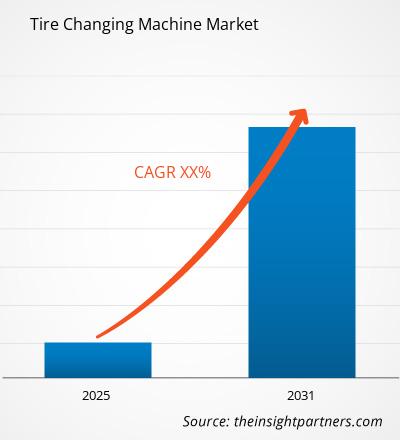
The Tire Changing Machine market was valued at US$ 583.63 million in 2025 and is expected to reach US$ 801.57 million by 2034; it is estimated to record a CAGR of 3.59% during 2026-2034.
Tire Changing Machine Market Assessment and Insights
- North America held 31–34% share in 2025 and is expected to grow at a CAGR range of 3.8–4.3% during 2026–2034, driven by high workshop density and replacement of aging service equipment.
- US represented 78–82% of North America in 2025 and is expected to grow at a CAGR range of 3.7–4.2% during 2026–2034.
- Europe accounted for 27–30% share in 2025 and is expected to expand at a CAGR range of 3.6–4.1% during 2026–2034, led by Germany, the UK, France, Italy, and Spain.
- Asia Pacific captured 25–28% share in 2025 and is expected to grow at a CAGR range of 4.5–5.1% during 2026–2034, with China, India, Japan, South Korea, and Australia leading adoption.
- Largest Segment Passenger Cars held 51–54% market share in 2025 and is expected to grow at a CAGR range of 3.9–4.4% during 2026–2034.
- High Growth Segment Automatic Tire Changing Machine held 34–37% market share in 2025 and is expected to grow at a CAGR range of 4.7–5.3% during 2026–2034.
- Key companies analyzed in detail: Bosch Automotive Service Solutions Inc., Beissbarth Automotive Testing Solutions GmbH, Hunter Engineering Company, Snap-on Incorporated, Guangzhou Jingjia Auto Equipment Co., Ltd., Hennessy Industries, LLC, TECO S.r.l., Nexion S.p.A., RAVAmerica, and Coburg Equipments Private Limited.
Source: The Insight Partners' analysis based on proprietary research, government publications, company annual reports, investor presentations, industry databases, and expert interviews.
In terms of design, workshop machinery has evolved from mechanical aid to clamping control, no-lever head mounting, bead setting, and pneumatic support arms that protect rims from damage. Factors that have influenced market dynamics also include the increasing diameter of wheels, stiffening of sidewalls, run flat tires, and increased production targets of labor. The manufacturers distinguish themselves in terms of ergonomics, rigidity of the machine, torque control, and aftersales support, whereas distributors rely on training and installation to minimize the time service shops need for their work.
Future demand will increase in the new service centers that are being opened due to vehicle parc expansion and increased maintenance rate. The industry investments will be directed towards automatic and semi-automatic units that reduce technician fatigue and throughput per bay. Attention paid to workplace safety, uptime requirements of fleets, and growth of tire retailing organizations should facilitate long replacement cycles of equipment in case of independent garages using manual methods and professional machines.
Tire Changing Machine Market Report Scope
| Report Attribute | Details |
|---|---|
| Market size in 2025 | US$ 583.63 Million |
| Market Size by 2034 | US$ 801.57 Million |
| Global CAGR (2026 - 2034) | 3.59% |
| Historical Data | 2021-2024 |
| Forecast period | 2026-2034 |
Tire Changing Machine Market Analysis
Growth in Tire Changing Machine Market is driven by increasing tire changeover frequency, higher number of vehicles, and pressure to finish the job quickly with minimum interference. Data related to OICA reveals continued momentum in vehicle manufacturing and thereby helps to support the cycle of replacement machinery. EVs and SUVs create the need for heavy-duty machinery to work with heavy wheel assemblies.
Supply chain participants include the providers of the motor, hydraulic components, pneumatic components, clamping jaws, control panels, and bead breaker assemblies, then original equipment manufacturers, distributors, and installation and servicing technicians. The dynamics of supply still relate to the cost of steel, electronics, and transportation but value addition comes from reliability, training, spare parts availability, and field service support.
The Tire Changing Machine Market report shows a competitive environment that consists of two categories – general shop equipment suppliers and tire servicing specialists. Hunter Engineering Company, Snap-on Incorporated, Bosch Automotive Service Solutions Inc., Beissbarth Automotive Testing Solutions GmbH, Nexion S.p.A., and Hennessy Industries, LLC compete in the market with premium automation and servicing network.
High throughput machines will dominate the market in dealership networks, durable semi-automatic equipment will be popular in independent garages, and robust platforms will be in demand in fleet workshops. Such companies as TECO S.r.l., RAVAmerica, Guangzhou Jingjia Auto Equipment Co., Ltd. and Coburg Equipments Private Limited meet cost concerns and regional demands, whereas branded companies compete with OEM, training and maintenance agreements.
● REPORT CUSTOMIZATION
Tailor This Report To Align With Your Specific Business Requirements
This report can be customized to align precisely with your business objectives, scope, and target markets. Customization options include tailored segmentation, geography, competitive analysis, and strategic insights to support informed decision-making.
Customize This Report →WHAT YOU CAN ADJUST
- ● Segmentations
- ● Geography
- ● Competitive Analysis
- ● Language Preferences
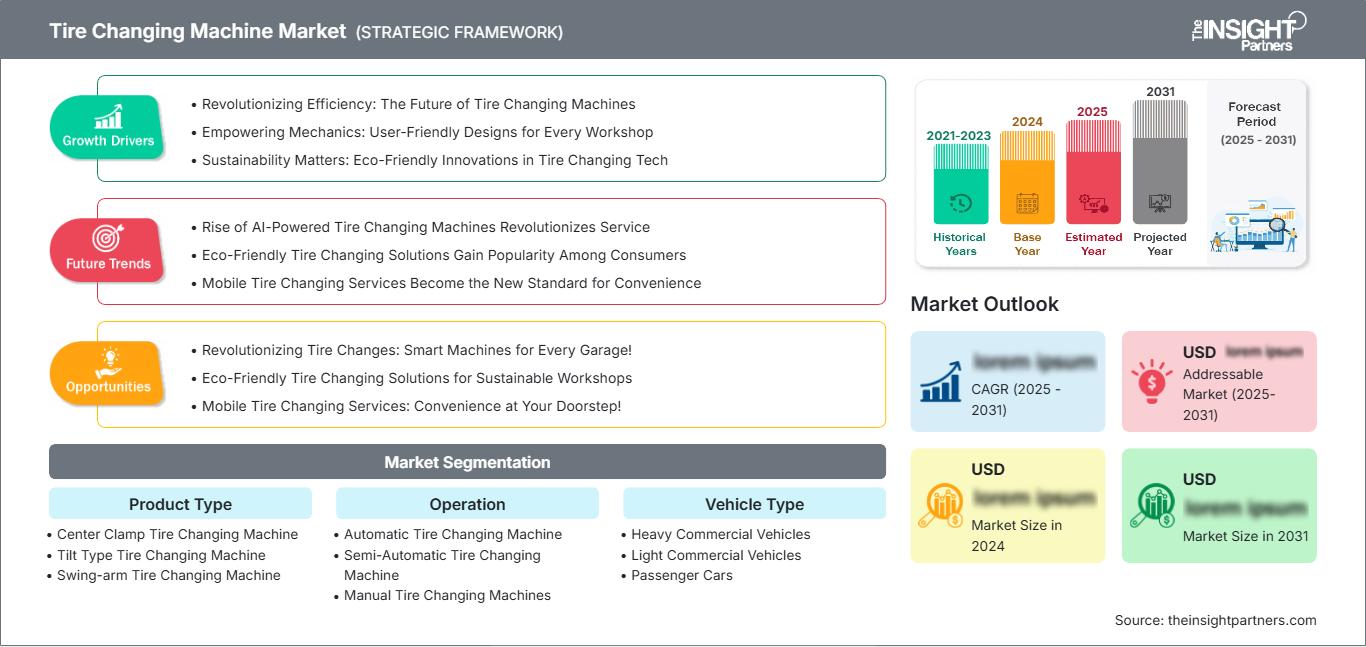
Tire Changing Machine Market: Strategic Insights
Regional Insights
North America Tire Changing Machine Market
North America accounted for 31–34% of 2025 revenue, with Tire Changing Machine Market share supported by dense tire retail networks, dealership service bays, and a high installed base of aging equipment. The region is projected to grow at a CAGR range of 3.8–4.3% during 2026–2034 as workshops replace manual and first-generation semi-automatic units.
Demand is strongest where shops manage SUVs, pickup trucks, fleet vans, and EV wheel assemblies that require greater clamping precision. Equipment decisions increasingly emphasize ergonomic lifts, leverless heads, bead seating performance, and technical service coverage. Established suppliers benefit from distributor depth, training programs, and parts availability, while value brands serve smaller garages replacing legacy machines in secondary cities.
U.S. Tire Changing Machine Market
The U.S. represented 78–82% of North America in 2025 and is expected to grow at a CAGR range of 3.7–4.2% during 2026–2034. Demand is linked to large independent service chains, tire retailers, dealership groups, and fleet maintenance facilities that require consistent throughput during seasonal tire replacement cycles.
Hunter Engineering Company, Snap-on Incorporated, Hennessy Industries, LLC, and Bosch Automotive Service Solutions Inc. maintain strong U.S. visibility through product breadth, field support, and shop relationships. Application trends favor automatic bead assist, center-clamp designs, integrated inflation systems, and machines capable of handling heavier light truck, EV, and performance wheel packages without rim damage.
Europe Tire Changing Machine Market
Europe held 27–30% share in 2025 and is forecast to grow at a CAGR range of 3.6–4.1% during 2026–2034. Germany leads through premium workshops, OEM-linked service standards, and strong equipment engineering traditions, while the UK benefits from organized MOT-related service infrastructure and independent garage modernization.
France, Italy, and Spain contribute through dense urban service networks, seasonal replacement demand, and adoption of machines suited to compact workshops. Beissbarth Automotive Testing Solutions GmbH, TECO S.r.l., and Nexion S.p.A. strengthen regional capability through OEM-aligned equipment, wheel service specialization, and dealer access. Efficiency regulations and technician safety expectations support upgrading from older manual platforms.
APAC Tire Changing Machine Market
Asia Pacific accounted for 25–28% share in 2025 and is projected to grow at a CAGR range of 4.5–5.1% during 2026–2034. China leads regional demand, followed by Japan, South Korea, India, and Australia, as service networks expand around rising vehicle parc and organized dealership operations.
Industrial policy supporting automotive manufacturing, growing tire retail chains, and higher workshop productivity expectations are widening adoption. Chinese suppliers serve price-sensitive buyers, while Japanese and Korean workshops emphasize precision and reliability. India presents long-run growth potential as formal service formats replace informal tire-changing practices in urban and highway corridors.
Middle East & Africa Tire Changing Machine Market
Middle East and Africa is expected to grow at a CAGR range of 3.9–4.5% during 2026–2034, led by Saudi Arabia and the UAE, with South Africa representing the most established African service base. Hot climates, highway mobility, and fleet maintenance needs increase tire service frequency.
Energy, logistics, construction, and tourism infrastructure support commercial vehicle servicing, particularly for light trucks and heavy fleets. Rest of MEA demand remains distributor-led, with purchasing focused on durable semi-automatic machines, parts availability, and operator training. Premium automation adoption is concentrated in dealership groups and high-volume urban tire shops.
Segmentation Analysis
Product Type
Product Type is expected to grow at a CAGR range of 3.8–4.4% during 2026–2034 as workshops balance affordability, wheel protection, and technician skill requirements. The Tire Changing Machine Market scope across product formats is shaped by shop size, service complexity, and rim damage risk, with center clamp formats gaining relevance for premium and EV fitments.
- Center Clamp Tire Changing Machine supports high-value wheel assemblies by reducing rim contact and improving centering accuracy, making it strategically important for premium cars, EVs, and performance tire service.
- Tilt Type Tire Changing Machine remains preferred in high-volume shops that need clearance, ergonomic loading, and flexibility across SUVs, light trucks, and broad wheel diameter ranges.
- Swing-arm Tire Changing Machine serves cost-conscious garages and small workshops, offering familiar operation, compact footprint, and reliable performance for routine passenger car and light commercial tire changes.
Operation
Operation is expected to grow at a CAGR range of 4.1–4.8% during 2026–2034 as operators prioritize throughput, safety, and labor efficiency. Automatic units address high-volume demand, semi-automatic machines balance cost with productivity, and manual systems remain relevant where service volumes and capital budgets are limited.
- Automatic Tire Changing Machine is strategically important for organized tire retailers and dealerships because it reduces manual effort, improves repeatability, and supports premium wheel protection.
- Semi-Automatic Tire Changing Machine attracts independent workshops seeking better productivity without premium capital expenditure, especially where mixed passenger car and light commercial service volumes are common.
- Manual Tire Changing Machines remain useful in low-volume garages, roadside support contexts, and price-sensitive markets where basic functionality, easy maintenance, and operator familiarity drive purchase decisions.
Vehicle Type
Vehicle Type is expected to grow at a CAGR range of 3.9–4.6% during 2026–2034, reflecting distinct service economics across heavy commercial vehicles, light commercial vehicles, and passenger cars. Passenger cars dominate bay utilization, while commercial fleets require rugged machines that support uptime, larger tires, and consistent service scheduling.
- Heavy Commercial Vehicles require robust platforms with higher torque, stronger bead breakers, and durable components, making reliability and safety central to fleet maintenance procurement.
- Light Commercial Vehicles generate steady demand from logistics, delivery, and trade fleets where fast tire turnaround reduces downtime and supports predictable operating schedules.
- Passenger Cars remain the largest application base because high vehicle parc, seasonal replacement, puncture repair, and premium wheel fitments sustain recurring workshop demand.
Opportunity Snapshot
| Vehicle Type | Revenue Contribution | Trend Tag | Adoption Stage |
| Heavy Commercial Vehicles | Medium | Fleet Uptime | Scaling |
| Light Commercial Vehicles | Medium | Urban Fleets | Scaling |
| Passenger Cars | High | Premium Wheels | Mature |
Tire Changing Machine Market Growth Drivers and Impact Analysis
Rising Vehicle Parc and Tire Replacement Frequency
Increasing vehicle parc will increase the frequency of tire changes, repairs of tires due to punctures, season-wise change of tires, and wheel servicing at workshops per annum. The OICA and other regional automobile organizations still provide evidence of a resilient level of production and ownership of vehicles, and thereby provide continuous demand in the aftermarket and not single time equipment purchase. This factor will affect tire retailers and independent workshops, where it will be required to decrease their waiting time during peak periods.
Shift Toward Safer and More Ergonomic Workshop Operations
The workshops now recognize the importance of tire changing machinery from both a safety perspective as well as a productivity one. The increasing weight of wheels along with the use of run-flat tires and low profile sidewalls increases the workload on the technicians and increases the chances of damaging the rims. Machinery that offers wheel lifts, bead assist arms, automatic inflation systems and even leverless heads ensure reduced operator fatigue as well as consistency in servicing. This point has a practical implication as far as cost is concerned.
Growth of Organized Tire Retail and Fleet Service Networks
Chain tire retail outlets, car dealerships' service departments, and fleet managers investing in equipment are making higher investments in standard machinery as uniformity is essential among several service stalls. The criteria used when choosing the machines include availability, uptime, technical training, warranty, and service outputs. Fleet managers in logistics and construction business must have access to reliable tire services in order to reduce vehicle downtime. The implication is that purchasing is becoming more structured, whereby high-end machinery suppliers will be able to justify prices charged, and regional manufacturers will compete through service and affordability.
Tire Changing Machine Market Future Trends
Automation Designed for EV and Premium Wheel Assemblies
Tire Changing Machine Market trends point toward machines engineered for heavier EV wheel assemblies, aerodynamic rims, and low rolling resistance tires. Future machines will utilize controlled clamping, sensor-based alignment, automatic bead management, and improved workflows for safe inflation more extensively. This is necessary since future workshops will deal with larger sizes of tires and expensive wheels for which damage claims may cost more than profits from servicing. The future trend is favorable to the equipment manufacturers who offer not only machines but also courses for proper handling techniques.
Connected Maintenance and Service Lifecycle Management
Connected service lifecycle management is expected to influence premium machine selection. Suppliers are likely to add usage tracking, preventive maintenance reminders, digital manuals, and remote diagnostics to reduce downtime and improve dealer support. For multi-site operators, machine-level data can help compare bay productivity, schedule servicing, and justify replacement cycles. This trend should gradually shift procurement from upfront price evaluation to total cost of ownership, especially among dealership networks, tire chains, and fleet workshops that cannot afford equipment failure during peak service periods.
Tire Changing Machine Market Opportunities
Expansion into Emerging Urban Service Corridors
Emerging urban corridors in India, Southeast Asia, the Gulf, and parts of Africa offer attractive Tire Changing Machine Market Forecasts because informal tire shops are gradually converting into organized service outlets. Suppliers can capture this transition by offering modular semi-automatic machines, financing support, operator training, and fast-moving spare parts kits. Distributors that establish demonstration centers and technician certification programs can reduce adoption friction. The opportunity is not limited to premium machines; mid-range equipment with rugged construction and reliable aftersales support can win share where buyers prioritize durability and payback visibility.
Bundled Workshop Modernization Solutions
Manufacturers can strengthen customer relationships by bundling tire changers with wheel balancers, alignment systems, lifts, inflation systems, and maintenance contracts. This approach suits dealership groups, tire retail chains, and fleet workshops that prefer integrated procurement and standardized service workflows. Bundled solutions improve installation efficiency, simplify technician training, and create recurring revenue through calibration, parts, and service agreements. Suppliers with broad product portfolios and dealer coverage can use bundling to defend margins, while specialists can partner with complementary equipment providers to offer complete bay modernization packages.
Recent Developments
- April 2026: Hofmann — the company introduced the monty 3850 heavy-duty tire changer for commercial service applications, extending its heavy-duty portfolio for shops handling larger assemblies and fleet work. The launch reinforced Snap-on Incorporated’s focus on productivity-focused wheel service equipment and premium undercar service solutions.
- August 2025: Hunter Engineering Company — the company introduced the Maverick Pro center-clamp tire changer, adding an ergonomic pick-and-place wheel lift for assemblies up to 175 pounds and under-wheel lighting to improve lower bead visibility. The update targeted safer, faster service for heavy and advanced fitments.
Frequently Asked Questions

- Comprehensive Market Sizing and Forecast Analysis
- Detailed Segmentation Analysis
- In-Depth Market Dynamics Assessment
- Regional and Country-Level Insights
- Competitive Landscape and Company Benchmarking
- Strategic Business Intelligence
Recent Reports
Testimonials

The Insight Partners provided valuable market intelligence that supported our global go-to-market strategy. Their team was professional, responsive, and attentive to our feedback, providing thoughtful analysis and helpful methodological clarifications throughout the project.
Junmo Kim Chief Financial Officer (CFO), Enertech Co., Ltd.
The Insight Partners' SCADA System Market report is comprehensive, with valuable insights on current trends and future forecasts. The team was highly professional, responsive, and supportive throughout. We are very satisfied and highly recommend their services.
RAN KEDEM Partner, Reali Technologies LTDs
I requested a report on a very specific software market and the team produced the report in a few days. The information was very relevant and well presented. I then requested some changes and additions to the report. The team was again very responsive and I got the final report in less than a week.
JEAN-HERVE JENN Chairman, Future Analytica
We worked with The Insight Partners for an important market study and forecast. They gave us clear insights into opportunities and risks, which helped shape our plans. Their research was easy to use and based on solid data. It helped us make smart, confident decisions. We highly recommend them.
PIYUSH NAGPAL Sr. Vice President, High Beam Global
The Insight Partners delivered insightful, well-structured market research with strong domain expertise. Their team was professional and responsive throughout. The user-friendly website made accessing industry reports seamless. We highly recommend them for reliable, high-quality research services
YUKIHIKO ADACHI CEO, Deep Blue, LLC.
This is the first time I have purchased a market report from The Insight Partners.While I was unsure at first, I visited their web site and felt more comfortable to take the risk and purchase a market report.I am completely satisfied with the quality of the report and customer service. I had several questions and comments with the initial report, but after a couple of dialogs over email with their analyst I believe I have a report that I can use as input to our strategic planning process.Thank you so much for taking the extra time and making this a positive experience.I will definitely recommend your service to others and you will be my first call when we need further market data.
JOHN SUZUKI President and Chief Executive Officer, Board Director, BK Technologies
I wish to appreciate your support and the professionalism you displayed in the course of attending to my request for information regarding to infectious disease IVD market in Nigeria. I appreciate your patience, your guidance, and the fact that you were willing to offer a discount, which eventually made it possible for us to close a deal. I look forward to engaging The Insight Partners in the future, all thanks to the impression you have created in me as a result of this first encounter.
DR CHIJIOKE ONYIA MANAGING DIRECTOR, PineCrest Healthcare Ltd.Reason to Buy
- Informed Decision-Making
- Understanding Market Dynamics
- Competitive Analysis
- Identifying Emerging Markets
- Customer Insights
- Market Forecasts
- Risk Mitigation
- Boosting Operational Efficiency
- Strategic Planning
- Investment Justification
- Tracking Industry Innovations
- Aligning with Regulatory Trends





 Get Free Sample for