
Tooling Board Market Growth, Demand & Size by 2034
Coverage: By Material (Polyurethane, Epoxy, Others); Application (Aerospace, Automotive, Marine, Wind Energy, Others) , and Geography (North America, Europe, Asia Pacific, and South and Central America)
- Status : Data Released
- Report Code : TIPRE00017210
- Category : Manufacturing and Construction
- No. of Pages : 150
- Available Report Formats :


- Last update date : August 06, 2026


2025 Market Size
US$ 1.61 Bn
Base year value
2034 Forecast
US$ 2.79 Bn
Projected by 2034
CAGR 2026-2034
6.31 %
Growth rate
Addressable Market
US$ 19.92 Bn
(2026-2034)
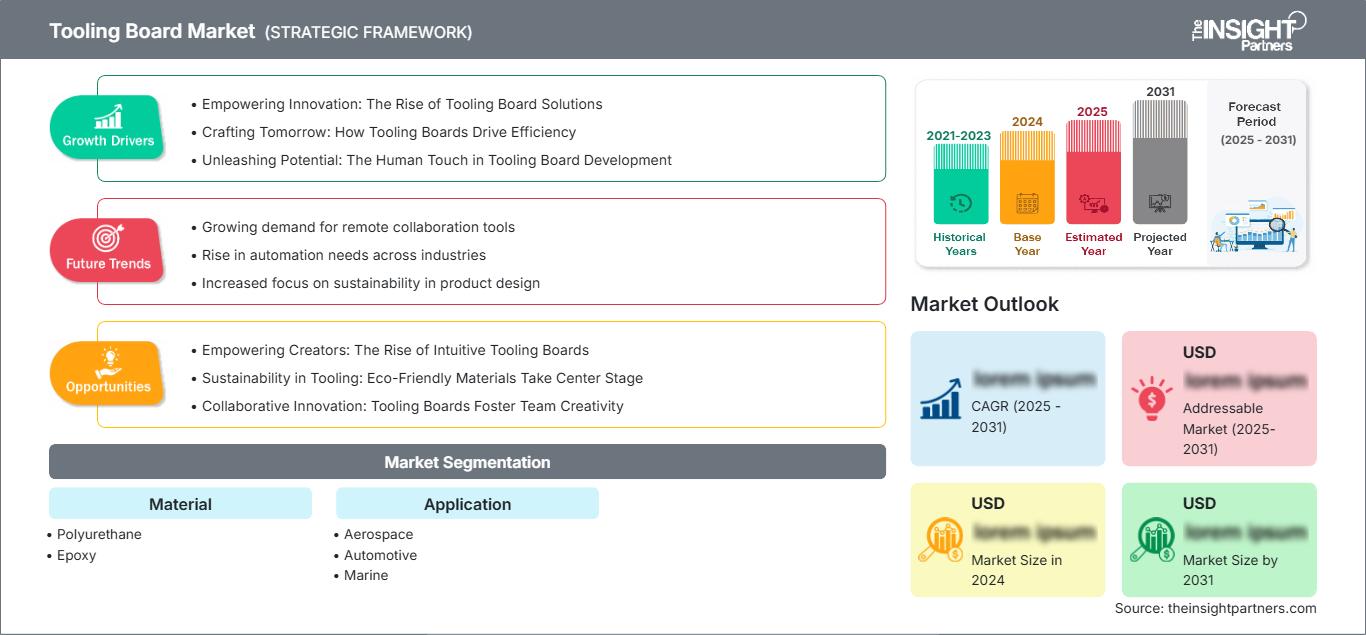
The global Tooling Board Market is projected to grow from US$ 1.61 Billion in 2025 to US$ 2.79 Billion by 2034, registering a CAGR of 6.31% during 2026–2034. The expansion reflects rising use of precision machinable boards in prototype validation, composite mold production, checking fixtures, and low-volume tooling across aerospace, automotive, marine, and wind energy manufacturing programs.
Across North America, demand is expected to advance at a 5.8–6.4% CAGR as aerospace composite tooling, electric vehicle prototyping, and wind blade development sustain premium material adoption. Tooling Board Market size in the region is supported by localized CNC machining capacity, defense procurement stability, and manufacturers shifting from metal masters toward lighter polyurethane and epoxy boards for faster engineering iteration.
Tooling Board Market Assessment and Insights
- North America accounted for 31–34% share in 2025 and is projected to grow at a 5.8–6.4% CAGR between 2026–2034, supported by aerospace tooling renewal, EV model launches, and composite fixture demand.
- US represented 78–82% of North America in 2025 and is expected to grow at a 5.9–6.5% CAGR between 2026–2034, led by aerospace, defense, and motorsport prototyping.
- Europe held 26–29% share in 2025 and is forecast to expand at a 5.4–6.0% CAGR between 2026–2034, with Germany, France, the UK, Italy, and Spain leading composite tooling demand.
- Asia Pacific captured 24–27% share in 2025 and is expected to grow at a 6.7–7.3% CAGR between 2026–2034 as China, Japan, South Korea, India, and Australia expand aerospace and wind manufacturing.
- Largest Segment Polyurethane held 62–66% market share in 2025 and is projected to grow at a 5.9–6.5% CAGR between 2026–2034 because it balances machinability, cost, and dimensional stability.
- High Growth Segment Wind Energy held 13–16% market share in 2025 and is forecast to grow at a 7.1–7.7% CAGR between 2026–2034, supported by larger blade molds and faster repair cycles.
- Key companies analyzed in detail: Alchemie Ltd., Alro Steel Corporation, Base Materials Ltd., Coastal Enterprises, Inc., Curbell Plastics, Inc., General Plastics Manufacturing Company, Inc., Goldenwest Manufacturing, Inc., Huntsman International LLC, RAMPF Group, Inc., and Trelleborg AB.
Source: The Insight Partners' analysis based on proprietary research, government publications, company annual reports, investor presentations, industry databases, and expert interviews.
Technology migration is affecting the Tooling Board Market production, where users are looking for tighter tolerances, cleaner chip creation, and higher cure temperature tolerance. This technology migration is resulting in suppliers providing density-specific polyurethane products, epoxy boards, chemically recycled resin feedstocks, and matched adhesives. The manufacturing process will be shifting towards producing near-net blocks and contour blanks to minimize wastage in machining, along with increasing efficiency in making composite molds and master models.
In the future, investments will be made in aerospace hubs, electric vehicle design centers, offshore wind manufacturing, and marine composite production hubs. The need for light vehicles, low production waste, and high efficiency in energy is supporting the adoption. It is expected that new manufacturing corridors in emerging Asia and diversification programs in the Middle East will result in additional demand.
Tooling Board Market Report Scope
| Report Attribute | Details |
|---|---|
| Market size in 2025 | US$ 1.61 Billion |
| Market Size by 2034 | US$ 2.79 Billion |
| Global CAGR (2026 - 2034) | 6.31% |
| Historical Data | 2021-2024 |
| Forecast period | 2026-2034 |
Tooling Board Market Analysis
Growth drivers for Tooling Boards come from the rapid development time of aircraft parts, electric vehicle components, high-speed boat hulls, and turbine blades. Engineers need fast-machined substrates that will go straight from a CAD file to a CNC pattern without waiting weeks for metallic tooling. The demand will be greatest in applications where there is frequent change in geometry and the finish affects the quality of the composite layup.
The value chain is made up of resin formulation, board casting, block lamination, distribution, CNC machining, and tool validation. Supply factors will create a preference for suppliers able to manage density, thermal expansion, and adhesion. For aerospace and wind turbine markets, batch traceability is important, and automotive buyers value quick prototyping and the machineability of the boards.
In the Tooling Board Market analysis, a competitive industry is revealed, whereby chemistry experts and suppliers of machining materials operate at a complementary level. Huntsman International LLC, RAMPF Group, Inc., Base Materials Ltd., General Plastics Manufacturing Company, Inc., and Trelleborg AB compete through resin expertise, whereas Alro Steel Corporation and Curbell Plastics, Inc. widen the market reach by providing inventory and fabrication.
New positioning focuses on sustainability, heat resistance, contour, and reduced removal of material. Alchemie Ltd., Coastal Enterprises, Inc., and Goldenwest Manufacturing, Inc. provide niche products that require customization. Investment strategies involve regional stocking capacity, online ordering, technical assistance to composite shops, and grades appropriate for automated machining and minimal wastage production.
● REPORT CUSTOMIZATION
Tailor This Report To Align With Your Specific Business Requirements
This report can be customized to align precisely with your business objectives, scope, and target markets. Customization options include tailored segmentation, geography, competitive analysis, and strategic insights to support informed decision-making.
Customize This Report →WHAT YOU CAN ADJUST
- ● Segmentations
- ● Geography
- ● Competitive Analysis
- ● Language Preferences
Tooling Board Market: Strategic Insights
Regional Insights
North America Tooling Board
North America held 31–34% Tooling Board Market share in 2025 and is expected to expand at a 5.8–6.4% CAGR. Stable demand is seen in aerospace composites, defense tooling remanufacturing, EV battery platform manufacturing, and motorsport prototyping. Customers in the region prefer locally available products with technical services because the lack of the fixture can disrupt qualification timelines.
Machining facilities in the US and Canada will serve short runs of aircraft interiors, composite ducts, marine plugs, and wind blade root tools. The companies that will provide the supply are RAMPF Group, Inc., General Plastics Manufacturing Company, Inc., Curbell Plastics, Inc., Alro Steel Corporation, and Coastal Enterprises, Inc. There is growing pressure on sustainable board materials, which include recycled content, less waste machining, and no aluminum masters.
U.S. Tooling Board Market
The U.S. Tooling Board Market represented 78–82% of North America in 2025 and is projected to grow at a 5.9–6.5% CAGR through 2034. Demand is concentrated around aerospace tier suppliers, defense composite programs, EV platform engineering, motorsport, and high-value marine fabrication. Domestic lead-time expectations favor distributors that stock multiple densities and provide rapid cut-to-size service.
Company presence is strongest in tooling clusters across Washington, California, Michigan, Texas, and the Southeast. General Plastics Manufacturing Company, Inc. supports aerospace foam and board applications, while RAMPF Group, Inc. serves composite tooling from its US operations. Tooling Board Market demand also benefits from additive-manufacturing validation, where machined boards remain useful for accurate surface confirmation.
Europe Tooling Board Market
Europe accounted for 26–29% of the Tooling Board Market share in 2025 and is forecast to grow at a 5.4–6.0% CAGR. Germany excels in automotive engineering, aerospace composites, and machinery tooling, while France is helped by aircraft and marine composite work. The UK still plays an important role in motorsport, material testing, and low-volume composite tooling.
Italy and Spain have been contributing to yacht building, wind components, and industrial design services. Increasingly, European clients are asking for materials that waste less and show responsible handling of chemicals, which makes suppliers promote recycled resin and close contour blanks. Adoption of Tooling Board technology has also been aided by high labor costs, making machining easier.
APAC Tooling Board Market
APAC held 24–27% share in 2025 and is expected to post a 6.7–7.3% CAGR, the fastest regional pace. China leads on wind blade tooling, EV model development, and industrial composites, while Japan and South Korea support precision automotive and aerospace applications. India and Australia add demand through defense, rail, marine, and renewable-energy programs.
Policy support for local aerospace supply chains and renewable power manufacturing is increasing demand for machinable boards. Tooling Board Market producers can benefit by combining regional distribution with technical training for CNC shops that are transitioning from wood, metal, or lower-grade polymer tooling.
Middle East & Africa Tooling Board Market
The Middle East & Africa Tooling Board Market is projected to grow at a 5.2–5.8% CAGR, with Saudi Arabia and the UAE leading demand through aerospace localization, marine fabrication, energy infrastructure, and industrial diversification. South Africa supports regional use through automotive tooling, rail components, and composite repair networks.
The rest of MEA demand remains project-based, but wind, defense maintenance, and luxury marine applications are creating specialized opportunities. Tooling Board suppliers that offer technical guidance, stable imports, and moisture-resistant grades can improve adoption in hot climates where storage and dimensional stability are critical.
Segmentation Analysis
Material
By Material, Epoxy is expected to grow at a 6.0–6.6% CAGR during 2026–2034. The Tooling Board Market scope across material types is defined by density, temperature resistance, machinability, and surface finish requirements. Polyurethane remains the standard for many prototype and fixture uses, while epoxy is preferred where higher thermal stability and composite curing performance are required.
- Polyurethane dominates volume because it machines cleanly, offers broad density choices, and supports cost-efficient plugs, checking fixtures, styling models, and low-temperature composite tools.
- Epoxy holds strategic importance in high-temperature layup tools, prepreg-compatible molds, and applications requiring lower thermal expansion, stronger edges, and improved durability under repeated processing.
Application
By Application, Aerospace demand is projected to expand at a 6.2–6.8% CAGR between 2026–2034. The Tooling Board Market shows that aerospace requires dimensional precision, automotive emphasizes faster design cycles, marine values large-format plugs, and wind energy needs efficient blade mold support. Adoption is strongest where composite structures are complex, expensive to rework, and dependent on accurate surface replication.
- Aerospace remains a premium application because composite ducts, interiors, fairings, and tooling masters require tight tolerances, traceability, stable surfaces, and reliable performance during qualification.
- Automotive uses boards for concept models, checking fixtures, EV battery prototypes, trim tools, and short-run molds where rapid design changes favor machinable polymer substrates.
- Marine demand is linked to yacht plugs, hull sections, deck molds, and repair tools, with users valuing moisture resistance, large block availability, and smooth finishing.
- Wind Energy is strategically important as longer blades and regional manufacturing programs require efficient master models, root tooling, repair molds, and lower-waste machining workflows.
Opportunity Snapshot
| Application | Revenue Contribution | Trend Tag | Adoption Stage |
| Aerospace | High | Composite Tools | Mature |
| Automotive | High | EV Prototypes | Scaling |
| Marine | Medium | Hull Plugs | Scaling |
| Wind Energy | Medium | Blade Molds | Emerging |
Tooling Board Market Growth Drivers and Impact Analysis
Composite Manufacturing Moves Toward Faster Tooling
The Tooling Board Market forecast indicates that composite manufacturers are under pressure to shorten tooling cycles as aircraft, EV, marine, and wind programs move through frequent design iterations. Tooling Board materials reduce dependence on heavy metal tools during early validation because they can be machined quickly, bonded into large blanks, repaired, and finished to tight surface requirements. The impact is strongest in prototype and low-volume environments, where avoiding a delayed metal tool can protect launch schedules. Suppliers that offer matching adhesives, repair pastes, and technical guidance can capture higher value because users increasingly evaluate the full tooling workflow rather than only board price.
Electric Vehicles Increase Prototype and Fixture Demand
Design validation of electric vehicle platforms will involve several rounds of design validation of the battery enclosure, the components for thermal management, interior structure, and aerodynamic surfaces. Machinable boards are used by automobile manufacturers and tier suppliers to develop the checking fixtures, trimming tools, styling mockups, and short-run moldings prior to final production tooling approval. Such a trend drives the need for polyurethane boards that provide an optimal price-to-machining rate ratio, whereas the market for epoxy boards becomes more important in terms of higher heat resistance requirements. The market effect is an expanded customer base.
Wind Blade Scale Raises Mold Accuracy Requirements
Increasing blade size makes dimensional accuracy even more crucial since any change on the blade surface might have a negative impact on aerodynamics, bonding, and repair work. Tooling Board materials can be used to create master models, root segments, repair molds, and other blade development tools where large bonded segments and precise CNC milling are required. As longer blades become prevalent in offshore projects, there will be more interest in tooling materials that can offer dimensional stability over large surfaces and save on finish time.
Tooling Board Market Future Trends
Recycled Resin Content Becomes a Procurement Factor
Tooling Board Market trends are moving toward lower-waste formulations as OEMs and tier suppliers extend sustainability requirements into prototype and tooling purchases. Recycled polyurethane inputs, closed-loop residue recovery, and close-contour blanks can reduce material loss compared with fully milled rectangular blocks. The trend will not replace performance requirements, but it will influence supplier selection where two products meet similar machining and stability thresholds. Over the forecast period, procurement teams are likely to request environmental documentation, recycled-content claims, and quantified waste-reduction benefits during qualification.
High-Temperature Epoxy Grades Expand in Composites
It is anticipated that composite programs will drive increased adoption of high-temperature epoxy boards as processes for prepreg manufacturing, autoclave tests, and specialized layup tooling become more challenging. These materials offer reduced coefficient of thermal expansion, improved edge stability, and enhanced durability when exposed repeatedly to high temperatures in comparison to most standard polyurethane boards. There will, however, be limited adoption due to the higher cost of epoxy boards, yet users will see value in the extra cost in terms of avoiding costly repairs from faulty tooling.
Tooling Board Market Opportunities
Regional Stocking and Cut-to-Size Services
The opportunity to increase market share lies in regional expansion of the stock of the material, cut-to-size capabilities and technical support. The customers will have a need to use the board right after the design is released, and any delay could mean loss of the capacity at the CNC or delaying the qualification of the tools. Having a stock of different densities, adhesives and repairs will give the service advantage, which will be especially valuable for small composite shops without much expertise in materials.
Application Engineering for Large Composite Tools
Large composite tools generate opportunities for suppliers who can offer design assistance, adhesion suggestions, machining techniques, and repairs instead of selling boards alone. Molds for wind blades, plugs for boats, and parts of an aircraft need predictable performance in bonded blocks since any incompatibility in the glue or internal stresses could affect precision. Suppliers of Tooling Boards who combine their products with engineering services can lessen risks for the buyer and justify high prices. The chance is proactive since suppliers can set up a service team, provide machining data, and work with CNC shops.
Recent Developments
- June 2026: RAMPF Group, Inc. — announced high-performance tooling materials and integrated engineering expertise for aerospace and defense composite manufacturing at Farnborough International Airshow, emphasizing lead-time and cost reduction for advanced composite programs.
- April 2023: Joby Aviation, Inc. (NYSE:JOBY), a company developing all-electric aircraft for commercial passenger service, today announced it has signed a long-term agreement with Toyota Motor Corporation Inc. (NYSE:TM) to supply key powertrain and actuation components for the production of the Company’s aircraft.
Frequently Asked Questions

- Comprehensive Market Sizing and Forecast Analysis
- Detailed Segmentation Analysis
- In-Depth Market Dynamics Assessment
- Regional and Country-Level Insights
- Competitive Landscape and Company Benchmarking
- Strategic Business Intelligence
Recent Reports
Testimonials

The Insight Partners' SCADA System Market report is comprehensive, with valuable insights on current trends and future forecasts. The team was highly professional, responsive, and supportive throughout. We are very satisfied and highly recommend their services.
RAN KEDEM Partner, Reali Technologies LTDs
I requested a report on a very specific software market and the team produced the report in a few days. The information was very relevant and well presented. I then requested some changes and additions to the report. The team was again very responsive and I got the final report in less than a week.
JEAN-HERVE JENN Chairman, Future Analytica
We worked with The Insight Partners for an important market study and forecast. They gave us clear insights into opportunities and risks, which helped shape our plans. Their research was easy to use and based on solid data. It helped us make smart, confident decisions. We highly recommend them.
PIYUSH NAGPAL Sr. Vice President, High Beam Global
The Insight Partners delivered insightful, well-structured market research with strong domain expertise. Their team was professional and responsive throughout. The user-friendly website made accessing industry reports seamless. We highly recommend them for reliable, high-quality research services
YUKIHIKO ADACHI CEO, Deep Blue, LLC.
This is the first time I have purchased a market report from The Insight Partners.While I was unsure at first, I visited their web site and felt more comfortable to take the risk and purchase a market report.I am completely satisfied with the quality of the report and customer service. I had several questions and comments with the initial report, but after a couple of dialogs over email with their analyst I believe I have a report that I can use as input to our strategic planning process.Thank you so much for taking the extra time and making this a positive experience.I will definitely recommend your service to others and you will be my first call when we need further market data.
JOHN SUZUKI President and Chief Executive Officer, Board Director, BK Technologies
I wish to appreciate your support and the professionalism you displayed in the course of attending to my request for information regarding to infectious disease IVD market in Nigeria. I appreciate your patience, your guidance, and the fact that you were willing to offer a discount, which eventually made it possible for us to close a deal. I look forward to engaging The Insight Partners in the future, all thanks to the impression you have created in me as a result of this first encounter.
DR CHIJIOKE ONYIA MANAGING DIRECTOR, PineCrest Healthcare Ltd.Reason to Buy
- Informed Decision-Making
- Understanding Market Dynamics
- Competitive Analysis
- Identifying Emerging Markets
- Customer Insights
- Market Forecasts
- Risk Mitigation
- Boosting Operational Efficiency
- Strategic Planning
- Investment Justification
- Tracking Industry Innovations
- Aligning with Regulatory Trends





 Get Free Sample for