
Towing Equipment Market Growth, Trends & Forecast by 2034
Coverage: by Product Type (Belt Towing Equipment and Crawler Towing Equipment); and Application (Architecture, Transport and Others), and Geography (North America, Europe, Asia Pacific, and South and Central America)
- Status : Data Released
- Report Code : TIPTE100000640
- Category : Manufacturing and Construction
- No. of Pages : 150
- Available Report Formats :


- Last update date : October 30, 2026


2025 Market Size
US$ 3.76 Bn
Base year value
2034 Forecast
US$ 6.4 Bn
Projected by 2034
CAGR 2026-2034
6.07 %
Growth rate
Addressable Market
US$ 45.96 Bn
(2026-2034)
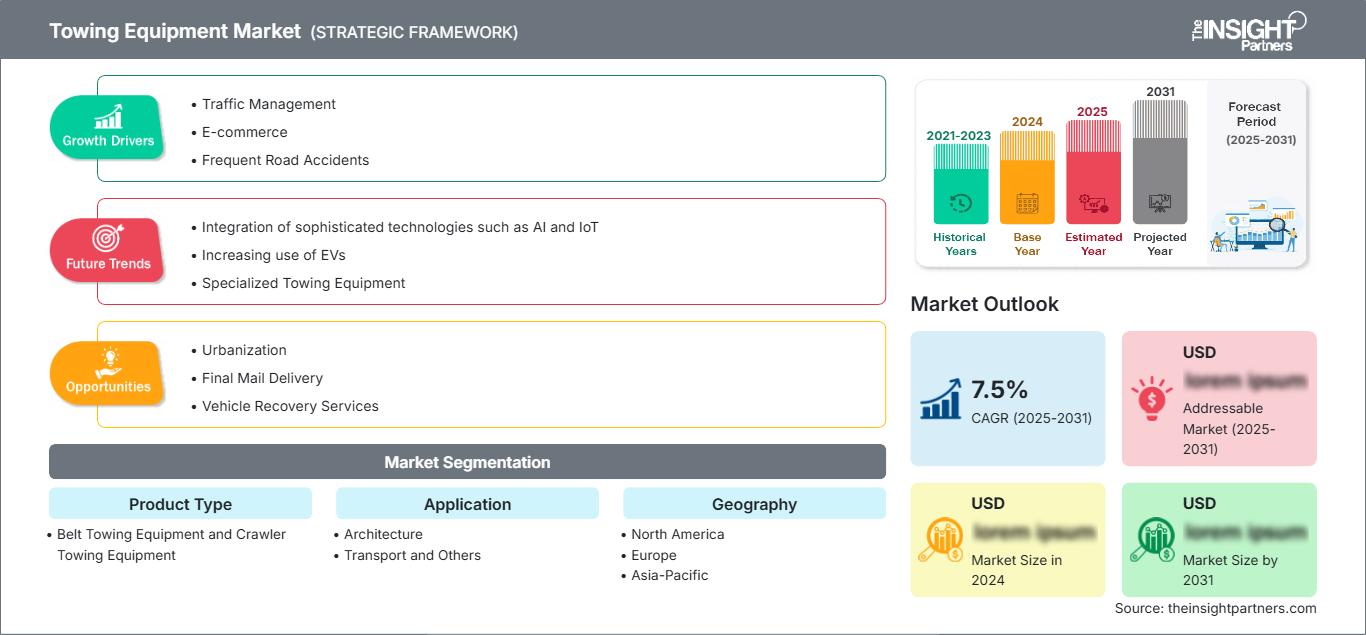
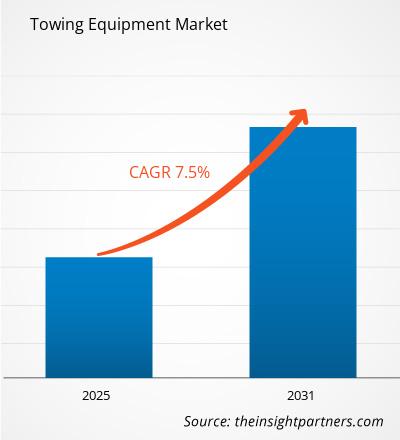
The Towing Equipment Market is valued at US$ 3.76 Billion in 2025 and is projected to reach US$ 6.4 Billion by 2034, registering a CAGR of 6.07% during 2026–2034. The market covers towing solutions used for vehicle, trailer, cargo, fleet, construction, and related mobility applications, with analysis structured around Belt Towing Equipment and Crawler Towing Equipment, and across Architecture, Transport, and Others. Demand is influenced by vehicle recovery requirements, transportation activity, construction operations, and the increasing need for safer and more efficient towing systems.
North America remains an important demand center because of its extensive vehicle parc, mature transportation infrastructure, developed aftermarket channels, and established towing-service ecosystem. The regional Towing Equipment Market size indicates a ~5% CAGR through 2034, supported by replacement demand, commercial fleet activity, construction equipment movement, and continued adoption of engineered towing systems. Increasing vehicle electrification is also encouraging manufacturers to develop application-specific equipment capable of handling changing vehicle configurations and towing requirements.
Towing Equipment Market Assessment and Insights
Regional Outlook
- North America: ~34% of the global market in 2025 | ~5% CAGR through 2034. Market position: North America represents the largest regional market, supported by a mature vehicle and trailer ecosystem, extensive road infrastructure, established aftermarket distribution, commercial fleet activity, and recurring replacement demand for towing equipment.
- US: ~78% of North American market revenue in 2025 | ~5% CAGR through 2034. Market position: The US is the leading country in North America, supported by a large automotive fleet, substantial recreational vehicle and commercial towing activity, construction demand, and broad availability of specialized towing products through OEM and aftermarket channels.
- Europe: ~28% of the global market in 2025 | ~6% CAGR through 2034. Market position: Europe is a mature towing-equipment market led by Germany within Europe, with France, the UK, Italy, and Spain providing substantial demand through automotive production, commercial transport, recreation, construction, and vehicle-specific towing systems.
- Asia Pacific: ~25% of the global market in 2025 | ~8% CAGR through 2034. Market position: Asia Pacific is the fastest-growing region, supported by expanding vehicle ownership, logistics infrastructure, construction activity, manufacturing capacity, and aftermarket development. China is the leading country in Asia Pacific by overall demand potential.
Segment Outlook
- Belt Towing Equipment: ~58% Share in 2025 | ~6% CAGR through 2034. Market position: Belt-based systems lead because their adaptable configuration supports a broad range of light and medium-duty towing requirements across transport, fleet, roadside assistance, and utility applications, while established distribution channels support replacement and aftermarket purchases.
- Transport: ~57% Share in 2025 | ~7% CAGR through 2034. Market position: Transport is the largest application segment, reflecting recurring towing requirements associated with vehicle recovery, fleet operations, logistics, trailers, roadside assistance, and movement of commercial assets across increasingly intensive transportation networks.
Competitive Coverage
Andersen Hitches, BOSAL, B&W Trailer Hitches, Camco Manufacturing, CURT Manufacturing, Demco Products, Hopkins Manufacturing Corporation, Horizon Global, Weigh Safe, Brink Group
Methodology
The Insight Partners follows Data Collection & Secondary Research, Primary Research, Data Analysis, and Data Triangulation & Final Review to validate market estimates and insights.
Source: The Insight Partners' analysis based on proprietary research, government publications, company annual reports, investor presentations, industry databases, and expert interviews.
The industry is changing from standardized towing mechanical products to custom-tailored towing systems that take into account vehicle configuration, towing capacity, installation considerations, safety and durability aspects, as well as customer convenience. Belt type systems will continue being applicable in situations where flexibility and attachment ease are critical, whereas crawler types will be used in cases when increased traction and stability are needed. The process of innovation of towing products is driven by such aspects as electrification of the vehicle, change in trailer structures, resistance to corrosion, lightweight designs and compatibility with a wider range of vehicles.
In the future, the demand is likely to increase in connection with growing transportation and construction industries. More people living in cities, increased demand for logistics related to road transport, larger number of vehicles and movement of equipment for business and recreational purposes lead to the need for more towing systems. There will also be investment in such areas as product localization, aftermarket products, use of high-tech materials and vehicle platform-compatible designs. Such trends as road safety and vehicle compatibility will additionally stimulate the demand for reliable towing components.
Towing Equipment Market Report Scope
| Report Attribute | Details |
|---|---|
| Market size in 2025 | US$ 3.76 Billion |
| Market Size by 2034 | US$ 6.4 Billion |
| Global CAGR (2026 - 2034) | 6.07% |
| Historical Data | 2021-2024 |
| Forecast period | 2026-2034 |
Towing Equipment Market Analysis
Demand for towing equipment is closely connected with the installed base of vehicles, trailers, commercial fleets, construction assets, recreational vehicles, and roadside recovery requirements. Transport applications generate recurring requirements because towing systems are used not only for new vehicle installations but also for fleet replacement, trailer upgrades, recovery operations, and accessory additions. Architecture-related demand is associated with construction and movement of equipment and materials, while other applications provide additional demand from specialized and recreational use cases.
The value chain comprises raw material suppliers, component suppliers, towing equipment designers, OEM integration suppliers, aftermarket distributors, installers, fleet operators, towing services, and end users. Structural material suppliers continue to play a critical role in load-carrying parts of the product, while coating, machining, welding, fastening, electrical connection and vehicle-specific mounting system affect performance. Competitive supply requires large manufacturing, engineering capability, vehicle coverage, distribution capability, compliance and timely product introduction for new vehicle model launches.
Competitive structure in the Towing Equipment Market Report is characterized by major towing products manufacturers with wide product range as well as specialists for specific types of vehicles, hitch type or aftermarket applications. CURT Manufacturing is the leading player with wide range of receiver hitches, fifth-wheel, gooseneck, weight-distribution, electrical and other towing products. Horizon Global operates through its well-known towing and trailering brands, whereas Brink Group concentrates mainly on vehicle-specific towbar systems. B&W Trailer Hitches and Weigh Safe concentrate on engineered towing connections, while Demco Products on towing, agricultural and recreational products.
Competitive positioning is becoming more dependent upon the product line itself, its compatibility with the particular vehicle, engineering excellence, distribution, and ease of installation rather than solely relying on towing capacity. The industry is developing products made out of light construction, anti-corrosive coatings, safety components built-in, electronics-based accessory components, and application-oriented products. Launches of products for new platforms serve as an important strategy for expansion into the after market, while OEM partnerships offer increased demand visibility.
● REPORT CUSTOMIZATION
Tailor This Report To Align With Your Specific Business Requirements
This report can be customized to align precisely with your business objectives, scope, and target markets. Customization options include tailored segmentation, geography, competitive analysis, and strategic insights to support informed decision-making.
Customize This Report →WHAT YOU CAN ADJUST
- ● Segmentations
- ● Geography
- ● Competitive Analysis
- ● Language Preferences
Towing Equipment Market: Strategic Insights
Regional Insights
North America Towing Equipment Market
North America comprised around 34% of the global market in 2025 and will grow at around 5% CAGR up to 2034. This region enjoys a well-established ecosystem of tow bars in the form of passenger cars, pickup trucks, commercial trucks, trailers, RVs, agriculture applications, construction applications, and roadside services. The demand for products is driven by the established base of vehicles and the use of towing accessories by OEM, dealers, retail, and specialty aftermarket channels.
The United States is the major consumer in this region, while Canada and Mexico offer additional opportunities for commercial transportation, recreation, logistics, agriculture, and manufacturing. The replacement demand is significant since tow bars are updated with the upgrading of vehicles, trailers, and accessories. Moreover, the rise in penetration of electric vehicles is providing scope for application-specific products where the vehicle design, loading, packaging of vehicle underbody, and electronics differ from the traditional platform.
U.S. Towing Equipment Market
United States accounted for ~78% of North America Towing Equipment Market share in 2025 and anticipated to witness a ~5% CAGR through 2034. It has been attributed due to an extensive presence of the passenger vehicles, pickups, SUVs, commercial vehicles, trailers, recreational vehicles, and specialty equipment. The transport, construction, agriculture, recreation, and roadside assistance result in varied demands which help in minimizing the dependence on any specific end-use application.
The competition includes well-established players such as CURT Manufacturing, B&W Trailer Hitches, Horizon Global, Demco Products, Andersen Hitches, and Weigh Safe. The offerings from these players include receiver hitches, fifth-wheel products, gooseneck products, couplers, towing accessories, and specific vehicle kits. The increase in the variety of vehicle models results in the need to widen the range of applications and easy installation process. With the rising adoption of the electric vehicles, the development of the towing systems needs to consider the differences in vehicle designs.
Europe Towing Equipment Market
Europe represented ~28% of the global market in 2025 and is expected to grow at a ~6% CAGR through 2034. Germany is the leading country in Europe, supported by a substantial automotive manufacturing base, engineering capabilities, commercial transport activity, and a developed towing aftermarket. The UK also represents an established market because of widespread trailer, caravan, commercial, and recreational towing applications. France contributes through automotive and transport demand, while Italy and Spain add requirements associated with commercial vehicles, tourism, recreation, agriculture, and construction.
The demands in Europe are being influenced by the individual development of the products and vehicle architecture. Companies will have to consider the different types of vehicle, body types, allowable weights, and fitting conditions, along with complying with all safety and technical regulations. Detachable and retractable systems are becoming strategically important as consumers and vehicle manufacturers become concerned with style and flexibility. There are also possibilities for premium products that provide better installation, corrosion resistance, electronic functionality, and hybrid and electric vehicles.
German vehicle manufacture infrastructure offers the basis for product engineering and aftermarket sales for neighboring regions. The United Kingdom has good trailer and recreational applications, while France, Italy, and Spain have a combination of passenger cars, commercial vehicles, agricultural and leisure use. These distinctions offer possibilities for companies with vehicle information databases and regional distributions.
APAC Towing Equipment Market
APAC accounted for ~25% of the global Towing Equipment Market in 2025 and is projected to expand at a ~8% CAGR through 2034, making it the fastest-growing region. China is the leading country in Asia Pacific, supported by its large vehicle manufacturing ecosystem, extensive logistics activity, infrastructure development, and expanding domestic aftermarket. Japan and South Korea provide demand from sophisticated automotive manufacturing and mature vehicle platforms, while India is developing rapidly through vehicle ownership, logistics, construction, and infrastructure expansion.
Australia adds demand from commercial vehicles, recreational towing, agriculture, mining-related activity, and long-distance road transportation. Across APAC, rising vehicle penetration and expanding logistics networks support equipment requirements. Product localization is increasingly important because manufacturers must address differences in vehicle architecture, road conditions, towing practices, and consumer requirements across countries.
Middle East & Africa Towing Equipment Market
The Middle East and Africa market is expected to expand at a ~6% CAGR through 2034. Saudi Arabia and the UAE represent important demand centers in the Middle East because infrastructure development, commercial fleets, logistics, construction, tourism, and recreational vehicle use create requirements for towing equipment. South Africa is an important market in the region because of its developed automotive aftermarket and substantial commercial, agricultural, and industrial activity.
Regional demand varies considerably by application and infrastructure maturity. Gulf markets are influenced by construction programs, logistics expansion, vehicle ownership, and specialized fleet requirements, while South Africa benefits from established automotive distribution and aftermarket channels. Rest of MEA markets offer longer-term potential as road infrastructure, vehicle fleets, commercial transportation, and recovery services develop. Product durability, corrosion resistance, service availability, and compatibility with heavy-duty applications remain important purchasing considerations.
Segmentation Analysis
Product Type
The Product Type segment in the Towing Equipment Market is expected to register a ~6% CAGR during 2026–2034. Demand is divided between Belt Towing Equipment and Crawler Towing Equipment, with product selection influenced by towing load, operating environment, traction requirements, maneuverability, equipment configuration, and installation preferences. Belt-based products address a broad range of transport and utility requirements, while crawler configurations are better suited to demanding environments where traction and stability are important.
- Belt Towing Equipment: Belt systems are widely applicable where flexible load engagement, maneuverability, and relatively straightforward operation are required. Their broad suitability across transport and fleet-related applications supports recurring aftermarket demand and encourages manufacturers to improve materials, durability, attachment mechanisms, and ease of installation.
- Crawler Towing Equipment: Crawler systems are suited to demanding applications requiring stronger traction, stability, and controlled movement over challenging surfaces. Their strategic importance is linked to construction, industrial, specialized transport, and environments where conventional wheeled towing solutions may have operational limitations.
Application
The Application segment is expected to record a ~6% CAGR during 2026–2034. Transport remains the principal demand area because towing equipment is repeatedly required for vehicle recovery, fleet movement, trailers, logistics, roadside assistance, and commercial operations. Architecture contributes through construction-related equipment movement and material handling requirements, while other uses broaden the addressable customer base.
- Architecture: Architecture-related applications encompass towing requirements associated with construction activities, equipment movement, material handling, and site operations. Demand is influenced by construction intensity, project scale, equipment mobility requirements, and the need to move specialized assets safely across worksites and between locations.
- Transport: Transport is the central application area, covering vehicle recovery, commercial fleets, trailers, logistics, roadside assistance, recreational towing, and related mobility requirements. Its strategic importance comes from recurring utilization and the large installed base of vehicles requiring compatible towing systems.
- Others: This category covers specialized uses outside the principal architecture and transport applications. Demand is influenced by recreational, agricultural, industrial, emergency, and application-specific towing requirements, creating opportunities for customized products and niche equipment configurations.
Opportunity Snapshot
| Application | Revenue Contribution | Trend Tag | Adoption Stage |
|---|---|---|---|
| Architecture | Medium | Site Mobility | Scaling |
| Transport | High | Fleet Recovery | Mature |
| Others | Medium | Specialty Towing | Scaling |
Towing Equipment Market Growth Drivers and Impact Analysis
Expansion of Vehicle Fleets and Transportation Activity
Growing vehicle populations and increasingly intensive road transportation activity create a structural requirement for towing and recovery equipment. Commercial fleets, trailers, logistics vehicles, recreational vehicles, and passenger vehicles generate demand not only when new vehicles enter service but also throughout their operating life. Breakdown recovery, accident response, trailer movement, maintenance, and fleet reconfiguration create recurring use cases. The expanding logistics ecosystem also increases the importance of equipment that can move vehicles and loads safely without excessive downtime. For manufacturers, this demand profile supports both OEM integration and aftermarket sales. Suppliers able to provide vehicle-specific products across multiple classes can capture replacement and accessory demand simultaneously. The market impact is therefore broader than new vehicle production alone, with installed-base activity providing an important recurring source of equipment requirements.
Growth of Construction and Specialized Equipment Movement
Construction and infrastructure activity creates demand for towing solutions capable of moving trailers, machinery, work equipment, and specialized loads between sites and operating areas. Architecture-related applications require equipment that can perform reliably under varying surface conditions, load configurations, and operating schedules. This favors products with strong structural performance, flexible attachment mechanisms, and compatibility with multiple towing vehicles. Urban infrastructure projects can also increase requirements for compact towing systems that operate in restricted spaces, while large projects may favor higher-capacity configurations. Manufacturers can benefit by tailoring products for contractors, equipment-rental companies, construction fleets, and specialized service providers. The resulting market impact includes demand for both standardized and application-specific equipment, with aftermarket serviceability becoming important as operators seek to minimize downtime and maintain equipment availability across project cycles.
Vehicle Electrification and Changing Towing Requirements
Vehicle electrification is changing the engineering requirements for towing equipment because electric vehicles can have different weight distributions, battery packaging, ground clearances, and permissible towing characteristics than conventional vehicles. These differences encourage manufacturers to reassess mounting structures, load ratings, installation procedures, electrical interfaces, and compatibility databases. At the same time, the continued expansion of hybrid and electric vehicle platforms creates a larger population of vehicles requiring accessories and towing solutions. Suppliers that can rapidly develop vehicle-specific systems can address new model introductions and aftermarket demand. Electrification also encourages greater attention to weight optimization, corrosion protection, and electronic integration. The impact extends across product development, testing, distribution, and installation, creating opportunities for manufacturers with strong engineering capabilities and close relationships with vehicle platforms.
Towing Equipment Market Future Trends
Integration of Smart Monitoring and Electronic Towing Features
The next stage of product development is likely to connect mechanical towing hardware with electronic monitoring and vehicle-level information systems. Sensors and connected components can help monitor equipment status, trailer-related conditions, installation integrity, and selected operating parameters. Such capabilities can support fleet operators by improving maintenance visibility and identifying potential issues before equipment failure. Electronic integration can also improve compatibility with increasingly software-defined vehicles, where towing-related functions may interact with vehicle stability, braking, lighting, and driver-assistance systems. As connected vehicle architectures expand, manufacturers will have opportunities to develop towing products that function as integrated components rather than standalone mechanical accessories. This shift could gradually change competitive differentiation from basic hardware availability toward engineering, electronics, software compatibility, diagnostics, and lifecycle support.
Lightweight, Modular, and Vehicle-Specific Towing Systems
The Towing Equipment Market trends are increasingly oriented toward lighter structures, modular components, easier installation, and precise vehicle compatibility. Vehicle-specific designs can improve fit and simplify installation, while modular construction allows manufacturers to adapt common components across several vehicle platforms. Lightweight materials and optimized structural designs can help manage overall vehicle weight while maintaining required towing performance. Retractable and detachable systems also provide flexibility for consumers who use towing equipment intermittently or prioritize vehicle styling. Over time, these features are expected to become more important as vehicle platforms diversify and consumers demand equipment that integrates with vehicle design. Manufacturers that combine modular engineering with broad application databases can reduce development duplication while expanding the number of vehicle models supported.
Towing Equipment Market Opportunities
Expansion of Vehicle-Specific Aftermarket Solutions
A significant opportunity exists in developing and distributing towing products for newly introduced passenger vehicles, pickups, SUVs, commercial vehicles, and electric platforms. Each new vehicle architecture can require dedicated mounting geometry, load specifications, electrical interfaces, and installation procedures. Suppliers with rapid product-development capabilities can capture aftermarket demand shortly after vehicle launches, particularly where consumers seek accessories that are not factory-installed. Digital vehicle-selection tools, installer networks, standardized documentation, and regional inventories can further improve market access. The opportunity extends beyond basic hitches to wiring, couplers, load-management systems, and other towing accessories. As vehicle platforms become more diverse, maintaining a comprehensive compatibility database can become a competitive asset. This creates a route for manufacturers to increase product breadth without relying solely on higher unit volumes from established vehicle models.
Growth in Fleet, Commercial, and Specialized Towing Applications
The Towing Equipment Market Opportunities extend into commercial fleets, construction operators, agricultural users, logistics companies, recreational vehicle owners, and specialized recovery providers. These customers often prioritize durability, uptime, load capability, ease of maintenance, and compatibility with multiple trailer or equipment configurations. Suppliers can respond through heavy-duty products, modular systems, fleet-oriented packages, installation services, replacement components, and lifecycle support. Commercial buyers also provide opportunities for repeat purchasing as fleets expand or equipment reaches replacement cycles. In emerging markets, local distribution and service partnerships can improve access where specialist towing infrastructure remains fragmented. Manufacturers that tailor product specifications, financing approaches, service arrangements, and inventory strategies to professional users can address a broader customer base while reducing dependence on individual consumer purchases.
Recent Developments
- December 2025: Demco introduced the Recon Stealth foldable fifth-wheel hitch, designed around a gooseball-mounted architecture with a folding base intended to free truck-bed space when the hitch is not required. The launch demonstrates continued product development toward easier storage, simplified handling, and greater flexibility for recreational and heavy-duty towing users.
- September 2025: Goldhofer unveiled the all-electric ATLAS 2 pushback tractor at the GSE Expo in Las Vegas. The development reflects the broader shift toward electrified towing equipment and integrated safety functions, although the product is positioned for aircraft ground handling rather than the vehicle and trailer towing scope assessed in this report.
- August 2025: Demco highlighted its towing capabilities through the Big Buddy 1300 dual-auger grain cart, incorporating a bull-pull hitch and enhanced visibility features for heavy agricultural operations. The development illustrates continued demand for robust towing interfaces in specialized transport applications and demonstrates product diversification around heavy-duty equipment movement.
Frequently Asked Questions

- Comprehensive Market Sizing and Forecast Analysis
- Detailed Segmentation Analysis
- In-Depth Market Dynamics Assessment
- Regional and Country-Level Insights
- Competitive Landscape and Company Benchmarking
- Strategic Business Intelligence
Recent Reports
Testimonials

The Insight Partners provided valuable market intelligence that supported our global go-to-market strategy. Their team was professional, responsive, and attentive to our feedback, providing thoughtful analysis and helpful methodological clarifications throughout the project.
Junmo Kim Chief Financial Officer (CFO), Enertech Co., Ltd.
The Insight Partners' SCADA System Market report is comprehensive, with valuable insights on current trends and future forecasts. The team was highly professional, responsive, and supportive throughout. We are very satisfied and highly recommend their services.
RAN KEDEM Partner, Reali Technologies LTDs
I requested a report on a very specific software market and the team produced the report in a few days. The information was very relevant and well presented. I then requested some changes and additions to the report. The team was again very responsive and I got the final report in less than a week.
JEAN-HERVE JENN Chairman, Future Analytica
We worked with The Insight Partners for an important market study and forecast. They gave us clear insights into opportunities and risks, which helped shape our plans. Their research was easy to use and based on solid data. It helped us make smart, confident decisions. We highly recommend them.
PIYUSH NAGPAL Sr. Vice President, High Beam Global
The Insight Partners delivered insightful, well-structured market research with strong domain expertise. Their team was professional and responsive throughout. The user-friendly website made accessing industry reports seamless. We highly recommend them for reliable, high-quality research services
YUKIHIKO ADACHI CEO, Deep Blue, LLC.
This is the first time I have purchased a market report from The Insight Partners.While I was unsure at first, I visited their web site and felt more comfortable to take the risk and purchase a market report.I am completely satisfied with the quality of the report and customer service. I had several questions and comments with the initial report, but after a couple of dialogs over email with their analyst I believe I have a report that I can use as input to our strategic planning process.Thank you so much for taking the extra time and making this a positive experience.I will definitely recommend your service to others and you will be my first call when we need further market data.
JOHN SUZUKI President and Chief Executive Officer, Board Director, BK Technologies
I wish to appreciate your support and the professionalism you displayed in the course of attending to my request for information regarding to infectious disease IVD market in Nigeria. I appreciate your patience, your guidance, and the fact that you were willing to offer a discount, which eventually made it possible for us to close a deal. I look forward to engaging The Insight Partners in the future, all thanks to the impression you have created in me as a result of this first encounter.
DR CHIJIOKE ONYIA MANAGING DIRECTOR, PineCrest Healthcare Ltd.Reason to Buy
- Informed Decision-Making
- Understanding Market Dynamics
- Competitive Analysis
- Identifying Emerging Markets
- Customer Insights
- Market Forecasts
- Risk Mitigation
- Boosting Operational Efficiency
- Strategic Planning
- Investment Justification
- Tracking Industry Innovations
- Aligning with Regulatory Trends





 Get Free Sample for