
Turbomolecular Pumps Market Demand, Trends & Forecast by 2034
Coverage: by Product (Magnetically Levitated, Oil Lubricated, Hybrid); Application (Analytical Instrumentation, Semiconductor, Research and Development, Others) , and Geography (North America, Europe, Asia Pacific, and South and Central America)
- Status : Data Released
- Report Code : TIPRE00004045
- Category : Manufacturing and Construction
- No. of Pages : 150
- Available Report Formats :


- Last update date : November 02, 2026


2025 Market Size
US$ 1.3 Bn
Base year value
2034 Forecast
US$ 1.74 Bn
Projected by 2034
CAGR 2026-2034
3.29 %
Growth rate
Addressable Market
US$ 13.80 Bn
(2026-2034)
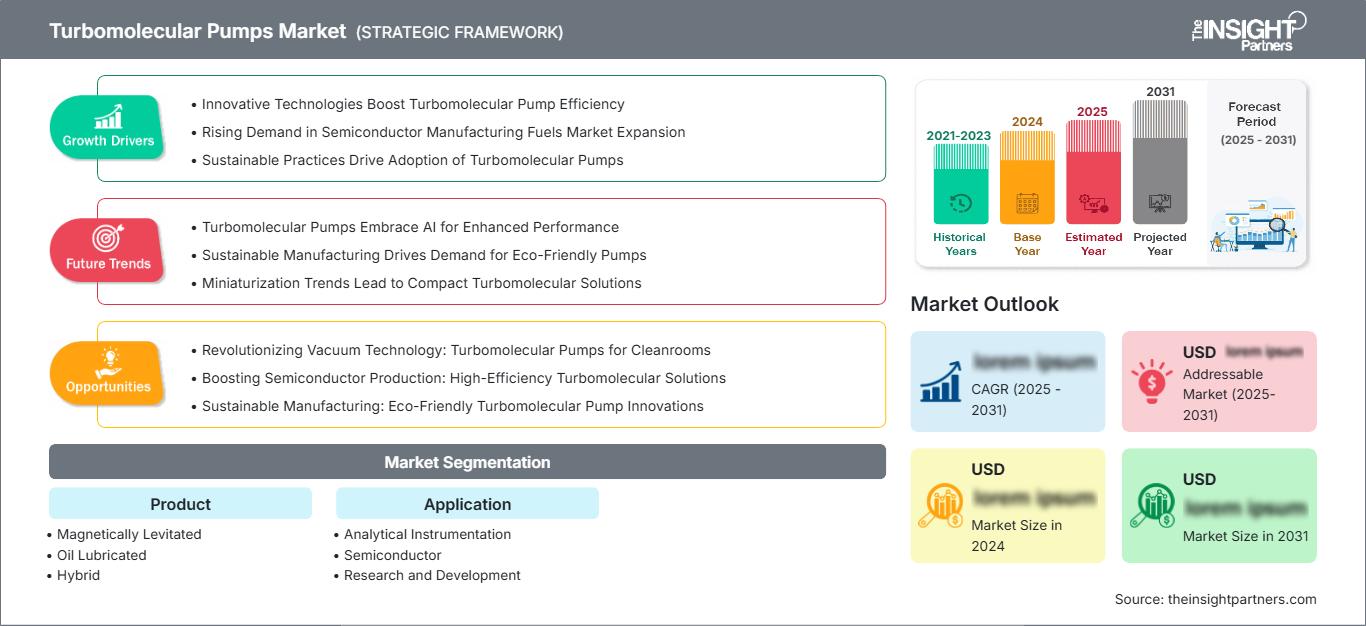
The Turbomolecular Pumps Market is valued at US$ 1.3 Billion in 2025 and is projected to reach US$ 1.74 Billion by 2034, registering a CAGR of 3.29% during 2026–2034. The market covers high-vacuum pumping technologies used to establish and maintain controlled vacuum environments across analytical instrumentation, semiconductor manufacturing, and research and development. Demand is shaped by requirements for low contamination, stable vacuum performance, high pumping speeds, equipment reliability, and integration with increasingly automated laboratory and industrial systems.
North America remains an important demand center, supported by advanced analytical instrumentation, semiconductor manufacturing programs, university research infrastructure, and high-value scientific equipment. The regional Turbomolecular Pumps Market Size is estimated to expand at a CAGR of ~3% through 2034. Continued investment in advanced laboratories and domestic semiconductor capacity, together with replacement demand for installed vacuum equipment, provides a relatively stable foundation for adoption.
Turbomolecular Pumps Market Assessment and Insights
Regional Outlook
- North America: ~27% of the global market in 2025 | ~3% CAGR through 2034. Market position: North America represents a major mature market, supported by analytical laboratories, semiconductor equipment, aerospace research, universities, and advanced manufacturing. Established vacuum infrastructure sustains replacement demand while new semiconductor capacity creates incremental requirements.
- US: ~78% of North American market revenue in 2025 | ~3% CAGR through 2034. Market position: The US accounts for most regional demand because of its concentration of analytical instrumentation manufacturers, research laboratories, semiconductor investments, national laboratories, and advanced vacuum-dependent manufacturing applications.
- Europe: ~23% of the global market in 2025 | ~2% CAGR through 2034. Market position: Europe is a mature vacuum-technology market with established research and industrial applications. Germany is the leading country in Europe, supported by scientific instrumentation, industrial manufacturing, semiconductor-related equipment, and established vacuum-technology suppliers.
- Asia Pacific: ~38% of the global market in 2025 | ~5% CAGR through 2034. Market position: Asia Pacific is the largest and fastest-growing regional market, driven by semiconductor manufacturing, electronics production, scientific instrumentation, and expanding domestic equipment ecosystems. China, Japan, and South Korea form the region's principal demand centers.
Segment Outlook
- Semiconductor: ~44% Share in 2025 | ~5% CAGR through 2034. Market position: Semiconductor applications lead demand because vacuum conditions are fundamental to deposition, etching, lithography support, wafer handling, and other fabrication processes. Expansion of advanced-node and memory capacity increases the requirement for reliable high-vacuum systems.
- Magnetically Levitated: ~55% Share in 2025 | ~4% CAGR through 2034. Market position: Magnetically levitated pumps lead product demand because oil-free operation, low contamination, reduced mechanical wear, and high reliability align closely with semiconductor, analytical, and research applications requiring clean high-vacuum environments.
Competitive Coverage
Agilent Technologies, Atlas Copco AB, Busch Vacuum Solutions, Ebara Corporation, KYKY Technology Co., Ltd., Pfeiffer Vacuum+Fab Solutions, Osaka Vacuum, Ltd., Shimadzu Corporation, ULVAC, Inc., Gardner Denver Holdings, Inc.
Methodology
The Insight Partners follows Data Collection & Secondary Research, Primary Research, Data Analysis, and Data Triangulation & Final Review to validate market estimates and insights.
Source: The Insight Partners' analysis based on proprietary research, government publications, company annual reports, investor presentations, industry databases, and expert interviews.
Turbomolecular Pumps Market has evolved significantly with increasing demands for precision in high-vacuum applications. Previous systems focused on the speed of the pumps and the ability to perform well in vacuum applications, while modern systems have developed features such as magnetic or hybrid bearings, low vibration operation, better thermal management, smaller size, and digital monitoring. There has also been a shift in production towards specific pump types depending on the application in which they will be used, including pumps for semiconductor processes, analytical equipment, laboratories, coating systems, and large vacuum chambers. Growing emphasis on contamination control has fueled demand for oil-free systems.
In terms of future growth, demand is projected to increase further in Asia Pacific through semiconductor production and advanced research facilities, while North America and Europe will continue to see demand from the replacement market and high-value instrumentation. Semiconductor equipment spending is one of the main drivers of demand downstream, with spending for global semiconductor manufacturing equipment at US$135.1 billion in 2025. Semiconductors manufacturing will continue to be highly localized in Asia with spending concentrated in Asia and fab localization, advanced packaging, memory investments, and research facilities expected to drive vacuum equipment demand.
Turbomolecular Pumps Market Report Scope
| Report Attribute | Details |
|---|---|
| Market size in 2025 | US$ 1.3 Billion |
| Market Size by 2034 | US$ 1.74 Billion |
| Global CAGR (2026 - 2034) | 3.29% |
| Historical Data | 2021-2024 |
| Forecast period | 2026-2034 |
Turbomolecular Pumps Market Analysis
The demand is supported by applications that cannot create a sufficient vacuum by mechanical pumping. Semiconductor production is one of the major sources of demand due to the requirement for a vacuum environment in many process stages and risk of contaminating the environment. There is also a demand from the analytical instrumentation field, especially for mass spectrometry, electron microscopy, surface analysis and other scientific systems. Particle physics, nuclear research, space simulation, materials science, lab experiments are among the demands created by research laboratories. The resulting ecosystem creates a need for pumps, controllers, accessories, maintenance, upgrades and replacements.
Competitiveness on the supply side is determined by pumping speed, compression ratio, bearing type, vibration characteristics, footprint, control system design, reliability and application specific engineering. Maglev vacuum pumps tend to be interesting in cases when contamination and maintenance issues matter, while hybrid and oil-lubed systems stay relevant in cases when buyers consider performance together with the cost of purchase and operation. Value chain consists of vacuum pump suppliers, vacuum systems integrators, original equipment manufacturers, semiconductor equipment manufacturers, analytical instruments providers, distributors, maintenance service providers and research laboratories. This makes it possible for suppliers to participate in equipment sales and lifecycle services.
As per the Turbomolecular Pumps Market Report, technology diversity and the capacity to serve various vacuum atmospheres are becoming more important competitive factors than pumping rate alone. Agilent Technologies has an extensive analytical and research-focused range, while Pfeiffer Vacuum+Fab Solutions and Busch Vacuum Solutions incorporate turbopumps into their wider vacuum solutions range. ULVAC, Ebara Corporation, Osaka Vacuum, and Shimadzu Corporation have extensive relevance in the Asian industrial and research markets. Atlas Copco and Gardner Denver have the advantage of a wider vacuum range, while KYKY Technology operates in China’s expanding vacuum equipment industry.
Investment tends to be focused on architectures that make for easy maintenance and built-in control features. Product introductions point to a trend towards smaller, easier to maintain systems with built-in control, digital capability, low vibration, and higher resistance to harsh process environments. Strategic positioning, then, rests on servicing not only equipment producers but also end-users, establishing regional service networks, and customizing pump systems for specialized applications in semiconductors, instrumentation, and research.
● REPORT CUSTOMIZATION
Tailor This Report To Align With Your Specific Business Requirements
This report can be customized to align precisely with your business objectives, scope, and target markets. Customization options include tailored segmentation, geography, competitive analysis, and strategic insights to support informed decision-making.
Customize This Report →WHAT YOU CAN ADJUST
- ● Segmentations
- ● Geography
- ● Competitive Analysis
- ● Language Preferences
Turbomolecular Pumps Market: Strategic Insights
Regional Insights
North America Turbomolecular Pumps Market
North America held ~27% of the global market in 2025 and is expected to witness a CAGR of ~3% over the period 2025–2034. North America has extensive installations of analytical instruments, university labs, national labs, semiconductor manufacturing assets, aerospace, and industrial equipment. The US is the main driver of the market, while Canada makes its contribution via the research, lab, and special industrial applications segments.
This regional market is driven much more by technology content and replacements than by volume growth. Increasing emphasis on vibration-free operation, contamination-free operation, equipment uptime, monitoring, and lower maintenance is being observed among customers. Growth from semiconductor investments is another area where the market can grow in terms of domestic manufacturing capacity. The existence of local suppliers like Agilent Technologies and Gardner Denver Holdings, as well as global vacuum experts, creates a competitive landscape where performance and life-cycle service are key. Applications in the research and development segment are highly significant since the high-vacuum pumps are critical to the analytical/scientific instrumentation systems where they are being used.
U.S. Turbomolecular Pumps Market
In 2025, the US accounted for approximately 78% of North American Turbomolecular Pumps Market Share and is projected to have a CAGR of ~3% up to 2034. The US possesses a large scientific research sector alongside semiconductor, aerospace, defense, pharmaceutical, materials and analytical instrumentation sectors which need vacuum control applications.
Semiconductor production becomes one of the increasingly pertinent applications due to the rise of investments into fabrication and advanced packaging. Analytical instrumentation is still structurally significant, especially mass spectrometry, microscopy, laboratory research and surface analysis instruments. Agilent Technologies enjoys considerable representation in the segment of analytical and research vacuum equipment while other vendors compete internationally via local sales, service and technical support. Therefore, the US market is impacted by not only equipment installations but replacements of legacy pumps as well.
Europe Turbomolecular Pumps Market
Europe accounted for ~23% of the global market in 2025 and is expected to register a CAGR of ~2% through 2034. Germany is the leading country in Europe, supported by industrial vacuum applications, scientific research, analytical instrumentation, engineering capabilities, and a strong supplier ecosystem. The UK remains relevant through universities, national research facilities, aerospace activities, and scientific instrumentation. France contributes through research, aerospace, industrial technology, and advanced laboratory applications.
Germany benefits from being home to many industrial machinery suppliers and vacuum expertise. Demand in France and the UK comes from research-oriented applications, whereas Italy and Spain benefit due to industrial processes, laboratories, scientific equipment, and specialized manufacturing. Replacement and upgrade become significant factors in Europe owing to its mature installed base. Energy savings, lower levels of contamination, less maintenance, and compactness of the equipment have started to be regarded together with the ability to pump. Suppliers should therefore be able to provide their customers with technical support.
APAC Turbomolecular Pumps Market
APAC represented ~38% of the global market in 2025 and is projected to expand at a CAGR of ~5% through 2034. China is the leading country in Asia Pacific, supported by its extensive semiconductor and electronics manufacturing ecosystem, while Japan and South Korea provide substantial demand through semiconductor, scientific, and industrial applications. India is expanding its semiconductor and research infrastructure, and Australia contributes through scientific and specialized industrial applications.
The region's growth is closely linked to fab construction, equipment localization, advanced memory, logic manufacturing, and research investment. Semiconductor equipment spending in China, Japan, and South Korea provides an important downstream indicator of vacuum-equipment demand. Local manufacturing capabilities are also becoming more important as customers seek shorter supply chains and technical support. These factors make Asia Pacific a central expansion area for pump manufacturers, especially for magnetically levitated and high-throughput systems.
Middle East & Africa Turbomolecular Pumps Market
Middle East & Africa is expected to register a CAGR of ~3% through 2034. Saudi Arabia and the UAE represent important regional demand centers because of investments in industrial diversification, advanced laboratories, energy-related technology, and research infrastructure. South Africa contributes through mining technology, scientific research, universities, and specialized industrial applications.
Demand remains smaller than in the major industrial regions but can increase through laboratory modernization, research facilities, advanced manufacturing, coating systems, and energy-sector projects. The region's vacuum-equipment opportunity is consequently more project-driven and application-specific. Suppliers with local distributors, technical service capabilities, and system-integration expertise can address customers that require complete vacuum solutions rather than individual pumps. Infrastructure development and industrial diversification provide the principal mechanisms supporting gradual expansion.
Segmentation Analysis
Product
Product segmentation in the Turbomolecular Pumps Market includes Magnetically Levitated, Oil Lubricated, and Hybrid turbomolecular pumps. The product segment is projected to grow at a CAGR of ~4% during 2026–2034. Technology selection depends on required vacuum quality, contamination tolerance, pumping speed, maintenance expectations, installation conditions, and total cost of ownership. Semiconductor and sensitive analytical applications increasingly favor architectures that minimize contamination and mechanical wear.
- Magnetically Levitated: These pumps are positioned strongly in clean and high-value applications because magnetic bearing systems minimize mechanical contact and eliminate lubricant-related contamination at the high-vacuum stage. Their combination of reliability, low vibration, and maintenance advantages supports adoption in semiconductor and research systems.
- Oil Lubricated: Oil-lubricated configurations remain relevant where acquisition economics, established equipment compatibility, and application requirements make conventional bearing arrangements practical. Demand is sustained by installed equipment, replacement cycles, and applications with less stringent contamination requirements.
- Hybrid: Hybrid pumps combine magnetic and mechanical bearing technologies to balance reliability, performance, and cost. They are strategically relevant where users require robust operation and high pumping performance but do not need the full architecture of a completely magnetically levitated system.
Application
Application segmentation in the Turbomolecular Pumps Market includes Analytical Instrumentation, Semiconductor, and Research and Development. The application segment is expected to expand at a CAGR of ~4% through 2034. Semiconductor manufacturing provides the largest demand pool, while analytical instrumentation and research applications support recurring requirements for compact, stable, low-contamination vacuum systems.
- Analytical Instrumentation: Mass spectrometry, electron microscopy, surface analysis, and related instruments require stable vacuum conditions and low vibration. Demand is closely linked to laboratory expansion, instrument replacement, scientific research, pharmaceutical analysis, and industrial quality-control applications.
- Semiconductor: Semiconductor applications require highly controlled vacuum conditions across multiple fabrication processes. Capacity additions, technology-node migration, advanced memory, advanced packaging, and equipment modernization make this application strategically important for high-throughput and contamination-sensitive turbopumps.
- Research and Development: R&D demand spans universities, national laboratories, particle physics, nuclear research, materials science, aerospace simulation, and experimental systems. Requirements vary substantially by application, encouraging suppliers to provide specialized pump sizes, controls, bearing architectures, and service arrangements.
Opportunity Snapshot
| Application | Revenue Contribution | Trend Tag | Adoption Stage |
|---|---|---|---|
| Analytical Instrumentation | Medium | Instrument Precision | Mature |
| Semiconductor | High | Fab Expansion | Scaling |
| Research and Development | Medium | Advanced Research | Mature |
Turbomolecular Pumps Market Growth Drivers and Impact Analysis
Expansion of Advanced Semiconductor Manufacturing
Semiconductor fabrication is one of the strongest structural demand drivers because many process environments depend on precisely controlled vacuum conditions. Increasing investment in advanced logic, memory, and high-bandwidth memory production expands the installed base of process equipment requiring vacuum systems. Semiconductor equipment billings reached US$135.1 billion globally in 2025, demonstrating the scale of downstream capital deployment. For turbopump suppliers, the effect extends beyond initial equipment shipments because fabs require replacement pumps, service, refurbishment, spare parts, and technology upgrades throughout equipment lifecycles. Advanced nodes also increase sensitivity to contamination and process instability, strengthening the value proposition of oil-free and low-vibration technologies. The result is a demand environment where pump suppliers increasingly compete on uptime, process compatibility, digital monitoring, and lifecycle economics rather than pumping speed alone.
Increasing Requirements for Clean High-Vacuum Environments
Analytical instrumentation and scientific research increasingly require stable, contamination-controlled vacuum conditions. Mass spectrometry, electron microscopy, surface analysis, particle research, and materials characterization all depend on vacuum performance that can be disrupted by vibration, hydrocarbon contamination, or unstable operating conditions. This favors magnetically levitated and hybrid technologies in applications where maintenance interruptions have a high operational cost. Instrument manufacturers are also integrating vacuum components into increasingly compact platforms, creating demand for smaller pumps with optimized thermal management, low acoustic output, and flexible installation. The market impact extends across both original equipment and replacement channels. As laboratories modernize installed equipment, suppliers with compact product families and application-specific configurations can address upgrades without requiring complete system redesigns.
Lifecycle Efficiency and Digital Pump Management
Customers increasingly evaluate vacuum equipment according to lifecycle cost rather than initial purchase price. Maintenance intervals, energy consumption, downtime, diagnostics, controller integration, and service availability influence purchasing decisions because a pump failure can interrupt an analytical instrument, production tool, or research experiment. Manufacturers are therefore incorporating integrated controllers, connectivity, condition monitoring, and simplified service procedures into newer pump architectures. Digital interfaces can support remote diagnostics and more predictable maintenance, while maintenance-free or reduced-maintenance bearing systems can lower service requirements. These changes create a secondary growth mechanism beyond unit demand because users can justify replacement of older pumps based on operating efficiency, reliability, and connectivity improvements. Suppliers that combine equipment with service and upgrade programs can consequently capture value throughout the installed base.
Turbomolecular Pumps Market Future Trends
Greater Integration of Smart Vacuum Controls
The next phase of product development is likely to place greater emphasis on connected pump-control architectures. Turbomolecular pumps are increasingly being designed with integrated controllers, wireless interfaces, automated operating functions, and digital monitoring capabilities. This can enable users to adjust operating parameters, monitor pump status, and identify abnormal conditions without relying entirely on manual inspection. In semiconductor facilities and research environments, such functionality can support centralized equipment management and predictive maintenance workflows. For analytical instrumentation manufacturers, compact integrated control can simplify system architecture and reduce external components. The commercial implication is a gradual shift from pumps being treated as standalone mechanical components toward being managed as digitally observable subsystems. This trend may also increase differentiation between newer connected products and legacy installed equipment.
Acceleration of High-Throughput and Contamination-Controlled Designs
Future demand is expected to encourage greater specialization around high gas throughput, demanding process environments, and contamination-sensitive applications. Semiconductor equipment is moving toward more complex process architectures, while large coating, space-simulation, research, and industrial systems require pumps capable of handling substantial gas loads without compromising vacuum stability. At the same time, contamination control remains essential for semiconductor and analytical applications. Manufacturers are responding through improved rotor designs, magnetic and hybrid bearing systems, thermal management, compact configurations, and higher foreline tolerance. These developments should broaden the addressable applications for advanced turbopumps. Rather than relying on a single universal pump design, suppliers are likely to maintain modular product families tailored to chamber size, process load, vacuum level, environmental conditions, and maintenance strategy.
Turbomolecular Pumps Market Opportunities
Localized Supply and Service Networks in Asia Pacific
Asia Pacific presents an important opportunity for suppliers seeking to align with the region's expanding semiconductor and scientific-equipment ecosystem. China, Japan, and South Korea already represent major semiconductor manufacturing centers, while India is developing additional semiconductor and research capabilities. Customers increasingly value rapid service, spare-parts availability, application engineering, and local technical support because vacuum-pump downtime can affect expensive process equipment. Suppliers can therefore expand through regional service centers, local inventory, application laboratories, training programs, and partnerships with equipment integrators. Localization does not necessarily require full manufacturing in every country. A graduated model combining local service and refurbishment with regional assembly or component sourcing can improve responsiveness while controlling investment requirements. Such strategies can strengthen customer retention and create recurring lifecycle revenue.
Upgrade Programs for Aging Vacuum Equipment
The installed base of turbomolecular pumps creates an opportunity for structured replacement and upgrade programs. Laboratories, analytical-instrument users, semiconductor facilities, and research institutions may operate pumps that remain mechanically functional but lack current controller capabilities, connectivity, energy efficiency, or modern service support. Suppliers can address this installed base through trade-in programs, compatible replacement models, controller upgrades, refurbishment, and application engineering. The opportunity is particularly relevant where customers want to improve performance without replacing an entire vacuum system. Upgrade pathways can also reduce procurement complexity because users retain existing chamber interfaces and system configurations. Vendors with broad legacy compatibility and strong field-service networks are positioned to convert replacement cycles into planned technology transitions while reducing disruption for end users.
Recent Developments
- January 2026: Pfeiffer Vacuum+Fab Solutions launched the ATH 4506 M turbomolecular pump, expanding its ATH-M range with a 4,500 l/s nitrogen pumping-speed model designed for semiconductor manufacturing, large-area coating, and large vacuum chambers. The model incorporates an integrated controller and reaches full rotational speed in nine minutes, targeting high-throughput applications requiring simplified installation and rapid process startup.
- December 2025: Ebara Corporation announced new dry vacuum pump and plasma-abatement products for sequential release from 2026. The EV-H dry vacuum pump was developed for semiconductor manufacturing processes such as ALD and CVD, with increased high-flow gas-handling capability and improved resistance to process by-products. The development reflects increasing requirements for stable vacuum performance as semiconductor structures become smaller and more three-dimensional.
- June 2025: Agilent Technologies expanded the documented capabilities of its TwisTorr turbo-pump portfolio, including the TwisTorr 305 FS, 305-IC, and related configurations. The products incorporate features such as low vibration, compact footprints, wireless connectivity, integrated controllers, and application suitability for research and analytical instrumentation, reflecting the industry's movement toward connected and application-specific vacuum equipment.
Frequently Asked Questions

- Comprehensive Market Sizing and Forecast Analysis
- Detailed Segmentation Analysis
- In-Depth Market Dynamics Assessment
- Regional and Country-Level Insights
- Competitive Landscape and Company Benchmarking
- Strategic Business Intelligence
Recent Reports
Testimonials

The Insight Partners provided valuable market intelligence that supported our global go-to-market strategy. Their team was professional, responsive, and attentive to our feedback, providing thoughtful analysis and helpful methodological clarifications throughout the project.
Junmo Kim Chief Financial Officer (CFO), Enertech Co., Ltd.
The Insight Partners' SCADA System Market report is comprehensive, with valuable insights on current trends and future forecasts. The team was highly professional, responsive, and supportive throughout. We are very satisfied and highly recommend their services.
RAN KEDEM Partner, Reali Technologies LTDs
I requested a report on a very specific software market and the team produced the report in a few days. The information was very relevant and well presented. I then requested some changes and additions to the report. The team was again very responsive and I got the final report in less than a week.
JEAN-HERVE JENN Chairman, Future Analytica
We worked with The Insight Partners for an important market study and forecast. They gave us clear insights into opportunities and risks, which helped shape our plans. Their research was easy to use and based on solid data. It helped us make smart, confident decisions. We highly recommend them.
PIYUSH NAGPAL Sr. Vice President, High Beam Global
The Insight Partners delivered insightful, well-structured market research with strong domain expertise. Their team was professional and responsive throughout. The user-friendly website made accessing industry reports seamless. We highly recommend them for reliable, high-quality research services
YUKIHIKO ADACHI CEO, Deep Blue, LLC.
This is the first time I have purchased a market report from The Insight Partners.While I was unsure at first, I visited their web site and felt more comfortable to take the risk and purchase a market report.I am completely satisfied with the quality of the report and customer service. I had several questions and comments with the initial report, but after a couple of dialogs over email with their analyst I believe I have a report that I can use as input to our strategic planning process.Thank you so much for taking the extra time and making this a positive experience.I will definitely recommend your service to others and you will be my first call when we need further market data.
JOHN SUZUKI President and Chief Executive Officer, Board Director, BK Technologies
I wish to appreciate your support and the professionalism you displayed in the course of attending to my request for information regarding to infectious disease IVD market in Nigeria. I appreciate your patience, your guidance, and the fact that you were willing to offer a discount, which eventually made it possible for us to close a deal. I look forward to engaging The Insight Partners in the future, all thanks to the impression you have created in me as a result of this first encounter.
DR CHIJIOKE ONYIA MANAGING DIRECTOR, PineCrest Healthcare Ltd.Reason to Buy
- Informed Decision-Making
- Understanding Market Dynamics
- Competitive Analysis
- Identifying Emerging Markets
- Customer Insights
- Market Forecasts
- Risk Mitigation
- Boosting Operational Efficiency
- Strategic Planning
- Investment Justification
- Tracking Industry Innovations
- Aligning with Regulatory Trends





 Get Free Sample for