
Ultra-thin Grain-Oriented Electrical Steel (GOES) Market Forecast Report - 2034
Coverage: By Thickness (≤ 0.20 mm, ≤ 0.15 mm, and ≤ 0.10 mm), End Use (High-frequency Transformers, Compact Power Transformers, Aerospace Transformers, Medical Equipment Transformers, Renewable Energy Transformers, Precision Electrical Equipment, and Others), and Geography (North America, Europe, Asia Pacific, and Rest of World)
- Status : Published
- Report Code : TIPRE00044084
- Category : Chemicals and Materials
- No. of Pages : 215
- Available Report Formats :


- Last update date : November 05, 2026


2025 Market Size
US$ 298.2 Mn
Base year value
2034 Forecast
US$ 615.56 Mn
Projected by 2034
CAGR 2026-2034
7.5 %
Growth rate
Addressable Market
US$ 3,920.46 Mn
(2026-2034)
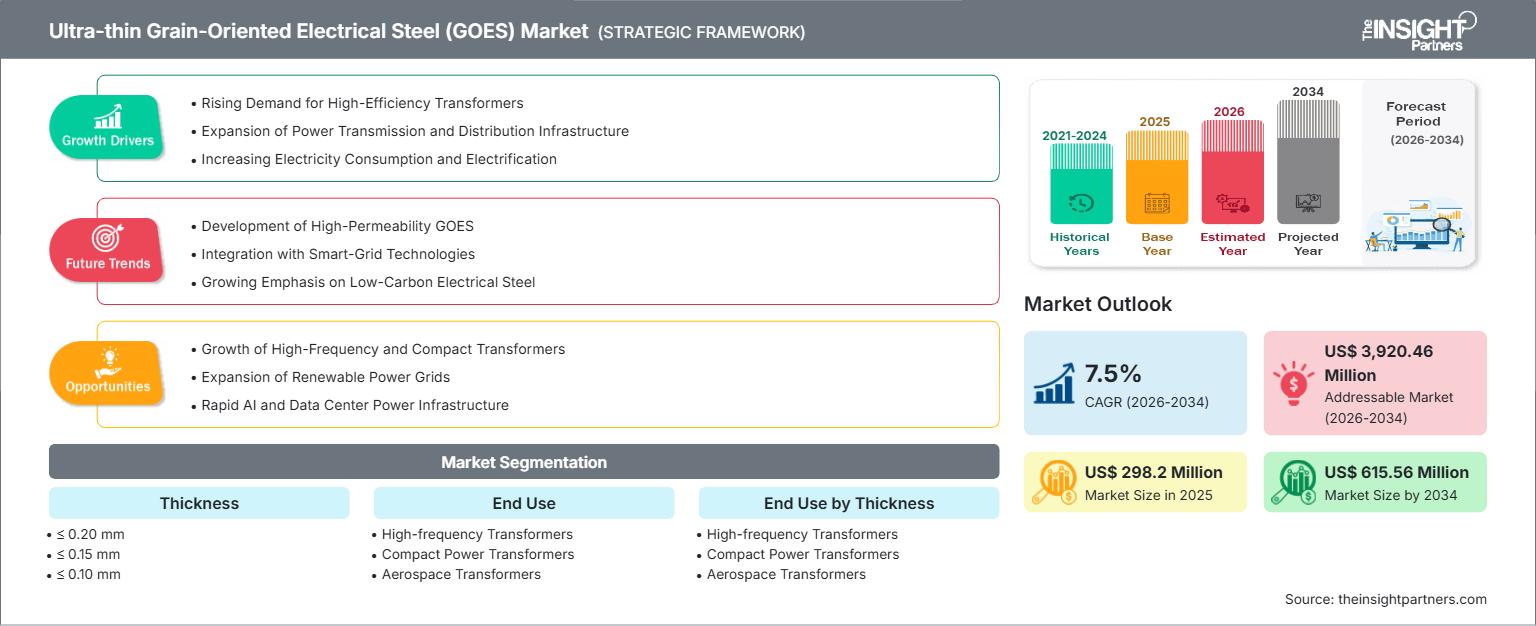
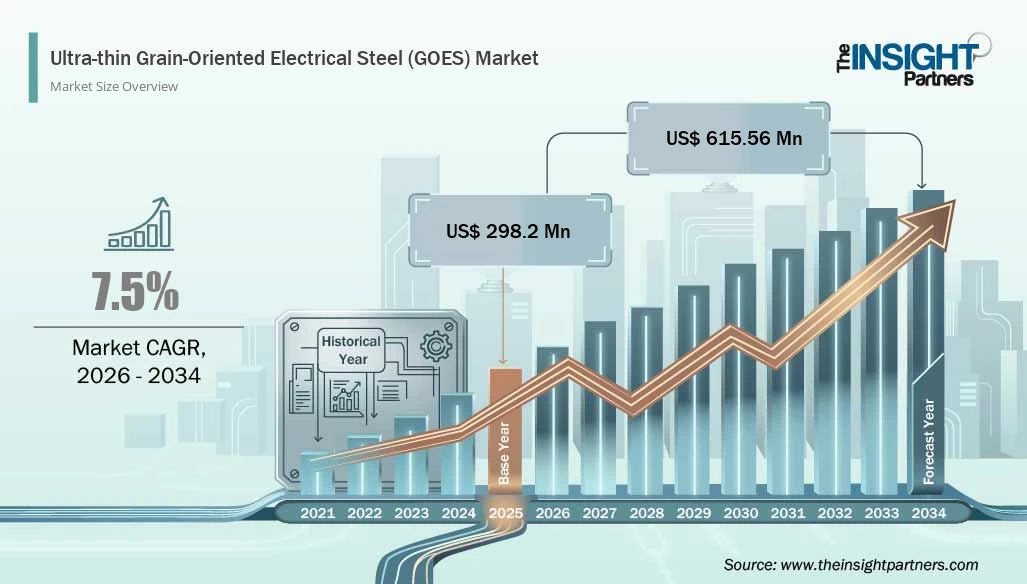
The Ultra-thin Grain-Oriented Electrical Steel (GOES) Market is valued at US$ 298.20 million in 2025 and is projected to reach US$ 615.56 million by 2034, reflecting a CAGR of 7.5% during 2026–2034. The market covers grain-oriented electrical steel products with thicknesses of ≤ 0.20 mm, ≤ 0.15 mm, and ≤ 0.10 mm, supplied for transformer and precision electrical applications where lower core loss, compact equipment design, and higher energy efficiency are important performance requirements.
Demand across the North American market is supported by transformer replacement, grid modernization, localized electrical-equipment manufacturing, and increasingly stringent efficiency requirements. The regional Ultra-thin Grain-Oriented Electrical Steel (GOES) Market Size is estimated to expand at a CAGR of ~7% through 2034. Growth is particularly linked to demand for lower-loss transformer cores, domestic electrical-steel supply, and investment in transformer manufacturing capacity.
Ultra-thin Grain-Oriented Electrical Steel (GOES) Market Assessment and Insights
Regional Outlook
- North America: ~27% of the global market in 2025 | ~7% CAGR through 2034. Market position: North America represents a substantial demand center because of transformer manufacturing, grid reinforcement, and domestic sourcing initiatives support consumption of high-performance electrical steel. The US accounts for most regional demand.
- US: ~90% of North American market revenue in 2025 | ~7% CAGR through 2034. Market position: The US has the largest demand base within North America, supported by transformer manufacturing, utility investment, and requirements for efficient grid equipment. Cleveland-Cliffs provides an integrated domestic GOES supply position.
- Europe: ~25% of the global market in 2025 | ~7% CAGR through 2034. Market position: Europe remains a technologically mature market, with Germany as the leading country in Europe and established electrical-steel and transformer manufacturing capabilities. Energy-efficiency requirements and grid investment support replacement demand.
- Asia Pacific: ~43% of the global market in 2025 | ~10% CAGR through 2034. Market position: Asia Pacific is the fastest-growing region, supported by transformer manufacturing, electricity-network expansion, industrial electrification, and large domestic electrical-steel production bases. China, Japan, and South Korea anchor the regional supply ecosystem.
Segment Outlook
- High-frequency Transformers: ~32% Share in 2025 | ~11% CAGR through 2034. Market position: High-frequency transformers lead because ultra-thin laminations reduce eddy-current losses and support compact magnetic components. Increasing requirements for high-frequency power conversion, renewable-energy electronics, UPS systems, and specialized power supplies reinforce demand.
- Renewable Energy Transformers: ~17% Share in 2025 | ~12% CAGR through 2034. Market position: Renewable Energy Transformers represent the high-growth main segment as solar, wind, storage, and grid-interconnection projects require efficient transformers and reactors. Ultra-thin GOES can support lower losses and compact designs in increasingly power-dense equipment.
Competitive Coverage
Cleveland-Cliffs Inc., Nippon Steel Corporation, Nippon Kinzoku Co., Ltd., China Baowu Steel Group Corporation Limited, Shougang Zhixin Qian'an Electromagnetic Material Co., Ltd., POSCO Holdings Inc., thyssenkrupp AG, Arnold Magnetic Technologies Corporation, HBIS Group Co., Ltd., JFE Steel Corporation
Methodology
The Insight Partners follows Data Collection & Secondary Research, Primary Research, Data Analysis, and Data Triangulation & Final Review to validate market estimates and insights.
Source: The Insight Partners' analysis based on proprietary research, government publications, company annual reports, investor presentations, industry databases, and expert interviews.
Market for Ultra-thin Grain Oriented Electrical Steel (GOES) is the result of advancements in the fields of grain orientation, insulation properties, magnetic domain manipulation, rolling process, and annealing technology. With thinning, engineers can tackle eddy current losses and still retain their magnetic properties. Product differentiation has been attained through low core losses, high permeability, enhanced lamination characteristics, and controlled surface properties. With the creation of ultra-thin GOES products, application areas have moved from standard transformer cores to include high-frequency transformers and reactors, pulse power devices, and precision electrical systems.
Looking forward, the Ultra-thin Grain-oriented Electrical Steel (GOES) Market would gain impetus from transformer replacement initiatives, interconnections with renewable energy sources, distributed generation, and localized manufacturing of electrical equipment. The Asia-Pacific region is expected to witness capacity and application growth, whereas North America and Europe are driven by the need for reliable grids. There is growing focus on investment in the manufacture of high-quality electrical steel through annealing and coating processes and modernization of production lines.
Ultra-thin Grain-Oriented Electrical Steel (GOES) Market Report Scope
| Report Attribute | Details |
|---|---|
| Market size in 2025 | US$ 298.2 Million |
| Market Size by 2034 | US$ 615.56 Million |
| Global CAGR (2026 - 2034) | 7.5% |
| Historical Data | 2021-2024 |
| Forecast period | 2026-2034 |
Ultra-thin Grain-Oriented Electrical Steel (GOES) Market Analysis
The Demand of the Ultra-thin GOES market is highly centered on equipment where core loss, temperature, size, and energy efficiency play important roles in determining the system’s economic feasibility. Transformers are bought by transformers and core makers who convert electrical steel strips into wounds and stacked cores. Special equipment makers use ultra-thin GOES to manufacture high-frequency magnetic parts.
Economics of supply are based on special steel making, cold rolling, texture control, high temperature annealing, coating, domain refinement, and dimensional control. Very thin materials involve even more stringent processes than those used for regular electrical steels, hence yield, surface quality, and magnetic uniformity become cost factors. Existing producers of electrical steel have an advantage in the form of their technological expertise, whereas new entrants have to be qualified by transformer users.
The Ultra-thin Grain-oriented Electrical Steel (GOES) market report is technologically concentrated. Nippon Steel Corporation and thyssenkrupp AG hold their respective positions of high-quality steel products while Cleveland-Cliffs Inc. holds its North American domestic supply position. China Baowu Steel Group Corporation Limited, Shougang Zhixin Qian’an Electromagnetic Material Co., Ltd., POSCO Holdings Inc., HBIS Group Co., Ltd., and JFE Steel Corporation are among those companies involved in the broader electrical steel market.
Positioning within the market now hinges not just on the price of the metal but on thickness, magnetic properties, coating capabilities, technical service, and qualification by the transformer makers. Capital expenditures will then be allocated towards dedicated electrical steel production lines, state-of-the-art annealing, rolling, control, and energy-efficient processes. Manufacturers have further enhanced their ability to develop applications in high-frequency and renewable energy equipment.
● REPORT CUSTOMIZATION
Tailor This Report To Align With Your Specific Business Requirements
This report can be customized to align precisely with your business objectives, scope, and target markets. Customization options include tailored segmentation, geography, competitive analysis, and strategic insights to support informed decision-making.
Customize This Report →WHAT YOU CAN ADJUST
- ● Segmentations
- ● Geography
- ● Competitive Analysis
- ● Language Preferences
Ultra-thin Grain-Oriented Electrical Steel (GOES) Market: Strategic Insights
Regional Insights
North America Ultra-thin Grain-Oriented Electrical Steel (GOES) Market
North America made up around 27% of the total Global Ultra-thin Grain-Oriented Electrical Steel (GOES) Market Share in 2025 and is projected to grow at a CAGR of around 7% until 2034. The region stands to gain from aging fleets of transformers, investments in strengthening the transmission networks, connecting renewable energy, and securing the supply chain of electrical equipment domestically. In addition, efficiency standards of transformers are driving this market directly, as high performance of electrical steel is needed to reduce losses.
In terms of the regional supply side, it is highly integrated within the domestic market of North America in terms of production of electrical steel and transformer manufacturing. Cleveland-Cliffs Inc. manufactures GOES in the United States and integrates electrical-steel production with transformer manufacturing investment. Such an integrated supply chain ensures that there is reduced reliance on core materials produced abroad for selected applications and qualification of the domestic grade. Demand will continue to be driven by distribution and power transformers with high frequency and special equipment adding to the market demand.
U.S. Ultra-thin Grain-Oriented Electrical Steel (GOES) Market
The US represented ~90% of North American Ultra-thin Grain-Oriented Electrical Steel (GOES) Market Share in 2025 and is projected to record a CAGR of ~7% through 2034. The country has a substantial installed transformer base and significant requirements for grid reinforcement. Utility investment, transformer replacement, domestic manufacturing initiatives, and energy-efficiency requirements create a structural demand base for low-loss electrical steel.
The importance of Cleveland-Cliffs Inc. as a domestic player is that the Butler Works of this company manufactures GOES with high silicon content and the transformer project at Weirton generates more demand for GOES from domestic sources. This is an example of vertical integration in the production of steel and transformers. High frequency transformers, compact power transformers, and precision electrical equipment offer other applications for GOES.
Europe Ultra-thin Grain-Oriented Electrical Steel (GOES) Market
Europe represented ~25% of the Ultra-thin Grain-Oriented Electrical Steel (GOES) Market in 2025 and is forecast to grow at a CAGR of ~7% through 2034. Germany is the leading country in Europe, supported by a mature electrical-steel industry, transformer manufacturing, industrial engineering capabilities, and strong emphasis on energy efficiency. France also has an established electrical-equipment ecosystem, while the UK benefits from grid investment and renewable-energy integration. Italy and Spain provide additional demand through industrial electrification, power infrastructure, and renewable-energy projects.
The stance of Germany is fortified by the existence of thyssenkrupp AG, which produces electrical steel that includes grain-oriented products. Grain-oriented products help in reducing the eddy current losses, hence becoming an important factor in the performance of materials used in the transformers. The producers in Europe have competition from the imported electrical steel, thus making manufacturing efficiencies, product differentiation, carbon performance, and client qualification important. In December 2025, thyssenkrupp Electrical Steel made cuts in its production levels in Germany and France due to high imports pressures.
APAC Ultra-thin Grain-Oriented Electrical Steel (GOES) Market
The APAC region held a ~43% share of the Ultra-thin Grain-Oriented Electrical Steel (GOES) Market in 2025 and will witness a CAGR of ~10% till 2034 and is projected to grow at the fastest rate among all regions. The leading countries in APAC region include China, which benefits from having transformer production capacity, power grid infrastructure and electricity production within the country. Japan and South Korea are still the leading technological suppliers, whereas India and Australia are the grid developers and producers of renewable energy.
The Chinese electrical steel market is working on developing thin gauge production capabilities, while Japan's Nippon Steel Corporation and Nippon Kinzoku Co., Ltd are suppliers of the high-performance and ultra-thin varieties of grain oriented electrical steel. South Korea's POSCO Holdings Inc. produces the grain oriented electrical steel for use in transformers.
Segmentation Analysis
Thickness
Thickness determines magnetic-loss performance, manufacturing complexity, and suitability for different transformer and high-frequency applications. As the gauge becomes thinner, eddy-current losses can be reduced, but processing precision, handling requirements, and cost sensitivity increase. The segmentation therefore captures the balance between magnetic efficiency, equipment compactness, manufacturing yield, and application economics.
- ≤ 0.20 mm: This thickness category provides a practical balance between lower core loss and manufacturing economics. It is relevant to advanced transformer designs and compact electrical equipment where improved efficiency is required without moving entirely toward the most specialized ultra-thin grades.
- ≤ 0.15 mm: Material at this thickness supports further reduction in eddy-current losses and enables more compact magnetic designs. It is strategically important for applications where transformer efficiency, thermal management, and power density justify tighter material specifications.
- ≤ 0.10 mm: The thinnest category is particularly suited to high-frequency magnetic applications. Its strategic value comes from minimizing eddy-current losses at elevated frequencies, although processing precision and material cost place greater emphasis on application-specific value.
End Use
End Use represents the primary application segmentation of the market. High-frequency Transformers account for ~32% of the market in 2025 and are expected to record a CAGR of ~11% through 2034. Their position reflects the direct relationship between thin-gauge electrical steel, frequency-related losses, compact magnetic components, and power-density requirements.
- High-frequency Transformers: These transformers require magnetic materials capable of limiting losses under rapidly changing magnetic fields. Ultra-thin GOES is relevant to compact power conversion, UPS equipment, renewable-energy electronics, and specialized power supplies where efficiency and size are critical.
- Compact Power Transformers: Compact transformers use advanced core designs to reduce equipment footprint while maintaining electrical performance. Ultra-thin steel can support lower losses and greater power density, making this application relevant to constrained installations and modern distribution architectures.
- Aerospace Transformers: Aerospace equipment places strong emphasis on weight, reliability, thermal management, and power density. Thin magnetic materials can support lighter and smaller transformer designs, although qualification requirements and performance consistency remain important barriers to adoption.
- Medical Equipment Transformers: Medical electrical systems require reliable and stable power conversion with controlled electromagnetic performance. Ultra-thin GOES can support compact transformer architectures in equipment where space, efficiency, and thermal characteristics influence system design.
- Renewable Energy Transformers: Renewable Energy Transformers represent the high-growth main segment, with a modeled CAGR of ~12% through 2034. Expansion of solar, wind, storage, and grid-interconnection infrastructure increase demand for efficient transformers and magnetic components.
- Precision Electrical Equipment: Precision electrical equipment benefits from consistent magnetic characteristics, dimensional control, and low-loss performance. The segment includes specialized systems where stable electrical behavior and compact component design justify the use of advanced electrical-steel grades.
End Use By Thickness
End Use By Thickness connects application requirements with ≤ 0.20 mm, ≤ 0.15 mm, and ≤ 0.10 mm material choices. The framework helps identify where deeper thinning creates measurable performance benefits and where conventional thin-gauge material provides sufficient efficiency at a lower processing burden.
- High-frequency Transformers (≤ 0.20 mm, ≤ 0.15 mm, ≤ 0.10 mm): The thickness combinations provide designers with different balances of loss reduction, magnetic performance, manufacturing complexity, and cost for high-frequency conversion systems.
- Compact Power Transformers (≤ 0.20 mm, ≤ 0.15 mm, ≤ 0.10 mm): Thickness selection depends on transformer efficiency targets, available installation space, core configuration, and the economic value of reducing losses over the equipment operating life.
- Aerospace Transformers (≤ 0.20 mm, ≤ 0.15 mm, ≤ 0.10 mm): Aerospace applications can justify thinner gauges when weight and power density benefits outweigh qualification and material costs, particularly in advanced electrical architectures.
- Medical Equipment Transformers (≤ 0.20 mm, ≤ 0.15 mm, ≤ 0.10 mm): Thickness selection is influenced by compactness, thermal performance, electrical stability, and equipment-specific reliability requirements rather than material cost alone.
- Renewable Energy Transformers (≤ 0.20 mm, ≤ 0.15 mm, ≤ 0.10 mm): Renewable-energy applications increasingly require efficient magnetic components capable of supporting higher power density and continuous operation across changing generation conditions.
- Precision Electrical Equipment (≤ 0.20 mm, ≤ 0.15 mm, ≤ 0.10 mm): Precision equipment uses thickness combinations according to magnetic-loss targets, frequency characteristics, component dimensions, and the required degree of control over electromagnetic behavior.
Opportunity Snapshot
| End Use | Revenue Contribution | Trend Tag | Adoption Stage |
| High-frequency Transformers | High | High-Frequency Power | Scaling |
| Compact Power Transformers | High | Compact Grid | Mature |
| Aerospace Transformers | Low | Weight Reduction | Emerging |
| Medical Equipment Transformers | Low | Compact Power | Emerging |
| Renewable Energy Transformers | High | Grid Integration | Scaling |
| Precision Electrical Equipment | Medium | Precision Power | Scaling |
| Others | Low | Specialized Systems | Emerging |
Ultra-thin Grain-Oriented Electrical Steel (GOES) Market Growth Drivers and Impact Analysis
Transformer Efficiency Requirements Are Raising Demand for Lower-Loss Core Materials
Transformer efficiency requirements are a central structural driver for the Ultra-thin Grain-Oriented Electrical Steel (GOES) Market because electrical-steel selection directly affects core losses. Thinner laminations reduce eddy-current losses, while improved grain orientation and surface insulation help maintain magnetic efficiency. Regulatory and utility attention to transformer energy consumption increases the economic value of materials that reduce lifetime losses rather than only minimizing initial equipment cost. In the US, updated distribution-transformer efficiency standards were explicitly linked to additional demand for grain-oriented electrical steel. Similar efficiency objectives in other markets support investment in advanced transformer cores. The resulting effect is a gradual shift from conventional grades toward thinner, higher-performance material where the lifetime energy-saving benefit can justify higher material and processing costs.
Grid Modernization Is Expanding the Addressable Transformer Material Base
Grid modernization is expanding the installed base of transformers required for transmission, distribution, renewable-energy interconnection, industrial electrification, and power-quality management. Each additional transformer creates potential demand for grain-oriented electrical steel, while replacement programs create recurring material consumption independent of new electricity generation. Ultra-thin grades become particularly relevant where equipment designers seek lower losses, reduced core dimensions, and improved thermal performance. The impact extends across the value chain because stronger transformer demand encourages core manufacturers to qualify additional steel grades and steelmakers to invest in capacity, processing, and technical support. Domestic sourcing initiatives can further influence procurement by favoring regional electrical-steel supply. This creates a reinforcing cycle between transformer capacity expansion, electrical-steel qualification, and investment in specialized thin-gauge production.
High-Frequency Power Conversion Is Increasing the Value of Ultra-Thin Grades
Higher operating frequencies increase the importance of controlling eddy-current losses in magnetic components, creating a distinct opportunity for ultra-thin electrical steel. High-frequency transformers, reactors, pulse-power systems, UPS equipment, and selected renewable-energy power-conversion systems can benefit from thinner magnetic laminations. Nippon Kinzoku Co., Ltd. markets ultra-thin GOES products down to 0.04 mm specifically for high-frequency transformers and related applications, demonstrating the technological direction of this niche. The commercial impact is not limited to material volume. Very thin grades can command value through performance differentiation, enabling suppliers to compete on magnetic characteristics, precision, coating quality, and application engineering. This supports a gradual expansion of premium electrical-steel demand within specialized power-electronics ecosystems.
Ultra-thin Grain-Oriented Electrical Steel (GOES) Market Future Trends
Ultra-Thin Grades Will Move Toward Higher-Frequency and Higher-Power-Density Designs
The future direction of the Ultra-thin Grain-Oriented Electrical Steel (GOES) Market Trends is likely to involve greater use of extremely thin grades in applications where power density and operating frequency are increasing simultaneously. Nippon Kinzoku Co., Ltd. already offers GOES products from 0.04 mm to 0.10 mm for high-frequency transformers and reactors, illustrating the technical feasibility of much thinner material than conventional transformer grades. As designers seek smaller magnetic components, the relative value of reduced eddy-current losses can increase. Future product development is therefore likely to focus on combining thin gauge, high permeability, controlled magnetic-domain behavior, surface insulation, and dimensional stability. The trend should favor suppliers capable of producing narrow tolerances consistently rather than relying only on higher production volume.
Low-Carbon Electrical Steel Will Become More Important in Transformer Procurement
Environmental performance is expected to become a stronger differentiation factor alongside magnetic performance. Steelmakers are developing lower-carbon production routes and linking electrical-steel portfolios with broader decarbonization strategies. thyssenkrupp AG, for example, has introduced bluemint powercore GOES positioning it as a lower-carbon material for energy infrastructure. Future procurement decisions may therefore evaluate both operational energy losses and embodied carbon. This creates an opportunity for suppliers that can document emissions reductions without compromising magnetic specifications, surface quality, or processing consistency. Transformer manufacturers may increasingly consider material carbon intensity as part of supplier qualification, particularly where utilities and industrial customers have carbon-accounting requirements. The resulting trend could shift competition from purely technical specifications toward combined lifecycle efficiency and carbon performance.
Ultra-thin Grain-Oriented Electrical Steel (GOES) Market Opportunities
Localized Production Can Capture Transformer Supply-Chain Investment
Localized electrical-steel production presents an investment opportunity where transformer supply shortages, grid expansion, or strategic-material policies encourage domestic sourcing. The US provides a clear example through Cleveland-Cliffs Inc.'s integrated GOES and transformer investment, while China has expanded specialized thin-gauge production capability. Similar opportunities can emerge in countries seeking to develop transformer manufacturing clusters or reduce reliance on imported core materials. Investors can target rolling, annealing, coating, slitting, and core-processing capabilities rather than only primary steelmaking. Partnerships between steel producers and transformer manufacturers can also shorten qualification cycles and create dedicated product specifications. The strongest commercial opportunities are likely to arise where local transformer demand is large enough to support dedicated production while import logistics or trade measures create an additional economic rationale.
Specialized High-Frequency Applications Offer Premium Product Opportunities
High-frequency magnetic applications in the Ultra-thin Grain-Oriented Electrical Steel (GOES) Market Forecast provide an opportunity to move beyond conventional transformer-grade volumes toward technically differentiated products. The ability to supply very thin GOES with stable magnetic properties, precise width control, reliable insulation, and consistent surface quality can create value in high-frequency transformers, reactors, pulse-power systems, and renewable-energy equipment. Nippon Kinzoku Co., Ltd.'s ultra-thin GT Series demonstrates the type of specialized product architecture already being commercialized for these applications. Suppliers entering this niche can focus on narrow-strip processing, application-specific grades, and engineering support rather than competing solely on tonnage. Strategic opportunities also exist for core manufacturers that can develop optimized winding and lamination processes for thinner material, improving overall system performance and strengthening customer relationships.
Recent Developments
- January 2026: Cleveland-Cliffs Steel Corp. has received a $400 million contract from the U.S. Department of War to provide grain-oriented electrical steel, as announced by the Defense Logistics Agency. This indefinite-delivery/indefinite-quantity contract lasts five years, concluding on September 8, 2030, with no additional option periods. The award was achieved through a sole-source acquisition under U.S. law. The steel will supply the Army, Marine Corps, Navy, Air Force, and Space Force, funded by fiscal 2025 to 2029 resources. Grain-oriented electrical steel is crucial for electrical equipment and transformers. Cleveland-Cliffs operates multiple steel facilities across the U.S.
- January 2025: Cleveland-Cliffs CEO Lourenço Gonçalves remains determined to acquire US Steel, even as a bidding season has not officially begun. Meanwhile, the company plans to focus on its strengths in the grain-oriented electrical steel market.
- November 2025: Nippon Steel plans to produce steel for transformers used in data centers, with mass production set to begin in 2028 at its Big River Steel facility in Osceola, Arkansas. The investment is expected to reach billions of dollars, focusing on grain-oriented electrical steel sheets crucial for electrical transformers that lower high-voltage power from the grid. This development aligns with U.S. Steel's goal of $14 billion in growth capital, with $11 billion invested by the end of 2028. Nippon Steel, the world's fourth-largest steel producer, acquired U.S. Steel in June 2024, which includes a US government ‘golden share’ for corporate oversight.
Frequently Asked Questions

- Comprehensive Market Sizing and Forecast Analysis
- Detailed Segmentation Analysis
- In-Depth Market Dynamics Assessment
- Regional and Country-Level Insights
- Competitive Landscape and Company Benchmarking
- Strategic Business Intelligence
Recent Reports
Testimonials

The Insight Partners provided valuable market intelligence that supported our global go-to-market strategy. Their team was professional, responsive, and attentive to our feedback, providing thoughtful analysis and helpful methodological clarifications throughout the project.
Junmo Kim Chief Financial Officer (CFO), Enertech Co., Ltd.
The Insight Partners' SCADA System Market report is comprehensive, with valuable insights on current trends and future forecasts. The team was highly professional, responsive, and supportive throughout. We are very satisfied and highly recommend their services.
RAN KEDEM Partner, Reali Technologies LTDs
I requested a report on a very specific software market and the team produced the report in a few days. The information was very relevant and well presented. I then requested some changes and additions to the report. The team was again very responsive and I got the final report in less than a week.
JEAN-HERVE JENN Chairman, Future Analytica
We worked with The Insight Partners for an important market study and forecast. They gave us clear insights into opportunities and risks, which helped shape our plans. Their research was easy to use and based on solid data. It helped us make smart, confident decisions. We highly recommend them.
PIYUSH NAGPAL Sr. Vice President, High Beam Global
The Insight Partners delivered insightful, well-structured market research with strong domain expertise. Their team was professional and responsive throughout. The user-friendly website made accessing industry reports seamless. We highly recommend them for reliable, high-quality research services
YUKIHIKO ADACHI CEO, Deep Blue, LLC.
This is the first time I have purchased a market report from The Insight Partners.While I was unsure at first, I visited their web site and felt more comfortable to take the risk and purchase a market report.I am completely satisfied with the quality of the report and customer service. I had several questions and comments with the initial report, but after a couple of dialogs over email with their analyst I believe I have a report that I can use as input to our strategic planning process.Thank you so much for taking the extra time and making this a positive experience.I will definitely recommend your service to others and you will be my first call when we need further market data.
JOHN SUZUKI President and Chief Executive Officer, Board Director, BK Technologies
I wish to appreciate your support and the professionalism you displayed in the course of attending to my request for information regarding to infectious disease IVD market in Nigeria. I appreciate your patience, your guidance, and the fact that you were willing to offer a discount, which eventually made it possible for us to close a deal. I look forward to engaging The Insight Partners in the future, all thanks to the impression you have created in me as a result of this first encounter.
DR CHIJIOKE ONYIA MANAGING DIRECTOR, PineCrest Healthcare Ltd.Reason to Buy
- Informed Decision-Making
- Understanding Market Dynamics
- Competitive Analysis
- Identifying Emerging Markets
- Customer Insights
- Market Forecasts
- Risk Mitigation
- Boosting Operational Efficiency
- Strategic Planning
- Investment Justification
- Tracking Industry Innovations
- Aligning with Regulatory Trends





 Get Free Sample for