
Ultra-Thin Non-Grain-Oriented Electrical Steel (NGOES) Market Size & Trends - 2034
Coverage: By Thickness (0.20mm, 0.15mm, and 0.10mm), End-use by Application (Automotive and E-mobility, High-Speed Home Appliances (Vacuum Cleaners, Hair Dryers, Power Tools, and Small Kitchen Appliances), Robotics (Industrial Robots, Collaborative Robots (Cobots), and Service Robots), Aerospace and Defense (Military Drones (UAVs), Actuation Systems, and Electric Aircraft Components), Precision Industrial Motors, Medical Devices, Consumer Electronics, and Others), and Geography (North America, Europe, Asia Pacific, the Middle East and Africa, and South and Central America)
- Status : Published
- Report Code : TIPRE00044083
- Category : Chemicals and Materials
- No. of Pages : 267
- Available Report Formats :


- Last update date : November 05, 2026


2025 Market Size
US$ 383.03 Mn
Base year value
2034 Forecast
US$ 797.79 Mn
Projected by 2034
CAGR 2026-2034
8.5 %
Growth rate
Addressable Market
US$ 5,299.26 Mn
(2026-2034)
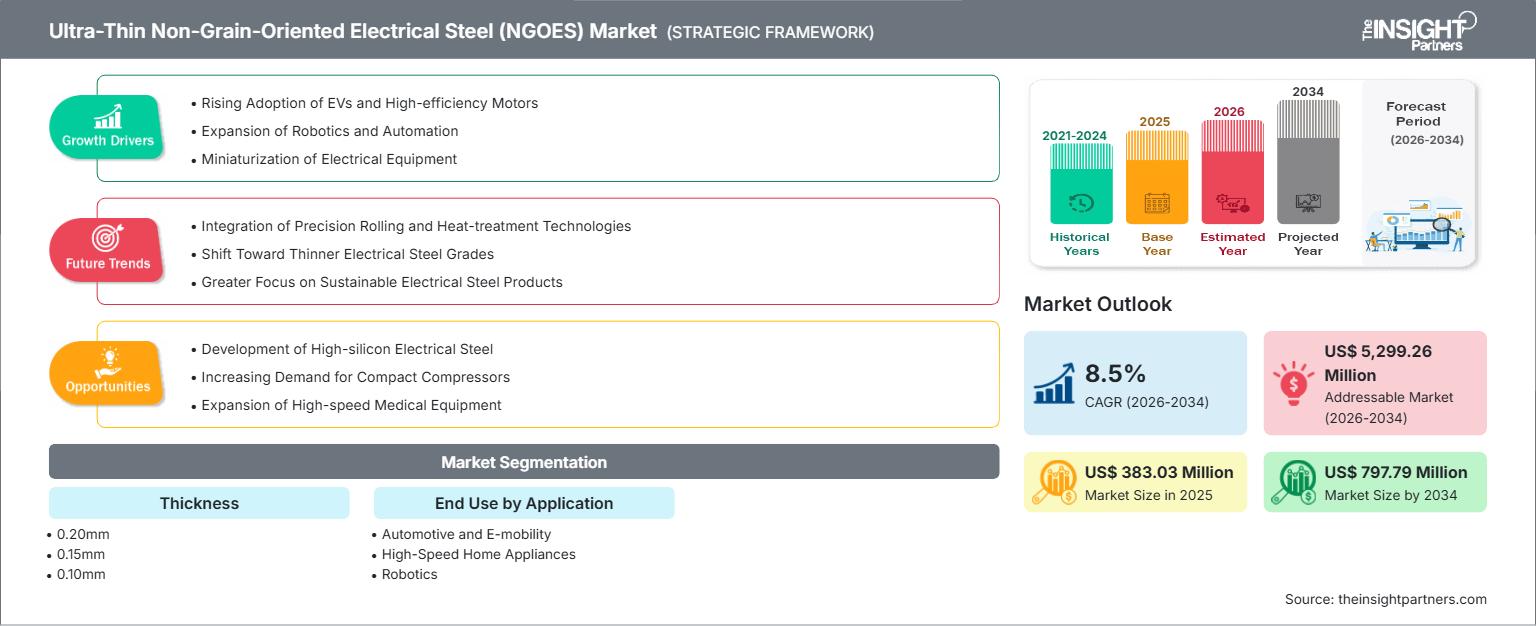
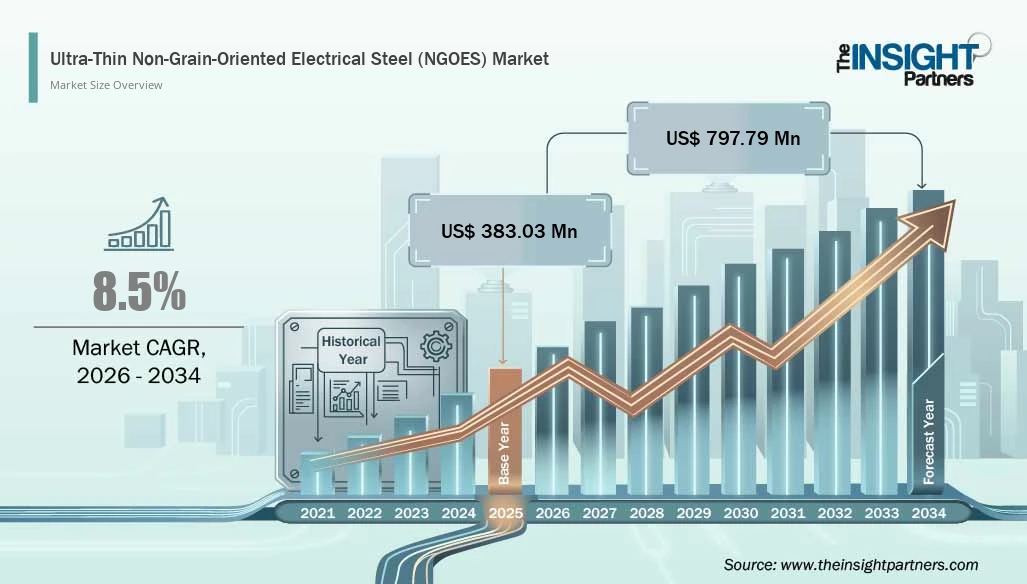
The Ultra-Thin Non-Grain-Oriented Electrical Steel (NGOES) Market was valued at US$ 383.03 million in 2025 and is projected to reach US$ 797.79 million by 2034, registering a CAGR of 8.5% during 2026–2034. The market covers ultra-thin non-grain-oriented electrical steel used where low core loss, high rotational efficiency, compact motor design, and high-frequency performance are important. Demand is concentrated across electric mobility, high-speed appliances, robotics, precision motors, medical equipment, aerospace, defense, and selected electronics applications.
North America is positioned for sustained adoption as electric mobility, high-speed motors, robotics, and specialized industrial equipment increasingly require low-loss magnetic materials. The Ultra-Thin Non-Grain-Oriented Electrical Steel Market size is supported by localized electrical-steel capacity, advanced motor engineering, and efforts to reduce reliance on imported strategic materials. The regional market is modeled to expand at approximately ~8% CAGR through 2034, supported by automotive electrification and high-performance motor applications.
Ultra-Thin Non-Grain-Oriented Electrical Steel (NGOES) Market Assessment and Insights
Regional Outlook
- North America: ~18% of the global market in 2025 | ~8% CAGR through 2034. Market position: North America represents a technologically mature market supported by electric vehicles, aerospace systems, industrial automation, and high-speed motors. Domestic production investment and supply-chain localization strengthen regional availability of advanced non-oriented electrical steel.
- US: ~80% of North American market revenue in 2025 | ~8% CAGR through 2034. Market position: The US represents the leading country in North America, supported by automotive electrification, aerospace manufacturing, industrial automation, robotics, and domestic electrical-steel investment. Demand increasingly favors thin gauges that improve motor efficiency and power density.
- Europe: ~27% of the global market in 2025 | ~8% CAGR through 2034. Market position: Europe has a mature automotive and industrial motor ecosystem, with Germany representing the leading country in Europe. France, Italy, Spain, and the UK contribute through automotive, industrial machinery, aerospace, and energy-transition applications.
- Asia Pacific: ~45% of the global market in 2025 | ~11% CAGR through 2034. Market position: Asia Pacific is the fastest-growing region, led by China, Japan, and South Korea, with India and Australia adding demand. EV production, appliance manufacturing, robotics, and regional steel capacity expansion support rapid adoption.
Segment Outlook
- Automotive and E-mobility: ~44% Share in 2025 | ~11% CAGR through 2034. Market position: This is the largest application segment because traction motors require high power density, low losses, and compact laminations. The shift toward higher motor speeds and improved vehicle efficiency increases the relevance of ultra-thin electrical steel.
- Robotics: ~9% Share in 2025 | ~13% CAGR through 2034. Market position: Robotics is the high-growth application segment as industrial robots, cobots, and service robots increasingly use compact, high-speed motors and actuators. Ultra-thin laminations support lower losses, reduced heat generation, and improved torque density.
Competitive Coverage
Nippon Steel Corporation, Nippon Kinzoku Co., Ltd., China Baowu Steel Group Corporation Limited, Shougang Zhixin Qian'an Electromagnetic Material Co., Ltd., POSCO Holdings Inc., thyssenkrupp AG, Arnold Magnetic Technologies Corporation, ArcelorMittal S.A., C.D. Wälzholz GmbH & Co. KG, JFE Steel Corporation, and Tata Steel Limited
Methodology
The Insight Partners follows Data Collection & Secondary Research, Primary Research, Data Analysis, and Data Triangulation & Final Review to validate market estimates and insights.
Source: The Insight Partners' analysis based on proprietary research, government publications, company annual reports, investor presentations, industry databases, and expert interviews.
The Ultra-Thin NGOES market has transformed from traditional motor-grade electrical steel to ultra-thin gauges suitable for high-frequency use, low eddy current loss, and increased power density. Suppliers have started adopting a combination of precision rolling, proper magnetization, surface coating, and mechanical properties for specific applications. The development is specifically significant for traction motors, compact industrial drives, medical devices, and aerospace actuator applications. The availability of ultra-thin gauges also enables the designer to design smaller motors without compromising the magnetic performance of the product.
For the future, there is an expectation that manufacturing processes will become increasingly regionalized due to the need for a reliable supply of specialized electrical steel. Asia Pacific will continue to dominate in terms of capacity addition and production of electric motors while North America and Europe will continue making investments in the regional supply chain. Energy efficiency regulations, vehicle electrification policies, industrial automation, and preference for domestically produced critical materials could support demand growth. The combination of thinner gauges, superior coating, higher strength grades, and lamination will expand the potential application space up to 2034.
Ultra-Thin Non-Grain-Oriented Electrical Steel (NGOES) Market Report Scope
| Report Attribute | Details |
|---|---|
| Market size in 2025 | US$ 383.03 Million |
| Market Size by 2034 | US$ 797.79 Million |
| Global CAGR (2026 - 2034) | 8.5% |
| Historical Data | 2021-2024 |
| Forecast period | 2026-2034 |
Ultra-Thin Non-Grain-Oriented Electrical Steel (NGOES) Market Analysis
Market dynamics in the Ultra-Thin Non-Grain-Oriented Electrical Steel Market arise predominantly from the engineering need for reduction in magnetic losses without increasing the size of the motor significantly. Thinner sheets will be beneficial in electric traction, high-speed compressors, robot actuators, precision motors, and special generators, as thinner electrical steels are capable of minimizing eddy current losses when working at higher frequencies. Therefore, the demand will not only be based on volumes of vehicles and machinery but also on motor design, operating speed, and efficiency.
A typical value chain includes the production of steel and preparation of silicon alloys, hot and cold rolling of material, annealing, surface treatment, slitting, and precise cutting of material into laminations or cores. Companies compete based on magnetic characteristics, gauge variability, mechanical properties, coating quality, width selection, and processing specifications. In addition, the supply is more consolidated compared to conventional steels due to specific capabilities needed for the production and further processing of the material.
Competition is formed by integrated steel producers, dedicated producers of electrical steel and accurate thin metals producers. These companies include Nippon Steel Corporation, POSCO Holdings Inc., JFE Steel Corporation, ArcelorMittal S.A., thyssenkrupp AG, and Tata Steel Limited, which are operating through comprehensive capabilities of producing electrical steel. At the same time, Nippon Kinzoku Co., Ltd., Arnold Magnetic Technologies Corporation, and C.D. Wälzholz GmbH & Co. KG specialize in producing thin gauge through their unique capabilities. China Baowu Steel Group Corporation Limited and Shougang Zhixin Qian’an Electromagnetic Material Co., Ltd. improve Asian manufacturing capability.
There is increasing linkage between investment and localization and electrification. Electrical steel manufacturers are building production capabilities near automotive and industrial customers. Similarly, core manufacturers are enhancing punching, bonding, stacking and automation capability. There is a shift from a focus on commodity volume to positioning in premium quality, with manufacturers looking for high-end applications in traction motors, high-speed drives, robotics, aerospace, and precision machinery.
● REPORT CUSTOMIZATION
Tailor This Report To Align With Your Specific Business Requirements
This report can be customized to align precisely with your business objectives, scope, and target markets. Customization options include tailored segmentation, geography, competitive analysis, and strategic insights to support informed decision-making.
Customize This Report →WHAT YOU CAN ADJUST
- ● Segmentations
- ● Geography
- ● Competitive Analysis
- ● Language Preferences
Ultra-Thin Non-Grain-Oriented Electrical Steel (NGOES) Market: Strategic Insights
Regional Insights
North America Ultra-Thin Non-Grain-Oriented Electrical Steel (NGOES) Market
North America accounts for approximately ~18% of the global Ultra-Thin Non-Grain-Oriented Electrical Steel (NGOES) Market in 2025 and is modeled to grow at approximately ~8% CAGR through 2034. The US constitutes the principal demand center, supported by electric-vehicle manufacturing, industrial automation, aerospace equipment, and specialized motor production. Automotive manufacturers are increasing the efficiency and rotational speed requirements of traction systems, creating demand for thinner and higher-performance electrical-steel grades.
The localization of the supply chain is now becoming strategically significant. ArcelorMittal S.A. is building up their capabilities in the manufacture of non-grain oriented electrical steel in Alabama, while current suppliers and precision material firms help out in the specialization of applications. Canada adds to the regional potential by means of their equipment and manufacturing prowess, but their market potential is much smaller compared to the US.
U.S. Ultra-Thin Non-Grain-Oriented Electrical Steel (NGOES) Market
The US represents approximately ~80% of North America's Ultra-Thin Non-Grain-Oriented Electrical Steel (NGOES) Market Share in 2025 and is modeled to grow at approximately ~8% CAGR through 2034. Automotive electrification is a major demand mechanism, complemented by aerospace, robotics, industrial drives, medical equipment, and high-speed appliance motors. The combination of localized EV production and advanced motor engineering supports demand for higher-performance magnetic materials.
Domestic supply development is also changing the competitive environment. ArcelorMittal S.A. is building an advanced NOES facility in Alabama, while Arnold Magnetic Technologies Corporation supplies specialized thin-gauge NGOES products for high-speed motors, generators, aerospace, defense, semiconductor, and medical applications. The US market therefore combines high-value specialty demand with growing automotive requirements, creating opportunities for suppliers able to meet stringent magnetic, dimensional, mechanical, and coating specifications.
Europe Ultra-Thin Non-Grain-Oriented Electrical Steel (NGOES) Market
Europe represents approximately ~27% of the global Ultra-Thin Non-Grain-Oriented Electrical Steel (NGOES) Market in 2025 and is modeled to expand at approximately ~8% CAGR through 2034. Germany is the leading country in Europe, reflecting its large automotive manufacturing base, industrial machinery ecosystem, engineering expertise, and established electrical-steel supply chain. Germany also provides a strong customer base for traction motors, industrial drives, robotics, and precision machinery.
France is significant from the perspective of automotive applications, industrial applications, and aerospace, Italy for motor and machinery production, appliances, and Spain for its involvement in automotive applications and industrial equipment production. UK continues to be relevant with aerospace applications, specialized engineering, and electric motors. The European suppliers are focusing increasingly on regional sourcing and high quality as automakers are seeking to control over strategic materials. Trade defense policies recently implemented against electrical steels highlight the significance of regional sourcing and economies of production.
Therefore, the regional market can be described as one with an established downstream demand and ongoing improvements in technology. Increasing motor speed, smaller powertrains, efficiency demands, and loss minimization are leading to a growing use of thinner electrical steels. Competition is expected to be based on quality, processing, energy efficiency, and delivery capabilities rather than volumes of steel produced.
APAC Ultra-Thin Non-Grain-Oriented Electrical Steel (NGOES) Market
APAC accounts for approximately ~45% of the global Ultra-Thin Non-Grain-Oriented Electrical Steel Market in 2025 and is the fastest-growing region at approximately ~11% CAGR through 2034. China is the leading country in Asia Pacific, supported by large EV, appliance, industrial motor, and robotics manufacturing ecosystems. Japan and South Korea remain important for advanced electrical-steel technology and premium motor applications, while India is expanding automotive and industrial manufacturing.
Together, China, Japan, South Korea, India, and Australia form a wide-ranging downstream market base. Funding into EVs, energy-efficient appliances, automation, and local steel manufacturing will help drive uptake. Japan has capabilities to manufacture ultra-thin sheets while South Korea has both electrical steel manufacturing and auto and electronics industry strengths. India’s growing automobile and industrial base forms yet another demand avenue.
Segmentation Analysis
Thickness
The thickness segment determines the balance among core loss, mechanical strength, manufacturability, and application economics. Demand is moving toward thinner gauges where high rotational speed and elevated switching frequency make eddy-current reduction increasingly important. The thickness segment is modeled to grow at approximately ~10% CAGR during 2026–2034.
- 0.20mm: This thickness provides a balance between thin-gauge performance and manufacturing practicality. It is relevant for applications requiring improved efficiency while retaining sufficient mechanical robustness, making it suitable for automotive, appliances, robotics, and industrial motor designs.
- 0.15mm: This gauge provides stronger loss-reduction benefits than conventional electrical-steel thicknesses while retaining useful mechanical characteristics. It is particularly relevant to high-speed motors, compact traction systems, precision drives, medical equipment, and specialized industrial machinery.
- 0.10mm: The thinnest supplied main thickness offers the strongest opportunity for minimizing eddy-current losses in high-frequency applications. It is strategically important for compact, high-speed motors used in advanced mobility, robotics, aerospace systems, medical devices, and specialized electronics.
End-use by Application
The application structure reflects the expanding use of ultra-thin electrical steel in motors that require compact dimensions, high efficiency, high rotational speed, or improved thermal behavior. Automotive and E-mobility is the largest application segment at approximately ~44% share in 2025 and is modeled to grow at approximately ~11% CAGR through 2034.
- Automotive and E-mobility: Traction motors increasingly require high power density and low electrical losses. Ultra-thin NGOES supports compact stator and rotor designs while helping control heat generation at high rotational speeds. The segment is strategically important as automakers optimize range, efficiency, and motor packaging.
- High-Speed Home Appliances (Vacuum Cleaners, Hair Dryers, Power Tools, and Small Kitchen Appliances): High-speed appliance motors benefit from reduced eddy-current losses and lighter magnetic assemblies. Thin electrical steel can support compact motors, higher operating speeds, lower heat generation, and improved efficiency across portable and household equipment.
- Robotics (Industrial Robots, Collaborative Robots (cobots), and Service Robots): Robotic systems require compact actuators with repeatable torque, high efficiency, and controlled thermal behavior. Ultra-thin NGOES supports smaller motor architectures and high-speed operation, making the material increasingly relevant to industrial automation, collaborative robots, and mobile service platforms.
- Aerospace and Defense (Military Drones (UAVs), Actuation Systems, and Electric Aircraft Components): Weight reduction and efficiency are critical for aerospace electrical systems. Ultra-thin electrical steel can improve power density in motors and actuators while reducing magnetic losses, supporting UAV propulsion, compact actuation, and emerging electrically powered aircraft subsystems.
- Precision Industrial Motors: Precision machinery requires stable motor performance, high efficiency, and controlled thermal behavior. Thin NGOES supports high-speed motors, specialized generators, pumps, compressors, and automation equipment where lower core losses can improve operating efficiency and enable smaller electromagnetic assemblies.
- Medical Devices: Medical equipment such as dental drills, imaging-related mechanisms, surgical systems, and precision pumps can benefit from compact high-speed motors. Ultra-thin electrical steel supports low-loss operation, reduced heat generation, and accurate motor control where equipment dimensions and operating reliability are important.
- Consumer Electronics: Compact electronic equipment increasingly incorporates miniature motors, cooling systems, actuators, and precision mechanisms. Thin electrical steel supports miniaturization and efficient magnetic operation, creating demand in applications where component size, noise, heat, and power consumption must be tightly controlled.
Opportunity Snapshot
| Application | Revenue Contribution | Trend Tag | Adoption Stage |
| Automotive and E-mobility | High | Traction Efficiency | Scaling |
| High Speed Home Appliances | Medium | High-Speed Motors | Mature |
| Robotics | Medium | Compact Actuators | Scaling |
| Aerospace and Defense | Low | Lightweight Drives | Emerging |
| Precision Industrial Motors | Medium | Power Density | Mature |
| Medical Devices | Low | Precision Motors | Scaling |
| Consumer Electronics | Low | Miniaturized Motors | Scaling |
| Others | Low | Specialized Systems | Emerging |
Ultra-Thin Non-Grain-Oriented Electrical Steel (NGOES) Market Growth Drivers and Impact Analysis
Rising power-density requirements in electric traction motors
Electric traction systems are increasingly designed around higher motor efficiency, greater rotational speed, and reduced package size. These engineering priorities directly increase the value of thin non-oriented electrical steel because thinner laminations can reduce eddy-current losses and improve high-frequency motor performance. For vehicle manufacturers, the benefit extends beyond material efficiency because lower magnetic losses can contribute to improved thermal management and powertrain packaging. The Ultra-Thin Non-Grain-Oriented Electrical Steel (NGOES) Market therefore benefits from a shift in motor design rather than simply from higher vehicle volumes. Suppliers capable of meeting automotive qualification requirements, dimensional tolerances, strength specifications, and consistent magnetic properties can capture demand as OEMs redesign traction systems around higher power density.
Expansion of high-speed and compact electric motors
The growth of high-speed compressors, vacuum cleaners, power tools, robotics, drones, medical drills, and precision industrial motors expands the addressable use of ultra-thin electrical steel beyond conventional automotive applications. At elevated frequencies, eddy-current losses become increasingly significant, making thinner laminations technically attractive. High-speed motor designers also value reduced heat generation because thermal constraints can otherwise limit enclosure size, operating speed, or continuous power. The resulting demand is distributed across multiple equipment categories, reducing dependence on a single end-use sector. Manufacturers that combine ultra-thin rolling capability with high-strength grades, specialized coatings, precision slitting, and customer-specific technical support can address applications where standard electrical steel cannot provide the required performance.
Localization of strategic electrical-steel supply chains
Supply-chain resilience is becoming a commercial consideration alongside material performance. Automotive and industrial customers increasingly seek regional sources for critical magnetic materials to reduce logistics exposure, qualification risk, and dependence on distant suppliers. New electrical-steel investments in North America and Europe illustrate this shift, while established Asian producers continue to expand premium product capabilities. Localization can shorten development cycles between steel producers, motor-core manufacturers, and OEM engineering teams. It can also encourage regional specialization, with suppliers positioning premium grades close to high-value applications. For the Market, localized supply therefore creates opportunities for both integrated steel producers and specialized precision-material manufacturers.
Ultra-Thin Non-Grain-Oriented Electrical Steel (NGOES) Market Future Trends
Greater adoption of ultra-thin gauges in high-frequency motor architectures
Future motor designs are expected to place greater emphasis on switching frequency, rotational speed, compactness, and thermal efficiency. As inverter-fed motors operate at increasingly demanding electrical conditions, material selection becomes a critical component of system-level efficiency. The Ultra-Thin Non-Grain-Oriented Electrical Steel (NGOES) Market Trends is consequently likely to see greater use of 0.15mm and 0.10mm grades where the incremental material cost can be justified by improved motor performance. Development will also extend beyond simple thickness reduction. Manufacturers are likely to optimize magnetic properties, mechanical strength, coating systems, and processing behavior simultaneously. This will encourage closer collaboration between steelmakers, core manufacturers, inverter developers, motor designers, and vehicle or equipment OEMs.
Integration of material engineering with automated motor-core production
The next phase of market development is likely to connect electrical-steel properties more closely with automated punching, bonding, stacking, and core assembly. Automated production can reduce dimensional variation and improve consistency when processing very thin materials, while application-specific coatings can support bonding and insulation requirements. Digital process monitoring may also improve quality control during slitting and lamination. These developments will allow customers to evaluate electrical steel based on total motor performance rather than solely on sheet-level magnetic characteristics. Suppliers that can provide both material and processing expertise may therefore gain stronger positions in complex applications such as EV traction motors, robotics, aerospace actuation, and medical equipment.
Ultra-Thin Non-Grain-Oriented Electrical Steel (NGOES) Market Opportunities
Localized premium electrical-steel capacity near automotive clusters
A significant commercial opportunity exists in establishing or expanding premium electrical-steel capacity close to major automotive and motor-production clusters. Local production can reduce supply-chain complexity while enabling faster technical qualification and joint development with motor-core manufacturers. North America and Europe are particularly relevant because both regions are strengthening strategic material supply chains while expanding electric mobility and industrial automation. Producers can differentiate through 0.10mm and 0.15mm grades, high-strength variants, specialized coatings, and application-specific magnetic performance. Investment decisions should prioritize locations with established automotive ecosystems, skilled steel-processing capabilities, reliable energy supply, and proximity to downstream lamination and motor-core facilities.
Specialized supply for robotics, aerospace, and precision motor applications
Specialized applications in the Ultra-Thin Non-Grain-Oriented Electrical Steel (NGOES) Market Forecast offer an opportunity to achieve higher material value through technical performance rather than volume. Robotics, aerospace, medical devices, drones, and precision industrial equipment require compact motors with demanding combinations of efficiency, weight, speed, reliability, and thermal behavior. These applications can justify premium ultra-thin grades when improved motor performance contributes directly to equipment differentiation. Suppliers can target this opportunity through small-lot production, rapid prototyping, precision slitting, application engineering, and customized coating solutions. Partnerships with actuator manufacturers and specialist motor designers can also shorten qualification cycles. This approach allows producers to build defensible positions in technically demanding niches alongside larger automotive programs.
Recent Developments
- June 2026: NIPPON KINZOKU CO., LTD. and its subsidiary, NIKKIN DENJI KOGYO CO., LTD., are launching a sales initiative for their ultra-thin electrical steel strips, the GT Series and ST Series, branded as “Fine Eco Metal.” This effort responds to the growing demand for efficient electrification amidst the shift toward a decarbonized society. The companies have utilized proprietary technologies to achieve remarkable thinness and superior magnetic properties, addressing the need to reduce energy loss, particularly in high-frequency applications. The initiative aims to support customers in developing next-generation technologies.
- August 2025: ArcelorMittal's Calvert, Alabama steelmaking campus will enhance its North American operations following the acquisition of the remaining 50% of the plant. The facility, featuring a new electric arc furnace (EAF) with a capacity of 1.5 million tons annually, aims to reach full capacity by mid-2026. The EAF, complemented by a rolling operation capable of processing 5.3 million tons of steel per year, has recently begun slab production. Additionally, a seven-year supply agreement with the merged Nippon Steel and U.S. Steel ensures access to domestically sourced materials. Production of nongrain-oriented electrical steel is expected to start in 2027.
- June 2025: ArcelorMittal has successfully acquired Nippon Steel Corporation’s 50% stake in AM/NS Calvert, now renamed ArcelorMittal Calvert, as per an Equity Purchase Agreement signed on October 11, 2024. Originally established in 2010, the facility, which was acquired in 2014 for $1.55 billion, has an annual capacity of 5.3 million metric tonnes and includes advanced production capabilities for various steel products. Furthermore, in February 2025, ArcelorMittal announced a $1.2 billion investment to build a non-grain-oriented electrical steel manufacturing facility at the site, aimed at producing up to 150,000 metric tonnes annually and enhancing U.S. manufacturing competitiveness. The project is on schedule, with construction set to complete by 2027.
Frequently Asked Questions

- Comprehensive Market Sizing and Forecast Analysis
- Detailed Segmentation Analysis
- In-Depth Market Dynamics Assessment
- Regional and Country-Level Insights
- Competitive Landscape and Company Benchmarking
- Strategic Business Intelligence
Recent Reports
Testimonials

The Insight Partners provided valuable market intelligence that supported our global go-to-market strategy. Their team was professional, responsive, and attentive to our feedback, providing thoughtful analysis and helpful methodological clarifications throughout the project.
Junmo Kim Chief Financial Officer (CFO), Enertech Co., Ltd.
The Insight Partners' SCADA System Market report is comprehensive, with valuable insights on current trends and future forecasts. The team was highly professional, responsive, and supportive throughout. We are very satisfied and highly recommend their services.
RAN KEDEM Partner, Reali Technologies LTDs
I requested a report on a very specific software market and the team produced the report in a few days. The information was very relevant and well presented. I then requested some changes and additions to the report. The team was again very responsive and I got the final report in less than a week.
JEAN-HERVE JENN Chairman, Future Analytica
We worked with The Insight Partners for an important market study and forecast. They gave us clear insights into opportunities and risks, which helped shape our plans. Their research was easy to use and based on solid data. It helped us make smart, confident decisions. We highly recommend them.
PIYUSH NAGPAL Sr. Vice President, High Beam Global
The Insight Partners delivered insightful, well-structured market research with strong domain expertise. Their team was professional and responsive throughout. The user-friendly website made accessing industry reports seamless. We highly recommend them for reliable, high-quality research services
YUKIHIKO ADACHI CEO, Deep Blue, LLC.
This is the first time I have purchased a market report from The Insight Partners.While I was unsure at first, I visited their web site and felt more comfortable to take the risk and purchase a market report.I am completely satisfied with the quality of the report and customer service. I had several questions and comments with the initial report, but after a couple of dialogs over email with their analyst I believe I have a report that I can use as input to our strategic planning process.Thank you so much for taking the extra time and making this a positive experience.I will definitely recommend your service to others and you will be my first call when we need further market data.
JOHN SUZUKI President and Chief Executive Officer, Board Director, BK Technologies
I wish to appreciate your support and the professionalism you displayed in the course of attending to my request for information regarding to infectious disease IVD market in Nigeria. I appreciate your patience, your guidance, and the fact that you were willing to offer a discount, which eventually made it possible for us to close a deal. I look forward to engaging The Insight Partners in the future, all thanks to the impression you have created in me as a result of this first encounter.
DR CHIJIOKE ONYIA MANAGING DIRECTOR, PineCrest Healthcare Ltd.Reason to Buy
- Informed Decision-Making
- Understanding Market Dynamics
- Competitive Analysis
- Identifying Emerging Markets
- Customer Insights
- Market Forecasts
- Risk Mitigation
- Boosting Operational Efficiency
- Strategic Planning
- Investment Justification
- Tracking Industry Innovations
- Aligning with Regulatory Trends





 Get Free Sample for