
UV Disinfection Market Size, Share & Demand by 2034
Coverage: by Application (Wastewater, Drinking Water, Process Water, Others); End-user (Residential, Commercial, Industrial) , and Geography (North America, Europe, Asia Pacific, and South and Central America)
- Status : Data Released
- Report Code : TIPRE00006049
- Category : Manufacturing and Construction
- No. of Pages : 150
- Available Report Formats :


- Last update date : September 15, 2026


2025 Market Size
US$ 4.38 Bn
Base year value
2034 Forecast
US$ 7.03 Bn
Projected by 2034
CAGR 2026-2034
6.09 %
Growth rate
Addressable Market
US$ 53.60 Bn
(2026-2034)
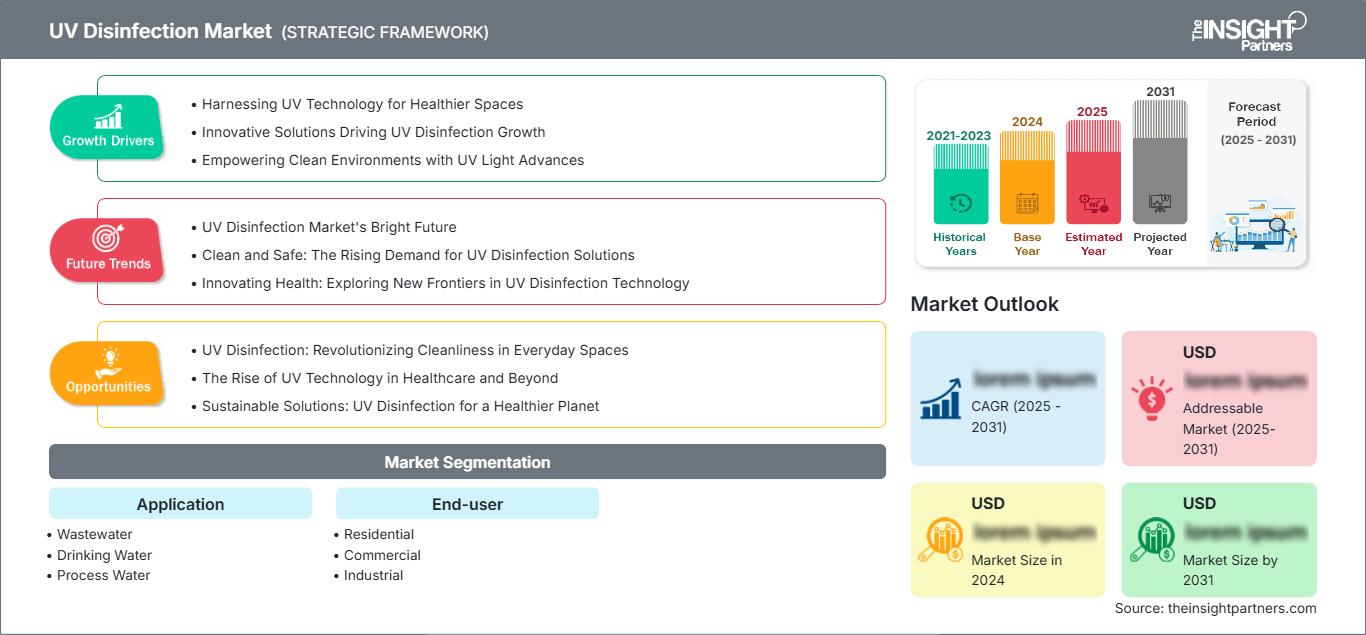
The UV disinfection market is valued at US$ 4.38 Billion in 2025 and is projected to reach US$ 7.03 Billion by 2034, registering a CAGR of 6.09% during 2026–2034. Expansion is supported by wider deployment of ultraviolet treatment across municipal water systems, industrial process-water facilities, and decentralized treatment applications requiring reliable pathogen control without conventional chemical dosing.
North America is expected to remain a major regional contributor, with an estimated 5.8–6.4% CAGR between 2026–2034. Replacement of aging treatment infrastructure and tighter microbial-performance requirements are structural drivers, while water reuse programs and investments in resilient municipal systems are broadening adoption across drinking water and wastewater facilities, supporting the growth of the UV Disinfection Market size.
UV Disinfection Market Assessment and Insights
- North America: The region is projected to hold a 30–34% share in 2025 and grow at a 5.8–6.4% CAGR between 2026–2034, supported by municipal upgrades, reuse projects, and established UV treatment infrastructure.
- US: The US is expected to account for 82–86% of North America's 2025 market and expand at a 5.9–6.5% CAGR during 2026–2034, led by municipal and industrial installations.
- Europe: Europe is estimated at a 24–28% share in 2025 and a 5.6–6.2% CAGR between 2026–2034, with Germany, the UK, France, Italy, and Spain supporting demand through water-quality regulation and infrastructure modernization.
- Asia Pacific: Asia Pacific is estimated to represent 26–30% share in 2025 and expand at a 6.7–7.3% CAGR during 2026–2034, led by China, Japan, India, South Korea, and Australia as water reuse and industrial treatment investments increase.
- Largest Segment: Wastewater is expected to hold a 48–52% market share in 2025 and record a 6.4–6.8% CAGR during 2026–2034, reflecting extensive municipal deployment and reuse requirements.
- High Growth Segment: Process water is projected to hold a 20–24% share in 2025 and grow at a 6.8–7.2% CAGR during 2026–2034, supported by stringent industrial water-quality specifications.
- Key companies analyzed in detail: Advanced UV, Inc.; American Ultraviolet, Inc.; Atlantic Ultraviolet Corporation; Atlantium Technologies Ltd.; Evoqua Water Technologies LLC; Halma plc; Reckitt Benckiser Group plc; Trojan Technologies, Inc.; uv-technik international ltd.; Xylem Inc.
Source: The Insight Partners' analysis based on proprietary research, government publications, company annual reports, investor presentations, industry databases, and expert interviews.
The UV disinfection market has evolved from relatively simple lamp-based treatment into digitally monitored systems incorporating dose control, automated cleaning, sensor feedback, and modular reactor designs. Increasingly, medium-pressure lamps and amalgam lamps can adapt themselves to variable flows, and ultraviolet advanced oxidation can move wastewater treatment further toward micropollutants. The dynamics of equipment production will move toward the development of standard modules, integration of controls, and service-based systems for replacements.
In the future, water-stressed developing countries are expected to invest more in reuse technologies and decentralized treatment processes. Regulatory requirements for the reduction of pathogens, contaminants, and safe chemicals are expected to enhance the use of ultraviolet light. Equipment producers will focus on low energy consumption, predictive maintenance, remote diagnostics, and compact design.
UV Disinfection Market Report Scope
| Report Attribute | Details |
|---|---|
| Market size in 2025 | US$ 4.38 Billion |
| Market Size by 2034 | US$ 7.03 Billion |
| Global CAGR (2026 - 2034) | 6.09% |
| Historical Data | 2021-2024 |
| Forecast period | 2026-2034 |
UV Disinfection Market Analysis
Demand is anchored by the need to control microorganisms without creating conventional chlorination byproducts. Municipal utilities, industrial plants, commercial water systems, and decentralized facilities form the principal ecosystem, connecting reactor manufacturers with lamp suppliers, controls providers, engineering firms, integrators, and maintenance contractors. The UV disinfection market growth increasingly depends on replacement cycles as installed systems reach lamp, sleeve, ballast, or control-system renewal points. Water quality remains central because UV transmittance, suspended solids, fouling, and hydraulic conditions directly influence dose delivery.
According to EPA guidelines, UV absorption, particle load, and sleeve fouling are among those design aspects which make pretreatment and testing crucial in the selection of the systems. Dynamics in the market tend towards modular units which can be tailored to fit in terms of flow, transmittance, geometry, and control aspects. The competition among manufacturers lies in validated performance, efficiency, cleaning technology, controls and servicing network rather than lamp technology. This resulted in higher demand for UV systems, providing stable operation in changing conditions without frequent maintenance.
The competitive landscape includes established water-treatment groups and specialized UV suppliers. Xylem combines Wedeco and ETS-UV offerings across municipal and industrial applications, while Trojan Technologies emphasizes validated treatment, connected controls, and upgradeable systems. Evoqua Water Technologies LLC, Atlantium Technologies Ltd., Halma plc, American Ultraviolet, and Atlantic Ultraviolet Corporation address distinct combinations of municipal, industrial, commercial, and specialized demand. Competitive positioning increasingly depends on application expertise, installed-base experience, engineering support, lifecycle services, and the ability to provide customized treatment solutions, according to the UV Disinfection Market report.
Trends for investments include optimization for the lifecycle, digital control, and retrofitability. Customers focus not only on the purchase price but on total operation costs as well, especially where energy usage and labor for maintenance play an important role in the financial performance of the installation. Positioning strategy includes reliability of dosing, automation of sleeve cleaning, maximization of the lamp life, remote diagnostics, and compatibility with existing hydraulic systems. Increasing application of the UV AOP opens the way to higher value-added markets, such as micropollutants destruction and the reuse of water. For instance, Trojan Technologies offers its UV AOP technology for the treatment of wastewater for reuse and contaminated groundwater remediation.
● REPORT CUSTOMIZATION
Tailor This Report To Align With Your Specific Business Requirements
This report can be customized to align precisely with your business objectives, scope, and target markets. Customization options include tailored segmentation, geography, competitive analysis, and strategic insights to support informed decision-making.
Customize This Report →WHAT YOU CAN ADJUST
- ● Segmentations
- ● Geography
- ● Competitive Analysis
- ● Language Preferences
UV Disinfection Market: Strategic Insights
Regional Insights
North America UV Disinfection Market
North America is estimated to represent 30–34% of the 2025 UV Disinfection Market and expand at a 5.8–6.4% CAGR during 2026–2034. The United States is still the main provider due to the availability of mature infrastructure for water treatment at the municipal level, high-performance standards for microorganisms, and replacement of outdated technology. Opportunities are present in Canada due to the modernization of municipalities, industrial water treatment, and resource sectors. EPA guidelines and regulations have created conditions for UV to be a known solution for surface water and water reclamation.
There is also operational economics influencing the regional demand. Utilities require technologies that will lower the need to handle chemicals, ensure constant microorganism efficiency, and work well within SCADA systems. Industrials require small reactors for their process water, especially when it influences the reliability of production. Replacement demand, reuse systems, and technology improvements must ensure regional growth. Monitoring of the processes is increasingly gaining importance, as variable flows and UV transmission can lead to increased energy use or lower treatment efficiency.
U.S. UV Disinfection Market Market
The US is estimated to account for 82–86% of North America's 2025 UV Disinfection Market and grow at a 5.9–6.5% CAGR during 2026–2034. Municipal wastewater remains a substantial application, while drinking-water facilities increasingly consider UV as part of multi-barrier treatment strategies. Federal infrastructure investment, replacement needs, and pathogen-control requirements support procurement.
Company presence is broad, spanning Xylem Inc., Evoqua Water Technologies LLC, Trojan Technologies, Inc., American Ultraviolet, Inc., and Advanced UV, Inc. Applications range from open-channel wastewater reactors to closed-vessel drinking-water systems and industrial process-water treatment. Trojan Technologies notes that UV AOP systems are deployed for potable reuse and contaminant remediation in several US states, reinforcing demand for advanced treatment architectures.
Europe UV Disinfection Market Market
Europe is estimated to hold a 24–28% of the UV Disinfection Market share in 2025 and register a 5.6–6.2% CAGR during 2026–2034. Germany is an important market due to sophisticated municipal treatment technology, industrial water technology standards, and engineering expertise. The UK, France, Italy, and Spain have additional influence through wastewater renewal, water reuse projects, and legislation. In particular, Germany is important because its industrial customers need reliable treatment performance and small systems.
The UK market is driven by investments in water infrastructure and leak reduction, while France has municipal and industrial treatment market needs. Italy and Spain offer growth prospects based on the water shortage issues, agricultural reuse, tourism, and decentralized treatment. Generally, suppliers in Europe are increasingly competing on their energy efficiency, automation, validation, and ability to work under challenging hydraulic conditions instead of mere disinfection capacity.
APAC UV Disinfection Market Market
APAC is estimated to represent 26–30% of the UV Disinfection Market share in 2025 and expand at a 6.7–7.3% CAGR during 2026–2034. China leads regional demand, followed by Japan, India, South Korea, and Australia. Industrial water treatment, municipal capacity expansion, and water-reuse requirements provide a broad demand base.
China is a mix of huge municipal needs and the requirements of manufacturing industries. High-quality treatment and small-scale infrastructure are the focus of Japan. The scope of India is vast through its process of urbanization, industrialization, and management of wastewater. Korea and Australia contribute through their industries’ water treatment and security. Water stress management and continued production at semiconductor, pharmaceutical, food, and chemical plants make the regional outlook promising.
Middle East & Africa UV Disinfection Market Market
The Middle East & Africa UV Disinfection Market is projected to expand at a 5.0–5.6% CAGR during 2026–2034. Both Saudi Arabia and the UAE are significant suppliers, thanks to desalination, water reuse, and diversification of their infrastructure. South Africa can be considered an important customer from the African region due to wastewater regeneration and industrial water security.
Energy-intensive water infrastructure provides a clear motive for efficiency of UV disinfection units, especially in cases when desalinated or recycled water is utilized in industrial and municipal water supply. In the case of Saudi Arabia and the UAE, it is expected that large-scale infrastructure will be used, while in South Africa and other MEA countries, there will be a place for modular installations.
Segmentation Analysis
Application
Wastewater represents the largest application because municipal and industrial facilities require reliable pathogen reduction before discharge or reuse. Drinking water remains strategically important where utilities need additional microbial barriers, while process water benefits from compact treatment for sensitive manufacturing operations. The application segment is expected to register a 6.2–6.8% CAGR during 2026–2034 as water-quality requirements become more demanding, according to the UV Disinfection Market forecast.
- Wastewater: Municipal and industrial wastewater treatment represents the largest demand base, supported by discharge standards, reuse initiatives, and the need to avoid chemical disinfection byproducts in treated effluent.
- Drinking Water: Drinking-water systems use UV as a physical microbial barrier, particularly where utilities address chlorine-resistant organisms, taste concerns, or multi-barrier treatment requirements.
- Process Water: Process-water applications prioritize precise microbial control, compact equipment, and integration with production systems, making UV increasingly relevant for pharmaceutical, food, beverage, semiconductor, and other quality-sensitive industries.
End-user
Industrial users are expected to post the strongest adoption trajectory as water-intensive manufacturers increase recycling and require consistent process-water quality. Commercial systems serve hotels, recreational facilities, and institutional sites, while residential systems provide decentralized treatment for homes and small facilities. The end-user segment is projected to record a 6.0–6.6% CAGR during 2026–2034, supported by broader decentralization and water-reuse requirements, reflecting key UV Disinfection Market trends.
- Residential: Residential adoption centers on point-of-use and point-of-entry treatment where households seek additional microbial protection, particularly for private wells, decentralized supplies, and locations with variable water quality.
- Commercial: Commercial installations address hotels, recreation facilities, institutional buildings, and small treatment systems where compact footprints, automated controls, and simplified maintenance influence procurement decisions.
- Industrial: Industrial users prioritize continuous treatment, validation, process integration, and lifecycle reliability, with applications spanning manufacturing, food and beverage, pharmaceuticals, electronics, and other water-intensive operations.
Opportunity Snapshot
| Segment Name | Revenue Contribution (High/Medium/Low) | Trend Tag (MAX 2 words) | Adoption Stage (Emerging/Scaling/Mature) |
| Wastewater | High | Water Reuse | Mature |
| Drinking Water | High | Multi-Barrier | Scaling |
| Process Water | Medium | Process Hygiene | Scaling |
| Residential | Low | Point-Entry | Scaling |
| Commercial | Medium | Compact Systems | Scaling |
| Industrial | High | Water Recycling | Scaling |
UV Disinfection Market Growth Drivers and Impact Analysis
Expansion of Water Reuse and Resource Recovery
Water reuse applications are establishing a structural need for dependable microbial barrier technology as communities and industrial companies strive to minimize fresh water extractions. UV systems fit naturally into multi-barrier trains since they offer physical kill without introducing any persistent chemical disinfectant residual or chlorinated byproducts typical in chlorination processes. Research conducted by the EPA still looks into UV combinations with other disinfecting agents like peracetic acid to increase disinfection effectiveness while decreasing the use of energy and minimizing byproducts. This development enhances the demand for UV systems in advanced wastewater treatment plants, potable reuse systems, and industrial recycling systems. To manufacturers, it means that there will be more equipment orders, validation services, monitoring contracts, and equipment replacements. To buyers, the cost-effectiveness of the system revolves around dose optimization and flow hydraulics.
Stricter Microbial Control Requirements
The importance placed on pathogen reduction by regulators is leading to the need to upgrade treatment barriers from the utility and industrial players. The Long Term 2 Enhanced Surface Water Treatment Rule in the US is aimed at reducing the threat of Cryptosporidium pathogens in surface waters and allows for a regulatory environment where UV systems can be used in treatment schemes. With comparable requirements in the developed water markets, there is more inclination towards purchasing equipment with validation rather than just lamps. The scope is not limited to new installations because existing plants will always need replacement of equipment, system upgrades, and capacity increases. The manufacturers who are capable of proving their ability to provide dose delivery regardless of changes in flow and UV transmittance have a competitive edge in this scenario.
Lifecycle Optimization and Chemical Handling Reduction
UV treatment methods may help to decrease the dependence on chemicals through storage and handling in applications where disinfection by physical means is technologically feasible. In such circumstances, the focus of procurement will move from equipment capital cost to the total cost of ownership, including safety of operation, maintenance considerations, and energy efficiency. Current UV technology employs intensity measurement, flow rate, automatic cleaning, adjustable power settings, and control techniques to achieve the necessary dose level without operating continuously at full capacity. For instance, Xylem's Wedeco K Series utilizes dosing based on sensor input and claims an energy savings potential of up to 20% relative to existing technologies at given conditions of operation. The market effect is thus positive for efficient solutions and scalable control systems.
UV Disinfection Market Future Trends
Intelligent Dose Management and Connected Operations
In the next phase of UV treatment, there will be increasing integration of performance metrics for the reactors into plant-level IT infrastructure. Flow sensors, measurements of the power intensity of the UV light, and transmittance can be used to facilitate a more dynamic dose adjustment as opposed to constant power operation. In connected systems, controllers can increasingly track the history of operations, diagnose fouling trends, and even plan future maintenance operations when performance is still at an optimal level. For bigger utilities, this could mean that the UV systems can become integrated parts of their treatment processes, as opposed to stand-alone treatment equipment. In smaller utilities, too, it would be expected for more systems to integrate simple remote access as the cost of connectivity decreases. Competitors will have to battle not only for the efficiency of the lamps but also for the ease of use of the software, cybersecurity, interoperability, and diagnostics.
UV-C LED Integration in Distributed Treatment
It is clear that UV-C LED technology will proliferate in targeted applications where compact design, faster switching, reduced reliance on mercury and flexible reactor design will be able to overcome the economic benefits of traditional lamps. While LEDs will still be less appropriate than traditional lamps for many of the high-flow municipal installations, their advantages will be better suited to the development of decentralized systems, point-of-entry devices, and special industrial applications. With higher efficiencies and longevity of the emitters, the designer can relieve himself of certain limitations imposed by lamp maintenance and reactor positioning. Additionally, the new technology may enable the development of modular reactors with separate control of each emitter or group of emitters, depending on demand. It will depend on such parameters as delivered dose, electrical efficiency, heat dissipation, initial cost, and field performance validation.
UV Disinfection Market Opportunities
Industrial Water Recycling and High-Purity Applications
Water recycling in the industry presents an exciting opportunity due to the increased need on the part of manufacturers to conserve water usage without affecting the quality of production. Companies in such industries as pharmaceutical, food & beverages, electronics, chemicals, among others, where there is heavy use of water, can incorporate UV in their treatment processes for purposes of disinfection, dechlorination, decomposition of ozone, and oxidation. Buyers will not shy away from investing in technology where there is a direct link between water quality and production quantity or machine efficiency. Suppliers can realize value through the bundling of reactors with sensors, polishing techniques, skids, commissioning, validation, and maintenance contracts. This is especially true in facilities looking to increase production in areas with limited water. Modular systems can also be utilized in brownfield projects since they can be built around existing process piping and machinery.
Water-Stressed Municipalities and Decentralized Treatment
Water-stressed municipalities offer another opportunity as utilities diversify supply through wastewater reuse, decentralized treatment, and smaller regional facilities. UV can serve as a final microbial barrier where operators need compact equipment and limited chemical handling. The opportunity extends beyond large centralized plants because packaged systems can be adapted to satellite facilities, remote communities, commercial developments, and industrial clusters. Suppliers can differentiate through standardized modules, remote monitoring, simplified maintenance, and rapid commissioning. Partnerships with engineering contractors and local integrators can improve access to fragmented procurement markets while reducing installation complexity. Investment decisions should prioritize regions combining water scarcity, population growth, infrastructure deficits, and regulatory pressure. Such markets can generate recurring revenue through replacement lamps, sensors, cleaning components, software, service contracts, and periodic performance verification rather than relying solely on initial equipment sales.
Frequently Asked Questions

- Comprehensive Market Sizing and Forecast Analysis
- Detailed Segmentation Analysis
- In-Depth Market Dynamics Assessment
- Regional and Country-Level Insights
- Competitive Landscape and Company Benchmarking
- Strategic Business Intelligence
Recent Reports
Testimonials

The Insight Partners' SCADA System Market report is comprehensive, with valuable insights on current trends and future forecasts. The team was highly professional, responsive, and supportive throughout. We are very satisfied and highly recommend their services.
RAN KEDEM Partner, Reali Technologies LTDs
I requested a report on a very specific software market and the team produced the report in a few days. The information was very relevant and well presented. I then requested some changes and additions to the report. The team was again very responsive and I got the final report in less than a week.
JEAN-HERVE JENN Chairman, Future Analytica
We worked with The Insight Partners for an important market study and forecast. They gave us clear insights into opportunities and risks, which helped shape our plans. Their research was easy to use and based on solid data. It helped us make smart, confident decisions. We highly recommend them.
PIYUSH NAGPAL Sr. Vice President, High Beam Global
The Insight Partners delivered insightful, well-structured market research with strong domain expertise. Their team was professional and responsive throughout. The user-friendly website made accessing industry reports seamless. We highly recommend them for reliable, high-quality research services
YUKIHIKO ADACHI CEO, Deep Blue, LLC.
This is the first time I have purchased a market report from The Insight Partners.While I was unsure at first, I visited their web site and felt more comfortable to take the risk and purchase a market report.I am completely satisfied with the quality of the report and customer service. I had several questions and comments with the initial report, but after a couple of dialogs over email with their analyst I believe I have a report that I can use as input to our strategic planning process.Thank you so much for taking the extra time and making this a positive experience.I will definitely recommend your service to others and you will be my first call when we need further market data.
JOHN SUZUKI President and Chief Executive Officer, Board Director, BK Technologies
I wish to appreciate your support and the professionalism you displayed in the course of attending to my request for information regarding to infectious disease IVD market in Nigeria. I appreciate your patience, your guidance, and the fact that you were willing to offer a discount, which eventually made it possible for us to close a deal. I look forward to engaging The Insight Partners in the future, all thanks to the impression you have created in me as a result of this first encounter.
DR CHIJIOKE ONYIA MANAGING DIRECTOR, PineCrest Healthcare Ltd.Reason to Buy
- Informed Decision-Making
- Understanding Market Dynamics
- Competitive Analysis
- Identifying Emerging Markets
- Customer Insights
- Market Forecasts
- Risk Mitigation
- Boosting Operational Efficiency
- Strategic Planning
- Investment Justification
- Tracking Industry Innovations
- Aligning with Regulatory Trends





 Get Free Sample for