
Vibrating Screen Panel Market Share, Demand & Growth by 2034
Coverage: by Product Type (Steel, Wire Mesh, Polyurethane (PU), Others); End-User (Metals and Mining, Waste Treatment, Construction and Manufacturing, Others) , and Geography (North America, Europe, Asia Pacific, and South and Central America)
- Status : Data Released
- Report Code : TIPRE00012420
- Category : Manufacturing and Construction
- No. of Pages : 150
- Available Report Formats :


- Last update date : September 15, 2026


2025 Market Size
US$ 837.52 Mn
Base year value
2034 Forecast
US$ 966.58 Mn
Projected by 2034
CAGR 2026-2034
1.81 %
Growth rate
Addressable Market
US$ 8,253.83 Mn
(2026-2034)
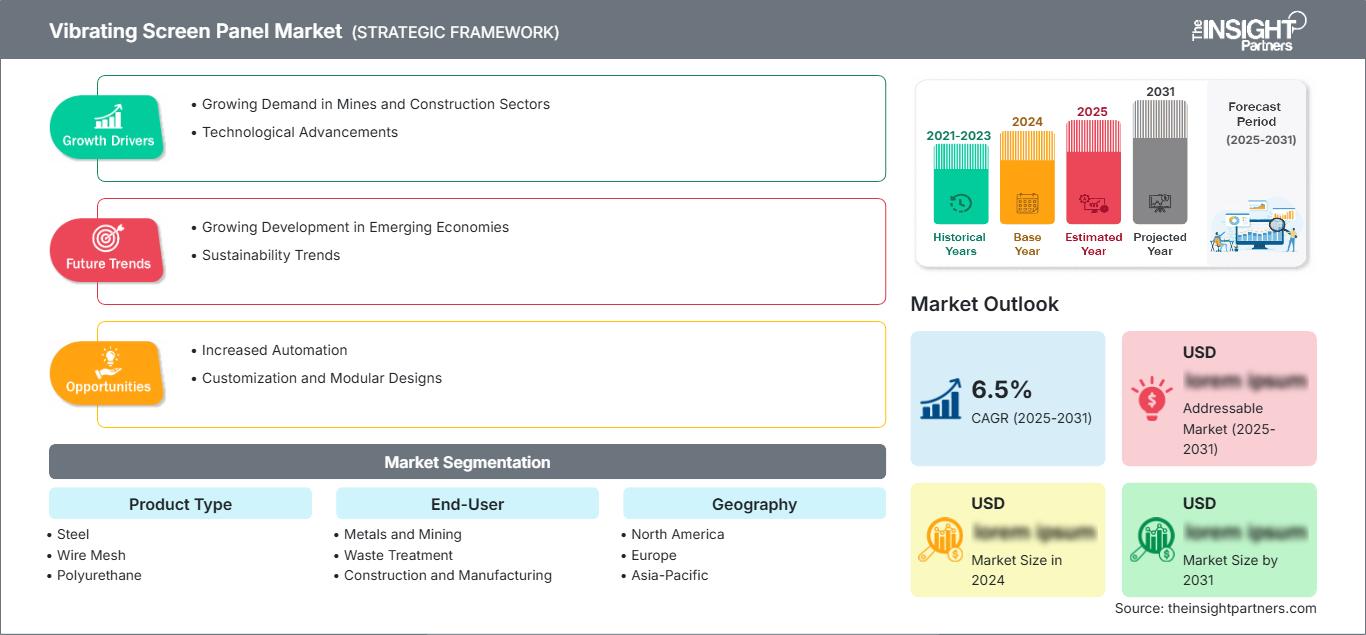
The vibrating screen panel market was valued at US$ 837.52 Million in 2025 and is projected to reach US$ 966.58 Million by 2034, registering a CAGR of 1.81% during 2026–2034. The market encompasses steel, wire mesh, polyurethane, and other panel materials used across metals and mining, waste treatment, construction and manufacturing, and related processing environments where controlled particle separation is essential.
North America is expected to record a CAGR of approximately 1.6–2.0% during 2026–2034. The vibrating screen panel market size in the region is supported by replacement demand from established mining and aggregates operations, modernization of processing plants, and tighter operating requirements for throughput, material recovery, worker safety, and maintenance efficiency.
Vibrating Screen Panel Market Assessment and Insights
- North America: North America is estimated to account for 24–28% share in 2025, growing at a CAGR of 1.6–2.0% between 2026–2034. Mature mining, aggregates, recycling, and infrastructure-processing facilities support recurring replacement and retrofit demand.
- US: The US represents approximately 62–66% of North America in 2025, with a CAGR of 1.7–2.1% during 2026–2034, supported by mining modernization, aggregates production, and equipment replacement.
- Europe: Europe is estimated at 23–27% share in 2025 and is projected to expand at 1.4–1.8% CAGR through 2034. Germany, the UK, France, Italy, and Spain remain important markets because of established processing industries and refurbishment activity.
- Asia Pacific: Asia Pacific is estimated to hold 32–36% share in 2025, expanding at 2.0–2.4% CAGR. China, India, Japan, South Korea, and Australia provide demand through mining, aggregates, metals processing, and industrial infrastructure.
- Largest Segment: Steel is estimated to hold a 34–38% market share in 2025, with a CAGR of 1.3–1.7% during 2026–2034, reflecting heavy-duty applications and established replacement cycles.
- High Growth Segment: Polyurethane is estimated at 24–28% share in 2025 and is expected to grow at 2.5–3.0% CAGR, supported by wear resistance, modularity, and wet-screening applications.
- Key companies analyzed in detail: Applied Vibration; Beijing HOT Mining Tech Co., Ltd (MES); HMB Engineering; Matech Equipments; Multotec (Pty) Ltd; Schenck Process Holding GmbH; Tega Industries Limited; Trelleborg Group; Vibroflow; Weir Slurry Group, Inc.
Source: The Insight Partners' analysis based on proprietary research, government publications, company annual reports, investor presentations, industry databases, and expert interviews.
The market has advanced from traditional metallic screening decks towards engineered media compatible with feed properties, slot shape, impact, and maintenance needs. Polyurethane and rubber solutions are increasingly preferred over steel and wire mesh because of the ability to replace worn sections on decks without having to replace the entire deck. Screening suppliers have also been developing application engineering, condition monitoring, fastening technologies, and deck design in order to increase efficiency and minimize costs per tonne processed.
For the future, spending will be expected to be on application-specific media, localized production, and retrofits rather than replacing screening equipment. The mining capacity that is being developed in Asia Pacific, Africa, and Latin America provides openings for screening suppliers with their products combined with engineering services. Environmental considerations are also driving efficient classification, water use and maintenance designs, whereas occupational safety considerations favor solutions with simplified handling of panels.
Vibrating Screen Panel Market Report Scope
| Report Attribute | Details |
|---|---|
| Market size in 2025 | US$ 837.52 Million |
| Market Size by 2034 | US$ 966.58 Million |
| Global CAGR (2026 - 2034) | 1.81% |
| Historical Data | 2021-2024 |
| Forecast period | 2026-2034 |
Vibrating Screen Panel Market Analysis
Demand is closely linked to mineral extraction, aggregates production, recycling, and industrial separation. The ecosystem includes screen manufacturers, media producers, polymer and steel suppliers, fabricators, distributors, plant operators, and maintenance contractors. Feed size, moisture, abrasiveness, density, throughput, and required cut size determine panel selection. Consequently, suppliers increasingly compete on lifecycle economics rather than purchase price alone.
The vibrating screen panel market growth is influenced by recurring replacement demand because screening surfaces operate under continuous impact, abrasion, vibration, and material flow. Steel still holds relevance for heavy-duty use, whereas polyurethane and wire solutions cater to unique working environments. Dynamics of supply are based on polymer supply, prices of steel, molding facilities, machining abilities, and regional service networks. Stocking locally can minimize plant downtime in cases of unexpected replacement needs.
The competitive structure consists of global screening experts, mineral processing firms, and regional engineering suppliers. Multotec offers modular polyurethane, rubber, steel, wedge-wire and composite media solutions, whereas Tega Industries Limited provides screening and trommel solutions along with mineral processing consumables. The focus of Trelleborg Group is on engineered polymer solutions in challenging screening environments, and Schenck Process Holding GmbH offers screening equipment solutions.
Applied Vibration, Beijing HOT Mining Tech Co., Ltd (MES), HMB Engineering, Matech Equipment, Vibroflow, and Weir Slurry Group, Inc. compete through application engineering, replacement media, equipment integration, and regional customer support. Strategic positioning increasingly depends on technical customization, availability, lifecycle service, and the ability to optimize panels for specific screen decks rather than selling standardized components alone.
● REPORT CUSTOMIZATION
Tailor This Report To Align With Your Specific Business Requirements
This report can be customized to align precisely with your business objectives, scope, and target markets. Customization options include tailored segmentation, geography, competitive analysis, and strategic insights to support informed decision-making.
Customize This Report →WHAT YOU CAN ADJUST
- ● Segmentations
- ● Geography
- ● Competitive Analysis
- ● Language Preferences
Vibrating Screen Panel Market: Strategic Insights
Regional Insights
North America Vibrating Screen Panel Market
North America is estimated to represent 24–28% of the vibrating screen panel market share in 2025 and is expected to grow at a CAGR of 1.6–2.0% during 2026–2034. The US dominates regional consumption because of its established aggregates, metals, mining, recycling, and industrial-processing capacity. Canada contributes through mineral extraction and beneficiation, while Mexico supports aggregates and metals-related screening demand.
Replacement cycles represent a significant demand base because installed screens experience abrasion, impact, and fatigue under continuous operation. Operators are increasingly evaluating panel selection using cost-per-tonne, changeout time, wear life, and separation accuracy. Infrastructure spending and quarry modernization also sustain demand for screening media, while digital maintenance programs encourage suppliers to provide condition assessment and application-specific recommendations.
U.S. Vibrating Screen Panel Market
The US accounts for approximately 62–66% of the North America vibrating screen panel market in 2025 and is expected to expand at a CAGR of 1.7–2.1% through 2034. Demand is supported by aggregates, coal, metals processing, recycling, and construction material production. Domestic plants increasingly prioritize retrofit-compatible media that can improve operating continuity without requiring extensive structural changes.
Applications range from primary scalping to fine classification and dewatering. Polyurethane and rubber panels are gaining consideration where abrasion, noise, blinding, or maintenance frequency constrain conventional wire media. Suppliers, including Applied Vibration, Trelleborg Group, and Weir Slurry Group, Inc., participate in the broader regional ecosystem through screening technologies, wear solutions, engineering services, and replacement components. Capital discipline favors upgrades with measurable operating benefits.
Europe Vibrating Screen Panel Market
Europe is estimated to hold 23–27% share of the vibrating screen panel market in 2025 and is projected to grow at a CAGR of 1.4–1.8% during 2026–2034. Germany remains a leading market because of its established machinery, aggregates, recycling, and industrial-processing base. The UK also maintains demand from quarrying, waste processing, mineral applications, and equipment refurbishment. European buyers generally emphasize reliability, safety, energy efficiency, and maintenance accessibility when evaluating screening media.
Germany's industrial base supports sophisticated screening applications where aperture precision, material durability, and automated maintenance planning are important. The UK market is influenced by aggregates, recycling, and quarry modernization, while France, Italy, and Spain contribute through construction materials, mining-related processing, and industrial separation applications. Regional suppliers and global companies compete through modular media, application engineering, and retrofit compatibility. Environmental standards and resource-efficiency priorities favor durable products that reduce replacement frequency and process losses.
APAC Vibrating Screen Panel Market
Asia Pacific is estimated at 32–36% share of the vibrating screen panel market in 2025 and is expected to grow at a CAGR of 2.0–2.4% through 2034. China leads regional demand, followed by Australia, India, Japan, and South Korea. Expanding mineral-processing capacity, quarrying, infrastructure construction, and recycling applications support panel consumption.
China and Australia provide strong mining-related demand, while India combines infrastructure expansion with growing aggregates and metals-processing activity. Japan and South Korea contribute through advanced industrial manufacturing and recycling applications. Policy support for mineral security, infrastructure investment, and resource efficiency should encourage replacement and modernization. Regional manufacturers also benefit from localized supply chains and shorter delivery cycles.
Middle East & Africa Vibrating Screen Panel Market
The Middle East and Africa vibrating screen panel market region is expected to record a CAGR of approximately 1.9–2.3% during 2026–2034. Saudi Arabia and the UAE are developing mining, aggregates, and infrastructure-processing capacity, while South Africa remains a major mineral-processing market. The remainder of the region contributes through quarrying, construction materials, and mineral beneficiation.
Mining diversification in Saudi Arabia supports equipment demand beyond hydrocarbons, while UAE infrastructure and aggregates activity sustains screening requirements. South Africa's established mining ecosystem generates recurring demand for wear-resistant panels and replacement media. Across the region, suppliers increasingly differentiate through local service, inventory availability, technical support, and products designed for abrasive materials, high temperatures, and demanding operating environments.
Segmentation Analysis
Product Type
Product Type is differentiated by Steel, Wire Mesh, Polyurethane, and Others. The segment is expected to grow at approximately 1.7–2.1% CAGR during 2026–2034. Material selection depends on impact severity, abrasion, moisture, aperture requirements, noise considerations, and replacement economics. Hybrid deck configurations are increasingly used to assign specialized media to different zones of a single screen, according to the Vibrating Screen Panel Market forecast.
- Steel: Steel remains important for heavy-duty screening where impact resistance, structural strength, and established installation practices outweigh the benefits of polymer alternatives. Demand remains concentrated in severe-duty applications and replacement programs.
- Wire Mesh: Wire mesh provides high open area and precise apertures, supporting fine classification and applications requiring established woven-media configurations. Its role remains significant where operators prioritize separation precision and familiar maintenance practices.
- Polyurethane: Polyurethane panels are increasingly selected for wet, abrasive, or blinding-prone applications because their molded geometry, wear resistance, and modular installation can improve maintenance planning and operating consistency.
End-User
End-User includes Metals and Mining, Waste Treatment, Construction and Manufacturing, and Others. This segment is estimated to expand at approximately 1.8–2.2% CAGR during 2026–2034. Metals and mining remain the principal demand base, while recycling, aggregates, and industrial separation broaden application opportunities, reflecting key Vibrating Screen Panel Market trends.
- Metals and Mining: Mining operations require durable screening surfaces for sizing, scalping, dewatering, and classification. Continuous abrasion and high throughput make wear life, aperture stability, and rapid changeout strategically important purchasing criteria.
- Waste Treatment: Waste treatment applications require reliable separation of mixed and wet materials. Panel selection increasingly considers clogging resistance, cleaning requirements, material variability, and the ability to maintain throughput despite inconsistent feed conditions.
- Construction and Manufacturing: Construction and manufacturing applications use screening for aggregates, raw materials, recycled products, and industrial feedstocks. Demand is influenced by infrastructure activity, material specifications, plant utilization, and equipment modernization.
Opportunity Snapshot
| End User | Revenue Contribution | Trend Tag | Adoption Stage |
| Metals and Mining | High | Ore Classification | Mature |
| Waste Treatment | Medium | Waste Sorting | Scaling |
| Construction and Manufacturing | High | Aggregate Screening | Mature |
| Others | Low | Specialty Separation | Emerging |
Vibrating Screen Panel Market Growth Drivers and Impact Analysis
Rising Mineral Processing Complexity
Mineral processing now increasingly relies on circuits that need to process varying feed properties, declining ore grades, and tight product specifications. Such a situation has led to the increasing demand for screening media that can perform efficiently irrespective of the changing operating conditions. With processing facilities striving to make maximum recovery from their current installations, screening decks have emerged as a logical opportunity for further improvement in performance. Polyurethane, rubber, steel, and composite screening media are among the types of engineered media that can be utilized on various deck sections based on the wear and tear profile of each section. The commercial impact is an increasing move away from off-the-shelf panels towards more tailor-made products. Screening media manufacturers that can show improvements in throughput capacity, consistent cut size, and extended maintenance periods will earn higher margins in the aftermarket business, especially in large mineral processing facilities.
Focus on Lifecycle Maintenance Economics
It is becoming more common for operators to base their assessment of the screening media on the total cost of operation rather than on the purchase cost. The analysis of economic sense will include replacement frequency, manpower, downtime of equipment, inventory, disposal and its influence on the quality of subsequent products. Modular panels would permit replacement only of the worn-out areas of the deck, thus decreasing unnecessary consumption of components and shortening the maintenance period. This would also push the suppliers to offer fastening systems, mapping of the deck, inspections and monitoring together with the media. The consequence of such a procurement strategy is that it favors the products with proven cycle life benefits and local availability. The effect on manufacturers is that the size of the aftermarket would be extended due to regular replacement needs that could be reinforced by service agreements and application review. The same trend would favor differentiation of products, including premium media.
Expansion of Aggregates and Recycling Infrastructure
Infrastructure and recycling of circular materials are broadening the application base beyond mining operations. Aggregate production plants need continuous separation of crushed rock, sand, and recycled construction material, while recycling plants now recycle mixed raw materials, which may pose challenges to standard screens. Such applications result in a demand for panels that can withstand changes in moisture content, shape of particles, contamination, and constant operational changes. This effect is especially important for producers that have a flexible aperture design and capability for retrofits, as many companies would rather invest in updating existing screens than buy a whole screening system. Replacement and refurbishment ensure regular demand for mature markets, while the installation of plants in developing regions offers extra chances. With the growing significance of material recovery in efficiency schemes, screening media can be a specific target of investments.
Vibrating Screen Panel Market Future Trends
Application-Specific Modular Deck Design
The vibrating screen panel market trends are moving toward deck configurations engineered around specific feed zones rather than uniform media across the complete screen. Designers have the ability to marry together materials that wear differently, different shaped apertures and open area ratio in order to handle the effect of the impact at the feed point while still having high efficiency separation further down the line. In the coming years, modularity will become even more critical since the operators want quick change-outs and versatility due to changes in feed properties. Digital modeling, lab testing, and field data can assist in better deck mapping. The suppliers that bring together material science and application engineering can offer a unique product. This approach is likely to help with waste because only the damaged modules will require changing.
Digital Monitoring and Predictive Screening Maintenance
Digital solutions are predicted to go beyond complete screen machine monitoring and into decisions on media level. Information gathered by sensors, inspections, past wear information and operational data could enable the detection of any abnormalities related to vibration, panel deterioration, blinding, and change in screening efficiency before any disruption in production occurs. This will allow for better planning of replacements and inventory management according to real operating conditions instead of scheduled intervals. Such a strategy is going to be particularly useful for large mining operations and processing plants, where it will minimize emergency maintenance and improve cooperation between the production and maintenance departments. Increasingly, panel suppliers will start bundling condition assessments along with panel supply, thus creating continuous service arrangements regarding the installed decks. It will be possible to integrate with overall analytics at the processing plant level and tie screening efficiency to grinding, conveying and classification.
Vibrating Screen Panel Market Opportunities
Localized Manufacturing and Regional Service Networks
The vibrating screen panel market scope offers opportunities for suppliers to establish localized molding, fabrication, finishing, and distribution capabilities close to major mining and aggregates clusters. Shorter lead times can be commercially important because an unexpected panel failure may interrupt an entire processing circuit. Regional production also allows manufacturers to tailor aperture sizes, panel dimensions, fastening configurations, and material formulations to local operating conditions. Asia Pacific, Africa, South America, and selected North American mining corridors provide attractive opportunities where installed screening fleets are expanding or aging. Partnerships with distributors and plant-service contractors can further strengthen aftermarket reach. Investment decisions should prioritize locations with dense concentrations of mineral-processing assets and reliable access to polymer, steel, tooling, and technical labor. A regional strategy can reduce logistics exposure while improving customer responsiveness and strengthening recurring replacement relationships.
Premium Wear Media for Water-Efficient Processing
Growing attention to water consumption creates an opportunity for screening media that improves dewatering and classification while reducing process inefficiencies. Mining operators face pressure to recover water, limit losses, and manage increasingly complex ore streams. Screening panels with optimized apertures, self-cleaning characteristics, and appropriate wear resistance can support more stable separation and drainage performance. The opportunity is strongest in regions where water availability constrains mine expansion or increases operating costs. Suppliers can develop premium solutions around wet screening, dewatering, fine classification, and sticky feed conditions rather than competing solely on standard panel pricing. Technical trials should demonstrate measurable effects on moisture content, throughput, recirculating load, and maintenance requirements. Such evidence can support premium pricing and create partnerships with processing plants seeking resource-efficiency improvements without undertaking major equipment replacement programs.
Frequently Asked Questions

- Comprehensive Market Sizing and Forecast Analysis
- Detailed Segmentation Analysis
- In-Depth Market Dynamics Assessment
- Regional and Country-Level Insights
- Competitive Landscape and Company Benchmarking
- Strategic Business Intelligence
Recent Reports
Testimonials

The Insight Partners' SCADA System Market report is comprehensive, with valuable insights on current trends and future forecasts. The team was highly professional, responsive, and supportive throughout. We are very satisfied and highly recommend their services.
RAN KEDEM Partner, Reali Technologies LTDs
I requested a report on a very specific software market and the team produced the report in a few days. The information was very relevant and well presented. I then requested some changes and additions to the report. The team was again very responsive and I got the final report in less than a week.
JEAN-HERVE JENN Chairman, Future Analytica
We worked with The Insight Partners for an important market study and forecast. They gave us clear insights into opportunities and risks, which helped shape our plans. Their research was easy to use and based on solid data. It helped us make smart, confident decisions. We highly recommend them.
PIYUSH NAGPAL Sr. Vice President, High Beam Global
The Insight Partners delivered insightful, well-structured market research with strong domain expertise. Their team was professional and responsive throughout. The user-friendly website made accessing industry reports seamless. We highly recommend them for reliable, high-quality research services
YUKIHIKO ADACHI CEO, Deep Blue, LLC.
This is the first time I have purchased a market report from The Insight Partners.While I was unsure at first, I visited their web site and felt more comfortable to take the risk and purchase a market report.I am completely satisfied with the quality of the report and customer service. I had several questions and comments with the initial report, but after a couple of dialogs over email with their analyst I believe I have a report that I can use as input to our strategic planning process.Thank you so much for taking the extra time and making this a positive experience.I will definitely recommend your service to others and you will be my first call when we need further market data.
JOHN SUZUKI President and Chief Executive Officer, Board Director, BK Technologies
I wish to appreciate your support and the professionalism you displayed in the course of attending to my request for information regarding to infectious disease IVD market in Nigeria. I appreciate your patience, your guidance, and the fact that you were willing to offer a discount, which eventually made it possible for us to close a deal. I look forward to engaging The Insight Partners in the future, all thanks to the impression you have created in me as a result of this first encounter.
DR CHIJIOKE ONYIA MANAGING DIRECTOR, PineCrest Healthcare Ltd.Reason to Buy
- Informed Decision-Making
- Understanding Market Dynamics
- Competitive Analysis
- Identifying Emerging Markets
- Customer Insights
- Market Forecasts
- Risk Mitigation
- Boosting Operational Efficiency
- Strategic Planning
- Investment Justification
- Tracking Industry Innovations
- Aligning with Regulatory Trends





 Get Free Sample for