Vitrified Tiles Market Size & Overview
The Vitrified tiles market is projected to grow from US$ 10.04 Billion in 2025 to US$ 16.55 Billion by 2034, recording a CAGR of 5.72% during 2026–2034. Growth is supported by higher residential renovation activity, commercial construction spending, and demand for low-porosity flooring surfaces that offer durability, stain resistance, and design flexibility.
North America remains a quality-led demand center, with the vitrified tiles market size supported by remodeling cycles, premium flooring preference, and commercial fit-outs across hospitality, retail, and offices. Regional growth is expected to remain steady as specifiers prioritize large-format glazed surfaces, slip-resistant finishes, and easy-maintenance flooring systems suited to replacement and new-build projects.
Demand is anchored in the shift from traditional ceramic and natural stone alternatives toward engineered tile surfaces with lower water absorption and higher dimensional stability. The market benefits from replacement demand in high-footfall buildings, expanding middle-income housing, and preference for hygienic flooring that withstands cleaning chemicals without visible degradation. Rising urbanization, growing residential construction activity, and increasing investment in commercial infrastructure are further supporting adoption. Consumers and developers increasingly value durable surfaces that combine aesthetics with long service life, making vitrified tiles a preferred option for modern flooring and wall applications across residential, retail, hospitality, and institutional environments, as highlighted in the Vitrified Tiles Market forecast. The supply-side competitive advantage relies on factors such as the availability of raw materials, the cost of fuel to fire the kilns, capacity for polishing, and shipping to export markets. Firms that have their own systems for preparing clay, decorating using digital means, and warehouse operations will be better able to defend their profit margins than small firms that do not have insulation against the vagaries of energy costs. These factors increase the importance of economies of scale, consistent coloration, and after-sales coordination.
Vitrified tiles market analysis shows that global and regional players are positioning around design breadth, slab size, sustainability messaging, and channel reach. Wide portfolios are the main competitive advantage of Mohawk Industries, Inc., RAK Ceramics PJSC, Grupo Lamosa, and The Siam Cement Public Company Limited. Premium Italian surfaces characterize ABK Group Industrie Ceramiche S.p.A. and Casalgrande Padana S.p.A.'s product lines. Competitive differentiation will continue to be associated with innovation in surface types, finishes, large-format tiles, and customizable designs. Companies will work on improving their ties with distributors and digital sales channels and use more project-oriented marketing techniques. High-definition printing, recycled content, and reduced emission firing will require investments. Asian Granito India Ltd., PT Arwana Citramulia Tbk, Ceramica Carmelo Fior, and ALTAECO S.p.A. need to develop products in accordance with contractors' demands, localize catalogs and speed up deliveries to customers for residential and commercial projects. In the future, companies will be influenced by sustainability goals, green buildings, and increased demand for premium interior finishes. Technological advancements, design versatility, and extended distribution networks can become new sources of growth in mature and developing construction markets.
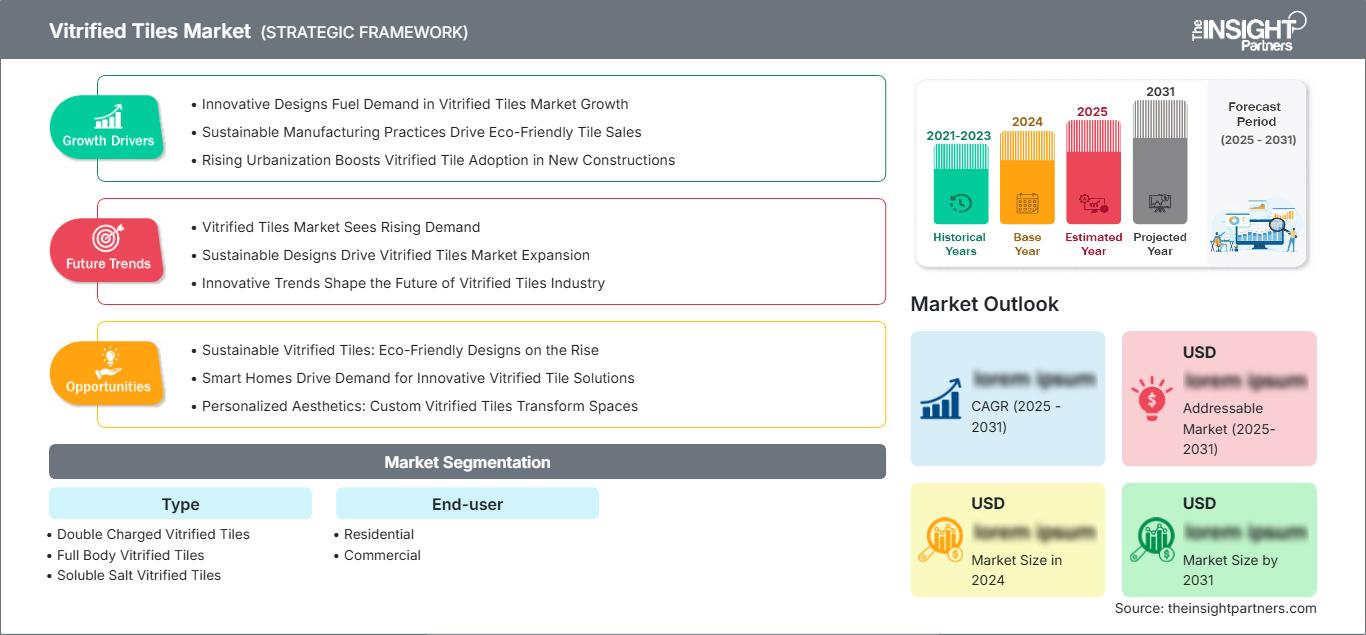
Vitrified Tiles Market Assessment and Insights
- North America: The region accounted for an estimated 24–27% share in 2025 and is expected to expand at a CAGR of 4.6–5.1% during 2026–2034, led by remodeling, multifamily housing, and commercial refurbishment.
- U.S.: The U.S. represented 78–82% of North America demand in 2025 and is projected to grow at 4.7–5.2% CAGR, supported by replacement flooring and retail construction.
- Europe: Europe held an estimated 20–23% share in 2025 and is expected to grow at 4.2–4.8% CAGR, with Italy, Spain, Germany, and the UK shaping premium product adoption.
- Asia Pacific: Asia Pacific held 38–42% share in 2025 and is likely to grow at 6.2–6.8% CAGR, driven by India, China, Vietnam, and Indonesia construction demand.
- Largest Segment: Glazed Body Vitrified Tile held 44–48% market share in 2025 and is projected to grow at 5.8–6.3% CAGR, supported by design flexibility.
- High Growth Segment: Commercial end-user demand held 35–39% share in 2025 and is projected to grow at 6.0–6.6% CAGR as retail and hospitality projects expand.
- Key companies analyzed in detail: Asian Granito India Ltd., ALTAECO S.p.A., ABK Group Industrie Ceramiche S.p.A., Ceramica Carmelo Fior, Casalgrande Padana S.p.A., Grupo Lamosa, Mohawk Industries, Inc., PT Arwana Citramulia Tbk, RAK Ceramics PJSC, and The Siam Cement Public Company Limited.
Source: The Insight Partners' analysis based on proprietary research, government publications, company annual reports, investor presentations, industry databases, and expert interviews.
Vitrified Tiles Market Trends
Low-Carbon Manufacturing Systems
Vitrified tiles market trends will increasingly reflect pressure to reduce emissions from firing, drying, and material preparation. It is also anticipated that manufacturers will have to invest in technologies of heat recovery, alternative fuel usage, optimal loading of kilns and use of recycled raw materials. There will be increased demand for sustainability information from purchasers of ceramic tiles for commercial and institutional buildings, where green building certification impacts procurement decisions. Such developments may benefit manufacturers who have environmental data and modern kilns.
Large-Format Decorative Surfaces
The large slabs will continue to be a major direction for products since they allow for the reduction of grouting and an increase in continuity. They will continue to find applications not only in floorings but also in walls, counters, reception rooms and any other spaces adjacent to facades. The manufacturers that have better capabilities in terms of pressing, handling and logistics will enjoy advantages in such situations when controlling the breakages and providing necessary training to installers becomes more crucial.
Vitrified Tiles Market Growth Factors
Urban Housing and Renovation Demand
Urbanization trends, smaller family setups, and increasing renovation expenses have ensured that there is a sustainable demand base for vitrified floors. Consumers are now inclined towards products that give the same look as marble and stone flooring but do not require the same maintenance issues as the natural materials. The factor has proven especially important in apartments, kitchens, bathrooms, balconies, and living rooms. This ensures more SKU variety for the producers along with prompt replenishment and design offerings by the dealerships.
Commercial Construction and High-Traffic Flooring Needs
The commercial building has a need for floor coverings that are durable and able to withstand constant usage and maintenance. This has been made possible by vitrified tiles that have the advantage of low porosity and dimensionality. The increasing demand for these tiles in such sectors as hotels, hospitals, educational institutions, airports, office blocks, and shopping centers has created stability in the demand regardless of residential cycles.
Manufacturing Technology and Design Innovation
Due to advancements in digital printing, improved chemistry of glazing, and larger-size pressing, there is an enhanced versatility in the functionality and appearance of vitrified tiles. There is now a capability of providing stones, cement, wood effects, etc., at various price levels. This makes vitrified tiles more competitive compared to laminates, vinyl, and natural stones. Due to technological advancement, there is greater consistency in shade, fewer defects, and faster design cycles.
Vitrified Tiles Market Opportunities
Project-Led Commercial Specification
Opportunities for project-based selling lie with developers, architects, and contractors looking for assured quality and timely deliveries. Companies that give technical data sheets, slip test information, installation advice, and consistent color batches can land bulk orders in the commercial sector. Such opportunities are available in retail chains, hotels, education buildings, healthcare institutions, and infrastructure projects linked with transit. Companies can increase their conversion rates by creating specification teams, samples, and databases to facilitate product selection in the design phase.
Digital Retail and Visualization Tools
Digital visualization technology has the potential to decrease time taken when making decisions in relation to residential and commercial buyers who purchase in smaller amounts. The process of tile selection is extremely visual and there is the use of augmented reality software, room planners, and catalogs to help buyers make comparisons between various finish types, sizes, and layout designs. There is a chance to create an omnichannel selling approach.
Segmentation Analysis
Type
Type is projected to grow at 5.5–6.1% CAGR during 2026–2034, reflecting the broad vitrified tiles market scope across economical, decorative, and high-performance formats. Product differentiation is increasingly tied to surface finish, body strength, design realism, and suitability for residential or commercial installation environments.
- Double Charged Vitrified Tiles: These tiles retain relevance in price-sensitive flooring projects where abrasion resistance, glossy appearance, and cost control are important for housing, small offices, and institutional spaces.
- Full Body Vitrified Tiles: Full body products are preferred for high-traffic areas because color consistency across the tile body helps reduce visible wear in airports, malls, and public buildings.
- Soluble Salt Vitrified Tiles: Soluble salt variants serve budget-oriented demand, particularly in smaller residential projects, where basic aesthetics, availability, and affordable installation remain primary purchase considerations.
- Glazed Body Vitrified Tile: Glazed body vitrified tile leads adoption because digital decoration supports marble, stone, wood, and concrete looks while maintaining durability for residential and commercial spaces.
End-user
End-user demand is projected to grow at 5.6–6.2% CAGR during 2026–2034. Residential use remains the volume base, while commercial projects are expanding faster as owners prioritize surfaces that combine design consistency, long replacement cycles, and easier cleaning in high-traffic settings.
- Residential: Residential demand benefits from apartment construction, home renovation, kitchen upgrades, and bathroom remodeling, with consumers selecting vitrified tiles for aesthetic choice and low maintenance.
- Commercial: Commercial adoption is rising across malls, hotels, offices, healthcare facilities, and transit projects, where flooring must withstand traffic while supporting consistent brand and interior design standards.
Opportunity Snapshot
| End-user | Revenue Contribution | Trend Tag | Adoption Stage |
|---|---|---|---|
| Residential | High | Renovation Demand | Mature |
| Commercial | Medium | Hospitality Fitout | Scaling |
Regional Insights
North America vitrified tiles market
North America is expected to hold 24–27% vitrified tiles market share in 2025, with growth at 4.6–5.1% CAGR during 2026–2034. The market demand is mainly driven by projects that involve remodeling of existing buildings and includes renovations of flooring, hospitality renovations and washroom upgrades. There is an increasing popularity of large-format glazed materials as there are fewer grout lines in such installations and better visual continuity. The choice is also affected by the safety rating and cleaning efficiency of the material.
U.S. vitrified tiles market
The U.S. represented 78–82% of North America demand in 2025 and is expected to grow at 4.7–5.2% CAGR. The areas of multifamily housing, retail renovations, healthcare buildings, and hospitality districts have been some of the main applications in which the use of tile has cost benefits relative to soft floor coverings.
A business profile is built on the existence of large distributors, contractors, and design centers for specifications. Market need is high for body vitrified glazed tiles, matt finish, and stone looks.
Europe vitrified tiles market
Europe held 20–23% share in 2025 and is expected to grow at 4.2–4.8% CAGR. The influence of Italy and Spain in manufacturing and design is still significant, and Germany and the UK are reliable markets for renovations. France, Italy, and Spain will keep influencing the design-driven adoption of tiles in residential and commercial interior spaces.
Energy efficiency, the use of recycled materials, and environmentally friendly products are becoming increasingly important in procurement processes. High-quality suppliers in Europe have the advantage of being specified by architects, exporting their reputation abroad, and offering innovative surface designs.
APAC vitrified tiles market
APAC accounted for 38–42% share in 2025 and is projected to grow at 6.2–6.8% CAGR. China remains a major production base, while India is a leading market for consumption and export growth. Japan, South Korea, Australia, and Southeast Asia support demand through renovation and commercial construction.
Policy-led infrastructure, urban housing, and organized retail expansion support the vitrified tiles market trends across APAC. Manufacturers are increasing capacity for glazed vitrified tiles and larger formats while competing on price, design variety, and dealer network reach.
Middle East & Africa vitrified tiles market
The Middle East & Africa is expected to grow at 5.4–6.0% CAGR through 2034, supported by Saudi Arabia, the UAE, South Africa, and the rest of MEA. Tourism, mixed-use developments, and public infrastructure create demand for durable flooring in high-temperature and high-traffic settings.
UAE and Saudi Arabia lead specification activity due to hospitality, residential towers, and commercial masterplans. Demand favors stain-resistant, polished, and matte vitrified surfaces that match premium interiors while meeting performance requirements for malls, hotels, and institutional buildings.
Vitrified Tiles Market Report Scope
| Report Attribute | Details |
|---|---|
| Market size in 2025 | US$ 10.04 Billion |
| Market Size by 2034 | US$ 16.55 Billion |
| Global CAGR (2026 - 2034) | 5.72% |
| Historical Data | 2021-2024 |
| Forecast period | 2026-2034 |
| Segments Covered | Type, End-user |
| Region scope | North America, Europe, Asia-Pacific, South and Central America, Middle East and Africa |
Frequently Asked Questions

Recent Reports






