
Water Cut Monitors Market Trends, Size & Growth by 2034
Coverage: by Sector (Upstream, Downstream, Midstream); Location (Onshore, Offshore); Application (Well Testing, Refinery, Tank Farm and Pipeline, Multiphase Flow Meters (MPFM), Separation Vessel, Lease Automatic Custody Transfer (LACT), Others) , and Geography (North America, Europe, Asia Pacific, and South and Central America)
- Status : Data Released
- Report Code : TIPRE00008888
- Category : Manufacturing and Construction
- No. of Pages : 150
- Available Report Formats :


- Last update date : September 28, 2026


2025 Market Size
US$ 279.17 Mn
Base year value
2034 Forecast
US$ 433.57 Mn
Projected by 2034
CAGR 2026-2034
5.01 %
Growth rate
Addressable Market
US$ 3,233.84 Mn
(2026-2034)
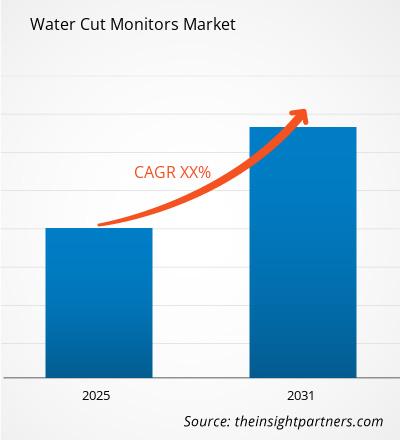
The water cut monitors market measures the water content present in hydrocarbon streams and supports production, separation, transportation, refining, and custody-transfer decisions. The market was valued at US$ 279.17 Million in 2025 and is projected to reach US$ 433.57 Million by 2034, expanding at a CAGR of 5.01% from 2026 to 2034 as operators prioritize continuous fluid-quality measurement and production efficiency.
Water Cut Monitors Market size remains significant in North America, with the regional market expected to expand at a CAGR of 4.8–5.8% between 2026 and 2034. Mature shale operations, brownfield modernization activities, stringent measurement requirements, and expanding digital production surveillance are supporting adoption across upstream oil and gas operations. Demand is particularly strong where operators seek continuous, real-time measurement capabilities rather than relying on periodic laboratory sampling, helping improve production efficiency, process control, and asset performance.
Water Cut Monitors Market Assessment and Insights
- North America: The region is estimated to represent 34–38% share in 2025 and is expected to grow at a 4.8–5.8% CAGR between 2026–2034, supported by shale production, mature assets, and measurement modernization.
- US: The US is estimated to account for 70–75% of North America share in 2025, expanding at a 4.9–5.9% CAGR between 2026–2034 as unconventional production sustains monitoring demand.
- Europe: Europe is estimated at 22–26% share in 2025, with a 4.3–5.3% CAGR between 2026–2034. Norway, the UK, Germany, France, Italy, and Spain support demand through offshore production and refining infrastructure.
- Asia Pacific: Asia Pacific is estimated at 18–22% share in 2025 and a 5.5–6.5% CAGR between 2026–2034, led by China, Japan, India, South Korea, and Australia amid refinery expansion and upstream investment.
- Largest Segment: Onshore is estimated at 63–67% market share in 2025, with a 4.4–5.4% CAGR between 2026–2034, reflecting its broad installed base across producing fields.
- High Growth Segment: Offshore is estimated at 33–37% market share in 2025, with a 7.0–8.0% CAGR between 2026–2034, supported by complex offshore production and remote monitoring needs.
- Key companies analyzed in detail: Agar Corporation, AMETEK, Inc., Delta C Technologies, Emerson Electric Co., LEMIS Process, M-Flow Technologies Ltd., Phase Dynamics, Inc., Sensia LLC, Sentech AS, and ZelenTech Pte Ltd.
Source: The Insight Partners' analysis based on proprietary research, government publications, company annual reports, investor presentations, industry databases, and expert interviews.
The water cut monitors market has evolved from sampling-led measurement toward continuous inline sensing, driven by improvements in microwave, capacitance, impedance, and density-based techniques. Production environments increasingly require faster identification of changing water fractions, while digital transmitters and control-system integration improve operational visibility. Equipment design is also shifting toward lower-maintenance architectures suitable for difficult field conditions and brownfield retrofits.
The Water Cut Monitors Market report indicates that, over the forecast period, adoption is expected to broaden across emerging production hubs and aging assets requiring improved production surveillance. It can be predicted that offshore applications will tend towards compact measurement, remote diagnosis, and lower intervention needs. Operators of refineries and pipelines are projected to value instruments that facilitate quality control, custody transfer, and decisions about operations. Regulatory focus on measuring accuracy, combined with investments in production optimization and digital measurement technologies, creates another tailwind for industry growth.
Water Cut Monitors Market Report Scope
| Report Attribute | Details |
|---|---|
| Market size in 2025 | US$ 279.17 Million |
| Market Size by 2034 | US$ 433.57 Million |
| Global CAGR (2026 - 2034) | 5.01% |
| Historical Data | 2021-2024 |
| Forecast period | 2026-2034 |
Water Cut Monitors Market Analysis
Demand is closely related to oil and gas production volumes, management of water cut through, effectiveness of separation and custody transfer requirements. This eco-system includes manufacturers of sensors, measurement of flow metering devices, engineering companies, system integration providers, operating companies, refineries, and pipeline companies. In-line monitoring will help decrease reliance on sampling techniques and get quick information about separation and treatment processes.
The water cut monitors market growth is also influenced by the increasing complexity of mature fields. As water production rises during field maturation, accurate fluid characterization becomes more important for maintaining net-oil output and avoiding unnecessary treatment costs. Suppliers therefore compete on measurement stability, installation flexibility, calibration requirements, operating range, and compatibility with existing supervisory control and data acquisition infrastructure.
Water Cut Monitors Market forecast indicates that competition includes diversified automation companies and specialist measurement providers. The Emerson Electric Co. offers water-cut measuring instruments along with more general flow, process, and automation systems, whereas the AMETEK, Inc. takes part through measuring instruments connected with the Drexelbrook range. The Agar Corporation, Phase Dynamics, Inc., LEMIS Process, Delta C Technologies, M-Flow Technologies Ltd., Sensia LLC, Sentech AS, and ZelenTech Pte Ltd. offer specialized or complementary services in production and hydrocarbon measurement applications.
In recent years, the focus of investments has been on easy-to-install instruments, digital communication, calibration capabilities, and application engineering. Consequently, the competitive advantage is not anymore defined by the sensor itself but rather the capability of incorporating measurement within the production process. Broadly covered service providers can cover commissioning, diagnostics, maintenance, and analysis of data, whereas specialists can stand out through sensitivity, response times, or customized measurements.
● REPORT CUSTOMIZATION
Tailor This Report To Align With Your Specific Business Requirements
This report can be customized to align precisely with your business objectives, scope, and target markets. Customization options include tailored segmentation, geography, competitive analysis, and strategic insights to support informed decision-making.
Customize This Report →WHAT YOU CAN ADJUST
- ● Segmentations
- ● Geography
- ● Competitive Analysis
- ● Language Preferences
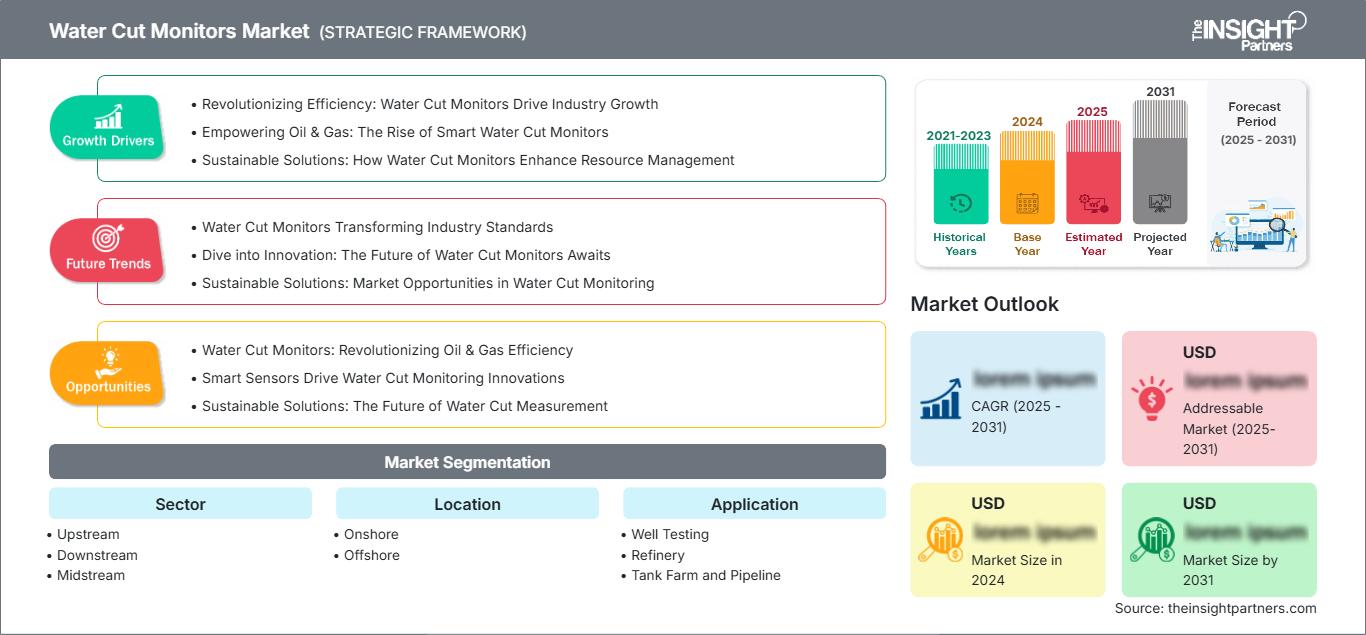
Water Cut Monitors Market: Strategic Insights
Regional Insights
North America water cut monitors market
North America is estimated to hold 34–38% share of the water cut monitors market in 2025 and expand at a 4.8–5.8% CAGR between 2026–2034. United States continues to be the major demand driver since there are plenty of measurement points in the processes of shale gas and conventional production. Canada offers demand due to the oil-sands and conventional production processes, while Mexico offers more upstream and refinery applications.
Regional demands are influenced by brownfield upgrade and the need for improved visibility into production without too much disruption of the process itself. Operators have become increasingly interested in inline solutions that are capable of feeding production control platforms and enabling quick detection of changing fluid properties. Established presence of instrumentation vendors, engineering companies, and oil field services eliminates any possible barriers.
U.S. water cut monitors Market
The US is estimated to represent 70–75% of North America water cut monitors market share in 2025 and is expected to grow at a 4.9–5.9% CAGR between 2026–2034. Good non-conventional production, mature conventional reservoirs, and substantial pipeline networks give rise to diverse measurement needs throughout the supply chain.
The company’s geographical reach is extensive, with Emerson Electric Co., AMETEK, Inc., Agar Corporation, Phase Dynamics, Inc., and other specialized suppliers catering to production and hydrocarbon measurement applications. Well testing and separation applications continue to play an important role, whereas pipeline and lease measurement applications will continue to benefit from reliable water content data. Remote monitoring and digital production have increased the need for instrumentation that can transmit process data.
Europe water cut monitors Market
Europe is estimated at 22–26% share of the water cut monitors market in 2025, with a 4.3–5.3% CAGR between 2026–2034. Norway is the key market for the region owing to the presence of offshore operations, whereas the UK continues to be significant owing to its mature offshore operations in the North Sea.
The UK market concentrates on offshore safety, compact solutions, and measurement solutions for the aging platforms. The German market is driven by the presence of refineries, process industries, and engineering expertise. The French market needs are driven by refinery needs and presence of industrial instrumentation systems, whereas Italy and Spain need products for refineries, tank farms, pipelines, and terminals.
APAC water cut monitors Market
APAC is estimated to represent 18–22% of the water cut monitors market share in 2025 and expand at a 5.5–6.5% CAGR between 2026–2034. China ranks first in the market, while other top-ranking markets include Japan, India, South Korea, and Australia. Refining, off-shore production, and pipelines enable the above factors.
Technological development and energy security are driving the need for advanced measurement systems in regional hydrocarbons. China gains an advantage through its refining capabilities, India through increased energy infrastructure, and Australia through off-shore and LNG-related production. Refining and process engineering help Japan and South Korea add value. Increasingly, demand relates to digital control systems and asset management.
Middle East & Africa water cut monitors Market
Middle East & Africa water cut monitors market is expected to expand at a 6.5–8.0% CAGR between 2026–2034, making it one of the faster-growing regional markets. The main sources of demand would be Saudi Arabia, as well as the UAE, through its investment in the upstream, midstream, and downstream segments.
Other countries include South Africa and MEA, again through refineries, storage, and process industries. Oil production from mature oil fields, enhanced recovery projects, newer production projects, and export terminals make it necessary to monitor the water content accurately. This is because of the tough operating conditions where robust measuring systems are required.
Segmentation Analysis
Sector
Water Cut Monitors Market trends indicate that the Sector segment is divided into Upstream, Downstream, and Midstream and is expected to expand across all three value-chain positions. Upstream applications remain central because water breakthrough directly affects production performance and reservoir management, while downstream and midstream demand benefits from refinery quality control, storage, transportation, allocation, and custody-transfer requirements. The sector segment is modeled at a CAGR of 4.7–5.7% from 2026–2034, supported by increasing emphasis on measurement accuracy, operational efficiency, and production optimization across hydrocarbon value chains.
- Upstream: Production optimization, separator control, well testing, and water breakthrough monitoring sustain demand. Continuous measurement helps operators distinguish changing water production from normal process variation and supports faster production-management decisions.
- Downstream: Refineries and terminals use monitoring for crude quality, desalting, offloading, and pipeline control. Measurement reliability is strategically important because excess water can influence treatment efficiency, product handling, and equipment performance.
- Midstream: Gathering, transportation, storage, and custody-transfer operations require consistent water-content information. Integration with flow computers and supervisory systems improves allocation accuracy and supports operational control at transfer points.
Location
Location comprises Onshore and Offshore and reflects installation environment, accessibility, production configuration, and operating complexity. Onshore remains the largest deployment category, while offshore projects require higher emphasis on compactness, reliability, remote diagnostics, and reduced maintenance. The location segment is modeled at a 5.0–6.0% CAGR from 2026–2034.
- Onshore: Onshore installations benefit from extensive producing-field infrastructure and comparatively accessible maintenance conditions. Demand is supported by shale operations, mature fields, gathering networks, separators, and lease-based measurement requirements.
- Offshore: Offshore adoption is strategically important where intervention costs are high and equipment must tolerate demanding conditions. Compact inline monitoring can support production surveillance while reducing dependence on frequent manual sampling or platform intervention.
Application
Application includes Well Testing, Refinery, Tank Farm and Pipeline, Multiphase Flow Meters, Separation Vessel, and Lease Automatic Custody Transfer. Application demand is driven by the need for timely water-content information at production, processing, and transfer points. The application segment is modeled at a 5.1–6.1% CAGR from 2026–2034.
- Well Testing: Water-content monitoring helps characterize changing well performance and supports production decisions. Reliable continuous readings are especially valuable where water breakthrough or variable fluid properties complicate conventional sampling.
- Refinery: Refinery applications emphasize crude quality, desalting, and process stability. Monitoring supports earlier identification of water-related deviations before they propagate into downstream treatment or equipment issues.
- Tank Farm and Pipeline: Storage and transportation facilities require consistent quality information during movement and transfer. Monitoring can strengthen operational controls where water contamination affects commercial or processing decisions.
- Multiphase Flow Meters: Water-cut information complements multiphase measurement by improving phase characterization. Integration can support production allocation and surveillance where oil, gas, and water move together.
- Separation Vessel: Monitoring around separators helps operators evaluate phase separation and manage changing water conditions. It can support more responsive process control and reduce reliance on periodic manual measurements.
- Lease Automatic Custody Transfer: LACT applications require dependable water-content information for crude quality and transfer calculations. Continuous monitoring can improve operational consistency at high-value transaction points.
Opportunity Snapshot
| Application | Revenue Contribution | Trend Tag | Adoption Stage |
| Well Testing | High | Production Surveillance | Mature |
| Refinery | High | Crude Quality | Mature |
| Tank Farm and Pipeline | High | Transfer Quality | Scaling |
| Multiphase Flow Meters | Medium | Phase Analytics | Scaling |
| Separation Vessel | High | Separator Control | Mature |
| Lease Automatic Custody Transfer | High | Fiscal Measurement | Mature |
Water Cut Monitors Market Growth Drivers and Impact Analysis
Rising Water Production in Mature Hydrocarbon Assets
Growing water production in mature oilfields represents a structural trend, because increased water management capability may lead to reduced effective hydrocarbon production and greater need for separation, treatment, pumping, and disposal. Monitoring gives operators quicker access to water content information, which allows for proactive action of the production department to prevent the deviation from becoming a problem for the process. The importance of the effect is high, especially in mature fields, where there may be great variations in water breakthrough from one well to another and from one period to another. Measurement can also assist field monitoring by providing consistent data for production allocation and well performance analysis. With operators trying to extend the lifetime of their assets while managing their operating costs, equipment providing accurate water content measurement without complex sample collection infrastructure will be more in favor.
Expansion of Automated Production and Process Control
Continuous fluid measurement is gaining more importance because operators are now making use of SCADA systems, distributed control systems, flow computers, and optimization software by connecting the field devices with them. Data collected from the water-content metering device can be made into actionable data as opposed to being just measurements, and fluid condition information can be compared with that of pressure, temperature, flow rate, and separator performance. This type of connectivity will lead to fast reaction times as well as a reduction in the reliance on manual readouts. Moreover, centralization of monitoring is possible even for remotely located equipment, especially onshore production systems. In this way, vendors offering digital capability, diagnostic ability, calibration services, and communications will have an opportunity beyond selling hardware.
Growing Measurement Requirements Across Transfer and Processing Points
Measurement of water content has become very significant where custody transfer takes place, crude oil enters processing equipment, or travels through any other infrastructure meant for storage and transportation purposes. The presence of water may affect the quality of crude oil, its processing needs, equipment performance, and commercial aspects, thus making the process of measuring water content significantly important not only at the point of production but also at other points along the way. Thus, there is a large number of potential customers from lease facilities, pipelines, tank farms, refineries, separators, multiphase meters, etc. Hence, the choice of instruments will be based on criteria such as repeatability, installation considerations, calibration procedures, range of operation, integration capabilities, and others, and not on their cost alone.
Water Cut Monitors Market Future Trends
Integration of Water-Content Measurement with Intelligent Field Analytics
In future, it is probable that such systems would incorporate water content measurements in addition to flow rate, pressure, temperature, density, and production history data, allowing more context-oriented operational information. Instead of providing just one water fraction reading, such systems will be able to recognize abnormalities and make abnormal situations a priority for operator analysis. It should also help in promoting devices that have open communication, high sampling frequency, and diagnostic features. Analytics will also help in recognizing water breakthrough and separation problems, based on historical data. In the long run, the benefit of such technology would lie in information rather than in the accuracy of readings. It may mean that suppliers could enhance their differentiation by improving software connectivity rather than by developing innovative measurement solutions.
Broader Measurement Ranges for Variable Fluid Conditions
Varied water regimes among production assets will lead to broader measurement ranges and increased adaptiveness in sensing architectures. Early wells can work on low water cut, whereas mature assets may be working on high water cut and varying flow regimes. Devices that can cope with such a transition will lower the need for additional measurement configuration when the conditions change during the production phase. Adaptive calibration, density adjustment, improved signal processing, and automatic mode operation should become key considerations when purchasing such devices. It is particularly pertinent to this development where costly interventions are required, as in the case of offshore platforms and mature fields. Increased application flexibility would allow the use of such devices not only in upstream applications but also in midstream and downstream operations.
Water Cut Monitors Market Opportunities
Brownfield Retrofit Programs for Mature Production Facilities
Modernization of brownfields is a promising avenue to pursue as most of the existing production assets have facilities for flow, separation, and control but do not have continuous water content measurements at all the critical points. In such projects, improvements could be made at the outlet of the separators, well testing, gathering pipelines, tanks, and loading terminals, where increased visibility will result in operational gains without upgrading the process. Providers should support the development of such opportunities through compact design, easy commissioning, digital interface, calibration, and compatibility with proven control systems. The commercial opportunity is even more promising where old oil fields need gradual investment rather than new greenfield developments.
Integrated Measurement Packages for Offshore and Export Infrastructure
Production and export infrastructure provide the chance for vendors who can integrate water content measurement into more comprehensive flow and quality measurement solutions. More and more, operators are looking to have fewer intervention points, better remote visibility capabilities, and technology that is able to operate with limited accessibility in mind. Comprehensive solutions could incorporate water cut measurement, flow measurement, density measurements, sampling, communication, and diagnostics, all based on a common data structure. In addition, such solutions could potentially make the engineering simpler and minimize the number of different interfaces that need to be maintained by the operator. Export pipelines, offshore loading systems, and production separators are among those that have an interest here since measurement accuracy can affect decision-making and transfer processes. Partnership with engineering and system integration companies could help suppliers get involved in projects sooner.
Frequently Asked Questions

- Comprehensive Market Sizing and Forecast Analysis
- Detailed Segmentation Analysis
- In-Depth Market Dynamics Assessment
- Regional and Country-Level Insights
- Competitive Landscape and Company Benchmarking
- Strategic Business Intelligence
Recent Reports
Testimonials

The Insight Partners' SCADA System Market report is comprehensive, with valuable insights on current trends and future forecasts. The team was highly professional, responsive, and supportive throughout. We are very satisfied and highly recommend their services.
RAN KEDEM Partner, Reali Technologies LTDs
I requested a report on a very specific software market and the team produced the report in a few days. The information was very relevant and well presented. I then requested some changes and additions to the report. The team was again very responsive and I got the final report in less than a week.
JEAN-HERVE JENN Chairman, Future Analytica
We worked with The Insight Partners for an important market study and forecast. They gave us clear insights into opportunities and risks, which helped shape our plans. Their research was easy to use and based on solid data. It helped us make smart, confident decisions. We highly recommend them.
PIYUSH NAGPAL Sr. Vice President, High Beam Global
The Insight Partners delivered insightful, well-structured market research with strong domain expertise. Their team was professional and responsive throughout. The user-friendly website made accessing industry reports seamless. We highly recommend them for reliable, high-quality research services
YUKIHIKO ADACHI CEO, Deep Blue, LLC.
This is the first time I have purchased a market report from The Insight Partners.While I was unsure at first, I visited their web site and felt more comfortable to take the risk and purchase a market report.I am completely satisfied with the quality of the report and customer service. I had several questions and comments with the initial report, but after a couple of dialogs over email with their analyst I believe I have a report that I can use as input to our strategic planning process.Thank you so much for taking the extra time and making this a positive experience.I will definitely recommend your service to others and you will be my first call when we need further market data.
JOHN SUZUKI President and Chief Executive Officer, Board Director, BK Technologies
I wish to appreciate your support and the professionalism you displayed in the course of attending to my request for information regarding to infectious disease IVD market in Nigeria. I appreciate your patience, your guidance, and the fact that you were willing to offer a discount, which eventually made it possible for us to close a deal. I look forward to engaging The Insight Partners in the future, all thanks to the impression you have created in me as a result of this first encounter.
DR CHIJIOKE ONYIA MANAGING DIRECTOR, PineCrest Healthcare Ltd.Reason to Buy
- Informed Decision-Making
- Understanding Market Dynamics
- Competitive Analysis
- Identifying Emerging Markets
- Customer Insights
- Market Forecasts
- Risk Mitigation
- Boosting Operational Efficiency
- Strategic Planning
- Investment Justification
- Tracking Industry Innovations
- Aligning with Regulatory Trends





 Get Free Sample for