
Water jet Cutting Machines Market Growth, Trends & Demand by 2034
Coverage: by Product Type (Robotic Water jet Cutting Machines, 3D Water jet Cutting Machines, Micro Water jet Cutting Machines); Application (Foam Product Cutting, Gasket Cutting, Fiberglass Cutting, Ceramic/Stone Cutting, Glass/Metal Art, Exotic Metal and Non-Traditional Material Cutting); Industry Vertical (Electronics, Metal Fabrication, Automotive, Aerospace, Food Processing, Machine Manufacturing, Others) , and Geography (North America, Europe, Asia Pacific, and South and Central America)
- Status : Data Released
- Report Code : TIPRE00006994
- Category : Manufacturing and Construction
- No. of Pages : 150
- Available Report Formats :


- Last update date : September 28, 2026


2025 Market Size
US$ 1.83 Bn
Base year value
2034 Forecast
US$ 2.99 Bn
Projected by 2034
CAGR 2026-2034
5.61 %
Growth rate
Addressable Market
US$ 21.85 Bn
(2026-2034)
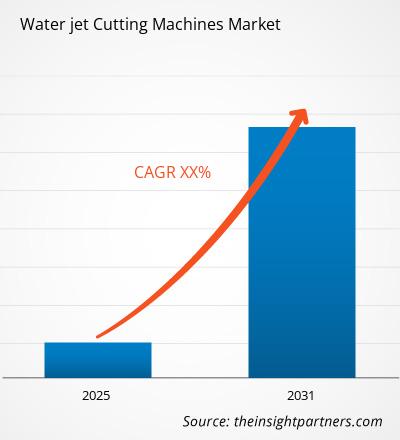
The water jet cutting machines market is projected to grow from US$ 1.83 Billion in 2025 to US$ 2.99 Billion by 2034, registering a CAGR of 5.61% during 2026–2034. Demand is supported by adoption in metal fabrication, automotive, aerospace, electronics, machine manufacturing, food processing, and specialty material cutting, where cold cutting, reduced thermal distortion, high edge quality, and flexible processing are essential.
North America remains a major demand center for the water jet cutting machines market size expansion, supported by established aerospace clusters, automotive tooling, EV component production, defense manufacturing, and precision job shops. The region is expected to grow at a CAGR of 5.2–5.6% during 2026–2034 as fabricators invest in multi-axis systems, automation-ready platforms, and waterjet systems that reduce secondary machining.
Water jet Cutting Machines Market Assessment and Insights
- North America: North America accounted for 33–35% share in 2025 and is expected to grow at a CAGR of 5.2–5.6% during 2026–2034, led by aerospace, automotive, and precision fabrication demand.
- US: The US represented 78–82% of North America revenue in 2025 and is expected to grow at a CAGR of 5.3–5.7% during 2026–2034.
- Europe: Europe held 25–27% share in 2025 and is expected to expand at a CAGR of 4.8–5.2% during 2026–2034, with Germany, the UK, France, Italy, and Spain leading demand.
- Asia Pacific: Asia Pacific captured 28–31% share in 2025 and is projected to grow at a CAGR of 6.0–6.5% during 2026–2034, supported by China, Japan, South Korea, India, and Australia.
- Largest Segment: Metal fabrication held 27–30% market share in 2025 and is expected to grow at a CAGR of 5.3–5.8% during 2026–2034.
- High Growth Segment: Aerospace held 10–13% market share in 2025 and is expected to grow at a CAGR of 6.2–6.8% during 2026–2034.
- Key companies analyzed in detail: A Innovative International Ltd, Flow International Corporation, Hornet Cutting Systems, Hypertherm Associates, Jet Edge, Inc., KMT Waterjet, Koike Aronson, Inc., OMAX Corporation, Resato International B.V., and Semyx.
Source: The Insight Partners' analysis based on proprietary research, government publications, company annual reports, investor presentations, industry databases, and expert interviews.
Manufacturing users have shifted from basic two-axis cutting tables toward high-pressure, software-enabled, robotic, 3D, and micro waterjet systems. The water jet cutting machines market growth is linked to demand for precise cutting of hardened steel, aluminum, titanium, composites, ceramics, glass, rubber, stone, and engineered plastics without heat-affected zones. Automation, abrasive recycling, pump efficiency, and real-time monitoring are changing equipment selection across fabrication environments.
Future demand will be shaped by industrial reshoring, aerospace production recovery, EV part complexity, semiconductor manufacturing, and architectural stone processing. Investment is also moving toward enclosed machines, low-pressure piercing, 5-axis heads, and connected software. Regulatory emphasis on worker safety, reduced thermal emissions, and lower material waste strengthens the case for waterjet systems in precision manufacturing, according to the Water Jet Cutting Machines Market report.
Water jet Cutting Machines Market Report Scope
| Report Attribute | Details |
|---|---|
| Market size in 2025 | US$ 1.83 Billion |
| Market Size by 2034 | US$ 2.99 Billion |
| Global CAGR (2026 - 2034) | 5.61% |
| Historical Data | 2021-2024 |
| Forecast period | 2026-2034 |
Water jet Cutting Machines Market Analysis
Demand is reinforced by flexible material processing across metals, composites, foam, rubber, glass, ceramics, stone, and non-traditional materials. Fabricators are adopting waterjet technology where laser or plasma cutting may create heat-affected zones, burrs, microcracking, or post-processing costs. The water jet cutting machines market analysis indicates that systems with improved CNC controls, high-pressure pumps, abrasive management, and nesting software are becoming central to productivity improvement.
The value chain consists of machine builders, pump providers, abrasives providers, software developers, distributors, service providers, fabricators, OEMs and industrial users. Supply considerations consist of precision components, pump performance, availability of abrasives and after-sales service. Buyers are focusing on machine uptime, training, remote diagnosis, safety, and low cost of ownership rather than machine price.
Competitive positioning is based on technology portfolio, software capabilities, service reach, and capacity to serve compact job shops as well as industrial production lines. Flow International Corporation, Hypertherm Associates, OMAX Corporation, KMT Waterjet, Resato International B.V., and Jet Edge, Inc. compete in terms of pump development, multiple-axis cutting, controls, and applications support.
Investments are now concentrated in closed systems, automation of abrasive retrieval systems, fabrication processes integration and cutting cells robotics. Hornet Cutting Systems, Koike Aronson, Inc., Semyx and A Innovative International Ltd specialize in application-specific machines where customization, gantry size, robustness of machines and promptness of service are essential.
● REPORT CUSTOMIZATION
Tailor This Report To Align With Your Specific Business Requirements
This report can be customized to align precisely with your business objectives, scope, and target markets. Customization options include tailored segmentation, geography, competitive analysis, and strategic insights to support informed decision-making.
Customize This Report →WHAT YOU CAN ADJUST
- ● Segmentations
- ● Geography
- ● Competitive Analysis
- ● Language Preferences
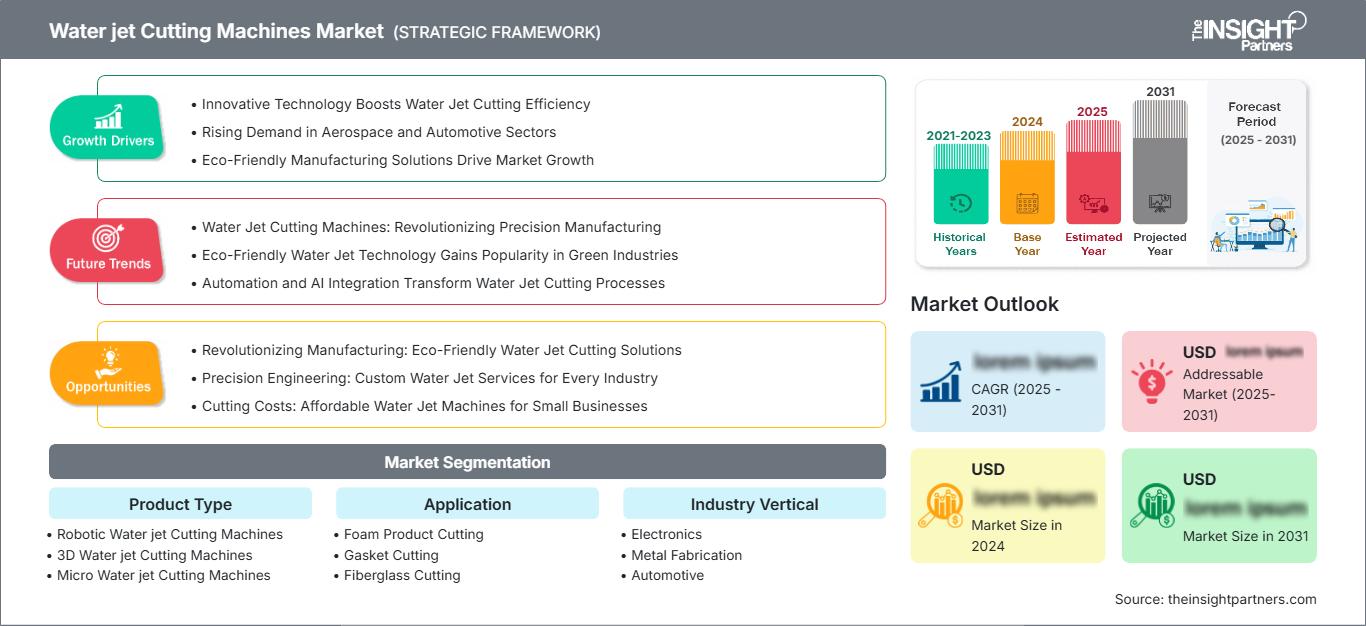
Water jet Cutting Machines Market: Strategic Insights
Regional Insights
North America Water Jet Cutting Machines Market
North America held 33–35% water jet cutting machines market share in 2025 and is expected to grow at a CAGR of 5.2–5.6% during 2026–2034. Aerospace-grade metals, defense components, EV parts, fabricated structures, and industrial repair work support machine demand. The region benefits from established job shop networks and early adoption of high-pressure cutting platforms.
Demand is supported by the replacement of older cutting systems, automation upgrades, and the rising need for mixed-material production. Fabricators are using waterjet systems to cut titanium, stainless steel, aluminum, composites, glass, and stone while minimizing thermal distortion. Strong service networks and domestic manufacturing investment improve adoption visibility.
U.S. Water Jet Cutting Machines Market
The US accounted for 78–82% of North America Water Jet Cutting Machines Market revenue in 2025 and is expected to record a CAGR of 5.3–5.7% during 2026–2034. Applications like automotive tooling, aerospace components, energy parts, architectural fabrication, and defense procurements maintain a consistent need for waterjet machines. Our company is well-established in machine manufacturing, software, pump manufacturing, and service.
Our technology has gained popularity among smaller and medium-sized fabrication shops that require versatile systems in order to produce low-volume-high-mix products. Precision machining of gaskets, composites, stone, metal art, and exotic metals drives the need for continued purchase.
Europe Water Jet Cutting Machines Market
Europe represented 25–27% share of the Water Jet Cutting Machines Market in 2025 and is expected to grow at a CAGR of 4.8–5.2% during 2026–2034. Germany spearheads regional adoption via auto engineering, machine building, aerospace supply chain components, and metalworking technology. The UK sustains adoption through the defense sector, aerospace maintenance, composites cutting, and special fabrication techniques.
France, Italy, and Spain contribute to adoption via aerospace construction, stone machining, glass machining, marine components, and industrial subcontracting. European consumers look at the efficiency of equipment, noise reduction, water handling, safety requirements, and edge precision. The market is mature but fueled by replacement cycles and advanced multi-axis cutting.
APAC Water Jet Cutting Machines Market
APAC accounted for 28–31% share of the Water Jet Cutting Machines Market in 2025 and is expected to grow at a CAGR of 6.0–6.5% during 2026–2034. China continues to be the largest contributor of demand due to large-scale manufacturing, electronics manufacturing, automotive manufacturing, and metal fabrication capabilities.
Demand is generated by Japan and South Korea due to their precision engineering, electronics, shipbuilding, and advanced material capabilities. India and Australia contribute to demand through infrastructure, machine tools, aerospace parts, stone processing, and industrialization policies. Users from the region are looking for productivity, cost effectiveness, and automation-friendly waterjet systems.
Middle East & Africa Water Jet Cutting Machines Market
The Middle East & Africa Water Jet Cutting Machines Market is expected to grow at a CAGR of 4.6–5.1% during 2026–2034. Saudi Arabia and the UAE are key demand centers due to construction, energy, metal fabrication, and architectural stone work.
South Africa contributes through mining equipment repair, manufacturing, infrastructure, and fabrication services. The rest of MEA demand remains project-led, but infrastructure spending, industrial diversification, and oil and gas maintenance create opportunities for precision cutting systems that handle thick metals, stone, glass, and non-traditional materials.
Segmentation Analysis
Product Type
Product Type is expected to grow at a CAGR of 5.4–5.9% during 2026–2034. The water jet cutting machines market scope across robotic, 3D, and micro systems reflects rising demand for flexible automation, complex geometry handling, and high-accuracy work on specialized materials.
- Robotic Water jet Cutting Machines: Robotic systems support automotive interiors, composites, molded components, and repetitive trimming tasks where flexible motion, reduced tooling changes, and repeatable precision improve production efficiency.
- 3D Water jet Cutting Machines: 3D systems are used for angled cuts, bevels, aerospace components, stone profiles, and metal fabrication tasks requiring multi-axis control and reduced secondary finishing.
- Micro Water jet Cutting Machines: Micro systems address electronics, medical components, precision gaskets, and small-format parts where narrow kerf width, minimal heat, and tight tolerance control are critical.
Application
Application is expected to grow at a CAGR of 5.5–6.0% during 2026–2034. Demand spans foam product cutting, gasket cutting, fiberglass cutting, ceramic/stone cutting, glass/metal art, and exotic metal and non-traditional material cutting.
- Foam Product Cutting: Foam cutting applications benefit from clean edges, low compression, and programmable paths used in packaging, insulation, automotive interiors, protective inserts, and specialty industrial products.
- Gasket Cutting: Gasket production uses waterjet equipment for rubber, composites, graphite, and engineered sheets where low tooling costs and short-run customization are commercially valuable.
- Fiberglass Cutting: Fiberglass cutting benefits from reduced delamination, precise contouring, and compatibility with marine, automotive, wind energy, construction, and molded component applications.
- Ceramic/Stone Cutting: Ceramic and stone processing uses waterjet systems for countertops, tiles, decorative inlays, architectural elements, and complex profiles that require low cracking risk.
- Glass/Metal Art: Glass and metal art applications use waterjet cutting for intricate designs, signage, decorative panels, sculptures, and customized architectural pieces requiring fine detail.
- Exotic Metal and Non-Traditional Material Cutting: This application supports titanium, Inconel, hardened steels, composites, laminates, and advanced materials where cold cutting prevents metallurgical damage.
Industry Vertical
Industry Vertical is expected to grow at a CAGR of 5.6–6.1% during 2026–2034. Metal fabrication remains the largest segment, while aerospace is the high growth segment due to precision, lightweight materials, and complex component requirements.
- Electronics: Electronics users require clean, precise, low-heat cutting for small parts, substrates, housings, insulation materials, and production aids used in advanced manufacturing environments.
- Metal Fabrication: Metal fabrication demand is driven by job shops, structural components, repair services, custom parts, prototypes, and thick metal cutting where process flexibility matters.
- Automotive: Automotive users apply waterjet systems for interior trim, composites, gaskets, prototypes, body components, battery-related parts, and tooling where dimensional accuracy is essential.
- Aerospace: Aerospace adoption is supported by titanium, aluminum, composites, insulation materials, and engineered structures that require precise cold cutting and reduced rework.
- Food Processing: Food processing applications use pure water cutting for frozen products, bakery items, confectionery, meat, and portioning tasks where hygiene and non-contact cutting are important.
- Machine Manufacturing: Machine manufacturers use waterjet systems for plates, parts, prototypes, fixtures, and mixed-material components that require flexible processing and minimal thermal distortion.
Opportunity Snapshot
| Industry Vertical | Revenue Contribution | Trend Tag | Adoption Stage |
|---|---|---|---|
| Electronics | Medium | Micro Cutting | Scaling |
| Metal Fabrication | High | Job Shops | Mature |
| Automotive | High | EV Tooling | Scaling |
| Aerospace | Medium | Composite Parts | Scaling |
| Food Processing | Low | Hygienic Cutting | Emerging |
| Machine Manufacturing | Medium | Flexible Cells | Scaling |
Water jet Cutting Machines Market Growth Drivers and Impact Analysis
Rising Need for Cold Cutting Across Heat-Sensitive Materials
Waterjets have become more popular because using lasers, plasmas, or mechanical saws can lead to distortion, burrs, tempering of the material, micro-cracking, or additional finishing cost. Such systems are especially important for aerospace alloys, composites, laminated materials, glass, ceramics, stones, rubber, and engineered plastics. Manufacturers apply waterjets to preserve material characteristics, decrease rejects, make further processing easier, and perform work with different substrates on the same machine.
Automation and Multi-Axis Cutting Improve Productivity
Automation-capable equipment, robots, 3D heads, and sophisticated CNC control systems enhance the consistency and minimize reliance on manual programming. Fabricators are implementing multi-axis capabilities for beveled edges, countersinks, profiles, mold trimming, and complicated shapes. The capabilities enable shorter time frames and less frequent machine changeovers. With limited labor available in many manufacturing areas, automation in waterjet cutting represents a sensible path forward to achieve improved productivity without sacrificing flexibility.
Industrial Diversification Expands Application Breadth
Market gains include widespread application within auto, aerospace, electronics, food production, machine making, stone, glass, and metal working industries. Each industry will have different cutting requirements, but water jets will allow for universal low heat cutting. Aerospace and electric vehicle parts are increasing the need for lightweight material cutting, whereas food and packaging parts will contribute to pure water cutting. The versatility of application helps to minimize cyclical nature and motivates manufacturers to create modular machines.
Water jet Cutting Machines Market Future Trends
Closed-Loop Abrasive and Water Management
The water jet cutting machines market trends increasingly point toward systems that reduce abrasive waste, recycle water, and lower operating cost per part. More intelligent abrasive recovery and better filtration technologies will assist in controlling the consumption costs and achieving sustainability objectives. The latest enclosed systems will cut down the amount of splashing, noise levels, and exposure to the operator. In the light of lifecycle cost evaluations, pump performance, abrasives management, sludge processing, and water recycling will be more important criteria for purchases.
Connected Waterjet Cells with Remote Monitoring
Connected controls, mobile monitoring, predictive maintenance, and real-time process alerts are forecast to drive the next era of equipment design. The need for the manufacturer to know whether the pump is working, whether there is abrasive flow, how the nozzles are performing, whether the cutting is going well, and the reasons for downtime is important information for the fabricator. Mobile monitoring provides operators with a better response time and allows small crews to control several machines at once.
Water jet Cutting Machines Market Opportunities
Expansion in Aerospace and Advanced Materials Processing
The Water Jet Cutting Machines Market Forecasts show a strong opportunity in aerospace, defense, space, and advanced materials manufacturing. The need to cut materials such as titanium, aluminum alloys, composites, honeycomb materials, insulation, and special laminates in a way that does not degrade the material calls for cutting techniques that have a number of capabilities. The suppliers have a chance to capitalize on providing equipment that enables such cutting capabilities, including five-axis systems, low-pressure piercing, application engineering, certification, and service.
Integrated Fabrication Platforms for Job Shops
Both job shops and small manufacturers need flexibility in a system that would involve precision cutting, computer software, reliable services, and affordable operation costs. Machine manufacturers can grow through modules, financial packages, operator training, abrasive management, and integration with other processes like bending, laser, or finishing. The growth potential is connected with high mix, rapid prototyping, repair activities, and custom orders, when waterjet machines can decrease outsourcing and process all kinds of materials in-house.
Frequently Asked Questions

- Comprehensive Market Sizing and Forecast Analysis
- Detailed Segmentation Analysis
- In-Depth Market Dynamics Assessment
- Regional and Country-Level Insights
- Competitive Landscape and Company Benchmarking
- Strategic Business Intelligence
Recent Reports
Testimonials

The Insight Partners provided valuable market intelligence that supported our global go-to-market strategy. Their team was professional, responsive, and attentive to our feedback, providing thoughtful analysis and helpful methodological clarifications throughout the project.
Junmo Kim Chief Financial Officer (CFO), Enertech Co., Ltd.
The Insight Partners' SCADA System Market report is comprehensive, with valuable insights on current trends and future forecasts. The team was highly professional, responsive, and supportive throughout. We are very satisfied and highly recommend their services.
RAN KEDEM Partner, Reali Technologies LTDs
I requested a report on a very specific software market and the team produced the report in a few days. The information was very relevant and well presented. I then requested some changes and additions to the report. The team was again very responsive and I got the final report in less than a week.
JEAN-HERVE JENN Chairman, Future Analytica
We worked with The Insight Partners for an important market study and forecast. They gave us clear insights into opportunities and risks, which helped shape our plans. Their research was easy to use and based on solid data. It helped us make smart, confident decisions. We highly recommend them.
PIYUSH NAGPAL Sr. Vice President, High Beam Global
The Insight Partners delivered insightful, well-structured market research with strong domain expertise. Their team was professional and responsive throughout. The user-friendly website made accessing industry reports seamless. We highly recommend them for reliable, high-quality research services
YUKIHIKO ADACHI CEO, Deep Blue, LLC.
This is the first time I have purchased a market report from The Insight Partners.While I was unsure at first, I visited their web site and felt more comfortable to take the risk and purchase a market report.I am completely satisfied with the quality of the report and customer service. I had several questions and comments with the initial report, but after a couple of dialogs over email with their analyst I believe I have a report that I can use as input to our strategic planning process.Thank you so much for taking the extra time and making this a positive experience.I will definitely recommend your service to others and you will be my first call when we need further market data.
JOHN SUZUKI President and Chief Executive Officer, Board Director, BK Technologies
I wish to appreciate your support and the professionalism you displayed in the course of attending to my request for information regarding to infectious disease IVD market in Nigeria. I appreciate your patience, your guidance, and the fact that you were willing to offer a discount, which eventually made it possible for us to close a deal. I look forward to engaging The Insight Partners in the future, all thanks to the impression you have created in me as a result of this first encounter.
DR CHIJIOKE ONYIA MANAGING DIRECTOR, PineCrest Healthcare Ltd.Reason to Buy
- Informed Decision-Making
- Understanding Market Dynamics
- Competitive Analysis
- Identifying Emerging Markets
- Customer Insights
- Market Forecasts
- Risk Mitigation
- Boosting Operational Efficiency
- Strategic Planning
- Investment Justification
- Tracking Industry Innovations
- Aligning with Regulatory Trends





 Get Free Sample for