Web 3.0 Market Size & Overview
The web 3.0 market was valued at US$ 4.99 Billion in 2025 and is projected to reach US$ 154.63 Billion by 2034, registering a CAGR of 46.45% during 2026–2034. This expansion reflects the rapid adoption of decentralized, blockchain-based applications, smart contracts, and tokenized digital assets across industries as organizations seek more transparent, user-centric internet architectures.
Across North America, web 3.0 market size is set to expand at an estimated CAGR of 38–42% from 2026 to 2034, supported by strong venture funding, early enterprise experimentation, and favorable innovation ecosystems in the US and Canada. Growing institutional interest in digital assets, combined with regulatory discussions around stablecoins and decentralized finance, is gradually creating structural conditions for broader commercial deployment in financial services, media, and enterprise data management.
The market growth is underpinned by strong demand for decentralized applications, non-custodial digital asset management, and transparent transaction recording, especially in financial services, gaming, and digital media. Across the value chain, protocol layer providers, infrastructure platforms, developer tooling companies, and application layer innovators interact to deliver end-to-end Web3 stacks, with public blockchains acting as foundational settlement layers. On the supply side, increasing availability of cloud-hosted nodes, modular blockchain frameworks, and open-source smart contract libraries is reducing barriers to entry for startups and enterprises, enabling faster experimentation with tokenized business models, reflecting key Web 3.0 Market trends.
This is the scenario that brings into the limelight increasing competition among network and protocol ecosystems in an attempt to capture developer attention, liquidity, and governance participation. Some of the entities include Web3 Foundation with Polkadot, Polygon Labs Ltd., and Kadena LLC. Their focus is on scalability, interoperability, and developer grants respectively. In addition, the entities such as Filecoin and Livepeer, Inc. are concentrating on decentralized storage and streaming infrastructure that increases the applicability of Web3 outside the financial industry. Examples of such include Helium Systems, Inc. and Coinbase Global, Inc.
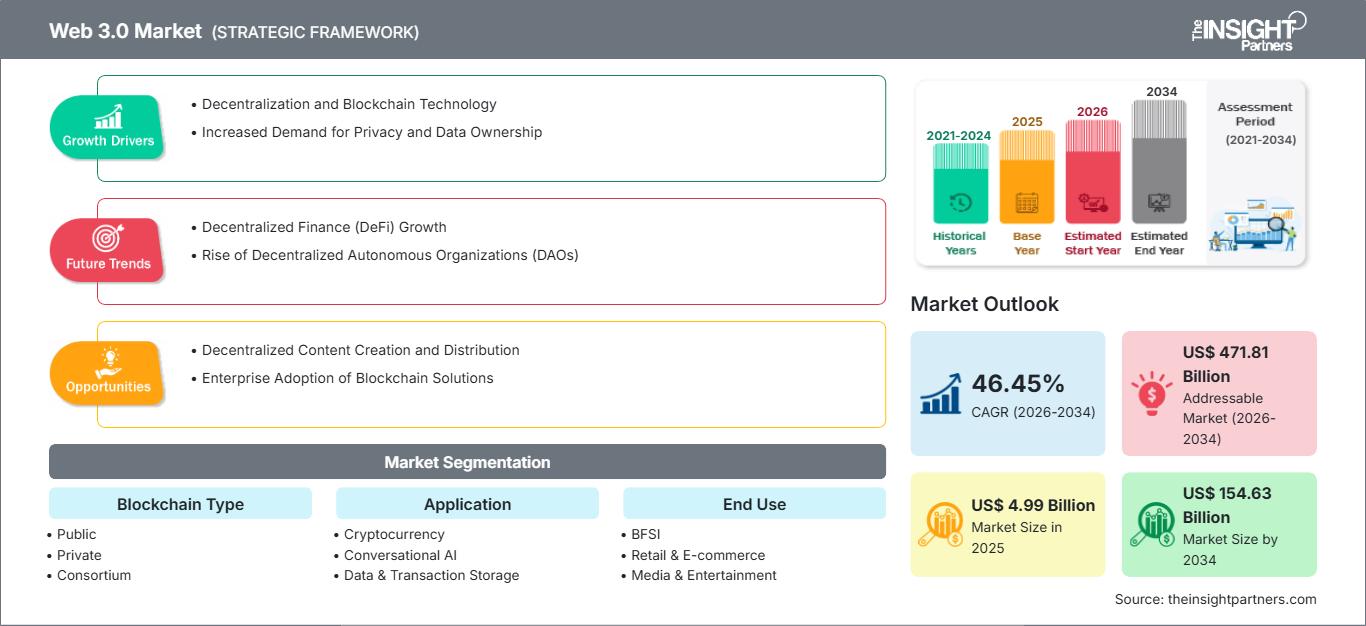
Web 3.0 Market Assessment and Insights
- North America: Accounted for 32–38% share in 2025, driven by US leadership in blockchain infrastructure and dApp development, and to grow at a CAGR between 38–42% from 2026–2034 as institutional participation deepens.
- US: Represented about 60–65% of North America’s web 3.0 market share in 2025 and is anticipated to grow at 39–43% CAGR through 2034, supported by dense developer communities and active venture capital flows into Web3 startups.
- Europe: Captured 24–28% of global value in 2025 and is likely to expand at 34–38% CAGR between 2026–2034, with leading contributions from the UK, Germany, and France as EU level regulation around digital assets and data sovereignty matures.
- Asia Pacific: Held 26–30% share in 2025 and is anticipated to grow at a CAGR of 40–44% from 2026–2034, led by China, Japan, South Korea, and India where consumer facing Web3 use cases and digital asset experimentation are accelerating.
- Largest Segment: Public Blockchain segment dominates with a market share between 38–42% in 2025, owing to open network accessibility and scalability, growing at a CAGR between 45–49% during 2026–2034.
- High Growth Segment: Smart Contracts application is projected to grow fastest with a share between 18–22% in 2025, expanding at a CAGR between 50–54% during 2026–2034 due to automation demand.
- Key companies analyzed in detail: Web3 Foundation (Polkadot), Helium Systems, Inc., Ocean Protocol Foundation Ltd., Zel Technologies Limited, Kusama, Livepeer, Inc., Filecoin (Protocol Labs), Kadena LLC, Polygon Labs Ltd., and Coinbase Global, Inc.
Source: The Insight Partners' analysis based on proprietary research, government publications, company annual reports, investor presentations, industry databases, and expert interviews.
Web 3.0 Market Trends
Convergence of AI, IoT, and Web3
A key future trend for the web 3.0 market is the convergence of artificial intelligence, Internet of Things, and blockchain, creating intelligent, autonomous systems that can transact and coordinate on chain. As devices and algorithms gain identities and wallets, they can participate in decentralized marketplaces for data, compute, and services, enabling new business models around machine-to-machine payments, predictive maintenance, and adaptive supply chains that rely on verifiable, tamper-resistant data flows.
Growth of decentralized social and creator economies
Another emerging trend is that of decentralization of social networks and economies that revolve around creators who use Web3 building blocks like NFTs, social tokens, and on-chain reputation. This model enables creators and communities to own their relationships, monetize their content, and have governance through tokens, removing the need for central intermediaries and hence creating the demand for scalable Web3 products.
Web 3.0 Market Growth Factors
Decentralized finance and tokenization momentum
DeFi is currently considered to be one of the main engines of demand for the web 3.0 ecosystem as individuals and organizations engage in non-custodial loans, trades, and yields that are generated using smart contracts. The tokenization of various kinds of assets, ranging from stablecoins to physical assets like property and invoices, creates additional value propositions for Web3 through fractional ownership, international liquidity, and regulatory compliance. Not only does this boost transaction volume and protocol revenue but it also attracts venture capital and institutional investments that enhance the ecosystem's robustness through security and analytical innovations.
Advances in scalability and interoperability
Improvements in performance in layer 1 and layer 2 networks form another key area of growth within the web 3.0 space, leading to lower latencies, cheaper transactions, and greater throughput. Rollups, sharding, and modularity technologies give Web3 platforms the capability to run even more sophisticated applications such as high-frequency trading, gaming, and social networks, without compromising on security. Interoperability technologies ensure that assets and data can be moved between chains, thus providing developers with the freedom to choose their platform of choice.
Regulatory clarification and institutional adoption
Growing regulatory clarification around digital assets, stablecoins, and token issuance in major markets is gradually reducing uncertainty and opening pathways for institutional adoption of Web3 technologies. As frameworks such as the EU’s MiCA and evolving US guidance define requirements for custody, disclosure, and capital treatment, banks, asset managers, and corporates can more confidently pilot tokenization, on chain settlement, and decentralized identity solutions. This institutional engagement not only increases transaction and asset volumes but also drives demand for compliance, security, and analytics services, reinforcing the broader web 3.0 market ecosystem and supporting the professionalization of infrastructure and governance.
Web 3.0 Market Opportunities
Institutional grade infrastructure and compliance services
Significant opportunity exists for providers of institutional-grade Web3 infrastructure, including custody solutions, compliance tooling, and risk analytics tailored to regulated financial institutions. As banks and asset managers increase their exposure to tokenized assets and on chain settlement, they require robust platforms that integrate with existing systems, meet security and reporting standards, and support governance across multiple protocols, positioning specialized service providers for sustained revenue growth and strategic partnerships. This segment will benefit from web 3.0 market Forecasts that anticipate rising institutional allocation to digital assets over the next decade.
Enterprise use cases beyond finance
Web3 also presents opportunities for manufacturing companies, logistics firms, health care providers, and even energy companies to reconsider how they manage data ownership, data tracing, and cross-organizational collaboration. Organizations can optimize their processes by employing the use of blockchain-based identity management, non-alterable audit trails, and programmable access control. This is likely to enhance their business processes since they will be able to optimize their processes by reducing reconciliation costs while ensuring that there is trust between the organization and its suppliers, regulators, and customers.
Segmentation Analysis
Blockchain Type
The Blockchain Type segment in the market is projected to grow at a CAGR of 40–44% between 2026–2034, reflecting its foundational role in enabling decentralized data storage, transaction validation, and programmable logic. Public, private, consortium, and hybrid blockchains serve distinct governance and performance needs, with enterprises increasingly mixing architectures to balance transparency, scalability, and compliance across internal and external use cases. Web 3.0 scope within this segment spans infrastructure, protocols, and interoperability solutions that underpin higher level applications.
- Public: The blockchains are responsible for most public Web3 networks, which bring in the most developers and liquidity owing to their nature of being open-source, globally available, and having high network effects.
- Private: The blockchains operate in enterprise and consortium settings where restricted access is required, and performance can be fine-tuned to meet specific requirements, such as those of supply chain and trade financing projects.
- Consortium: The blockchains provide for the multi-stakeholder governance framework in banks, logistics companies, and other businesses by providing a shared infrastructure for recording transactions, tokenizing assets, and reporting purposes.
- Hybrid: The architectures involve the combination of public settlement layers with private information channels, which helps businesses combine transparency for certain transactions with confidentiality for others.
Application
The Application segment of the web 3.0 market is expected to register a CAGR of 42–46% from 2026–2034 as decentralized solutions move closer to mainstream business and consumer workflows. Demand spans cryptocurrency transactions, conversational AI integrated with blockchain-based identity, on-chain data and transaction storage, digital payments, and smart contracts that automate agreements and asset movements. As ecosystems mature, Web 3.0 market scope across applications widens from speculative trading to utility-driven use cases in finance, media, and enterprise resource planning.
- Cryptocurrency: A key application of Web3 remains as it enables peer-to-peer money transfers, remittances, and investments. Also, cryptocurrency offers liquidity and incentives for the growth of other Web3 platforms including DeFi and NFT platforms.
- Conversational AI: Together with Web3 makes possible intelligent agents which can interact with on-chain information, manage digital wallets, and enable privacy-preserving personalized interactions across financial and commerce applications.
- Data & Transaction Storage: Data & Transaction Storage Solutions such as decentralized storage networks enable immutable recording and file hosting for content delivery, archiving, and compliance needs in various industries.
- Payments: Payments using blockchain technology enable cheaper and faster cross-border money transfers, settlements between merchants and users of micro-payments for services and content.
- Smart Contracts: An application of smart contracts allows the programming of agreements for automated execution and are an engine of innovation for the Web3 application layer.
End Use
The end use segment is expected to grow at a CAGR between 45–49% during 2026–2034, driven by increasing enterprise adoption across multiple industries. Organizations are leveraging decentralized technologies to enhance operational efficiency, security, and transparency in business processes.
• BFSI – The BFSI sector is a major adopter of Web 3.0 technologies, leveraging blockchain for secure transactions, fraud prevention, and decentralized finance platforms. Increasing regulatory support is further accelerating adoption.
• Retail & E-commerce – Retailers are adopting decentralized solutions to enhance supply chain transparency, customer engagement, and digital payments. Tokenization and NFTs are creating new revenue streams and customer experiences.
• Media & Entertainment – The sector is leveraging blockchain for content distribution, digital rights management, and monetization. Decentralized platforms enable creators to directly engage with audiences and retain ownership of their content.
• Pharmaceuticals – Blockchain is improving drug traceability, clinical trial transparency, and data security in the pharmaceutical industry. These applications enhance compliance and reduce risks associated with counterfeit products.
• IT & Telecom – The IT and telecom sector is utilizing decentralized networks to improve data management, cybersecurity, and network efficiency. Integration with 5G and edge computing is further expanding use cases.
Opportunity Snapshot
| Application | Revenue Contribution (High/Medium/Low) | Trend Tag | Adoption Stage |
| Cryptocurrency | High | DeFi Expansion | Scaling |
| Conversational AI | Medium | On chain Agents | Emerging |
| Data & Transaction Storage | Medium | Decentralized Storage | Scaling |
| Payments | High | Cross border Rails | Scaling |
| Smart Contracts | High | Programmable Finance | Scaling |
Regional Insights
North America web 3.0 market
North America currently represents the largest regional share of the market, estimated at 32–38% of global revenue in 2025, reflecting early adoption of blockchain, DeFi, and NFT platforms. The region benefits from a dense concentration of software developers, cloud infrastructure providers, and venture investors, particularly in the US, who collectively accelerate innovation and commercialization of Web3 applications across consumer and enterprise segments.
Over 2026–2034, North America’s web 3.0 market share is expected to remain substantial while growing at a CAGR of 38–42%, supported by expanding institutional participation and gradual regulatory clarity around digital assets. Financial services, media, and supply chain solutions are likely to be key demand drivers, as organizations experiment with tokenization, on-chain data analytics, and decentralized identity frameworks to enhance transparency and operational efficiency.
U.S. web 3.0 Market
Within North America, the U.S. market accounts for an estimated 60–65% of regional revenue in 2025, anchored by Silicon Valley and other technology hubs that host leading blockchain, crypto exchange, and Web3 infrastructure players. The US market benefits from strong venture capital flows, extensive developer communities, and a consumer base increasingly familiar with digital assets, driving demand for DeFi, NFTs, and on-chain gaming experiences.
From 2026 to 2034, the U.S. market is projected to grow at a CAGR of 39–43%, remaining the dominant contributor to North American revenues while diversifying into enterprise data, identity, and supply chain applications. The presence of companies such as Coinbase Global, Inc., Polygon Labs Ltd., and Protocol Labs (Filecoin) supports experimentation with new application use cases, including decentralized storage, programmable compliance, and cross-chain asset management across financial institutions and technology firms.
Europe web 3.0 Market
Europe’s market is estimated to capture 24–28% of global revenue in 2025, reflecting growing adoption of blockchain-based solutions across financial services, digital identity, and public sector initiatives. The emerging regulatory environment, which includes both MiCA and developing data protection regulation, sets up new rules for digital assets and tokenization. It triggers structured experiments from the part of the banks, fintechs, and industrial companies.
Europe's UK and Germany become the leaders in innovation in Web3, thanks to their startup ecosystem and enterprises involved in tokenized securities, trade finance, and digital collectibles. On the one hand, the UK has its specialization in financial technology regulations, while Germany is advanced in the industrial sector. On the other hand, France, Italy, and Spain start exploring innovations in Web3 in the areas of creative industries, tourism, and SMEs financing. Overall, Europe's market will experience a growth of 34-38% CAGR during 2026-2034. The UK will probably become the leader in adoption in the region, due to its role of the financial center.
APAC web 3.0 Market
Asia Pacific’s market is projected to represent 26–30% of global revenue in 2025, with demand concentrated in China, Japan, South Korea, India, and Australia. These countries combine high digital payment penetration, strong gaming cultures, and proactive exploration of blockchain for trade, logistics, and digital identity.
Over the 2026–2034 period, Asia Pacific is expected to register a CAGR of 40–44%, the fastest among major regions, driven by consumer-facing Web3 applications, government-backed blockchain pilots, and integration with IoT and AI technologies. China and South Korea are likely to lead regional adoption, supported by industrial policy, investments in digital infrastructure, and experimentation with central bank digital currencies that complement broader decentralized ecosystems.
Middle East & Africa web 3.0 Market
The Middle East & Africa market remains smaller in absolute terms but is gaining traction as governments and enterprises explore blockchain for trade finance, energy asset tokenization, and identity solutions. Countries such as Saudi Arabia, the UAE, and South Africa are piloting decentralized platforms for cross-border payments, supply chain transparency, and public service delivery, creating early demand for Web3 infrastructure and applications.
From 2026–2034, MEA’s market is anticipated to grow at a CAGR of 32–36%, supported by large unbanked populations, mobile-first behaviors, and ongoing investment in digital and energy infrastructure. The UAE is expected to lead regional adoption, leveraging its role as a financial and logistics hub and its strategic focus on blockchain and digital asset regulation to attract global Web3 developers and platforms.
Web 3.0 Market Report Scope
| Report Attribute | Details |
|---|---|
| Market size in 2025 | US$ 4.99 Billion |
| Market Size by 2034 | US$ 154.63 Billion |
| Global CAGR (2026 - 2034) | 46.45% |
| Historical Data | 2021-2024 |
| Forecast period | 2026-2034 |
| Segments Covered | Blockchain Type, Application, End Use, Geography |
| Region scope | North America, Europe, Asia-Pacific, South and Central America, Middle East and Africa |
Frequently Asked Questions

Recent Reports






