
Wegovy Market Size, Demand & Growth by 2034
Wegovy Market Size and Forecasts (2021 - 2034), Global and Regional Share, Trends, and Growth Opportunity Analysis Report Coverage : by Indication (Weight Management, Type 2 Diabetes Management); Distribution Channel (Hospital Pharmacies, Retail Pharmacies, Online Pharmacies); and Geography (North America, Europe, Asia Pacific, and South and Central America)
- Status : Data Released
- Report Code : TIPRE00040672
- Category : Life Sciences
- No. of Pages : 150
- Available Report Formats :


- Last update date : September 08, 2026


2025 Market Size
US$ 3.03 Bn
Base year value
2034 Forecast
US$ 25.14 Bn
Projected by 2034
CAGR 2026-2034
26.52 %
Growth rate
Addressable Market
US$ 105.62 Bn
(2026-2034)
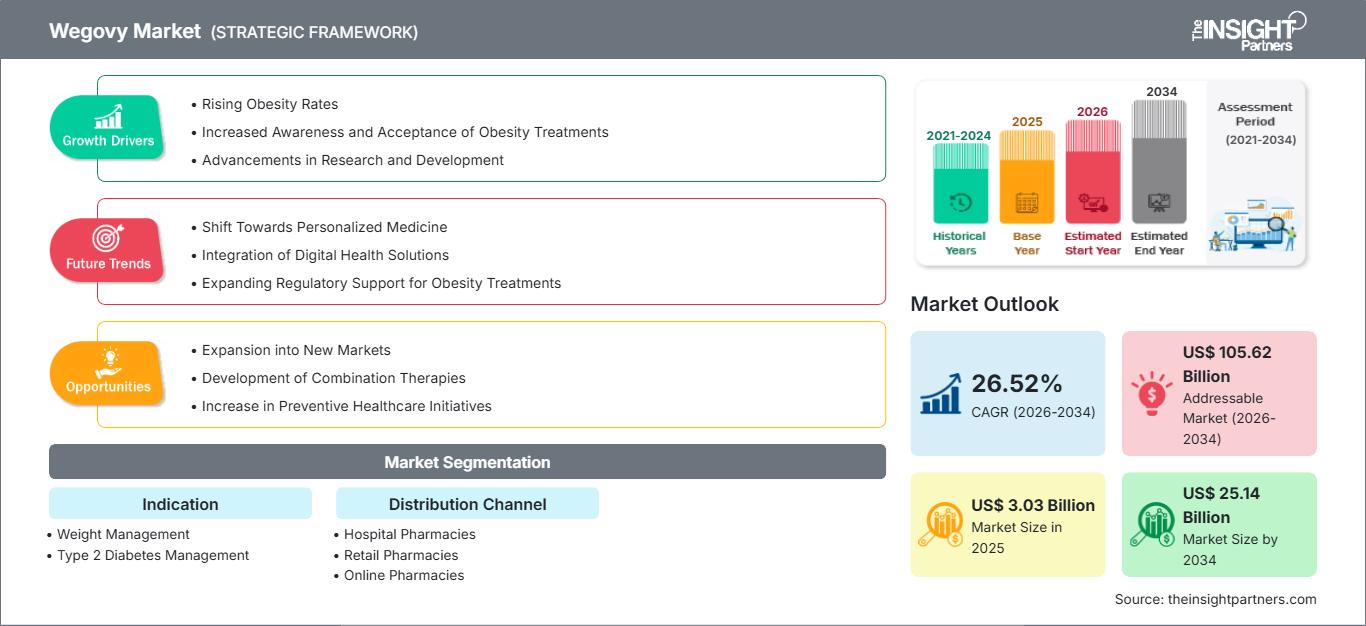
The Wegovy Market was valued at US$ 3.03 Billion in 2025 and is projected to reach US$ 25.14 Billion by 2034, registering a CAGR of 26.52% during 2026–2034. The market is expanding as semaglutide-based obesity treatment becomes embedded within chronic weight-management pathways and prescribing moves beyond specialist settings toward broader primary-care, cardiometabolic, and digitally supported treatment models.
North America remains central to the commercial expansion, with the Wegovy Market size supported by high obesity prevalence, widening reimbursement pathways, cardiovascular-risk evidence, and expanding prescribing infrastructure. The region is estimated to expand at a modeled 25.5–27.5% CAGR during 2026–2034. In the US, 40.3% of adults had obesity during August 2021–August 2023, demonstrating the substantial addressable treatment population.
Wegovy Market Assessment and Insights
- North America: The region accounted for a modeled 55–60% share in 2025 and is expected to record a 25.5–27.5% CAGR during 2026–2034, supported by established obesity-treatment infrastructure, commercial coverage, direct-to-patient channels, and cardiovascular-risk positioning.
- US: The country represented an estimated 88–92% of North American revenue in 2025 and is projected to register a 25.0–27.0% CAGR during 2026–2034, reflecting substantial obesity prevalence and broad specialist access.
- Europe: Europe represented an estimated 20–25% share in 2025 and is expected to expand at a 25.0–27.0% CAGR during 2026–2034. Germany and the UK remain important markets, alongside France, Italy, and Spain.
- Asia Pacific: The region accounted for an estimated 12–17% share in 2025 and is projected to register a 28.0–30.0% CAGR during 2026–2034, supported by launches, obesity recognition, healthcare investment, and expanding access in China and Japan.
- Largest Segment: Weight Management accounted for a modeled 85–90% market share in 2025 and is projected to grow at a 26.0–28.0% CAGR during 2026–2034, supported by Wegovy's core approved therapeutic positioning.
- High Growth Segment: Online Pharmacies represented a modeled 8–12% market share in 2025 and is expected to register a 30.0–33.0% CAGR during 2026–2034, supported by digital prescribing, home delivery, and integrated obesity-care platforms.
- Key companies analyzed in detail: Novo Nordisk A/S, Eli Lilly and Company, Roche Holding Ltd, Amgen Inc., Pfizer Inc., Viking Therapeutics, Inc., AstraZeneca PLC, Boehringer Ingelheim International GmbH, Zealand Pharma A/S, Structure Therapeutics Inc.
Source: The Insight Partners' analysis based on proprietary research, government publications, company annual reports, investor presentations, industry databases, and expert interviews.
The commercial obesity pharmacotherapy landscape has evolved from weight loss treatments with less impact to incretin-based drugs able to cause substantial weight loss in addition to cardiometabolic benefits. The growth of Wegovy has been characterized by increased manufacturing capabilities, dose form expansion, geographic expansion, and growing competition through GLP-1, GLP-1/GIP, amylin, and multi-agonist technologies. According to Novo Nordisk, the company’s sales from the area of obesity care amounted to DKK 82.3 billion in 2025, up 31% at constant exchange rates. Wegovy was available in 52 countries.
Any future growth is forecasted to be contingent upon reimbursement issues, manufacturing capacity, oral formulation availability, adherence to therapy, and proof of obesity management as a chronic condition requiring long-lasting care. The WHO guideline of 2025 conditionally endorses GLP-1 treatment of long-term obesity in adults considering cost issues, health care system readiness, long-term evidence, and equity issues. This kind of development can gradually increase use of the drug worldwide.
Wegovy Market Report Scope
| Report Attribute | Details |
|---|---|
| Market size in 2025 | US$ 3.03 Billion |
| Market Size by 2034 | US$ 25.14 Billion |
| Global CAGR (2026 - 2034) | 26.52% |
| Historical Data | 2021-2024 |
| Forecast period | 2026-2034 |
Wegovy Market Analysis
Strong Wegovy Market growth is supported by the huge number of obese individuals yet to be treated, growing acceptance of drug treatment for weight control and the link between obesity treatment and cardiometabolic benefits. As per WHO, there are over one billion individuals suffering from obesity around the world, creating a large gap between those eligible for pharmacotherapy and those being treated.
The supply chain includes production of API, fill-finish capability, wholesalers, hospital pharmacies, retail pharmacies, online pharmacies, doctors, telemedicine platforms, payers, and obesity treatment programs. Hence, the supply scalability plays an important role in the penetration along with the demand for prescriptions. Novo Nordisk has reported treating 3.6 million individuals for obesity treatment by 2025.
Competitive intensity is reshaping Wegovy Market analysis as pharmaceutical companies develop differentiated oral, injectable, combination, and extended-interval therapies. Eli Lilly and Company, Roche Holding Ltd, Amgen Inc., Pfizer Inc., Viking Therapeutics, Inc., AstraZeneca PLC, Boehringer Ingelheim International GmbH, Zealand Pharma A/S, and Structure Therapeutics Inc. collectively represent an increasingly diverse obesity-development landscape.
Strategic positioning is shifting toward efficacy, tolerability, administration convenience, comorbidity benefits, manufacturing economics, and patient persistence rather than weight reduction alone. Roche reported 22.5% placebo-adjusted weight loss at 48 weeks with investigational CT-388, while Amgen reported up to approximately 20% average weight loss at 52 weeks with monthly or less frequently dosed MariTide, demonstrating the competitive innovation benchmark facing established therapies.
● REPORT CUSTOMIZATION
Tailor This Report To Align With Your Specific Business Requirements
This report can be customized to align precisely with your business objectives, scope, and target markets. Customization options include tailored segmentation, geography, competitive analysis, and strategic insights to support informed decision-making.
Customize This Report →WHAT YOU CAN ADJUST
- ● Segmentations
- ● Geography
- ● Competitive Analysis
- ● Language Preferences
Wegovy Market: Strategic Insights
Regional Insights
North America Wegovy Market
North America held an estimated 55–60% Wegovy Market share in 2025 and is modeled to grow at a 25.5–27.5% CAGR during 2026–2034. The region benefits from high diagnosed obesity prevalence, specialist networks, commercial insurance coverage, digital healthcare infrastructure, and established pharmaceutical distribution. The US provides the dominant revenue base, while Canada contributes incremental adoption through regulated weight-management pathways.
Commercial growth will be more associated with comorbidity management for obesity rather than cosmetic weight loss. FDA’s cardiovascular indication will allow Wegovy to decrease the risk of cardiovascular death, myocardial infarction, and stroke among adults with cardiovascular disease and overweight/obesity. The product positioning will help improve the engagement between cardiology and metabolic fields. Growth will be aided by manufacturing growth and diversification of distribution channels, but pricing, coverage limitations, treatment adherence, and competition from other incretin drugs will be significant factors through 2034.
U.S. Wegovy Market
The US accounted for an estimated 88–92% of North American revenue in 2025 and is modeled to expand at a 25.0–27.0% CAGR during 2026–2034. The country's addressable population remains substantial, with CDC data showing adult obesity prevalence of 40.3% during August 2021–August 2023 and severe obesity affecting 9.4% of adults.
While Novo Nordisk A/S continues with the existing Wegovy franchise, Eli Lilly and Company and various other clinical-stage companies step up their efforts to compete for the obese patient population. The reduction of cardiovascular risk serves as another clinical avenue, besides weight reduction, that could further facilitate referrals by specialists. Meanwhile, retail pharmacies will continue to play an important role in fulfilling prescriptions, but integrated digital platforms would be utilized more by patients for initiating and refilling prescriptions.
Europe Wegovy Market
Europe accounted for an estimated 20–25% share in 2025 and is modeled to record a 25.0–27.0% CAGR during 2026–2034. Germany and the UK are among the leading commercial opportunities, supported by developed obesity-care systems and increasing recognition of pharmacological weight management. The EMA authorizes Wegovy for weight management in eligible adults and adolescents meeting defined criteria.
There are substantial private and specialist-based demand drivers in Germany, along with the impact of reimbursement policies on adoption. In the UK, there are well-established weight management programs among specialists, along with rigorous technology assessment in health, thus resulting in controlled and yet scalable adoption. France, Italy, and Spain also offer additional opportunities as clinical awareness and treatment capabilities develop. Adoption will continue to be driven by local reimbursement policies, prescription restrictions, healthcare budgets, and public-private differences across the region.
APAC Wegovy Market
Asia Pacific represented an estimated 12–17% share in 2025 and is modeled to expand at a 28.0–30.0% CAGR during 2026–2034. China and Japan provide the largest strategic opportunities, while South Korea, India, and Australia contribute through expanding metabolic-care demand, urban healthcare access, and increasing awareness of obesity-related complications.
Regional growth will be fast-tracked as there is increased regulatory access and as management of obesity becomes a priority. There is tremendous patient potential in China. Japan has an organized health system where there will be physician-driven adoption. India is relatively price-sensitive, and therefore affordability is key.
Middle East & Africa Wegovy Market
The Middle East & Africa market is modeled to expand at a 24.0–27.0% CAGR during 2026–2034. Saudi Arabia and the UAE represent leading commercial opportunities due to healthcare investment, private-sector access, specialist infrastructure, and high policy attention toward diabetes, obesity, and associated cardiovascular disease.
The key Sub-Saharan commercial growth opportunity is South Africa, while the Rest of MEA faces limitations due to cost and specialty accessibility. Modernizing healthcare in the Gulf, expanding the pharmaceutical industry, and building the digital health framework could be helpful in this process, despite variable reimbursement and unequal access.
Segmentation Analysis
Indication
Indication is modeled to expand at a 26.0–28.0% CAGR during 2026–2034. The Wegovy Market scope across indications is principally anchored in chronic weight management, while patients with type 2 diabetes and obesity constitute an important overlapping metabolic population. Clinical positioning increasingly emphasizes weight-related complications and cardiovascular outcomes, strengthening integration across endocrinology, obesity medicine, and cardiometabolic care.
- Weight Management: Represents the primary commercial indication, supported by obesity prevalence, long-term treatment requirements, physician acceptance, and demand for clinically meaningful weight reduction alongside dietary and physical-activity interventions.
- Type 2 Diabetes Management: Represents an overlapping patient pathway because obesity frequently coexists with dysglycemia and diabetes, creating opportunities for integrated metabolic treatment decisions across endocrinology and primary-care settings.
Distribution Channel
Distribution Channel is modeled to expand at a 26.0–28.0% CAGR during 2026–2034. Channel development reflects the transition of obesity pharmacotherapy toward recurring chronic prescriptions. Retail pharmacies provide broad community access, hospital pharmacies support specialist-led initiation, and online channels are becoming strategically important as telehealth, electronic prescribing, home delivery, and direct patient engagement reshape medicine access.
- Hospital Pharmacies: Serve patients entering treatment through endocrinology, cardiology, and specialist obesity clinics, particularly where comorbidity assessment, dose escalation, multidisciplinary care, and structured monitoring influence initiation.
- Retail Pharmacies: Remain the principal community fulfillment channel because recurring prescriptions require accessible dispensing networks, pharmacist support, insurance processing, and reliable inventory across long-duration treatment cycles.
- Online Pharmacies: Are scaling through digital prescriptions, home delivery, telehealth integration, and convenience-oriented refill models, making the channel increasingly important for recurring obesity-management therapies and patient retention.
Opportunity Snapshot
↵
| Distribution Channel | Revenue Contribution (High/Medium/Low) | Trend Tag | Adoption Stage |
| Hospital Pharmacies | Medium | Specialist Initiation | Mature |
| Retail Pharmacies | High | Chronic Refills | Mature |
| Online Pharmacies | Medium | Digital Fulfillment | Scaling |
Wegovy Market Growth Drivers and Impact Analysis
Expanding Recognition of Obesity as a Chronic Treatable Disease
Management of obesity is moving towards extended duration of clinical intervention, especially with regulatory agencies and health organizations viewing obesity as a chronic condition that needs an integrated approach in the treatment. According to WHO, obesity has affected more than one billion people globally and has issued its first guideline related to GLP-1 treatments for obesity in 2025. This institutional acceptance could lead to greater physician involvement, lesser dependence on lifestyle treatments, and motivate healthcare systems to adopt treatment approaches. Commercial implications are not only about the volume of prescriptions but also about chronic interventions, which entail diagnosis, patient management, dose management, behavior management, and ongoing care. But WHO also mentions that affordability, health system readiness, equality, and long-term maintenance uncertainty are some of the limitations, and hence, the clinical population would be considerably larger compared to commercially available demand.
Cardiovascular Evidence Broadens the Clinical Value Proposition
Cardiovascular effects are adding support for the pharmacological management of obesity, extending its benefits beyond weight loss. The FDA, in March 2024, approved Wegovy for reducing the risk of cardiovascular mortality, heart attack, and stroke among adults with cardiovascular diseases and obesity or overweight. Such an extended-use indication makes Wegovy relevant not only to cardiologists but also to general practitioners and obesity specialists, among others. It is important for the product's strategic positioning because cardiovascular effects are among the major contributors to the overall impact of obesity. Results on outcomes other than kilograms reduced may thus make a difference for formulary evaluations and treatment prioritization by physicians. In the coming years, competition will be characterized by obesity-related cardiovascular, metabolic, renal, sleep apnea and other outcomes, making differentiation necessary along several comorbidity pathways, not just in headline weight loss efficacy.
Global Commercial Availability and Manufacturing Scale Expansion
The ability to supply is now emerging as a major driver of growth, driven by increasing patient demand in existing and new markets. According to Novo Nordisk, Wegovy is now available in 52 countries, up from 17 in 2024, indicating rapid geographic expansion. It reached 3.6 million people globally through its range of obesity-care products in 2025, and sales from its obesity-care division grew by 31%. The reason the scalability of production is important is that injection-based therapy requires synchronization across drug production, device manufacturing, filling and finishing, packaging, cold chain logistics, and pharmacy-level inventory. This means that greater scalability will help with launches and limit supply-side constraints, while more dosage forms will help meet diversified capacity demands.
Wegovy Market Future Trends
Oral Therapies Reshape Patient Choice and Treatment Access
Among the defining Wegovy Market trends will be the transition from an injection-dominated category toward multiple administration formats. Novo Nordisk reported development and commercialization progress around oral Wegovy, while competing oral GLP-1 programs are advancing across the industry. Oral medicines can reduce injection-related barriers, simplify distribution, and potentially increase acceptance among patients reluctant to initiate injectable treatment. Competition will consequently shift toward convenience, dosing restrictions, persistence, efficacy, tolerability, and manufacturing economics. Oral options may also expand the addressable prescribing base through primary care and digitally enabled treatment models. Rather than replacing injectable therapies entirely, the emerging landscape is likely to become segmented according to patient preferences, clinical requirements, desired weight reduction, comorbidity profile, reimbursement status, and treatment history.
Next-Generation Multi-Pathway Medicines Intensify Competition
Future obesity treatment will increasingly involve differentiated biological mechanisms rather than standalone GLP-1 receptor agonism. Roche's CT-388, Amgen's MariTide, Viking Therapeutics' pipeline, and programs involving Boehringer Ingelheim International GmbH and Zealand Pharma A/S illustrate expanding investment in next-generation approaches. Roche reported 22.5% placebo-adjusted weight loss at 48 weeks for CT-388 at its highest tested dose, while Amgen reported up to approximately 20% average weight loss at 52 weeks with MariTide. These programs indicate that future competitive benchmarks will incorporate efficacy, dosing frequency, lean-mass preservation, tolerability, discontinuation patterns, and metabolic outcomes. Successful late-stage candidates could increase competitive pressure, diversify physician choices, and encourage established manufacturers to pursue combination therapies and lifecycle-management strategies.
Wegovy Market Opportunities
Expansion Across Underserved International Patient Populations
International commercialization represents a substantial opportunity because current obesity-pharmacotherapy penetration remains small relative to the global eligible population. WHO estimates more than one billion people live with obesity, whereas Novo Nordisk reported reaching 3.6 million people with obesity medicines during 2025. Market development can therefore focus on regulatory expansion, localized evidence generation, physician education, reimbursement engagement, pharmacy availability, and differentiated affordability models. Asia Pacific and selected Middle Eastern markets offer particularly attractive expansion potential as metabolic-disease burdens increase and healthcare infrastructure develops. Investment priorities should include supply localization, payer evidence, patient-support systems, and partnerships with specialist and primary-care networks. Commercial success will nevertheless depend on aligning price and access models with country-level healthcare economics rather than transferring US-oriented commercialization strategies directly into international markets.
Integrated Cardiometabolic Care Pathways Create New Commercial Models
The widening clinical relationship between obesity, cardiovascular disease, diabetes, sleep apnea, and other complications creates opportunities to organize treatment around integrated cardiometabolic pathways. Pharmaceutical manufacturers can support evidence generation and healthcare-provider education across specialties, while pharmacies and digital platforms can improve adherence and recurring prescription management. The FDA cardiovascular indication illustrates how outcome evidence can expand the clinical relevance of obesity treatment beyond body-weight reduction. Future investment can target patient identification, treatment initiation, monitoring, persistence programs, and real-world outcomes measurement. Such infrastructure may improve continuity while generating evidence needed for payer negotiations. The opportunity is particularly relevant where fragmented obesity care currently separates primary care, endocrinology, cardiology, nutrition, and pharmacy services, limiting systematic identification and sustained management of eligible patients.
Frequently Asked Questions

- Comprehensive Market Sizing and Forecast Analysis
- Detailed Segmentation Analysis
- In-Depth Market Dynamics Assessment
- Regional and Country-Level Insights
- Competitive Landscape and Company Benchmarking
- Strategic Business Intelligence
Recent Reports
Testimonials

The Insight Partners' SCADA System Market report is comprehensive, with valuable insights on current trends and future forecasts. The team was highly professional, responsive, and supportive throughout. We are very satisfied and highly recommend their services.
RAN KEDEM Partner, Reali Technologies LTDs
I requested a report on a very specific software market and the team produced the report in a few days. The information was very relevant and well presented. I then requested some changes and additions to the report. The team was again very responsive and I got the final report in less than a week.
JEAN-HERVE JENN Chairman, Future Analytica
We worked with The Insight Partners for an important market study and forecast. They gave us clear insights into opportunities and risks, which helped shape our plans. Their research was easy to use and based on solid data. It helped us make smart, confident decisions. We highly recommend them.
PIYUSH NAGPAL Sr. Vice President, High Beam Global
The Insight Partners delivered insightful, well-structured market research with strong domain expertise. Their team was professional and responsive throughout. The user-friendly website made accessing industry reports seamless. We highly recommend them for reliable, high-quality research services
YUKIHIKO ADACHI CEO, Deep Blue, LLC.
This is the first time I have purchased a market report from The Insight Partners.While I was unsure at first, I visited their web site and felt more comfortable to take the risk and purchase a market report.I am completely satisfied with the quality of the report and customer service. I had several questions and comments with the initial report, but after a couple of dialogs over email with their analyst I believe I have a report that I can use as input to our strategic planning process.Thank you so much for taking the extra time and making this a positive experience.I will definitely recommend your service to others and you will be my first call when we need further market data.
JOHN SUZUKI President and Chief Executive Officer, Board Director, BK Technologies
I wish to appreciate your support and the professionalism you displayed in the course of attending to my request for information regarding to infectious disease IVD market in Nigeria. I appreciate your patience, your guidance, and the fact that you were willing to offer a discount, which eventually made it possible for us to close a deal. I look forward to engaging The Insight Partners in the future, all thanks to the impression you have created in me as a result of this first encounter.
DR CHIJIOKE ONYIA MANAGING DIRECTOR, PineCrest Healthcare Ltd.Reason to Buy
- Informed Decision-Making
- Understanding Market Dynamics
- Competitive Analysis
- Identifying Emerging Markets
- Customer Insights
- Market Forecasts
- Risk Mitigation
- Boosting Operational Efficiency
- Strategic Planning
- Investment Justification
- Tracking Industry Innovations
- Aligning with Regulatory Trends





 Get Free Sample for