
Weigh-In-Motion (WIM) Market Share, Growth & Demand by 2034
Coverage: By Vehicle Speed (Low-Speed); Type (In-Road System, Weigh Bridge System, Onboard System); End Use Industry (Logistics, Oil and Refinery, Others); Function (Vehicle Profiling, Axle Counting, Weight Enforcement, Weight-Based Toll Collection, Traffic Data Collection); , and Geography (North America, Europe, Asia Pacific, and South and Central America)
- Status : Data Released
- Report Code : TIPRE00004334
- Category : Manufacturing and Construction
- No. of Pages : 150
- Available Report Formats :


- Last update date : September 28, 2026


2025 Market Size
US$ 1.44 Bn
Base year value
2034 Forecast
US$ 2.15 Bn
Projected by 2034
CAGR 2026-2034
4.55 %
Growth rate
Addressable Market
US$ 16.30 Bn
(2026-2034)
The global Weigh-In-Motion (WIM) market was valued at US$ 1.44 billion in 2025 and is expected to reach US$ 2.15 billion by 2034; it is estimated to record a CAGR of 4.55% during 2026-2034.
Weigh-In-Motion (WIM) Market Assessment and Insights
- North America: North America is estimated to hold a 25–29% share in 2025 and expand at a 4.7–5.3% CAGR between 2026–2034. Mature enforcement networks and bridge monitoring programs sustain replacement and modernization demand.
- US: The US represents approximately 68–72% of North American demand in 2025 and is expected to grow at a 4.8–5.4% CAGR between 2026–2034, supported by federal and state transportation programs.
- Europe: Europe accounts for an estimated 29–33% share in 2025 and is projected to grow at a 4.9–5.5% CAGR. Germany, France, the UK, Italy, and Spain remain important markets because of freight regulation and intelligent transport investment.
- Asia Pacific: Asia Pacific is estimated at 26–30% share in 2025 and is expected to register a 6.5–7.2% CAGR. China, India, Japan, South Korea, and Australia are leading deployment activity through highway modernization and freight digitization.
- Largest Segment: In-road systems represent an estimated 45–49% market share in 2025 and are projected to grow at a 5.4–5.9% CAGR between 2026–2034, reflecting broad roadside enforcement applicability.
- High Growth Segment: Weight-based toll collection represents approximately 12–16% share in 2025 and is projected to grow at a 6.5–7.2% CAGR as free-flow tolling expands.
- Key companies analyzed in detail: Axis Communications AB; Avery Weigh-Tronix; EFKON India Pvt. Ltd.; International Road Dynamics Inc.; Kapsch TrafficCom AG; Kistler Holding AG; METTLER TOLEDO International Inc.; TE Connectivity Ltd.; TransCore; Intercomp Company; Q-Free ASA.
Source: The Insight Partners' analysis based on proprietary research, government publications, company annual reports, investor presentations, industry databases, and expert interviews.
The weigh-in-motion market has evolved from standalone axle measurement toward integrated transportation intelligence. Current systems consist of piezo-, quartz-, bending plate-, or load cell-based sensors working in conjunction with cameras, vehicle classification, communication, and analysis. Procurement processes are becoming increasingly dependent on lifecycle maintenance, calibration, pavement status, interoperability of information, and the degree of accuracy of enforcement, rather than only the sensor itself.
From a future perspective, the areas for investment will be in corridor-level installations linking roadside sensors with tolling, enforcement, bridge management, and fleet management systems. The need for WIM systems stems from regulations requiring enforcement against overweight commercial trucks, with standards such as ISO 15638-20 creating an interoperable framework for exchanging WIM data. Deployment opportunities should increase where transport agencies seek continuous measurement without diverting trucks into static weighing facilities, according to the Weigh-in-Motion Market report.
Weigh-In-Motion (WIM) Market Report Scope
| Report Attribute | Details |
|---|---|
| Market size in 2025 | US$ 1.44 Billion |
| Market Size by 2034 | US$ 2.15 Billion |
| Global CAGR (2026 - 2034) | 4.55% |
| Historical Data | 2021-2024 |
| Forecast period | 2026-2034 |
Weigh-In-Motion (WIM) Market Analysis
The demand is associated with freight density, road degradation, and the cost of conventional enforcement. The WIM system makes it possible for enforcement agencies to conduct continuous screening of vehicle loads, identify abnormal axle loads, and select trucks that need additional examination. The supply chain comprises sensor producers, equipment makers for roadside facilities, system integrators, software firms, communication companies, transportation agencies, tolling authorities, and enforcement agencies. The installation quality is important since it affects the measurement accuracy in relation to the pavement condition, lane shape, temperature, and calibration.
In terms of supply, there has been an increase in the technological component due to customer preference for integrated platforms compared to measurement tools. The choice of sensors is related to the traffic speed, traffic volume, accuracy requirement, pavement type, and enforcement needs. Suppliers capable of combining sensing, identification, analytics, and service support can address larger portions of the transportation technology value chain, as outlined in the Weigh-in-Motion Market forecast.
The weigh-in-motion market analysis indicates that competition is increasingly organized around accuracy, integration, installation flexibility, software capability, and geographic service coverage. While Kistler Holding AG has a specialization in precise measurement and digital infrastructure monitoring, International Road Dynamics Inc. offers an integrated system of WIM with vehicle enforcement and traffic data systems. Kapsch TrafficCom AG integrates WIM technology with overall intelligent transportation systems while Q-Free ASA links weight measurement with traffic classification, tolling, and enforcement solutions.
However, other participants have differentiating strategies. While Avery Weigh-Tronix integrates its expertise in dynamic weighing and industrial weighing, EFKON India Pvt. Ltd. concentrates on electronic tolling and intelligent transport infrastructure. METTLER TOLEDO International Inc. and TE Connectivity Ltd. have measurement and sensor technologies relevant to transportation solutions. Axis Communications AB supports the video and identification layers, while TransCore and Intercomp Company operate in wider transportation and vehicle weighing systems. Priorities of investments include modularity, analytics, remote diagnostics, and integration with agency infrastructure.
● REPORT CUSTOMIZATION
Tailor This Report To Align With Your Specific Business Requirements
This report can be customized to align precisely with your business objectives, scope, and target markets. Customization options include tailored segmentation, geography, competitive analysis, and strategic insights to support informed decision-making.
Customize This Report →WHAT YOU CAN ADJUST
- ● Segmentations
- ● Geography
- ● Competitive Analysis
- ● Language Preferences
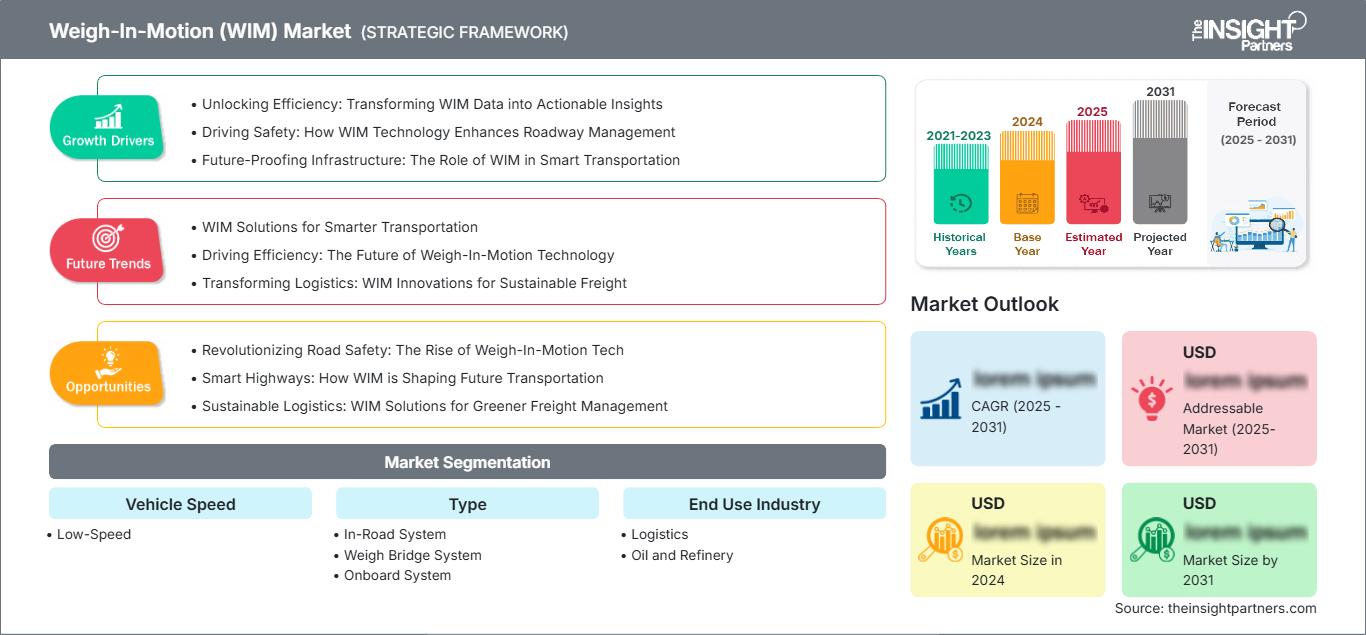
Weigh-In-Motion (WIM) Market: Strategic Insights
Regional Insights
North America Weigh-in-motion Market
North America is estimated to represent 25–29% of the global Weigh-in-Motion Market in 2025, with a 4.7–5.3% CAGR through 2034. The region benefits from established commercial vehicle enforcement, extensive interstate freight movement, bridge preservation programs, and long-standing traffic data collection practices. US agencies increasingly use WIM as a screening layer before directing suspected overweight vehicles toward enforcement facilities.
Canada adds demand through provincial highway management, freight corridors, and infrastructure monitoring. Sensor replacement, pavement rehabilitation, and modernization of roadside communications create recurring procurement opportunities. Cloud connectivity is becoming more relevant because agencies increasingly seek centralized dashboards, automated alerts, and historical axle-load datasets. The regional competitive environment favors suppliers with calibration expertise, installation capability, federal procurement familiarity, and established maintenance networks.
U.S. Weigh-in-motion Market
The US is estimated to account for 68–72% of North American Weigh-in-Motion Market revenue in 2025 and is projected to expand at a 4.8–5.4% CAGR through 2034. Federal Highway Administration guidance addresses technology selection, site design, installation, maintenance, and calibration, reinforcing the importance of standardized procurement practices. Commercial vehicle enforcement remains a central application.
State transportation departments are also using WIM data for pavement design, traffic monitoring, bridge assessment, and freight planning. Increasing integration with automated license plate recognition and electronic screening can reduce unnecessary stops while directing enforcement resources toward higher-risk vehicles. Infrastructure funding requirements are additionally influencing supplier selection, manufacturing location, cybersecurity, data governance, and domestic support capabilities. These factors favor established suppliers with broad technical and service coverage.
Europe Weigh-in-motion Market
Europe is estimated to hold 29–33% of the global Weigh-in-Motion Market in 2025 and is expected to grow at a 4.9–5.5% CAGR through 2034. Germany remains a leading market, supported by heavy freight activity, road preservation priorities, and automated enforcement. The UK continues to apply WIM within broader traffic monitoring and overweight-vehicle management frameworks.
France and Italy present opportunities through major freight corridors, toll roads, and infrastructure asset management. Spain is also adopting increasingly connected roadside technologies as motorway operators and authorities pursue more efficient freight oversight. European procurement generally places strong emphasis on calibration, measurement accuracy, interoperability, and compliance with technical specifications. Cross-border freight movements create additional value for consistent data exchange and vehicle classification, supporting integrated WIM architectures across national road networks.
APAC Weigh-in-motion Market
APAC is estimated to capture 26–30% of the global Weigh-in-Motion Market revenue in 2025 and is projected to register a 6.5–7.2% CAGR through 2034. China leads regional deployment, while India, Japan, South Korea, and Australia provide additional demand through highway modernization, logistics corridors, and infrastructure monitoring.
India is particularly important because expanding freight infrastructure and electronic tolling can support wider integration of vehicle identification, classification, and weight measurement. China benefits from large freight volumes and extensive expressway networks, while Japan and South Korea emphasize sophisticated transport management. Australia’s long-distance freight environment supports WIM for compliance and pavement protection. Policy-led smart transportation programs are expected to accelerate connected roadside deployments across the region.
Middle East & Africa Weigh-in-motion Market
The Middle East and Africa Weigh-in-Motion Market region is expected to record a 5.8–6.4% CAGR through 2034. Saudi Arabia and the UAE are leading Middle Eastern markets because of highway modernization, logistics-zone expansion, energy-related freight, and smart transportation investment. WIM can support overweight enforcement without interrupting high-volume traffic.
South Africa represents a key African market because road freight, mining logistics, and port connectivity create persistent axle-load management requirements. Other MEA countries are likely to adopt selectively where transport corridors receive infrastructure investment. Deployment economics remain sensitive to road quality, enforcement capacity, financing, and maintenance expertise. Consequently, turnkey systems with remote monitoring and service support may be particularly valuable in emerging markets.
Segmentation Analysis
Vehicle Speed
Vehicle Speed is centered on Low-Speed applications in the supplied segmentation. Low-speed WIM is suitable for controlled transport environments where vehicles move through designated weighing areas. The segment is estimated to grow at a 4.5–5.0% CAGR through 2034, supported by enforcement screening and operational weighing requirements, reflecting key Weigh-in-Motion Market trends.
- Low-Speed: Low-speed deployment supports controlled measurement at approaches, inspection facilities, logistics sites, and selected toll environments. Its principal advantage is measurement stability, where vehicle movement can be managed operationally.
Type
Type includes In-Road System, Weigh Bridge System, and Onboard System. Within the Weigh-in-Motion Market, the segment is projected to grow at a 5.1–5.6% CAGR through 2034 as buyers balance accuracy, infrastructure requirements, installation complexity, and operating flexibility across diverse transportation and enforcement applications.
- In-Road System: In-road systems are strategically important for continuous roadside measurement, enforcement screening, and traffic monitoring. Their permanent configuration supports repeated vehicle measurements across high-volume corridors and enables integration with identification technologies.
- Weigh Bridge System: Weigh bridge systems provide a controlled measurement environment and remain relevant where legal or operational weighing requires structured vehicle processing. They can complement WIM screening by providing secondary verification.
- Onboard System: Onboard systems support fleet-level monitoring by measuring vehicle loads during normal operations. They are attractive for logistics operators seeking route-level information, load optimization, compliance visibility, and reduced dependence on fixed infrastructure.
End Use Industry
End Use Industry comprises Logistics and Oil and Refinery. Within the Weigh-in-Motion Market, the segment is forecast to expand at a 5.3–5.9% CAGR through 2034, reflecting the growing importance of freight efficiency, load compliance, asset protection, and operational optimization across heavy transport and industrial logistics operations.
- Logistics: Logistics operators use weight information to improve load planning, prevent overload-related penalties, and manage fleet utilization. Connected WIM can provide continuous operational data across distribution corridors and high-volume freight routes.
- Oil and Refinery: Oil and refinery logistics require disciplined management of heavy tanker movements and payloads. WIM supports safer movement, load verification, compliance monitoring, and infrastructure protection around terminals and industrial access roads.
Function
Function includes Vehicle Profiling, Axle Counting, Weight Enforcement, Weight-Based Toll Collection, and Traffic Data Collection. Within the Weigh-in-Motion Market, the segment is estimated to grow at a 5.6–6.2% CAGR through 2034 as multifunctional roadside platforms gain acceptance and transportation agencies increasingly integrate weighing, enforcement, tolling, and traffic-monitoring capabilities into unified infrastructure systems.
- Vehicle Profiling: Vehicle profiling creates detailed records of dimensions, axle configuration, weight, and movement characteristics. Such information supports enforcement prioritization, traffic engineering, and infrastructure planning.
- Axle Counting: Axle counting provides classification information required for freight statistics, pavement models, and enforcement workflows. Integration with speed and weight data increases the analytical value of each vehicle passage.
- Weight Enforcement: Weight enforcement remains a core use case because overloaded vehicles accelerate pavement and bridge deterioration. Automated screening can improve enforcement efficiency by identifying higher-risk vehicles before physical inspection.
- Weight-Based Toll Collection: Weight-based toll collection is becoming more relevant as road operators evaluate differentiated charging models. Linking weight measurements with vehicle identification can enable automated charging while reducing dependence on manual transactions.
- Traffic Data Collection: Traffic data collection transforms WIM infrastructure into a broader transportation intelligence asset. Authorities can use weight, speed, axle, and classification information for planning, forecasting, road design, and maintenance decisions.
Opportunity Snapshot
| End Use Industry | Revenue Contribution (High/Medium/Low) | Trend Tag (MAX 2 words, specific) | Adoption Stage (Emerging/Scaling/Mature) |
| Logistics | High | Freight Analytics | Scaling |
| Oil and Refinery | Medium | Tanker Compliance | Scaling |
Weigh-In-Motion (WIM) Market Growth Drivers and Impact Analysis
Expansion of automated commercial vehicle enforcement
Automated screening as an alternative to manual roadside inspections makes the operation of WIM systems more valuable. It becomes possible to receive the data about weights and axles at any time and to define which vehicles need additional inspection on the basis of such data. Such a method will help to increase the efficiency of enforcement activities since only vehicles that have a higher chance of non-compliance are screened. The connection with automatic number plate recognition and vehicle classification makes the identification process even more effective. The effect of such technology is not limited to law enforcement agencies since improved loading will help to reduce the damage to the pavement and to bridges and will also decrease the frequency of unforeseen maintenance activities.
Growing emphasis on infrastructure preservation and freight efficiency
The need for road agencies to manage their bridges and pavements while allowing more freight volumes is increasing. Heavy trucks impose an excessive burden on the structure, due to which knowing the weight of each truck is important. The data from weigh-in-motion devices can be used for such purposes as traffic-load datasets can be gathered without forcing all trucks to come to a complete halt. Such datasets will help the agencies in improving pavement design, scheduling maintenance and assessing bridges. Logistics operators will benefit from such datasets as they can plan loads better and can minimize the consequences of overweight trucks. This dual benefit for both the government and the logistics industry helps increase the scope of customers for WIM systems.
Integration of WIM with intelligent transportation infrastructure
Integration will change the economics of roadside measurement in that a single system will be able to serve multiple transportation applications. WIM sensors will be able to communicate with cameras, vehicle classification systems, electronic tolling, traffic management, and analytical centers. This way, there is no need to have redundant roadside installations and more robust datasets for making operational decisions. It is especially important when talking about smart corridors when there is a need to have real-time monitoring of freight traffic, abnormal loads, congestion, and infrastructure stresses. The ability to have interoperability also means that there is a possibility to introduce new technologies gradually without having to deploy all of them at once. Manufacturers that rely on open interfaces and modular design will be able to serve agencies with different technology backgrounds.
Weigh-In-Motion (WIM) Market Future Trends
Cloud-native infrastructure monitoring and predictive analytics
WIM system trends are becoming increasingly oriented towards cloud-based systems, which integrate vehicle data with structural condition data, traffic data, weather data, and maintenance information. Future WIM systems will be based on the creation of longitudinal databases that demonstrate changes in axle load profile, freight frequency, and exposure to traffic. Models can assist agencies in identifying corridors where degradation risks are rising ahead of visual inspections. In addition, cloud-based architectures facilitate the management of widely dispersed stations, and thus allow authorities to compare performance and calibration status at a distance. Alerts can be triggered when sensors behave abnormally, a strange vehicle appears, or when the traffic composition changes suddenly. As for the infrastructure owners, it means that WIM becomes an asset intelligence system rather than just a measurement system.
AI-assisted classification and multimodal roadside sensing
Future artificial intelligence could enhance the analysis capacity of roadside WIM stations through integration of weight measurement data with visuals, dimensions, and behavior data. Intelligent classification algorithms can aid in improved detection of abnormal configurations, loading, and behavior of vehicles that may not be complying with the road laws. Image analysis technology can help in associating the identity of the vehicle with the weight data while minimizing the need for manual inspection of the images. The multimodal sensing approach could assist in overcoming the limitations of individual sensors by integrating the measurements before the creation of an enforcement report. With the evolution of electric trucks, unique trailers, and new designs of commercial vehicles into the freight fleet, intelligent classification algorithms will have to account for new physical characteristics. Such a scenario may lead to future reliance on continually updating software models instead of classification rules.
Weigh-In-Motion (WIM) Market Opportunities
Corridor-scale freight intelligence platforms
There is an excellent opportunity to create corridor-level solutions linking different WIM sites through databases of tolling, traffic management, enforcement, and logistics. As opposed to purchasing stand-alone roadside installations, transportation agencies will be able to develop networks that will be able to detect patterns of overload through certain routes as well as areas where heavy axles may put the structure at risk. Technology providers will have another business opportunity associated with the development of software, cloud services, analytics, cybersecurity, communications, and ongoing technical support. The logistics companies will also have an advantage through improved route optimization and fleet management when authorized data is used. Investments should be made in an open architecture so that new sensors and applications can be added to the system without replacing its basic elements.
Integration with electronic tolling and freight compliance
There is potential for creating automatic charging systems based on information about the features of the vehicle and load verification through the synergy between WIM and electronic tolling. Load-based pricing will make road use charges more proportional to the damage caused and less intrusive through fewer physical tolling operations. This potential becomes especially important in the case of heavily loaded freight corridors where the free flow tolling system is equipped for vehicle identification and transaction processing. With the addition of verified load data, a more extensive transaction history could be generated and used for implementing differentiated charging strategies, provided such practices are allowed. Suppliers may choose a solution that integrates various components, including sensors, identification, payment processing, interface with law enforcement bodies, and analytics.
Frequently Asked Questions

- Comprehensive Market Sizing and Forecast Analysis
- Detailed Segmentation Analysis
- In-Depth Market Dynamics Assessment
- Regional and Country-Level Insights
- Competitive Landscape and Company Benchmarking
- Strategic Business Intelligence
Recent Reports
Testimonials

The Insight Partners provided valuable market intelligence that supported our global go-to-market strategy. Their team was professional, responsive, and attentive to our feedback, providing thoughtful analysis and helpful methodological clarifications throughout the project.
Junmo Kim Chief Financial Officer (CFO), Enertech Co., Ltd.
The Insight Partners' SCADA System Market report is comprehensive, with valuable insights on current trends and future forecasts. The team was highly professional, responsive, and supportive throughout. We are very satisfied and highly recommend their services.
RAN KEDEM Partner, Reali Technologies LTDs
I requested a report on a very specific software market and the team produced the report in a few days. The information was very relevant and well presented. I then requested some changes and additions to the report. The team was again very responsive and I got the final report in less than a week.
JEAN-HERVE JENN Chairman, Future Analytica
We worked with The Insight Partners for an important market study and forecast. They gave us clear insights into opportunities and risks, which helped shape our plans. Their research was easy to use and based on solid data. It helped us make smart, confident decisions. We highly recommend them.
PIYUSH NAGPAL Sr. Vice President, High Beam Global
The Insight Partners delivered insightful, well-structured market research with strong domain expertise. Their team was professional and responsive throughout. The user-friendly website made accessing industry reports seamless. We highly recommend them for reliable, high-quality research services
YUKIHIKO ADACHI CEO, Deep Blue, LLC.
This is the first time I have purchased a market report from The Insight Partners.While I was unsure at first, I visited their web site and felt more comfortable to take the risk and purchase a market report.I am completely satisfied with the quality of the report and customer service. I had several questions and comments with the initial report, but after a couple of dialogs over email with their analyst I believe I have a report that I can use as input to our strategic planning process.Thank you so much for taking the extra time and making this a positive experience.I will definitely recommend your service to others and you will be my first call when we need further market data.
JOHN SUZUKI President and Chief Executive Officer, Board Director, BK Technologies
I wish to appreciate your support and the professionalism you displayed in the course of attending to my request for information regarding to infectious disease IVD market in Nigeria. I appreciate your patience, your guidance, and the fact that you were willing to offer a discount, which eventually made it possible for us to close a deal. I look forward to engaging The Insight Partners in the future, all thanks to the impression you have created in me as a result of this first encounter.
DR CHIJIOKE ONYIA MANAGING DIRECTOR, PineCrest Healthcare Ltd.Reason to Buy
- Informed Decision-Making
- Understanding Market Dynamics
- Competitive Analysis
- Identifying Emerging Markets
- Customer Insights
- Market Forecasts
- Risk Mitigation
- Boosting Operational Efficiency
- Strategic Planning
- Investment Justification
- Tracking Industry Innovations
- Aligning with Regulatory Trends





 Get Free Sample for