
Welding Pen Market Demand, Share & Growth by 2034
Coverage: By Type (45°, 90°); Application (Chemical Processing, Oil and Gas, Water and Waste Water, Food and Beverage, Others) , and Geography (North America, Europe, Asia Pacific, and South and Central America)
- Status : Data Released
- Report Code : TIPRE00020784
- Category : Manufacturing and Construction
- No. of Pages : 150
- Available Report Formats :


- Last update date : September 28, 2026


2025 Market Size
US$ 1.31 Bn
Base year value
2034 Forecast
US$ 2.25 Bn
Projected by 2034
CAGR 2026-2034
6.17 %
Growth rate
Addressable Market
US$ 16.10 Bn
(2026-2034)
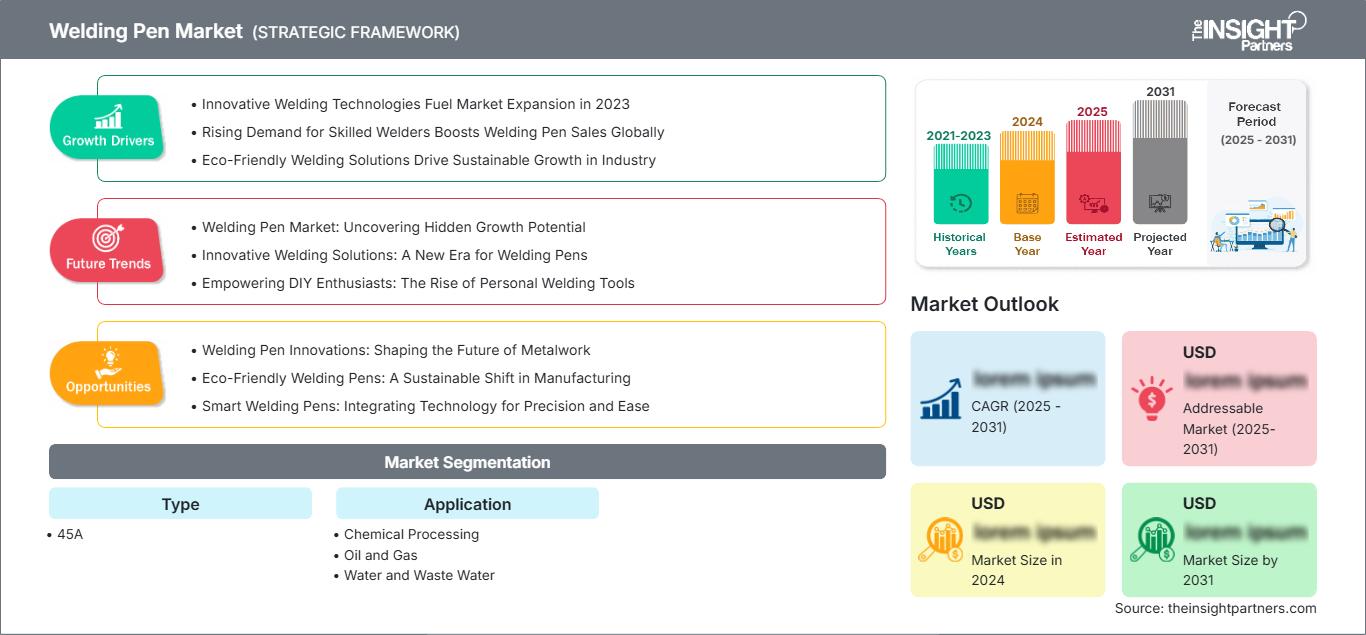
The Welding pen market is valued at US$ 1.31 Billion in 2025 and is projected to reach US$ 2.25 Billion by 2034, registering a CAGR of 6.17% during 2026–2034. Demand is supported by the need for compact, controllable welding equipment across industrial maintenance, fabrication, piping, and repair activities. Product portability, operator accessibility, and suitability for localized joining tasks position welding pens as a complementary tool within broader welding equipment ecosystems.
North America is expected to remain an important regional market, with the welding pen market size supported by an estimated 6.4–7.4% CAGR between 2026 and 2034. Replacement of aging industrial infrastructure and continued investment in energy, water treatment, chemical processing, and fabrication facilities are expected to sustain demand. Workforce productivity requirements and growing preference for portable equipment also support adoption among maintenance contractors and smaller industrial workshops.
Welding Pen Market Assessment and Insights
- North America: North America is estimated to account for 30–34% share in 2025, supported by established fabrication capabilities, maintenance spending, and energy infrastructure. The region is projected to grow at a 6.4–7.4% CAGR between 2026–2034 as portable joining equipment gains wider industrial acceptance.
- US: The US is estimated to represent 62–66% of North America's 2025 market, with demand concentrated in industrial maintenance, energy infrastructure, fabrication, and water applications. Growth is projected at a 6.3–7.3% CAGR between 2026–2034.
- Europe: Europe is estimated to hold 25–29% share in 2025, with Germany, Italy, France, and the UK providing important industrial demand. Modernization of process facilities, manufacturing quality requirements, and energy-efficiency initiatives support a 5.8–6.8% CAGR between 2026–2034.
- Asia Pacific: Asia Pacific is estimated at 29–33% share in 2025, led by China, India, Japan, and South Korea. Expanding manufacturing capacity, infrastructure development, and industrial maintenance requirements support a 6.8–8.0% CAGR between 2026–2034.
- Largest Segment: The 45A type represents the largest segment with approximately 100% share in 2025 within the supplied segmentation and is expected to expand at a 6.0–6.4% CAGR between 2026–2034.
- High Growth Segment: Oil and Gas is assessed as the high-growth application, representing approximately 23–27% share in 2025 and projected to grow at a 7.2–8.4% CAGR between 2026–2034.
- Key companies analyzed in detail: Al Garhoud Engineering and Marine Services, Guru Gautam Steels, Ganpat Metal Industries, Kalikund Steel and Engineering Company, Metal Udyog, M P Jain Tubing Solution LLP, Simplex Steel Industries, Sunny Steel, Vishal Steel, and Sagar Forge and Fitting.
Source: The Insight Partners' analysis based on proprietary research, government publications, company annual reports, investor presentations, industry databases, and expert interviews.
The welding pen market has evolved alongside demand for compact joining equipment capable of delivering controlled heat to localized work areas. Developments in product innovation will focus on ergonomic handiness, better electrode control, constant power supply, and compatibility with maintenance-oriented uses. Industrial buyers will assess equipment based on portability, quickness of repairs, safety of use, and overall operating expenses rather than just on the basis of price alone.
In the forecast period, investment is expected to expand into new manufacturing centers and capital-intensive countries. Growth in water treatment facilities, process industry upgrades, infrastructure for energy production, and fabrication needs may further increase demand. The Welding Pen Market report highlights that regulatory attention to workplace safety, welding emissions, energy efficiency, and quality documentation should encourage suppliers to improve product reliability and operator controls while distributors increasingly emphasize technical support, training, replacement components, and application-specific configurations.
Welding Pen Market Report Scope
| Report Attribute | Details |
|---|---|
| Market size in 2025 | US$ 1.31 Billion |
| Market Size by 2034 | US$ 2.25 Billion |
| Global CAGR (2026 - 2034) | 6.17% |
| Historical Data | 2021-2024 |
| Forecast period | 2026-2034 |
Welding Pen Market Analysis
The demand is influenced by the requirement for localized welding, repair and fabrication processes, which may prove less efficient using larger systems for performing these processes. The value chain includes suppliers, welding equipment manufacturers, distributors, industrial contractors, maintenance firms, and end-users. The power control components, electrodes, handle, cable, and protection accessories affect product quality. Thus, the growth of the welding pen market is dependent not just on equipment purchases, but on replacement cycles and service and consumables availability.
Supply remains fragmented, especially between specialized industrial suppliers and regional distributors. The competition among manufacturers is based on durability, stability, ergonomic design, customer service, and flexibility. Industrial buyers prefer equipment that operates reliably and can be repaired since equipment breakdowns may interrupt production processes. Distributors with distribution networks can increase the availability of the equipment in smaller industrial towns, whereas specialized manufacturers can compete with their application knowledge, product flexibility, and fast technical support for maintenance-intensive customers.
Positioning in terms of competition is becoming more dependent on the development of welding technology overall than on the specifications of the device itself. In accordance with the welding pen market analysis, manufacturers who supply their products to the industrial sector should find a good balance between small sizes and reliable thermal control and performance. The representatives of the analyzed competitive structure include such companies as Al Garhoud Engineering and Marine Services, Guru Gautam Steels, Ganpat Metal Industries, and Kalikund Steel and Engineering Company.
The list of competitors may also feature regional players such as Metal Udyog, M P Jain Tubing Solution LLP, Simplex Steel Industries, Sunny Steel, Vishal Steel, and Sagar Forge and Fitting. It is possible to differentiate oneself with the help of such aspects as material competence, customization, distribution channels, and after-sales service. At the same time, the progress of welding technology as a whole raises customers' expectations concerning the energy efficiency, ergonomic properties, performance consistency, and the possibility of monitoring the process digitally.
● REPORT CUSTOMIZATION
Tailor This Report To Align With Your Specific Business Requirements
This report can be customized to align precisely with your business objectives, scope, and target markets. Customization options include tailored segmentation, geography, competitive analysis, and strategic insights to support informed decision-making.
Customize This Report →WHAT YOU CAN ADJUST
- ● Segmentations
- ● Geography
- ● Competitive Analysis
- ● Language Preferences
Welding Pen Market: Strategic Insights
Regional Insights
North America Welding Pen Market
North America is estimated to hold 30–34% share in 2025 and expand at a 6.4–7.4% CAGR through 2034. The US continues to be the largest demand center for the product due to industrial maintenance, oil and gas infrastructure, chemical production and water treatment. Canada has contributed because of energy, mining and fabrication as well as infrastructural maintenance needs. Mexico will benefit from growing manufacturing and the use of the industrial supply chain in Mexico. Portable equipment is preferred in areas where repair teams work on scattered facilities, using portable equipment that does not need many preparations to be done before use. Industrial contractors prefer equipment that helps them reduce intervention time when doing maintenance.
Growth in regional demand is increasingly linked with the renewal of aging infrastructure and the upgrading of process facilities. Investment in water infrastructure leads to opportunities for local repairs of pipes and components. Chemical and energy facilities need reliable maintenance equipment. Expectations for safety lead to better control and protection. Therefore, the welding pen market is being positioned as complementary equipment in welding fleets.
U.S. Welding Pen Market
The US is estimated to represent 62–66% of North America's 2025 share and is projected to expand at a 6.3–7.3% CAGR. There will be high demands from infrastructure, industry maintenance, water works, chemical plant, and fabrication works in a distributed manner. The contractor base in this country enables continuous procurement, while the replacement demand will favor the suppliers of quality goods and efficient service networks. The applications that need immediate repairs on-site are significant in places where minimizing the transport of equipment and setup time becomes commercially viable.
The US market also stands to gain through the continuous investment in local manufacturing facilities and infrastructure resilience. In recent times, welding contractors have shown increasing preference for small-sized equipment that could work in tandem with the traditional machines during maintenance and repair work. The selection process depends on electricity stability, longevity, ergonomics, parts availability, and compatibility with existing processes.
Europe Welding Pen Market
Europe is estimated to account for 25–29% share of the Welding Pen Market in 2025 and is expected to grow at a 5.8–6.8% CAGR through 2034. Germany is the leading country, supported by machinery, automotive, chemical, and industrial fabrication capabilities. The UK supplies its market via the energy, infrastructure, maintenance and processes industries; the demand side comes from manufacturers in France, Italy and Spain, along with construction fabrications, utilities and industrial services. European buyers are becoming more aware of the importance of efficient machines, ergonomic use and reliability in line with workplace regulations.
Germany is supplied via its manufacturing industry, which uses specialized welds in machinery and industrial equipment. The UK enjoys maintenance in energy and infrastructure applications, while the French market has its demand in terms of industrial fabrication combined with utilities and process applications. The Italian and Spanish markets have their share via machinery, metalworking, construction, food and water infrastructure.
APAC Welding Pen Market
APAC is estimated to hold 29–33% of the Welding Pen Market share in 2025 and is projected to grow at a 6.8–8.0% CAGR, making it the fastest-growing major region. China leads regional demand, followed by Japan, South Korea, India, and Australia. The industrial growth, infrastructure development, water treatment initiatives, and investments in manufacturing are among the various opportunities. In particular, India and Southeast Asian production facilities can be considered as a good base for portable machinery since small and mid-size producers are often in need of versatile equipment.
The manufacturing, industrialization, infrastructure development, and utilities growth will further encourage demand in the region. The industrial environment in China and Japan is quite developed, Korea will provide advanced manufacturing and shipbuilding capabilities, India is going to make an effort on infrastructure and process industries, while Australia will provide mining and resources applications.
Middle East & Africa Welding Pen Market
The Middle East and Africa Welding Pen Market demand is supported by oil and gas, petrochemical processing, utilities, construction, and industrial infrastructure. Saudi Arabia leads regional demand, followed by the UAE and South Africa, while other Gulf and African markets contribute through maintenance and infrastructure programs. The region is projected to grow at a 5.5–6.5% CAGR through 2034 as industrial assets require localized repair and maintenance capabilities.
Energy infrastructure remains a major application base, while water scarcity and desalination investment create additional opportunities for equipment used in utility maintenance. Saudi Arabia and the UAE benefit from industrial diversification and infrastructure programs, whereas South Africa contributes through mining, manufacturing, and utilities. Distributor capability, equipment durability, and field-service responsiveness remain important competitive factors across geographically dispersed industrial sites.
Segmentation Analysis
Type
Type remains a focused product classification in the supplied market structure, with 45A representing the defined product category. The segment is projected to expand at a 6.0–6.4% CAGR between 2026–2034. According to the Welding Pen Market forecast, demand is influenced by portable operation, localized repair requirements, ease of handling, and suitability for applications where controlled welding access is more valuable than high-volume automated production.
- 45A: The 45A configuration serves users requiring compact and controllable welding capability for maintenance, fabrication, and localized repair tasks. Its strategic relevance is strengthened by portability and suitability for field-oriented operations.
Application
Application is projected to grow at a 6.6–7.4% CAGR between 2026–2034, reflecting varied requirements across process industries and utility infrastructure. The welding pen market scope extends across environments where maintenance teams require compact equipment for localized joining, repairs, fabrication adjustments, and component servicing. Oil and gas is expected to demonstrate the strongest expansion because distributed assets and maintenance-intensive operations create recurring requirements.
- Chemical Processing: Chemical facilities require controlled maintenance tools for process equipment, piping, supports, and associated metal components. Equipment selection is shaped by reliability, accessibility, maintenance procedures, and the need to minimize operational disruption.
- Oil and Gas: Oil and gas applications benefit from portable equipment for field maintenance, pipeline-related work, fabrication support, and localized repairs. Asset dispersion and maintenance schedules create recurring opportunities for compact welding solutions.
- Water and Waste Water: Treatment facilities use welding equipment for pipework, tanks, supports, frames, and maintenance activities. Infrastructure expansion and rehabilitation can sustain demand for portable tools capable of addressing localized repair requirements.
- Food and Beverage: Food and beverage facilities require maintenance solutions compatible with hygienic production environments, stainless-steel components, processing equipment, and utility systems. Compact tools can support repair activities where accessibility and controlled operation are important.
Opportunity Snapshot
| Application | Revenue Contribution | Trend Tag | Adoption Stage |
| Chemical Processing | High | Process Maintenance | Mature |
| Oil and Gas | High | Field Repair | Scaling |
| Water and Waste Water | Medium | Utility Renewal | Scaling |
| Food and Beverage | Medium | Hygienic Fabrication | Scaling |
Welding Pen Market Growth Drivers and Impact Analysis
Expansion of Industrial Maintenance Requirements
Increasingly, industrial machines will need scheduled maintenance for continued reliability and longevity. Machines in chemical plants, energy plants, water structures, and industrial plants use intricate pipes, supports, vessels, frames, and fabricated structures that will at times need local maintenance. Small-sized welding machines can lower the cost of logistics involved in transporting bulky machines into smaller spaces for repair. It helps in addressing the demand for maintenance and plant services. It becomes highly significant in cases where there are high economic losses due to downtime, since it makes access to adequate welding machines easier. In the long run, maintenance schedules become a factor in creating replacement demand for dedicated portable welding machines along with regular machines.
Growth of Portable and Specialized Fabrication Tools
There is a growing recognition among industrial users of the advantages of equipment that allows for rapid deployment at varying job sites. There are circumstances where portable welders offer a solution to difficulties of movement and assembly of the traditional systems, like those found in field servicing, smaller welding shops, pipe welding, and general repairs. The effects of portability are felt not only in terms of purchasing equipment but also because of its impact on contractor efficiency, labor usage, and responsiveness. Suppliers offering smaller sizes and reliable performance gain an edge over competitors in dealing with maintenance-minded customers. In addition, there is demand from smaller industrial firms that need flexible equipment without having automated welding systems.
Industrial Infrastructure Development in Emerging Economies
In terms of fabrication needs and facilities that require maintenance in emerging countries, there has been an increase in the installation of facilities in need of fabrication and maintenance. There are newly constructed facilities that create a need for welding machines during installation and maintenance processes. There is the potential of India, China, Southeast Asia, and selected markets in the Middle East due to investment in industries spread in secondary manufacturing locations. The effects on suppliers could be the need for distributors, local stocking, and technical support for the end user. Suppliers that are able to meet pricing and quality will be able to serve smaller workshops and contractors, whereas suppliers that are able to provide proven performance and service will meet the needs of industrial customers.
Welding Pen Market Future Trends
Integration of Ergonomic and Assisted Welding Features
Future product development is likely to place greater emphasis on ergonomics, operator assistance, and consistent process execution. Welding activities can involve repetitive positioning, constrained access, and prolonged manual handling, making operator fatigue an important productivity consideration. Suppliers are expected to explore lighter assemblies, improved grip designs, better cable management, temperature control, and more intuitive operating interfaces. Assisted functions may increasingly help users maintain stable welding conditions without requiring extensive manual correction. These developments could broaden adoption among maintenance contractors and smaller workshops where operator skill varies significantly. The welding pen market trends are therefore likely to move beyond simple portability toward user-centered design that improves repeatability and reduces physical strain. Integration with basic monitoring or diagnostic features could further improve equipment utilization and maintenance planning.
Greater Focus on Energy Efficiency and Resource Utilization
Energy consumption and material efficiency are becoming more important considerations across industrial welding operations. Future welding tools are likely to emphasize efficient power conversion, controlled heat delivery, reduced consumable waste, and longer component life. Manufacturers may also provide clearer operating information to help users select appropriate settings for different materials and repair tasks. These developments can support customers seeking lower operating costs while responding to broader industrial sustainability objectives. In parallel, equipment manufacturers may increasingly design products for easier servicing, component replacement, and longer useful life. This approach can reduce total ownership costs and support circularity objectives without compromising performance. Buyers may consequently evaluate products using lifecycle criteria rather than acquisition price alone, encouraging suppliers to demonstrate measurable efficiency, durability, and maintenance advantages.
Welding Pen Market Opportunities
Application-Specific Solutions for Process Industries
Suppliers can pursue targeted opportunities by developing configurations and accessories tailored to specific process environments. Chemical processing, oil and gas, water treatment, and food and beverage facilities have different requirements concerning materials, accessibility, hygiene, maintenance procedures, and operating conditions. Rather than offering standardized equipment alone, manufacturers can create application packages that combine the welding pen, suitable accessories, protective equipment, replacement components, and technical guidance. Such positioning can increase customer confidence and simplify procurement for maintenance contractors. Opportunities are especially relevant in markets where industrial facilities are expanding outside traditional manufacturing clusters. Local service partnerships can further improve response times and customer retention. Companies that establish application engineering capabilities alongside distribution networks can build stronger relationships with recurring industrial buyers and identify additional requirements for future product development.
Distribution Expansion Across Emerging Industrial Clusters
Geographic expansion represents an opportunity for suppliers that can strengthen distribution coverage in secondary industrial cities and emerging manufacturing corridors. Many smaller fabricators and maintenance contractors purchase through regional distributors because they require immediate product availability, technical advice, and replacement components. Establishing local inventory can reduce procurement delays and improve responsiveness during urgent repair activities. India, Southeast Asia, the Middle East, and selected African markets offer opportunities where infrastructure investment is increasing and industrial assets are becoming more geographically dispersed. Suppliers can combine distributor partnerships with digital product catalogs, training programs, and service agreements to improve customer engagement. This strategy also enables manufacturers to collect application feedback from local users and adapt products to environmental, electrical, and operational requirements. Effective channel development can therefore support both volume expansion and longer-term market intelligence.
Frequently Asked Questions

- Comprehensive Market Sizing and Forecast Analysis
- Detailed Segmentation Analysis
- In-Depth Market Dynamics Assessment
- Regional and Country-Level Insights
- Competitive Landscape and Company Benchmarking
- Strategic Business Intelligence
Recent Reports
Testimonials

The Insight Partners provided valuable market intelligence that supported our global go-to-market strategy. Their team was professional, responsive, and attentive to our feedback, providing thoughtful analysis and helpful methodological clarifications throughout the project.
Junmo Kim Chief Financial Officer (CFO), Enertech Co., Ltd.
The Insight Partners' SCADA System Market report is comprehensive, with valuable insights on current trends and future forecasts. The team was highly professional, responsive, and supportive throughout. We are very satisfied and highly recommend their services.
RAN KEDEM Partner, Reali Technologies LTDs
I requested a report on a very specific software market and the team produced the report in a few days. The information was very relevant and well presented. I then requested some changes and additions to the report. The team was again very responsive and I got the final report in less than a week.
JEAN-HERVE JENN Chairman, Future Analytica
We worked with The Insight Partners for an important market study and forecast. They gave us clear insights into opportunities and risks, which helped shape our plans. Their research was easy to use and based on solid data. It helped us make smart, confident decisions. We highly recommend them.
PIYUSH NAGPAL Sr. Vice President, High Beam Global
The Insight Partners delivered insightful, well-structured market research with strong domain expertise. Their team was professional and responsive throughout. The user-friendly website made accessing industry reports seamless. We highly recommend them for reliable, high-quality research services
YUKIHIKO ADACHI CEO, Deep Blue, LLC.
This is the first time I have purchased a market report from The Insight Partners.While I was unsure at first, I visited their web site and felt more comfortable to take the risk and purchase a market report.I am completely satisfied with the quality of the report and customer service. I had several questions and comments with the initial report, but after a couple of dialogs over email with their analyst I believe I have a report that I can use as input to our strategic planning process.Thank you so much for taking the extra time and making this a positive experience.I will definitely recommend your service to others and you will be my first call when we need further market data.
JOHN SUZUKI President and Chief Executive Officer, Board Director, BK Technologies
I wish to appreciate your support and the professionalism you displayed in the course of attending to my request for information regarding to infectious disease IVD market in Nigeria. I appreciate your patience, your guidance, and the fact that you were willing to offer a discount, which eventually made it possible for us to close a deal. I look forward to engaging The Insight Partners in the future, all thanks to the impression you have created in me as a result of this first encounter.
DR CHIJIOKE ONYIA MANAGING DIRECTOR, PineCrest Healthcare Ltd.Reason to Buy
- Informed Decision-Making
- Understanding Market Dynamics
- Competitive Analysis
- Identifying Emerging Markets
- Customer Insights
- Market Forecasts
- Risk Mitigation
- Boosting Operational Efficiency
- Strategic Planning
- Investment Justification
- Tracking Industry Innovations
- Aligning with Regulatory Trends





 Get Free Sample for