
Wireless Temperature Sensor Market Share, Demand & Growth by 2034
Coverage: By Type (ZigBee, Wi-Fi, IPv6, Bluetooth, Others); Application (Military and Security, Medical, Automotive, Industrial Monitoring, Building Automation, Others), and Geography (North America, Europe, Asia Pacific, and South and Central America)
- Status : Data Released
- Report Code : TIPRE00016462
- Category : Electronics and Semiconductor
- No. of Pages : 150
- Available Report Formats :


- Last update date : September 28, 2026


2025 Market Size
US$ 3.08 Bn
Base year value
2034 Forecast
US$ 5.39 Bn
Projected by 2034
CAGR 2026-2034
6.42 %
Growth rate
Addressable Market
US$ 38.33 Bn
(2026-2034)
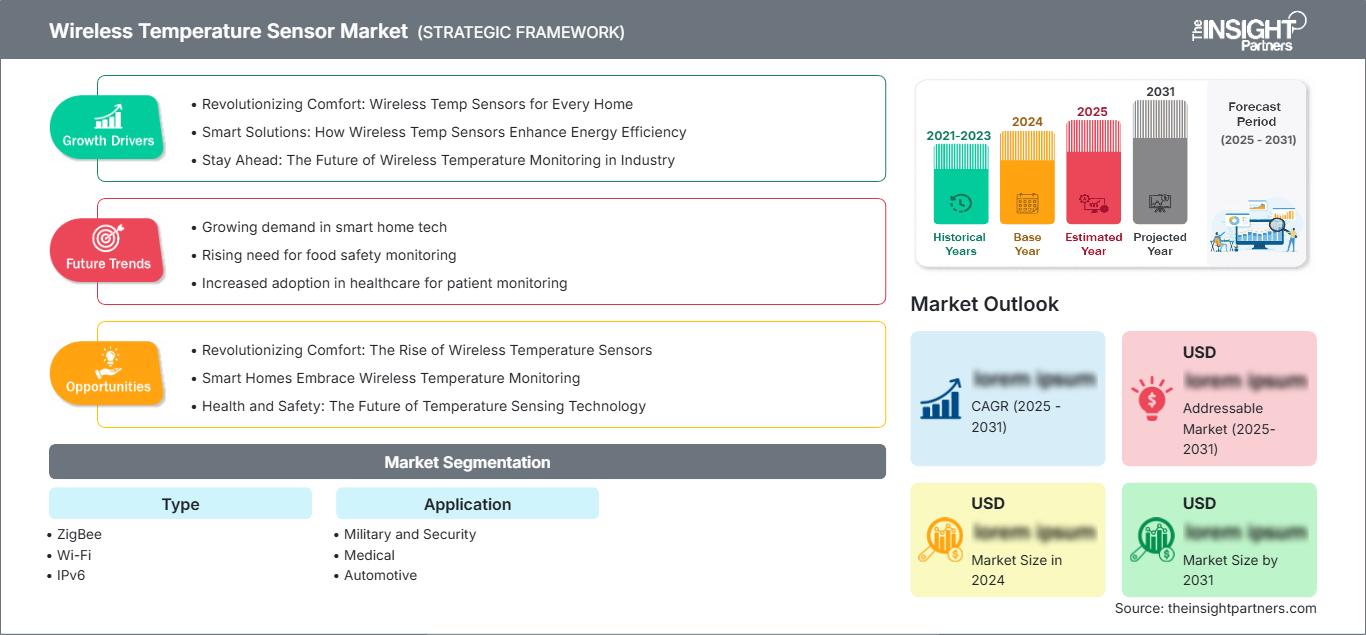
The wireless temperature sensor market is valued at US$ 3.08 Billion in 2025 and is projected to reach US$ 5.39 Billion by 2034, registering a CAGR of 6.42% during 2026–2034. The market reflects increasing deployment of wireless sensing across industrial, medical, automotive, security, and building applications, where remote measurement, reduced cabling, faster installation, and continuous monitoring are increasingly important for operational visibility and asset management.
North America remains a structurally important demand center, with the wireless temperature sensor market size supported by industrial automation, connected buildings, process modernization, and replacement of wired instrumentation. The region is estimated to expand at a CAGR of 6.8–7.4% from 2026–2034, with demand reinforced by predictive maintenance, data-center infrastructure, and increasingly connected manufacturing environments.
Wireless Temperature Sensor Market Assessment and Insights
- North America: North America is estimated to hold a 34–38% wireless temperature sensor market share in 2025 and expand at a 6.8–7.4% CAGR between 2026–2034, supported by industrial digitization, connected infrastructure, and replacement of hardwired monitoring points.
- US: The US represents approximately 63–67% of North American demand in 2025 and is projected to grow at a 6.9–7.5% CAGR through 2034, led by automation and building controls.
- Europe: Europe accounts for an estimated 19–22% share in 2025 and is expected to grow at a 5.8–6.5% CAGR, with Germany, the UK, France, Italy, and Spain supporting adoption through factory modernization and energy-efficiency programs.
- Asia Pacific: Asia Pacific represents approximately 30–34% of 2025 demand and is expected to expand at a 7.0–7.8% CAGR, led by China, Japan, South Korea, India, and Australia as industrial connectivity expands.
- Largest Segment: Industrial Monitoring is estimated to command a 28–32% market share in 2025 and grow at a 6.8–7.5% CAGR, reflecting broad deployment across plants, machinery, and utilities.
- High Growth Segment: Building Automation represents approximately 16–20% share in 2025 and is projected to grow at a 7.5–8.4% CAGR as connected HVAC and energy-management systems scale.
- Key companies analyzed in detail: ABB Ltd.; Analog Devices, Inc.; General Electric Company; Honeywell International Inc.; Microchip Technology Inc.; NXP Semiconductors N.V.; Schneider Electric SE; Siemens AG; Texas Instruments Incorporated; Yokogawa Electric Corporation.
Source: The Insight Partners' analysis based on proprietary research, government publications, company annual reports, investor presentations, industry databases, and expert interviews.
The wireless temperature sensors market has shifted its focus from simply sending remote temperature data to connected sensing systems that incorporate low-power electronics, wireless protocols, gateways, analytics, and cloud or edge computing. Improvements in energy harvesters, semiconductor technologies, small radios, and precision of the sensors are making installation less difficult. Manufacturers compete based on network dependability, security, battery performance, interoperability, and integration into current automation systems, rather than solely on sensing devices.
In the future, investments will be made in areas of the wireless temperature sensor market where wiring is not feasible due to high costs, disruption, or other practical difficulties. New manufacturing hubs in Asia, upgrades at North American plants, and energy efficiency drives in Europe are creating new avenues for use of wireless temperature sensors. Industrial safety, building efficiency, pharmaceutical management, and critical infrastructure monitoring are also receiving regulatory attention, which drives continuous measurements and edge computing.
Wireless Temperature Sensor Market Report Scope
| Report Attribute | Details |
|---|---|
| Market size in 2025 | US$ 3.08 Billion |
| Market Size by 2034 | US$ 5.39 Billion |
| Global CAGR (2026 - 2034) | 6.42% |
| Historical Data | 2021-2024 |
| Forecast period | 2026-2034 |
Wireless Temperature Sensor Market Analysis
Wireless temperature sensor demand will be driven by the necessity for constant monitoring of condition status in a wide array of equipment. Wireless nodes are used in industrial settings to sense temperature of motors, pumps, switchgear, pipelines, refrigeration units, and process equipment where cable use may extend installation and maintenance efforts. Value chain involves sensing devices, signal processing, microcontrollers, wireless communication, gateways, software, system integration, and life cycle services. Efficient energy consumption is very important since battery changes for a huge number of nodes may become expensive.
Wireless temperature sensor market growth is also driven by ecosystem interoperability. There is a variety of wireless communication protocols with various trade-offs between range, bandwidth, energy consumption, and architecture including ZigBee, Wi-Fi, IP v6 solutions, and Bluetooth technologies. Radio efficiency and semiconductor integration capabilities define system economics by suppliers of components, while software and gateways will serve as differentiation tools by automation vendors. Availability of semiconductors, radios, batteries, and industrial packaging determines supply conditions.
The wireless temperature sensor market forecast highlights a competitive landscape covering automation firms, semiconductor producers, instrumentation providers, and technology vendors. ABB Ltd. focuses on wireless monitoring for electrical infrastructure, Honeywell International Inc. offers wireless instrumentation solutions for process and building environments, whereas Siemens AG offers industrial connectivity solutions along with automation and edge computing capabilities. Schneider Electric SE operates through connected power and building systems, whereas Yokogawa Electric Corporation enjoys a strong presence in process instrumentation and industrial measurement systems.
Analog Devices, Inc., Texas Instruments Incorporated, Microchip Technology Inc., and NXP Semiconductors N.V. offer enabler components such as temperature sensors, low-power processors, and wireless communications technologies. General Electric Company is participating through its industrial technology solutions. The growing investment is focused on integrated sensing solutions rather than discrete hardware pieces. This implies strategic positioning in complete measurement systems.
● REPORT CUSTOMIZATION
Tailor This Report To Align With Your Specific Business Requirements
This report can be customized to align precisely with your business objectives, scope, and target markets. Customization options include tailored segmentation, geography, competitive analysis, and strategic insights to support informed decision-making.
Customize This Report →WHAT YOU CAN ADJUST
- ● Segmentations
- ● Geography
- ● Competitive Analysis
- ● Language Preferences
Wireless Temperature Sensor Market: Strategic Insights
Regional Insights
North America wireless temperature sensor market
North America is estimated to represent 34–38% of 2025 global wireless temperature sensor market and is projected to grow at a 6.8–7.4% CAGR through 2034. Industrial automation, process modernization, data-center expansion, and connected building programs support adoption. Wireless monitoring is particularly valuable where retrofitting existing plants would otherwise require extensive cabling, shutdowns, or access to difficult equipment locations.
The regional opportunity also derives from sophisticated automation infrastructures and extensive industrial communication networks. The opportunities lie in industries such as oil and gas, chemicals, power generation, pharma, food, and discrete manufacturing that offer repeatable use cases. The operators of buildings are now using the temperature data along with HVAC and energy management systems. The demand is highest where remote monitoring can help with maintenance, inspection, or extended measurements.
U.S. wireless temperature sensor market
According to the wireless temperature sensor market report, the U.S. accounts for approximately 63–67% of North American demand in 2025 and is expected to grow at a 6.9–7.5% CAGR through 2034. Industrial plants, commercial buildings, healthcare facilities, utilities, and data centers represent major deployment environments. Large installed automation bases also encourage wireless upgrades where conventional wiring limits additional measurement points.
Applications in the wireless temperature sensor market are moving towards predictive maintenance, remote management of assets, and facility optimization. Honeywell International Inc., Texas Instruments Incorporated, Analog Devices, Inc., General Electric Company, and many other well-established technology vendors are adding to the local environment. End users are assessing wireless applications based on factors such as cybersecurity, network reliability, battery management, interfacing with supervision systems, and overall installation cost instead of simply the cost of sensors.
Europe wireless temperature sensor market
Europe is estimated to hold a 19–22% share in 2025 and expand at a 5.8–6.5% CAGR through 2034. Why Germany continues to be an important market is due to the sophistication of manufacturing and automation. While the UK has a focus on smart buildings and efficiency in industries, France favors connectivity of infrastructure and efficiency in processes. Italy and Spain create further demands through manufacturing, commercial buildings, food processing, and energy applications.
Deployment in the region now tends to reflect efficiency and digitalization needs. In industries, there is the need for more measurement points without extensive wiring, especially when the plants are old. In buildings, there is another application in terms of building automation where HVAC efficiency plays a key role in energy management.
APAC wireless temperature sensor market
APAC is estimated to represent 30–34% of 2025 demand in the wireless temperature sensor market and is projected to grow at a 7.0–7.8% CAGR through 2034. China dominates regional installation, backed by industry automation, electronics fabrication, process industries, and smart factories. Japan and South Korea focus on precise manufacturing, whereas India and Australia offer growth in terms of industrial, infrastructure, and energy markets.
The regional market demand is fueled by investments and upgrading of industries. The wireless sensor technology will be appealing when there is a requirement for monitoring of new plants as well as incremental instrumentation of existing equipment. There is also an increased demand for building automation in metropolitan cities, along with connected infrastructure projects.
Middle East & Africa wireless temperature sensor market
The Middle East and Africa market is expected to expand at a 6.0–6.8% CAGR through 2034. Saudi Arabia and the UAE provide leading opportunities through industrial diversification, energy infrastructure, smart-city programs, and large commercial projects. South Africa contributes through mining, manufacturing, utilities, and industrial maintenance requirements.
Energy-intensive facilities create a strong use case for remote temperature monitoring, particularly around electrical equipment, rotating machinery, process systems, and cooling infrastructure. Wireless deployment can reduce installation complexity across large sites. The wider region is also adopting connected building and infrastructure technologies, creating opportunities for integrated temperature, energy, and equipment-monitoring platforms.
Segmentation Analysis
Type
Type segmentation in the wireless temperature sensor market reflects different requirements for range, power consumption, network topology, interoperability, and installation environment. The segment is projected to expand at a 6.2–6.9% CAGR from 2026–2034. Industrial buyers increasingly select protocols according to existing infrastructure and the required balance between reliability, scalability, and energy efficiency.
- ZigBee: ZigBee remains strategically relevant for low-power mesh applications where multiple temperature nodes must communicate across buildings or industrial spaces. Its mesh architecture supports distributed monitoring and can reduce dependence on direct point-to-point links.
- Wi-Fi: Wi-Fi is suited to environments with established wireless infrastructure and relatively high data connectivity requirements. It can simplify integration with enterprise networks, although power management and network congestion remain important design considerations.
- IPv6: IPv6-enabled approaches support addressable sensing architectures and integration with broader Internet Protocol environments. Their strategic value increases where operators require scalable device management, direct network visibility, and compatibility with evolving industrial IoT frameworks.
- Bluetooth: Bluetooth is important for short-range monitoring, commissioning, mobile access, and low-power sensor deployments. Bluetooth-enabled architectures are particularly useful where technicians need convenient device configuration or where sensors operate close to gateways and connected equipment.
Application
Application represents the principal demand layer because temperature monitoring requirements differ substantially by operating environment. The segment is expected to grow at a 6.7–7.4% CAGR during 2026–2034. Industrial Monitoring remains the largest application, while Building Automation is positioned for faster expansion as connected HVAC and energy systems become more prevalent.
- Military and Security: Temperature sensing supports equipment protection, environmental monitoring, and operational reliability across sensitive installations. Wireless architectures can provide measurement coverage in locations where conventional cabling adds logistical complexity or compromises deployment flexibility.
- Medical: Medical environments require dependable temperature monitoring for equipment, facilities, storage areas, and selected clinical processes. Wireless connectivity can improve visibility while reducing installation disruption across hospitals, laboratories, and distributed healthcare environments.
- Automotive: Automotive applications include production facilities, battery systems, testing environments, and connected equipment. Wireless sensing can support flexible monitoring during manufacturing and validation, particularly where rapid reconfiguration or additional measurement points are required.
- Industrial Monitoring: Industrial Monitoring is the largest application because temperature is a critical indicator of equipment condition and process stability. Wireless nodes enable broader coverage across machinery, electrical assets, utilities, and production environments.
- Building Automation: Building Automation is a high-growth application as smart HVAC, energy management, occupancy optimization, and remote facility supervision become increasingly integrated. Wireless sensors help extend monitoring coverage while reducing installation constraints in existing structures.
Opportunity Snapshot
| Application | Revenue Contribution (High/Medium/Low) | Trend Tag (MAX 2 words, specific) | Adoption Stage (Emerging/Scaling/Mature) |
| Military and Security | Medium | Asset Protection | Scaling |
| Medical | Medium | Cold Chain | Scaling |
| Automotive | Medium | Battery Monitoring | Scaling |
| Industrial Monitoring | High | Predictive Maintenance | Mature |
| Building Automation | High | Smart HVAC | Scaling |
Wireless Temperature Sensor Market Growth Drivers and Impact Analysis
Expansion of Predictive Maintenance Programs
Modern industrial managers consider temperature to be the first sign of potential wear-and-tear, unusual friction, resistance, overload, and process deviation. The wireless capability opens up the opportunity to place monitoring nodes in equipment that was previously subject to manual inspection or intermittent monitoring. That shifts the economics from fixed-time maintenance to condition-based maintenance. It is most effective in plants where there are numerous motors, pumps, compressors, switchgear, and other rotating machinery. As analysis systems get better at correlating temperature with vibration, electrical current, pressure, and operational state, the value of each individual temperature node rises. Companies who are capable of integrating sensing, communication, analysis, and alerting have a more valuable proposition than companies selling just the hardware part of the system.
Retrofitting Existing Industrial and Commercial Infrastructure
Large numbers of operating facilities were designed around wired instrumentation, creating practical limits on expanding measurement coverage. Wireless architectures reduce the need for new cable trays, conduits, penetrations, and shutdowns, making them particularly attractive for retrofit projects. The economic advantage becomes more visible when sensors must be installed across difficult-to-access machinery or geographically dispersed assets. Commercial buildings also benefit because wireless nodes can be positioned around HVAC equipment, rooms, refrigeration systems, and energy-intensive zones without major structural modifications. This driver supports demand across mature markets where replacement of entire control systems is rarely economical. It also encourages phased deployment, allowing customers to begin with critical assets and expand networks after demonstrating operational value.
Growth of Connected Building and Energy Infrastructure
The expansion of smart buildings, distributed energy systems, and digitally managed infrastructure increases the number of locations requiring continuous environmental and equipment measurement. Temperature data supports HVAC optimization, thermal comfort, equipment protection, energy management, and fault detection. In commercial properties, wireless deployment can help facility managers extend sensing coverage across renovated or occupied spaces without extensive construction work. Energy infrastructure creates additional applications around electrical distribution, transformers, batteries, cooling systems, and power electronics. The growing integration of sensors with building-management and energy-management platforms also increases the value of standardized data. As infrastructure owners prioritize operational efficiency and remote supervision, wireless temperature measurement becomes an enabling layer within broader connected asset architectures.
Wireless Temperature Sensor Market Future Trends
Energy Harvesting and Battery-Light Sensor Architectures
Future wireless sensing platforms are likely to place greater emphasis on reducing or eliminating routine battery replacement. Energy harvesting from light, vibration, thermal gradients, or other local sources can support longer operating periods and lower lifecycle maintenance requirements. The technology is particularly relevant in industrial locations where access is difficult, hazardous, or expensive. Improvements in ultra-low-power processors, radios, sleep modes, and event-driven measurement will further reduce energy requirements. Sensor nodes may increasingly operate with intermittent measurement and local decision-making rather than continuous high-power transmission. This architecture can improve deployment economics for large networks because maintenance effort becomes less dependent on the number of installed devices. Vendors that combine energy management with reliable communication are positioned to address applications requiring long service intervals.
Edge Intelligence for Distributed Thermal Monitoring
Wireless temperature networks are expected to move toward greater local processing, allowing sensor nodes or gateways to identify abnormal patterns before sending information to centralized platforms. Edge intelligence can reduce unnecessary communication, improve response times, and support operation during intermittent network connectivity. Instead of transmitting every measurement at the same frequency, future systems may recognize threshold violations, rate-of-change anomalies, or correlations with operating conditions and prioritize only relevant events. This approach is particularly valuable for industrial monitoring, electrical infrastructure, refrigeration, and critical facilities. Integration with machine-learning models could also help distinguish normal thermal variation from developing faults. As computing becomes more capable at the edge, wireless temperature sensor market trends will increasingly center on actionable intelligence rather than simple measurement transmission.
Wireless Temperature Sensor Market Opportunities
Integrated Monitoring Packages for Brownfield Facilities
Brownfield industrial facilities present an attractive opportunity because operators often need more monitoring coverage without replacing existing control infrastructure. Suppliers can package wireless temperature nodes with gateways, installation services, cybersecurity features, and software connectors designed for established automation environments. Such solutions can shorten project planning and reduce integration risk for customers with heterogeneous equipment. A modular approach also enables phased deployment across production lines, utilities, electrical rooms, and storage areas. Commercial success will depend on proving lifecycle economics rather than simply offering lower hardware prices. Vendors should emphasize rapid commissioning, protocol compatibility, battery management, remote diagnostics, and straightforward expansion. These capabilities can help convert isolated sensor projects into broader monitoring programs and strengthen recurring service relationships.
Temperature Monitoring for Energy Storage and Electrification Assets
Electrification is creating new temperature-monitoring requirements around batteries, charging infrastructure, power conversion equipment, electrical distribution, and thermal-management systems. Wireless sensing can provide additional measurement points without extensive wiring, especially across distributed equipment and retrofit installations. Opportunities are strongest where thermal conditions can change rapidly and early detection has safety or operational value. Suppliers can differentiate through high-temperature capability, fast response, secure communication, redundant monitoring, and integration with asset-management systems. The opportunity extends beyond electric vehicles to stationary energy storage, renewable power facilities, microgrids, and industrial electrification projects. Developing application-specific packages for these assets could allow sensor vendors to move beyond commodity hardware and participate in higher-value monitoring architectures.
Frequently Asked Questions

- Comprehensive Market Sizing and Forecast Analysis
- Detailed Segmentation Analysis
- In-Depth Market Dynamics Assessment
- Regional and Country-Level Insights
- Competitive Landscape and Company Benchmarking
- Strategic Business Intelligence
Recent Reports
Testimonials

The Insight Partners provided valuable market intelligence that supported our global go-to-market strategy. Their team was professional, responsive, and attentive to our feedback, providing thoughtful analysis and helpful methodological clarifications throughout the project.
Junmo Kim Chief Financial Officer (CFO), Enertech Co., Ltd.
The Insight Partners' SCADA System Market report is comprehensive, with valuable insights on current trends and future forecasts. The team was highly professional, responsive, and supportive throughout. We are very satisfied and highly recommend their services.
RAN KEDEM Partner, Reali Technologies LTDs
I requested a report on a very specific software market and the team produced the report in a few days. The information was very relevant and well presented. I then requested some changes and additions to the report. The team was again very responsive and I got the final report in less than a week.
JEAN-HERVE JENN Chairman, Future Analytica
We worked with The Insight Partners for an important market study and forecast. They gave us clear insights into opportunities and risks, which helped shape our plans. Their research was easy to use and based on solid data. It helped us make smart, confident decisions. We highly recommend them.
PIYUSH NAGPAL Sr. Vice President, High Beam Global
The Insight Partners delivered insightful, well-structured market research with strong domain expertise. Their team was professional and responsive throughout. The user-friendly website made accessing industry reports seamless. We highly recommend them for reliable, high-quality research services
YUKIHIKO ADACHI CEO, Deep Blue, LLC.
This is the first time I have purchased a market report from The Insight Partners.While I was unsure at first, I visited their web site and felt more comfortable to take the risk and purchase a market report.I am completely satisfied with the quality of the report and customer service. I had several questions and comments with the initial report, but after a couple of dialogs over email with their analyst I believe I have a report that I can use as input to our strategic planning process.Thank you so much for taking the extra time and making this a positive experience.I will definitely recommend your service to others and you will be my first call when we need further market data.
JOHN SUZUKI President and Chief Executive Officer, Board Director, BK Technologies
I wish to appreciate your support and the professionalism you displayed in the course of attending to my request for information regarding to infectious disease IVD market in Nigeria. I appreciate your patience, your guidance, and the fact that you were willing to offer a discount, which eventually made it possible for us to close a deal. I look forward to engaging The Insight Partners in the future, all thanks to the impression you have created in me as a result of this first encounter.
DR CHIJIOKE ONYIA MANAGING DIRECTOR, PineCrest Healthcare Ltd.Reason to Buy
- Informed Decision-Making
- Understanding Market Dynamics
- Competitive Analysis
- Identifying Emerging Markets
- Customer Insights
- Market Forecasts
- Risk Mitigation
- Boosting Operational Efficiency
- Strategic Planning
- Investment Justification
- Tracking Industry Innovations
- Aligning with Regulatory Trends





 Get Free Sample for