
Zero Turn Mowers Market Size, Share & Demand by 2034
Coverage: By Product Type (Less than 50 inches, 50-60 inches, More than 60 inches); Horsepower (Less than 25 HP and More than 25 HP); Application (Commercial and Residential), and Geography (North America, Europe, Asia Pacific, and South and Central America)
- Status : Data Released
- Report Code : TIPRE00012523
- Category : Manufacturing and Construction
- No. of Pages : 150
- Available Report Formats :


- Last update date : September 30, 2026


2025 Market Size
US$ 2.92 Bn
Base year value
2034 Forecast
US$ 4.6 Bn
Projected by 2034
CAGR 2026-2034
5.18 %
Growth rate
Addressable Market
US$ 34.12 Bn
(2026-2034)
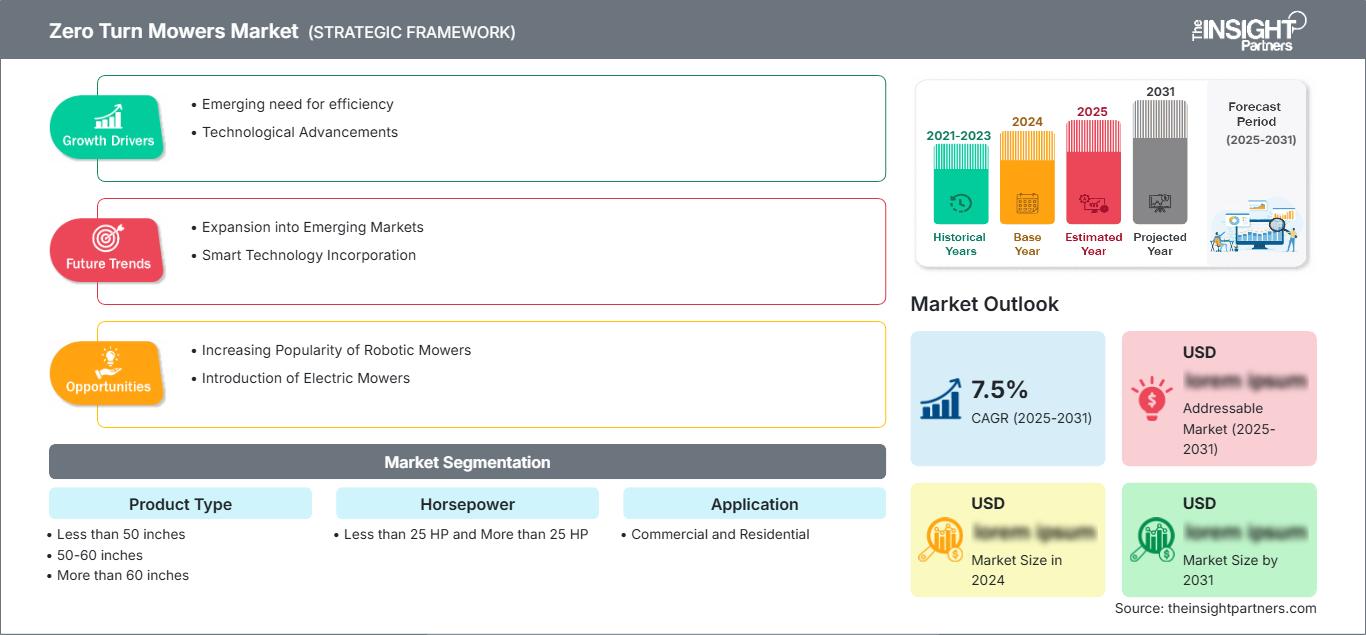
The Zero turn mowers market was valued at US$ 2.92 Billion in 2025 and is projected to reach US$ 4.6 Billion by 2034, registering a CAGR of 5.18% during 2026–2034. Demand is supported by increasing preference for maneuverable mowing equipment, replacement of aging residential and commercial fleets, and continuing product improvements in deck engineering, operator comfort, drivetrain efficiency, and power management across established and emerging markets.
North America remains the principal demand center, with the zero turn mowers market size supported by extensive suburban properties, professional landscaping activity, established dealer networks, and recurring equipment replacement. The regional market is estimated to expand at a CAGR of 5.8–6.3% from 2026–2034. Commercial fleet modernization and rising interest in battery-powered outdoor equipment are expected to strengthen replacement demand while manufacturers broaden financing and service offerings.
Zero Turn Mowers Market Assessment and Insights
- North America represented an estimated 36–39% zero turn mowers market share in 2025 and is projected to grow at a CAGR of 5.8–6.3% between 2026–2034, supported by mature landscaping services, large properties, dealer infrastructure, and replacement cycles.
- US accounted for approximately 76–81% of North American demand in 2025 and is expected to expand at a CAGR of 5.5–6.1% during 2026–2034, led by residential replacement and professional fleet investment.
- Europe held an estimated 24–27% share in 2025 and is forecast to register a CAGR of 5.0–5.7% through 2034, with Germany, the UK, France, Italy, and Spain representing important adoption markets.
- Asia Pacific captured approximately 20–23% share in 2025 and is anticipated to grow at a CAGR of 7.0–8.0% through 2034, with China, Japan, South Korea, India, and Australia supporting regional expansion.
- Largest Segment: The 50–60 inches product category held an estimated 42–46% market share in 2025 and is projected to grow at a CAGR of 5.2–5.8% during 2026–2034.
- High Growth Segment: Commercial applications represented approximately 54–58% share in 2025 and are projected to expand at a CAGR of 5.6–6.3% through 2034.
- Key companies analyzed in detail: AriensCo; Briggs & Stratton Corporation; Deere & Company; Husqvarna AB; Hustler Turf Equipment, Inc.; Textron Inc.; MTD Products Limited; Swisher Acquisition, Inc.; The Grasshopper Company; The Toro Company; Kubota Corporation.
Source: The Insight Partners' analysis based on proprietary research, government publications, company annual reports, investor presentations, industry databases, and expert interviews.
Zero turn mowers' production and new product development are evolving towards platforms that integrate hydrostatic drive with enhanced fabricated decks, better suspension, ergonomics, and more diverse powertrains. Zero turn mowers are becoming more differentiated by deck size and horsepower capacity, allowing manufacturers to cater to needs for compact residential lawn mowing, larger private land mowing, and professional mowing applications.
Moving forward, manufacturers of zero turn mowers are expected to invest in electric battery platforms, modularity of powertrains, telematics solutions, and lower maintenance components while retaining gasoline platforms for heavy usage situations. Dealers' servicing capacity, finance solutions, parts availability, and local configuration of products will be critical investments for manufacturers to make. Growing demand in Asia Pacific and some European countries is expected to drive manufacturers to adapt their platforms to various property sizes and conditions.
Zero Turn Mowers Market Report Scope
| Report Attribute | Details |
|---|---|
| Market size in 2025 | US$ 2.92 Billion |
| Market Size by 2034 | US$ 4.6 Billion |
| Global CAGR (2026 - 2034) | 5.18% |
| Historical Data | 2021-2024 |
| Forecast period | 2026-2034 |
Zero Turn Mowers Market Analysis
The demand for zero-turn mowers is driven by the productivity benefits provided by zero turn steering in situations that require mowing around trees, landscaping, buildings, and uneven boundaries. Growth in the zero turn mowers market, thus, has a strong relationship with grounds management services, suburban homeownership, property management activities, and replacement of old ride-on machines. Larger deck size enhances productivity in case of large areas whereas smaller size increases accessibility.
As per the zero turn mowers market report, the value chain consists of providers of engines and batteries, suppliers of drivetrain and transmission, makers of deck and chassis, manufacturers of components, original equipment makers, dealers, rental firms, landscapers, and end-users. The supply chain puts more focus on reliable hydraulics, cutting systems, electronics, batteries, and engines. Integrated sourcing and extensive dealer networks help in better handling of production schedules.
Competitive positioning revolves around product range, longevity, dealer coverage, finance options, operator comfort, and lifecycle costing. Deere & Company and The Toro Company have large residential and commercial product ranges, while Husqvarna AB and AriensCo are competitors based on differentiated deck, comfort, and productivity characteristics. Briggs & Stratton Corporation is still relevant due to its powertrain knowledge, and Hustler Turf Equipment, Inc. focuses on commercial and residential machines.
In the zero-turn mower market forecast, there is also an increasing trend of strategic differentiation based on electric propulsion and productivity engineering. Deere & Company has added electric options, while AriensCo has introduced battery interchangeability on professional products. The Toro Company maintains a combination of conventional and electric platforms. Kubota Corporation, Textron Inc., MTD Products Limited, Swisher Acquisition, Inc., and The Grasshopper Company enhance competitive depth.
● REPORT CUSTOMIZATION
Tailor This Report To Align With Your Specific Business Requirements
This report can be customized to align precisely with your business objectives, scope, and target markets. Customization options include tailored segmentation, geography, competitive analysis, and strategic insights to support informed decision-making.
Customize This Report →WHAT YOU CAN ADJUST
- ● Segmentations
- ● Geography
- ● Competitive Analysis
- ● Language Preferences
Zero Turn Mowers Market: Strategic Insights
Regional Insights
North America zero turn mowers market
North America accounted for an estimated 36–39% share in 2025 and is expected to expand at a CAGR of 5.8–6.3% through 2034. The area enjoys well-endowed suburban lawns, professional landscape services, golf course grounds keeping, city grounds keeping services, and strong demand for replacement. Availability of the product through speciality distributors further facilitates purchasing decisions.
Today, business purchasers weigh productivity, down time, access to maintenance, finance, and operator comfort when evaluating a machine rather than cost alone. Homeowners are more concerned with maneuverability and mowing times of large areas. Battery-powered equipment is more applicable in situations where noise levels, maintenance, and emissions are key factors, while gasoline-powered equipment is used in heavy-duty applications.
U.S. zero turn mowers market
The US represented approximately 76–81% of North American demand in 2025 and is projected to grow at a CAGR of 5.5–6.1% through 2034. Demand is driven by broad dealer distribution network, high installation equipment, commercial landscaping work, and heightened awareness among residential consumers about zero-turn steering capacity. The southern states continue to be especially critical since longer mowing seasons lead to higher equipment usage.
Commercial landscapers prefer wider decks, robust fabricated components, suspension systems, and ease of maintenance. The demand among residential users stays focused on 42-60 inches, but the commercial fleet is looking at battery-operated machines to cut down noise. Deere & Company, The Toro Company, Husqvarna AB, AriensCo, Briggs & Stratton Corporation, and Hustler Turf Equipment, Inc. occupy notable market positions.
Europe zero turn mowers market
Europe held an estimated 24–27% share in 2025 and is forecast to register a CAGR of 5.0–5.7% through 2034. Germany and the United Kingdom serve as key demand centers, aided by professional grounds care, private estates, sport grounds, and commercial landscaping. Germany will be helped by advanced equipment engineering skills and organized distribution channels, whereas the United Kingdom has an advanced grounds care market that calls for maneuverability.
According to the Zero turn mowers market forecast, France, Italy, and Spain offer further prospects with the upgrade of mower fleets among municipalities, hotel complexes, sports grounds, and private landowners. European customers are beginning to look at sound levels, exhaust emissions, operator comfort, maintainability, and cost of operation along with cutting capabilities. AriensCo, Husqvarna AB, Deere & Company, The Toro Company, and Kubota Corporation are well placed to cater to diverse needs among national markets.
APAC zero turn mowers market
APAC represented approximately 20–23% share in 2025 and is projected to grow at a CAGR of 7.0–8.0% through 2034. Australia holds first place in regional markets owing to large plots of land, landscape business operations, and familiarity with ride-on equipment. Japanese and Korean manufacturers focus on compact machinery, whereas China and India provide prospects of long-term development.
Urban landscape, hospitality projects, institutions’ property, and quality residential areas broaden the target customer base. Production at the local level, improvements in the network of dealerships, and sustainable procurement practices can assist in electrification processes. Adaptation to smaller plots of land, local topography, climate, and servicing needs would still be critical for the manufacturers.
Middle East & Africa zero turn mowers market
Middle East and Africa demand remains smaller but is expected to expand at a CAGR of 4.2–5.0% through 2034. Saudi Arabia and the UAE lead regional opportunities because of landscaping investment associated with hospitality, residential developments, public spaces, and major infrastructure projects. South Africa provides a more established grounds-care environment with commercial and institutional demand.
Heat, dust, irrigation, and maintenance all affect product choices. Larger landscaped sites offer potential for bigger decks and more powerful machinery, and access to service is essential. Energy efficiency has become increasingly significant in institutional purchasing decisions, though gas-powered machinery still plays an important role where charging and high-duty cycles limit electric use.
Segmentation Analysis
Product Type
The product type segment is expected to grow at a CAGR of 5.0–5.6% during 2026–2034. Cutting width directly influences productivity, transportability, maneuverability, and purchase economics. Manufacturers therefore maintain multiple deck configurations to serve residential properties, professional landscaping operations, and larger commercial grounds with different mowing requirements.
- Less than 50 inches: Compact configurations address residential properties, narrow access points, and buyers prioritizing maneuverability. Their smaller footprint supports easier storage and transport while broadening adoption among homeowners with constrained landscapes.
- 50-60 inches: Mid-width decks provide a practical balance between productivity, maneuverability, and equipment cost. They remain strategically important for homeowners and landscaping contractors requiring versatile performance across mixed property sizes.
- More than 60 inches: Wider decks target expansive properties and high-utilization commercial applications where mowing productivity is prioritized. Their value proposition strengthens when operators can maintain uninterrupted passes across large, relatively open grounds.
Horsepower
The horsepower segment is projected to grow at a CAGR of 4.8–5.4% through 2034. Power requirements vary according to deck width, grass density, terrain, operating duration, and attachment use. Manufacturers continue refining engine efficiency and drivetrain matching to balance cutting performance with fuel consumption and service requirements.
- Less than 25 HP: Lower-power machines primarily address residential and light commercial applications. Their affordability, simpler operating requirements, and compatibility with compact and mid-width decks support broad buyer accessibility.
- More than 25 HP: Higher-power platforms serve intensive commercial mowing and larger properties requiring wider decks and sustained operating capability. Durability, cooling, transmission performance, and operator comfort become increasingly important purchase criteria.
Application
The application segment is expected to register a CAGR of 5.6–6.3% during 2026–2034. Commercial operators typically place greater emphasis on utilization, productivity, uptime, service response, and lifecycle cost, whereas residential buyers weigh convenience, property size, comfort, price, and equipment longevity. This distinction shapes product specifications and channel strategies.
- Commercial: Commercial users include landscaping contractors, municipalities, institutions, sports facilities, and property managers. High utilization encourages investment in durable decks, efficient drivetrains, ergonomic seating, rapid serviceability, and increasingly battery-powered alternatives.
- Residential: Residential adoption is concentrated among owners of medium and large properties seeking faster mowing and precise maneuverability. Financing, ease of operation, comfort, warranty coverage, and dealer support strongly influence purchase decisions.
Opportunity Snapshot
| Application | Revenue Contribution (High/Medium/Low) | Trend Tag | Adoption Stage |
| Commercial | High | Fleet Renewal | Mature |
| Residential | Medium | Premium Yards | Scaling |
Zero Turn Mowers Market Growth Drivers and Impact Analysis
Expansion of Professional Landscaping and Grounds Maintenance
Professional landscaping will continue to be a structurally driven demand force as contractors have to deal with ongoing mowing needs in commercial, residential, institutional, sports, and public properties. In comparison with traditional tractor designs, zero-turn platforms help avoid inefficiencies in maneuvering around obstacles and allow better productive time in mowing operations. It is particularly true when it comes to contractors using several crews since their equipment efficiency directly affects their labor efficiency and their ability to serve their clients. Fleet buyers, on their part, usually make replacement decisions based on operating hours and cost of maintenance. Therefore, there is a need for manufacturers and dealers to keep replacing equipment due to the regularity in fleet turnover.
Rising Preference for Efficient Equipment on Large Properties
Increasingly, many residential estates, institutional campuses, hotel grounds, and recreational facilities find the need for equipment that has the ability to cover huge areas of the lawn without too much maneuverability. Zero turn designs come into the picture due to their independent wheel movements, quick turns, and deck widths. The productivity advantage offered by such designs can lead to reduced operator hours during mowing cycles and make it economical for companies to purchase expensive equipment. Residential customers with larger estates now consider equipment on the basis of comfort, efficiency, warranty terms, and accessibility of maintenance apart from horsepower figures. Commercial purchasers also factor in down times and operator fatigue.
Electrification and Lower-Maintenance Powertrain Development
Electrification is forming a new path for product development due to advancements in battery technology, motor efficiency, and charging technologies. Battery-powered equipment eliminates the necessity for fueling, maintenance of engines, and localized noise during operation; these factors make the equipment highly applicable to universities, cities, luxury homes, and noise-sensitive commercial premises. This is illustrated by Deere & Company, which provides electric ZTrak equipment that utilizes sealed lithium-ion batteries, and AriensCo, which has introduced battery swappable design for professional zero turn equipment. This has an effect not only on the mower, but also on the ability of manufacturers to develop batteries, charging systems, controls, service tools, and software environment around the product.
Zero Turn Mowers Market Future Trends
Interoperable Battery Platforms and Modular Energy Systems
The zero turn mowers market trends indicate that battery systems are likely to evolve from mower-specific components toward modular platforms shared across broader outdoor power equipment portfolios. Interoperability could help optimize resource efficiency through the capability of switching batteries among compatible machines, whether mowers, handheld units, or others. For businesses, interoperable packs would streamline logistics and minimize the need for specialized charging systems for each unit. Companies may compete not only on the battery capacity but also through battery management systems, cooling solutions, battery charging capabilities, diagnostic services, and warranty arrangements. A modular design may also enable phased introduction of battery-powered equipment with the ability to start with quiet applications and then move to electrification of all fleet components over time.
Connected Fleet Management and Data-Assisted Maintenance
Connectivity is expected to become more relevant as commercial operators seek greater visibility into utilization, maintenance schedules, operating hours, location, and equipment availability. Embedded sensors and digital dashboards can help fleet managers identify underused machines, schedule preventative maintenance, monitor battery condition, and coordinate service interventions. Future systems may combine machine data with job scheduling and workforce-management platforms, enabling contractors to allocate equipment according to property size and operating requirements. Remote diagnostics could also reduce service downtime by allowing dealers to identify component issues before a machine arrives at a workshop. For manufacturers, connected equipment provides a pathway toward differentiated service relationships and improved product-development feedback. Adoption will depend on hardware costs, data interoperability, cybersecurity, connectivity coverage, and clear operational benefits.
Zero Turn Mowers Market Opportunities
Localized Product Platforms for Emerging APAC Demand
Manufacturers can capture incremental demand in APAC by adapting established platforms to regional property sizes, terrain, climate, dealer capabilities, and purchasing preferences. Australia provides an immediate opportunity for larger commercial machines, while Japan and South Korea favor compact equipment suitable for more constrained environments. India and China offer longer-term potential as premium landscaping, hospitality developments, institutional grounds, and organized property services expand. Localized assembly or component sourcing could improve cost competitiveness and shorten supply chains, while regional training programs can strengthen dealer service quality. Manufacturers should consider modular product families that share core drivetrains and controls but permit localized deck sizes, seating, safety equipment, and power configurations. Such strategies can reduce development complexity while improving market fit.
Specialized Fleet Solutions for Municipal and Institutional Buyers
Municipalities, universities, healthcare campuses, sports facilities, resorts, and corporate properties represent an opportunity for suppliers offering complete fleet propositions rather than standalone equipment. These buyers increasingly evaluate procurement through lifecycle economics, service availability, noise considerations, operating consistency, and sustainability objectives. Suppliers can differentiate through bundled financing, preventative maintenance contracts, operator training, replacement planning, telematics, and battery infrastructure where electrification is practical. Fleet standardization can also reduce training complexity and simplify parts inventories. Manufacturers with broad product ranges can position compact machines for confined areas alongside wider commercial units for open grounds. Building direct relationships with institutional procurement teams may reduce dependence on purely transactional retail channels while creating longer replacement cycles and repeat equipment orders.
Frequently Asked Questions

- Comprehensive Market Sizing and Forecast Analysis
- Detailed Segmentation Analysis
- In-Depth Market Dynamics Assessment
- Regional and Country-Level Insights
- Competitive Landscape and Company Benchmarking
- Strategic Business Intelligence
Recent Reports
Testimonials

The Insight Partners' SCADA System Market report is comprehensive, with valuable insights on current trends and future forecasts. The team was highly professional, responsive, and supportive throughout. We are very satisfied and highly recommend their services.
RAN KEDEM Partner, Reali Technologies LTDs
I requested a report on a very specific software market and the team produced the report in a few days. The information was very relevant and well presented. I then requested some changes and additions to the report. The team was again very responsive and I got the final report in less than a week.
JEAN-HERVE JENN Chairman, Future Analytica
We worked with The Insight Partners for an important market study and forecast. They gave us clear insights into opportunities and risks, which helped shape our plans. Their research was easy to use and based on solid data. It helped us make smart, confident decisions. We highly recommend them.
PIYUSH NAGPAL Sr. Vice President, High Beam Global
The Insight Partners delivered insightful, well-structured market research with strong domain expertise. Their team was professional and responsive throughout. The user-friendly website made accessing industry reports seamless. We highly recommend them for reliable, high-quality research services
YUKIHIKO ADACHI CEO, Deep Blue, LLC.
This is the first time I have purchased a market report from The Insight Partners.While I was unsure at first, I visited their web site and felt more comfortable to take the risk and purchase a market report.I am completely satisfied with the quality of the report and customer service. I had several questions and comments with the initial report, but after a couple of dialogs over email with their analyst I believe I have a report that I can use as input to our strategic planning process.Thank you so much for taking the extra time and making this a positive experience.I will definitely recommend your service to others and you will be my first call when we need further market data.
JOHN SUZUKI President and Chief Executive Officer, Board Director, BK Technologies
I wish to appreciate your support and the professionalism you displayed in the course of attending to my request for information regarding to infectious disease IVD market in Nigeria. I appreciate your patience, your guidance, and the fact that you were willing to offer a discount, which eventually made it possible for us to close a deal. I look forward to engaging The Insight Partners in the future, all thanks to the impression you have created in me as a result of this first encounter.
DR CHIJIOKE ONYIA MANAGING DIRECTOR, PineCrest Healthcare Ltd.Reason to Buy
- Informed Decision-Making
- Understanding Market Dynamics
- Competitive Analysis
- Identifying Emerging Markets
- Customer Insights
- Market Forecasts
- Risk Mitigation
- Boosting Operational Efficiency
- Strategic Planning
- Investment Justification
- Tracking Industry Innovations
- Aligning with Regulatory Trends





 Get Free Sample for