
Aircraft Conversion Market Trends, Demand & Growth by 2034
Coverage: By Aircraft Size (Narrow-body Freighters, Wide-Body Freighters); Conversion Type (Freighters, Combis, Quick-Change) , and Geography (North America, Europe, Asia Pacific, and South and Central America)
- Status : Data Released
- Report Code : TIPRE00025426
- Category : Aerospace and Defense
- No. of Pages : 150
- Available Report Formats :


- Last update date : November 02, 2026


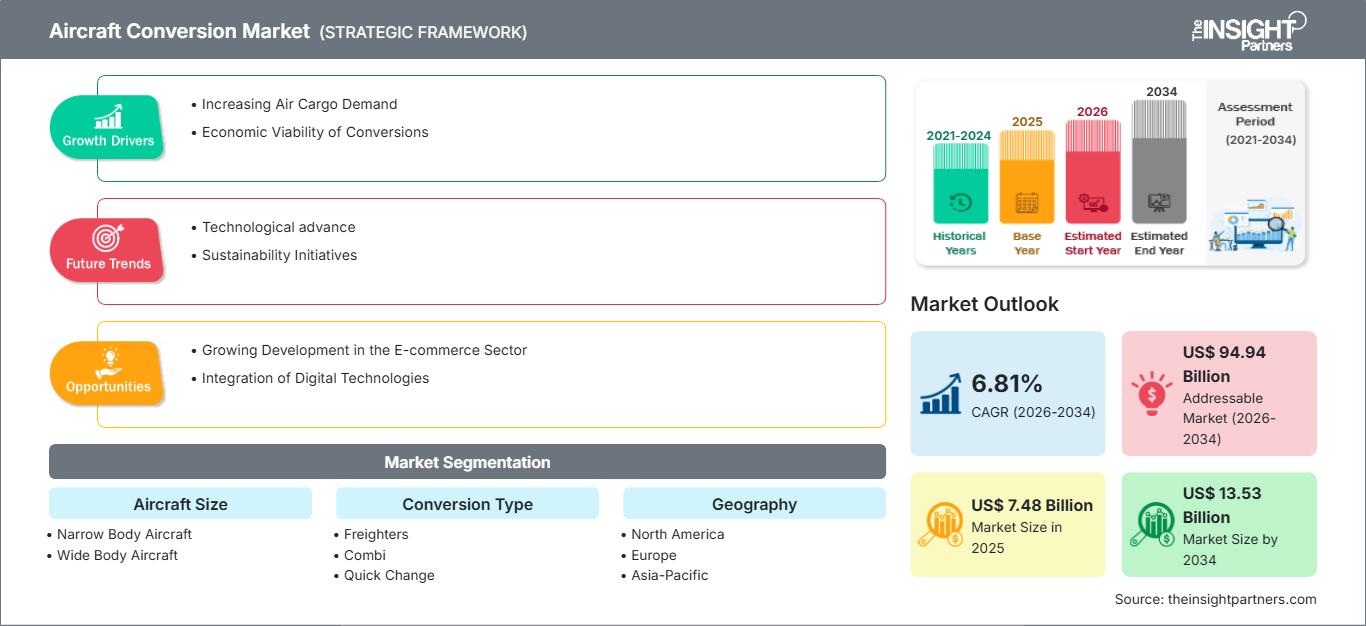
2025 Market Size
US$ 7.48 Bn
Base year value
2034 Forecast
US$ 13.53 Bn
Projected by 2034
CAGR 2026-2034
6.81 %
Growth rate
Addressable Market
US$ 94.94 Bn
(2026-2034)
The aircraft conversion market is projected to expand from US$ 7.48 Billion in 2025 to US$ 13.53 Billion by 2034, registering a CAGR of 6.81% during 2026–2034. The market encompasses structural, systems, interior, cargo, and mission modifications that reposition existing aircraft for new operational roles. Demand is closely connected with fleet renewal, air cargo requirements, aircraft lifecycle economics, and the availability of mature passenger-aircraft feedstock suitable for conversion.
North America remains an important conversion ecosystem because of its established freighter operator base, engineering capabilities, aircraft leasing activity, and mature aftermarket infrastructure. The region is expected to record a ~7% CAGR through 2034. Demand is supported by the replacement of aging freighters, continued express cargo operations, and the commercial rationale of extending useful aircraft life rather than acquiring entirely new aircraft.
Aircraft Conversion Market Assessment and Insights
Regional Outlook
- North America: ~30% of the global market in 2025 | ~7% CAGR through 2034. Market position: North America combines a large installed aircraft base with established conversion engineering, certification, leasing, and cargo networks. The US provides substantial demand for narrowbody and widebody freighter programs, while Canada contributes specialized modification and missionized conversion capabilities.
- US: ~80% of North American market revenue in 2025 | ~7% CAGR through 2034. Market position: The US benefits from extensive express and parcel networks, major aircraft lessors, cargo operators, engineering organizations, and certification infrastructure. Boeing-backed programs and specialist providers support both high-volume narrowbody conversions and more specialized aircraft modifications.
- Europe: ~24% of the global market in 2025 | ~6% CAGR through 2034. Market position: Europe has a mature aerospace engineering base and significant freighter conversion expertise. Germany is the leading country in Europe, supported by EFW’s Dresden activities, while the UK, France, Italy, and Spain contribute operators, maintenance capabilities, aircraft assets, and cargo demand.
- Asia Pacific: ~28% of the global market in 2025 | ~9% CAGR through 2034. Market position: Asia Pacific is the fastest-growing region as manufacturing, e-commerce, cross-border trade, and dedicated cargo networks expand. China is the leading country in Asia Pacific, with Japan, South Korea, India, and Australia supporting additional conversion and cargo-aircraft demand.
Segment Outlook
- Narrow Body Aircraft: ~65% Share in 2025 | ~6% CAGR through 2034. Market position: Narrowbody platforms lead because aircraft such as the 737 and A320/A321 families offer extensive feedstock, lower conversion complexity, flexible regional deployment, and strong suitability for parcel, express, and short-haul cargo networks.
- Wide Body Aircraft: ~35% Share in 2025 | ~8% CAGR through 2034. Market position: Widebody conversions have a higher growth trajectory as operators seek greater payload and volume, while new freighter acquisition costs and limited availability of suitable factory-built aircraft encourage conversion of mature 767, 777, and A330 platforms.
Competitive Coverage
Aeronautical Engineers, Inc., Israel Aerospace Industries, Boeing, Elbe Flugzeugwerke GmbH, Airborne Maintenance & Engineering Services, Precision Aircraft Solutions, ST Engineering, Kelowna Flightcraft, Kuehne+Nagel, Cascade Aerospace Inc.
Methodology
The Insight Partners follows Data Collection & Secondary Research, Primary Research, Data Analysis, and Data Triangulation & Final Review to validate market estimates and insights.
Source: The Insight Partners' analysis based on proprietary research, government publications, company annual reports, investor presentations, industry databases, and expert interviews.
Aircraft conversion has evolved from a largely lifecycle-extension activity into an integrated aerospace engineering and asset-management proposition. Passenger-to-freighter programs now combine structural modification, cargo-door installation, floor reinforcement, avionics work, certification, material management, and continuing airworthiness. Narrowbody platforms remain important because they can serve regional cargo routes and express networks, while widebody programs increasingly address payload-intensive international missions. Boeing projects that roughly two-thirds of freighter deliveries over the next two decades will be converted passenger aircraft, reinforcing the role of conversion alongside factory-built freighters.
The forward outlook for the Aircraft Conversion Market forecast is shaped by fleet aging, air cargo diversification, aircraft availability, and investment in conversion capacity. Boeing expects Asia Pacific and North America to account for the largest portions of future freighter deliveries, while Airbus also anticipates substantial demand for A320/A321 and A330 passenger-to-freighter solutions. Regulatory certification remains a central determinant because every structural conversion requires validated engineering and airworthiness approval. The expansion of conversion programs into India, China, and other emerging cargo markets is also broadening the geographic footprint of the industry.
Aircraft Conversion Market Report Scope
| Report Attribute | Details |
|---|---|
| Market size in 2025 | US$ 7.48 Billion |
| Market Size by 2034 | US$ 13.53 Billion |
| Global CAGR (2026 - 2034) | 6.81% |
| Historical Data | 2021-2024 |
| Forecast period | 2026-2034 |
Aircraft Conversion Market Analysis
The aircraft conversion market growth mechanism begins with the economic gap between retiring passenger aircraft and the cost of acquiring additional dedicated freighters. The aircraft owners may convert mature assets into cargo aircraft where the residual life of the aircraft structure, engine state, maintenance record, and economics of conversion favor the venture. The value chain thus connects the aircraft lessors and operators to the aircraft conversion design houses, engineers, parts suppliers, certifiers, MRO service providers, and the logistics companies. The availability of material is especially critical since the conversion process depends on coordination in delivering the aircraft structure, cargo system, interior, wiring, and certificate data.
The supply process is becoming increasingly oriented toward standardization in supplemental type certificates, conversion production lines, and cooperation among OEMs, engineers, aircraft lessors, and MRO companies. ST Engineering and EFW have conversion facilities in Singapore and Dresden, respectively, while specialization firms such as Aeronautical Engineers, Inc. and Precision Aircraft Solutions focus on particular aircraft series and conversions. Kuehne+Nagel has also developed dedicated logistics capabilities for P2F programs, illustrating how supply-chain execution has become an integral part of conversion economics.
Competition in the aircraft conversion market is differentiated by certification ownership, aircraft-family expertise, conversion throughput, engineering depth, production capacity, and customer support. Israel Aerospace Industries has expanded its widebody portfolio through the B777-300ERSF and A330-300 programs, while ST Engineering and EFW provide Airbus conversion solutions across narrowbody and widebody platforms. Boeing combines OEM engineering and lifecycle support with converted-freighter offerings, giving operators an integrated route from modification to aftermarket support.
Key Aircraft Conversion Market trends show that investment is increasingly directed toward conversion capacity, certification programs, and lifecycle services rather than isolated modification projects. EFW’s 2025 agreement involving Confity Capital Partners targeted A330P2F demand in India and emerging markets, while its 2026 agreement with Asia Pacific Aviation Leasing Group expanded its presence in the Chinese cargo market. Such arrangements indicate that capital providers, lessors, conversion specialists, and operators are increasingly aligning aircraft acquisition with conversion schedules and downstream cargo demand.
● REPORT CUSTOMIZATION
Tailor This Report To Align With Your Specific Business Requirements
This report can be customized to align precisely with your business objectives, scope, and target markets. Customization options include tailored segmentation, geography, competitive analysis, and strategic insights to support informed decision-making.
Customize This Report →WHAT YOU CAN ADJUST
- ● Segmentations
- ● Geography
- ● Competitive Analysis
- ● Language Preferences
Aircraft Conversion Market: Strategic Insights
Regional Insights
North America aircraft conversion market
North America represents approximately ~30% of the global aircraft conversion market in 2025 and is expected to expand at a ~7% CAGR through 2034. The region benefits from a large installed base of Boeing aircraft, extensive parcel and express networks, mature aircraft leasing infrastructure, and a concentration of engineering organizations with FAA certification experience. The US accounts for approximately ~80% of North American revenue, reflecting its scale in air cargo, aircraft ownership, leasing, and aftermarket services.
Conversion activity is supported by demand for 737, 757, 767, and other established platforms. Aeronautical Engineers, Inc. maintains extensive narrowbody conversion capabilities, while Boeing provides OEM-backed converted-freighter support. Precision Aircraft Solutions adds A321 and 757 conversion expertise, and Airborne Maintenance & Engineering Services supports Boeing 737 passenger-to-freighter work through PEMCO. Canada contributes specialized modification capacity through Cascade Aerospace and Kelowna Flightcraft. Boeing's current outlook indicates that North American carriers will represent roughly one-third of projected freighter deliveries through 2044, supporting sustained conversion demand.
U.S. aircraft conversion market
The US accounts for approximately ~80% of the North American aircraft conversion market revenue in 2025 and is projected to register a ~7% CAGR through 2034. Integrator networks, express carriers, aircraft leasing companies, existing MRO providers and a large fleet of mature narrowbody and widebody aircraft make up the structure of the market in the country.
Engineering firms operating in the United States offer diverse services. Aeronautical Engineers, Inc. offers more than 130 STCs and has modified more than 600 aircraft. Precision Aircraft Solutions is focused on cargo conversions and special mission modifications. Airborne Maintenance & Engineering Services offers maintenance and engineering services as well as PEMCO passenger-to-freighter programs. Boeing has converted-freighter offerings that include OEM-supported engineering and field support. Certification by the FAA plays an important role in this market due to structural changes like main deck cargo doors, strengthened floors, cargo barriers and related systems.
Europe aircraft conversion market
Europe holds approximately ~24% of the global aircraft conversion market in 2025 and is expected to grow at a ~6% CAGR through 2034. Germany is the leading country in Europe because of its established aerospace engineering base and EFW's conversion operations in Dresden. The UK plays host to a considerable aviation and leasing industry, while France continues to be significant because of the aerospace industrial sector, as well as cargo aircraft requirements. Both Italy and Spain continue to make contributions through the airline companies, MRO, aviation services, and regional cargo operations.
EFW, the joint venture of Airbus and ST Engineering, is one of the conversion organizations in Europe, providing Airbus P2F programs as well as having conversion centers in Dresden and other partner sites. EFW has been reporting over 500 aircraft redeliveries through ST Engineering's passenger-to-freighter programs since 1996. The European demand is also linked to the replacement of older converted freighters, which is being regarded as one of the sources of conversions in the future, according to the industry participants.
APAC aircraft conversion market
Asia Pacific represents approximately ~28% of the global aircraft conversion market in 2025 and is the fastest-growing region, with a projected ~9% CAGR through 2034. China stands as the biggest country in the Asia Pacific region, while Japan and South Korea have developed their aviation and logistics infrastructure. India is now emerging as a relevant player due to developing cargo and e-commerce, while Australia sustains demand due to the distributed nature of freight flows and aviation companies.
The industrial base of the region, international trade, and manufacturing corridors drive conversion demand. According to IATA, in 2025, Asia Pacific carriers had the greatest regional air-cargo demand growth. At the same time, Boeing predicts that the region will have the largest part of future deliveries of freighters. The 2026 EFW agreement of A330P2F with a Hong Kong-based lessor proves increasing conversion demand associated with Chinese cargo needs.
Middle East & Africa aircraft conversion market
The Middle East & Africa aircraft conversion market is expected to expand at a ~6% CAGR through 2034. Saudi Arabia and the UAE provide the strongest regional aviation and logistics infrastructure, supported by large airport investments, cargo connectivity, and airline fleet development. South Africa contributes through its established aerospace maintenance and aviation services base, while the Rest of the MEA segment remains linked to emerging logistics corridors and specialized fleet requirements.
The region's geographic position between Europe, Asia, and Africa supports demand for aircraft capable of serving long-distance cargo networks. Investment in logistics infrastructure and cargo hubs can improve utilization economics for converted aircraft, particularly when operators require additional capacity without committing to new-build freighter acquisition. The UAE also participates in conversion investment activity, including capital partnerships supporting EFW's A330P2F expansion into India and emerging markets.
Segmentation Analysis
Aircraft Size
Narrowbody aircraft represent the largest main segment of the aircraft conversion market, with an estimated ~6% CAGR through 2034. Their extensive installed base, comparatively flexible airport compatibility, lower mission scale, and suitability for regional and express cargo routes support conversion economics. Widebody aircraft are expected to record a higher ~8% CAGR, reflecting increasing demand for greater payload and cargo volume on international routes.
- Narrow Body Aircraft: Narrowbody platforms such as the Boeing 737 and Airbus A320/A321 families offer extensive feedstock and strong compatibility with parcel, express, and regional cargo operations. Their large installed bases also support standardized engineering and parts availability.
- Wide Body Aircraft: Widebody conversions address higher-volume cargo missions and can provide an alternative to new-build freighter acquisition. Boeing 767 and 777 and Airbus A330 platforms are relevant where payload, range, and main-deck capacity justify conversion expenditure.
Conversion Type
Freighters are the dominant conversion-type application and are expected to register a ~7% CAGR through 2034. The segment benefits from continued air-cargo demand, replacement of aging dedicated freighters, and the availability of passenger aircraft that can be economically repurposed. Combi and quick-change configurations address more specialized operational requirements and therefore have narrower demand profiles.
- Freighters: Passenger-to-freighter conversions transform aircraft into dedicated cargo platforms through structural, cargo-door, floor, loading-system, and systems modifications. Demand is supported by express logistics, e-commerce, general air freight, and replacement requirements.
- Combi: Combi aircraft retain both passenger and cargo capability, allowing operators to adapt capacity according to route economics and seasonal demand. The configuration is particularly relevant where passenger traffic and cargo requirements need to be balanced within constrained fleets.
- Quick Change: Quick-change aircraft are designed to switch between passenger and cargo configurations with limited downtime. Their strategic value is strongest for operators facing variable demand, specialized missions, or routes where aircraft utilization must remain flexible.
Opportunity Snapshot
| Conversion Type | Revenue Contribution | Trend Tag | Adoption Stage |
|---|---|---|---|
| Freighters | High | Cargo Expansion | Mature |
| Combi | Medium | Mixed Capacity | Scaling |
| Quick Change | Low | Fleet Flexibility | Emerging |
Aircraft Conversion Market Growth Drivers and Impact Analysis
Expansion of Global Air Cargo and E-Commerce Networks
The most dominant structural force is the ongoing need for dedicated freighter capacity in the parcel, express, e-commerce, and time-critical freight sectors. As per the data provided by IATA, there has been an increase in the demand for air cargo worldwide in 2025. Also, the Asia-Pacific has been experiencing a strong increase in the demand for air cargo. Converted aircraft allow operators to add capacity in terms of already-proven airframes and propulsion systems without having to wait for new-build freighters. The long-term forecast for Boeing's fleet also shows that the converted passenger aircraft will make up a significant part of the future freighter deliveries.
Economic Value of Extending Mature Aircraft Lifecycles
The value creation in terms of aircraft conversion comes from allocating resources that may not be efficiently used in passenger flights to cargo services through utilization differences. This business model depends on factors such as aircraft purchase price, structural lifetime remaining, maintenance status, cost of conversion, estimated cargo income, and residual value. According to Boeing, the converted freighters can fly far beyond the passenger operation life cycle, while IAI states that lifecycle prolongation is one of the advantages of P2F projects. Such a practice enables lessors and operators to use alternative methods of fleet management without relying on newly produced planes.
Increasing Availability of Certified Conversion Platforms
The expansion of certified aircraft conversion platforms lowers technical uncertainty for operators and lessors. Established STCs enable providers to repeat validated structural and systems modifications across aircraft families, supporting predictable engineering processes and customer planning. IAI's certification of the B777-300ERSF and ongoing A330-300 program demonstrates the extension of conversion capability into larger widebody platforms. ST Engineering and EFW similarly provide Airbus conversion solutions using OEM technical data, while specialist companies focus on individual aircraft families. As certified programs broaden, the addressable feedstock pool expands and conversion providers can support a wider range of cargo missions without developing entirely new engineering architectures for every aircraft.
Aircraft Conversion Market Future Trends
Greater Integration of Conversion With Aircraft Asset Management
Upcoming conversion programs would increasingly be integrated into aircraft acquisitions, financing, leasing, maintenance, materials management, and support of converted fleets. Rather than viewing modification purely as an engineering function, lessors and users will coordinate feedstock sourcing, conversion slots, certification dates, major maintenance and lease positioning ahead of the entry of the aircraft into a conversion center. The case of ST Engineering, which has integrated aviation asset management, leasing, maintenance, and P2F conversion under one roof, is a good example of such integration. Material tracking and serial numbers would improve the process further by allowing for better schedule management and reducing material-related delays.
Shift Toward Higher-Capacity Widebody Conversion Platforms
Widebody conversion programs are likely to receive greater attention as cargo operators seek higher payload and volume and as mature passenger aircraft become available for secondary-market applications. IAI's B777-300ERSF certification and A330-300 program demonstrate how conversion providers are moving into aircraft capable of supporting larger cargo missions. EFW's A330 activity in China also indicates that widebody conversion demand is becoming linked with emerging cargo markets. Over time, conversion economics will increasingly depend on fuel efficiency, payload capability, remaining structural life, cargo loading systems, and certification maturity. These factors favor programs that combine strong aircraft economics with standardized conversion processes and globally deployable engineering support.
Aircraft Conversion Market Opportunities
Capacity Expansion in India, China, and Emerging Cargo Corridors
The expansion of cargo infrastructure in emerging Asian economies creates opportunities for conversion providers, lessors, logistics companies, and component suppliers. India is developing into an increasingly important cargo market, while China combines large manufacturing activity with extensive domestic and international freight requirements. EFW's agreements targeting India and China demonstrate how conversion providers are positioning capacity around these demand centers. Opportunity extends beyond physical conversion because operators also require engineering support, parts logistics, certification assistance, maintenance, and financing. Providers that can combine conversion slots with localized material management and lifecycle services can address customer requirements more efficiently, particularly where operators are entering dedicated freighter operations or expanding regional express networks.
Lifecycle Services Around Aging Converted Freighter Fleets
A growing installed base of converted freighters creates opportunities after the initial modification is complete. Aging converted aircraft require inspections, structural repairs, component replacement, avionics upgrades, cargo-system maintenance, and continuing airworthiness support. Industry participants have identified the approaching retirement of earlier converted 757 and 767 aircraft as a potential source of replacement conversion demand. This creates a recurring opportunity for companies that can combine conversion engineering with MRO, material planning, logistics, and asset-management services. Suppliers with established STCs and aircraft-family knowledge can use installed fleets to generate follow-on engineering and support work while also positioning replacement conversion programs as older aircraft reach economic or structural limits.
Frequently Asked Questions

- Comprehensive Market Sizing and Forecast Analysis
- Detailed Segmentation Analysis
- In-Depth Market Dynamics Assessment
- Regional and Country-Level Insights
- Competitive Landscape and Company Benchmarking
- Strategic Business Intelligence
Recent Reports
Testimonials

The Insight Partners provided valuable market intelligence that supported our global go-to-market strategy. Their team was professional, responsive, and attentive to our feedback, providing thoughtful analysis and helpful methodological clarifications throughout the project.
Junmo Kim Chief Financial Officer (CFO), Enertech Co., Ltd.
The Insight Partners' SCADA System Market report is comprehensive, with valuable insights on current trends and future forecasts. The team was highly professional, responsive, and supportive throughout. We are very satisfied and highly recommend their services.
RAN KEDEM Partner, Reali Technologies LTDs
I requested a report on a very specific software market and the team produced the report in a few days. The information was very relevant and well presented. I then requested some changes and additions to the report. The team was again very responsive and I got the final report in less than a week.
JEAN-HERVE JENN Chairman, Future Analytica
We worked with The Insight Partners for an important market study and forecast. They gave us clear insights into opportunities and risks, which helped shape our plans. Their research was easy to use and based on solid data. It helped us make smart, confident decisions. We highly recommend them.
PIYUSH NAGPAL Sr. Vice President, High Beam Global
The Insight Partners delivered insightful, well-structured market research with strong domain expertise. Their team was professional and responsive throughout. The user-friendly website made accessing industry reports seamless. We highly recommend them for reliable, high-quality research services
YUKIHIKO ADACHI CEO, Deep Blue, LLC.
This is the first time I have purchased a market report from The Insight Partners.While I was unsure at first, I visited their web site and felt more comfortable to take the risk and purchase a market report.I am completely satisfied with the quality of the report and customer service. I had several questions and comments with the initial report, but after a couple of dialogs over email with their analyst I believe I have a report that I can use as input to our strategic planning process.Thank you so much for taking the extra time and making this a positive experience.I will definitely recommend your service to others and you will be my first call when we need further market data.
JOHN SUZUKI President and Chief Executive Officer, Board Director, BK Technologies
I wish to appreciate your support and the professionalism you displayed in the course of attending to my request for information regarding to infectious disease IVD market in Nigeria. I appreciate your patience, your guidance, and the fact that you were willing to offer a discount, which eventually made it possible for us to close a deal. I look forward to engaging The Insight Partners in the future, all thanks to the impression you have created in me as a result of this first encounter.
DR CHIJIOKE ONYIA MANAGING DIRECTOR, PineCrest Healthcare Ltd.Reason to Buy
- Informed Decision-Making
- Understanding Market Dynamics
- Competitive Analysis
- Identifying Emerging Markets
- Customer Insights
- Market Forecasts
- Risk Mitigation
- Boosting Operational Efficiency
- Strategic Planning
- Investment Justification
- Tracking Industry Innovations
- Aligning with Regulatory Trends





 Get Free Sample for