
Aircraft Docking Systems Market Size, Growth & Trends by 2034
Coverage: By Application (Commercial, Military, General Aviation); Aircraft type (Fixed Wing, Rotary Wing); Operation (Powered, Non-Powered); Type (Nose Docks, Complete Docks, Engine Docks, Fuselage Docks, Wing Docks, Tail Docks) , and Geography (North America, Europe, Asia Pacific, and South and Central America)
- Status : Data Released
- Report Code : TIPRE00017085
- Category : Aerospace and Defense
- No. of Pages : 150
- Available Report Formats :


- Last update date : November 02, 2026


2025 Market Size
US$ 10.8 Bn
Base year value
2034 Forecast
US$ 13.72 Bn
Projected by 2034
CAGR 2026-2034
2.69 %
Growth rate
Addressable Market
US$ 111.26 Bn
(2026-2034)
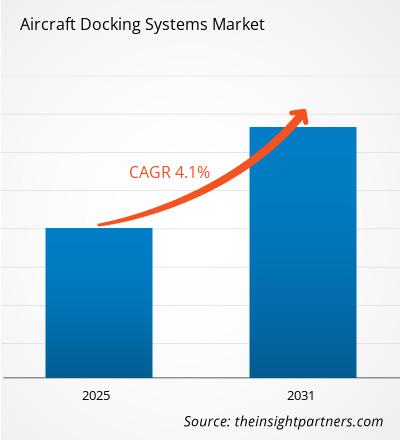
The aircraft docking systems market was valued at US$ 10.8 Billion in 2025 and is projected to reach US$ 13.72 Billion by 2034, expanding at a CAGR of 2.69% during 2026–2034. The market covers engineered access and docking structures used to position maintenance personnel and equipment around aircraft, with demand shaped by fleet utilization, maintenance requirements, hangar configuration, safety, and turnaround needs across aviation.
North American demand is supported by a large installed aircraft base, extensive MRO infrastructure, and military maintenance requirements. The aircraft docking systems market size in the region is modeled at a ~2% CAGR through 2034, supported by replacement, modernization, and multi-aircraft systems.
Aircraft Docking Systems Market Assessment and Insights
Regional Outlook
- North America: ~34% of the global market in 2025 | ~2% CAGR through 2034. Market position: North America is the largest region, supported by extensive airline, cargo, defense, and MRO infrastructure and recurring demand for engineered maintenance access.
- US: ~78% of North American market revenue in 2025 | ~2% CAGR through 2034. Market position: The US has the largest country base because of extensive commercial and military fleets, major MRO centers, and demand for customized maintenance systems.
- Europe: ~29% of the global market in 2025 | ~2% CAGR through 2034. Market position: Europe is mature, with Germany leading and France, the UK, Italy, and Spain contributing through manufacturing, conversion, airline operations, and MRO.
- Asia Pacific: ~25% of the global market in 2025 | ~4% CAGR through 2034. Market position: Asia Pacific is the fastest-growing region, driven by fleet expansion, MRO localization, new hangars, and aerospace manufacturing across China, India, Japan, South Korea, and Australia.
Segment Outlook
- Application: ~68% Share in 2025 | ~3% CAGR through 2034. Market position: Commercial application leads because airlines and commercial MRO providers perform recurring inspections, repairs, modifications, and heavy maintenance requiring reliable aircraft access.
- Operation: ~60% Share in 2025 | ~4% CAGR through 2034. Market position: Powered operation has the higher growth profile as large facilities adopt mechanized movement, positioning, and height adjustment to reduce manual handling and improve maintenance workflows.
Competitive Coverage
Altech, CTI Systems S.à r.l., Instant UpRight, KAWASAKI HEAVY INDUSTRIES, LTD., Kern Steel Fabrication, Inc., Metaltech, NIJL Aircraft Docking, SICK AG, Turner Access Ltd, ZARGES GmbH
Methodology
The Insight Partners follows Data Collection & Secondary Research, Primary Research, Data Analysis, and Data Triangulation & Final Review to validate market estimates and insights.
Source: The Insight Partners' analysis based on proprietary research, government publications, company annual reports, investor presentations, industry databases, and expert interviews.
Aircraft maintenance access has evolved from stand-based and conventional scaffolding to modular access, providing access to the nose, fuselage, wings, engines, and tail end of the aircraft. Aircraft access includes platforms that are adjustable, sliding panels, a fall arrest system and mobility-based structures to help mechanics maintain safety during various configurations of the aircraft. An extended life span and limited maintenance capabilities increase the value of repeated access. The industry overlaps with the market for tools, utilities, safety equipment, and planning.
The future market demand is likely to shift to flexible hangar solutions for mixed fleets and higher maintenance capacities. APAC is increasing its MRO capacity, whereas the mature markets are updating their facilities. Due to safety concerns, the engineered access solutions are more popular than ad hoc access solutions. The future market demand is driven not only by deliveries but also by an aging fleet, high utilization, conversions, localizations, and extended aircraft service life.
Aircraft Docking Systems Market Report Scope
| Report Attribute | Details |
|---|---|
| Market size in 2025 | US$ 10.8 Billion |
| Market Size by 2034 | US$ 13.72 Billion |
| Global CAGR (2026 - 2034) | 2.69% |
| Historical Data | 2021-2024 |
| Forecast period | 2026-2034 |
Aircraft Docking Systems Market Analysis
The Aircraft Docking Systems Market growth is driven by increasing requirements for aircraft inspections, structural repairs, cabin maintenance, engine access, painting, modifications, and scheduled maintenance. Aging aircraft fleets can increase maintenance intensity, while aviation supply chain constraints may encourage operators to retain aircraft in service for longer periods. Higher maintenance costs and extended aircraft utilization further support demand for efficient docking and access solutions. The value chain includes aircraft operators, MRO companies, engineering firms, fabricators, automation providers, safety-equipment suppliers, and system installers.
Supply dynamics in the Aircraft Docking Systems Market are influenced by aircraft dimensions, hangar configurations, maintenance workflows, and safety requirements. CTI Systems S.à r.l. provides wing, fuselage, nose, tail, and engine access systems, while ZARGES GmbH manufactures modular docking solutions that can accommodate different aircraft dimensions. Kern Steel Fabrication, Inc. supplies engineered maintenance stands and docking systems. These capabilities highlight the importance of customized engineering, installation expertise, and lifecycle support alongside standardized components.
The Aircraft Docking Systems Market analysis indicates that competition includes specialized docking-system manufacturers as well as access, automation, sensing, and industrial engineering companies. Instant UpRight applies aluminum access-system expertise to aerospace applications, while SICK AG contributes sensing and automation technologies. KAWASAKI HEAVY INDUSTRIES, LTD. participates through broader aircraft manufacturing and maintenance capabilities. Altech, Metaltech, NIJL Aircraft Docking, and Turner Access Ltd further strengthen competition through specialized aircraft access and docking solutions.
Investment in the Aircraft Docking Systems Market is increasingly focused on modularity, power-assisted movement, enhanced safety features, automation, and retrofit capabilities. Modular systems can help MRO providers accommodate multiple aircraft types, while power-assisted and sensor-enabled solutions can improve positioning, operator safety, and maintenance efficiency. Retrofit opportunities are also becoming important as operators seek to modernize existing hangar infrastructure without completely replacing installed docking systems.
● REPORT CUSTOMIZATION
Tailor This Report To Align With Your Specific Business Requirements
This report can be customized to align precisely with your business objectives, scope, and target markets. Customization options include tailored segmentation, geography, competitive analysis, and strategic insights to support informed decision-making.
Customize This Report →WHAT YOU CAN ADJUST
- ● Segmentations
- ● Geography
- ● Competitive Analysis
- ● Language Preferences
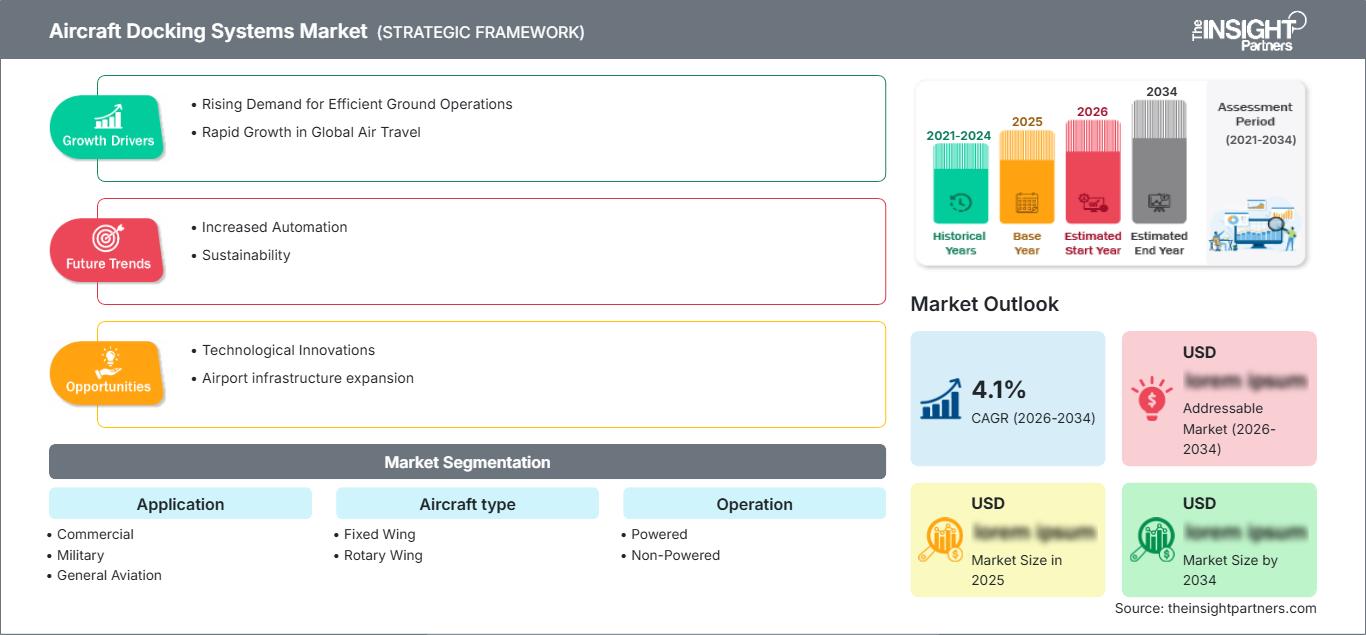
Aircraft Docking Systems Market: Strategic Insights
Regional Insights
North America aircraft docking systems market
North America accounted for ~34% of the global market in 2025 and is modeled at a ~2% CAGR through 2034. The region benefits from extensive airline, cargo, defense, and independent MRO infrastructure. The US represents the main demand center, while Canada contributes through commercial, regional, aerospace, and defense maintenance activity. MRO hubs reinforce demand.
Older fleets and delivery constraints increase pressure on operators to maximize maintenance capacity. Demand therefore includes new hangar equipment, replacement of aging access structures, and modernization of existing facilities. Suppliers with experience in large airframes and military platforms are positioned for projects requiring wing, fuselage, engine, nose, and tail access, while powered systems support repeatable positioning in high-throughput facilities.
U.S. aircraft docking systems market
The U.S. represents ~78% of North American market revenue in 2025 and is modeled at a ~2% CAGR through 2034. Demand spans airlines, cargo operators, defense organizations, aircraft manufacturers, and MRO providers. Large fleets create recurring requirements for inspection, modification, structural repair, and heavy-maintenance access.
Commercial and military programs support different equipment requirements, from repeatable fleet-specific docks to highly customized structures. Cargo and conversion work add further maintenance-access requirements. Kern Steel Fabrication, Inc. provides docking and maintenance systems for Boeing, Airbus, and Lockheed platforms. The market also supports sensor-assisted positioning, mechanized movement, and digital design where operators seek greater productivity without reducing safety.
Europe aircraft docking systems market
Europe held ~29% of the global aircraft docking systems market share in 2025 and is modeled at a ~2% CAGR through 2034. Germany is the leading country in Europe, supported by aerospace manufacturing, aircraft conversion, engineering services, and MRO activity. France has a substantial aviation industrial base, while the UK, Italy, and Spain contribute through airlines, defense fleets, aerospace manufacturing, and maintenance networks.
European demand emphasizes modernization of existing hangars, worker protection, ergonomic maintenance, and efficient use of constrained floor space. ZARGES GmbH and CTI Systems S.à r.l. illustrate regional capabilities in modular and engineered access systems. Aircraft-specific configurations remain important because fuselage heights, wing geometries, engine positions, and tail structures vary across platforms.
Conversion and modification programs also favor flexible docks that can be reconfigured as work scopes change. Mature MRO infrastructure and safety practices support replacement and modernization demand.
APAC aircraft docking systems market
Asia Pacific represented ~25% of the global market in 2025 and is modeled at a ~4% CAGR through 2034, making it the fastest-growing region. China is the leading country in Asia Pacific, while India, Japan, South Korea, and Australia contribute through fleet expansion, MRO, aerospace production, and defense maintenance.
Growth combines new hangar construction with maintenance localization. Operators increasingly require multi-aircraft systems, modular structures, and powered equipment. Investment in regional MRO capacity is broadening the addressable customer base and creating demand for installation, modernization, training, and lifecycle support.
Middle East & Africa aircraft docking systems market
The Middle East & Africa market is modeled at a ~3% CAGR through 2034. Saudi Arabia and the UAE are important Middle Eastern demand centers because of aviation infrastructure, airline activity, airport investment, and MRO development. South Africa provides a major maintenance base, while other countries contribute commercial, general aviation, and defense demand.
The UAE is the leading country in the Middle East & Africa based on the concentration of aviation infrastructure and MRO activity. Hangar development, fleet utilization, defense requirements, and broader transport infrastructure investment support demand for engineered access systems. Energy-sector investment can also reinforce industrial and logistics capacity around aviation hubs.
Segmentation Analysis
Application
Application is modeled at a ~3% CAGR within the aircraft docking systems market scope from 2026 to 2034. Commercial aviation provides the largest demand pool because airline and MRO fleets undergo recurring inspections, repairs, modifications, and heavy checks. Suppliers emphasize fleet compatibility, safety, and efficient hangar use.
- Commercial: Operators require recurring access for inspections, structural maintenance, modifications, and heavy checks. Demand emphasizes fleet compatibility, rapid configuration, safety, and efficient hangar use.
- Military: Users require specialized access for transport, fighter, trainer, and other aircraft. Rugged construction, custom geometry, mobility, security, and long service life are important considerations.
- General Aviation: Demand spans business aircraft, helicopters, and specialized aircraft. Buyers often favor compact, modular, movable systems that support varied maintenance tasks without large commercial-hangar infrastructure.
Aircraft type
Aircraft type is modeled at a ~2% CAGR from 2026 to 2034. Fixed-wing aircraft provide the broader addressable base because commercial and military fleets require scheduled access. Rotary-wing applications require specialized structures around fuselage, tail, and rotor areas.
- Fixed Wing: Fixed-wing aircraft require access to fuselage, wings, engines, landing gear, nose, and tail. Systems are engineered around aircraft dimensions and maintenance sequences, with modular designs supporting several fleet variants.
- Rotary Wing: Rotary-wing aircraft require access around fuselage, tail boom, rotor systems, and elevated zones. Adjustable platforms matter because helicopter dimensions vary and many sites have constrained floor or ceiling space.
Operation
Operation is modeled at a ~4% CAGR from 2026 to 2034, the highest rate among the main dimensions. Powered systems gain from interest in mechanized positioning, height adjustment, repeatable docking, and reduced manual handling. They are particularly relevant in large, frequently used maintenance facilities.
- Powered: Powered docks support mechanized positioning, lifting, adjustment, or movement and reduce manual effort. Value increases where structures are repeatedly repositioned and precision, safety, and throughput are closely linked.
- Non-Powered: Non-powered systems remain relevant because of simple mechanical design, straightforward maintenance, and suitability for stable aircraft configurations. They are practical where docks move infrequently or manual adjustment remains economical.
Type
Type is modeled at a ~3% CAGR from 2026 to 2034. Demand varies by work package and aircraft geometry. Suppliers increasingly combine multiple dock types into integrated systems for continuous aircraft access.
- Nose Docks: Nose docks provide access to cockpits, radomes, forward doors, avionics areas, and nose-wheel zones. Aircraft-specific configuration supports safe technician access without interfering with sensitive structures.
- Complete Docks: Complete docks integrate multiple access zones into a broader maintenance system. They are useful for heavy maintenance because coordinated structures reduce repeated setup and support several work teams around the aircraft.
- Engine Docks: Engine docks provide controlled access around propulsion systems and adjacent structures. Their value is strongest during inspections, engine-related maintenance, and component removal, where clearance and worker protection are central.
- Fuselage Docks: Fuselage docks support work around doors, windows, cargo areas, structural panels, and cabin interfaces. Sliding or adjustable platforms help accommodate contour differences and improve access across aircraft configurations.
- Wing Docks: Wing docks provide access to leading and trailing edges, engines, landing-flap areas, spoilers, wheel wells, and wing tips. Design balances reach, fall protection, aircraft clearance, and hangar constraints.
- Tail Docks: Tail docks provide access to stabilizers, rudders, APU areas, and rear doors. Cantilevered or adjustable configurations can permit aircraft docking and undocking with limited movement of the maintenance structure.
Opportunity Snapshot
| Application | Revenue Contribution | Trend Tag | Adoption Stage |
| Commercial | High | Fleet MRO | Mature |
| Military | Medium | Defense MRO | Scaling |
| General Aviation | Low | Modular Access | Scaling |
Aircraft Docking Systems Market Growth Drivers and Impact Analysis
Longer aircraft service lives increase maintenance-access requirements
Aircraft supply constraints are extending operating lives, increasing maintenance volume and complexity. IATA has reported higher fleet ages, delivery shortfalls, and supply-chain disruption, conditions that can increase maintenance requirements. For docking suppliers, this supports new equipment and modernization of existing hangars. Older aircraft may require repeated inspections, repairs, component access, and modifications, increasing the value of safe, repeatable access. The impact is strongest where operators cannot quickly add replacement aircraft and instead need higher productivity from existing capacity. Modular systems compatible with several aircraft types can address this need while reducing dependence on dedicated structures.
Expansion of MRO capacity creates new hangar-equipment demand
Airline fleet growth and geographic expansion of MRO capability are creating requirements for new hangar infrastructure. Facilities need access systems around wings, fuselage sections, engines, and tail structures while meeting safety requirements. Asia Pacific is particularly relevant as airlines and MRO organizations add base-maintenance capacity. The opportunity extends beyond initial equipment because new facilities require installation, commissioning, training, inspection, and lifecycle support. Retrofit programs also create demand where operators upgrade existing hangars without full reconstruction.
Automation and sensor integration improve docking precision and safety
Automation is becoming more relevant as maintenance organizations seek repeatable positioning and lower manual handling. Sensors can support position detection, collision avoidance, contour recognition, and controlled movement, while powered platforms can reduce physical effort during repositioning. SICK AG has demonstrated sensor applications for docking ground equipment, and CTI Systems is developing automated access technologies for aerospace environments. The impact is a gradual shift from purely structural products toward integrated systems combining mechanical equipment, controls, sensing, and safety functions. Adoption is likely to be strongest in large commercial and defense facilities where docks are frequently repositioned and where incremental productivity improvements can increase use of expensive hangar capacity.
Aircraft Docking Systems Market Future Trends
Modular docks will increasingly serve mixed-aircraft hangars
aircraft docking systems market trends are likely to place greater emphasis on modular architectures serving multiple aircraft families. Airlines, MRO providers, and military operators need facilities that can accommodate changing fleet mixes, conversions, and maintenance scopes. Modular docks can reduce the need for dedicated structures while allowing sections to be replaced, repositioned, or expanded. Future designs may combine standardized frames with adjustable panels, powered movement, quick-change interfaces, and digital configuration data. Such systems can improve asset utilization across several aircraft variants. The trend is particularly relevant to constrained hangars where fixed structures reduce usable floor area and where operators need flexible maintenance layouts.
Digital control will connect docking equipment with maintenance workflows
Digitalization is likely to move beyond individual sensors toward integrated control of access equipment and hangar operations. Future systems may use geometry databases, positioning sensors, collision-avoidance logic, and maintenance instructions to guide configuration. Digital records can support inspection, service scheduling, fault identification, and lifecycle management. The trend is particularly relevant to powered systems, where movement must be coordinated with aircraft clearance and worker safety. Adoption will depend on certification, cybersecurity, interoperability, and the economic case for automation.
Aircraft Docking Systems Market Opportunities
Target new MRO infrastructure in Asia Pacific
Investment opportunities in aircraft docking systems market Forecasts are emerging around Asia Pacific MRO infrastructure, where fleet growth and localization support new hangar projects. Suppliers can target greenfield facilities with integrated docking designs combining access platforms, powered movement, fall protection, and aircraft-specific modules. India, China, Southeast Asia, Japan, and South Korea offer different aircraft requirements. Local partnerships can help with installation, service, compliance, and customer support. Retrofit packages are also relevant for existing hangars, adding modular sections, mechanized movement, or safety upgrades without full reconstruction.
Develop lightweight and reconfigurable systems for flexible MRO
A second opportunity lies in lightweight, reconfigurable docking structures that can move between aircraft positions and adapt to changing work scopes. Aluminum and hybrid construction can reduce handling loads, while modular connections can allow operators to expand or rearrange systems as fleet requirements change. This is relevant to independent MRO providers serving several aircraft families. Suppliers can differentiate through rapid installation, compact storage, adjustable height, and mobile or powered movement. Combining lightweight structures with digital positioning and sensor-based safety can provide flexibility without sacrificing control. The commercial opportunity centers on higher hangar utilization and lower reconfiguration effort.
Frequently Asked Questions

- Comprehensive Market Sizing and Forecast Analysis
- Detailed Segmentation Analysis
- In-Depth Market Dynamics Assessment
- Regional and Country-Level Insights
- Competitive Landscape and Company Benchmarking
- Strategic Business Intelligence
Recent Reports
Testimonials

The Insight Partners provided valuable market intelligence that supported our global go-to-market strategy. Their team was professional, responsive, and attentive to our feedback, providing thoughtful analysis and helpful methodological clarifications throughout the project.
Junmo Kim Chief Financial Officer (CFO), Enertech Co., Ltd.
The Insight Partners' SCADA System Market report is comprehensive, with valuable insights on current trends and future forecasts. The team was highly professional, responsive, and supportive throughout. We are very satisfied and highly recommend their services.
RAN KEDEM Partner, Reali Technologies LTDs
I requested a report on a very specific software market and the team produced the report in a few days. The information was very relevant and well presented. I then requested some changes and additions to the report. The team was again very responsive and I got the final report in less than a week.
JEAN-HERVE JENN Chairman, Future Analytica
We worked with The Insight Partners for an important market study and forecast. They gave us clear insights into opportunities and risks, which helped shape our plans. Their research was easy to use and based on solid data. It helped us make smart, confident decisions. We highly recommend them.
PIYUSH NAGPAL Sr. Vice President, High Beam Global
The Insight Partners delivered insightful, well-structured market research with strong domain expertise. Their team was professional and responsive throughout. The user-friendly website made accessing industry reports seamless. We highly recommend them for reliable, high-quality research services
YUKIHIKO ADACHI CEO, Deep Blue, LLC.
This is the first time I have purchased a market report from The Insight Partners.While I was unsure at first, I visited their web site and felt more comfortable to take the risk and purchase a market report.I am completely satisfied with the quality of the report and customer service. I had several questions and comments with the initial report, but after a couple of dialogs over email with their analyst I believe I have a report that I can use as input to our strategic planning process.Thank you so much for taking the extra time and making this a positive experience.I will definitely recommend your service to others and you will be my first call when we need further market data.
JOHN SUZUKI President and Chief Executive Officer, Board Director, BK Technologies
I wish to appreciate your support and the professionalism you displayed in the course of attending to my request for information regarding to infectious disease IVD market in Nigeria. I appreciate your patience, your guidance, and the fact that you were willing to offer a discount, which eventually made it possible for us to close a deal. I look forward to engaging The Insight Partners in the future, all thanks to the impression you have created in me as a result of this first encounter.
DR CHIJIOKE ONYIA MANAGING DIRECTOR, PineCrest Healthcare Ltd.Reason to Buy
- Informed Decision-Making
- Understanding Market Dynamics
- Competitive Analysis
- Identifying Emerging Markets
- Customer Insights
- Market Forecasts
- Risk Mitigation
- Boosting Operational Efficiency
- Strategic Planning
- Investment Justification
- Tracking Industry Innovations
- Aligning with Regulatory Trends





 Get Free Sample for