
Aircraft Refueling Hose Market Growth, Demand & Size by 2034
Coverage: By Type (Composite Hose, Stainless Steel Hose, Rubber Hose); Application (Helicopters, Military Aircraft, Unmanned Aerial Vehicle (UAV), Commercial Aircraft) , and Geography (North America, Europe, Asia Pacific, and South and Central America)
- Status : Data Released
- Report Code : TIPRE00023925
- Category : Aerospace and Defense
- No. of Pages : 150
- Available Report Formats :


- Last update date : November 02, 2026


2025 Market Size
US$ 2.58 Bn
Base year value
2034 Forecast
US$ 3.88 Bn
Projected by 2034
CAGR 2026-2034
4.63 %
Growth rate
Addressable Market
US$ 29.32 Bn
(2026-2034)
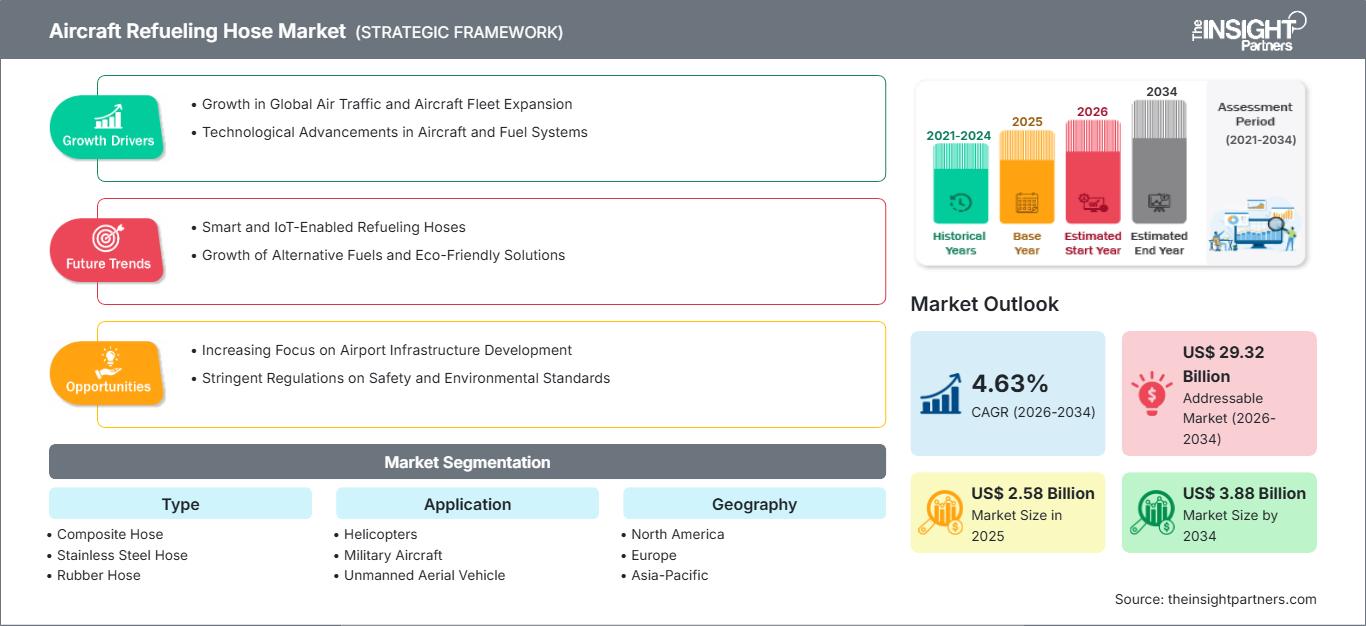
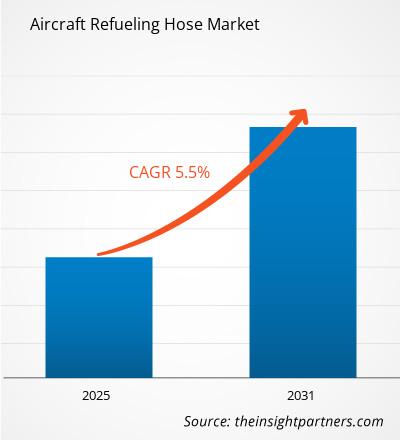
The aircraft refueling hose market was valued at US$ 2.58 Billion in 2025 and is projected to reach US$ 3.88 Billion by 2034, registering a CAGR of 4.63% from 2026 to 2034. Growth is supported by expanding aircraft fleets, rising passenger and military aviation activity, replacement of aging fueling equipment, and stricter requirements for fuel transfer safety, static control, durability, and chemical resistance across commercial and defense operations.
North America remains a structurally important market because of its extensive airport and military aviation infrastructure, established fueling networks, and recurring replacement requirements. The region is expected to expand at approximately ~4% CAGR through 2034, supported by fleet modernization, MRO activity, and continued procurement of high-performance fueling equipment for commercial and defense applications.
Aircraft Refueling Hose Market Assessment and Insights
Regional Outlook
- North America: ~38% of the global market in 2025 | ~4% CAGR through 2034. Market position: North America holds the largest regional position, supported by mature airport infrastructure, extensive military aviation activity, established MRO networks, and recurring replacement demand for aircraft fueling equipment.
- US: ~78% of North American market revenue in 2025 | ~4% CAGR through 2034. Market position: The US represents the leading country in North America, supported by a large commercial fleet, extensive military aircraft inventory, major airport networks, and strong supplier capabilities spanning ground and aerial refueling systems.
- Europe: ~25% of the global market in 2025 | ~5% CAGR through 2034. Market position: Europe has a mature aviation ecosystem, with Germany, France, the UK, Italy, and Spain contributing through commercial fleet operations, military modernization, airport infrastructure, and established aerospace manufacturing capabilities.
- Asia Pacific: ~23% of the global market in 2025 | ~6% CAGR through 2034. Market position: Asia Pacific is the fastest-growing region, driven by expanding airline fleets, airport construction, rising passenger traffic, defense aviation modernization, and increasing investment in fueling infrastructure across China, India, Japan, and South Korea.
Segment Outlook
- Commercial Aircraft: ~46% Share in 2025 | ~5% CAGR through 2034. Market position: Commercial aircraft represent the largest application because high-frequency fueling cycles create recurring requirements for reliable hoses, replacement assemblies, and compatible fueling equipment across major airports and airline maintenance networks.
- Unmanned Aerial Vehicle: ~12% Share in 2025 | ~7% CAGR through 2034. Market position: UAV applications have a smaller current base but stronger growth potential as longer-endurance unmanned platforms, autonomous operations, and defense missions increase requirements for compact and specialized fuel transfer systems.
Competitive Coverage
Eaton, JGB Enterprises, Inc., Parker Hannifin Corporation, Husky Corporation, Mission Systems Wimborne Limited, Asia-PacificHE, ELAFLEX HIBY GmbH & Co. KG, PEAR Corporation, A.E.R.O. Aviation Hose Shop, SafeFlex
Methodology
The Insight Partners follows Data Collection & Secondary Research, Primary Research, Data Analysis, and Data Triangulation & Final Review to validate market estimates and insights.
Source: The Insight Partners' analysis based on proprietary research, government publications, company annual reports, investor presentations, industry databases, and expert interviews.
The fueling systems on planes have been upgraded from traditional rubber hose systems towards engineered systems with properties such as flexibility, fuel compatibility, static dissipative, pressure resistance, wear resistance, and longevity. Composite systems are becoming relevant in areas where weight savings and resistance to adverse environmental conditions is essential, while stainless steel suits well those applications which require durability and heat resistance. The design of modern aircraft refueling hose focuses more on controlled bending, low permeation, and repeated usage performance.
The future prospects are influenced by an increased number of aircraft, upgrade of airports, defense contracts, and renewal of aged fueling systems. In emerging aviation countries in the Asia Pacific region and select Middle East regions, fueling systems will be added to new airports and aircraft. Quality of fuel, spills, equipment integrity and safety will also drive replacements and system upgrades. This will be beneficial to those companies that can offer certified hose systems along with custom-built assembly systems.
Aircraft Refueling Hose Market Report Scope
| Report Attribute | Details |
|---|---|
| Market size in 2025 | US$ 2.58 Billion |
| Market Size by 2034 | US$ 3.88 Billion |
| Global CAGR (2026 - 2034) | 4.63% |
| Historical Data | 2021-2024 |
| Forecast period | 2026-2034 |
Aircraft Refueling Hose Market Analysis
Market expansion in aircraft refueling hoses depends on aircraft usage, frequency of fueling cycle, fleet expansion, and replacement cycles. Civilian airports need hoses that can endure multiple connections, movement, pressure, and fueling without losing its static-discharge attributes. Military operators impose further constraints of flexible deployment, tough conditions handling capability, and compatibility with certain aircraft refueling systems. The manufacturing process of these products consists of sourcing raw materials such as polymers, elastomers, reinforcements, metals, and fittings from which the actual hose assemblies can be produced.
Current supply trends are increasingly becoming favorable to suppliers having a wide range of material processing capacity and certification experience. Manufacturing composite and reinforced hoses could be more complex than rubber hoses, and stainless steel hose assembly requires forming, braiding, welding, and good connection capability. Supplier qualification will also depend on certification, traceability, dimension control, and pressure testing. In addition, replacement cycles provide a regular after-sales market opportunity.
The competitive landscape involves major suppliers of aerospace systems as well as suppliers of hoses and fueling equipment. Eaton possesses a large range of aerial and ground refueling solutions, whereas Parker Hannifin Corporation manufactures hoses for aircraft fueling and fluid management systems as well. Mission Systems Wimborne Limited brings expertise in aerial refueling, while JGB Enterprises, Inc., Husky Corporation, ELAFLEX HIBY GmbH & Co. KG, PEAR Corporation, A.E.R.O. Aviation Hose Shop, SafeFlex, and Asia-PacificHE provide special solutions for hoses, fueling, assembly and geographical segments.
Increasingly the focus of investment is being shifted towards the durability of materials, lightweight design, statics management, greater flow capacity, and quicker replacement capabilities. As a result, strategic positioning involves much more than only production of hoses. Those suppliers that offer their products certified, engineering services for applications, assembly, distribution on the global level, and aftermarket services are capable of meeting the demands of regular replacements as well as military procurement.
● REPORT CUSTOMIZATION
Tailor This Report To Align With Your Specific Business Requirements
This report can be customized to align precisely with your business objectives, scope, and target markets. Customization options include tailored segmentation, geography, competitive analysis, and strategic insights to support informed decision-making.
Customize This Report →WHAT YOU CAN ADJUST
- ● Segmentations
- ● Geography
- ● Competitive Analysis
- ● Language Preferences
Aircraft Refueling Hose Market: Strategic Insights
Regional Insights
North America aircraft refueling hose market
North America accounts for approximately ~38% of the global aircraft refueling hose market in 2025 and is expected to expand at approximately ~4% CAGR through 2034. The region benefits from a mature network of commercial airports, military airfields, general aviation facilities, and maintenance providers. The US represents the principal demand center because of its large aviation ecosystem and extensive requirement for fuel transfer equipment across commercial and defense operations.
The reason why replacement of these parts is important is due to their being subjected to bending, exposure to fuel, pressure, and handling in the course of the normal refueling process. Military operations create a further requirement for aerial refueling equipment and hoses. Eaton provides an extensive range of aerial refueling equipment, while Parker Hannifin Corporation supplies aircraft fueling hoses and fluid management systems.
U.S. aircraft refueling hose market
The US represents approximately ~78% of North American aircraft refueling hose market revenue in 2025 and is expected to grow at approximately ~4% CAGR through 2034. The location is influenced by the size of the commercial air transport sector, military aircraft operations, airports, and aerospace industry manufacturing. Constant usage of aircraft leads to continuous need for replacements in aircraft refueling and maintenance.
The commercial air transport sector creates an opportunity for high volumes of use of flexible, fuel resistant hoses, whereas the military sector requires equipment which will work in the most extreme environment conditions. The Eaton company produces aerial and ground aircraft refueling equipment, while the Parker Hannifin Corporation produces aircraft fueling hose which is based on fuel resistant properties and static protection of the fuel.
Europe aircraft refueling hose market
Europe represents approximately ~25% of the global aircraft refueling hose market in 2025 and is projected to grow at approximately ~5% CAGR through 2034. This area features well-established airlines, significant aerospace manufacturing, defense aviation projects, and infrastructure for fueling at the airports. Germany ranks first among all European countries according to the level of aviation manufacturing industry, aviation activity, industrial facilities, and defense operations. France and UK rank second due to their significant involvement in the aerospace manufacturing industry and defense fleets.
The German industry requires components and hose assemblies designed specifically for the aircraft refueling process, whereas France will benefit from commercial aviation, aerospace manufacturing, and defense. The UK involves large-scale airports along with military and aerospace operations and will require fueling equipment on regular basis. Italy and Spain will make their contribution via commercial aviation, airport modernization, defense operations, and increasing number of tourists.
The European purchasers are very concerned about material compatibility, traceability, longevity, and adherence to the aviation and aircraft refueling standards. Some suppliers such as ELAFLEX HIBY GmbH & Co. KG and Mission Systems Wimborne Limited work in special fueling applications, whereas other international manufacturers have much wider possibilities for fluid management.
APAC aircraft refueling hose market
Asia Pacific accounts for approximately ~23% of the global aircraft refueling hose market in 2025 and is expected to expand at approximately ~6% CAGR through 2034. China is the leading country in Asia Pacific, supported by its large aviation system and continuing fleet and infrastructure development. India represents another important growth market as airport capacity and airline operations expand.
China and Japan combine substantial commercial and defense aviation requirements, while South Korea maintains significant military aviation activity. India is adding airport capacity and aircraft, supporting future fueling-equipment requirements. Australia contributes through commercial, regional, and defense aviation operations. The region's demand is reinforced by expanding passenger traffic, airport investment, aircraft fleet modernization, and localization of aviation-support infrastructure.
Middle East & Africa aircraft refueling hose market
The Middle East and Africa market is projected to expand at approximately ~5% CAGR through 2034. Saudi Arabia represents the leading country in the Middle East and Africa region where evidence supports the position, with airport expansion, airline development, defense aviation, and broader infrastructure investment supporting equipment requirements. The UAE remains an important aviation hub with high aircraft utilization and sophisticated airport infrastructure.
South Africa contributes through commercial, military, and regional aviation requirements, while the rest of the region presents opportunities linked to airport modernization and developing fueling infrastructure. Energy-sector capabilities also support industrial expertise in fuel handling, while airport investment increases the need for dependable transfer equipment. Demand varies significantly by country, making local certification, distribution, and maintenance support important for suppliers targeting the region.
Segmentation Analysis
Type
Type is a fundamental purchasing criterion because hose construction determines flexibility, weight, fuel compatibility, pressure capability, durability, and maintenance requirements. The category is led by solutions that balance repeated handling with resistance to aviation fuels and environmental exposure. Composite Hose is expected to record approximately ~5% CAGR from 2026 to 2034 as operators increasingly value lightweight construction and improved resistance characteristics in demanding fueling environments.
- Composite Hose: Composite construction combines multiple material layers to achieve a balance of flexibility, weight efficiency, chemical resistance, and mechanical durability. It is particularly relevant where hose handling and environmental exposure must be managed simultaneously.
- Stainless Steel Hose: Stainless steel construction serves applications where structural strength, temperature resistance, and long service life are priorities. Its characteristics support demanding fixed or specialized fueling configurations requiring robust metallic reinforcement.
- Rubber Hose: Rubber remains widely used because established formulations provide flexibility, practical handling, fuel compatibility, and cost-effective replacement. Its familiarity across airport fueling operations supports continued demand in both mature and developing aviation markets.
Application
Application determines the operating environment, fueling frequency, pressure requirements, and specification priorities for aircraft refueling hose systems. Commercial aviation provides the largest demand base because aircraft undergo frequent fueling cycles, while defense applications require additional durability and mission reliability. Commercial Aircraft is expected to record approximately ~5% CAGR through 2034, supported by fleet expansion, increasing utilization, and recurring replacement requirements across airport fueling operations.
- Helicopters: Helicopter applications require compact and flexible fueling arrangements suited to rotorcraft operations, including military, emergency, offshore, and general aviation environments where access conditions can vary substantially.
- Military Aircraft: Military aircraft require robust fueling solutions capable of operating across demanding environments and deployment conditions. Reliability, pressure performance, compatibility, and maintenance readiness are particularly important for defense operators.
- Unmanned Aerial Vehicle: UAV fueling requirements are emerging alongside longer-endurance platforms and specialized defense missions. Lightweight and compact systems can become increasingly relevant as unmanned aircraft adopt more sophisticated propulsion and logistics architectures.
- Commercial Aircraft: Commercial aircraft generate recurring hose demand because of intensive utilization and structured airport fueling procedures. Fleet growth and maintenance cycles reinforce requirements for reliable, standardized, and readily replaceable fueling assemblies.
Opportunity Snapshot
| Application | Revenue Contribution | Trend Tag | Adoption Stage |
|---|---|---|---|
| Helicopters | Medium | Rotorcraft Modernization | Scaling |
| Military Aircraft | High | Defense Readiness | Mature |
| Unmanned Aerial Vehicle | Low | Autonomous Refueling | Emerging |
| Commercial Aircraft | High | Fleet Turnaround | Mature |
Aircraft Refueling Hose Market Growth Drivers and Impact Analysis
Expansion of Aircraft Fleets and Airport Fueling Infrastructure
Aircraft fleet expansion directly increases the installed base requiring fueling infrastructure, while higher aircraft utilization raises the number of fueling cycles performed by existing equipment. New airports and terminal expansions also require additional fueling points, hoses, reels, couplings, and associated equipment. Commercial aviation therefore creates a dual demand mechanism: new infrastructure increases initial equipment requirements, while greater utilization accelerates wear and replacement. The effect is particularly significant in high-growth aviation markets where airport operators are expanding capacity while airlines add aircraft. Suppliers that can provide standardized products alongside application-specific assemblies can capture both original installation and subsequent replacement demand. The resulting opportunity extends beyond hose volume because new infrastructure often requires compatible assemblies, testing, certification, and maintenance support.
Stricter Safety, Fuel Compatibility, and Static-Control Requirements
Aircraft fueling involves flammable liquids, pressurized transfer, repeated hose movement, and potential static-charge generation, making equipment integrity central to operational safety. International aviation guidance emphasizes the importance of safe fueling procedures and fuel-quality control across the supply chain. Hose manufacturers consequently face requirements for appropriate materials, antistatic characteristics, pressure performance, chemical compatibility, abrasion resistance, and reliable connection systems. These requirements support demand for higher-specification products even when the number of fueling points changes slowly. They also encourage replacement when existing assemblies no longer satisfy operational or maintenance requirements. The commercial impact is a gradual shift from purely price-driven procurement toward total service-life considerations, favoring suppliers that can demonstrate consistent construction, traceability, certification, and performance under aviation operating conditions.
Military Aviation Modernization and Specialized Refueling Requirements
Defense aviation creates a distinct demand channel because military aircraft and aerial-refueling systems can operate under environmental and mission conditions that differ from commercial airport fueling. Modernization of tanker fleets, fighter aircraft, transport platforms, helicopters, and unmanned systems increases demand for hoses and assemblies that combine flexibility, pressure tolerance, durability, and predictable behavior during repeated deployment. Military procurement can also require specialized engineering, qualification, long-term availability, and lifecycle support. These characteristics create opportunities for established suppliers with aerospace certifications and system-level engineering capabilities. The effect extends into aftermarket services because military operators seek reliable replacement components that minimize aircraft downtime. As unmanned platforms gain more sophisticated logistics and endurance capabilities, specialized refueling requirements can broaden the addressable application base beyond conventional manned aircraft.
Aircraft Refueling Hose Market Future Trends
Lightweight and High-Durability Hose Construction
Future product development is likely to focus on reducing hose weight without compromising pressure capability, fuel compatibility, static control, or service life. Composite constructions, advanced elastomers, reinforced polymers, and optimized reinforcement architectures can help manufacturers balance competing requirements. Weight reduction is particularly relevant to aerospace applications because equipment handling affects operator workload and system integration, while durability reduces replacement frequency and maintenance interruptions. Product development will also increasingly consider resistance to abrasion, temperature variation, chemical exposure, and repeated bending. The aircraft refueling hose market trends are therefore likely to move toward application-specific construction rather than a single material solution. Suppliers that can tailor reinforcement, lining, and cover characteristics to aircraft and fueling-system requirements can differentiate their products through performance rather than commodity pricing.
Digitalized Inspection and Predictive Replacement
Inspection practices are expected to become more structured as operators seek to reduce unexpected equipment failures and improve maintenance planning. Hose condition can be influenced by pressure cycling, bending, environmental exposure, fuel contact, and handling frequency, creating an opportunity for condition-based replacement programs. Digital maintenance records, identification technologies, inspection histories, and equipment-management platforms can help operators connect hose assemblies with aircraft, fueling assets, service intervals, and replacement records. Over time, this approach can improve traceability and support more accurate lifecycle decisions. The shift is relevant to commercial airports and military operators because unplanned fueling-equipment failures can interrupt aircraft turnaround or mission availability. Manufacturers may therefore increasingly compete through lifecycle support, documentation, and service programs alongside physical hose performance.
Aircraft Refueling Hose Market Opportunities
Localized Manufacturing and Distribution in High-Growth Aviation Markets
Asia Pacific and selected Middle Eastern markets provide opportunities for suppliers to strengthen local manufacturing, assembly, distribution, and technical-support capabilities. Local presence can shorten lead times, reduce logistics complexity, and improve access to airport operators, MRO providers, defense organizations, and fueling-equipment integrators. The opportunity is especially relevant where airport construction and fleet expansion are occurring simultaneously because new infrastructure requires reliable equipment availability during commissioning and subsequent maintenance. Regional partnerships can also help suppliers adapt products to local certification, service, and procurement requirements. For manufacturers, localization does not necessarily require complete production relocation. Regional assembly, certified service centers, inventory hubs, and technical partnerships can provide a lower-risk route to market expansion while retaining centralized control over critical materials and quality processes.
Premium Aftermarket Solutions for Fleet Maintenance and Replacement
The replacement cycle provides an opportunity to move customers toward higher-performance hose assemblies that emphasize service life, fuel compatibility, static control, and traceability. Operators managing heavily utilized commercial fleets or mission-critical military aircraft have incentives to minimize equipment-related downtime and simplify maintenance planning. Suppliers can respond with application-specific assemblies, documented testing, hose identification, replacement programs, and rapid AOG support. This approach increases the value captured per replacement cycle rather than relying solely on unit-volume expansion. Specialist companies can also compete by offering duplication, customization, and short-turnaround assembly services, while larger manufacturers can combine global distribution with broader aerospace portfolios. The resulting aftermarket opportunity is particularly relevant where aging infrastructure coexists with rising aircraft utilization and stricter maintenance expectations.
Frequently Asked Questions

- Comprehensive Market Sizing and Forecast Analysis
- Detailed Segmentation Analysis
- In-Depth Market Dynamics Assessment
- Regional and Country-Level Insights
- Competitive Landscape and Company Benchmarking
- Strategic Business Intelligence
Recent Reports
Testimonials

The Insight Partners provided valuable market intelligence that supported our global go-to-market strategy. Their team was professional, responsive, and attentive to our feedback, providing thoughtful analysis and helpful methodological clarifications throughout the project.
Junmo Kim Chief Financial Officer (CFO), Enertech Co., Ltd.
The Insight Partners' SCADA System Market report is comprehensive, with valuable insights on current trends and future forecasts. The team was highly professional, responsive, and supportive throughout. We are very satisfied and highly recommend their services.
RAN KEDEM Partner, Reali Technologies LTDs
I requested a report on a very specific software market and the team produced the report in a few days. The information was very relevant and well presented. I then requested some changes and additions to the report. The team was again very responsive and I got the final report in less than a week.
JEAN-HERVE JENN Chairman, Future Analytica
We worked with The Insight Partners for an important market study and forecast. They gave us clear insights into opportunities and risks, which helped shape our plans. Their research was easy to use and based on solid data. It helped us make smart, confident decisions. We highly recommend them.
PIYUSH NAGPAL Sr. Vice President, High Beam Global
The Insight Partners delivered insightful, well-structured market research with strong domain expertise. Their team was professional and responsive throughout. The user-friendly website made accessing industry reports seamless. We highly recommend them for reliable, high-quality research services
YUKIHIKO ADACHI CEO, Deep Blue, LLC.
This is the first time I have purchased a market report from The Insight Partners.While I was unsure at first, I visited their web site and felt more comfortable to take the risk and purchase a market report.I am completely satisfied with the quality of the report and customer service. I had several questions and comments with the initial report, but after a couple of dialogs over email with their analyst I believe I have a report that I can use as input to our strategic planning process.Thank you so much for taking the extra time and making this a positive experience.I will definitely recommend your service to others and you will be my first call when we need further market data.
JOHN SUZUKI President and Chief Executive Officer, Board Director, BK Technologies
I wish to appreciate your support and the professionalism you displayed in the course of attending to my request for information regarding to infectious disease IVD market in Nigeria. I appreciate your patience, your guidance, and the fact that you were willing to offer a discount, which eventually made it possible for us to close a deal. I look forward to engaging The Insight Partners in the future, all thanks to the impression you have created in me as a result of this first encounter.
DR CHIJIOKE ONYIA MANAGING DIRECTOR, PineCrest Healthcare Ltd.Reason to Buy
- Informed Decision-Making
- Understanding Market Dynamics
- Competitive Analysis
- Identifying Emerging Markets
- Customer Insights
- Market Forecasts
- Risk Mitigation
- Boosting Operational Efficiency
- Strategic Planning
- Investment Justification
- Tracking Industry Innovations
- Aligning with Regulatory Trends





 Get Free Sample for