
Apple Extract Market Regional Share, Size, Trends, and Forecast by 2034
Coverage: By Form (Liquid, Powder); Application (Food and Beverage, Nutrcaeuticals, Cosmetics and Personal Care, Others), and Geography (North America, Europe, Asia Pacific, and South and Central America)
- Status : Data Released
- Report Code : TIPRE00018465
- Category : Food and Beverages
- No. of Pages : 150
- Available Report Formats :


- Last update date : August 26, 2026


2025 Market Size
US$ 1.09 Bn
Base year value
2034 Forecast
US$ 2.56 Bn
Projected by 2034
CAGR 2026-2034
7.69 %
Growth rate
Addressable Market
US$ 14.47 Bn
(2026-2034)
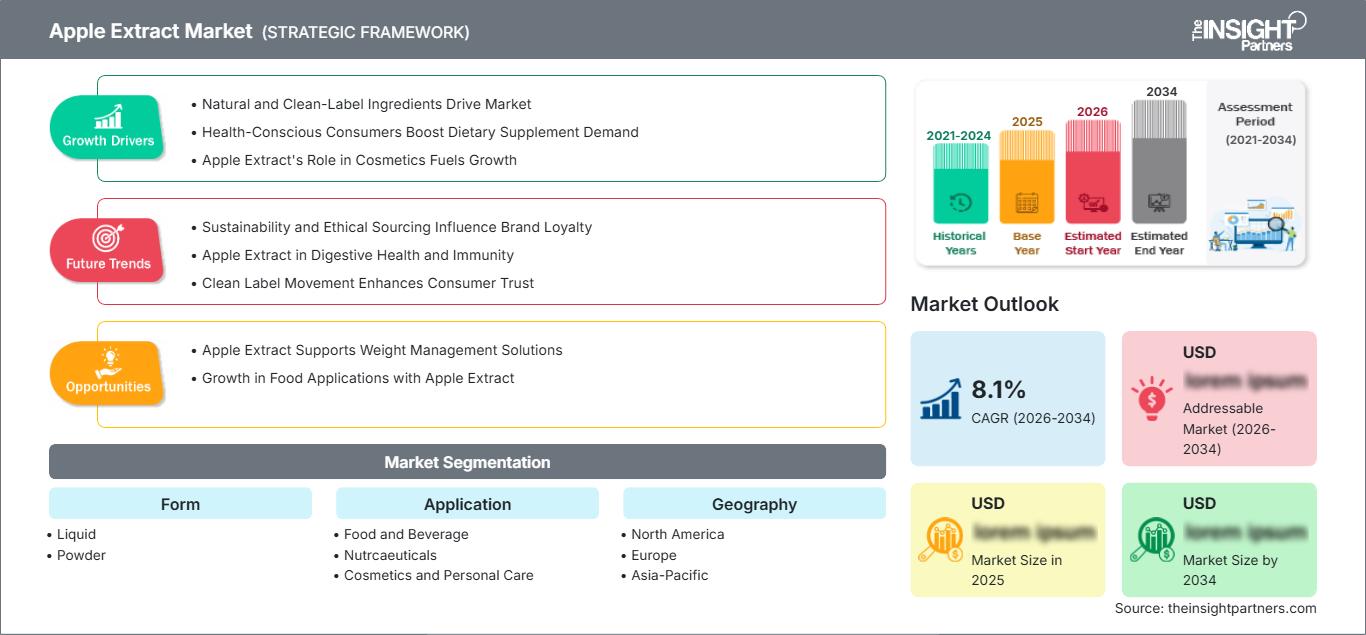
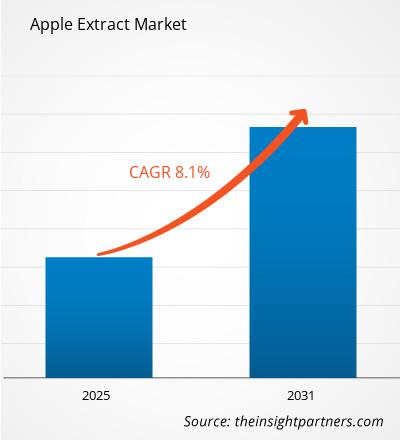
The Apple Extract Market is projected to grow from US$ 1.09 Billion in 2025 to US$ 2.56 Billion by 2034, registering a CAGR of 7.69% during 2026–2034. Demand is supported by rising use of apple-derived polyphenols, flavonoids, pectin, acids, and antioxidant compounds across food and beverage, nutraceuticals, cosmetics and personal care, and other functional applications.
North America continues to represent a high-value demand center, supported by clean-label reformulation, established dietary supplement channels, and consumer preference for plant-derived actives. The region is estimated to expand at a CAGR of 7.4–7.8% during 2026–2034 as brands increase usage of apple extract market size ingredients in functional beverages, gummies, powders, and topical wellness products.
Apple Extract Market Assessment and Insights
- North America: The region accounted for 31–34% share in 2025 and is expected to grow at a CAGR of 7.4–7.8% during 2026–2034, driven by supplement launches, clean-label foods, and premium personal care formulations.
- US: The US represented 72–76% of North America demand in 2025 and is projected to grow at a CAGR of 7.5–7.9% during 2026–2034.
- Europe: Europe held 25–28% share in 2025 and is expected to grow at a CAGR of 7.1–7.5% during 2026–2034, led by Germany, France, Italy, Spain, and the UK.
- Asia Pacific: Asia Pacific accounted for 27–30% share in 2025 and is projected to grow at a CAGR of 8.0–8.5% during 2026–2034, supported by China, Japan, India, South Korea, and Australia.
- Largest Segment: Food and beverage held 41–44% market share in 2025 and is expected to grow at a CAGR of 7.2–7.6% during 2026–2034.
- High Growth Segment: Nutraceuticals held 28–31% share in 2025 and is expected to grow at a CAGR of 8.1–8.6% during 2026–2034.
- Key companies analyzed in detail: Kuber Impex Ltd., Herbal Extraction Group Inc., Kepler Biotech Co. Ltd., Ambe Organic Food Products, Himalayan Herbaria Inc., Shanghai FanPharma Co. Ltd., Naturex, Glanbia Nutritionals, Runherb Inc., and GR Herbal.
Source: The Insight Partners' analysis based on proprietary research, government publications, company annual reports, investor presentations, industry databases, and expert interviews.
Application development ranges from simple fruit flavoring to advanced bioactive components that have specified levels of polyphenols, phloridzin, quercetin, and chlorogenic acid. Advancements in extraction, such as membrane filtration, solvent selection, and low-temperature concentration, are aiding in greater consistency, as well as cleaner ingredient branding. Production dynamics can be aided by using the apple pomace as a valuable source for extracting higher-value functional ingredients from juice and cider processing by-products.
Future demand should improve as developing countries grow their retail presence for wellness, beauty from within, and fortified foods. Regulatory preference for transparent labeling and naturally sourced actives is also encouraging formulators to replace artificial antioxidants, color modifiers, and flavor enhancers. The apple extract market growth outlook remains linked to reliable sourcing, standardized potency, and application-specific solubility.
Apple Extract Market Report Scope
| Report Attribute | Details |
|---|---|
| Market size in 2025 | US$ 1.09 Billion |
| Market Size by 2034 | US$ 2.56 Billion |
| Global CAGR (2026 - 2034) | 7.69% |
| Historical Data | 2021-2024 |
| Forecast period | 2026-2034 |
Apple Extract Market Analysis
Apple extract market growth is being shaped by the convergence of preventive nutrition, clean-label processing, and sustainable ingredient sourcing. Food and beverage manufacturers use liquid and powder extracts for flavor complexity, color support, and antioxidant positioning, while supplement producers prioritize concentrated apple polyphenols for capsules, gummies, and drink powders. Supply dynamics are favorable because apple pomace and peel streams from processing plants create scalable raw material availability when quality controls are applied.
Demand is also supported by the broader shift toward recognizable botanical ingredients. Apple extract market analysis indicates that brands value the ingredient because apples are familiar to consumers, available across major producing regions, and compatible with sweet, acidic, and fruit-forward formulations. However, price sensitivity remains important because standardized extracts require drying, purification, and testing that can raise costs above commodity fruit powders.
Competition is fragmented, with global ingredient houses, botanical extract specialists, and regional exporters serving different purity and application tiers. Naturex and Glanbia Nutritionals bring formulation credibility and international supply capabilities, while Kuber Impex Ltd., Herbal Extraction Group Inc., Kepler Biotech Co. Ltd., Shanghai FanPharma Co. Ltd., Runherb Inc., and GR Herbal compete in standardized plant extract supply. Smaller players such as Ambe Organic Food Products and Himalayan Herbaria Inc. strengthen the market through flexible sourcing, organic positioning, and niche botanical portfolios. Strategic positioning is moving toward traceability, standardized active content, and documentation for food, supplement, and cosmetic compliance. Companies that provide application guidance, stability data, and clean-label processing support are expected to gain an advantage, according to the Apple Extract Market forecast.
● REPORT CUSTOMIZATION
Tailor This Report To Align With Your Specific Business Requirements
This report can be customized to align precisely with your business objectives, scope, and target markets. Customization options include tailored segmentation, geography, competitive analysis, and strategic insights to support informed decision-making.
Customize This Report →WHAT YOU CAN ADJUST
- ● Segmentations
- ● Geography
- ● Competitive Analysis
- ● Language Preferences
Apple Extract Market: Strategic Insights
Regional Insights
North America Apple Extract Market
North America represented 31–34% share in 2025 and is projected to grow at a CAGR of 7.4–7.8% during 2026–2034. The region benefits from mature supplement distribution, high awareness of antioxidant ingredients, and strong consumer adoption of functional drinks, bars, gummies, and powdered mixes. Apple extract market share is supported by brands seeking fruit-derived actives that align with clean-label claims.
In terms of ingredient purchasing, consumers in this part of the world are favoring ingredients that meet strict specifications, have clarity regarding allergens, and have natural claims. The demand is particularly high in the nutraceuticals and functional beverage categories because apple polyphenols can be combined with fibers, vitamin mixes, probiotics, and beauty products with collagen claims.
U.S. Apple Extract Market
The US accounted for 72–76% of North America's Apple Extract Market demand in 2025 and is expected to grow at a CAGR of 7.5–7.9% during 2026–2034. The demand is fueled by dietary supplement brands, drink manufacturers, and personal care brands using fruit-based raw materials for their natural claims. The nation also has an advantage due to existing facilities for processing apples.
Application trends include high acceptance in gummy applications, hydration powders, wellness shots, natural flavor systems, scalp care, and antioxidants in skin care. American consumers demand proof of active content, quality assurance, and scalability in terms of supply. This makes it necessary for the suppliers to develop better methods of standardizing their extraction process.
Europe Apple Extract Market
Europe held 25–28% share of the Apple Extract Market in 2025 and is estimated to grow at a CAGR of 7.1–7.5% during 2026–2034. Germany leads regional demand due to its dietary supplement, natural cosmetics, and functional food base, followed by France, Italy, Spain, and the UK. Regional buyers emphasize traceability, residue control, and sustainable sourcing.
The UK market is expanding through functional beverages, natural snacks, and premium personal care. Germany remains the strongest technical market because formulators prioritize standardized botanicals and documented polyphenol profiles. France, Italy, and Spain support demand through clean beauty, fruit-based wellness products, and food applications where natural ingredients are central to consumer positioning.
APAC Apple Extract Market
APAC accounted for 27–30% share in 2025 and is projected to grow at a CAGR of 8.0–8.5% during 2026–2034. According to the Apple Extract Market report, China is a major sourcing and processing base, while Japan and South Korea drive premium beauty and nutraceutical demand. India and Australia are expanding adoption through wellness retail and natural product launches.
Regional growth is supported by rising disposable income, e-commerce penetration, and functional nutrition awareness. Manufacturers are investing in cost-efficient extraction and contract supply models. Local availability of apple raw materials in China and expanding botanical processing capacity across Asia give APAC a strong role in both supply and consumption.
Middle East & Africa Apple Extract Market
The Middle East & Africa Apple Extract Market is projected to grow at a CAGR of 6.6–7.0% during 2026–2034. The Saudi Arabian and UAE markets take the lead in premium wellness and personal care products, while South Africa provides support for functional food products and dietary supplements. There is still some selectivity involved with growth becoming more promising as more retailers become available.
Since there is an import dependency, consistency in pricing and supplies is still an issue for formulators. The demand is the greatest in fortified beverages, clean-label skincare, and wellness supplements available via pharmacies and online portals.
Segmentation Analysis
Form
Form is central to the apple extract market scope because ingredient performance differs by solubility, concentration, stability, and processing format. The form segment is expected to grow at a CAGR of 7.5–7.9% during 2026–2034 as buyers select liquid extracts for beverages and syrups, while powder grades remain preferred for capsules, tablets, dry mixes, confectionery, and cosmetic premixes.
- Liquid: Liquid extract is preferred in beverages, syrups, sauces, and topical formulations where dispersion and flavor integration are important, particularly for products requiring smooth processing and rapid blending.
- Powder: Powder extract is valued for shelf stability, easier transport, accurate dosing, and compatibility with supplements, dry beverages, bakery mixes, gummies, and powdered cosmetic bases.
Application
Application demand is projected to grow at a CAGR of 7.6–8.0% during 2026–2034, led by clean-label food systems, preventive nutrition, and botanical beauty. Food and beverage remains the largest use case, while nutraceuticals show the highest growth because standardized apple polyphenols meet rising interest in antioxidant, metabolic wellness, and functional supplementation.
- Food and Beverage: This segment uses apple extract for natural flavor support, fruit identity, color contribution, and antioxidant positioning in juices, yogurts, fruit snacks, confectionery, sauces, and functional beverages.
- Nutraceuticals: Nutraceutical companies use apple extract in capsules, gummies, tablets, and powders, where polyphenol standardization, antioxidant messaging, and consumer familiarity improve product acceptance.
- Cosmetics and Personal Care: Cosmetic formulators use apple extract in serums, creams, cleansers, haircare, and masks for botanical positioning, antioxidant support, natural acid content, and skin-conditioning claims.
Opportunity Snapshot
| Application | Revenue Contribution | Trend Tag | Adoption Stage |
| Food and Beverage | High | Clean Label | Mature |
| Nutraceuticals | High | Polyphenol Wellness | Scaling |
| Cosmetics and Personal Care | Medium | Botanical Beauty | Scaling |
| Others | Low | Specialty Uses | Emerging |
Apple Extract Market Growth Drivers and Impact Analysis
Clean-Label Reformulation Across Food and Beverage
Brands in food and beverages are opting for ingredients made from botanicals and fruits, which are not synthetic or artificial, and have an established natural flavor profile. Apple extract is a good choice in this regard since it provides a fruit identity and helps establish natural flavors, acidity, and antioxidants. The key driver has the maximum influence on beverages, snacks, candies, sauces, and functional foods in the immediate term. It promotes the use of extracts that are ready to use with uniform color, flavor, and solubility properties.
Rising Demand for Polyphenol-Rich Nutraceuticals
Demand for plant-based antioxidants to help meet consumers' need for preventative healthcare is growing as consumers take more preventive care of their health by consuming these products in capsule, gummy, tablet, and powdered forms in beverages. The apple extract includes polyphenols, flavonoids, phloridzin, and phenolic acids that enable supplement companies to market their products on the basis of their antioxidant properties. This trend has resulted in increased demand for high-quality and standardized extracts as opposed to common fruit powder. It has also positively affected the margins of suppliers as nutraceutical applications need documentation and testing.
Expansion of Botanical Beauty and Personal Care
Skin care and cosmetics firms are making more use of fruits in their ingredients in order to create products that will appeal to consumers seeking out the concept of “clean” beauty. Apple extract is found in creams, serums, cleansers, masks, hair care, and scalp care products due to its antioxidant properties and clean image of ingredients. The impact on the market is notable for suppliers of cosmetic-grade extracts, which have low odor, stability of color, and proper preservative properties.
Apple Extract Market Future Trends
Standardized Bioactive Extracts
Apple extract market trends are moving toward standardized bioactive profiles rather than broad fruit extract labeling. Buyers increasingly request defined polyphenol concentrations, batch-to-batch consistency, and documentation for phloridzin, quercetin, chlorogenic acid, and antioxidant activity. This trend will favor processors that invest in better testing, controlled extraction, and application-specific grades. Standardization also helps brands differentiate products in crowded supplement and skincare categories. Over the forecast period, premium suppliers are expected to compete less on volume and more on verified ingredient performance.
Upcycled Apple Pomace Valorization
Byproducts like pomace and peel emerge from apple processing and can be transformed into value-added extracts if correctly sourced and processed. Companies with a sustainable approach should include an emphasis on upcycled sourcing as a part of their circular economy initiatives. Such initiatives could help cut down on raw material waste and create additional income sources for juice, cider, and fruit processing companies. The process is cost-effective if companies are able to obtain consistent amounts of pomace.
Apple Extract Market Opportunities
Functional Beverage and Powdered Nutrition Innovation
Functional drinks, hydration powders, wellness shots, and premixed nutritional products offer a lucrative chance for the use of apple extract since the ingredient blends nicely into fruit-focused taste profiles. Companies can incorporate it in order to enhance taste, capitalize on its antioxidant benefits, and meet consumer demands for clean labels. Such a chance becomes particularly relevant in North America, Europe, Japan, South Korea, and India's urban markets. Those manufacturers who offer water-soluble versions, lower browning characteristics, and sensory input stand to benefit from such use.
Premium Cosmetic-Grade Botanical Extracts
Personal care formulators require botanical extracts that are stable, safe, and suitable for claims around skin-conditioning, antioxidant support, and natural inspiration. Apple extract can benefit from the expansion of clean beauty, especially in serums, creams, masks, shampoos, and scalp care products. The opportunity is strongest for suppliers offering low-odor, light-colored, preservative-compatible grades with documentation for cosmetic use. Partnerships between extract producers and beauty brands can also accelerate product development by linking ingredient stories with formulation performance.
Frequently Asked Questions

- Comprehensive Market Sizing and Forecast Analysis
- Detailed Segmentation Analysis
- In-Depth Market Dynamics Assessment
- Regional and Country-Level Insights
- Competitive Landscape and Company Benchmarking
- Strategic Business Intelligence
Recent Reports
Testimonials

The Insight Partners' SCADA System Market report is comprehensive, with valuable insights on current trends and future forecasts. The team was highly professional, responsive, and supportive throughout. We are very satisfied and highly recommend their services.
RAN KEDEM Partner, Reali Technologies LTDs
I requested a report on a very specific software market and the team produced the report in a few days. The information was very relevant and well presented. I then requested some changes and additions to the report. The team was again very responsive and I got the final report in less than a week.
JEAN-HERVE JENN Chairman, Future Analytica
We worked with The Insight Partners for an important market study and forecast. They gave us clear insights into opportunities and risks, which helped shape our plans. Their research was easy to use and based on solid data. It helped us make smart, confident decisions. We highly recommend them.
PIYUSH NAGPAL Sr. Vice President, High Beam Global
The Insight Partners delivered insightful, well-structured market research with strong domain expertise. Their team was professional and responsive throughout. The user-friendly website made accessing industry reports seamless. We highly recommend them for reliable, high-quality research services
YUKIHIKO ADACHI CEO, Deep Blue, LLC.
This is the first time I have purchased a market report from The Insight Partners.While I was unsure at first, I visited their web site and felt more comfortable to take the risk and purchase a market report.I am completely satisfied with the quality of the report and customer service. I had several questions and comments with the initial report, but after a couple of dialogs over email with their analyst I believe I have a report that I can use as input to our strategic planning process.Thank you so much for taking the extra time and making this a positive experience.I will definitely recommend your service to others and you will be my first call when we need further market data.
JOHN SUZUKI President and Chief Executive Officer, Board Director, BK Technologies
I wish to appreciate your support and the professionalism you displayed in the course of attending to my request for information regarding to infectious disease IVD market in Nigeria. I appreciate your patience, your guidance, and the fact that you were willing to offer a discount, which eventually made it possible for us to close a deal. I look forward to engaging The Insight Partners in the future, all thanks to the impression you have created in me as a result of this first encounter.
DR CHIJIOKE ONYIA MANAGING DIRECTOR, PineCrest Healthcare Ltd.Reason to Buy
- Informed Decision-Making
- Understanding Market Dynamics
- Competitive Analysis
- Identifying Emerging Markets
- Customer Insights
- Market Forecasts
- Risk Mitigation
- Boosting Operational Efficiency
- Strategic Planning
- Investment Justification
- Tracking Industry Innovations
- Aligning with Regulatory Trends





 Get Free Sample for