
Automatic Screen Filter Market Trends, Share & Demand by 2034
Coverage: by Type (Horizontal, Vertical); Operation (Hydraulic, Electric); Application (Agricultural, Industrial, Municipal) , and Geography (North America, Europe, Asia Pacific, and South and Central America)
- Status : Data Released
- Report Code : TIPRE00010594
- Category : Manufacturing and Construction
- No. of Pages : 150
- Available Report Formats :


- Last update date : November 05, 2026


2025 Market Size
US$ 1.21 Bn
Base year value
2034 Forecast
US$ 1.97 Bn
Projected by 2034
CAGR 2026-2034
5.61 %
Growth rate
Addressable Market
US$ 14.45 Bn
(2026-2034)
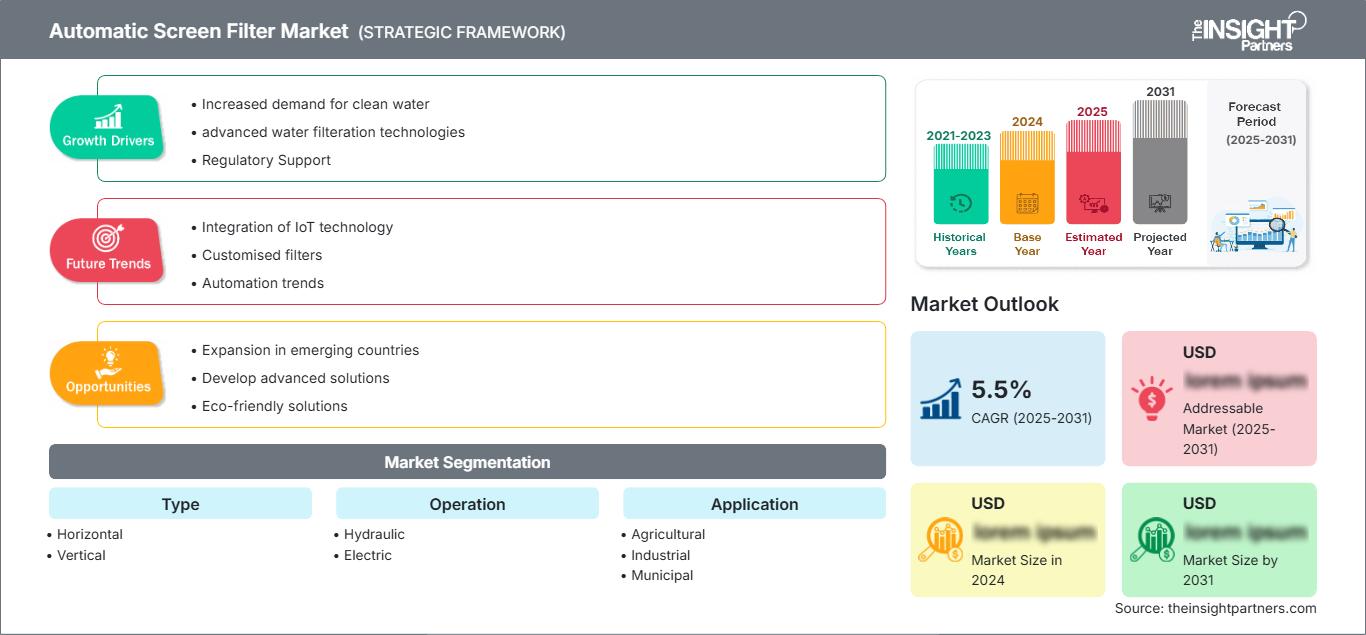
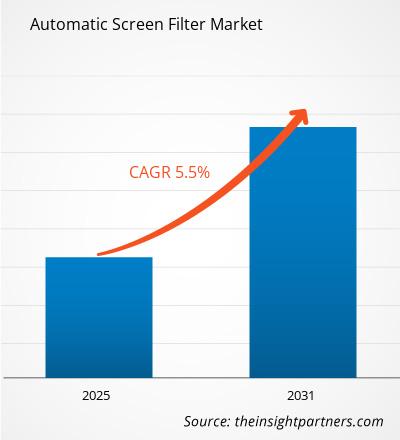
The Automatic Screen Filter Market is valued at US$ 1.21 Billion in 2025 and is projected to reach US$ 1.97 Billion by 2034, expanding at a 5.61% CAGR during 2026–2034. Demand is increasingly influenced by water-quality variability, filtration automation, operating-cost reduction, and the need to protect downstream irrigation and water-management infrastructure. Market is positioned as a water-filtration equipment segment serving agricultural irrigation, industrial water handling, and municipal applications where continuous particle removal and automated cleaning are required.
North America represents a mature demand center, supported by replacement of aging filtration equipment, increasing water reuse, and greater emphasis on automated water-management systems. The regional Automatic Screen Filter Market Size is expected to expand at approximately ~4% CAGR through 2034, with agricultural irrigation remaining an important application while industrial and municipal users increasingly adopt automated filtration to reduce maintenance intervention and improve process continuity.
Automatic Screen Filter Market Assessment and Insights
Regional Outlook
- North America: ~27% of the global market in 2025 | ~4% CAGR through 2034. Market position: North America is a major mature market supported by established irrigation infrastructure, industrial water treatment, municipal modernization, water reuse initiatives, and replacement demand for automated filtration systems.
- US: ~76% of North American market revenue in 2025 | ~4% CAGR through 2034. Market position: The US is the largest country market within North America, supported by agricultural irrigation, industrial process-water management, municipal water infrastructure, and increasing requirements for reliable filtration under water-reuse programs.
- Europe: ~23% of the global market in 2025 | ~4% CAGR through 2034. Market position: Europe is a mature filtration market, with Germany leading regional demand, followed by strong technology adoption in the UK, France, Italy, and Spain across agriculture, industrial water management, and municipal infrastructure.
- Asia Pacific: ~34% of the global market in 2025 | ~7% CAGR through 2034. Market position: Asia Pacific is the largest and fastest-growing regional market, driven by expanding irrigation, water scarcity, industrialization, infrastructure investment, and filtration modernization. China is the leading country in Asia Pacific.
Segment Outlook
- Agricultural: ~58% Share in 2025 | ~6% CAGR through 2034. Market position: Agricultural applications lead because automated filtration protects drip and sprinkler systems from sediment and suspended particles while reducing manual cleaning. Expansion of precision irrigation and water-efficiency investments reinforces demand across large and intensive farming operations.
- Electric: ~44% Share in 2025 | ~7% CAGR through 2034. Market position: Electric operation has a strong growth outlook because electrically driven cleaning supports automation where hydraulic pressure is insufficient or variable. Digital controllers, remote monitoring, and low-pressure filtration requirements increasingly favor electrically operated configurations.
Competitive Coverage
Amiad Water Systems Ltd., ARMAŞ, AZUD, BERMAD, Evoqua Water Technologies LLC, Glacier Filtration Pty Ltd, Hydra Filter, Jain Irrigation Systems Ltd., Netafim, Rivulis Irrigation Ltd., UVAR Holland BV
Methodology
The Insight Partners follows Data Collection & Secondary Research, Primary Research, Data Analysis, and Data Triangulation & Final Review to validate market estimates and insights.
Source: The Insight Partners' analysis based on proprietary research, government publications, company annual reports, investor presentations, industry databases, and expert interviews.
The market has grown beyond its traditional manual cleaning of screens to incorporate auto-cleaning technology with the use of hydraulically operated pistons, suction scanners, brushes, differential-pressure systems, electrical drive systems, and programmable controllers. There has been diversification in product architecture into vertical and horizontal designs depending on the installation conditions, flow rates, and maintenance considerations. Filtration equipment manufacturers are increasingly integrating their products with control systems that start the cleaning process depending on the differential pressure or programmed triggers.
Going forward, the largest growth potential is expected to lie in agricultural regions facing water shortages and also industrial regions where water reuse and continuity of the production processes is an important objective. Markets like Asia Pacific, Middle East, and Latin America present opportunities for growth as the need to automate irrigation and water quality management processes increases. Regulations concerning water efficiency, wastewater reuse, and water conservation should create additional opportunities for growth, especially as buyers make decisions based on operational costs as opposed to purchase costs.
Automatic Screen Filter Market Report Scope
| Report Attribute | Details |
|---|---|
| Market size in 2025 | US$ 1.21 Billion |
| Market Size by 2034 | US$ 1.97 Billion |
| Global CAGR (2026 - 2034) | 5.61% |
| Historical Data | 2021-2024 |
| Forecast period | 2026-2034 |
Automatic Screen Filter Market Analysis
The relationship between demand and clogging prevention, pumps and distribution system protection, and flow consistency is high. Irrigation of the agricultural fields still constitutes the most important demand due to the influence of filtration efficiency on emitters, sprinklers, fertigation equipment, and irrigation efficiency. Industrial customers have demand for automatic screens for process water treatment, cooling, recirculating, and wastewater treatment purposes. Municipalities use filtration equipment in their water treatment and distribution systems. The market consists of screen manufacturers, control systems producers, irrigation companies, engineering companies, distributors, and service providers.
In terms of competition among suppliers, the key criteria include filtration area, pressure loss features, cleaning method, screen resistance, corrosion resistance, flow rate, and level of automation. While hydraulic systems still look good from the standpoint of possibility of cleaning through using the differential pressure and without electricity, the electric systems provide better control in case of low pressure or very automated installation. Suppliers more and more often create modular equipment that can be configured according to different flow rates and screen qualities.
According to the Automatic Screen Filter Market Report, competition involves global experts in irrigation systems as well as filtration and water technology suppliers. Amiad Water Systems Ltd offers a wide range of products in automatic screen filtration, whereas Netafim offers automatic filtration in precision-irrigation systems. Rivulis Irrigation Ltd is concerned with hydraulic and electrical systems and digital monitoring of filtration systems. AZUD and BERMAD offer filtration and water management technologies for agricultural and infrastructural applications. UVAR Holland BV is engaged in agricultural, industrial, and recirculation applications, expanding the number of specialists in the field.
Innovations are more and more concentrated on intelligent control systems, low consumption of backflush water, durable construction, modularity, and remote diagnosis. Therefore, positioning should be oriented at the sale not of a filter but of an entire package for filtration management. Companies which are able to sell equipment along with intelligent control systems, technical support, spare parts and digital monitoring will have better chances of increasing their recurring revenue streams. However, regional production and distribution channels still remain significant since filtration systems need sizing, installation, and commissioning.
● REPORT CUSTOMIZATION
Tailor This Report To Align With Your Specific Business Requirements
This report can be customized to align precisely with your business objectives, scope, and target markets. Customization options include tailored segmentation, geography, competitive analysis, and strategic insights to support informed decision-making.
Customize This Report →WHAT YOU CAN ADJUST
- ● Segmentations
- ● Geography
- ● Competitive Analysis
- ● Language Preferences
Automatic Screen Filter Market: Strategic Insights
Regional Insights
North America Automatic Screen Filter Market
North America represents an advanced market with irrigation, industry, and municipal water supply facilities featuring comprehensive systems of irrigation, industry, and municipal water treatment infrastructures. Demand in North America depends increasingly on modernization rather than the initial deployment of automatic equipment, thereby ensuring steady replacement demand for automated equipment. In agricultural applications, customers prefer those filtration systems that require low maintenance and preserve irrigation infrastructure, while in industrial applications the reliability of the operation, minimal pressure losses, and reduced water use during cleaning are crucial factors. Programs of water reuse are also contributing to the need for reliable particle removal equipment.
North America is expected to grow with ~4% CAGR until 2034. The USA is dominating demand within the region due to its substantial agricultural industry, industrial processing, and needs for municipal facilities. Canada is represented by demand driven by applications in agriculture, industry, and natural resources sector. Suppliers with existing distribution and engineering network have good opportunities since technical specifications differ significantly depending on the water source, sedimentation load, pressure, and downstream equipment.
U.S. Automatic Screen Filter Market
The USA accounts for ~76% of the total Automatic Screen Filter Market share in North America in 2025 and will experience a ~4% CAGR through 2034. Irrigation in agriculture contributes heavily to the demand for automatic screens owing to the necessity of constant filtration in drip irrigation, sprinkler irrigation, greenhouse irrigation, orchard irrigation, and field irrigation.
Market competition includes Amiad Water Systems Ltd., Netafim, Rivulis Irrigation Ltd., BERMAD, and others who deal in filters, among others. More and more consideration is now being given to such aspects as flow rate, water quality, filtration grade, cleaning method, and hydraulic pressure while choosing an automatic screen. Digital monitoring has become more and more important due to efforts made by operators to cut down field visits and detect abnormal pressure conditions. Water reuse in municipal and industrial facilities can be another potential demand source as a result of the necessity of reliable pretreatment and process water filtration.
Europe Automatic Screen Filter Market
Europe is projected to account for ~23% of global market revenues in 2025, recording ~4% CAGR during 2025-2034. Germany leads in Europe on the back of state-of-the-art water management abilities and engineering knowledge in industrial sector. The UK and France benefit from applications in the municipal and industrial end-user segment, whereas, Italy and Spain benefit from their need for irrigation in agriculture and exposure to water efficiency measures. European buyers generally consider reliability of equipment, energy use, maintenance needs, and environmental operating standards seriously.
Italy and Spain make particularly valuable agricultural markets due to the fact that automated filtration ensures efficient irrigation of crops in times of water stress. Germany has greater industrial and infrastructure demands whereas France and the UK benefit from diversified end-user applications in municipalities, industries, and agriculture. Local competitors distinguish themselves through engineering adaptation, corrosion resistance, space-saving installation, and automatic cleaning of filters. Market dynamics are becoming less driven by filtration system penetration into new locations and more driven by system upgrades.
APAC Automatic Screen Filter Market
In APAC, it constitutes ~34% of global Automatic Screen Filter Market revenues in 2025 and is expected to grow at ~7% CAGR till 2034, thereby being the fastest growing region. China dominates the Asia Pacific market owing to significant water requirements for agriculture, industry, and infrastructure development. Technologically developed uses of filtration technologies by Japan and South Korea along with increasing irrigation and focus on efficiency in India add to the growth.
Australia offers demand due to water intensive agriculture and mining industry among others. In terms of agriculture filtration, there is expansion in use of drip and sprinklers, while in industries there is the need for high-quality water due to which water quality control is becoming important. There is huge variation in development of market across countries in the region, providing opportunity to those who can offer cost-effective designs as well as advanced automation.
Middle East & Africa Automatic Screen Filter Market
The Middle East and Africa market is expected to expand at ~6% CAGR through 2034. Saudi Arabia is the leading country in the Middle East & Africa region where automated agricultural filtration demand is supported by controlled irrigation, water conservation requirements, and investment in efficient water infrastructure. The UAE also provides demand through advanced irrigation, landscaping, and water-management projects.
Contributions of South Africa arise from agriculture-based industries, municipal infrastructures, and industrial water use. In the entire region, water shortage and need for optimal use of the available fresh water have made automatic filtering systems desirable due to the ability of such filtration systems to operate continuously without requiring frequent maintenance.
Segmentation Analysis
Type
Type segmentation in the Automatic Screen Filter Market comprises Horizontal and Vertical configurations. Horizontal systems remain important where conventional pipeline layouts and maintenance access favor horizontal installation, while vertical designs can reduce footprint and support compact filtration stations. Overall type selection is increasingly determined by available installation space, flow configuration, maintenance access, and project-specific hydraulic requirements.
- Horizontal: Horizontal filters are widely suited to conventional irrigation and industrial pipeline arrangements where equipment access is straightforward. Their established installation architecture supports replacement projects and makes them attractive where plant layouts already accommodate horizontal filtration assemblies.
- Vertical: Vertical configurations address installations where floor space is constrained or where system designers prefer compact equipment arrangements. Their strategic importance is increasing in modern filtration stations requiring efficient use of plant space and simplified integration with automated controls.
Operation
Operation segmentation in the Automatic Screen Filter Market includes Hydraulic and Electric systems. Hydraulic operation benefits from installations where available pressure can power the cleaning cycle without external electricity, whereas electric operation offers stronger automation flexibility. Electric systems are expected to register ~7% CAGR through 2034, supported by low-pressure applications, electronic controls, and remote operating requirements.
- Hydraulic: Hydraulic filters use water pressure and differential pressure to initiate and support cleaning. They are particularly attractive for agricultural systems where external electrical infrastructure is limited and operators prioritize simple, self-powered filtration with controlled water consumption.
- Electric: Electric systems employ motorized cleaning mechanisms and electronic controls to automate backflushing. They are increasingly selected for low-pressure applications, industrial installations, and digitally managed systems where operators need greater control over cleaning cycles and equipment status.
Application
Application segmentation in the Automatic Screen Filter Market covers Agricultural, Industrial, and Municipal uses. Agricultural applications account for approximately ~58% share in 2025 and are expected to grow at ~6% CAGR through 2034. Water scarcity, irrigation modernization, and protection of precision-irrigation equipment support sustained demand, while industrial and municipal applications diversify the market.
- Agricultural: Agricultural systems use automatic screens to remove suspended particles before water reaches driplines, sprinklers, and fertigation equipment. Demand is strongest where irrigation reliability, labor reduction, and protection against emitter clogging are important operating priorities.
- Industrial: Industrial applications include process water, cooling systems, recirculation, manufacturing, mining, and wastewater handling. Buyers emphasize filtration reliability, low pressure loss, cleaning efficiency, corrosion resistance, and compatibility with continuous industrial processes.
- Municipal: Municipal applications use filtration equipment within water treatment, distribution, reuse, and infrastructure projects. Demand is shaped by water-quality requirements, system modernization, operating continuity, and the need to control suspended solids before downstream treatment or distribution stages.
Opportunity Snapshot
| Application | Revenue Contribution | Trend Tag | Adoption Stage |
|---|---|---|---|
| Agricultural | High | Precision Irrigation | Mature |
| Industrial | Medium | Water Reuse | Scaling |
| Municipal | Low | Infrastructure Renewal | Scaling |
Automatic Screen Filter Market Growth Drivers and Impact Analysis
Water Scarcity and Irrigation Efficiency Requirements
Water scarcity is increasing the economic importance of filtration reliability in irrigation systems. Agriculture remains the largest freshwater user globally, making efficient water-management infrastructure strategically important for food production and agricultural resilience. Automatic filtration reduces the need for frequent manual intervention and helps protect emitters, sprinklers, and fertigation components from suspended particles. For growers operating under constrained water allocations, filtration performance can influence irrigation uniformity and system uptime rather than functioning only as a maintenance feature. This expands the addressable opportunity beyond basic filtration replacement. Suppliers can capture additional value by combining automatic cleaning with pressure monitoring, flow measurement, and irrigation controls, particularly in commercial farms and protected cultivation. The impact is strongest in water-stressed regions where irrigation modernization is increasingly tied to productivity and resource-efficiency objectives.
Expansion of Industrial Water Reuse and Recirculation
Industrial facilities are increasingly evaluating water reuse and recirculation as methods of strengthening water security and reducing dependence on fresh supplies. Automated screen filtration can serve as a practical component of these systems by controlling suspended solids before water enters sensitive downstream processes. Applications include cooling-water circuits, manufacturing processes, wastewater reuse, mining, and other operations where water quality directly influences equipment reliability. As industrial users pursue higher reuse rates, filtration systems must operate continuously while minimizing pressure loss and maintenance interruptions. This favors self-cleaning configurations over manually serviced alternatives. The market impact extends beyond equipment sales because filtration performance affects pumps, valves, heat-transfer equipment, and downstream treatment units. Suppliers able to provide engineered filtration packages for specific process conditions can therefore benefit from larger project scopes and higher-value replacement cycles.
Automation and Reduction of Filtration Maintenance Labor
Labor availability and operating continuity are strengthening the case for automated filtration. Manual screen cleaning requires routine inspection and intervention, which can become difficult across geographically dispersed farms, large industrial facilities, or remote water infrastructure. Automatic systems can trigger cleaning based on differential pressure or programmed operating conditions, reducing the frequency of manual servicing while maintaining filtration performance. Electric drives and programmable controllers further improve operational flexibility where hydraulic pressure varies. This driver is particularly relevant for large installations in which a filtration failure can affect extensive irrigation acreage or interrupt industrial processes. The resulting value proposition increasingly centers on total operating cost rather than purchase price alone. Manufacturers that improve controller reliability, simplify maintenance, and provide remote diagnostics can differentiate products while increasing the attractiveness of automated equipment for new installations and modernization projects.
Automatic Screen Filter Market Future Trends
Connected Filtration and Predictive Maintenance
Future filtration systems are likely to incorporate more sensors, connected controllers, and condition-based maintenance functions. Differential pressure, cleaning frequency, flow behavior, and equipment status can provide operational signals that help users identify abnormal loading or deteriorating performance before a failure affects downstream equipment. This creates an opportunity in the Automatic Screen Filter Market Trends to shift filtration management from reactive servicing toward predictive intervention. Integration with irrigation-management platforms can allow filtration status to become part of broader water-management decisions, particularly on large farms and distributed agricultural networks. Industrial customers can similarly integrate filtration data into plant monitoring systems. Over time, the commercial differentiation of automatic filters is therefore expected to move beyond screen design toward the quality of data, controls, diagnostics, and service support surrounding the physical equipment.
Low-Water Cleaning and Modular Filtration Architecture
Filtration technology is expected to increasingly emphasize low-water cleaning, lower pressure requirements, compact footprints, and modular expansion. Water consumed during backflushing represents an operating consideration in both agricultural and industrial systems, especially where source water is limited or treatment costs are high. Manufacturers can address this through more efficient suction mechanisms, optimized cleaning sequences, larger filtration areas, and control logic that initiates cleaning only when required. Modular assemblies will also become more valuable as projects expand because additional filtration capacity can be incorporated without completely redesigning the filtration station. These developments support lifecycle economics and make automated filtration more attractive for customers balancing capacity expansion with constrained water and infrastructure budgets.
Automatic Screen Filter Market Opportunities
Integrated Filtration Packages for Precision Irrigation
Precision irrigation provides an opportunity for suppliers to position automatic screens as part of integrated water-delivery packages rather than standalone components. Large farms, greenhouse operators, orchards, and high-value crop producers require filtration that works consistently with pumps, fertigation units, pressure controls, valves, and irrigation controllers. Bundled solutions can simplify equipment selection and reduce compatibility risks while enabling suppliers to capture engineering and service revenue. The opportunity in the Automatic Screen Filter Market Forecast is particularly strong in developing agricultural markets where irrigation infrastructure is expanding and system designers increasingly seek standardized, scalable packages. Companies with established irrigation channels can leverage existing customer relationships to promote higher-value automated filtration upgrades. Product strategies should emphasize simple commissioning, low water consumption during cleaning, robust screen construction, and compatibility with remote monitoring systems.
Industrial and Municipal Retrofit Programs
Industrial and municipal retrofit programs offer another attractive opportunity because existing water infrastructure often requires improved filtration without complete system replacement. Retrofit solutions can target filtration stations with excessive pressure loss, high manual-maintenance requirements, inadequate screen area, or increasing suspended-solid loads. Industrial water reuse projects can create additional demand where existing treatment systems are being adapted to recycle more water. Municipal customers similarly require equipment that can operate reliably within established treatment and distribution infrastructure. Suppliers can improve project economics by offering modular filters, replacement screens, control upgrades, commissioning services, and maintenance contracts. This approach broadens the revenue opportunity from equipment replacement to lifecycle support. Vendors with engineering expertise and local service capabilities are likely to be better positioned for technically complex retrofit projects.
Recent Developments
- August 2026: Orbia Advance Corporation S.A.B. de C.V. (BMV: ORBIA*) Precision Agriculture business, Netafim, announced the launch of GrowSphere FLEX, a smart irrigation and fertigation controller developed to bring professional digital farming capabilities to smallholders and mid-sized farmers. As part of the wider GrowSphere portfolio, FLEX supports Orbia Netafim's closed-loop approach to digital farming, enabling farmers to continuously optimize irrigation, improve efficiency and enhance crop performance.
- August 2026: Rivulis has appointed Steve Francis as its new Chief Executive Officer. Steve joins Rivulis at an important point in the company’s journey. Over many years, Rivulis has grown into a global leader in advanced irrigation and climate solutions, serving growers and business partners across the world through a combination of innovation, technical expertise and strong local relationships.
- March 2026: StarTech.com, a global leader in performance connectivity solutions for IT professionals, announced the launch of its new Bright Privacy Screen Filters. These new filters offer increased light passthrough compared to previous privacy filters, while protecting sensitive on-screen information without reducing screen brightness or visual clarity, addressing common frustrations associated with traditional privacy screens, such as dim displays and reduced color accuracy.
Frequently Asked Questions

- Comprehensive Market Sizing and Forecast Analysis
- Detailed Segmentation Analysis
- In-Depth Market Dynamics Assessment
- Regional and Country-Level Insights
- Competitive Landscape and Company Benchmarking
- Strategic Business Intelligence
Recent Reports
Testimonials

The Insight Partners provided valuable market intelligence that supported our global go-to-market strategy. Their team was professional, responsive, and attentive to our feedback, providing thoughtful analysis and helpful methodological clarifications throughout the project.
Junmo Kim Chief Financial Officer (CFO), Enertech Co., Ltd.
The Insight Partners' SCADA System Market report is comprehensive, with valuable insights on current trends and future forecasts. The team was highly professional, responsive, and supportive throughout. We are very satisfied and highly recommend their services.
RAN KEDEM Partner, Reali Technologies LTDs
I requested a report on a very specific software market and the team produced the report in a few days. The information was very relevant and well presented. I then requested some changes and additions to the report. The team was again very responsive and I got the final report in less than a week.
JEAN-HERVE JENN Chairman, Future Analytica
We worked with The Insight Partners for an important market study and forecast. They gave us clear insights into opportunities and risks, which helped shape our plans. Their research was easy to use and based on solid data. It helped us make smart, confident decisions. We highly recommend them.
PIYUSH NAGPAL Sr. Vice President, High Beam Global
The Insight Partners delivered insightful, well-structured market research with strong domain expertise. Their team was professional and responsive throughout. The user-friendly website made accessing industry reports seamless. We highly recommend them for reliable, high-quality research services
YUKIHIKO ADACHI CEO, Deep Blue, LLC.
This is the first time I have purchased a market report from The Insight Partners.While I was unsure at first, I visited their web site and felt more comfortable to take the risk and purchase a market report.I am completely satisfied with the quality of the report and customer service. I had several questions and comments with the initial report, but after a couple of dialogs over email with their analyst I believe I have a report that I can use as input to our strategic planning process.Thank you so much for taking the extra time and making this a positive experience.I will definitely recommend your service to others and you will be my first call when we need further market data.
JOHN SUZUKI President and Chief Executive Officer, Board Director, BK Technologies
I wish to appreciate your support and the professionalism you displayed in the course of attending to my request for information regarding to infectious disease IVD market in Nigeria. I appreciate your patience, your guidance, and the fact that you were willing to offer a discount, which eventually made it possible for us to close a deal. I look forward to engaging The Insight Partners in the future, all thanks to the impression you have created in me as a result of this first encounter.
DR CHIJIOKE ONYIA MANAGING DIRECTOR, PineCrest Healthcare Ltd.Reason to Buy
- Informed Decision-Making
- Understanding Market Dynamics
- Competitive Analysis
- Identifying Emerging Markets
- Customer Insights
- Market Forecasts
- Risk Mitigation
- Boosting Operational Efficiency
- Strategic Planning
- Investment Justification
- Tracking Industry Innovations
- Aligning with Regulatory Trends





 Get Free Sample for