
Automotive Manufacturing Equipment Market Trends, Demand & Growth by 2034
Automotive Manufacturing Equipment Market Size and Forecasts (2021 - 2034), Global and Regional Share, Trends, and Growth Opportunity Analysis Report Coverage : By The report is segmented into Equipment Type (CNC Machine, Conveyor Belt, Injection Molding Machine, Robot), Mode of Operation (Automatic, Semi-Automatic), Vehicle Type (Passenger Vehicle, Commercial Vehicle)
- Status : Data Released
- Report Code : TIPRE00039740
- Category : Automotive and Transportation
- No. of Pages : 150
- Available Report Formats :


- Last update date : August 14, 2026


2025 Market Size
US$ 33.59 Bn
Base year value
2034 Forecast
US$ 52.26 Bn
Projected by 2034
CAGR 2026-2034
5.03 %
Growth rate
Addressable Market
US$ 389.49 Bn
(2026-2034)
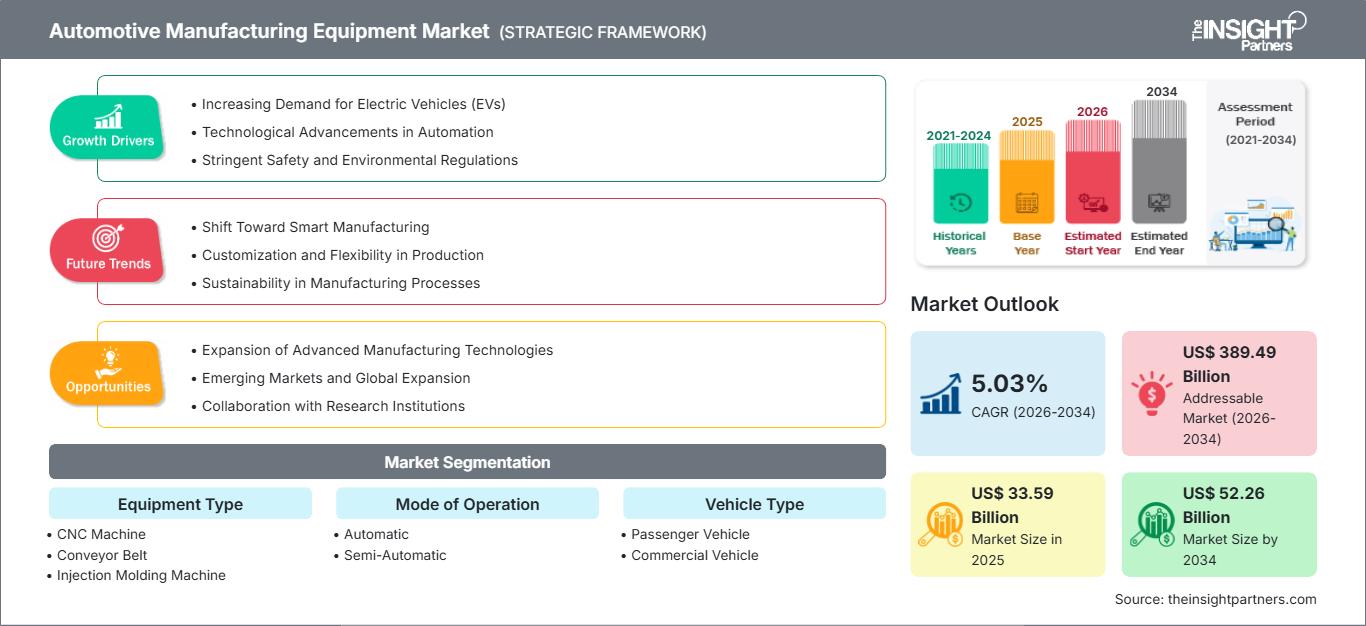
The automotive manufacturing equipment market is projected to grow from US$ 33.59 Billion in 2025 to US$ 52.26 Billion by 2034, registering a CAGR of 5.03% during 2026–2034. Demand is supported by vehicle platform diversification, rising automation intensity, and the shift toward electric, hybrid, and software-defined vehicle production that requires flexible machining, molding, material handling, and robotic assembly systems.
North America remains a strategically important contributor to automotive manufacturing equipment market size, with regional demand expected to grow at a CAGR of 4.4–4.8% during 2026–2034. Plant modernization, reshoring of critical components, battery and powertrain investments, and higher use of connected factory systems are strengthening equipment replacement and capacity expansion across vehicle assembly and component manufacturing facilities.
Automotive Manufacturing Equipment Market Assessment and Insights
- North America: Accounted for 24–27% share in 2025 and is projected to grow at a CAGR of 4.4–4.8% between 2026–2034, supported by EV plant upgrades and automation-led capacity renewal.
- US: Represented 78–82% of North America in 2025 and is expected to grow at a CAGR of 4.3–4.7%, driven by robotics, CNC systems, and battery assembly investments.
- Europe: Held 25–28% share in 2025 and is forecast to grow at a CAGR of 4.2–4.6%, with Germany, France, Italy, Spain, and the UK leading demand.
- Asia Pacific: Accounted for 36–40% share in 2025 and is projected to grow at a CAGR of 5.6–6.1%, supported by China, Japan, South Korea, India, and Australia.
- Largest Segment: CNC Machine held 27–30% market share in 2025 and is projected to grow at a CAGR of 4.8–5.2% due to precision machining requirements.
- High Growth Segment: Robot held 22–25% market share in 2025 and is projected to grow at a CAGR of 6.1–6.7% as automated welding, handling, and inspection expand.
- Key companies analyzed in detail: ABB Ltd., FANUC CORPORATION, KUKA AG, Yaskawa Electric Corporation, Kawasaki Heavy Industries, Ltd., AMADA CO., LTD., AIDA ENGINEERING, LTD., Dürr Aktiengesellschaft, Schuler Group GmbH, TRUMPF SE + Co. KG, Universal Robots A/S, Daifuku Co., Ltd., Yamazaki Mazak Corporation.
Source: The Insight Partners' analysis based on proprietary research, government publications, company annual reports, investor presentations, industry databases, and expert interviews.
Manufacturing equipment used in automotive plants has shifted from stand-alone machinery to integrated, sensor-enabled systems that support faster model changeovers and higher quality consistency. The automotive manufacturing equipment market is increasingly shaped by CNC machine adoption, robotic welding, injection molding upgrades, automated conveyors, and digital production control. Equipment suppliers are responding with modular platforms that reduce downtime, improve asset utilization, and support mixed vehicle production.
In the forecast period, manufacturers will focus on flexible equipment, which will facilitate the implementation of internal combustion engine, hybrid, and EV projects within one facility. The biggest investments will be made in the regions where vehicle manufacturing, localization, and battery supply chains are growing simultaneously. Suppliers who can provide reliable mechanics, software, energy savings, and service will be in a better position than those providing a single type of equipment.
Automotive Manufacturing Equipment Market Report Scope
| Report Attribute | Details |
|---|---|
| Market size in 2025 | US$ 33.59 Billion |
| Market Size by 2034 | US$ 52.26 Billion |
| Global CAGR (2026 - 2034) | 5.03% |
| Historical Data | 2021-2024 |
| Forecast period | 2026-2034 |
Automotive Manufacturing Equipment Market Analysis
The automotive manufacturing equipment market growth is driven by plant automation, precision component demand, and rising pressure to shorten vehicle development cycles. Automakers are adopting CNC systems, conveyors, injection molding machines, and robots to improve repeatability across machining, body assembly, interiors, battery enclosures, and inspection operations. Equipment replacement is also rising as legacy lines become less suitable for multi-platform production.
The supply chain dynamics have grown interconnected since OEMs have been buying equipment through full production cells and not just individual machines. The suppliers who can offer expertise in areas of robotics, control, tooling, material handling, and after-sales will be favored. Predictive maintenance and remote diagnosis, and availability of standard spare parts are now being considered important aspects during procurement.
In the market analysis, we have seen that the market is characterized by automation and machinery specialists who can support OEM programs around the world. Some of the key players include ABB Ltd., FANUC CORPORATION, KUKA AG, Yaskawa Electric Corporation, Daifuku Co., Ltd., and Dürr Aktiengesellschaft. They are well-known in robotics, conveyors, painting, and automation cells, while AMADA CO., LTD., AIDA ENGINEERING, LTD., Schuler Group GmbH, TRUMPF SE + Co. KG, and Yamazaki Mazak Corporation are well-known in machining, forming, and fabrication ecosystems.
Investment trends are shifting toward scalable factory architectures, AI-assisted inspection, collaborative robots, and equipment that can operate with lower energy consumption. Strategic positioning is also influenced by regional service depth because automakers need faster commissioning and maintenance support. Suppliers with standardized platforms and local engineering teams can better address customer demands for resilience, cost control, and faster production ramp-up.
● REPORT CUSTOMIZATION
Tailor This Report To Align With Your Specific Business Requirements
This report can be customized to align precisely with your business objectives, scope, and target markets. Customization options include tailored segmentation, geography, competitive analysis, and strategic insights to support informed decision-making.
Customize This Report →WHAT YOU CAN ADJUST
- ● Segmentations
- ● Geography
- ● Competitive Analysis
- ● Language Preferences
Automotive Manufacturing Equipment Market: Strategic Insights
Regional Insights
North America automotive manufacturing equipment market
North America held 24–27% share in 2025 and is projected to grow at a CAGR of 4.4–4.8% during 2026–2034. The automotive manufacturing equipment market share in the region is supported by EV assembly investments, battery module production, and modernization of body shops and machining lines.
OEMs and Tier 1 suppliers are increasing spending on flexible robots, CNC machines, automated conveyors, and quality inspection systems. Labor availability constraints and higher wage structures also favor automation. Equipment demand is strongest where manufacturers must balance conventional vehicle output with electrified platforms while maintaining productivity and product consistency.
U.S. automotive manufacturing equipment Market
The US represented 78–82% of North America in 2025 and is forecast to grow at a CAGR of 4.3–4.7%. Demand is concentrated in robotic welding, battery assembly, CNC machining, conveyors, and plant digitalization linked to large vehicle and component manufacturing clusters.
Company presence is strong across automation suppliers, machine tool providers, system integrators, and local service networks. Application trends include robotic inspection, flexible material handling, die and mold machining, and automated intralogistics. Capital deployment is increasingly tied to reshoring strategies, supplier localization, and production resilience after recent supply chain disruptions.
Europe automotive manufacturing equipment Market
Europe accounted for 25–28% share in 2025 and is expected to grow at a CAGR of 4.2–4.6%. Germany remains the leading country due to its OEM base, automation engineering depth, machine tool capability, and high-value component manufacturing across premium and commercial vehicle platforms.
The UK supports demand through specialty manufacturing, powertrain transition programs, and automation upgrades in assembly operations. France, Italy, and Spain contribute through compact vehicle assembly, metal forming, robotics, and supplier networks. Equipment demand is increasingly linked to emissions regulation, lightweighting, battery integration, and competitiveness pressures across European vehicle plants.
APAC automotive manufacturing equipment Market
APAC held 36–40% share in 2025 and is projected to grow at a CAGR of 5.6–6.1%. China leads through large-scale EV and conventional vehicle production, while Japan and South Korea contribute high-precision robotics, CNC systems, and automation engineering.
India is emerging as a major demand center as vehicle output, component localization, and export-oriented manufacturing expand. Australia contributes through specialized engineering and aftermarket-linked production. Regional growth benefits from supplier density, policy support for domestic manufacturing, cost-competitive assembly, and rising deployment of automated equipment in new plants.
Middle East & Africa automotive manufacturing equipment Market
The Middle East & Africa is expected to grow at a CAGR of 4.0–4.4% during 2026–2034. Saudi Arabia and the UAE are supporting industrial diversification, vehicle assembly initiatives, and logistics-linked manufacturing investments, while South Africa remains the region’s most established automotive production base.
Demand is concentrated in assembly equipment, conveyors, painting systems, and component machining rather than full-spectrum advanced automation. Growth is supported by infrastructure development, fleet localization, and regional manufacturing incentives. However, import dependence and limited supplier ecosystems keep adoption below the Asia Pacific and Europe.
Segmentation Analysis
Equipment Type
Equipment Type is projected to grow at a CAGR of 5.1–5.6% during 2026–2034. The market scope across equipment categories is shaped by precision, flexibility, cycle time, and integration with digital factory systems. Demand is strongest for technologies that reduce defects, support multiple vehicle platforms, and improve productivity across component and final assembly operations.
- CNC machines lead demand because engine parts, chassis components, molds, battery housings, and drivetrain parts require tight tolerances, repeatability, and advanced machining flexibility.
- Conveyor Belt remains essential for assembly flow, material movement, and line balancing, especially where high-volume plants require synchronized movement between welding, painting, and final assembly areas.
- Injection Molding Machine supports plastic interior, exterior, connector, and lightweight component production, with EV programs increasing demand for complex molded parts and thermal management applications.
- Robot adoption is accelerating across welding, painting, handling, inspection, and collaborative assembly as manufacturers seek lower variability, higher throughput, and improved worker safety.
Equipment Type
Equipment Type continues to grow at a CAGR of 5.1–5.6% during 2026–2034 because automakers are standardizing equipment families across global plants. The repeated input segment reinforces the same core equipment categories, with procurement decisions focused on lifecycle cost, installation speed, spare part availability, and compatibility with automated production management systems.
- CNC machines benefit from mold, die, and precision component manufacturing, where high accuracy and repeatable quality directly influence downstream assembly efficiency.
- A conveyor belt is strategically important in flexible factories because modular conveyor layouts help plants switch production schedules with lower disruption.
- Injection molding machines gain relevance as automakers replace selected metal parts with engineered plastics and require machines capable of consistent high-volume output.
- Robots are increasingly deployed with vision systems, force control, and collaborative features that support safer, more adaptive assembly environments.
Vehicle Type
Vehicle Type is expected to grow at a CAGR of 4.9–5.4% during 2026–2034. Passenger vehicles account for the largest equipment demand due to higher production volumes and broader model diversity, while commercial vehicles require durable manufacturing systems for chassis, driveline, cargo body, and fleet-specific configurations.
- Passenger vehicles lead equipment demand because frequent model refreshes, EV launches, and high-volume assembly require advanced machining, molding, robotics, and automated material handling systems.
- Commercial Vehicle adoption is supported by fleet electrification, heavy-duty component manufacturing, and demand for robust assembly equipment suited to larger structures and lower-volume customization.
Opportunity Snapshot
| Equipment Type | Revenue Contribution | Trend Tag | Adoption Stage |
| CNC Machine | High | Precision Machining | Mature |
| Conveyor Belt | Medium | Smart Flow | Mature |
| Injection Molding Machine | Medium | Lightweight Parts | Scaling |
| Robot | High | Flexible Cells | Scaling |
Automotive Manufacturing Equipment Market Growth Drivers and Impact Analysis
EV and Hybrid Production Line Modernization
Projects relating to electrified vehicle development involve new machinery that will be used for manufacturing battery trays, modules, lightweight assemblies, power electronics, and thermal management parts. The effect is being felt in the need for machining centers, robotics, conveyor technology, and injection molding machines capable of handling smaller tolerances in cleaner assembly environments. The driver is far-reaching because many original equipment manufacturers are not creating new production facilities but rather adapting their current factories to produce both internal combustion engine and electrified vehicles from the same factory.
Automation Need from Labor and Quality Pressures
The auto industry is under increasing pressure to increase its efficiency without making mistakes, producing waste, or incurring additional costs due to rework. Lack of skilled workforce for welding, machining, inspecting, and maintenance makes automation an obvious choice, especially in expensive manufacturing locations. Robotics and intelligent conveyors ensure smooth production flow, while CNC technology and connected molding machines ensure the quality of individual parts. This can be observed in OEM and Tier 1 plants alike because any problems with one part may affect the scheduling of assembly.
Industry 4.0 Integration Across Vehicle Plants
Programs for digital factories are encouraging the use of connected equipment, which is able to perform real-time monitoring, predictive maintenance, and data-driven process control. Manufacturers require the machines to be connected with manufacturing execution systems, quality management systems, and enterprise planning software. The above driver encourages manufacturers to make purchases based on machine intelligence rather than their mechanical capabilities. Machines that can be used to measure vibrations, energy consumption, cycle time, and tool wear can assist manufacturers in avoiding downtime and increasing planning accuracy. As manufacturing processes become more complex, connected manufacturing machines become vital.
Automotive Manufacturing Equipment Market Future Trends
AI-Enabled Inspection and Process Optimization
One of the key automotive manufacturing equipment market trends is the wider integration of AI into inspection, robotics, machining, and molding processes. Vision systems, machine learning models, and digital twins will help plants identify defects earlier, adjust process parameters automatically, and reduce unplanned downtime. This trend will be especially relevant in battery production, lightweight component manufacturing, and body assembly, where tolerances are critical. Suppliers that embed analytics into equipment platforms will gain an advantage over vendors selling hardware without actionable production intelligence.
Collaborative and Reconfigurable Production Cells
Vehicle manufacturers are developing production cells that can be reconfigured more quickly for new vehicles, low-production vehicles, and hybrid powertrain production. Cobots, modular conveyors, mobile tooling, and machine interfaces are just some of the solutions that will be critical in an era of shorter product lifecycles. This is an efficient use of capital as manufacturers will be able to reuse their equipment on several programs instead of having to replace their entire line.
Automotive Manufacturing Equipment Market Opportunities
Localized Equipment Supply for Emerging Manufacturing Hubs
The automotive manufacturing equipment market forecasts point to rising opportunities in countries expanding domestic vehicle and component production. India, Southeast Asia, Mexico, Saudi Arabia, and South Africa are expanding their supplier network and assembling capabilities. Equipment suppliers can capitalize on this opportunity by regionalizing the service team, spare parts, application engineering, and financing. The rationale behind such actions is the preference for suppliers who minimize the risk associated with installation and downtime. Regional partnerships with the system integrator can be an additional way to compete against the local machine makers.
Retrofit and Lifecycle Services for Existing Plants
Since many automobile manufacturing plants cannot afford to replace entire production lines at one go, there is an enormous opportunity in retrofitting, automation, integration of software, and predictive maintenance solutions. Supplier firms can get repeated business from updating CNC controls, installing robotics, improving conveyor systems, and linking legacy systems to information platforms. This will reduce the capital requirement for auto companies as well as increase the life of their equipment. It will be most viable in situations where the plants need to improve their quality and flexibility without shutting down.
Frequently Asked Questions

- Comprehensive Market Sizing and Forecast Analysis
- Detailed Segmentation Analysis
- In-Depth Market Dynamics Assessment
- Regional and Country-Level Insights
- Competitive Landscape and Company Benchmarking
- Strategic Business Intelligence
Recent Reports
Testimonials

The Insight Partners' SCADA System Market report is comprehensive, with valuable insights on current trends and future forecasts. The team was highly professional, responsive, and supportive throughout. We are very satisfied and highly recommend their services.
RAN KEDEM Partner, Reali Technologies LTDs
I requested a report on a very specific software market and the team produced the report in a few days. The information was very relevant and well presented. I then requested some changes and additions to the report. The team was again very responsive and I got the final report in less than a week.
JEAN-HERVE JENN Chairman, Future Analytica
We worked with The Insight Partners for an important market study and forecast. They gave us clear insights into opportunities and risks, which helped shape our plans. Their research was easy to use and based on solid data. It helped us make smart, confident decisions. We highly recommend them.
PIYUSH NAGPAL Sr. Vice President, High Beam Global
The Insight Partners delivered insightful, well-structured market research with strong domain expertise. Their team was professional and responsive throughout. The user-friendly website made accessing industry reports seamless. We highly recommend them for reliable, high-quality research services
YUKIHIKO ADACHI CEO, Deep Blue, LLC.
This is the first time I have purchased a market report from The Insight Partners.While I was unsure at first, I visited their web site and felt more comfortable to take the risk and purchase a market report.I am completely satisfied with the quality of the report and customer service. I had several questions and comments with the initial report, but after a couple of dialogs over email with their analyst I believe I have a report that I can use as input to our strategic planning process.Thank you so much for taking the extra time and making this a positive experience.I will definitely recommend your service to others and you will be my first call when we need further market data.
JOHN SUZUKI President and Chief Executive Officer, Board Director, BK Technologies
I wish to appreciate your support and the professionalism you displayed in the course of attending to my request for information regarding to infectious disease IVD market in Nigeria. I appreciate your patience, your guidance, and the fact that you were willing to offer a discount, which eventually made it possible for us to close a deal. I look forward to engaging The Insight Partners in the future, all thanks to the impression you have created in me as a result of this first encounter.
DR CHIJIOKE ONYIA MANAGING DIRECTOR, PineCrest Healthcare Ltd.Reason to Buy
- Informed Decision-Making
- Understanding Market Dynamics
- Competitive Analysis
- Identifying Emerging Markets
- Customer Insights
- Market Forecasts
- Risk Mitigation
- Boosting Operational Efficiency
- Strategic Planning
- Investment Justification
- Tracking Industry Innovations
- Aligning with Regulatory Trends





 Get Free Sample for