
Automotive PCB Market Demand, Size & Forecast by 2034
Coverage: by Type (Single Sided PCB, Double Sided PCB, and Multi-layed PCB); Engine Type (Electric Vehicle and ICE Vehicle); Vehicle Type (Autonomous Vehicle and Conventional Vehicle), and Geography (North America, Europe, Asia Pacific, and South and Central America)
- Status : Data Released
- Report Code : TIPAT00002716
- Category : Electronics and Semiconductor
- No. of Pages : 150
- Available Report Formats :


- Last update date : July 20, 2026


2025 Market Size
US$ 10.0 Bn
Base year value
2034 Forecast
US$ 17.86 Bn
Projected by 2034
CAGR 2026-2034
6.66 %
Growth rate
Addressable Market
US$ 125.97 Bn
(2026-2034)
The Automotive PCB Market is valued at US$ 10.0 Billion in 2025 and is projected to reach US$ 17.86 Billion by 2034, registering a CAGR of 6.66% from 2026 to 2034. Demand reflects expanding electronic control content across powertrain, ADAS, infotainment, body comfort, lighting, battery management, and connectivity systems in internal combustion, hybrid, and battery-electric light-duty vehicles.
North America remains a technology-led adoption base, with the Automotive PCB Market size supported by a 4.7–5.4% CAGR during 2026–2034. Regional growth is shaped by software-defined vehicle platforms, higher safety electronics content, and local investment in EV battery, power electronics, and connected mobility supply chains. Advanced driver assistance and electrified drivetrain modules are creating steady demand for multilayer and thermally robust boards.
Automotive PCB Market Assessment and Insights
- North America: North America held a 24–28% share in 2025 and is growing at a 4.7–5.4% CAGR between 2026–2034, led by EV manufacturing, ADAS integration, and electronics localization.
- US: The US represented 76–80% of North America in 2025 and is growing at a 4.8–5.6% CAGR between 2026–2034, supported by OEM electrification programs.
- Europe: Europe accounted for a 21–25% share in 2025 and is growing at a 4.4–5.1% CAGR between 2026–2034, with Germany, France, the UK, Italy, and Spain leading safety and EV electronics demand.
- Asia Pacific: Asia Pacific held a 42–46% share in 2025 and is growing at a 5.5–6.3% CAGR between 2026–2034, driven by China, Japan, South Korea, India, and Taiwan-linked PCB ecosystems.
- Largest Segment: Multi-Layer PCB led with a 44–48% market share in 2025 and a 5.4–6.1% CAGR between 2026–2034 due to dense electronic architectures.
- High Growth Segment: BEV held a 25–29% market share in 2025 and is growing at a 7.2–8.4% CAGR between 2026–2034 as battery management and inverter electronics expand.
- Key companies analyzed in detail: Aptiv PLC, Samsung Electro-Mechanics Co., Ltd., CMK Corporation, Unimicron Technology Corporation, Meiko Electronics Co., Ltd., Chin Poon Industrial Co., Ltd., KCE Electronics Public Company Limited, Daeduck Electronics Co., Ltd., Tripod Technology Corporation, and Nippon Mektron, Ltd.
Source: The Insight Partners' analysis based on proprietary research, government publications, company annual reports, investor presentations, industry databases, and expert interviews.
Automotive electronics transition from isolated control modules to domain architecture is driving increased need for PCBs with an increased number of layers, tight impedance control, and enhanced thermal performance. Electrification is further driving changes in the manufacturing process due to the requirements of copper thickness, insulation resistance, and vibration tolerance of the battery management system, charger, DC-DC converter, and traction control module. This is driving the Automotive PCB Market from commoditized boards to application-specific boards optimized based on safety, power density, and longevity.
Drivers will include fabrication capabilities of Asia, localization drives of North America, and safety mandates of Europe. According to IEA, electric vehicle sales surpassed 17 million in 2024 and were forecasted to exceed 20 million in 2025. Power electronic modules will further drive demand for automotive PCBs. Manufacturers capable of providing automotive-grade certification, material traceability, and local delivery capability will see benefits as automakers optimize designs for connectivity, electrification, and automation.
Automotive PCB Market Report Scope
| Report Attribute | Details |
|---|---|
| Market size in 2025 | US$ 10.0 Billion |
| Market Size by 2034 | US$ 17.86 Billion |
| Global CAGR (2026 - 2034) | 6.66% |
| Historical Data | 2021-2024 |
| Forecast period | 2026-2034 |
Automotive PCB Market Analysis
Automotive PCB Market growth is being reinforced by rising semiconductor content per vehicle, stricter safety electronics requirements, and the transition from mechanical assemblies to electronically controlled systems. Battery electric and hybrid cars require an increased number of boards in batteries, thermal systems, power converters, and charging systems, whereas internal combustion engine cars have the need for engine, transmission, braking, lighting, and infotainment boards.
The supply chain involves laminate suppliers, copper foil makers, PCB assemblers, EMS providers, Tier-1 companies, and OEM validation groups. The supply situation is getting better due to capacity diversification from Taiwan, Japan, South Korea, Thailand, India, Mexico, and Eastern Europe. Nevertheless, automotive qualification takes longer than consumer electronics qualification as there is a need to satisfy the temperature cycle, moisture, vibration, and traceability criteria.
Automotive PCB Market analysis indicates a competitive landscape led by scaled fabricators and automotive electronics specialists. Samsung Electro-Mechanics Co., Ltd., Unimicron Technology Corporation, Meiko Electronics Co., Ltd., CMK Corporation, Chin Poon Industrial Co., Ltd., KCE Electronics Public Company Limited, Daeduck Electronics Co., Ltd., Tripod Technology Corporation, Nippon Mektron, Ltd., and Aptiv PLC rely on quality systems, geographic location, and design capabilities to compete.
Investment considerations focus on multilayer capability, HDI process control, heavy copper, flex assemblies, and AOI. Strategic positioning is becoming more reliant on co-development due to the impact of PCB design on electromagnetic compatibility, thermal management, functional safety, and software-defined vehicle performance. Suppliers with automotive certification and diverse geographic manufacturing facilities have an advantage for platform nominations that have long cycle times.
● REPORT CUSTOMIZATION
Tailor This Report To Align With Your Specific Business Requirements
This report can be customized to align precisely with your business objectives, scope, and target markets. Customization options include tailored segmentation, geography, competitive analysis, and strategic insights to support informed decision-making.
Customize This Report →WHAT YOU CAN ADJUST
- ● Segmentations
- ● Geography
- ● Competitive Analysis
- ● Language Preferences
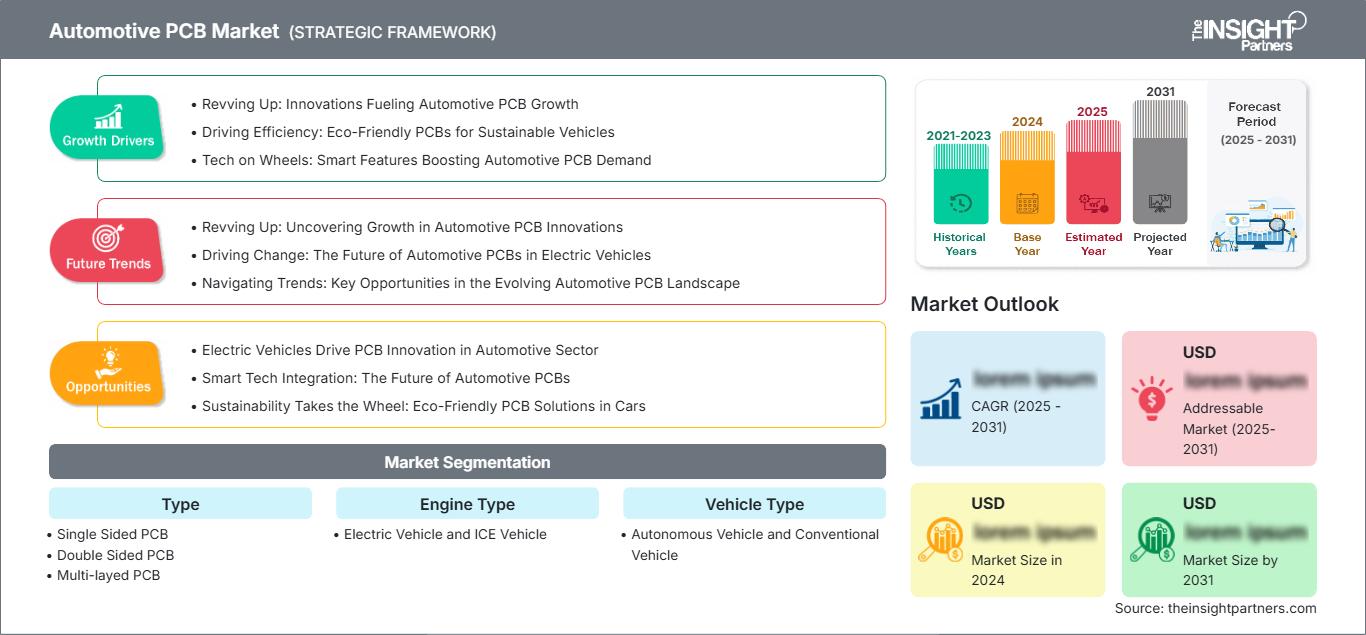
Automotive PCB Market: Strategic Insights
Regional Insights
North America Automotive PCB Market
North America accounted for a 24–28% share in 2025 and is expected to grow at a 4.7–5.4% CAGR during 2026–2034. The Automotive PCB Market share in the region is supported by EV assembly investments, ADAS mandates, connected-vehicle software programs, and localization of power electronics supply. OEMs are raising demand for multilayer boards used in battery management, telematics, infotainment, lighting, and chassis control.
Demand is strongest in the US, while Canada and Mexico contribute through vehicle assembly, electronics integration, and cross-border supplier networks. Policy support for domestic EV and battery supply chains encourages PCB localization, although advanced laminates and copper inputs remain globally sourced. Suppliers are prioritizing automotive qualification, traceability, and shorter logistics routes to reduce risk for long-life vehicle platforms.
U.S. Automotive PCB Market
The US represented 76–80% of North America in 2025 and is growing at a 4.8–5.6% CAGR during 2026–2034. Demand is supported by EV launches, ADAS fitment, infotainment upgrades, and vehicle electrification programs from domestic and international automakers. Board content is rising in battery packs, onboard chargers, radar modules, lighting controllers, body electronics, and increasingly centralized compute systems.
Company presence is shaped by tier-one integrators, electronics manufacturing services, and Asian PCB suppliers serving US OEM platforms. Aptiv PLC supports vehicle electronics architecture and connection systems, while global fabricators provide qualified boards through regional and imported supply. Applications are moving toward higher-density boards for driver assistance, thermal management, battery monitoring, and connected cockpit systems.
Europe Automotive PCB Market
Europe held a 21–25% share in 2025 and is expected to grow at a 4.4–5.1% CAGR during 2026–2034. Germany leads since high-layer-count and reliability of boards are required in premium OEM platforms, electronics suppliers, and EV engineering solutions. UK participates via software-defined vehicle testing, motorsports electronics, and connected mobility tests.
Electrification is facilitated by France via OEMs' and the battery ecosystem development. Italy and Spain contribute to light-duty vehicle manufacturing and body electronics and lighting segments. Increasing electronics intensity per vehicle due to EU safety and emissions regulations persists. Functional safety, defect-free production, and resiliency are crucial procurement considerations due to costly recalls related to PCB failure in the automotive sector.
APAC Automotive PCB Market
APAC represented a 42–46% share in 2025 and is projected to expand at a 5.5–6.3% CAGR during 2026–2034. China dominates regional volume in terms of electric vehicle (EV) manufacturing, battery electronics, and the use of connected cockpits. Japan and South Korea provide quality-intensive automotive electronics, whereas Taiwan provides state-of-the-art PCB manufacturing capabilities. India and Australia bring about growth via vehicle assembly, modernization of fleets, and policy support in electrification.
Industrial strength provides the APAC region with several strengths with regard to copper-clad laminates, manufacturing, testing, and EMS capabilities. IEA statistics proving China’s dominance in terms of EV sales reinforce the long-term need for PCBs in the manufacturing of battery and powertrain electronics. Suppliers in APAC are expanding in Thailand, Vietnam, and India.
Middle East & Africa Automotive PCB Market
The Middle East & Africa is expected to grow at a 3.9–4.8% CAGR during 2026–2034. Saudi Arabia leads regional demand through premium vehicles, smart mobility projects, and emerging EV assembly ambitions. The UAE supports connected fleet and luxury vehicle electronics, while South Africa contributes established automotive manufacturing and aftermarket electronics demand.
Adoption remains smaller than in Asia, Europe, and North America, but energy, logistics, mining, and infrastructure fleets require durable electronic modules. Growth depends on vehicle imports, service capability, and regional industrial policy. Suppliers can capture early opportunities by pairing qualified PCB supply with repair, traceability, and local electronics integration support.
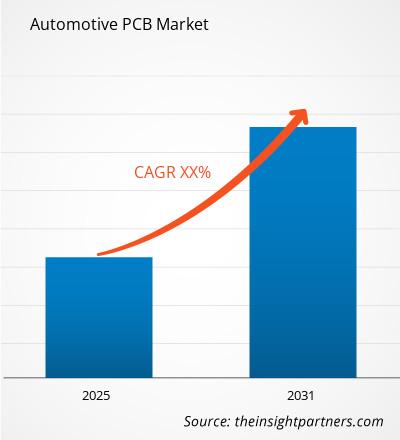
Segmentation Analysis
Type
The Type segment is forecast to grow at a 5.1–5.9% CAGR during 2026–2034. The scope of the Automotive PCB Market across this segment is widening as OEMs specify boards by signal density, thermal load, reliability class, and available space. Multilayer boards support ADAS, powertrain, and cockpit modules, while double-sided and single-sided boards retain relevance in lighting, switches, and lower-complexity electronics.
- Double-Sided PCB: Double-sided boards serve cost-sensitive control modules, lighting circuits, and body electronics where moderate routing density, manageable heat, and stable automotive qualification are more important than maximum miniaturization.
- Multi-Layer PCB: Multi-layer boards dominate higher-value applications because ADAS, battery management, infotainment, and domain controllers need compact routing, controlled impedance, thermal stability, and reliable signal integrity.
- Single-Sided PCB: Single-sided boards remain strategically useful in basic lighting, switches, relays, and comfort electronics where low cost, simple manufacturing, and dependable electrical performance support high-volume light-duty vehicles.
Fuel Type
The Fuel Type segment is projected to grow at a 5.3–6.2% CAGR during 2026–2034 as electronics intensity rises across BEV, hybrid, and ICE platforms. BEVs require battery and high-voltage boards, hybrids add power conversion complexity, and ICE vehicles continue to incorporate safety, emissions, infotainment, and comfort electronics that sustain board demand.
- BEV: BEVs create the strongest incremental PCB demand because battery management, inverters, onboard chargers, thermal systems, ADAS sensors, and connected cockpit modules raise board count and specification complexity.
- Hybrid: Hybrid vehicles require boards for engine control and electrified subsystems, making them important bridge platforms where power electronics, energy recovery, and emissions compliance converge.
- ICE: ICE vehicles retain great installed demand because engine management, transmission control, lighting, safety, infotainment, and body electronics continue to require reliable boards across economic and mid-priced models.
End User
The End User segment is expected to grow at a 4.9–5.7% CAGR during 2026–2034. Economic light-duty vehicles drive volume, luxury vehicles accelerate advanced electronics adoption, and mid-priced models translate premium features into scale. The segment outlook depends on OEM decisions about ADAS fitment, connected cockpit packages, electrified variants, and cost-efficient board standardization.
- Economic Light Duty Vehicles: Economic vehicles contribute high unit volume and rely on single-sided and double-sided boards for lighting, safety basics, infotainment, engine control, and cost-optimized body electronics.
- Luxury Light Duty Vehicles: Luxury vehicles lead specification intensity because advanced driver assistance, digital cockpit, premium lighting, electrified drivetrains, and comfort systems require multilayer and high-reliability boards.
- Mid-Priced Light Duty Vehicles: Mid-priced vehicles represent the strategic scaling zone as OEMs add ADAS, connectivity, hybrid options, and comfort electronics without reaching premium price points.
Opportunity Snapshot
| End User | Revenue Contribution | Trend Tag | Adoption Stage |
| Economic Light Duty Vehicles | High | Cost Boards | Mature |
| Luxury Light Duty Vehicles | Medium | ADAS Density | Scaling |
| Mid-Priced Light Duty Vehicles | High | Feature Scaling | Scaling |
Automotive PCB Market Growth Drivers and Impact Analysis
Vehicle Electrification Raises Board Content per Platform
Electrification is the most quantifiable driver of demand since both BEVs and hybrids will use PCB assemblies in their battery management systems, on-board chargers, DC-DC converters, inverters, thermal management, charging systems, and communication modules in the vehicle. According to the IEA report, more than 17 million electric cars had been sold in 2024, and the prediction was that more than 20 million electric cars would be sold in 2025, which means more PCBs in high-voltage and thermal stress environments. This has led to a transition to boards that are more insulated, use thick copper, can withstand higher temperatures, and have better documentation.
ADAS and Safety Electronics Expand Multilayer Demand
Driver assistive technology needs robust boards that have the capability to interface with the cameras, radars, ultrasonics, electronic braking systems, electronic steering and sensor fusion boxes. With higher regulatory demands and requirements for automation of the emergency braking system, lane keep assistive, driver monitoring systems and crash avoidance technologies, there is a need for increased fitment within the mid-range segments. This would increase the demand for the boards other than the premium series, which require multi-layered boards with controlled impedance and lower defects. The suppliers having knowledge of functional safety documents and automotive testing could get into design collaborations.
Software-Defined Vehicles Reshape Electronics Architecture
While software-defined cars are increasingly adopting the approach of domain controller architectures and high-performance computing systems, they also pose the increasing challenge of ensuring that robust printed circuit boards are available to interconnect sensors, actuators, displays, wireless modules, and power supply. This is because of the increased need for data rates and over-the-air capability, which increases demands on the integrity of signals, shielding, and thermal management. The impact on the market is shifting from the provision of simple boards to partnerships involving engineering, where design, stack-up, laminate material choices, and testing affect the performance of the car.
Automotive PCB Market Future Trends
High-Density and Heavy-Copper Boards Move into Mainstream Platforms
Automotive PCB Market trends point toward wider use of high-density interconnect, heavy-copper, and thermally enhanced boards as EVs, ADAS, and digital cockpits converge in mid-priced vehicles. Future designs will need to carry higher currents, manage heat from power semiconductors, and preserve signal quality for sensors and connectivity modules. This transition favors fabricators that can combine microvia reliability, copper plating control, laminate stability, and automated inspection. The trend also increases collaboration between PCB suppliers and semiconductor, inverter, and domain-controller teams because board design will affect efficiency, safety, and software-defined feature performance.
Regionalized Supply Chains Become a Procurement Requirement
The expectation is that OEMs consider PCB procurement in light of resilience and not in terms of costs alone. The shortage of components in the pandemic era, supply chain disruption, and geopolitics have caused procurement departments within automakers to begin qualifying their second-tier suppliers and production within a region. Any future strategy for sourcing PCBs will be based on leveraging Asian volume with North American and European proximity for critical PCBs needed in safety, batteries, and power electronics.
Automotive PCB Market Opportunities
Localized EV Power Electronics Supply Programs
Automotive PCB Market Forecasts indicate that EV power electronics will create attractive investment openings for fabricators able to serve battery management systems, inverters, onboard chargers, and thermal-control modules near vehicle assembly hubs. The localized supply chain lowers the risk of logistics and allows meeting the requirements of the OEM in terms of warranty, engineering support, and regulation. The investors need to focus on those facilities which are able to perform heavy copper plating, high voltage insulation testing, automated inspection, and automotive documentation. Collaboration with companies producing battery packs, power semiconductors, and tier-one electronics integration will speed up the process of qualification.
Mid-Priced Vehicle Electronics Standardization
Another promising area is mid-price light-duty cars since they have the potential to incorporate premium content on a large scale yet remain highly sensitive to costs. Suppliers can help OEMs in building standard families of circuit boards for ADAS, lights, infotainment systems, connectivity and body modules, which can then be used interchangeably between trims and regions. It will allow for decreased engineering efforts, improved purchasing capabilities, and faster validation periods. The most promising areas would be those where suppliers can apply design for cost along with automotive quality.
Recent Developments
- June 2026: Schweizer Electronic AG and ILJIN Electronics (India) Pvt. Limited, part of the Amber Group, entered into a strategic cooperation in the field of printed circuit boards. ILJIN Electronics operates its bare PCB business through its subsidiaries with the cooperation specifically focussed on Ascent Circuits. The planned cooperation will combine Schweizer’s long-standing experience in automotive and industrial PCB applications with Ascent Circuits’ manufacturing footprint and expansion plans in India.
- January 2026: Amber Enterprises India Ltd. completed the acquisition of a majority stake in Shogini Technoarts Pvt. Ltd.. Shogini has become a subsidiary of IL JIN Electronics (India) Pvt., and a step down subsidiary of the Amber Group. Shogini manufactures various types of printed circuit boards including single sided, double sided, multilayered, metal and flexible PCBs catering to a wide range of applications. The company provides PCB solutions across diverse applications such as automotive, defense, medical electronics, industrial electronics, power electronics, process control, telecommunication, computer peripheral, LED lighting etc.
- September 2025: TE Connectivity (TE), a global leader in connectors and sensors, introduces its inside device connectivity portfolio designed to support the evolving needs of automotive electronic control units (ECUs) and next-generation vehicle platforms, including software defined vehicles. The portfolio includes board-to-board, wire-to-board, flex-to-board and wire-to-wire connector solutions, purpose-built for compact, high-performance applications.
Frequently Asked Questions

- Comprehensive Market Sizing and Forecast Analysis
- Detailed Segmentation Analysis
- In-Depth Market Dynamics Assessment
- Regional and Country-Level Insights
- Competitive Landscape and Company Benchmarking
- Strategic Business Intelligence
Recent Reports
Testimonials

The Insight Partners' SCADA System Market report is comprehensive, with valuable insights on current trends and future forecasts. The team was highly professional, responsive, and supportive throughout. We are very satisfied and highly recommend their services.
RAN KEDEM Partner, Reali Technologies LTDs
I requested a report on a very specific software market and the team produced the report in a few days. The information was very relevant and well presented. I then requested some changes and additions to the report. The team was again very responsive and I got the final report in less than a week.
JEAN-HERVE JENN Chairman, Future Analytica
We worked with The Insight Partners for an important market study and forecast. They gave us clear insights into opportunities and risks, which helped shape our plans. Their research was easy to use and based on solid data. It helped us make smart, confident decisions. We highly recommend them.
PIYUSH NAGPAL Sr. Vice President, High Beam Global
The Insight Partners delivered insightful, well-structured market research with strong domain expertise. Their team was professional and responsive throughout. The user-friendly website made accessing industry reports seamless. We highly recommend them for reliable, high-quality research services
YUKIHIKO ADACHI CEO, Deep Blue, LLC.
This is the first time I have purchased a market report from The Insight Partners.While I was unsure at first, I visited their web site and felt more comfortable to take the risk and purchase a market report.I am completely satisfied with the quality of the report and customer service. I had several questions and comments with the initial report, but after a couple of dialogs over email with their analyst I believe I have a report that I can use as input to our strategic planning process.Thank you so much for taking the extra time and making this a positive experience.I will definitely recommend your service to others and you will be my first call when we need further market data.
JOHN SUZUKI President and Chief Executive Officer, Board Director, BK Technologies
I wish to appreciate your support and the professionalism you displayed in the course of attending to my request for information regarding to infectious disease IVD market in Nigeria. I appreciate your patience, your guidance, and the fact that you were willing to offer a discount, which eventually made it possible for us to close a deal. I look forward to engaging The Insight Partners in the future, all thanks to the impression you have created in me as a result of this first encounter.
DR CHIJIOKE ONYIA MANAGING DIRECTOR, PineCrest Healthcare Ltd.Reason to Buy
- Informed Decision-Making
- Understanding Market Dynamics
- Competitive Analysis
- Identifying Emerging Markets
- Customer Insights
- Market Forecasts
- Risk Mitigation
- Boosting Operational Efficiency
- Strategic Planning
- Investment Justification
- Tracking Industry Innovations
- Aligning with Regulatory Trends





 Get Free Sample for