
Bariatric Beds Market Demand, Share & Growth by 2034
Coverage: By Weight Capacity (500-700 Lbs, 700-1000 Lbs, More Than 1000); End User (Hospital, Clinics, Long-Term Care Centers, Home Healthcare, Others) , and Geography (North America, Europe, Asia Pacific, and South and Central America)
- Status : Data Released
- Report Code : TIPRE00028545
- Category : Life Sciences
- No. of Pages : 150
- Available Report Formats :


- Last update date : November 06, 2026


2025 Market Size
US$ 332.06 Mn
Base year value
2034 Forecast
US$ 491.41 Mn
Projected by 2034
CAGR 2026-2034
4.45 %
Growth rate
Addressable Market
US$ 3,738.88 Mn
(2026-2034)
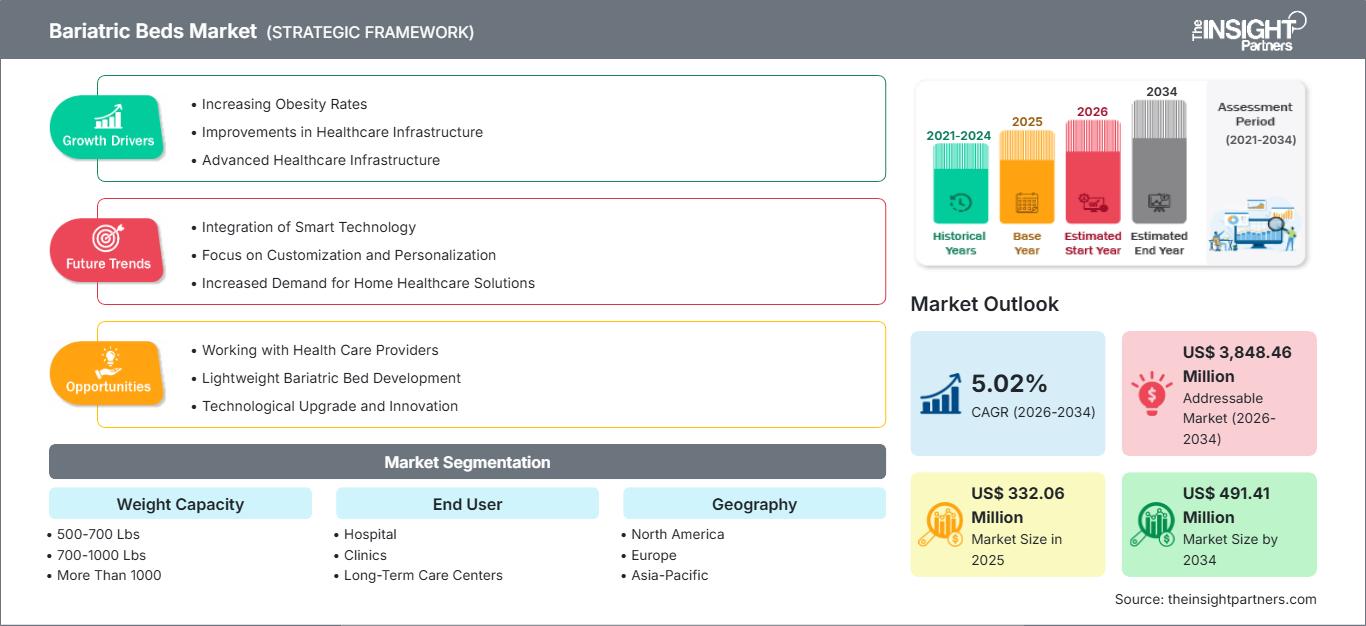
The bariatric beds market was valued at US$ 332.06 Million in 2025 and is projected to reach US$ 491.41 Million by 2034, registering a CAGR of 4.45% during 2026–2034. Expansion is supported by the increasing prevalence of obesity, higher hospitalization of patients requiring specialized weight accommodation, and stronger institutional focus on safe patient handling. Replacement of conventional beds with wider, reinforced, electrically adjustable systems further support capital expenditure.
Across North America, the bariatric beds market size is expected to increase at a CAGR of ~4% through 2034. The region benefits from a large addressable patient population, mature hospital infrastructure, and formal workplace-safety practices intended to reduce injuries during repositioning and transport. Hospitals and long-term care providers are also adopting powered mobility, expandable deck widths, integrated weighing, and pressure-management surfaces to improve clinical efficiency and patient dignity.
Bariatric Beds Market Assessment and Insights
Regional Outlook
- North America: ~39% of the global bariatric beds market share in 2025 | ~4% CAGR through 2034. Market position: North America leads through substantial hospital capital expenditure, high obesity prevalence, established equipment-rental networks, and institutional investment in safe patient handling, pressure management, and caregiver injury reduction.
- US: ~84% of North American market revenue in 2025 | ~4% CAGR through 2034. Market position: The US leads North America because of its extensive hospital and long-term care infrastructure, strong manufacturer presence, home medical equipment reimbursement pathways, and demand for powered bariatric-care systems.
- Europe: ~30% of the global market in 2025 | ~4% CAGR through 2034. Market position: Europe is a mature procurement market supported by public hospitals, long-term care facilities, equipment-rental services, and established suppliers. Germany and the UK represent the leading national markets.
- Asia Pacific: ~23% of the global market in 2025 | ~6% CAGR through 2034. Market position: Asia Pacific is the fastest-growing region as hospitals expand, obesity-related care needs increase, and domestic manufacturing develops. China leads regional revenue, while India offers significant procurement potential.
Segment Outlook
- Hospital: ~57% Share in 2025 | ~5% CAGR through 2034. Market position: Hospitals lead because bariatric beds are required across emergency, intensive-care, surgical, orthopedic, rehabilitation, and general inpatient departments handling patients with elevated weight and mobility limitations.
- Home Healthcare: ~12% Share in 2025 | ~7% CAGR through 2034. Market position: Growth is supported by care decentralization, rehabilitation at home, chronic mobility limitations, rental availability, and demand for electrically adjustable beds that can be transported and assembled in residential environments.
Competitive Coverage
Drive DeVilbiss Healthcare Ltd., Arjo AB, Betten Malsch GmbH, Stryker Corporation, Benmor Medical Limited, Haelvoet NV, Magnatek Enterprises, Invacare Corporation, Baxter International Inc. (Hillrom), Merits Health Products Co., Ltd.
Methodology
The Insight Partners follows Data Collection & Secondary Research, Primary Research, Data Analysis, and Data Triangulation & Final Review to validate market estimates and insights.
Source: The Insight Partners' analysis based on proprietary research, government publications, company annual reports, investor presentations, industry databases, and expert interviews.
Bed design and construction have evolved from reinforcement in manual beds to an integrated care bed system that offers profiling, expandable widths, powered transportation, low height, scales, exit alarm and therapeutic surface solutions. The manufacturer of bed systems designs the beds around the full flow of patient care rather than simply focusing on its weight-bearing capacity. The construction entails use of high-grade steel, efficient actuators, reinforced castors, control circuits, cleanable polymer components, and thorough load testing. Bed rentals are becoming popular due to hospitals’ need for immediate availability.
During 2034, the demand will increase among new health systems, rehabilitation centers, long term care centers, and the home care sector. Hospital units in the Asia-Pacific region and the Middle East are expected to embrace the use of the high capacity beds in their construction and renovation processes. Investments will be on modular design, service provision within localities, preventive maintenance, and compatibility with pressure relief mattresses. Regulations in electrical safety, entrapment protection, load performance, infection control and caregiver ergonomics will define purchase criteria and suppliers.
Bariatric Beds Market Report Scope
| Report Attribute | Details |
|---|---|
| Market size in 2025 | US$ 332.06 Million |
| Market Size by 2034 | US$ 491.41 Million |
| Global CAGR (2026 - 2034) | 4.45% |
| Historical Data | 2021-2024 |
| Forecast period | 2026-2034 |
Bariatric Beds Market Analysis
Bariatric bed growth drivers arise from the nexus between obesity, age, immobility, long recovery periods, and the need for safer environments. The standard hospital bed may fail to have adequate size and weight capacity along with stability and positioning. Systems specifically designed for obese patients allow the healthcare worker to accomplish repositioning, examination, transfer, pressure management, and mobilization activities more easily. Demand stems from the needs of the healthcare environment along with the needs for workforce protection and respect for dignity.
The value chain has suppliers of steel and polymers, manufacturers of actuators and control systems, frame manufacturers, support surface providers, distributors, rentals and service technicians as well as procurement departments within hospitals. Competitiveness among supply options comes from the load-tested design, motor reliability, component supply chain, decontamination ease, delivery speed and maintenance capabilities. Since bariatric beds are costly and difficult to warehouse, renting makes sense.
According to the bariatric beds market analysis, the nature of competition is different depending on the application settings, which include acute care, long-term care, and home care. The market players competing via the hospital platform are Stryker Corporation, Arjo AB, and Baxter International Inc. (Hillrom). Drive DeVilbiss Healthcare Ltd., Invacare Corporation, and Merits Health Products Co., Ltd. provide solutions for institutional and home mobility, whereas Benmor Medical Limited provides bariatric care knowledge.
Investments in development are focused on powered drives, increased widths, weighing integration, lowered bed heights, maintenance integration, and pressure injury protection. Betten Malsch GmbH and Haelvoet NV expand the diversity of European production, whereas Magnatek Enterprises ensures affordable pricing. The strategic advantage is achieved by combining robust engineering with clinical training, renting opportunities, fast maintenance, and appropriate accessories.
● REPORT CUSTOMIZATION
Tailor This Report To Align With Your Specific Business Requirements
This report can be customized to align precisely with your business objectives, scope, and target markets. Customization options include tailored segmentation, geography, competitive analysis, and strategic insights to support informed decision-making.
Customize This Report →WHAT YOU CAN ADJUST
- ● Segmentations
- ● Geography
- ● Competitive Analysis
- ● Language Preferences
Bariatric Beds Market: Strategic Insights
Regional Insights
North America bariatric beds market
North America accounted for ~39% of global revenue in 2025 and is forecast to register a CAGR of ~4% through 2034. Market share of the bariatric beds in the region is a result of high demand for advanced inpatient bed technology, well-developed distribution channels for home medical equipment, and occupational safety initiatives. Inpatient beds are now chosen with the consideration of their mobility, pressure reduction, variable width, fall protection, and ergonomic design.
Canada has an impact due to the purchase of beds by hospitals in the provinces, long-term care facilities, and community-based rehabilitation. Mexico can be regarded as an emerging market because of the building of private hospitals, medical tourism, and modernization of tertiary care facilities. The regional market is characterized by well-established vendors of beds, rental agencies, and servicing organizations.
U.S. bariatric beds market
The US represented ~84% of North American revenue in 2025 and is projected to expand at a CAGR of ~4% through 2034. North American leaders with a huge base of hospitals, long-term care facilities, and home health care distribution systems. The bariatric bed is used in the emergency rooms, intensive care units, medical/surgical floors, rehab facilities, and assisted living facilities.
Some of the major suppliers to the purchasers are Stryker Corporation, Baxter International Inc. (Hillrom), Drive DeVilbiss Healthcare Ltd., Invacare Corporation and so on. Purchasers evaluate the life cycle cost which includes preventive maintenance, support surface replacement, battery management, training needs, decontamination, and usage of fleets. The integrated scale and power mobility system is in high demand due to increased work process complexity and caregiver risk while transferring bariatric patients just for weighing and transportation.
Europe bariatric beds market
Europe held ~30% of global revenue in 2025 and is expected to grow at a CAGR of ~4% through 2034. The area enjoys well-developed public healthcare systems, well-defined equipment standards, existing long-term care infrastructure, and special rental services. Key criteria for procurement include safety of working load, safety from electricity, prevention of entrapment, cleanability, maneuverability, pressure distribution, and availability of technical assistance.
Germany is the leading country in Europe, being backed up by its hospital infrastructure, manufacturing of medical devices, and demand from rehabilitation and geriatric facilities. Betten Malsch GmbH is a supplier of relevant beds manufacturing capabilities. Another significant market in the area is the United Kingdom where the demand is being satisfied by Benmor Medical Limited.
France provides demand from public hospitals, private clinics, rehabilitation centers, and residential care facilities. Italy combines regional healthcare procurement with demand from hospitals and elderly-care facilities. Spain provides replacement and modernization demand through procurement and hospital networks. Across Europe, key competitors are Arjo AB, Haelvoet NV, and others providing regional supplies of ergonomic and durable beds with clinical support and lifecycle services. Growth in procurement will be consistent, as rooms and patient handling will have to be adjusted to bigger equipment.
APAC bariatric beds market
Asia Pacific accounted for ~23% of global revenue in 2025 and is projected to record a CAGR of ~6% through 2034, making it the fastest-growing region. China is the leading country in Asia Pacific because of its hospital scale, manufacturing capabilities, and growing demand for specialized inpatient equipment. Japan, South Korea, and Australia maintain higher adoption of electrically adjustable care systems.
India is providing a growing number of opportunities through the establishment of private hospitals, investments in public health care and the manufacture of medical equipment domestically. The regional demand is fueled by the need for proper patient care, an increase in obesity cases, and improvements in intensive care and rehabilitation units.
Middle East & Africa bariatric beds market
The Middle East & Africa market is expected to register a CAGR of ~5% through 2034. Saudi Arabia is the leading country in the Middle East & Africa, supported by hospital construction, tertiary-care investment, and modernization of clinical infrastructure. The UAE contributes through medical tourism, advanced private hospitals, and international equipment procurement.
South Africa is still considered an important sub-Saharan market with existing private hospitals and good logistics. In terms of demand from the Rest of MEA, it will depend on healthcare budgets, coverage, and availability of technicians. Investments related to urbanization, energy sector communities, and healthcare development within the country could be used to make purchases, though renting solutions and modularity may be more applicable for irregular patient numbers.
Segmentation Analysis
Weight Capacity
Weight Capacity determines structural specifications, deck width, actuator requirements, mobility characteristics, and clinical suitability. The bariatric beds market scope includes reinforced systems designed for different patient-weight profiles across acute, long-term, and home environments. Buyers must select capacity without creating excessive room, transport, or storage constraints. The 700-1000 Lbs sub-segment is projected to register a CAGR of ~5% during 2026–2034 as facilities seek a practical balance between high-load accommodation and maneuverability.
- 500-700 Lbs: These beds serve a broad patient group while remaining comparatively manageable for transport, storage, and residential installation. Demand is supported by hospitals, rehabilitation centers, long-term care facilities, and home medical equipment providers.
- 700-1000 Lbs: Products in this category offer reinforced construction and wider sleeping surfaces for patients requiring greater accommodation. They are relevant to acute-care facilities seeking versatile bariatric capacity without adopting the largest available bed platforms.
- More Than 1000: These beds address patients with exceptional weight and dimensional requirements. Adoption is concentrated in specialist hospitals and bariatric centers with sufficient room configuration, lifting equipment, trained staff, and high-capacity transport pathways.
End User
End-user requirements vary according to patient acuity, length of stay, staffing, room dimensions, equipment utilization, and maintenance capability. Hospitals prioritize advanced functionality and fleet integration, while community buyers place greater emphasis on delivery, assembly, and simplified controls. Home Healthcare is projected to register a CAGR of ~7% through 2034 as more patients receive rehabilitation, chronic care, and mobility assistance in residential settings. Channel success depends on rental support and responsive servicing.
- Hospital: Hospitals require bariatric beds across emergency, inpatient, intensive-care, surgical, orthopedic, and rehabilitation departments. High utilization encourages procurement of powered positioning, transport assistance, integrated weighing, alarms, and compatible pressure-management surfaces.
- Clinics: Clinics use specialized beds for examinations, short observation, wound care, and minor procedures involving patients of size. Compact footprints, safe height adjustment, affordability, and accessible patient transfer are important purchasing considerations.
- Long-Term Care Centers: Long-term care centers prioritize comfort, pressure management, resident independence, and durability under extended use. Beds must support daily personal care, repositioning, mobility assistance, and integration with lifting and transfer equipment.
- Home Healthcare: Residential users require equipment that can pass through domestic access points, be assembled efficiently, and operate through intuitive controls. Rental availability, quieter motors, adjustable height, and service response influence product selection.
- Others: Other users include rehabilitation institutions, specialized obesity centers, hospices, emergency preparedness organizations, and equipment-rental providers. Demand depends on patient throughput, temporary capacity requirements, and access to compatible handling accessories.
Opportunity Snapshot
| End Users | Revenue Contribution | Trend Tag | Adoption Stage |
| Hospital | High | Fleet Modernization | Mature |
| Clinics | Low | Accessible Exams | Emerging |
| Long-Term Care Centers | Medium | Pressure Management | Scaling |
| Home Healthcare | Medium | Residential Recovery | Scaling |
| Others | Low | Flexible Rental | Emerging |
Bariatric Beds Market Growth Drivers and Impact Analysis
Increasing Need for Weight-Appropriate Patient Infrastructure
Healthcare facilities must accommodate patients whose weight, body dimensions, and mobility needs exceed the specifications of conventional beds. A bariatric bed offers a reinforced platform, additional width, suitable side protection, and controlled positioning while preserving patient dignity. The operational impact extends beyond comfort because inappropriate equipment can complicate examination, repositioning, pressure management, and emergency response. Facilities are therefore incorporating bariatric capacity into room planning, admission protocols, and capital budgets. This driver creates demand for several load categories rather than a single universal platform, allowing manufacturers to serve general hospitals, specialist units, rehabilitation centers, and long-term care providers with differentiated configurations.
Stronger Focus on Caregiver Safety and Manual Handling
Repositioning or transporting a patient of size can expose caregivers to musculoskeletal strain when equipment lacks powered assistance or suitable access. Electrically adjustable height, powered drive wheels, turn assistance, integrated scales, and expandable decks reduce dependence on manual force and repeated transfers. Healthcare providers increasingly evaluate equipment as part of broader safe patient handling programs that combine beds, lifts, slings, transfer aids, and staff training. The market impact is a shift from purchasing based primarily on load capacity toward assessment of complete workflow performance. Suppliers offering clinical education and lifecycle service can consequently differentiate beyond the hardware specification.
Expansion of Long-Term and Home-Based Care
More patients with chronic conditions, reduced mobility, and extended rehabilitation needs are receiving care outside acute hospitals. This creates demand for bariatric beds suited to nursing facilities and residential environments. Products must balance strength with transportation, tool-free assembly, quiet operation, simple controls, and compatibility with domestic electrical systems. Rental providers play an important role because families and community-care organizations may require equipment temporarily or face high upfront costs. Expansion outside hospitals diversifies manufacturer revenue and increases the importance of regional distribution, replacement parts, field servicing, and support surfaces designed for prolonged use.
Bariatric Beds Market Future Trends
Connected Beds and Predictive Fleet Management
Bariatric beds market trends will increasingly include connectivity for location tracking, maintenance alerts, occupancy monitoring, bed-exit notifications, and utilization analysis. Hospitals can use fleet data to identify underused equipment, accelerate preparation between patients, and position specialized beds before admission. Embedded diagnostics may also alert biomedical teams to actuator, battery, brake, or control-system issues before failure disrupts care. Adoption will depend on cybersecurity, interoperability, procurement budgets, and demonstrable workflow savings. Manufacturers that provide configurable connectivity rather than mandatory complex systems can address both digitally advanced hospitals and facilities requiring simpler platforms.
Modular Platforms for Different Care Environments
Product architecture is expected to become more modular through 2034. Manufacturers may use standardized frames, actuators, electronics, and service components while offering different widths, load capacities, side systems, support surfaces, and mobility packages. This approach can reduce production complexity and allow healthcare groups to standardize training and spare parts across multiple facilities. Modular beds may also help buyers upgrade capabilities without replacing an entire platform. The trend will favor suppliers able to combine scalable manufacturing with country-specific compliance, local service, and accessories for acute care, long-term care, and residential use.
Bariatric Beds Market Opportunities
Rental Fleets and Managed Equipment Services
The bariatric beds market Forecasts indicate opportunity for manufacturers, distributors, and specialist service companies to expand rental and managed-fleet programs. Hospitals often face fluctuating bariatric admissions and may be unable to justify maintaining large inventories of high-capacity beds. Rapid-delivery rental networks help facilities access suitable equipment while transferring maintenance, storage, decontamination, and asset-tracking responsibilities to the provider. Investment priorities include strategically located depots, trained technicians, digital availability systems, standardized cleaning protocols, and compatible mattresses and lifts. Subscription or utilization-based contracts can also improve revenue visibility while helping providers align expenditure with actual patient demand.
Localized Production and Service Networks in Emerging Markets
Asia Pacific, the Middle East, Africa, and Latin America offer opportunities for localized assembly and component sourcing. Full import dependence increases freight costs, lead times, and service challenges because bariatric beds are large and technically complex. Manufacturers can partner with regional fabricators, electronics suppliers, distributors, and hospital-equipment companies to assemble compliant products closer to demand. Commercial success requires load-testing capability, quality assurance, spare-parts availability, and technician training. Localized configurations may prioritize essential electrical adjustment and durable construction before advanced connectivity, enabling suppliers to address budget constraints without compromising core patient and caregiver safety.
Recent Developments
- May 2026: Arjo AB, the Clinicia Bed Series was highlighted at a special exhibition organized at the Industrial Design Centre, IIT Mumbai, recognizing the collaboration behind the bed platform. The series emphasizes ergonomic design, patient safety, and operational efficiency, while the collaboration with an Indian polymer specialist demonstrates the role of regional engineering and component partnerships in expanding medical-bed production capabilities.
- February 2026: Invacare Corporation’s Europe and Asia Pacific businesses combined with Direct Healthcare Group to create DHCare. The transaction brought together complementary mobility, pressure-care, and reduced-movement solutions, broadening the combined organization’s reach across institutional and community-care environments. The development is relevant to the competitive structure for specialized beds and associated patient-mobility equipment.
- February 2025: Stryker Corporation launched the ProCeed hospital bed in markets outside the US. The platform incorporates low-height positioning, full-coverage side rails, bed-status indicators, cleanable construction, and a fifth wheel intended to reduce initial push force during transport. Its commercialization reinforces the industry focus on caregiver ergonomics, durability, and efficient hospital workflows.
Frequently Asked Questions

- Comprehensive Market Sizing and Forecast Analysis
- Detailed Segmentation Analysis
- In-Depth Market Dynamics Assessment
- Regional and Country-Level Insights
- Competitive Landscape and Company Benchmarking
- Strategic Business Intelligence
Recent Reports
Testimonials

The Insight Partners provided valuable market intelligence that supported our global go-to-market strategy. Their team was professional, responsive, and attentive to our feedback, providing thoughtful analysis and helpful methodological clarifications throughout the project.
Junmo Kim Chief Financial Officer (CFO), Enertech Co., Ltd.
The Insight Partners' SCADA System Market report is comprehensive, with valuable insights on current trends and future forecasts. The team was highly professional, responsive, and supportive throughout. We are very satisfied and highly recommend their services.
RAN KEDEM Partner, Reali Technologies LTDs
I requested a report on a very specific software market and the team produced the report in a few days. The information was very relevant and well presented. I then requested some changes and additions to the report. The team was again very responsive and I got the final report in less than a week.
JEAN-HERVE JENN Chairman, Future Analytica
We worked with The Insight Partners for an important market study and forecast. They gave us clear insights into opportunities and risks, which helped shape our plans. Their research was easy to use and based on solid data. It helped us make smart, confident decisions. We highly recommend them.
PIYUSH NAGPAL Sr. Vice President, High Beam Global
The Insight Partners delivered insightful, well-structured market research with strong domain expertise. Their team was professional and responsive throughout. The user-friendly website made accessing industry reports seamless. We highly recommend them for reliable, high-quality research services
YUKIHIKO ADACHI CEO, Deep Blue, LLC.
This is the first time I have purchased a market report from The Insight Partners.While I was unsure at first, I visited their web site and felt more comfortable to take the risk and purchase a market report.I am completely satisfied with the quality of the report and customer service. I had several questions and comments with the initial report, but after a couple of dialogs over email with their analyst I believe I have a report that I can use as input to our strategic planning process.Thank you so much for taking the extra time and making this a positive experience.I will definitely recommend your service to others and you will be my first call when we need further market data.
JOHN SUZUKI President and Chief Executive Officer, Board Director, BK Technologies
I wish to appreciate your support and the professionalism you displayed in the course of attending to my request for information regarding to infectious disease IVD market in Nigeria. I appreciate your patience, your guidance, and the fact that you were willing to offer a discount, which eventually made it possible for us to close a deal. I look forward to engaging The Insight Partners in the future, all thanks to the impression you have created in me as a result of this first encounter.
DR CHIJIOKE ONYIA MANAGING DIRECTOR, PineCrest Healthcare Ltd.Reason to Buy
- Informed Decision-Making
- Understanding Market Dynamics
- Competitive Analysis
- Identifying Emerging Markets
- Customer Insights
- Market Forecasts
- Risk Mitigation
- Boosting Operational Efficiency
- Strategic Planning
- Investment Justification
- Tracking Industry Innovations
- Aligning with Regulatory Trends





 Get Free Sample for