
Composite Dressing Market Demand, Share & Growth by 2034
Coverage: By Type (Alginate, Absorbent, Anti-Microbial, CMC, Silver); End User (Hospital, clinics, others), and Geography (North America, Europe, Asia Pacific, and South and Central America)
- Status : Data Released
- Report Code : TIPRE00020217
- Category : Life Sciences
- No. of Pages : 150
- Available Report Formats :


- Last update date : November 09, 2026


2025 Market Size
US$ 1.66 Bn
Base year value
2034 Forecast
US$ 3.06 Bn
Projected by 2034
CAGR 2026-2034
7.03 %
Growth rate
Addressable Market
US$ 21.31 Bn
(2026-2034)
The Composite Dressing Market was valued at US$ 1.66 Billion in 2025 and is expected to reach US$ 3.06 Billion by 2034, registering a CAGR of 7.03% during 2026–2034. Expansion is supported by the increasing treatment burden associated with surgical wounds, diabetic foot ulcers, pressure injuries, and venous leg ulcers. Healthcare providers are adopting multifunctional dressings that combine fluid handling, antimicrobial protection, cushioning, and secure fixation to simplify wound-care protocols and reduce avoidable dressing changes.
North America represents a clinically mature component of the Composite Dressing Market size and is projected to expand at approximately ~6% CAGR through 2034. Growth is supported by established wound-care centers, high treatment volumes for diabetes-related wounds, and procurement emphasis on products that improve wear time and nursing productivity. Chronic wounds affect approximately 10.5 million US Medicare beneficiaries, reinforcing sustained demand for advanced wound-management products.
Composite Dressing Market Assessment and Insights
Regional Outlook
- North America: ~39% of the global Composite Dressing Market share in 2025 | ~6% CAGR through 2034. Market position: North America leads through established reimbursement pathways, specialist wound-care networks, broad hospital adoption, and strong supplier access to clinicians managing chronic, surgical, and pressure-related wounds.
- US: ~85% of North American market revenue in 2025 | ~6% CAGR through 2034. Market position: The US anchors regional demand through advanced clinical protocols, high diabetes-related wound expenditure, active product evaluation, and substantial use across hospitals, outpatient wound centers, and specialist clinics.
- Europe: ~30% of the global market in 2025 | ~6% CAGR through 2034. Market position: Europe benefits from mature wound-management guidelines and structured purchasing systems. Germany leads the region, while the UK and France maintain substantial clinical demand.
- Asia Pacific: ~23% of the global market in 2025 | ~9% CAGR through 2034. Market position: Asia Pacific is the fastest-growing region, supported by hospital expansion, rising diabetes prevalence, local manufacturing, and increasing advanced dressing adoption in China, Japan, India, South Korea, and Australia.
Segment Outlook
- Hospitals: ~72% Share in 2025 | ~7% CAGR through 2034. Market position: Hospitals lead because complex surgical wounds, infected ulcers, burns, and pressure injuries require clinician-directed product selection, regular assessment, and access to multidisciplinary wound-care teams.
- Clinics: ~28% Share in 2025 | ~8% CAGR through 2034. Market position: Clinics show the stronger growth outlook as wound treatment shifts toward ambulatory care, specialist centers, and scheduled follow-up pathways intended to reduce inpatient utilization.
Competitive Coverage
Solventum Corporation, Smith & Nephew plc, Convatec Group Plc, Mölnlycke Health Care AB, Coloplast A/S, Laboratoires URGO, Medline Industries, LP, Cardinal Health, Inc., Hollister Incorporated, PAUL HARTMANN AG
Methodology
The Insight Partners follows Data Collection & Secondary Research, Primary Research, Data Analysis, and Data Triangulation & Final Review to validate market estimates and insights.
Source: The Insight Partners' analysis based on proprietary research, government publications, company annual reports, investor presentations, industry databases, and expert interviews.
The product development process has evolved from basic coverings to a combination of multiple wound contact systems that take into account a number of clinical considerations. Companies tend to incorporate absorbent cores, atraumatic contact layer, moisture barrier, antimicrobials, and conforming adhesive border. The production process requires good coating uniformity, validation of sterilization, converting capabilities, and reliable supply chain of fibers, polymers, silver compounds, and hydrocolloid ingredients. Such development pattern benefits those suppliers who will be able to accommodate multiple indications for wounds and provide necessary evidence regarding exudate management, skin protection, bacteria barriers, and wear time.
Between 2018 and 2034, market growth will be more focused on Asia Pacific region, Middle East, and underserved parts of Europe hospitals. It is expected that the investment will be made in scalability of manufacturing, training of clinicians, localization of products, and evidencing in regards to diabetic and pressure ulcers. Further regulatory expectations will favor those companies that can provide evidence of material safety, antimicrobial properties, sterilization performance, and comparability of their products through testing.
Composite Dressing Market Report Scope
| Report Attribute | Details |
|---|---|
| Market size in 2025 | US$ 1.66 Billion |
| Market Size by 2034 | US$ 3.06 Billion |
| Global CAGR (2026 - 2034) | 7.03% |
| Historical Data | 2021-2024 |
| Forecast period | 2026-2034 |
Composite Dressing Market Analysis
Growth in the Composite Dressing Market is tied directly to longevity, diabetes, obesity, vascular disease, surgery, and pressure sores due to immobility. This creates wounds which need to be treated by balancing moisture, retaining exudates, preventing infection, and minimizing disruption in the healing process. The value chain starts from suppliers of specialty polymers, fibers, gel-forming agents, adhesives, and anti-microbial materials before moving on to processes such as lamination, coating, conversion, packaging, sterilization, and distribution.
Healthcare facilities take into account more factors than cost per unit when purchasing. These include wear time, fluid management, application time, damage to skin, storage difficulties, and suitability for standard wound treatment protocol. Supply chain stability is therefore significant as disruptions in sterile product supply might compel hospitals to switch to dressing with different handling properties.
Based on the analysis of the Composite Dressing Market, it shows the presence of a fairly consolidated competitive environment where factors such as scale, clinical studies, and distribution channels affect the positioning of products. The companies that comprise a wide range of products with strong connections with clinicians include Solventum Corporation, Smith & Nephew plc, Convatec Group Plc, and Mölnlycke Health Care AB. Coloplast A/S and Laboratoires URGO offer specialized wound care technology and focused clinical training. There is an ongoing trend towards investments in multifunctional anti-microbial platform technologies, atraumatic adhesive technologies, biomechanical protection, fluid locking, and dressings for undisturbed healing.
● REPORT CUSTOMIZATION
Tailor This Report To Align With Your Specific Business Requirements
This report can be customized to align precisely with your business objectives, scope, and target markets. Customization options include tailored segmentation, geography, competitive analysis, and strategic insights to support informed decision-making.
Customize This Report →WHAT YOU CAN ADJUST
- ● Segmentations
- ● Geography
- ● Competitive Analysis
- ● Language Preferences
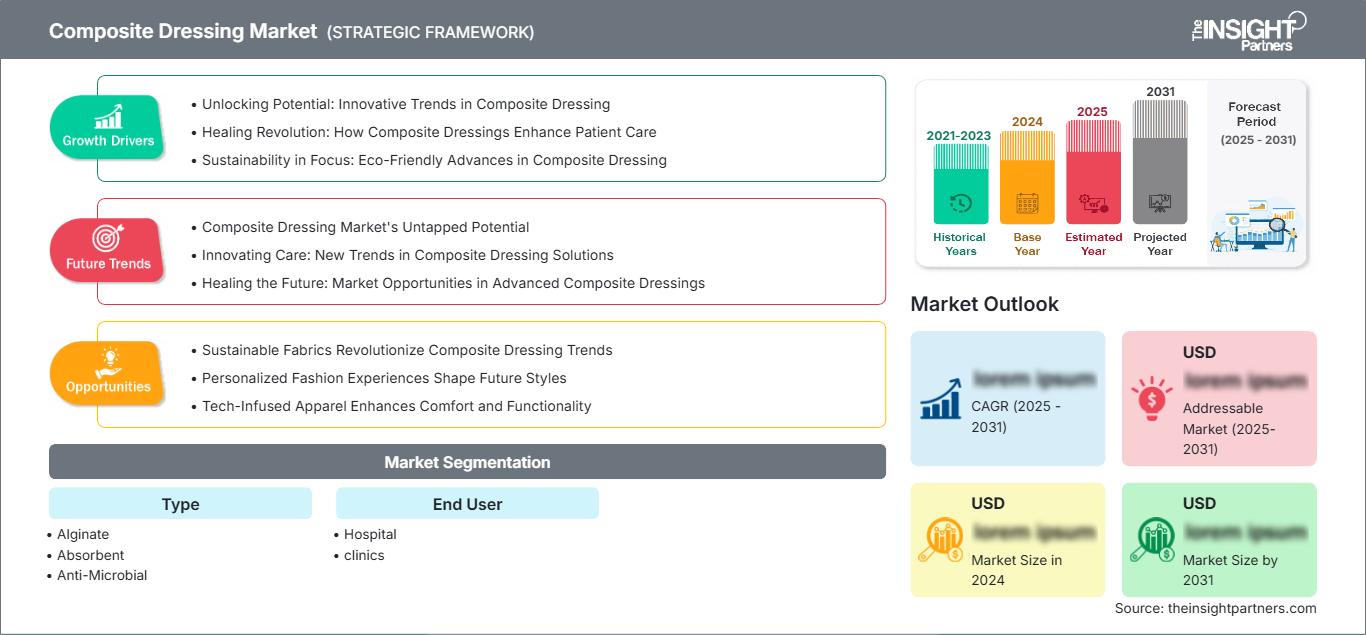
Composite Dressing Market: Strategic Insights
Regional Insights
North America Composite Dressing Market
North America accounted for approximately ~39% of global revenue in 2025 and is forecast to record a ~6% CAGR through 2034. Share of the Composite Dressing market is high due to the use of advanced dressings in acute-care hospitals, outpatient wound care centers, long-term care institutions, and specialized clinics. The clinical pull is driven by ulcers related to diabetes, pressure ulcers, surgical site dressings, vascular wounds, and skin protection around wound sites.
Regional procurement factors include decreased leakage, extended duration of use, lower nursing labor costs, and standardized formularies. Canada brings its healthcare system based on provincial organization and increased chronic wounds awareness, whereas Mexico represents the development of private hospitals and presence of international products. Maturity limits regional growth in comparison to Asia Pacific, but replacement and upgrade continue to generate revenues.
U.S. Composite Dressing Market
The US represented approximately ~85% of North American revenue in 2025 and is projected to grow at a ~6% CAGR through 2034. This country is considered the leader of North America due to its large number of people receiving treatment, presence of specialists who deal with wounds, advanced purchasing infrastructure for hospitals, and the availability of specialized wound products.
Suppliers strive to gain formulary entry through the proof of their products' ability to retain exudates, atraumatic removal of wounds, infection control, pressure relief, and workflow efficiency. Solventum Corporation, Smith & Nephew plc, Convatec Group Plc, Medline Industries, LP, and Cardinal Health, Inc. enjoy great access to the market. Usage is shifting towards protocols, where hospitals keep high-performing composite dressings for complicated, exuding, infected, or challenging wounds.
Europe Composite Dressing Market
Europe captured approximately ~30% of global revenue in 2025 and is expected to expand at a ~6% CAGR through 2034. The market has the combination of well-defined wound care guidelines, aging population, advanced nursing practice, and procurement that becomes more value-based in terms of clinical efficacy. Germany is the leader in Europe with its large number of hospitals, defined reimbursement policy, and high prevalence of both chronic and postoperative wounds.
The UK has strong demand through its hospital and community care pathways, but purchasing is price-sensitive and considers fewer changes of dressings required. France has structured reimbursement policy and high engagement of local wound care specialists such as Laboratoires URGO. Italy and Spain provide interesting opportunities due to diabetes management, care of elderly population, and increased access to specialized wound clinics.
There are specific reimbursement, tenders, and clinical needs in each country, which manufacturers have to consider. Such companies as Convatec Group Plc, Mölnlycke Health Care AB, Coloplast A/S, Smith & Nephew plc, Laboratoires URGO, and PAUL HARTMANN AG have already taken their places in the market. Antimicrobial stewardship plays an important role nowadays when differentiation is needed between preventive barrier dressings and dressings for infected wounds.
APAC Composite Dressing Market
Asia Pacific held approximately ~23% of global revenue in 2025 and is forecast to register a ~9% CAGR through 2034, making it the fastest-growing region. China is the top nation in the Asia Pacific region because of large hospitals, local manufacturing capacity, and increasing accessibility of treatments. Japan brings to the table a developed clinical application, whereas South Korea and Australia focus on advanced hospital protocols.
There is a lot of room for growth in India through private hospital development, need for diabetic wounds, and increasing awareness among clinicians. Regional efforts in policies to develop modern hospitals, local medical device manufacturing, and improved health coverage have enhanced product access; however, manufacturers need to consider functionality and affordability.
Middle East & Africa Composite Dressing Market
The Middle East & Africa market is projected to grow at a ~7% CAGR through 2034. Saudi Arabia is positioned as the leading country in the Middle East & Africa, supported by hospital investment, specialist-care development, and healthcare transformation programs. The UAE shows strong premium-product adoption in private and tertiary hospitals, particularly for postoperative and diabetes-related wound management.
Sub-Saharan Africa is the key commercial hub, while the Rest of MEA suffers from inconsistent reimbursements, lack of specialist accessibility, and price-sensitivity. Investment in healthcare infrastructure, medical logistics, and energy-enabled government spending in Gulf countries is contributing to better access to advanced dressings. Cooperation with distributors and education of physicians is critical to making the most of infrastructure investments and turning them into ongoing dressing sales.
Segmentation Analysis
Type
Type-based selection reflects wound depth, exudate level, infection risk, anatomical location, and condition of the surrounding skin. The Composite Dressing Market scope encompasses material systems that combine complementary functions within a single dressing structure. Adoption favors products that reduce application steps and remain effective under variable wound conditions. Among the supplied categories, the Silver sub-segment is projected to register a ~8% CAGR during 2026–2034 as clinicians seek targeted antimicrobial functionality for appropriately assessed wounds.
- Alginate: Alginate-based composite dressings are relevant for moderate-to-heavily exuding wounds because their fibers form a conformable gel after fluid contact. Demand is concentrated in cavity wounds, ulcers, and clinical situations requiring effective moisture handling.
- Absorbent: Absorbent products address leakage and maceration risks by drawing wound fluid into retention layers. Their market position is strongest where clinicians require dependable exudate control, cushioning, and fewer unscheduled dressing replacements.
- Anti-Microbial: Anti-microbial composite dressings are selected when wound assessment identifies elevated bioburden or infection-management requirements. Adoption depends on clinical protocols, demonstrated activity, material compatibility, and responsible use within broader antimicrobial-stewardship practices.
- CMC: Carboxymethyl cellulose-based products form a cohesive gel that supports moisture balance and atraumatic removal. They are strategically relevant for chronic wounds where conformability, fluid retention, and protection of the developing wound environment influence treatment continuity.
- Silver: Silver-containing dressings occupy a differentiated position in infection-focused wound management. Their use is guided by wound condition, treatment duration, local protocols, and evidence supporting antimicrobial action without unnecessary prolonged exposure.
End User
End-user demand is determined by wound complexity, care setting, clinician availability, purchasing authority, and follow-up frequency. The Composite Dressing Market is concentrated in facilities that can assess tissue condition, exudate, infection risk, and healing progression before selecting a product. Clinics are expected to post a ~8% CAGR during 2026–2034 as outpatient wound treatment, ambulatory procedures, and specialist follow-up services expand across developed and emerging healthcare systems.
- Hospitals: Hospitals represent the primary treatment setting for surgical wounds, severe pressure injuries, infected ulcers, burns, and medically complex patients. Centralized procurement and formulary policies encourage products supported by clinical evidence and dependable supply.
- Clinics: Clinics support recurring wound assessment, dressing replacement, and ongoing management after hospital discharge. Their strategic relevance is increasing as health systems move suitable chronic-wound care toward ambulatory pathways and specialized outpatient centers.
Opportunity Snapshot
| End Users | Revenue Contribution | Trend Tag | Adoption Stage |
| Hospitals | High | Formulary Standardization | Mature |
| Clinics | Medium | Outpatient Care | Scaling |
Composite Dressing Market Growth Drivers and Impact Analysis
Rising Clinical Burden of Chronic and Complex Wounds
Diabetes, vascular disease, reduced mobility, obesity, and population aging increase the probability of wounds that heal slowly or recur. Chronic wounds affect approximately 10.5 million US Medicare beneficiaries, illustrating the continuing treatment burden within a major healthcare market. Composite products are relevant because one dressing can provide absorption, protection, cushioning, moisture management, and secure placement. This reduces the need to assemble several separate components and can improve protocol consistency. The resulting impact extends beyond product volume: complex wounds require repeated assessment and sustained supplies over extended treatment periods. Demand therefore reflects both the number of patients entering care and the recurring consumption associated with prolonged healing.
Healthcare Focus on Fewer Dressing Changes and Nursing Efficiency
Hospitals face pressure to manage nursing time, bed utilization, supply complexity, and avoidable treatment disruption. Dressings that retain exudate, resist leakage, remain securely positioned, and protect surrounding skin can support longer wear when clinically appropriate. This value proposition is important because dressing replacement consumes materials, staff time, preparation resources, and disposal capacity. Multifunctional designs can also simplify inventory by replacing combinations of contact layers, absorbent pads, and fixation products. Suppliers able to connect product performance with workflow benefits are gaining stronger formulary relevance. The commercial impact is a shift from price-per-dressing comparisons toward evaluation of treatment episodes, change frequency, clinician handling, and complication avoidance.
Expansion of Surgical and Ambulatory Wound-Care Pathways
Surgical volumes and outpatient procedures generate demand for dressings capable of managing incision fluid, protecting vulnerable tissue, and accommodating patient movement. At the same time, many patients transition rapidly from hospital treatment to clinics or scheduled follow-up, creating a need for products that can be applied consistently across care settings. Composite systems help clinicians standardize postoperative wound protection while adapting absorbency and antimicrobial properties to clinical risk. This transition enlarges addressable demand in specialist clinics and ambulatory centers, not only inpatient departments. Manufacturers benefit when product education, pack design, and distribution support continuity between discharge and follow-up care.
Composite Dressing Market Future Trends
Biomechanically Protective and Sensor-Ready Dressing Platforms
Composite Dressing Market trends will increasingly involve dressings engineered to manage mechanical forces in addition to wound fluid. Layered structures that redistribute shear, reduce friction, cushion pressure-prone areas, and maintain adhesion during movement may gain importance in pressure-injury prevention and postoperative care. Smith & Nephew’s 2026 ALLEVYN COMPLETE CARE launch illustrates industry attention to multilayer construction, fluid locking, bacterial barriers, and mechanical-energy absorption. Over time, manufacturers may create sensor-ready platforms capable of accommodating moisture, temperature, or pH-monitoring components. Adoption will depend on clinical evidence, affordability, interoperability, and whether additional information produces actionable treatment decisions.
Greater Use of Advanced Antimicrobial and Antibiofilm Mechanisms
Future product differentiation will extend beyond conventional antimicrobial impregnation toward controlled-release agents, nitric oxide platforms, antibiofilm technologies, and materials designed to disrupt persistent microbial communities. Convatec’s ConvaNiox received regulatory approval in 2025 for an initial launch addressing diabetic foot ulcers, with broader commercialization planned for 2026. The sector is likely to emphasize indication-specific evidence and defined treatment windows rather than indiscriminate antimicrobial use. Product developers will need to balance microbial control, cytocompatibility, exudate management, manufacturing stability, and cost. Successful technologies could command premium positioning when they demonstrate clinically meaningful healing or workflow advantages.
Composite Dressing Market Opportunities
Localized Portfolios for High-Growth Asian Healthcare Systems
Composite Dressing Market Forecasts indicate an opportunity for manufacturers to develop region-specific products for China, India, and Southeast Asian healthcare systems. Action areas include local converting capacity, affordable material combinations, smaller pack configurations, bilingual instructions, distributor training, and evidence generated in representative patient populations. Large tertiary hospitals may adopt premium antimicrobial and high-absorbency products, while secondary facilities require cost-controlled solutions with dependable performance. Partnerships with domestic manufacturers can improve tender access and reduce logistics exposure. Investors should prioritize markets where hospital expansion, diabetes treatment, insurance coverage, and specialist wound-care education are progressing together rather than treating Asia Pacific as a uniform opportunity.
Outpatient Protocols and Integrated Clinical Education
Clinics offer an actionable opportunity because recurring wound management increasingly occurs outside inpatient departments. Manufacturers can support this transition with simplified selection algorithms, starter formularies, digital application guidance, and training on exudate assessment, periwound protection, and appropriate antimicrobial use. The Composite Dressing Market Opportunities are especially relevant to specialist wound centers, diabetic foot clinics, vascular clinics, and post-surgical follow-up services. Commercial programs should connect products with measurable outcomes, including wear duration, leakage reduction, patient comfort, and avoided escalation. Suppliers that combine reliable distribution with clinical-service capabilities can create stronger retention than competitors relying primarily on catalogue breadth.
Recent Developments
- March 2026: Smith & Nephew plc – The company launched ALLEVYN COMPLETE CARE Foam Dressing, a five-layer product developed for wound management and pressure-injury prevention. The dressing incorporates fluid-locking, bacterial-barrier, and biomechanical-protection technologies. The launch strengthens Smith & Nephew’s positioning in multifunctional advanced dressings intended to reduce leakage, extend wear, and protect vulnerable skin
- November 2025: Solventum Corporation – Solventum announced an agreement to acquire Acera Surgical for US$ 725 million in cash, plus potential milestone payments. The transaction expands Solventum’s wound-care portfolio into synthetic tissue matrices and adds Acera’s Restrata products, which are used for hard-to-heal complex wounds in acute-care settings
- April 2025: Convatec Group Plc – Convatec received regulatory approval for ConvaNiox, a nitric oxide-generating multimodal dressing with antimicrobial and antibiofilm functionality. The company planned an initial European launch during 2025, followed by a broader 2026 rollout. The product was initially positioned for diabetic foot ulcers managed in secondary-care and specialist-clinic settings
Frequently Asked Questions

- Comprehensive Market Sizing and Forecast Analysis
- Detailed Segmentation Analysis
- In-Depth Market Dynamics Assessment
- Regional and Country-Level Insights
- Competitive Landscape and Company Benchmarking
- Strategic Business Intelligence
Recent Reports
Testimonials

The Insight Partners provided valuable market intelligence that supported our global go-to-market strategy. Their team was professional, responsive, and attentive to our feedback, providing thoughtful analysis and helpful methodological clarifications throughout the project.
Junmo Kim Chief Financial Officer (CFO), Enertech Co., Ltd.
The Insight Partners' SCADA System Market report is comprehensive, with valuable insights on current trends and future forecasts. The team was highly professional, responsive, and supportive throughout. We are very satisfied and highly recommend their services.
RAN KEDEM Partner, Reali Technologies LTDs
I requested a report on a very specific software market and the team produced the report in a few days. The information was very relevant and well presented. I then requested some changes and additions to the report. The team was again very responsive and I got the final report in less than a week.
JEAN-HERVE JENN Chairman, Future Analytica
We worked with The Insight Partners for an important market study and forecast. They gave us clear insights into opportunities and risks, which helped shape our plans. Their research was easy to use and based on solid data. It helped us make smart, confident decisions. We highly recommend them.
PIYUSH NAGPAL Sr. Vice President, High Beam Global
The Insight Partners delivered insightful, well-structured market research with strong domain expertise. Their team was professional and responsive throughout. The user-friendly website made accessing industry reports seamless. We highly recommend them for reliable, high-quality research services
YUKIHIKO ADACHI CEO, Deep Blue, LLC.
This is the first time I have purchased a market report from The Insight Partners.While I was unsure at first, I visited their web site and felt more comfortable to take the risk and purchase a market report.I am completely satisfied with the quality of the report and customer service. I had several questions and comments with the initial report, but after a couple of dialogs over email with their analyst I believe I have a report that I can use as input to our strategic planning process.Thank you so much for taking the extra time and making this a positive experience.I will definitely recommend your service to others and you will be my first call when we need further market data.
JOHN SUZUKI President and Chief Executive Officer, Board Director, BK Technologies
I wish to appreciate your support and the professionalism you displayed in the course of attending to my request for information regarding to infectious disease IVD market in Nigeria. I appreciate your patience, your guidance, and the fact that you were willing to offer a discount, which eventually made it possible for us to close a deal. I look forward to engaging The Insight Partners in the future, all thanks to the impression you have created in me as a result of this first encounter.
DR CHIJIOKE ONYIA MANAGING DIRECTOR, PineCrest Healthcare Ltd.Reason to Buy
- Informed Decision-Making
- Understanding Market Dynamics
- Competitive Analysis
- Identifying Emerging Markets
- Customer Insights
- Market Forecasts
- Risk Mitigation
- Boosting Operational Efficiency
- Strategic Planning
- Investment Justification
- Tracking Industry Innovations
- Aligning with Regulatory Trends





 Get Free Sample for